R E S E A R C H A R T I C L E
Open Access
Correlating mechanical work with energy
consumption during gait throughout
pregnancy
Zarko Krkeljas
*and Sarah Johanna Moss
Abstract
Background:Measures of mechanical work may be useful in evaluating efficiency of walking during pregnancy. Various adaptations in the body during pregnancy lead to altered gait, consequently contributing to the total energy cost of walking. Measures of metabolic energy expenditure may not be reliable for measuring energetic cost of gait during pregnancy as pregnancy results in numerous metabolic changes resulting from foetal development. Therefore, the aim of this study is to determine if mechanical work prediction equations correlate with the metabolic energy cost of gait during pregnancy.
Methods:Thirty-five (35) women (27.5 ± 6.1 years) gave informed consent for participation in the study at different weeks of gestation pregnancy. Gas exchange and gait data were recorded while walking at a fixed self-selected walking speed. External (Wext) work was estimated assuming no energy transfer between segments, while internal work (Wint) assumed energy transfer between segments. Hence total energy of the body (Wtot) was calculated based on the segmental changes relative to the surrounding, and relative to the centre of mass of the whole body. Equations for mechanical work were correlated with net and gross O2rate, and O2cost.
Results:External, internal and total mechanical energy showed significant positive relationship with gross O2rate (r= 0.48,r= 0.35; andr= 0.49 respectively), and gross O2cost (r= 0.42;r= 0.70, andr= 0.62, respectively). In contrast, external, internal and total mechanical energy had no significant relationship with net O2rate (r= 0.19,r= 0.24, and r= 0.24, respectively). Net O2cost was significant related Wext(r= 0.49) Wint(r= 0.66) and Wtot(r= 0.62). Energy recovery improved with increase in gait speed.
Conclusions:Measures of mechanical work, when adjusted for resting energy expenditure, and walking speed may be useful in comparing metabolic energy consumption between women during pregnancy, or assessment or gait changes of the same individual throughout pregnancy.
Keywords:Gait, Pregnancy, Energy expenditure, Metabolic energy, Mechanical work
Background
During pregnancy energy required for walking may increase significantly due to an increase in weight [1–3]. Hence walking, as a common activity of daily living, may contribute to an increase in total energy expenditure during pregnancy. Previous studies indicate high vari-ability in gait during pregnancy due to pregnancy-related physical and physiological changes [4], which may result
in an increase in mechanical work. The ability to predict changes in mechanical energy based on pregnancy-related adaptations to gait may provide a better under-standing of energy balance during pregnancy.
Current research in pregnancy is largely focused on increased energy demands stemming from foetal devel-opment, hormonal changes, and changes in physical activity [2, 5–7]. Any increase in energy expenditure during pregnancy has been attributed largely to an increase in resting metabolic rate (RMR) [2], while any increase in the active energy expenditure (AEE) has been attributed primarily to the mass gain during pregnancy
* Correspondence:[email protected]
Physical Activity, Sport and Recreation Research Focus Area, Private Bag x6001, Internal Box 481, North-West University, Potchefstroom 2520, South Africa
[1–3]. This indicates that no other factors have currently been identified that contribute to the energy cost, and that relative to mass, AEE remains unchanged through-out pregnancy. In addition, difficulties in metabolic analysis of gait during pregnancy stem mostly from the large inter-subject variability in physiological changes resulting from pregnancy [4]. These include changes in dietary-induced thermogenesis, pre-pregnancy malnutri-tion, or energy cost to synthesize new placental tissue.
However, studies examining gait biomechanics during pregnancy report that walking speed lowers significantly throughout pregnancy [1, 4], a behavioural change indicat-ing that women durindicat-ing pregnancy are more comfortable at lower velocities. At lower velocities vertical excursions of the centre of gravity (COG) decrease, which contributes to the increase in energy expenditure [8–11]. In addition, step width tends to increase with pregnancy, a change consistent with the need for an increased balance, also an emphasis on safety, which is characterized by the change in path of the COG [12–17]. This seems to indicate a trade-off mechanism for gait during pregnancy, where women would choose to walk slower with wider steps that may result in an increase in walking energy expenditure, contributing to AEE. This notion contradicts the inherent nature of energy sparing during pregnancy [1, 18, 19]. Hence, the use of mechanical work measures would per-mit simplified evaluation of changes in walking patterns during pregnancy that may reduce the energy expenditure in walking during pregnancy. However, measures of mechanical work have an inherent weakness stemming from assumptions of energy transfers, relative metabolic cost of positive and negative work, stored elastic energy, captivation of antagonist muscles, and isometric work [20]. As a result, the use of mechanical power output in clinical populations tends to be equivocal. Furthermore, the application of mechanical power output on self-paced walking during pregnancy is also lacking.
Therefore, the purpose of this study was to examine the ability of total body mechanical power to explain the variability in the metabolic energy cost of self-paced walking during pregnancy in a South African cohort of women.
Methods
This study is ancillary to a larger Habitual Activity Patterns during Pregnancy (HAPPY)-study that investi-gated the influence of objectively determined physical activity patterns on various pregnancy parameters. Thirty-five (35) pregnant South African women at differ-ent stages of pregnancy, mean age 27 years (S.D. = 6.1) were recruited, by advertisements in the local press, the consulting rooms of local gynaecologists, and a local health clinic in Potchefstroom, North West Province, South Africa. For participation in the study, women had
to be healthy, between ages 18 and 40 years, without mental or physical disability, and able to complete the test protocol. Participants were excluded from the study, if they presented with physical limitations that may prevent movement, the inability to complete test procedures, or were considered high-risk pregnancy according to ACSM guidelines [21]. The study was approved by the Human Research Ethics committee of the North-West University (NWU-0044-10-A1). Participants gave written consent for participation in the study before data collection. A translator was available in the case of language barriers. Participants were informed that they are free to withdraw from the study at any point. In addition, at the day of motion analyses testing participants were free to withdraw from this specific protocol. An opportunity to ask questions was also given.
Participants RMR was assessed using the fraction of oxygen in expired gases (Cosmed Fitmate, Italy), apply-ing standard metabolic formulas, while energy expend-iture was calculated using a fixed respiratory quotient (RQ) of 0.85 [22]. Before the Fitmate was attached, participants were laying still for 5 min on their left side, to ensure resting state. Prior to gas collection, partici-pants were connected to the Fitmate for no longer than two (2) minutes to ensure that all dead space and any other gases are flushed prior to data collection. Follow-ing the initial 2 min preparation period, RMR gas exchange is collected for 16 min per Fitmate RMR protocol. Participants were instructed not to perform any exercise 24 h prior to testing, and fast for at least 10 h prior to the measurement. A calibration of the Fitmate was done before each participant was subjected to a measurement.
Three dimensional (3-D) gait analysis was collected using eight Oqus 300+ cameras from Qualisys Motion Analysis System (Qualisys, Sweden) and filmed at 220 Hz. Before each gait data analysis, a 90-s wand (750 mm) calibration was completed, with a long arm of a L-shaped reference structure. Participants were dressed in appropriate clothing, cycling shorts and a tank top which would allow marker placement on the skin and minimize any artefacts from clothing movement. A full-body CAST/IK/HH gait model was used, requiring 12-mm self-adhesive reflective markers to be applied on the following anatomical landmarks (right and left): heel at the insertion of the Achilles tendon, head of the first, second and fifth metatarsal, medial and lateral malleoli, lower leg (shank) cluster consisting of 4 markers, lateral and medial knee epicondyles, thigh cluster consisting of 4 markers, greater trochanter, anterior and posterior super-ior iliac spine, infersuper-ior angle of scapula, thoracic vertebrae (T10), cervical vertebrae (C7), radial and ulnar styloid pro-cesses, humeral lateral epicondyle, humerus, acromion. This full marker set was used for a static trial only, which required the participant to stand still for 5 s while filmed in the centre of the calibrated area. Static trials were used to create a dynamic model for gait analysis. Once the static trial was completed, only dynamic markers were left, hence the markers on the medial and lateral malleoli, knee epicondyles, and the trochanter were removed.
During the dynamic trials, each participant was instructed to walk in a straight line at a self-selected pace along a 15-m laboratory walkway embedded with 4 AMTI BP400600 force plates (AMTI, MA, USA). Video and ground reaction force data were collected simul-taneously for five seconds in the middle portion of the runway. Only trials in which the participant’s foot landed entirely on a force plate for three consecutive steps (i.e. full stride), were considered for inclusion in the data set. The participants continued walking until 3 trials of full strides were completed. The participants were instructed to stop and rest as long as necessary, should they feel tired at any stage of the gait analyses. None of the participants requested a rest period dur-ing gait measures.
Data analysis
During walking trials, the data were inspected for gaps in marker trajectories. The default gap-fill function was applied for gaps of no more than 10 frames using NURB spline interpolation. No walking data trials analysed had gaps larger than 10 frames. Once the walking trials were trimmed to include completed strides, the data were exported to Visual 3D-motion analysis software for processing, through which segmental and whole-body kinetic data and gait kinematic data were calculated. The kinetic and kinematic parameters were low-pass filtered
with a bidirectional Butterworth with a 10-Hz cut-off frequency to remove noise from the differentiation process with zero-phase distortion [13, 25].
Metabolic energy expenditure is generally reported in terms of O2 consumption (O2 rate), the millilitres of O2 consumed, per kilogram body mass per minute (ml/kg/min). However, to demonstrate the physiological work (O2cost) for a given task, the physiological equiva-lent rate will also be normalized for speed to express the physiological work per unit distance (ml/kg/m) which is used to depict energy efficiency [10]. Therefore steady state walking total O2 cost might be affected by an increase in O2 rate, or a change in a walking speed, in which case the participant would not experience any physical differences. To reduce the impact of changes in resting metabolic rate (RMR), a non-dimensional param-eter (NN) was used as it deduces the resting energy ex-penditure from gross or total energy exex-penditure during walking, leaving only energy cost required for walking and non- dimensional scaling to account for stature [26]. The net O2cost may also be less sensitive to changes in walk-ing speed [11]. While this method theoretically accounts for the pregnancy induced changes there are no articles addressing this normalization for gait in pregnancy.
Mechanical work and total energy expenditure were explained in detail in Bennett et al. [16], and Willems et al. [27], hence only a brief summary will be provided in this study. Internal (Wint) and external work (Wext), were calculated from COM excursion considering energy exchange as
and with no energy exchange as
Wint¼
whereΔEp andΔEk are changes in potential and kinetic energy, respectively [16]. Then, the energy recovery fac-tor (R) representing the percentage of mechanical energy recovered via exchange between kinetic and potential energy in the COM movement is computed as [16]:
R¼100 ðWint−WextÞ
Wint ð
3Þ
Etot;wb¼MgHþ 1 2MVcg
2þX N
i¼1 1 2mivi
2þ1 2miKi
2ω i2
;
ð4Þ
where M is the total body mass; g the acceleration due to gravity; H is height of the COM; Vcg the velocity of
the COG;miandviare mass and velocity of the ith
seg-ment relative to the surrounding;ωiandKiare the
angu-lar velocity and the radius of gyration of theith segment around its centre of mass [27].
Statistical analysis
A one-way ANOVA was used to assess differences between trimesters for descriptive participants’ param-eters. Simple linear regression was used to calculate the relationship between metabolic energy and mech-anical work. All analyses were performed using SPSS v.21.0 (IBM Corp., Armonk, NY), and significance set at p<0.05.
Results
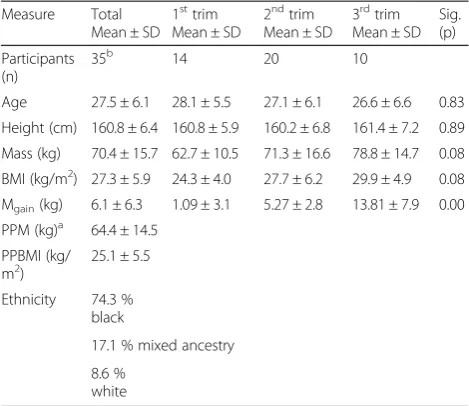
The participant demographics by trimester are given in Table 1. Some of the participants completed analysis at multiple trimesters totalling 44 measures during the total period of pregnancy. There were no differences in age and height between participants in each trimester, although mass gain was significantly increased through-out pregnancy as the foetus grew.
Table 1Descriptive statistics of the participants by trimesters
Measure Total Mean ± SD
1sttrim Mean ± SD
2ndtrim Mean ± SD
3rdtrim Mean ± SD
Sig. (p) Participants
(n)
35b 14 20 10
Age 27.5 ± 6.1 28.1 ± 5.5 27.1 ± 6.1 26.6 ± 6.6 0.83 Height (cm) 160.8 ± 6.4 160.8 ± 5.9 160.2 ± 6.8 161.4 ± 7.2 0.89 Mass (kg) 70.4 ± 15.7 62.7 ± 10.5 71.3 ± 16.6 78.8 ± 14.7 0.08 BMI (kg/m2) 27.3 ± 5.9 24.3 ± 4.0 27.7 ± 6.2 29.9 ± 4.9 0.08
Mgain(kg) 6.1 ± 6.3 1.09 ± 3.1 5.27 ± 2.8 13.81 ± 7.9 0.00
PPM (kg)a 64.4 ± 14.5 PPBMI (kg/
m2)
25.1 ± 5.5 Ethnicity 74.3 %
black
17.1 % mixed ancestry 8.6 %
white
Mgainmass gain from pre-pregnancy (i.e. total mass gain),PPMpre-pregnancy mass;a
Self-reported;PPBMIpre-pregnancy body mass index; trim trimester;
b
Several participants were measured in multiple stages
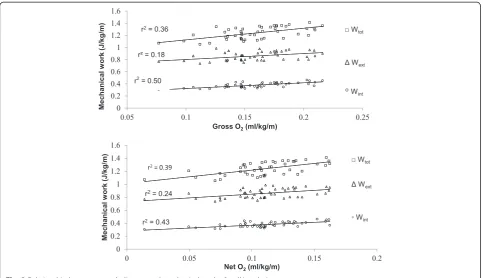
Prediction equations for external (Wext), internal work (Wint) and total work (Wtot) depict no significant rela-tionship with net O2 expenditure of walking during pregnancy (p =0.19, p =0.10 and p= 0.11, respectively), Fig. 1. However, once normalized for speed to express energy efficiency (net O2cost) (Fig. 2), prediction equa-tions (Table 2) show moderate, but significant relation-ship for external work (Wext) (r= 0.49,p≤0.01), internal work (Wint) (r= 0.66, p≤0.00), and total work (Wtot) (r= 0.63, p≤0.01). Although net O2 expenditure did not demonstrate a significant relationship to mechanical work, adding REE resulted in a significant relationship to mechanical work. Gross O2 expenditure during walk-ing shows a weak to moderate, but significant rela-tionship to Wint (r= 0.60, p≤0.01), moderate with Wext (r= 0. 42, p≤0.01), as well as with Wtot (r= .71, p≤0.01). When considering REE in walking energy cost, the relationship with mechanical work as dem-onstrated in Fig. 2, did not change significantly. The mass is also the most significant (r= 0.79, p≤0.01) contributor in variance of gross O2 consumption (VO2) with 33.3 %, next to walking speed (10.0 %, p≤0.05). However, once normalized for REE, walking speed explained 26.1 % of the net energy expenditure (p≤0.01). Energy recovery factor (R) for the pregnant population in this study was 58.1 ± 3.2 %. The ex-change of potential and kinetic energies, a determin-ing factor for energy recovery, was largely affected by speed of walking. Figure 3 demonstrates a significant relationship between speed and energy recovery (r= 0.61, p≤0.01), indicating that during pregnancy en-ergy recovered may be improved with an increase in speed. However, in this study pregnant women decrease their walking speed later in pregnancy. The changes observed are an indication of an increase in walking economy with an increase in walking speed.
Discussion
This study addressed the relationship between metabolic energy expenditure and mechanical work measures of gait throughout pregnancy. With significant findings in studies on gait in pregnancy, as well as energy expenditure during pregnancy, researchers may be able to determine whether changes in gait during pregnancy may contribute
to the overall energy expenditure, and whether changes in gait may be used as an energy-sparing strategy during pregnancy.
The study finds significant relationship between Wint, Wext, and Wtot, and net O2 and gross O2 energy cost, and gross O2rate, but not for net O2rate. The signifi-cance between parameters, however, was of different magnitudes and was relevant to the resting energy expenditure, and the normalization for the walking speed. The changes in metabolic system due to foetal development will affect the resting energy expenditure, and consequently the total energy expenditure during pregnancy. This change cannot be accounted for by mechanical work measures, and metabolic changes in resting energy expenditure are also generally based on the estimates. In this study normalizing gross O2 cost for resting energy expenditure, resulted in a stronger correlation, which suggests that normalization for rest-ing energy expenditure does not decrease the internal consistency of data [23], and reduces the variability of the metabolic changes from foetal development.
Measuring metabolic energy consumption relative to distance or time travelled, may also affect the strength of the correlation [10, 26, 28]. Burdet et al. [28] found that the correlation of mechanical work with metabolic energy consumption per meter walked (ml/kg/m) weaker than when metabolic consumption was measured per time (ml/kg/s). However, Schwartz et al. [26] and Waters and Mulroy [10] demonstrate that normalizing for walking speed would give a better indication of walking efficiency. In this study, once the metabolic energy consumption was normalized for speed, the correlation improved 62.5 % for Wtot, 4.3 % for Wext, and more than doubled for Wint. This increase may be rooted in the re-lationship between energy recovery (i.e. energy transfer) and walking speed.
Optimized energy transfer during walking would be inversely related to metabolic cost [29]. The results of this are indicative of this notion. There was a significant positive relationship between the percentage of energy recovered and walking speed (Fig. 3). In addition, women in this study had walking speed significantly lower than that of reported optimal walking efficiency where energy recovery is the highest [10, 11, 30]. Furthermore, as energy transfer demonstrated significant
Table 2Regression equation for metabolic energy expenditure and mechanical work
Wext(J/kg/min) Wint(J/kg/min) Wtot(J/kg/min)
Net O2 cost(ml/kg/m) 1.1646O2+ 0.7314 0.889O2+ 0.2807 2.0536O2+ 1.0121
Net O2 rate(ml/kg/min) 0.0045O2+ 0.8211 0.0032O2+ 0.3514 0.0077O2+ 1.1724
Gross O2 cost(ml/kg/m) 0.9865O2+ 0.7032 0.9384O2+ 0.2299 1.925O2+ 0.9331
inverse correlation with the measures of gross O2 cost (r=−0.44,p= 0.002) and net O2cost (r=−.328,p= .023). These results are in agreement with previous findings of Willems et al. [27] and Olney et al. [25].
Conclusion
Therefore, measures of mechanical work, when adjusted for resting energy expenditure and walking speed, may be useful in comparing metabolic energy consumption of gait between women during pregnancy, or longitudinal assessment of the same individual throughout pregnancy. Although mechanical work may not account for the variability in metabolic cost stemming from the foetal development, normalizing for REE and speed of walking, may allow mechanical work to predict the changes in gait during pregnancy.
Competing interests
The authors declare that they have no competing interests.
Authors’contributions
ZK carried out the walking energy expenditure study, designed the protocol, collected data, and drafted the manuscript. SJM is the principle investigator of the larger conceptual project, the HAPPY-study and participated in critically revising the manuscript, and gave the final approval for the version to be published. All authors read and approved the final manuscript.
Acknowledgements
We would like to acknowledge our co-worker, Abie van Oort, for assisting with the recruitment of the participants. In addition, we would like to extend our gratitude to the participants of the HAPPY-study and the clinic staff for assisting and supporting the recruitment of participants and translation when needed. We also convey our gratitude to The South African Sugar Association and National Research Foundation’s Swiss South African Joint Research Programme (UID: 78606) of the HAPPY project. Funding was specific for the collection of physical activity data and resting metabolic rate.
Received: 30 April 2015 Accepted: 17 November 2015
References
1. Byrne NM, Groves AM, McIntyre HD, Callaway LK. Changes in resting and walking energy expenditure and walking speed during pregnancy in obese women. Am J Clin Nutr. 2011;94(6):819–30.
2. Melzer K, Schutz Y, Boulvain M, Kayser B. Pregnancy-related changes in activity energy expenditure and resting metabolic rate in Switzerland. Eur J Clin Nutr. 2009;63(10):1185–91.
3. Van Raaij JM, Schonk C, Vermaat-Miedema SH, Peek ME, Hautvast JG. Energy before, cost of walking at a fixed pace during, and after pregnancy. Am J Clin Nutr. 1990;51:158–61.
4. Wu WH, Meijer OG, Jutte CP, Uegaki K, Lamoth CJC, de Wolf GS, et al. Gait coordination in pregnancy: transverse pelvic and thoracic rotations and their relative phase. Clin Biomech. 2002;19:480–8.
Fig. 3Relationship between mechanical energy recovery and walking speed throughout pregnancy
5. Butte NF, Wong WW, Treuth MS, Ellis KJ, Smith EOB. Energy requirements during pregnancy based on total energy expenditure and energy deposition. Am J Clin Nutr. 2004;79(1):1078–87.
6. Melzer K, Schutz Y, Kayser B. Normalization of basal metabolic rate for differences in body weight in pregnant women. Eur J Obst Gynecol Reprod Biol. 2011;159(2):480–1.
7. Löf M. Physical activity pattern and activity energy expenditure in healthy pregnant and non-pregnant Swedish women. Eur J Clin Nutr. 2011;65(12):1295–301.
8. Gordon KE, Ferris DP, Kuo AD. Metabolic and mechanical energy costs of reducing vertical center of mass movement during gait. Arch Phys Med Rehabil. 2009;90(1):136–44.
9. Ortega JD, Farley CT. Minimizing center of mass vertical movement increases metabolic cost in walking. J Appl Physiol. 2005;99(6):2099–107. 10. Waters RL, Mulroy S. The energy expenditure of normal and pathologic gait.
Gait Posture. 1999;9:207–31.
11. Baker R, Hausch A, Mcdowell B. Reducing the variability of oxygen consumption measurements. Gait Posture. 2001;13:202–9.
12. Dumas GA, Reid JG, Wolfe LA, Griffin MP. Exercise, posture, and back pain during pregnancy. Part 2. Exercise and back pain. Clin Biomech. 1995;10(2):104–9.
13. Wu G, Siegler S, Allard P, Kirtley C, Leardini A, Rosenbaum D, et al. ISB recommendation on definitions of joint coordinate system of various joints for the reporting of human joiont motion - part I: ankle, hip, and spine. J Biomech. 2002;35:543–8.
14. Whittlesey SN, van Emmerik RE, Hamill J. The swing phase of human walking is not a passive movement. Mot Control. 2000;4(3):273–92. 15. Foti T, Davids JR, Bagley A. A biomechanical analysis of gait during
pregnancy a biomechanical analysis of gait during pregnancy. J Bone Jt Surg. 2000;82-A(5):625–32.
16. Bennett BC, Abel MF, Wolovick A, Franklin T, Allaire PE, Kerrigan DC. Center of mass movement and energy transfer during walking in children with cerebral palsy. Arch Phys Med Rehabil. 2005;86(11):2189–94.
17. Kerrigan DC, Della CU, Marciello M, Riley PO. A refined view of the determinants of gait: significance of heel rise. Arch Phys Med Rehabil. 2000;81(8):1077–80.
18. Poppitt SD, Prentice AM, Jequier E, Schutz Y, Whitehead RG. Evidence of energy sparing in gambian women during pregnancy: a longitudinal study using whole-body calorimetry. Am J Clin Nutr. 1993;57:353–64.
19. Prentice AM, Goldberg GR, Davies HL, Murgatroyd PR, Scott W. Energy-sparing adaptations in human pregnancy assessed by whole-body calorimetry. Br J Nutr. 1989;62:5–22.
20. Unnithan VB, Dowling J, Frost G, Bar-or O. Role of mechanical power estimates in the O2cost of walking in children with cerebral palsy.
Med Sci Sports Exerc. 1999;31(12):1703–8.
21. ACSM (American College of Sports Medicine). ACSM’s guidelines for exercise testing and prescription. 9th ed. Philadelphia: Lippincott, Williams and Wilkins; 2013.
22. Nieman DC, Austin MD, Benezra L, Pearce S, McInnis T, Unick J, et al. Validation of Cosmed’s FitMate in measuring oxygen consumption and estimating resting metabolic rate. Res Sports Med. 2006;14(2):89–96. 23. Thomas SS, Buckon CE, Schwartz MH, Sussman MD, Aiona MD. Walking
energy expenditure in able-bodied individuals: a comparison of common measures of energy efficiency. Gait Posture. 2009;29(4):592–6.
24. Schutz Y. Dietary fat, lipogenesis and energy balance. Physiol Behav. 2004;83(4):557–64.
25. Olney SJ, Macphail HEA, Hedden DM, Boyce WF. Work and power in hemiplegic cerebral palsy gait. J Phys Ther. 1990;70(7):431–8.
26. Schwartz MH, Koop SE, Bourke JL, Baker R. A nondimensional normalization scheme for oxygen utilization data. Gait Posture. 2006;24(1):14–22. 27. Willems PA, Cavagna GA, Heglund NC. External, internal and total work in
human locomotion. J Experiemental Biol. 1995;198:379–93.
28. Burdett RG, Skrinar GS, Simon SR. Comparison of mechanical work and metabolic energy consumption during normal gait. J Orthop Res. 1983;1(1):63–72.
29. Winter DA. Human balance and posture standing and walking control during. Gait Posture. 1995;3:193. 214.
30. Abe D, Muraki S, Yasukouchi A. Ergonomic effects of load carriage on the upper and lower back on metabolic energy cost of walking. Appl Ergon. 2008;39(3):392–8.
• We accept pre-submission inquiries
• Our selector tool helps you to find the most relevant journal
• We provide round the clock customer support
• Convenient online submission
• Thorough peer review
• Inclusion in PubMed and all major indexing services
• Maximum visibility for your research
Submit your manuscript at www.biomedcentral.com/submit