
R E S E A R C H
Open Access
Encoder-driven rate control and mode decision
for distributed video coding
Frederik Verbist
1,2*, Nikos Deligiannis
1,2, Shahid M Satti
1,2, Peter Schelkens
1,2and Adrian Munteanu
1,2Abstract
To provide low-complexity encoding for video in unidirectional or offline compression scenarios, this paper proposes an efficient feedback-channel-free distributed video coding architecture featuring a novel encoder-driven rate control scheme in tandem with a designated mode selection process. To this end, the encoder features a novel low-complexity motion estimation technique to approximate the side-information (SI) available at the decoder. Then, a SI-dependent correlation channel estimation between the approximated SI and the original frames is used to derive the theoretically required rate for successful Slepian-Wolf (SW) decoding. Based on the evaluation of the expected trade-off between the estimated required coding rate and the estimated distortion outcome, a novel encoder-side mode decision module assigns a different coding mode to distinct portions of the coded frames. In this context, skip, intra and SW coding modes are supported. To reduce the effect of underestimation, the final SW rate is adjusted upwards using a novel rate formula. Additionally, a successive SI refinement technique is exploited at the decoder to decrease the number of SW decoding failures. Experimental results illustrate the benefit of the different coding options and show similar or superior compression performance with respect to the feedback-based DISCOVER benchmark system. Finally, the low-complexity encoding characteristics of the proposed system are confirmed, as well as the beneficial impact of the proposed scheme on the decoding complexity.
Keywords:Distributed video coding; Feedback channel suppression; Encoder-driven mode decision
1 Introduction
The fundamental work of Slepian and Wolf [1] proved that separate lossless encoding but joint decoding of in-dependently and identically distributed (i.i.d.) discrete random sources X and Ycan be as efficient as joint en-coding and joint deen-coding. The former setting is known as Slepian-Wolf (SW) coding or distributed source cod-ing. In a particular case of the former scenario, called asymmetricSW coding, one source, e.g.Y, is compressed to its proper entropy while the other source, X, is com-pressed separately to the conditional entropy H(X|Y).
At the decoder, source Y is restored after which X is
decoded in the presence ofY, called the side-information
(SI). Extending theasymmetricSW coding setup, Wyner
and Ziv [2] established the achievable lower rate bound under a distortion constraint when a single source is in-dependently encoded but decoded in the presence of SI.
The Wyner-Ziv (WZ) theorem states that in such a cod-ing scenario, a rate loss generally occurs compared to the setting where the encoder also has access to the SI.
However, a loss in compression performance is accept-able with respect to the benefit brought by adopting WZ coding. Independent encoding of information sources enables low-complexity encoding architectures since the removal of inter-source redundancy is no longer an en-coder task. Instead, the encoding operation is essentially reduced to quantization followed by asymmetric SW en-coding, usually implemented using channel encoding which is of low complexity. WZ coding found its appli-cation in coding data under severe resource constraints [3], e.g. in terms of computational power or energy supply. Specifically, distributed video coding (DVC) [4,5] ‘essentially WZ coding for video’ offers low-complexity encoding architectures. In DVC, complex operations, like motion estimation and compensation, are performed at the decoder to create SI. As a result, DVC targets lightweight multimedia applications [6], e.g. wireless capsule endoscopy [7,8].
* Correspondence:[email protected]
1Electronics and Informatics Department, Vrije Universiteit Brussel, Pleinlaan 2, Brussels 1050, Belgium
2Future Media and Imaging Department, iMinds, Gaston Crommenlaan 8 (b102), Ghent 9050, Belgium
In practical WZ coding of video, rate control poses a major challenge. Namely, what is the required SW or channel rate to ensure successful channel decoding in the presence of the SI? Because of the distributed nature of a WZ coding system, the encoder has no access to the SI, since it is generated at the decoder. Hence, a WZ encoder is not in a position to determine the required channel rate exactly, since the conditional entropy H(X|Y) cannot be measured directly. Solely duplicating the operations performed at the decoder would provide the encoder an identical copy of the SI. However, this would involve com-plex SI generation operations at the encoder, which would (1) compromise the low encoding complexity benefit of DVC and (2) rather favour a traditional predictive coding approach from a compression performance point of view.
The majority of high-performance DVC systems make use of a feedback channel to solve the rate control
prob-lem. Such an approach, often referred to as decoder
-driven rate control, sends non-systematic information in chunks [5]. Should the channel rate prove insufficient for proper decoding, the decoder is able to request a lar-ger amount of non-systematic information from the en-coder and attempt decoding anew. The process is repeated until decoding proves successful. In this way, the presence of a feedback channel not only guarantees decoding success but also ensures that this is achieved at a minimal channel rate. However, it is evident that a feedback-channel-based rate control scheme is incom-patible with unidirectional application scenarios. More-over, decoder-driven rate control links the encoding and decoding process. Consequently, feedback-channel-based DVC is unsuitable for offline applications, e.g. storage purposes, and may demonstrate excessive delay [9].
In feedback-channel-free (alias unidirectional) DVC ar-chitectures, the encoder is responsible for determining the required channel rate for successful decoding, which is referred to as encoder-driven rate control. However, estimating the necessary channel rate at the encoder is a delicate problem; underestimation leads to a poor de-coding of the source while overestimation results in wasted rate. Hence, such DVC systems suffer a perform-ance loss with respect to feedback-based schemes. The encoder's main obstacle to determine the necessary rate to guarantee decoding is the lack of access to the SI. Instead, the latter is approximated at the encoder, where special care must be taken as not to compromise the low-complexity encoding characteristics. Moreover, feed-back-channel-free systems may suffer from inflated de-coding complexity [4,10].
This paper introduces a novel feedback-channel-free transform-domain WZ (TDWZ) video coding architec-turea. The core system is an efficient hash-based WZ video codec [11]. To avoid feedback, the proposed sys-tem creates an encoder-side approximation of the SI
using a novel technique that mimics the SI generation executed by the decoder, without undermining low-complexity encoding. Based on the correlation between the original frame and the estimated SI, a novel encoder-driven rate allocation scheme assigns an appropriate SW rate. To increase compression performance and reduce the effect of SW rate underestimation, the proposed architecture also features a novel encoder-driven mode decision process. If the quality of the corresponding SI is expected to be high, parts of the original frames may not be coded at all but rather skipped and reconstructed as the SI.Alternatively, conventional entropy (intra) coding may be applied when failure of proper SW decoding is likely or would result in severe distortion. At the de-coder, a successive SI refinement scheme is exploited to minimize the distortion associated to SW rate underesti-mation. At every SI refinement stage, a higher-quality ver-sion of the SI is generated. This creates the opportunity to reattempt to decode any SW coded information that failed to decode properly at the previous refinement stages.
A version of the feedback-free DVC system proposed in this paper, excluding the encoder-driven mode deci-sion process, was presented in [12]. The experimental results presented in this work illustrate the benefit of the different coding modes available to the proposed system and clarify their influence on the compression perform-ance. Additionally, in contrast to [12], the experimental results include an analysis of the impact of the low-complexity SI approximation methods on the overall RD performance and the encoding complexity. The compres-sion performance of the proposed feedback-free system is compared to a collection of alternative feedback-based DVC systems, including the benchmark DISCOVER [13] codec. The experimental results show that the proposed feedback-free architecture achieves similar or superior compression performance with respect to DISCOVER [13], which is noteworthy considering that most feedback-channel-free systems in the literature are significantly fall-ing behind DISCOVER [14-16]. A last set of experiments confirms the low-complexity encoding characteristics and the beneficial effect of the proposed scheme on the decod-ing complexity.
The rest of this paper is organized as follows. Section 2 offers an overview of related work and highlights the novel features included in the proposed architecture. Section 3 details the proposed system broken down in its primary components. Experimental results are provided in Section 4, and finally, Section 5 concludes the paper.
2 Related work and contributions 2.1 Related work
2.1.1 Feedback-free DVC solutions
is scattered by interleavers prior to encoding. The archi-tecture was further enhanced [18] with an iterative de-coding scheme where the SI was gradually updated using spatio-temporal predictions. In both schemes, the rate was an input parameter. An alternative encoder-driven rate control scheme for pixel-domain DVC was put forward in [16]. A coarse approximation of the SI is generated at the encoder by averaging the key frames in a group of pictures (GOP) of 2, after which the correl-ation noise is modelled by a zero-mean Laplacian distri-bution. The Laplacian correlation noise model serves as a basis to derive the bit-plane error probability, which is mapped to a bit-rate using functions trained offline. The probabilities are calculated without taking any previously decoded bit-planes into account. The final rate calcula-tion was modified in [19], where the offline module was replaced by machine learning. Considering a multi-user scenario, the feedback channel was removed from a pixel-domain architecture in [20].
However, the compression performance of pixel-domain DVC lags behind that of TDWZ architectures [5]. In [21], a feedback-channel-free transform-domain architecture was designed, where a coarse version of the SI was generated by averaging the key frames in a GOP size of 2. Then, the SW rate is derived from the coarse SI based on empirical results obtained in offline experiments.
The first motion estimation algorithm to generate an approximation of the SI at the encoder was proposed in [14] and integrated in a TDWZ architecture. In essence, the algorithm constitutes a low-complexity variant of the motion-compensated interpolation (MCI) method employed by the decoder to generate SI. The technique performs MCI for a limited number of blocks based on the sum of absolute differences (SAD) criterion, while the SI approximation for the other blocks is the average of the co-located blocks in the reference frames. The resulting approximation of the correlation noise instantiates a Laplacian correlation noise model per frequency band, based on which a closed-form formula determines the required SW rate. The conditional error probabilities are computed as in [22], where any already decoded bit-planes are taken into account. The scheme was extended in [15], where additional care was taken to reduce the probability of failed channel decoding. When a bit-plane is not error-free after the maximum num-ber of decoding runs has been reached, the log-likelihood ratios (LLRs) for the bits that are most likely to be erroneous are flipped, after which channel decoding is attempted anew.
In [23], further tools were introduced to increase the performance. At the encoder, the quantized symbols of original WZ frames as well as the coarse SI frames undergo Gray mapping [24] prior to SW coding. Add-itionally, an updated form of the closed-form formula in
[14] yields the estimated SW rate. At the decoder, the reconstruction [25] of the coefficients was modified to cope with any bit-planes of the quantization indices that failed to decode. The final reconstruction is the weighted sum of the centroids of every individual bin, where the weights are assigned according to the bit-plane LLRs after Turbo decoding [26]. Finally, [23] used a SI refine-ment stage after all frequency bands have been decoded based on overlapped block motion estimation (OBME). Based on the refined SI, new attempts are made to decode any erroneous bit-planes and reconstruction is performed again.
2.1.2 Coding modes and DVC architectures
When integrating multiple coding modes in DVC, a fun-damental decision is the locality of the mode decision process, namely, at the encoder or at the decoder. Given the distributed nature of the system, optimized mode se-lection is challenged by the fact that the original signal is only available to the encoder, while the SI is only present at the decoder.
Regarding decoder-driven mode decision, a pixel-domain DVC architecture which skips bit-planes based on a rate-distortion model was presented in [27]. However, the skip mode only improved performance on low and medium motion sequences. The work in [28] includes a feedback-based TDWZ architecture with decoder-driven skip, intra and SW modes. The skip mode is selected based on the trade-off between rate and distortion derived from the SI and the virtual correlation channel. The deci-sion whether to apply intra or SW coding is made by ap-plying both modes to the co-located bit-plane in the previous decoded frame, after which the mode yielding the lowest rate is selected. In this way, the complexity of the decoder is increased since encoding and decoding is duplicated at the decoder.
A decoder-driven block-based mode decision scheme was proposed in [29]. By evaluating the linearity of the motion vectors, blocks with linear motion vectors were skipped, while blocks with highly non-linear motion vec-tors were supported with additional hash information to help improve the SI quality. Alternatively, the block-based DVC architecture in [28] allowed individual blocks to be skipped, intra or WZ coded, based on the estimated accuracy of the SI. This is achieved by assessing the mean squared error between the past and the future reference blocks. The decision between intra and WZ coding is de-termined on an RD basis, by selecting the mode with the lowest rate at equal distortion.
different coding modes or classes are available for every 8×8 block, where each class corresponds to a different distribution of skipped, intra or SW coded bits. PRISM assigns coding modes based on thresholding the squared error difference between every block and its co-located block in the previous frame. In [30], blocks were coded either WZ or with a combination of WZ and intra cod-ing. The encoder selects the mode that yields the lowest estimated rate. The hybrid coding mode sends a low-quality intra-coded version of the block, which helps to improve the quality of the SI. In [31], a block-based skip mode was integrated in a TDWZ codec. SW coding, using Turbo [26] codes, was used to compress the entire frame, where the Turbo decoder was modified as to cope with the skipped blocks. Both codecs in [30] and [31] employ a feedback channel for rate control.
2.2 Contributions
In contrast to existing systems, this is the first work to introduce an encoder-driven mode decision at the bit-plane and frequency band level in a feedback-free hash-based DVC system. To support unidirectional operation, the proposed codec includes several new features at the encoder and decoder.
First, the SI is approximated at the encoder by a low-complexity emulation of the hash-based OBME and compensation (OBMEC) technique used to generate the SI at the decoder. This approach conceptually differs from the fast MCI scheme used in [23], which coarsely matches the motion-compensated interpolation tech-nique of [23] to generate SI at the decoder.
Second, the SI approximation at the encoder is used to compute the theoretical required SW rate, namely the conditional entropy H(X|Y), to represent the quantized
source X. The pursued approach varies from existing
schemes by relying on a SI-dependent (SID) correlation channel [11,32] to capture the dependency between the coarse SI and the WZ frame. To limit the likelihood that bit-planes fail to decode due to SW rate underestima-tion, the final SW rate is adjusted using a novel formula that takes the significance of the bit-plane into account.
Third, based on the approximation of the SI and cor-relation channel model, a novel mode decision process is executed. Three coding modes are supported, namely, skip, intra and SW coding. The skip mode is applied per frequency band whereas intra and SW modes are assigned per bit-plane. Since the proposed WZ architec-ture is feedback-free, the full responsibility for selecting and signalling the coding modes falls to the encoder.
The proposed architecture also features specific mea-sures at the decoder to reduce the suffered distortion due to any SW coded information that fails to decode properly. For this purpose, the principles of successive SI refinement [33] are adopted. The WZ frames are
decoded in distinct stages called refinement levels [34], where at each stage, a higher quality version of the SI is generated. Given the improved SI at every refinement level, SW decoding is reattempted for all SW coded in-formation that failed to decode at previous levels, when only a poorer version of the SI was available. The pro-posed decoding process thereby merges SI refinement, SW decoding and reattempts at SW decoding of any SW coded information that failed to decode at previous refinement levels. In contrast, the approach in [23] first decodes an entire WZ frame, after which additional SI updates create new opportunities to attempt decoding bit-planes that failed to SW decode successfully.
Finally, the proposed feedback-free system is thor-oughly evaluated. In this context, preliminary results of the proposed feedback-free architecture without any encoder-side mode decision were presented in [12]. The experimental results presented in this work, however, show the benefit of the different coding modes available to the proposed system and clarify their influence on the compression performance. Additionally, the compression performance of the proposed feedback-channel-free DVC architecture is compared to the benchmark sys-tems in DVC, that is, the DISCOVER codec [13] and H.264/AVC Intra [35], as well as our previous hash-based DVC system with feedback from [7]. In addition, compression results obtained using the proposed system including the presented mode decision process but con-figured with decoder-driven feedback-channel-based rate allocation are included as well. The evaluation for a GOP size of 2, 4 and 8 shows comparable or superior performance compared to the DISCOVER [13] codec. Despite the additional tools, experimental results con-firm that the proposed system maintains low encoding complexity.
3 Proposed feedback-free distributed video coding architecture
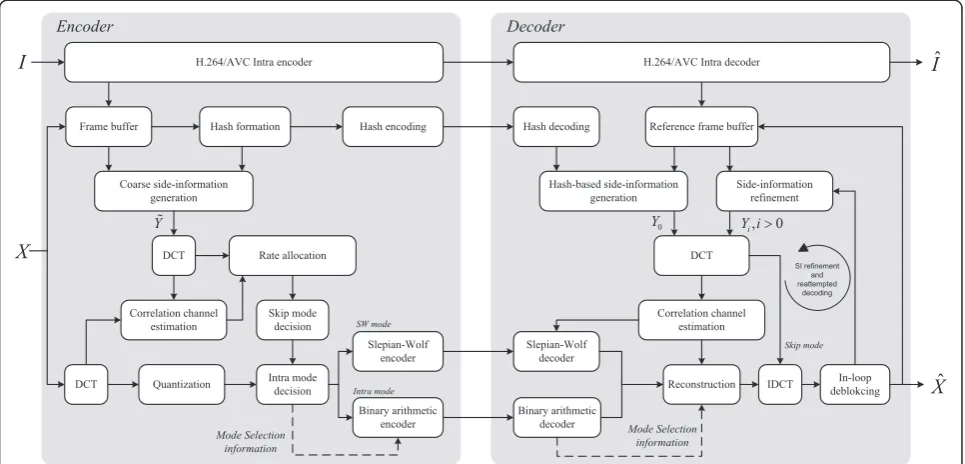
The block diagram of the proposed feedback-free WZ codec is presented in Figure 1.
3.1 The encoding procedure
Building on the architecture presented in [34], the en-coder divides an input video sequence into GOPs. Every
GOP contains a key frame I, which is coded using
H.264/AVC Intra [35], and WZ framesX, which are WZ
the technique presented in [11,34] to enable hash-based SI generation at the decoder.
Since a feedback channel is not present, the encoder is forced to estimate the required channel rate for success-ful decoding per bit-plane in every frequency band. For this purpose, the encoder generates a coarse approxima-tion of the SI available to the decoder using a low-complexity SI generation technique that emulates the hash-based OBMEC used at the decoder. Using the ap-proximated SI, the encoder computes the theoretical rate, that is, the conditional entropy given the coarse SI, for every bit-plane in every quantized frequency band of the WZ frames. Finally, a rate formula is used to com-pute the final channel rate estimate from the conditional entropy in order to compensate for the mismatch be-tween the SI estimated at the encoder and the real SI generated at the decoder.
Encoder-driven rate control is a sensitive process since underestimation leads to failed channel decoding and
poorly reconstructed samples while overestimation
wastes rate and no longer reduces the distortion level. To counter the effect of over- and underestimation on the overall RD performance, the proposed system in-cludes additional tools.
To mitigate the effect of overestimation, the encoder first applies a band-level mode decision process, referred to as skip mode selection. Skipped DCT bands are not actually coded but are substituted by the corresponding band in the SI at the decoder. The bit-planes of the bands that are not skipped are additionally subjected to a second mode decision process. The encoder decides
whether a particular bit-plane is SW encoded or enco-ded in intra mode using a binary arithmetic entropy coder. When a specific coding mode has been assigned to every bit-plane, the bit-plane is fed to the appropriate encoder (unless the band the bit-plane belongs to is skipped). The resulting syndrome bits and binary arith-metic coded data are multiplexed with the hash bit-stream, as well as the mode signalling information, and sent to the decoder or stored for offline decoding.
3.1.1 Low-complexity side-information generation
Reference frame averaging is a simple low-complexity technique to generate a coarse SI signal at the encoder to approximate the true SI. The result may resemble the SI generated at the decoder rather well for low-motion sequences and small GOP sizes, e.g. GOP2. However, since mere averaging of the reference frames is incapable of capturing motion patterns, the SI estimate will signifi-cantly deviate from the true SI at the decoder when motion content or GOP size increase. Therefore, the proposed system features an alternative option to esti-mate the SI at the encoder, namely, a coarse approxi-mation of the hash-based SI generation technique employed at the decoder. In other words, the encoder carries out a substantially simplified version of bidir-ectional OBMEC.
frames with dimensions W′=W/ξ, H′=H/ξ. High
downscaling factors ξ reduce the motion estimation
complexity at the cost of reduced accuracy. Next, mim-icking the SI generation process at the decoder [11,34], the encoder divides every downscaled WZ frame into overlapping blocksβof B×Bpixels with an overlap step size ofεpixels, 1≤ε<B.
For every such block, the best matching block is found in the reference framesRn,n∈{0, 1} within search range sr. To this end, the Hamming distance calculated from the most significant bit of the pixels values in the blocks is minimized. In other words, best matching blocks have a maximum number of co-located pixel values, for which the most significant bit is equal. To reduce the number of block matching operations per motion-estimated block, the search range sr is kept low. Since, the downscaling process does not include filtering; ac-tual down-sampling is not required from an implemen-tation point of view. Instead, the block matching process can only take samples located at the preserved row and column positions into account.
After OBME, every motion vector per overlapping block is upscaled by a factorξ, after which the upscaled motion field is used to motion-compensate blocksξβof sizeξB×ξB from the original reference frames. Since these blocks are overlapping as well, every pixel position in the predicted frame belongs to a number of overlapping blocksξβ, each of them linked with their best matching blocks in each of the reference frames. The pixels in these best matching blocks act as temporal predictors for the co-located pixels in the predicted block. In this way, every pixel in the pre-dicted frame is linked to a set of candidate predictor pixels. Finally, the pixel values in the predicted WZ frame are calculated as the average of the candidate temporal predictors at every pixel position.
To reduce the involved computational complexity, particular measures are taken. Namely, (1) motion esti-mation is carried out on downscaled versions of the ori-ginal frames, (2) the size of the overlapping blocks together with the overlap size is chosen to be large as to substantially reduce the number of motion-estimated blocks, (3) the motion search range is kept small and (4) overlapping blocks with low-motion characteristics are skipped and replaced by the average of the co-located blocks in the reference frames.
To reduce the complexity at the encoder, a block skip function is included. Namely, prior to motion estimation of a particular overlapping block, the Hamming distance between the co-located blocks in the reference frames is checked first. If the Hamming distance is smaller than a specific threshold TH, motion estimation is skipped and zero motion vectors are used instead. In this way, the
parameter TH influences the number of skipped blocks
and thereby the motion estimation complexity.
3.1.2 Determining the conditional entropy
Let X, Ỹ denote the random variables representing the transform-domain samples, that is, the transform coeffi-cients, in the original WZ frame and the coarse SI frame, respectively. Duplicating the rationale at the decoder, the correlation between the transformed sourceX and coarse SIỸis expressed as an additive noise channelX¼Y~þZ~, where Z~ is the random variable representing the samples of the estimated correlation noise.
Since both X and Ỹ are available at the encoder, the correlation noise Z~ can be computed directly based on the histogram. Similar to the noise model established by the decoder, the SID correlation channel concept [11] is adopted. Specifically, the channel output X is modelled by a Laplacian distribution centred on the particular realization of the SIỹwith a standard-deviationσ(ỹ) that
depends on ỹ. The different standard deviations are
obtained using the offline SID correlation channel esti-mation (CCE) procedure, described in [11].
Once the correlation channel has been modelled, the conditional entropy of every bit-plane in every frequency band (that is coded according to the QM) is determined. For simplicity, the presentation in the following is
narrowed down to the coefficients X and Ỹ that belong
to a specific frequency bandβ. Not to overload the nota-tion, the suffix βis omitted. LetM be the total number of bit-planes used to represent the coefficients in band β. Denote by xn, ỹn the nth coefficient in the bands of the WZ and SI frame, respectively. Also, denote by qn the M-bit quantization index corresponding to xn. Fi-nally, let b0n;b1n;…;bMn−1 represent the bits composing the binary representation of index qn, where b0n is the most significant bit. With these notations, the condi-tional probability pm
n of bitmof thenth quantized
coef-ficient inXis calculated according to [22],
pmn ¼p bmn ~y;bn0;b1n;…;bmn−1Þ are evaluated using the SID correlation channel model estimated at the encoder. Then, the conditional entropy HmXjY~ of the entire bit-plane m, given the transform-domain coarse SIỸ, is computed as [22]
3.1.3 Proposed coding mode selection process
Concerning mode decision, similar to [28], the skip mode is selected on a frequency band basis, in which case, entire frequency bands from the SI are substituted in the reconstructed WZ frames. Such an approach is advantageous in the sense that high-frequency compo-nents are often less important and can be replaced by the corresponding components at a relatively small distortion penalty while no rate is spent. Moreover, skipping entire frequency bands creates more consistent reconstructed coefficients compared to, for instance, a bit-plane-based skip where potentially erroneous bits are introduced. Such erroneous bits undermine the success-ful decoding of any less significant SW bit-planes since during the creation of the soft-input information every already decoded bit-plane is assumed to be correct. What is more, even when decoding of subsequent bit-planes proves successful, be it intra or SW, any errors in more significant skipped bit-planes would push the reconstructed coefficient value into the wrong quan-tization bin which increases the incurred distortion. Moreover, the rate spent on any subsequent less signifi-cant bit-planes is used sub-optimally. On the other hand, both intra and SW modes are assigned on a bit-plane basis. Intra coding is an attractive alternative when SW coding is expected to be inefficient due to poor SI. Under this condition, SW decoding failure is a potential risk. In this context, intra coding is favoured for bit-planes with higher significance as to further reduce the danger of distortion due to significant SW coded bit-planes that fail to decode.
The proposed mode selection is performed on the fly at the encoder and the selected modes are sig-nalled to the decoder. The mode signalling informa-tion (MSI) is compiled per frame and organized into a binary map. For every frequency band considered in the relevant QM, the MSI indicates whether the band is skipped or not, while for every bit-plane in a coded band the MSI signals whether intra or SW cod-ing is applied. The binary MSI strcod-ing is compressed using binary arithmetic coding and the resulting bit-stream is multiplexed with the intra, SW and hash bitstream.
3.2 Skip mode selection
For clarity of the ensuing discussion, the source data is confined to the transform coefficients of a single fre-quency bandβ. The problem to solve is whether the
co-efficients in band β should be skipped or not. On the
one hand, skipping a band does not spend any rate at the cost of the distortion incurred by using the SI as re-construction. On the other hand, coding a band con-sumes rate with the benefit of reduced distortion. Such a balancing act can be expressed as a Lagrangian cost. The
Lagrangian cost functionCSkip, when skipping band β, is given by:
CSkip¼RSkipþλDSkip; ð3Þ
whereRSkip,DSkipare, respectively, the required rate and suffered distortion. In a complementary manner, the cost
function CNoSkip, when frequency band β would be
coded, is given by:
CNoSkip¼RNoSkipþλDNoSkip; ð4Þ
where RNoSkip is the rate for coding the bit-planes of
the band and DNoSkip corresponds to distortion from
quantization, under the assumption that all bit-planes
are correctly decoded. The Lagrange multiplier λ in
Equations (3) and (4) controls the relative importance of rate versus distortion in the total cost.
In case the frequency band is skipped, no data is actu-ally coded. Hence, it is trivial that RSkip = 0. When the band is not skipped, the rate is approximated by the sum of the theoretically required SW rates for coding the bit-planes composing the quantization indices of the quantized transform coefficients in the band. The condi-tional bit-plane entropy Hm
XjY~ of bit-plane m, given the coarse SI Ỹ is given in Equation (1). Hence, the esti-mated total rate is the sum of the conditional entropies over allMbit-planes, that is,
RNoSkip¼X
Regarding the computation of the distortion contribu-tions in the Lagrangian cost funccontribu-tions, the distortion suf-fered from skipping the band is due to the reconstruction at the co-located SI values. However, the true SIYis not available at the encoder, where only its coarse approxima-tionỸis present. Hence, the mean square error (MSE) dis-tortionDSkipis estimated using the coarse SIỸas:
DSkip¼E X−Yð Þ2≈E X−Y~2 where Nis the number of coefficient samples in the fre-quency band and xn, ~yn are the nth sample value of the original coefficientsXandỸ, respectively.
In case the frequency band is not skipped, the expected MSE distortionDNoSkipbetween the original coefficientsX and their reconstructionX^ is expressed by:
DNoSkip¼E X−X^2
where^xnis the reconstruction of thenth sample valuexn.
that all bit-planes representing X are properly decoded, the reconstruction points at the encoder are derived from coarse SI valuesỹnand the encoder-side correlation chan-nel statisticsfXjY~ð jxY~ ¼~ynÞ. In particular, the
reconstruc-tion of thenth sample is approximated by:
^
xn¼
∫
u qð Þn
l qð Þn
xfXjY~ð jxY~ ¼~ynÞdx
∫
u qð Þn
l qð Þn
fXjY~ð jxY~ ¼~ynÞdx
;
ð8Þ
where u(qn),l(qn) are the upper and lower bound of the quantization interval defined byqn, respectively.
An appropriateλconfiguration was obtained as a result of offline experimentation on (1) a set of medium and high-motion sequences different from the ones reported in Section 4 and (2) over the entire rate range per sequence. Theλparameter is calculated according to the form:
λ¼λ1e−λ2ð1−QmÞ; ð9Þ
where the parameter Qm is the sequence number,
ran-ging from 1 (lowest quality) to 8 (highest quality), of the QM [36,37] used for quantizing the WZ frames andλ1,λ2 are the model parameters. Then the final decision whether
to skip frequency band β is made by comparing both
Lagrangian cost functionsCSkipandCNoSkip, the smaller of the two indicating the selected coding mode.
3.3 Intra mode decision
From a compression point of view, intra coding is theor-etically less efficient given that the entropy HX‘the the-oretical lower bound for intra coding’ is always higher than or equal to the conditional entropyHXjY~ the theor-etical limit for the SW mode. Nevertheless, the option of an intra coding mode is very attractive in the context of the proposed feedback-free WZ architecture to reduce the suffered distortion. Indeed, intra decoding success is independent of the quality of the SI and does not de-pend on any encoder-side rate estimation.
As before, the binary representation of every
quantization index q is composed by M bits, b0,b1,…, bM−1, withb0the most significant bit. Then, the entropy HmX of bit-planem= 0, 1,…,M−1 is
HmX ¼−p bð Þm log2ðp bð Þm Þ−ð1−p bð Þm Þlog2ð1−p bð Þm Þ;
ð10Þ
where the bit probabilities p(bm) are obtained directly
from the histogram of the quantization indices q
com-posing frequencyβband.
The decision process whether to apply SW or intra coding to bit-planemis based on a comparison between the bit-plane entropy HmX and the conditional bit-plane entropyHm
XjY~, specifically,
μð Þm H mXjY~<HmX;
ð11Þ
withμ(m)≥1 and of the form,
μð Þ ¼m 1þμ1e−μ2m; ð12Þ
where μ1and μ2are the model parameters. If Equation
(11) is true, bit-plane m is SW coded, otherwise intra coding is applied.
Significant bit-planes that are SW coded but fail to de-code properly due to channel rate underestimation introduce large reconstruction errors, even when subse-quent bit-planes of lesser significance are successfully decoded. Additionally, the generation of the soft-input information to initialize the LDPCA-decoder for decoding a particular bit-plane supposes that all previous bit-planes have been correctly restored. Erroneously decoded bits distort the soft input information, that is, the LLRs are cal-culated from erroneous data, which could result in failure to decode even though the assigned channel rate would prove sufficient when the soft input information were de-rived under error-free conditions.
Gradually decreasing μ(m) from the most to the least significant bit-plane tends to concentrate the likelihood of intra coding at the more significant bit-planes. As a result, the chance of reconstructing coefficients with large distortion at the decoder is reduced, since proper intra decoding is guaranteed. Moreover, channel decod-ing of later SW coded bit-planes is less disrupted by soft-input information derived from already decoded bit-planes that contain errors.
3.3.1 Finalizing the Slepian-Wolf rate
For those bit-planes m∈{0,…,M−1} that are SW
coded, the theoretically required channel rate for successful decoding given the coarse SI signal Ỹ, i.e. the conditional entropy HmXjY~, is adjusted. This
com-pensates for the mismatch between the SI Ỹ
approxi-mated at the encoder and the SI Y generated at
Based on HmXjY~, where 0≤HmXjY~≤1, the following sim-ple yet effective rate formula is used to calculate the final rateRm
SW for the SW-coded bit-planemin bandβ,
RmSW ¼ HmXjY~
g mð Þ
; ð13Þ
where g(m) is a linearly increasing function given by g(m) =b+ (a−b)/M⋅(m−1), where a,b∈[0, 1], a>b
are the model parameters and M is the total number
of bit-planes in β. Under these conditions, 0 <g(m)≤1 and thereby,Rm
SW≥HmXjY~ holds for every bit-planem. The
rationale behind Equation (13) is the following. The incurred distortion due to decoding failure is higher for more significant bit-planes. Therefore, the
expo-nent in Equation (13) increases with m, thus
compen-sating more rate for more significant bit-planes. Finally, after the rate has been adjusted according to Equation (13), the closest supported syndrome for bit-plane m, that is, with length closest to ceil Rm
SWN
is sent to the decoder.
3.4 The decoding procedure
In the decoder, the key frames are decoded, recon-structed and stored in a buffer to serve as reference frames for motion estimation. The hash is decoded as well. Then, every WZ frame is decoded in distinct stages, called SI refinement levels (SIRLs), where after each stage, a higher quality version of the SI is generated by the decoder. Every SIRL is built around frequency bands of the 4×4 DCT aggregated along the diagonal, as introduced in our previous work [34]. The proposed feedback-channel-free DVC architecture takes advantage of the presence of the SI refinement scheme to reduce the distortion incurred at the decoder.
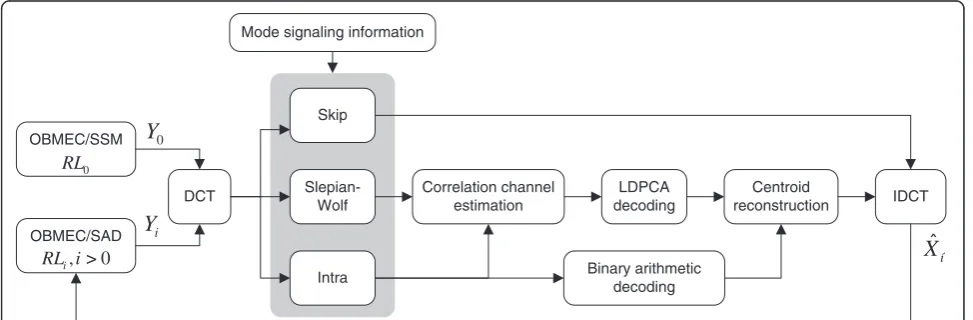
Figure 2 shows an overview of the proposed method. Suppose there is a total number of L refinement levels SIRLl, l= {1, 2,…,L−1}. At the first level, SIRL0, the de-coder creates the initial SIY0, using the designated hash-based OBMEC with sub-sampled matching (OBMEC/ SSM) technique from [11]. The 4×4 DCT is applied and the coding MSI for the bit-planes in the frequency bands that belong to SIRL0, that is, the DC band, is addressed.
When the skip mode was selected for the DC frequency bands, no decoding, and as a consequence, no CCE or re-construction takes place and the coefficients in the DC band of the current version of the SI are copied into the partially decoded frame in the transform domain. When the band was not skipped, every bit-plane composing the band is passed to the appropriate decoder, as dictated by the MSI, with the understanding that SW coded bit-planes might fail to decode while the intra-coded bit-planes are guaranteed to decode successfully. The success of SW decoding is determined as in [40].
As more bit-planes of a band are processed, the bit-plane-per-bit-plane progressively refined CCE algo-rithm of [11] simultaneously updates the correlation channel estimate for that particular frequency band. For decoding SW bit-planes, the last update of the correlation channel estimate serves as basis to gener-ate the soft-input for the LDPCA decoder. When the bit-plane fails to decode, the erroneous bit-plane is still used to update the correlation channel estimate. For those bit-planes that require binary arithmetic de-coding, CCE is irrelevant. However, after dede-coding, these bit-planes are valuable to the CCE algorithm to further refine the estimate.
When all bit-planes have been decoded, the coeffi-cients are reconstructed at the centroid calculated over all quantization bins that match the correctly decoded bit-planes, using the available SI and CCE result.
OBMEC/SSM
Specifically, the nth coefficient in a decoded band is
where In is the set of quantization indices q that agree with the successfully decoded bit-planes in the band and u(q),l(q) are the respective upper and lower edge of the interval designated by indexq.
The frequency bands that have not yet been processed are substituted by their co-located counterparts in the SI and the application of the IDCT yields the partially reconstructed frame X^0 in the spatial domain. The ap-plied reconstruction technique is optimal in the MSE sense given the SI, even when SW coded bit-planes failed to decode and no unique quantization bin in which to reconstruct is available.
The primary objective, however, should be to minimize the total number of SW decoding failures. Therefore, with the intention of minimizing the number of bit-planes that fail to SW decode successfully, the proposed WZ system exploits the successive SI refinement loop at the decoder, by reattempting to decode any bit-planes that failed to decode at previous SIRLs using the updated SI available at the current refinement level. At the same time, the distortion due to skipped frequency bands can be mitigated by substituting the co-located frequency bands in the latest version of the SI into the partially decoded frame at every successive SIRL.
In detail, for every SIRLi, i > 0, the partially decoded frame X^i−1, created at the previous level, is used in an-other round of SI generation by means of OBMEC [34], where the SAD criterion is used as the error metric during block matching since the hash frame is no longer involved in the motion estimation. The resulting motion-compensated frame serves as a new version of the SI information and is converted to DCT domain.
Then, a new correlation channel estimate is executed for all the coded bands belonging to any previous SIRLj, j< i. The result is then used, together with the SIYito create the soft-input information for any bit-planes of SIRLj,j< i, that failed to decode and reattempt SW de-coding given the fixed number of received syndrome bits. These bands are indicated by the light grey cells in Figure 3 for every level in a configuration using six SIRLs. Although successful decoding is still not assured, any bit-planes that actually are decoded successfully re-duce the distortion without additional rate. Next, the frequency bands that actually belong to SIRLi are han-dled (i.e. the dark grey cells in Figure 3).
The mode selection information determines whether a band is skipped or not and in the latter case decides whether a bit-plane is passed to the LDPCA or binary arithmetic decoder. For every bit-plane, a CCE is performed to generate soft-input information to enable SW decoding or simply to update the CCE algorithm for the next bit-plane. When all bit-planes have been processed, the coefficients in the band are reconstructed given the current SIYi. Due to the CCE at every refine-ment level using the updated SI, the reconstruction of the coefficients in the already completed SIRL is further improved as well. At last, the coefficients of the bands of the processed SIRLs are assembled with the SI coeffi-cients belonging to the as of yet not decoded bands, which after the IDCT yields the partially decoded WZ frame X^i. To sum up, the proposed decoding process
merges SI refinement, CCE updating, SW decoding and reattempting to decode any SW-coded bit-planes that failed to decode at previous refinement levels. This con-trasts the approach proposed in [23], where an entire WZ frame is first decoded completely after which add-itional SI updating and CCE runs enable new opportun-ities to attempt decoding bit-planes that failed to SW decode successfully.
Yet, when all SIRLs have been terminated, the proposed decoder architecture still does not guarantee all SW coded bit-planes have been decoded properly. Therefore, similar to [23], additional SIRLs are added. These supplemental SIRLs, that is, the SIRLi,i> 5 in the configuration depicted in Figure 3, solely consist of OMBEC-based SI generation,
0 1 5 6
CCE, reattempting to decode any failed bit-planes and reconstructing the coefficients in all frequency bands given the updated SI and correlation channel model. The number of these additional refinement levels is controlled by a fixed parameter or are skipped when all bit-planes happen to decode properly.
4 Experimental results
4.1 Experimental setup and codec configuration
The proposed feedback-channel-free WZ codec is con-figured using the following settings. The parameters governing the hash formation process, as well as the hash-based SI generation method used to create the ini-tial version of the SI at the decoder, are identical to the configuration used in [11]. A total number of seven SIRLs are considered. During the first five levels new fre-quency bands are decoded, while the last two SIRLs only serve to reduce the number of SW coded bit-planes that fail to decode.
Regarding the configuration of the encoder-side com-ponents for rate control and coding mode selection, the following parameters are used. The coarse SI generation module uses a downscaling factorξ = 4. The size of the overlapping blocks is B= 8 with an overlap step size of
ε = 4. The search range is put to sr = 4 pixels. The
resulting motion vectors are upscaled by a factor ξ = 4 to motion-compensate overlapping blocks of sizeξB×ξB pixels, i.e. 32×32 pixels, from the original sized reference
frames. Additionally, the threshold TH that controls
whether a block is skipped during motion estimation is set toTH= 12. Namely, a block is skipped if the number of unequal bits at the same position in the two co-located blocks in the reference frame is lower than 12, which is equivalent to a pixel error ratio of 12/(8 × 8)≈ 0.18. Concerning the mode selection modules, the
parameters that control the Lagrange multiplier λ in
Equation (9) are fixed to λ1= 0.03 and λ1 = 0.5. Simi-larly, the parameters μ1, μ2 in Equation (12) to derive μ(m), which governs the intra mode decision process, are set to μ1= 0.5 and μ2= 2.0. Finally, the model pa-rameters of the exponent g (m) in the rate formula of Equation (13) are put tob= 0.4 anda= 1.0.
The parameters were derived heuristically based on offline experimentation on a training set, excluding the sequences reported in the experimental results. The values were selected to achieve good RD performance for various degrees of motion while not compromising the complexity at the encoder. In this context, the RD performance could be further optimized for different motion profiles. For instance, in case of high-motion se-quences, the SI approximation module could be config-ured using a less strict, that is, lower, threshold TH. Skipping a lower number of blocks during coarse motion estimation would increase the accuracy of the
resulting SI approximation, in particular when the mo-tion content is high. Addimo-tionally, a smaller overlap step
size ε and/or a smaller downscaling factor ξ would
increase the accuracy of the temporal prediction. However, all these measures have to be applied carefully since these would increase the SI approximation com-plexity at the encoder. On the other side, in case of low-motion sequences, more overlapping blocks could be skipped during the SI approximation, without signifi-cantly undermining the temporal prediction accuracy. Analogously, the number of overlapping blocks may be decreased. In this regard, a low-motion profile would impose less complexity on the encoder.
Further room for optimization may be achieved by tuning the parameters controlling the mode decision processes. Indeed, a high-motion parameter profile may put less stress on skipping frequency bands but rather put more emphasis on intra-coded bit-planes. Conversely, low-motion profiling should be more advantageous to-wards skipping frequency bands while penalizing the intra coding mode. However, the single parameter profile presented in this work was determined to (1) achieve good RD performance over all motion profiles, while (2) containing the additional complexity imposed on the encoder such that the low-complexity encoding characteristics are not compromised.
4.2 Mode selection evaluation
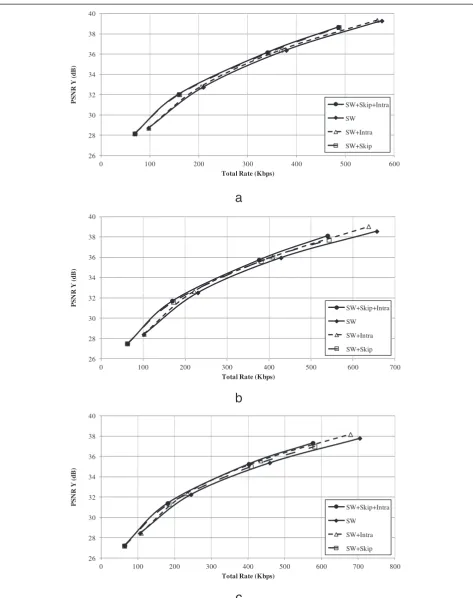
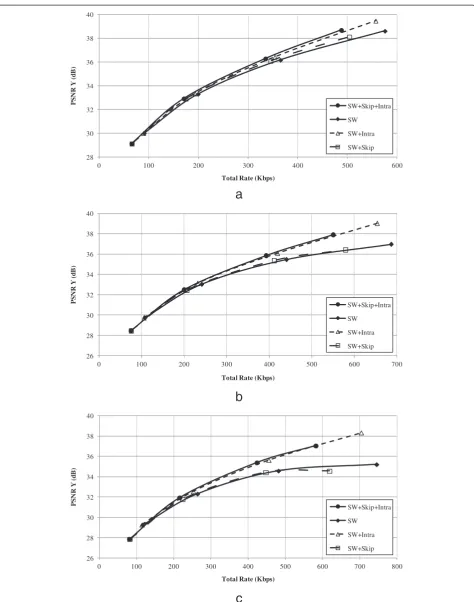
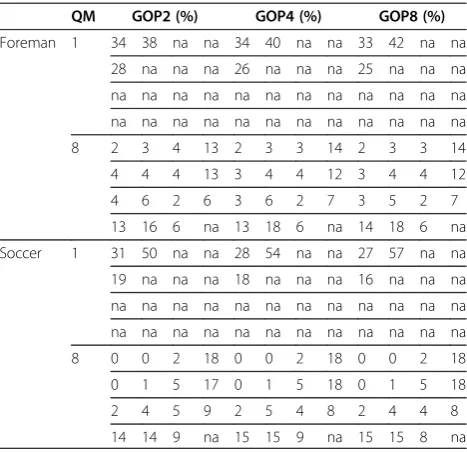
In the first set of experiments, the influence of the dif-ferent coding modes is illustrated. To this end, the com-pression performance of four versions of the proposed system is assessed. The first version only supports the SW coding mode and essentially corresponds to our pre-vious system presented in [12]. The second and third versions support an additional skip (SW+Skip) or intra (SW+Intra) coding mode, respectively. The final version of the system features all three coding modes (SW+Skip+Intra). Figures 4 and 5 show the compression performance of the proposed feedback-free DVC system with the four config-urations on Foreman and Soccer QCIF 15Hz, GOP 2, 4 and 8. For the system featuring all three coding modes, Table 1 reports the percentage of bit-planes assigned to each mode for every GOP size at each considered RD point. Table 2 zooms in on the skip mode and provides insight to which frequency bands are skipped at the lowest and the highest RD point, corresponding to QM 1 and 8, respectively. Table 2 presents the frequency bands similar to the presentation of a QM, where frequency bands that are not coded according to the QM are marked not applicable (na).
a
b
c
26 28 30 32 34 36 38 40
0 100 200 300 400 500 600
P
S
N
R
Y
(d
B)
Total Rate (Kbps)
SW+Skip+Intra
SW
SW+Intra
SW+Skip
26 28 30 32 34 36 38 40
0 100 200 300 400 500 600 700
P
S
NR Y (
d
B
)
Total Rate (Kbps)
SW+Skip+Intra
SW
SW+Intra
SW+Skip
26 28 30 32 34 36 38 40
0 100 200 300 400 500 600 700 800
P
S
N
R
Y
(d
B)
Total Rate (Kbps)
SW+Skip+Intra
SW
SW+Intra
SW+Skip
28 30 32 34 36 38 40
0 100 200 300 400 500 600
P
S
NR Y (
d
B
)
Total Rate (Kbps)
SW+Skip+Intra
SW
SW+Intra
SW+Skip
a
26 28 30 32 34 36 38 40
0 100 200 300 400 500 600 700
P
S
NR Y (
d
B
)
Total Rate (Kbps)
SW+Skip+Intra
SW
SW+Intra
SW+Skip
b
26 28 30 32 34 36 38 40
0 100 200 300 400 500 600 700 800
P
S
NR Y (
d
B
)
Total Rate (Kbps)
SW+Skip+Intra
SW
SW+Intra
SW+Skip
c
quality of the SI of the skipped frequency bands is suffi-cient as not to have a negative impact on the distortion at no rate cost. For a GOP size of 4, the quality of the SI drops which results in comparable performance whether SW coding is supplemented with the skip or intra cod-ing mode. When the GOP size increases to 8, resultcod-ing in a declining SI quality, the intra coding mode - added as an alternative to SW coding - results in superior per-formance. Although the influence of adding coding modes is notable, the performance of the proposed encoder-driven rate control by itself, that is, the version with SW coding only, is, although lower, still respectable. The configuration with all three coding modes available delivers the best performance, taking advantage of the effects of both supplemental coding modes, namely, (1) an increase in quality of the reconstructed WZ frames due to the guaranteed successful decoding of intra-coded bit-planes at the expense of rate, which is compensated by (2) a reduction in rate by skipping bit-planes without notably compromising the distortion.
When all three coding modes are enabled, the statis-tics of the coding mode assignment for Foreman in Table 1 show that skip is dominant for the lower RD points. For instance, Table 1 reports that 84% of the bit-planes are actually skipped at the lowest RD point in a GOP of 2, while at the second RD point in a GOP of 2 the percentage of skipped bit-planes drops to 57%. In the higher rate region, that is, QM 7 and 8, SW coding dominates, accounting for around 50% of the bit-planes. The remaining bit-planes are more or less evenly distrib-uted between the skip and intra modes. Regarding the distribution of the frequency bands affected by the skip mode, Table 2 reports a somewhat uniform distribution of the three frequency bands relevant to the lowest RD point all GOPs. At the highest rate point (QM8), how-ever, it is clear that the majority of skipped bit-planes belong to high frequency bands. This is in line with traditional compression logic, where high-frequency in-formation can often be discarded without causing an ex-aggerated increase in distortion.
The influence of the skip and intra coding options
be-comes more prominent in case of Soccer ‘a high-motion
sequence’where SI generation is strained. Considering the system with SW coding only, Figure 5 shows that the RD performance experiences a saturation effect at the higher rate points, in particular for the larger GOPs. The encoder has difficulty to create an accurate approximation of the SI, and thereby accurate SW rate estimates. Adding only the skip mode does not increase the performance since for such a high-motion sequence, the quality of the SI at the decoder is lower. However, adding the intra coding mode drastically increases the compression performance and completely removes the performance saturation. Since intra coding is completely independent of the SI, it boosts
Table 1 Percentage of the total number of bit-planes in every test sequence assigned to the skip, intra or SW coding mode
QM GOP2 GOP4 GOP8
Skip (%) Intra (%) SW (%) Skip (%) Intra (%) SW (%) Skip (%) Intra (%) SW (%)
Foreman 1 84 3 13 79 4 17 74 5 21
4 57 14 29 49 17 34 45 17 38
7 28 22 50 25 24 51 24 24 52
8 36 18 46 31 20 49 29 22 49
Soccer 1 55 9 36 48 10 42 45 10 45
4 30 23 47 28 24 48 27 24 47
7 16 30 54 15 31 54 15 53 32
8 25 29 46 24 31 45 25 31 44
Table 2 Statistics of the skip mode selection in all considered test sequences, organized in a GOP of 2, 4 and 8
QM GOP2 (%) GOP4 (%) GOP8 (%)
Foreman 1 34 38 na na 34 40 na na 33 42 na na
28 na na na 26 na na na 25 na na na
na na na na na na na na na na na na
na na na na na na na na na na na na
8 2 3 4 13 2 3 3 14 2 3 3 14
4 4 4 13 3 4 4 12 3 4 4 12
4 6 2 6 3 6 2 7 3 5 2 7
13 16 6 na 13 18 6 na 14 18 6 na
Soccer 1 31 50 na na 28 54 na na 27 57 na na
19 na na na 18 na na na 16 na na na
na na na na na na na na na na na na
na na na na na na na na na na na na
8 0 0 2 18 0 0 2 18 0 0 2 18
0 1 5 17 0 1 5 18 0 1 5 18
2 4 5 9 2 5 4 8 2 4 4 8
the performance when the SI quality is low. Under such conditions, replacing SW coding with intra coding de-creases the distortion by reducing the number of bit-planes that fail to decode, in particular significant ones. When all modes are turned on, the system takes full ad-vantage of the effect of the skip and intra modes.
As expected, due to the increased motion content in Soccer, the skip mode is selected less often compared to Foreman, in particular in the lower rate region (see Table 1). Towards the higher rates, the percentage of skipped bit-planes approaches the skip level of Fore-man. According to Table 2, the distribution of the skip mode over the frequency bands is similar to Foreman. The most important observation on Soccer is the in-creased occurrence of the intra coding mode, which is imperative to maintain competitive compression per-formance for high-motion sequences as seen Figure 5.
To sum up, the skip mode targets rate reduction with-out invoking a degree of distortion that undermines the RD performance. This is particularly useful at low rates or for low- to medium-motion sequences. The intra cod-ing mode targets bit-planes that are difficult or ineffi-cient to code using SW principles. The SW coding mode holds the middle ground, offering good compression when the SI is of sufficient quality.
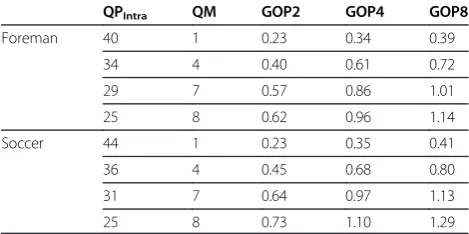
Since the entire mode decision process is encoder-driven, a rate overhead to signal the selected coding modes is present. As mentioned in Section 3, the MSI is compiled per frame and organized into a binary map, which is entropy coded using binary arithmetic coding. Per frequency band actually considered in the applied QM, the MSI indicates whether the band is skipped or not, while for every bit-plane in band that is not skipped the MSI signals whether intra or SW coding has been assigned. Table 3 provides insight in the mode signalling rate overhead (kbps) at all RD points and GOP sizes for Foreman and Soccer. As expected, the required rate to code the MSI is largest for QM8, since both the number of frequency bands and the number of bit-planes assigned
to each band is the largest. This setting corresponds to the largest number of mode decisions at the frequency level, in case of the skip mode, as well as the bit-plane level, in case of the intra or SW mode. Similarly, the rate overhead increases with increasing GOP size, due to the increased number of WZ frames for which mode decision is exe-cuted. Nevertheless, the MSI rate overhead remains rather small for all RD points and all GOP sizes, with the max-imum rate reported in Table 3 equalling 1.29 kbps for the highest RD point in Soccer GOP of 8.
Rate points are determined by the quality of the intra frames (QPIntra) and the employed QM.
4.3 The effect of side-information approximation at the encoder
To create an approximation of the SI, the encoder of the proposed WZ codec features a low-complexity SI gener-ation technique. However, the proposed SI approxima-tion method based on moapproxima-tion estimaapproxima-tion is inevitably more complex than reference frame averaging. It is therefore necessary to examine the performance gain brought by the proposed technique at the cost of in-creased complexity.
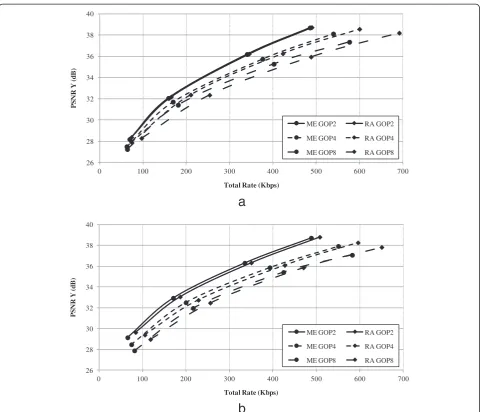
The compression performance on Foreman and Soccer, shown in Figure 6a,b, respectively, illustrates the effect of both encoder-side SI approximation techniques on the performance of the proposed feedback-free DVC system. The performance when using the proposed low-complex-ity technique‘marked ME’and reference frame averaging ‘marked RA’nearly coincides for Foreman, GOP2. Conse-quently, the proposed encoder-side SI estimation tech-nique is not warranted in this case, since the limited gain in RD performance does not compensate for the increase in complexity. When the GOP size increases, however, the proposed technique clearly outperforms reference frame averaging. On Soccer, the proposed motion estimation-based method systematically asserts itself as the better of the two at all GOP sizes.
Overall, the proposed feedback-free system configured with the low-complexity OBMEC method, outperforms the system where the SI is approximated by reference frame averaging. However, the difference in compression performance is not overwhelming at all times. For example, when the motion activity is low and the GOP size is small, reference frame averaging seems a good option given the lower computational cost. In general, the choice of the SI approximation method should be evaluated in an applica-tion context to establish whether increased compression performance outweighs the added encoding complexity.
4.4 Performance comparisons against benchmark techniques
Compression results are presented on the Foreman, Carphone, Soccer and Football sequences, all at QCIF
Table 3 Rate overhead (kbps) to convey the selected coding modes from encoder to decoder at every considered rate point
QPIntra QM GOP2 GOP4 GOP8
Foreman 40 1 0.23 0.34 0.39
34 4 0.40 0.61 0.72
29 7 0.57 0.86 1.01
25 8 0.62 0.96 1.14
Soccer 44 1 0.23 0.35 0.41
36 4 0.45 0.68 0.80
31 7 0.64 0.97 1.13
15Hz. All sequences are organized into GOPs of size 2, 4 and 8. The compression performance of the proposed feedback-free architecture with all three coding modes activated is benchmarked against the feedback-channel-based DISCOVER [13] codec, as well as H.264/AVC Intra [35]. In addition, compression results obtained with our previous hash-based DVC architecture from [7] are also included. The system generates SI by means of hash-based OBMEC, where the original WZ frames are downscaled and subsequently coded using H.264/AVC Intra coding at low bit-rate to create the hash informa-tion. Similar to DISCOVER [13], rate allocation is implemented as a request-and-decode approach via a feedback channel. Finally, the compression performance of the proposed feedback-free architecture is compared to the performance of the same system, including
all three coding modes, when rate allocation is implemented using the feedback mechanism as in DIS-COVER [13]. In this context, it is important to emphasize that systems with decoder-driven feedback-based rate allocation enjoy the advantage in terms of RD performance, since the presence of a feedback channel not only guarantees decoding success but also ensures that decoding is achieved at a minimal rate. On the other hand, such systems are unable to support unidirec-tional application scenarios and link the encoding and decoding process, which may lead to excess delays.
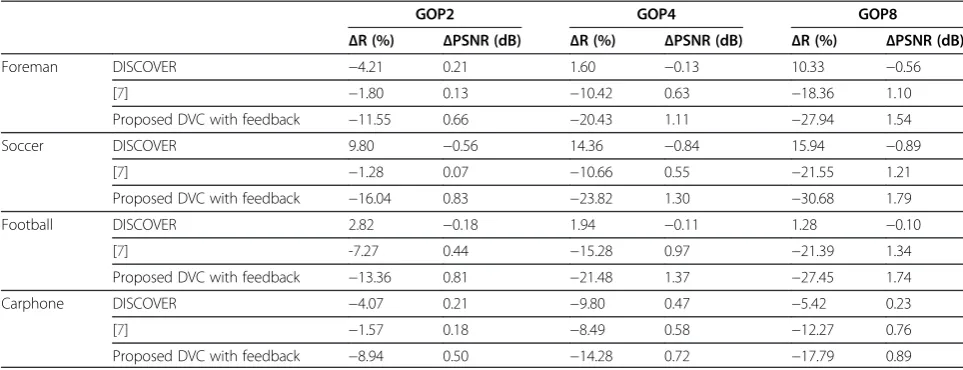
A summary of the compression performance compari-son of the proposed feedback-free architecture, expressed in Bjøntegaard [41] rate reduction (%) and peak signal-to-noise ratio (PSNR) improvement (dB), with respect to DISCOVER [13], our previous hash-based DVC system
a
b
26 28 30 32 34 36 38 40
0 100 200 300 400 500 600 700
P
S
NR Y (
d
B
)
Total Rate (Kbps)
ME GOP2 RA GOP2
ME GOP4 RA GOP4
ME GOP8 RA GOP8
26 28 30 32 34 36 38 40
0 100 200 300 400 500 600 700
P
S
NR Y (
d
B
)
Total Rate (Kbps)
ME GOP2 RA GOP2
ME GOP4 RA GOP4
ME GOP8 RA GOP8
from [7] and the proposed system with feedback, is given in Table 4.
Regarding the performance on Foreman, shown in Figure 7, the compression performance of the proposed feedback-channel-free architecture is roughly compar-able to the performance of DISCOVER, H.264/AVC Intra and the hash-based system from [7] for a GOP of 2. Amongst these, the DVC systems slightly outperform H.264/AVC Intra at low rates but lag somewhat behind at the highest rates. However, the proposed DVC architecture using all three presented coding modes outperforms all other systems when rate-allocation is performed at the decoder via a feedback channel. At GOP sizes 4 and 8, the proposed feedback-free system sill outperforms DISCOVER at low to medium rates, steadily losing ground towards the highest rate point. Table 4 reports a Bjøntegaard [41] rate gain of DIS-COVER with respect to the proposed unidirectional sys-tem of 4.21% for a GOP of 2 which turns into a rate loss of 1.60% and 10.33% for GOP4 and GOP8, respectively. Our previous hash-based system with feedback [7] con-sistently outperforms both DISCOVER and the proposed feedback-free solution. When feedback is turned on in the proposed DVC architecture, the compression per-formance of the resulting system is boosted, regularly surpassing the performance of H.264/AVC Intra.
The results on Carphone, shown in Figure 8, are more or less similar to the results obtained on Foreman. The DVC systems have comparable performance at lower rates, superior to H.264/AVC Intra. In the higher rate region, H.264/AVC Intra becomes dominant. At the same time, DISCOVER outperforms the proposed feedback-free WZ architecture. Comparing these WZ ar-chitectures, Table 4 reports Bjøntegaard [41] rate gains
from 4.07% to 9.80% of DISCOVER compared to the proposed system. The two remaining feedback-based DVC architectures outperform both DISCOVER and the feed-back-free solution, where the DVC system supporting the proposed mode decision process is consistently on top.
The complex motion content in Soccer is highly favourable to H.264/AVC Intra. Indeed, Figure 9 shows that the performance of H.264/AVC Intra is far better than the performance of the WZ codecs, which are hard-pressed estimating the motion at the decoder. However, the proposed feedback-free system outper-forms the feedback-based DISCOVER codec at all GOP sizes and RD points, save the highest rate point where a slight performance loss is incurred. In general, DIS-COVER is outperformed by the proposed system with Bjøntegaard [41] rate losses ranging from 9.80% in a GOP of 2 up to 15.94% in a GOP of 8. Similarly, Football exhibits a very high degree of motion and complex cam-era movements. Again, these conditions are to the ad-vantage of H.264/AVC Intra, as supported by the results in Figure 10. In general, DISCOVER is outperformed by the proposed feedback-free WZ architecture in all GOP sizes, with Bjøntegaard [41] rate losses from 2.82% to 1.28% in a GOP of 2 and 8, respectively. As shown in Figure 5, the application of the intra mode safeguards the compression performance of the proposed codec when high-quality SI generation is strained. Regarding the performance of our previous hash-based system from [7] and the performance of the proposed system configured with feedback-based rate allocation, both sys-tems significantly outperform DISCOVER and the pro-posed feedback-free architecture. This is expected, since hash-based architectures in combination with decoder-driven rate allocation via feedback are known to perform
Table 4 Comparative compression performance of the proposed feedback-free architecture
GOP2 GOP4 GOP8
ΔR (%) ΔPSNR (dB) ΔR (%) ΔPSNR (dB) ΔR (%) ΔPSNR (dB)
Foreman DISCOVER −4.21 0.21 1.60 −0.13 10.33 −0.56
[7] −1.80 0.13 −10.42 0.63 −18.36 1.10
Proposed DVC with feedback −11.55 0.66 −20.43 1.11 −27.94 1.54
Soccer DISCOVER 9.80 −0.56 14.36 −0.84 15.94 −0.89
[7] −1.28 0.07 −10.66 0.55 −21.55 1.21
Proposed DVC with feedback −16.04 0.83 −23.82 1.30 −30.68 1.79
Football DISCOVER 2.82 −0.18 1.94 −0.11 1.28 −0.10
[7] -7.27 0.44 −15.28 0.97 −21.39 1.34
Proposed DVC with feedback −13.36 0.81 −21.48 1.37 −27.45 1.74
Carphone DISCOVER −4.07 0.21 −9.80 0.47 −5.42 0.23
[7] −1.57 0.18 −8.49 0.58 −12.27 0.76
a
b
c
26 28 30 32 34 36 38 40
0 100 200 300 400 500 600
PSNR Y (
d
B)
Total Rate (Kbps)
DISCOVER
H.264/AVC Intra
Proposed feedback-free DVC
[7]
Proposed DVC with feedback
26 28 30 32 34 36 38 40
0 100 200 300 400 500 600
PSN
R
Y (dB)
Total Rate (Kbps)
DISCOVER
H.264/AVC Intra
Proposed feedback-free DVC
[7]
Proposed DVC with feedback
26 28 30 32 34 36 38 40
0 100 200 300 400 500 600
PSNR Y (dB
)
Total Rate (Kbps)
DISCOVER
H.264/AVC Intra
Proposed feedback-free DVC
[7]
Proposed DVC with feedback
a
b
c
28 30 32 34 36 38 40 42
0 100 200 300 400 500
PSN
R
Y
(dB)
Total Rate (Kbps)
DISCOVER
H.264/AVC Intra
Proposed feedback-free DVC
[7]
Proposed DVC with feedback
27 29 31 33 35 37 39 41
0 100 200 300 400 500
PSNR Y (
d
B)
Total Rate (Kbps)
DISCOVER
H.264/AVC Intra
Proposed feedback-free DVC
[7]
Proposed DVC with feedback
27 29 31 33 35 37 39 41
0 100 200 300 400 500
P
S
NR Y (
d
B)
Total Rate (Kbps)
DISCOVER
H.264/AVC Intra
Proposed feedback-free DVC
[7]
Proposed DVC with feedback
a
b
c
26 28 30 32 34 36 38 40
0 100 200 300 400 500 600
PSNR Y (
d
B)
Total Rate (Kbps)
DISCOVER
H.264/AVC Intra
Proposed feedback-free DVC
[7]
Proposed DVC with feedback
26 28 30 32 34 36 38 40
0 100 200 300 400 500 600
PSNR Y (dB)
Total Rate (Kbps)
DISCOVER
H.264/AVC Intra
Proposed feedback-free DVC
[7]
Proposed DVC with feedback
26 28 30 32 34 36 38 40
0 100 200 300 400 500 600
PSN
R
Y
(dB)
Total Rate (Kbps)
DISCOVER
H.264/AVC Intra
Proposed feedback-free DVC
[7]
Proposed DVC with feedback
a
b
c
24 26 28 30 32 34 36 38 40
0 100 200 300 400 500 600 700
PSNR Y (
d
B)
Total Rate (Kbps)
DISCOVER
H.264/AVC Intra
Proposed feedback-free DVC
[7]
Proposed DVC with feedback
24 26 28 30 32 34 36 38 40
0 100 200 300 400 500 600 700 800
PSN
R
Y (dB)
Total Rate (Kbps)
DISCOVER
H.264/AVC Intra
Proposed feedback-free DVC
[7]
Proposed DVC with feedback
24 26 28 30 32 34 36 38 40
0 100 200 300 400 500 600 700 800
PSN
R
Y (dB
)
Total Rate (Kbps)
DISCOVER
H.264/AVC Intra
Proposed feedback-free DVC
[7]
Proposed DVC with feedback

![Figure 7 Compression results obtained on Foreman in a GOP of (a) 2, (b) 4 and (c) 8. The results include DISCOVER [13], H.264/AVC Intra[35], the proposed feedback-free DVC with all three modes, our previous hash-based DVC architecture from [7] and a version of the proposedDVC system using decoder-driven feedback-based rate allocation.](https://thumb-us.123doks.com/thumbv2/123dok_us/902097.1108833/18.595.64.537.86.688/compression-obtained-foreman-discover-proposed-architecture-proposeddvc-allocation.webp)