Performance and Emission Evaluation of C.I
Engine Using Methyl Tertiary Butyl Ether on
Various Methyl Esters
P.Arjunraj1, Dr.M.Subramanian2, N.Rathina Prakash3
Senior Engineer, Engines Research and Development, Mahindra and Mahindra Limited, India1
Professor and Head, Department of Automobile Engineering, B S Abdur Rahman University, Chennai, India2
Engineer, Product Development, Layam-Chennai, India3
ABSTRACT:In recent years due to depletion of fossil fuels, high oil prices and emission problems with conventional fuels such as gasoline and diesel, there has arisen a need for alternate fuels. Biodiesel is an important alternate fuel and that has been used here. In this paper blending method of Methyl tertiary butyl ether with diesel and its performance and emission characteristics were studied in detail. Transport vehicles greatly pollute the environment through emissions such as CO, CO2 , NOX, unburnt or partially burnt HC and particulate emissions. Fossil fuels are the chief contributors to urban air pollution and major source of Green House Gases (GHGs) and considered to be the prime cause behind the global climate change. Though diesel fuelled compression ignition engine can operate at high thermal efficiency creates more emission of HC and CO, the high level of NOX poses problems. The high combustion temperature and lean mixtures used are the reasons. This paper presents the results of performance and emission analyses carried out in diesel engine fuelled with Methyl Tertiary Butyl Ether(MTBE) and its blends with diesel, Mahua and Pongamia. Engine tests have been conducted to get the comparative measures of Brake Specific Fuel Consumption (BSFC), Brake Thermal Efficiency (BTE) and emissions such as HC, CO, NOX. The results indicates that Pongamia with methyl tertiary butyl ether shows far better emissions results than diesel and mahua.
KEYWORDS: Biodiesel, Compression Ignition Engines, Methyl Tertiary Butyl Ether ,Performance and Emissions, Thermal Efficiency
I. INTRODUCTION
II. TRANSESTERIFICATION
Transesterification is the process of using an alcohol (e.g. methanol or ethanol) in the presence of catalyst such as sodium hydroxide (NaOH) or potassium hydroxide (KOH), which chemically breaks the molecule of the raw oil into methyl or ethyl esters with glycerol as a by-product, which reduces the high viscosity of oils. This method also reduces the molecular weight of the oil to1/3 of its original value, and reduces the viscosity, and increase the volatility and Cetane number to levels comparable to diesel fuel
III.EXPERIMENTAL SETUP
The present work is carried out to study the performance and emission characteristics of a small direct injection (DI) type compression ignition engine using the emulsified fuel. According to the problem statement water-in diesel oil (W/O) emulsion is prepared in a variable speed, motor driven stirrer in the presence of emulsifying agents. Then these emulsified fuels are used in DI type diesel engine by a fuel burette. A peony brake dynamometer is connected with this engine to determine the engine performance with varying engine speed. A gas analyzer and smoke meter are used with this diesel engine to determine the emission characteristics of the engine.
III.A. Experimental Set-up Overview
The schematic diagram of the engine test rig used is shown in Figure. The engine is fully equipped with measurements of all operating parameters. The arrangement requires the following systems and apparatus for carrying out the desired experiment.
(1) Diesel engine
(2) Prony brake dynamometer (3) Exhaust gas analyzer (4) Smoke meter (5) Mixer machine (6) Bomb calorimeter
III.B. SPECIFICATIONS OF THE APPARATUSES
In the test rig there are several instruments/equipments have been used for the purpose of the experiment. Brief Specification, the calibration procedure and working principle of all the instruments used for conducting the experiment are given below.
III.B.a. Diesel Engine
The engine used in test rig is a single cylinder, four stroke, water-cooled, direct injection type, diesel engine. To reduce the temperature of the cylinders and the lubricant, the cooling system of theengine is connected to a cooling-water tower by means of a cooling-cooling-water pipe line. The specifications of the engine are listed in Table
III.B.b. ENGINE SPECIFICATION
Engine used : Single Cylinder Bore : 78 mm Stroke : 110 mm Cooling : Water Cooling Rated Speed : 1500 rpm
POWER : 5 BHP SFC : 245 g/ kw.hr Compression Ratio: 16.5 : 1
Lubrication Oil : HD type 3 as per IS:496-1982 Rating at 1500 rpm : 3.7 Kw.
III.C. SMOKE METER
Smoke meter is used to determine the smoke density of the engine exhaust. The AVL 437 Smoke meter has been designed for simple one man operation either from alongside a vehicle for either free acceleration or steady state test procedures. Control is via a compact and rugged handset with a digital L.C.D. display. Any out of range parameters are automatically flagged to the operator. The brief specifications of the smoke meter are given below:
Type:AVL 437 Smoke meter
Make :AVL India Pvt. Ltd.
Measuring range:0 to 100 HSU (Hart ridge Smoke Unit)
IV. PROPERTIES OF FUELS
Property Diesel Diesel with
1% mtbe
Diesel with 2% mtbe
Diesel with 3% mtbe
Table IV.B.Properties Of Mahua Methyl Ester After Adding MTBE
Table IV.C Properties Of pongamia Methyl Ester After Adding MTBE.
V. RESULTS AND DISCUSSIONS
Graphs:
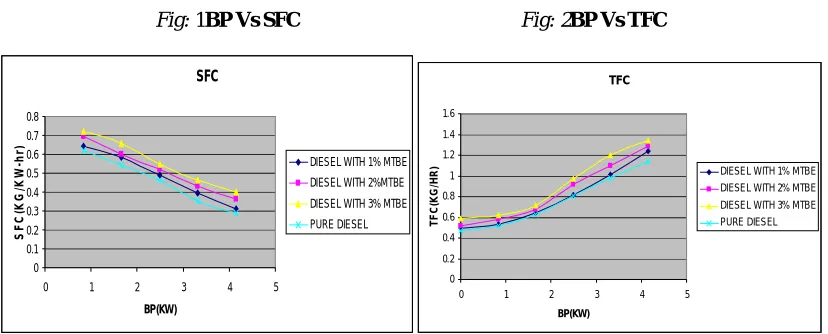
V.A Performance Characteristics of Diesel Fuel with MTBE addition and pure Diesel.
Fig: 1BP Vs SFC Fig: 2BP Vs TFC
Fig: 3
BP Vs BTESFC
0 0.1 0.2 0.3 0.4 0.5 0.6 0.7 0.8
0 1 2 3 4 5
BP(KW)
S
F
C
(K
G
/K
W
-h
r)
DIESEL WITH 1% MTBE DIESEL WITH 2%MTBE DIESEL WITH 3% MTBE PURE DIESEL
TFC
0 0.2 0.4 0.6 0.8 1 1.2 1.4 1.6
0 1 2 3 4 5
BP(KW)
T
F
C
(K
G
/H
R
) DIESEL WITH 1% MTBE
DIESEL WITH 2% MTBE
DIESEL WITH 3% MTBE
PURE DIESEL
Property Mahua Mahua with
1% mtbe
Mahua with 2% mtbe
Mahua with 3% mtbe Calorific value
(MJ/Kg)
40 39.6 39.3 39
Sp.gravity .8411 .847 .85 .867
Property Pongamia Pongamia with 1% mtbe
Pongamia with 2% mtbe
Pongamia with 3% mtbe
Calorific value (MJ/Kg)
38 37.3 37.1 37
It is very clear from the above graphs that the brake thermal efficiency of diesel reduces with increase in the percentage of methyl tertiary butyl ether. However the brake thermal efficiency of diesel with 1%MTBE are closer to that of the pure diesel as compared to the blend of diesel with 2% and 3% MTBE.
V.B HC,CO,NOX And Smoke Emission Characteristics Of Diesel Fuel and MTBE blended Diesel Fuel.
Fig:4 BP Vs HC Fig:5 BP VS CO
Fig:6 BP VS NOX Fig:7 BP VS SMOKE BTE
0 5 10 15 20 25 30
0 1 2 3 4 5
BP(KW)
B
T
E
(%
) DIESEL WITH 1%MTBE
DIESELWITH 2% MTBE DIESEL WITH 3% MTBE PURE DIESEL
HC EMISSIONS
0 500 1000 1500 2000 2500
0 1 2 3 4 5
BP(KW)
HC(
P
P
M
) DIESEL WITH 1% MTBE
DEISEL WITH 2% MTBE
DIESEL WITH 3% MTBE PURE DIESEL
CO EMISSIONS
0 0.05 0.1 0.15 0.2
0 1 2 3 4 5
BP(KW)
C
O
(%
) DIESEL WITH 1% MTBE
DIESEL WITH 2% MTBE
DIESEL WITH 3% MTBE PURE DIESEL
NOx EMISSIONS
100 150 200
x
(P
P
M
) DIESEL WITH 1% MTBE DIESEL WITH 2% MTBE DIESEL WITH 3%MTBE
SMOKE EMISSION
50 60 70 80 90
O
K
E
(%
) DIESEL WITH 1%MTBE
It is very clear from the above graphs that the emission CO, HC,NOx and smoke decreases with increase in the percentage of methyl tertiary butyl ether in diesel. This is because of the presence of oxygen content in the methyl tertiary butyl ether which converts CO into CO2 and HC into H2O.The presence of oxygen further increases diffusive combustion in the combustion chamber and higher flame temperature which reduces the smoke emission.
V.C Performance Characteristics and HC Emission of Mahua Methyl Ester and blended with Diesel.
Fig:8BP VS SFC Fig:9 BP VS TFC
Fig:10BP VS BTE Fig:11 BP VS HC
It is very clear from the above graphs that the brake thermal efficiency of pure mahua reduces with increase in the percentage of methyl tertiary butyl ether. However the brake thermal efficiency of mahua with 1%MTBE are closer to that of the pure mahua as compared to the blend of mahua with 2% and 3% MTBE. In addition the hydrocarbon emission reduces with the increase of the percentage of the MTBE in Mahua.
SFC
0 0.2 0.4 0.6 0.8 1 1.2
0 1 2 3 4 5
BP(KW)
S
F
C
(K
W
/K
G
-h
)
MAHUA WITH 1% MTBE
MAHUA WITH 2% MTBE
MAHUA WITH 3% MTBE
PURE MAHUA
TFC
0 0.2 0.4 0.6 0.8 1 1.2 1.4 1.6
0 1 2 3 4 5
BP(KW)
T
F
C
(K
G
/h
) MAHUA WITH 1% MTBE MAHUA WITH 2%MTBE MAHUA WITH 3% MTBE PURE MAHUA
BTE
0 5 10 15 20 25 30
0 1 2 3 4 5
BP(KW)
B
T
E
(%
) MAHUA WITH 1% MTBE
MAHUA WITH 2% MTBE MAHUA WITH 3% MTBE PURE MAHUA
HC EMISSIONS
0 200 400 600 800 1000 1200 1400 1600
0 1 2 3 4 5
BP(KW)
H
C
(P
P
M
) MAHUA WITH 1% MTBE
MAHUA WITH 2% MTBE
MAHUA WITH 3% MTBE
V.D NOX,CO,Smoke Emissioncharacteristics Of Mahua Methyl Esters and Diesel Blended mahua
Fig:12 BP VS NOX Fig:13BP VS CO
Fig:14BP VS SMOKE
It is very clear from the above graphs that the emission CO, NOx and smoke decreases with increase in the percentage of methyl tertiary butyl ether in mahua. This is because of the presence of oxygen content in the methyl tertiary butyl ether which converts CO into CO2. The presence of oxygen further increases diffusive combustion in the combustion chamber and higher flame temperature which reduces the smoke emission.
V.E Performance Characteristics Pure Pongamia Methyl Ester and Diesel Blended.
Fig:15 BP VS SFC Fig:16 BP VS TFC
NOx EMISSIONS
0 20 40 60 80 100 120 140 160 180
0 1 2 3 4 5
BP(KW)
N
O
x
(P
P
M
) MAHUA WITH 1% MTBE
MAHUA WITH 2% MTBE MAHUA WITH 3% MTBE PURE MAHUA
CO EMISSIONS
0 0.02 0.04 0.06 0.08 0.1 0.12 0.14 0.16 0.18
0 1 2 3 4 5
BP(KW)
C
O
(%
B
Y
V
O
L
)
MAHUA WITH 1% MTBE MAHUA WITH 2% MTBE MAHUA WITH 3% MTBE PURE MAHUA
SMOKE EMISSIONS
0 20 40 60 80 100
0 1 2 3 4 5
BP(KW)
S
M
O
K
E
(%
) MAHUA WITH 1% MTBE
MAHUA WITH 2% MTBE
MAHUA WITH 3% MTBE
PURE MAHUA
SFC
1.4
PONGAMIA WITH 1%
TFC
1.6
Fig:17 BP VS BTE
It is very clear from the above graphs that the brake thermal efficiency of pure pongamia reduces with increase in the percentage of methyl tertiary butyl ether. However the brake thermal efficiency of pongamia with 1%MTBE are closer to that of the pure pongamia as compared to the blend of mahua with 2% and 3% MTBE.
V.F HC,CO,NOX,Smoke Emissions Characteristics with Pongamia and MTBE mixture.
Fig:18 BP VS HC Fig:19 BP VS NOX
Fig:20 BP VS CO Fig:21 BP VS SMOKE
BTE 0 5 10 15 20 25
0 1 2 3 4 5
BP(KW) B T E (% )
PONGAMIA WITH 1% MTBE PONGAMIA WITH 2% MTBE PONGAMIA WITH 3% MTBE PURE PONGAMIA HC EMISSIONS 0 500 1000 1500 2000
0 1 2 3 4 5
BP(KW) H C (P P M )
PONGAMIA WITH 1%MTBE
PONGAMIA WITH 2% MTBE
PONGAMIA WITH 3% MTBE PURE PONGAMIA NOx EMISSIONS 0 50 100 150 200 250
0 1 2 3 4 5
BP(KW) N O x ( P P M )
PONGAMIA WITH 1% MTBE PONGAMIA WITH 2% MTBE PONGAMIA WITH 3% MTBE PURE PONGAMIA CO EMISSIONS 0 0.05 0.1 0.15 0.2 0.25
0 1 2 3 4 5
BP(KW) C O (% B Y V O L )
PONGAMIA WITH 1% MTBE
PONGAMIA WITH 2% MTBE
PONGAMIA WITH 3% MTBE PURE PONGAMIA smoke emission 0 20 40 60 80 100 120
0 1 2 3 4 5
BP(KW) S M O K E (% )
It is very clear from the above graphs that the emission CO,HC NOx and smoke decreases with increase in the percentage of methyl tertiary butyl ether in mahua. This is because of the presence of oxygen content in the methyl tertiary butyl ether which converts CO into CO2 and HC into H20. The presence of oxygen further increases diffusive combustion in the combustion chamber and higher flame temperature which reduces the smoke emission.
VI. CONCLUSION
Based on the results of this experiment, the following conclusions are drawn:
1. After blending the Methyl tertiary butyl ether with diesel, it is found that the calorific value is reduced by 4%..
2. When the percentage of methyl tertiary butyl ether is increased, it is found the emissions characteristics are good and reduced a lot.
3. Higher percentage of methyl tertiary butyl ether did not show good blending with fuel.
4. In case of diesel with methyl tertiary butyl ether, it is found that the performance though is not efficient as compared to diesel fuel but the emission characteristics are good. The HC, CO and NOx are reduced well about when adding 3% MTBE.
5. Well in the case of mahua with methyl tertiary butyl ether, it shows lesser performance than mahua but emissions are far than mahua and diesel.
6. The emissions after adding methyl tertiary butyl ether, shows lesser than mahua and than diesel when compared.
7. Pongamia with methyl tertiary butyl ether shows far better emissions results than diesel and mahua.
8. The blending of methyl tertiary butyl ether with pongamia reduces emission when compared to diesel and mahua
REFERENCES
1. Gerhald Vellguth (1998) performance ofvegetable oils and their monoesters as fuels for diesel engines, SAE 831358
2. Knothe, G,. Dunn, R.O and Bagby, M.O (2001) Biodiesel: “The Use of Vegetable Oils and Their Derivatives as Alternate Diesel Fuels” 3. M.A.Fanguri, M.A.Hanna, “Biodiesel Production: A Review”, bio source technology, vol70, 1999, 1-15
4. K. Nantha Gopal, , R. Thundil Karuppara-Science Direct Effect of pongamia biodiesel on emission and combustion characteristics of DI compression ignition engine
5. Gupta, S., V, M., Gupta, D., and Kumar, N., "Comparative Study on Performance and Emission Characteristics of Fish Oil Biodiesel and Mahua Oil Biodiesel Blend with Diesel in a Compression Ignition Engine," SAE Technical Paper 2013-01-2666, 2013, doi:10.4271/2013-01-2666.
6. Bora, D., Das, L., and Babu, M., "Experimental Evaluation of Mahua based Biodiesel as Supplementary Diesel Fuel," SAE Technical Paper 2009-01-0479, 2009, doi:10.4271/2009-01-0479.
7. Bilgin A, Durgun O, Sahin Z. The effects of Diesel–ethanol blends on Diesel engine performance. Energy Sources 2002; 24(5):431–40.
8. Weidmann K, Menrad H. Fleet test, performance and emissions of Diesel engines using different alcohol–Diesel fuel blends. SAE Paper no. 841331, 1984.
9. Adhav, S. and Tandale, M., "Biodiesel (Mangifera Oil Methyl Ester) Derived from Triglycerides of Mangifera Kernel Seed and Leaves Oil by using Heterogeneous Catalyst," SAE Technical Paper 2015-01-1682, 2015, doi:10.4271/2015-01-1682.