Seismic Response of High rise Structures
Considering the Effect of Interaction between
Layered Soils and the Structure
Urmila Pallepamula1, Dr. S. R. K. Reddy2
P.G. Student, Department of Civil Engineering, Gudlavalleru Engineering College, Gudlavalleru, A.P, India1
Professor, Department of Civil Engineering, Gudlavalleru Engineering College, Gudlavalleru, A.P, India2
ABSTRACT: Earthquakes are spasmodic disasters caused by sudden release of energy in the earth’s lithosphere.
Earthquakes occur sudden and bulk of destruction takes place within short duration of time. Bitter experiences left by past earthquakes reveal the importance of constructing earthquake resistant structures and influence of soil-structure interaction on the behaviour of structures during an earthquake. It has been well recognized that the interaction between flexible soil and the structure indeed affect the response of the structure apart from other parameters like ground excitation, configuration and ductility.During an earthquake, when seismic waves travel through different rocks and soil media, the values of shear wave velocity and shear modulus will be different in different layers of soil and the interaction of layered soils with the structure play vital role in obtaining the seismic response of structures, particularly in loose soils.In this project, a multi-storied building proposed to be constructed in the region of new capital, Amaravathi, Andhra Pradesh, is chosen for the study. Studies are carried out to obtain the response parameters like time period, base shear and storey displacement under seismic load conditions, when the similar structure rests on layered soil. The results are compared with those when the structure is assumed to be fixed at the base.
KEYWORDS: Soil structure interaction, Free vibration analysis, Layered soil,Stiffness, Time period, Story shear,
Storey displacement.
I. INTRODUCTION
Earthquakes are the most dangerous natural disasters which occur suddenly without warning and cause large scale destruction with in a very short duration of time. Earthquakes are mainly caused by rupture of geological faults, and also by other events such as volcanic activities, landslides, mine blasts and nuclear tests. Though earthquakes cannot be predicted directly, potential seismic zones can be identified using geospatial technologies.
When earthquake originates from focus, seismic waves travel through different rock / soil media and when they reach the foundation, the structure vibrates. Shear wave velocity varies from low value in case of flexible soils to a higher value for stiff soil / rock and hence the geo-technical properties of different geomorphic units will change from static to dynamic state and greatly influence on the response. It has been well established that interaction between flexible soils and the structure will greatly affect the response of the structure apart from other parameters like earthquake magnitude, configuration, ductility and construction quality. Italy(1783), Alaska(1964), Kobe(1995), Bhuj(2001), Indonesia – Sumatra(2004) and Nepal(2016) earthquakes are some of the best examples for failure of the buildings due to soil conditions.
ISSN(Online) : 2319-8753 ISSN (Print) : 2347-6710
I
nternational
J
ournal of
I
nnovative
R
esearch in
S
cience,
E
ngineering and
T
echnology
(An ISO 3297: 2007 Certified Organization)
Website:
www.ijirset.com
Vol. 6, Issue 5, May 2017
Most of the loss of life during an earthquake comes from the total or partial collapse of buildings. Damage sustained in recent earthquakes, have also highlighted that the seismic behaviour of a structure is highly influenced not only by the response of the superstructure, but also by the response of the foundation and the soil as well. For the seismic analysis, foundation of the structure usually assumed to be fixed at the base to simplify the analysis; but in reality, as the foundation of the structure rests on soil, the response depends upon the properties of the structure as well as soil. The interaction phenomenon is principally affected by the mechanism of energy exchanged between the soil and the structure. Shear modulus values of soil changes with the shear wave velocities travel through different soil media. Modelling of soil requires representation of soil stiffness, mass and damping characteristics allowing for strain-dependence and variation of soil properties. Hence the structures are usually designed for gravity loads, translational and rocking springs of soil.
Equivalent soil spring constants are worked out for different types of soils based on the work done by Whitman and Richart (1967) for footing type foundation and work done by Novak (1974) for pile foundations. The structure and the soil can be idealized as mass-spring-dashpot system treating it one having n+2 degrees of freedom where ‘n’ is no of storey masses idealized in the structure and the other two are spring constants represented by the soil. The response of a structure considering soil-structure interaction significantly change, particularly, when the structure rests on loose soil. The present study focus on the analysis of the multi stories structure subjected to gravity as well as seismic loads by considering the Soil-Structure Interaction using free vibration analysis. The analysis has been carried out considering the building rests on layered soil.The results of fixed base condition are compared with the results obtained considering soil – structure interaction when the building rests on layered soils to obtain the parameters like displacements, time periods and base shears at different floor levels.
II. PROPOSED WORK
Amaravathi which is located near the right stream side of river Krishna is announced as the new capital of Andhra Pradesh. Many multi storied structures are expected in this region. This region is mainly covered with four geomorphological units namely black cotton soil, red gravelly soils, sandy alluvial soils, saline swampy soils (Data from National Informatics Centre, Guntur). This region falls under seismic zone III. The interaction between the structure and soil plays a key role to obtain the dynamic response of the structure during earthquake.
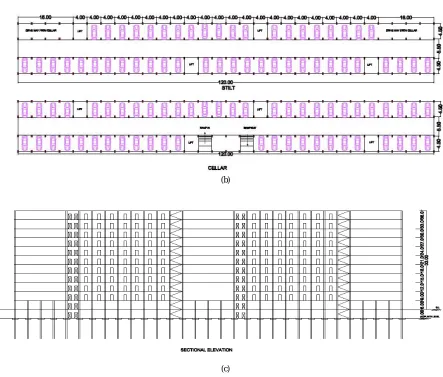
In the present study, a twelve storied building (multi-storied building), with lower two stories for parking (soft stories) and the remaining ten stories for five star hotel resting on two different types of layered soil, is chosen for the analysis. The dimensions and properties and the structural element of the building are presented in table 1&2. Plan and elevation of building is shown in figs. 1(a), 1 (b) and 1(c).
(b)
(c)
Fig. 1. Plan and elevation of the building (a) Plan of the top and first floors (b) Plan of the stilt and cellar (c) Sectional elevation of the building
Preliminary data
Table 1.Properties of materials and different loads
Name of the property/element Description
Grade of concrete M25
Grade of steel Fe 415
Unit weight of RCC 25 KN/ m3
ISSN(Online) : 2319-8753 ISSN (Print) : 2347-6710
I
nternational
J
ournal of
I
nnovative
R
esearch in
S
cience,
E
ngineering and
T
echnology
(An ISO 3297: 2007 Certified Organization)
Website:
www.ijirset.com
Vol. 6, Issue 5, May 2017
Live load (floor)
(Seminar halls) 5.0 KN/ m2
(Rooms) 3.0 KN/ m2
Live load (terrace) 1.50 KN/ m2
floor finish 1.0 KN/ m2
Terrace finish 1.5KN/ m2
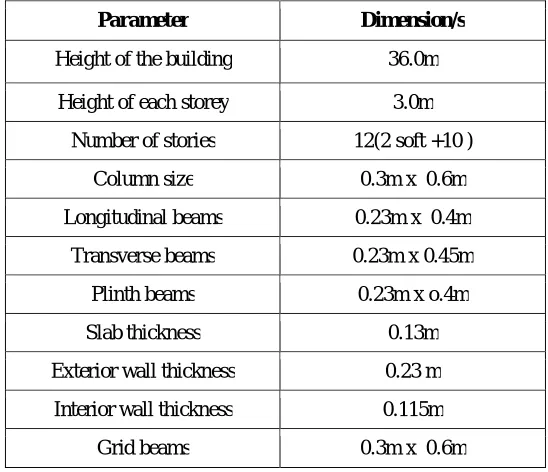
Table 2. Dimensions of structural elements
Parameter Dimension/s
Height of the building 36.0m
Height of each storey 3.0m
Number of stories 12(2 soft +10 )
Column size 0.3m x 0.6m
Longitudinal beams 0.23m x 0.4m
Transverse beams 0.23m x 0.45m
Plinth beams 0.23m x o.4m
Slab thickness 0.13m
Exterior wall thickness 0.23 m
Interior wall thickness 0.115m
Grid beams 0.3m x 0.6m
III.GEOTECHNICAL STUDIES
Geotechnical Classification in Study Area
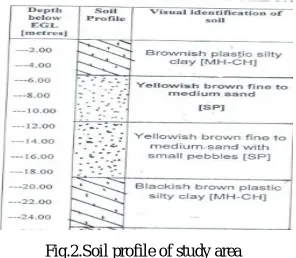
The study area is covered by different types of geomorphic units/ landforms. The seismic response of similar building behaves differently in different soil units during an earthquake. Assuming the chosen building rests on deep foundations, and the soil consists of two layers in study area as given below
Fig.2.Soil profile of study area
Table 3. Geo-technical properties of various geomorphic units
Property of the material Units Layer 1 Layer 2
Shear wave velocity Vs m/s 60 150
Mass density ( ) KN-m2/m4 1.6 1.7
Poisson’s ratio (µ) - 0.4 0.4
Shear modulus (Gs) = ∗ Vs2 KN/m 2
x 105 5760 38250
Young’s modulus (Es) KN/m2x 105 0.161 1.071
IV.MATHEMATICAL MODEL
The structure can be treated as a mass-spring dash pot system, which is having n+2 degrees of freedom, where ‘n’ represents the number of lumped storey masses idealised in the structure and the other two components are the spring constants of the soil namely horizontal stiffness and the rocking stiffness.
Foundation model
In present study pile foundation is the one which can be used so as to get the SSI effect due to the layered soils. A pile group consists of four piles of 0.5m diameter and 17.2m of length. Dimensions of pile cap in plan is of 3m X 3m.
Soil model
The soil model has to represents the soil mass and soil stiffness factors which are to be allowed for the stain dependence and soil properties. The soil structure is modelled by considering that the structure is assumed to rest on an uniform elastic half space and soil-spring is used. The most common method of modelling the soil is done by considering that the soil springs are located at the base of the structure. Only horizontal and rocking springs are considered since the structures are designed for gravity loads and the plan the building is symmetrical. The equivalent spring constant for the layered soil is worked out based on the Novak and EI-Sharmouby formula (1983).
Equivalent stiffness of the layered soils
Calculation of stiffness of pile by using Novak and EI-Sharnouby Formulae (1983) Translational stiffness kx=[
∗ ^ ] *fx1
Rocking stiffness kφ = [ ∗
ISSN(Online) : 2319-8753 ISSN (Print) : 2347-6710
I
nternational
J
ournal of
I
nnovative
R
esearch in
S
cience,
E
ngineering and
T
echnology
(An ISO 3297: 2007 Certified Organization)
Website:
www.ijirset.com
Vol. 6, Issue 5, May 2017
Where, = Modulous of elasticity of pile material = moment of inertia of single pile about X or Y axis = pile radius fx1, fφ 1are Novak’s coefficients
Structure model
A twelve storey building of 120m X 14.5m size in plan, in which two soft stories are at bottom for parking and other floors are for commercial purpose, has been analysed by Free vibration analysis. It is idealised as dash- pot system treating it as one having twelve degree of freedom system with fived base condition and fourteen degree of freedom system with SSI consideration. The dead and seismic loads are calculated according to IS 875-partIII. The inner story stiffness are worked out by adding the stiffness values of the column and stiffness of all infill walls parallel to the lateral load in each storey.
Stiffness of each column kc = 12EI/L3
Stiffness of infill walls kw =AEm/ld(cos2ϴ)
Where,
Em = Elastic Modulus of Masonry Wall Ef= Elastic Modulus of Frame material
ld = Diagonal length of the strut = √ ( h + l) h = Height of wall
A = Cross-sectional area of diagonal strut = W x t
W = Width of strut l = Length of wall t = Thickness of wall W = 1/2(√(αh2+αl2)) ϴ =Tan-1(h/l)
αh = Contact length between wall and columns αl = Contact length between wall and beams αh =π/2(( EfIch) / (2 Emt sin2ϴ))1/4 αl = π((EfIcl ) / ( Emt sin2ϴ ) )1/4
Table 4. Mass and stiffness values of structure
Mass(kN-sec2/m) Stiffness(kN/m)
m12 =1523.3 k12 =26.17x10⁶ m11-4 =2020.3 k11-4 =26.17 x10⁶ m3 =1780 k3 =25.6 x10⁶ m1 =1138.1 k1 =12.11 x10⁶ m2 =1591.3 k2 =12.11 x10⁶
Table 5. Calculation of stiffness of piles
Mass of the soil M0 = 5691 kN-sec2/m
Parameter Layer 1 Layer 2
Shear wave velocity Vs(m/sec) 60 150
Soil density s(kN. Sec2/m) 1.6 1.7
Depth of layer 4.5 14.5
µ 0.4 0.4
ro(m) 0.5 0.5
Gs(kN/m2) 5760 38250
Ep (kN/m2)x105 274 274
Ip(m4) 0.00306 0.00306
Ep/Gs 4747 716
fx1 0.0042 0.0125
kx * 106 11.178 33.27
fφ1 0.233 0.388
Mass moment of inertia of soil I0 = 99711.1 m4
IV. FREE VIBRATION ANALYSIS
Using SRSS (Square Root Sum of Squares) method, the equilibrium equations are formulated and put them in matrix form and also by
[m] ̈+ [k] x = 0 Where, [m] – mass matrix,[k] – stiffness matrix,
̈– horizontal acceleration, x – horizontal displacement.
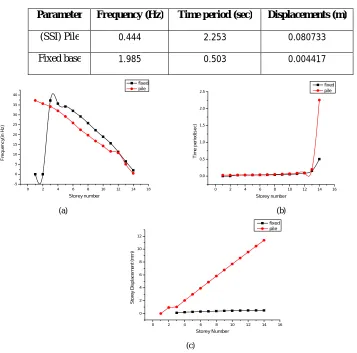
Undamped free vibration analysis is carried out to obtain the time periods, base shears, and storey displacements when the building rests on the five categorized types of soil/rock units treating the building as one with 14 degrees of freedom, the fundamental frequency and the time period are given in table 6. Seismic analysis is also carried out when the building is assumed to be fixed at the base treating it as one with 12 degrees of freedom and displacements are obtained considering soil-structure interaction effect and the results are presented in table 6.
Table 6. Comparison of results
Parameter Frequency (Hz) Time period (sec) Displacements (m)
(SSI) Pile 0.444 2.253 0.080733
Fixed base 1.985 0.503 0.004417
0 2 4 6 8 10 12 14 16 -5 0 5 10 15 20 25 30 35 40 F re q u e n c y (i n H z ) Storey number fixed pile
0 2 4 6 8 10 12 14 16 0.0 0.5 1.0 1.5 2.0 2.5 T im e p e ri o d (s e c ) Storey number fixed pile
(a) (b)
0 2 4 6 8 10 12 14 16 0 2 4 6 8 10 12 S to re y D is p la c e m e n t (m m ) Storey Number fixed pile (c)
ISSN(Online) : 2319-8753 ISSN (Print) : 2347-6710
I
nternational
J
ournal of
I
nnovative
R
esearch in
S
cience,
E
ngineering and
T
echnology
(An ISO 3297: 2007 Certified Organization)
Website:
www.ijirset.com
Vol. 6, Issue 5, May 2017
VI.CONCLUSION
Failure examples during past earthquakes reveal that soil structure interaction effect play vital role in response of structures, particularly when structure rests on loose soils.
Stiffness of soil both in translation and rocking direction decreases with decrease of shear wave velocity of soil.
It is observed that rocking spring constant value of layered soil is more than that of values obtained for horizontal spring constant.
Time period increases with decrease of stiffness of the soil and this increase is observed more in upper storey levels. In case of buildings with soft stories at lower level, this increase is exponential.
Frequency values in upper stories decrease compared to the decrease of frequency in lower stories.
When soil structure interaction is considered, the displacements at different storey levels are observed more compared to the fixed base condition and this increase is found more due to rocking effect during an earthquake.
REFERENCES
[1] Ghosh, B. “ Behaviour of rigid foundation in layered soil during seismic liquefaction.” PhD thesis, University of Cambridge, 2003.
[2] Xilin Lu, Peizhen Li, Bo Chen, Yueqing Chen, Computer simulation of the dynamic layered soil–pile–structure interaction system,Canadian
Geotechnical Journal, 2005, 42(3): 742-751, 10.1139/t05-01.
[3] S.R.K.Reddy, et al, “Terrain evaluation and influence of soil-structure interaction on seismic response of structures in urban environs” proc of
3rd International conference (2006)Venice, Italy, pp235-242.
[4] Whiteman. R.V, Richart.F.E, “Design procedure for dynamically loaded foundations” journal of soil mechanics and foundation engg., Division,
ASCE 93, 1967, pp167-191.
[5] P.A Dode, H.S.Chore and D.K.Agraual, “Space frame – pile foundation –soil interaction analysis”, Journal of structural engg. Vol.42, No.3,
August – September 2015.pp.246-255.
[6] Milos Novak “Dynamic stiffness and damping of piles” (1974) Canadian Geo Technical Engineering, journal, 1974, pp 574-598.
[7] A Criterion For Considering Soil-structure Interaction Effects In Seismic Design Of Ductile Rc-mrfs According To Iranian Codes By
Massumi 1 And H.R. Tabatabaiefar.
[8] BharathBhushan Prasad, “Fundamentals of Soil Dynamics and Earthquake Engineering’’, PHI learning private limited,2009.
[9] Ketan Bajaj, JiteshTChavda, Bhavik M Vyas, “seismic behaviour of buildings on different types of soil”.
[10] W. Teng, W. Kuihua, and X. Kanghe, “Study on vibration properties of piles in layered soils”, China Civil Engineering Journal, vol. 35, no. 1,