The Matrix Coalescent and an Application to Human
Single-Nucleotide Polymorphisms
Stephen Wooding*
,1and Alan Rogers
†*Eccles Instititute of Human Genetics, University of Utah, Salt Lake City, Utah 84112-5330 and†Department of Anthropology,
University of Utah, Salt Lake City, Utah 84112-0060
Manuscript received July 5, 2001 Accepted May 10, 2002
ABSTRACT
The “matrix coalescent” is a reformulation of the familiar coalescent process of population genetics. It ignores the topology of the gene tree and treats the coalescent as a Markov process describing the decay in the number of ancestors of a sample of genes as one proceeds backward in time. The matrix formulation of this process is convenient when the population changes in size, because such changes affect only the eigenvalues of the transition matrix, not the eigenvectors. The model is used here to calculate the expectation of the site frequency spectrum under various assumptions about population history. To illustrate how this method can be used with data, we then use it in conjunction with a set of SNPs to test hypotheses about the history of human population size.
T
HE history of population size is a point of general more than one gene in the modern sample. Each time this happens, the number of ancestors decreases by one. interest in studies of biological variation. Amongother things, population size changes can affect levels Eventually, we reach the gene that is ancestral to the entire modern sample, and the process ends. This pro-of heterozygosity, allele frequency, and the extent pro-of
cess provides a natural description of genetic variation, linkage disequilibrium (Harpending et al. 1998;
Ter-which can be described both in terms of the topological
willigeret al. 1998). In humans, these effects are an
(or genealogical) relationships among genetic lineages important consideration in problems ranging from
evo-and the genetic distances (or coalescence times) be-lutionary biology to gene mapping. Thus, information
tween them. about long-term population size contributes to the
un-The coalescent process is an example of a Markov derstanding of both ancient human history and modern
process—a stochastic process in which the probability human biology.
of moving from one state to another depends only on Information about the history of human population
the state you are in, not on the states you have previously size comes from a variety of sources. Archaeology,
pa-visited. In previous literature, attention has focused on leoanthropology, linguistics, and historical
documenta-the Markov chain that governs not only documenta-the lengths tion are all important. Over the last 25 years, however,
of the intervals between coalescent events but also the genetic evidence has risen to the forefront. By providing
topology of the resulting gene genealogy (e.g.,
Taka-information inaccessible through traditional means,
ge-hata 1988). In this article, we introduce a reduced netic data play a key role in inferences about the ancient
version of the Markov chain that ignores topology and human past. Central to this role are the theoretical tools
deals only with the lengths of intervals. Our procedure of population genetics, which attempt to describe the
has a number of advantages, especially in dealing with relationship between demography and genetic diversity.
variation in population size. After introducing the Among these tools, models of the coalescent process
model, we use it to study a set of human single-nucleo-have distinguished themselves as a way to extract
infor-tide polymorphisms (SNPs). mation about past patterns of population size change
from present patterns of genetic variation (Fuand Li
2001). MODEL
The coalescent process (Kingman 1982a; Hudson
The matrix coalescent:If time is measured backward 1990) describes the ancestry of a sample of genes. As
into the past, and a sample ofklineages is selected t
we trace the ancestry of each modern gene backward
generations before present from a haploid population from ancestor to ancestor, we occasionally encounter
with sizeN(t), then the probability that theksampled common ancestors—genes whose descendants include
lineages havek⫺1 distinct ancestorst⫹1 generations before present is approximately
1Corresponding author:Eccles Instititute of Human Genetics,
Univer-sity of Utah, 15 N. 2030 E., Salt Lake City, UT 84112-5330. ␣k(t)⫽ k(k⫺ 1)
2N(t) (1)
E-mail: [email protected]
(Hudson1990). For diploid populations, 2N(t) can be whereciis theith entry in vectorc. Thejth eigenvector
replaced by 4N(t). is calculated by setting ⫽ ⫺␣j, settingc1to an arbitrary
A sample ofnlineages gathered at the present (t⫽ constant, and then applying (6) repeatedly. Wheni⫽
0 generations ago) will have a genealogy proceeding j, this equation becomescj⫹1⫽cj⫻0. Consequentlyci⫽ from the state of havingndistinct lineages to the state 0 for alli⬎j, and the matrixCof column eigenvectors of havingn⫺1 lineages, and so on down to one lineage, is upper triangular.
at a rate determined by the transition probabilities␣n(t), Equation 6 also implies that the column eigenvectors
␣n⫺1(t), . . . ,␣2(t). In general, the probability,pk(t), of are time invariant: Substitute (1) into (6) for the jth observingklineagestgenerations before present where column eigenvector to obtain
nⱖkⱖ1 is described by a system of recurrence
equa-tions c
i⫹1 ⫽ci
i(i⫺1) ⫺j(j⫺1)
i(i⫹ 1) .
pk(t⫹1)⫽
冦
pk(t)·(1⫺ ␣k(t))⫹pk⫹1(t)·␣k⫹1(t), 1ⱕk⬍npk(t)·(1⫺ ␣k(t)), k⫽n Since this expression does not depend ont, the matrix
Cof column eigenvectors is time invariant. (2)
The row eigenvectors of A are defined byrA ⫽ r, whereis an eigenvalue ofAandris the corresponding with initial condition pn(0) ⫽ 1, pn⫺1(0) ⫽ 0, . . . ,
row eigenvector. This equation can be reexpressed as
p1(0)⫽ 0.
In calculations, we exclude terms for the absorbing
ri⫺1⫽ri( ⫹ ␣i)/␣i, (7) state, in which there is just a single lineage. This is not
restrictive, since we can always calculate
and row eigenvectors can be calculated iteratively in the same way as column eigenvectors. LikeC, the matrixR
p1(t)⫽1⫺
兺
ni⫽2
pi(t) .
of row eigenvectors will be upper triangular and time invariant.
In matrix notation, Equation 2 becomes Before these eigenvectors can be used, they must be
normalized so thatRC⫽I, whereIis the identity matrix.
p(t⫹ 1)⫽(I⫹A(t))p(t) , (3)
Since both matrices are upper triangular, this requires where p(t) is a column vector with entries p2(t),p3(t), only that, for eigenvector j, we ensure that rjcj ⫽ 1. . . . ,pn(t), whereIis the identity matrix, and where Our computer program normalizes the eigenvectors by
settingrj⫽ cj⫽ 1.
By expanding the matrix exponential in Equation 5 in diagonal form, we obtain
A(t)⫽
⫺␣2(t) ␣3(t)
⫺␣3(t) ...
... ␣n(t)
⫺␣n(t)
p(t)⫽CP(t)Rp(0) , (8)
where P(t) is a diagonal matrix whose xth diagonal is the transition rate matrix. Equation 3 can be approxi- element is
mated in continuous time by an ordinary differential
Px(t)⫽e⫺兰
t
0␣x()d (9)
equation
andp(0)⫽[0, 0, . . . , 1] as described for (2). Thekth
dp(t)
dt ⫽A(t)p(t) , (4) element of p(t) contains the probability of observing
k distinct lineages t generations before present when
which is solved by population size is described by the functionN(t).
The second row of plots in Figure 1a shows howpk(t)
p(t)⫽ e兰0tA(z)dzp(0) . (5)
varies withtfor several different values ofkand under three population histories: a sudden population in-The entries,pi(0), of the initial vectorp(0) are defined
crease, a gradual increase, and a gradual increase with above.
periodic cycling.
Eigenvalues and eigenvectors:SinceA(t) is a
triangu-Expected lengths of coalescent intervals: Let m de-lar matrix, its eigenvalues are equal to its diagonal
en-note the vector whose kth entry, mk, is the expected tries:⫺␣2(t), . . . ,⫺␣n(t). The column eigenvectors of
duration in generations of the interval during which the
A(t) are defined by the equation A(t)c ⫽ c, where
process containsklineages. There is a close relationship is a scalar—one of the eigenvalues ofA—andca column
betweenmandp: Thekth entry inp(t) is the probability eigenvector. This equation can be reexpressed
(sup-that generation tmakes a contribution to the interval pressingt) as
during which the process hask lineages. To calculate
m, we integrate acrossp:
Figure1.—Theoretical expec-tations. Shown are the relation-ships between population history, probability of coalescence, expected interval length, and theoretical frequency spectrum under three population histories for samples ofn⫽5 lineages. (a) Top, popula-tion size over time; middle, the probability that there are stillk dis-tinct lineages in the genealogy t
generations ago, given the popula-tion history at top; bottom, ex-pected interval lengths given the population history at top. Dashed vertical lines indicate that no par-ticular branching order is implied for the genealogies. (b) Normal-ized frequency spectra for the ge-nealogies represented in a. These results were generated using the Maple 5.1 software package using default numerical precision.
from populations that have increased in size show an
m⫽
冮
∞
0
p(t)dt. (10)
overabundance of rare variants relative to populations of constant size, but populations that have decreased After substituting Equation 8, this becomes
show an underabundance (Harpending et al. 1998;
m⫽CERp(0) , (11) Wooding1999). The sensitivity of the frequency spec-trum to population size change is exploited in several where E is a diagonal matrix whose xth diagonal
ele-statistical tests of stationarity or neutrality (Tajima1989; ment is
Fu 1997).
A polymorphic nucleotide site is ordinarily present
Ex⫽
冮
∞0
e⫺兰0␣x(t)dtd (12)
in only two states within a sample, one of which is ances-tral and the other derived. The expected fraction,k, of (Ross1997, Chap. 5). The third row of plots in Figure
sites at which the derived allele occursktimes is given by 1a shows the expected length of each coalescent interval
under several hypothetical population histories.
k⬇
兺
nj⫽2jmjy(j,k,n)
兺
n j⫽2jmj, (13)
The theoretical frequency spectrum of mutations:
The frequency spectrum is the distribution describing
wherenis the number of DNA sequences in the sample, the relative abundance of alleles occurringi⫽1, 2, . . . ,
con-tainingjdistinct lineages, andy(j,k,n) is the probability
L(D|H)⫽
兺
n⫺1k⫽1
Sklnk, that a single lineage within coalescent interval j has k
descendants in a sample of sizen. This equation is
de-whereSkis the number of sites occurringktimes in the rived inappendix a.
sample and k is the probability of a variant site oc-The probability y(j, k, n) is given by Polya’s
distri-curringktimes in the sample. If different sample sizes bution:
are used for different loci,kchanges from site to site. The ratios of likelihoods under different population
y(j,k,n)⫽(j⫺1)(n⫺ k⫺ 1)!(n⫺ j)!
(n⫺1)!(n⫺j⫺ k⫹1)! histories can be compared using standard likelihood-ratio tests (Bulmer1979;Edwards1992).
(Felsenstein1992;Sherryet al.1997; see also Equa- Application to human SNPs: SNPs are a potentially
tion 21 in Fu 1995). Figure 1b shows the theoretical valuable source of information about population his-frequency spectrum under several assumptions about tory: They are abundant, they are spread widely across
population history. the genome, and they are relatively inexpensive to assay.
Numerical methods: Equation 5 contains a matrix Most studies of SNPs are focused on their potential exponential, and these are notoriously difficult to evalu- epidemiological applications (e.g.,Cargillet al.1999; ate numerically (Moler and Loan1978). It does not Halushkaet al.1999). SNPs have also been exploited help to expand the exponential in terms of eigenvalues as a source of information about the process of natural and eigenvectors. When the sample size is much over selection (Sunyaevet al.2000;Fayet al.2001). We focus 50, the two eigenvector matrices in Equation 8 will con- here on human population history, although we include tain very large numbers as well as small ones. Even worse, some discussion of selective processes.
the entries of each row ofC alternate in sign, leading Cargill et al. (1999) surveyed SNPs in 196.2 kb of to severe cancellation errors in the matrix product on nuclear DNA sequence in 20 Europeans, 14 Asians, 10 the right-hand side of Equation 8. With samples of even African Americans, and 7 African Pygmies. Most of the moderate size, straightforward evaluation of these equa- sequence was from the coding portion of genes impli-tions can produce results without any significant digits. cated in cardiovascular, endocrine, and neuropsychiat-We deal with these problems in two different ways. For ric diseases, but some noncoding sequence was se-population histories of arbitrary complexity, we resort to quenced in flanking and intervening regions. Each brute force and use the CLN-1.0.1 programming library amplified segment was screened by both DNA
sequenc-(Haible 2000) to perform computations either with ing and denaturing high-performance liquid
chroma-high-precision floating-point numbers or with rational tography, and every putative SNP was verified by rese-numbers. By varying the precision, it is possible to deter- quencing (Cargillet al.1999). In total, 612 SNPs were mine how many digits of precision are needed. Some identified in 106 genes.
of our calculations were performed with floating-point The laboratory methodology used byCargill et al. numbers using 500 decimal digits of precision. (1999) avoided some problems such as false positives, Better alternatives are available when the population’s but two features of the SNP data made analysis difficult. history is piecewise constant. By this we mean that the First, the SNPs were a combination of linked and un-history is divided into a series of epochs within each of linked loci. Second, different SNP loci were assayed in whichN(t) is constant. If the number of epochs is large, different numbers of chromosomes. Some SNPs were the piecewise constant model can approximate any his- sampled in 28 chromosomes, for example, while others tory of population size. Even with only a few epochs, were sampled in 114. To cope with these problems, it is probably realistic for populations whose sizes are Cargillet al. (1999) were forced in some analyses to ordinarily held constant by density-dependent popula- rely on doubtful assumptions. The matrix coalescent
tion regulation. provides an alternative approach. It cannot accomodate
For such histories, we use the “uniformization” algo- sites with varying levels of linkage, but likelihood-ratio rithm ofStewart(1994, Chap. 8), to evaluate equation tests can take varying sample sizes into account. 5 across a single epoch of the population’s history. This To take advantage of the informativeness of unlinked makes it possible to project the vectorpbackward in time sites and to avoid the confounds associated with partial epoch by epoch. With this method, double-precision linkage, we resampled the original data set randomly floating-point calculations are able to deal with
prob-in three steps: lems involving samples of at least 1000.
1. All of the SNPs reported byCargillet al.(1999) were This method for projectingp backward in time also
divided into the three categories reported originally: makes it easy to calculatem.Details are given in
appen-coding nonsynonymous (cns) and appen-coding
synony-dix b.
mous (cs) and noncoding (nc) sites near genes.
Statistical methods: Under the assumption that the
2. To minimize linkage between sampled sites, only one genealogies of unlinked sites are statistically
indepen-randomly chosen SNP from each category was scored dent, the log-likelihood of an observed data set (D)
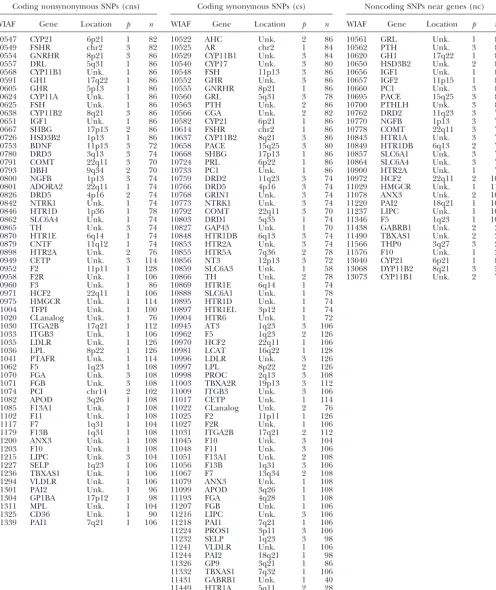
TABLE 1
Sampled SNPs
Coding nonsynonymous SNPs (cns) Coding synonymous SNPs (cs) Noncoding SNPs near genes (nc)
WIAF Gene Location p n WIAF Gene Location p n WIAF Gene Location p n
10547 CYP21 6p21 1 82 10522 AHC Unk. 2 86 10561 GRL Unk. 1 86
10549 FSHR chr2 3 82 10525 AR chr2 1 84 10562 PTH Unk. 3 86
10554 GNRHR 8p21 3 86 10529 CYP11B1 Unk. 3 84 10620 GH1 17q22 1 86
10557 DRL 5q31 1 86 10540 CYP17 Unk. 3 80 10650 HSD3B2 Unk. 2 82
10568 CYP11B1 Unk. 1 86 10548 FSH 11p13 3 86 10656 IGF1 Unk. 1 84
10591 GH1 17q22 1 86 10552 GHR Unk. 3 86 10657 IGF2 11p15 1 80
10605 GHR 5p13 1 86 10555 GNRHR 8p21 1 86 10660 PC1 Unk. 3 82
10624 CYP11A Unk. 1 86 10560 GRL 5q31 3 78 10695 PACE 15q25 3 82
10625 FSH Unk. 1 86 10563 PTH Unk. 2 86 10700 PTHLH Unk. 3 86
10638 CYP11B2 8q21 3 86 10566 CGA Unk. 2 82 10762 DRD2 11q23 3 74
10651 IGF1 Unk. 1 86 10582 CYP21 6p21 1 86 10770 NGFB 1p13 3 74
10667 SHBG 17p13 2 86 10614 FSHR chr2 1 86 10778 COMT 22q11 3 70
10726 HSD3B2 1p13 1 86 10637 CYP11B2 8q21 3 86 10843 HTR1A Unk. 3 78 10753 BDNF 11p13 3 72 10658 PACE 15q25 3 80 10849 HTR1DB 6q13 2 78
10780 DRD3 3q13 3 74 10668 SHBG 17p13 1 86 10857 SLC6A1 Unk. 3 72
10791 COMT 22q11 3 70 10724 PRL 6p22 1 86 10864 SLC6A4 Unk. 3 72
10793 DBH 9q34 2 70 10733 PC1 Unk. 1 86 10900 HTR2A Unk. 1 74
10800 NGFB 1p13 3 74 10759 DRD2 11q23 3 74 10972 HCF2 22q11 2 104
10801 ADORA2 22q11 1 74 10766 DRD5 4p16 3 74 11029 HMGCR Unk. 1 114
10826 DRD5 4p16 2 74 10768 GRIN1 Unk. 3 74 11078 ANX3 Unk. 2 104
10842 NTRK1 Unk. 1 74 10773 NTRK1 Unk. 3 74 11220 PAI2 18q21 1 104
10846 HTR1D 1p36 1 78 10792 COMT 22q11 3 70 11237 LIPC Unk. 1 106
10862 SLC6A4 Unk. 1 74 10803 DRD1 5q35 1 74 11346 F5 1q23 1 108
10865 TH Unk. 3 74 10827 GAP43 Unk. 1 70 11438 GABRB1 Unk. 2 38
10870 HTR1E 6q14 1 74 10848 HTR1DB 6q13 3 74 11490 TBXAS1 Unk. 2 34
10879 CNTF 11q12 1 74 10853 HTR2A Unk. 3 74 11566 THP0 3q27 3 28
10898 HTR2A Unk. 2 76 10855 HTR5A 7q36 2 78 11576 F10 Unk. 1 38
10949 CETP Unk. 3 114 10856 NT3 12p13 3 72 13040 CYP21 6p21 1 82
10952 F2 11p11 1 128 10859 SLC6A3 Unk. 1 58 13068 DYP11B2 8q21 3 56
10958 F2R Unk. 1 106 10866 TH Unk. 2 78 13073 CYP11B1 Unk. 2 70
10960 F3 Unk. 1 86 10869 HTR1E 6q14 1 74
10971 HCF2 22q11 1 106 10888 SLC6A1 Unk. 1 78 10975 HMGCR Unk. 1 114 10895 HTR1D Unk. 1 74 11004 TFPI Unk. 1 100 10897 HTR1EL 3p12 1 74 11020 CLanalog Unk. 1 76 10904 HTR6 Unk. 1 72 11030 ITGA2B 17q21 1 112 10945 AT3 1q23 3 106
11033 ITGB3 Unk. 1 106 10962 F5 1q23 2 126
11035 LDLR Unk. 1 126 10970 HCF2 22q11 1 106
11036 LPL 8p22 1 126 10981 LCAT 16q22 1 128
11041 PTAFR Unk. 1 114 10996 LDLR Unk. 3 126
11062 F5 1q23 1 108 10997 LPL 8p22 2 126
11070 FGA Unk. 3 108 10998 PROC 2q13 3 108
11071 FGB Unk. 3 108 11003 TBXA2R 19p13 3 112 11074 PCI chr14 2 102 11009 ITGB3 Unk. 3 106
11082 APOD 3q26 1 108 11017 CETP Unk. 1 114
11085 F13A1 Unk. 1 108 11022 CLanalog Unk. 2 76
11102 F11 Unk. 1 108 11025 F2 11p11 1 126
11117 F7 1q31 1 104 11027 F2R Unk. 1 106
11179 F13B 1q31 1 108 11031 ITGA2B 17q21 2 112
11200 ANX3 Unk. 1 108 11045 F10 Unk. 3 104
11203 F10 Unk. 1 108 11048 F11 Unk. 3 106
11215 LIPC Unk. 3 104 11051 F13A1 Unk. 2 108
11227 SELP 1q23 1 106 11056 F13B 1q31 3 106
11236 TBXAS1 Unk. 1 106 11067 F7 13q34 2 108 11294 VLDLR Unk. 1 106 11079 ANX3 Unk. 1 108
11301 PAI2 Unk. 1 96 11099 APOD 3q26 1 108
11304 GP1BA 17p12 1 98 11193 FGA 4q28 1 108
11311 MPL Unk. 1 104 11207 FGB Unk. 1 106
11325 CD36 Unk. 1 90 11216 LIPC Unk. 3 106
11339 PAI1 7q21 1 106 11218 PAI1 7q21 1 106
11224 PROS1 3p11 3 106
11232 SELP 1q23 3 98
11241 VLDLR Unk. 1 106 11244 PAI2 18q21 1 98
11326 GP9 3q21 1 86
11332 TBXAS1 7q32 1 106 11431 GABRB1 Unk. 1 40 11449 HTR1A 5q11 2 28
Figure 2.—Pitch plot of deviations from expectation. The deviation of each frequency category (0–5%, 5–15%, and 15–50%) from expectation in each SNP category (cns, cs, and nc is shown). Devi-ations given are the mean difference from expectation across all sample sizes within a SNP category, since not all loci were sampled in the same number of chromosomes. The hypotheses are as follows: (a) stationarity, constant popu-lation size, and selective neutrality; (b) mtDNA (recent), the most recent popu-lation expansion not rejected byRogers
(1995) on the basis of mtDNA polymor-phism (see model); (c) mtDNA (an-cient), the most ancient population expansion not rejected by Rogers
(1995); (d) the maximum-likelihood pa-rameters for coding nonsynonymous SNPs (cns); (e) the maximum-likeli-hood parameters for coding synony-mous SNPs (cs); (f) the maximum-likeli-hood parameters for noncoding SNPs near genes (nc). The probability of the observed data given the history is indi-cated for hypotheses that were rejected.
were found in a given gene, then no SNP in that Likelihoods of hypotheses given the observed fre-category was chosen from the gene. quency spectra were generated for each data set over a 3. The number of sites in each of the frequency catego- series of hypothetical population histories. Although ries reported inCargillet al.(1999; 0–5%, 5–15%, the matrix coalescent can cope with very complicated and 15–50%) was tabulated for cns, cs, and nc SNPs models of history, it is doubtful that we could estimate using the dbSNP database (Sherryet al.2000, 2001). more than a few parameters with the data at hand. We have therefore limited our analysis to piecewise-constant Totals of 60 cns loci, 68 cs loci, and 30 nc loci were
population histories containing two history epochs. We included in the randomized data set, which was
com-define these histories using three parameters:N0is the posed of sites from at least 19 different chromosomes
population size during the most recent epoch (epoch (Table 1). The sites within each category, which were
0),N1is that in the earlier epoch (epoch 1), andTis the always from different genes and often from different
duration of epoch 0 in generations. Epoch 1 is assumed to chromosomes, were assumed to be unlinked.
have infinite duration. Our analysis loses a degree of SNPs occurring k times could not be distinguished
freedom because the data are a collection of polymor-from SNPs occurringn⫺ktimes for roughly one-half
phic sites and do not inform us about the fraction of sites of the SNPs in the original data set, so theoretical spectra
that are polymorphic within the region of the genome were “folded” at frequency 0.5 in tests here, as described
for nc and cs data sets were rejected as an explanation for the cns data set. The maximum-likelihood parame-ters for the cns data set were almost (but not quite) rejected as an explanation for the nc (p ⬍0.08). The nc and cs data were indistinguishable, but both could be distinguished from cns (Figure 2). In addition, the cns data showed an excess of low frequency variation relative to expectations under stationarity, asCargill et al.(1999) also observed.
The failure of likelihood-ratio tests to distinguish be-tween cs and nc categories is a result of their similar estimates. Whenis near 1 the time of population size change has little effect on the frequency spectrum, and confidence intervals around are broad. When is exactly 1 they extend to infinity regardless of sample size. Given the nearness of the nc SNPs to coding
re-Figure 3.—Maximum-likelihood parameter estimates. gions, the similarity of nc and cs frequency spectra is Open circles show the parameters of two alternative hypotheses consistent.
estimated from mitochondrial DNA (seemodel).
If evolutionary processes in SNPs are neutral, then the three categories should be indistinguishable, yet clearly they are not. The frequency spectrum in cns three parameters just defined, we work instead with SNPs differs from that of nc and cs SNPs, and none of two: ⫽ T/N0 and ⫽N0/N1. Here, is a parameter the observed spectra is consistent with hypotheses about
human population growth inferred from mtDNA. representing the magnitude of population growth and
is a parameter representing the time of population size change. Each parameter introduced 1 d.f. in
likelihood-DISCUSSION ratio tests. Maximum-likelihood estimates of and
were obtained for each SNP category by iterating over The model introduced here differs from the coales-cent theory introduced byKingman(1982a) in that it a series of values ofand.
Five hypotheses were tested for each SNP category. ignores the topology of the gene genealogy. This simpli-fied theory has a smaller state space than the classical First, the maximum likelihood of each category was
compared with the category’s likelihood under the max- theory, and it is easy to apply the elementary methods of the theory of Markov chains. This opens up opportu-imum-likelihood parameters of the other two categories
(Figure 2). Then the maximum likelihood of each SNP nities for the study of populations that vary in size. Conventional coalescent theory can deal with varying category was tested against the category’s likelihood of
three alternatives: (a) stationarity, (b) the most recent population sizes, as well: One simply uses 1/N(t) as the unit of time in generation t. [This procedure was population expansion not excluded byRogers(1995;
⫽4.7 ⫻ 10⫺3, ⫽1000), and (c) the most ancient suggested by Kingman (1982b, p. 31) and has been used by many later authors; we use it inappendix bof population expansion not excluded byRogers(1995;
⫽2.1 ⫻10⫺2, ⫽1000); (see Figure 2). this article.] However, this procedure is awkward when mutations are introduced, because mutations occur at
Cargillet al.(1999) found that the frequency
distri-bution of cs and nc SNPs differed significantly from that a constant rate on the normal (not the rescaled) time-scale. This has complicated efforts to calculate quantities of cns SNPs, and that cns SNPs showed an excess of
low-frequency variants.Fayet al.(2001) found differences like the expected site frequency spectrum under models of varying population size. Such problems are easier between the frequency spectra of synonymous and
non-synonymous changes in theCargillet al.(1999) data under the formulation introduced here.
The results of this study clearly reject the hypothesis set as well. Our parameter estimates confirm these
re-sults (Figure 3). The cns category had maximum-likeli- that the cns, cs, and nc SNP data were produced by drift and mutation alone under a model of recent population hood parameters implying recent population growth
under the assumption of selective neutrality ( ⫽8.6⫻ expansion. The simplest explanation for the present results, taken in isolation, is that human population 10⫺6and ⫽9900), and the cs and nc categories yielded
estimates implying little or no change in population size size has been constant, but some form of selection has affected the cns data. The preponderance of low-fre-( ⫽0.4 for cs and 0.6 for nc).
Maximum-likelihood estimates for the nc data set quency polymorphisms in those data is consistent either with purifying selection acting on linked sites or with a were not rejected as an explanation for the cs data set
et al.(2001), for example, found evidence for purifying quency loci should be larger among cns SNPs than among cs or nc SNPs. This is exactly the pattern that selection in an analysis of the ratios of synonymous and
nonsynonymous variants in different frequency catego- we observe.
ries in theCargillet al.(1999) data set. Similar patterns There are undoubtedly other ways to explain these of variation have been attributed to weak purifying selec- data, and there is no good reason for confidence in the tion elsewhere (Przeworskiet al.1999). hypothesis we just proposed. Our point is merely that Yet the present results should probably not be taken in the present data are consistent with the view that the isolation. Genetic data from substantial human samples human population underwent an expansion whose ef-involving a variety of genetic systems are now published. fects are visible in data from neutral loci but are hidden These can be divided into two categories: noncoding by balancing selection at protein-coding loci.
regions that ona priorigrounds ought to be selectively Henry Harpending, Jon Seger, Stewart Ethier, John Hawks, Pat neutral and coding regions (or closely linked introns) Corneli, David Witherspoon, Josh Cherry, Pui-Yan Kwok, Brad Demar-est, and Lara Carroll provided helpful comments and discussion. that ona priorigrounds are more likely to be selected.
Nelson Beebe provided helpful advice on numerical methods. Yun-The presumably neutral systems all show evidence either
Xin Fu and two anonymous reviewers provided helpful comments. of population growth or of a selective sweep. (We cannot
S.W. was supported by a National Institutes of Health (NIH) Genome tell the difference.) The presumably selected systems Sciences Training Grant (Genome Informatics) to the University of are all consistent either with neutral evolution under Utah. A.R. was supported by NIH grant GM-59290 to the University constant population size or with weak balancing selec- of Utah. Software developed for this project is available at http://
www.anthro.utah.edu/ⵑrogers/src. tion. To account for this strange pattern,Harpending
andRogers (2000) suggested that population growth
did in fact occur during the Late Pleistocene, but that
its signature has been obscured in the coding portions LITERATURE CITED
of the human genome by pervasive balancing selection.
Braverman, J. M., R. R. Hudson, N. L. Kaplan, C. H. Langleyand Additional data sets that have appeared since then have W. Stephan,1995 The hitchhiking effect on the site frequency been consistent with this hypothesis (Rogers 2001). spectrum of DNA polymorphisms. Genetics140:783–796.
Bulmer, M. G.,1979 Principles of Statistics.Dover Publications, New Thus, it is natural to wonder whether the present data
York.
set is also consistent with this hypothesis. Let us con- Cargill, M., D. Altshuler, J. Ireland, P. Sklar, K. Ardlieet al., sider, then, the possibility that the present data reflect 1999 Characterization of single-nucleotide polymorphisms in
coding regions of human genes. Nat. Genet.22:231–238. the simultaneous effects of population growth and
selec-Edwards, A. W. F.,1992 Likelihood.The Johns Hopkins University tion.
Press, Baltimore.
In the absence of selection, population growth pro- Fay, J. C., G. J. WyckoffandC.-I Wu,2001 Positive and negative selection on the human genome. Genetics158:1227–1234. duces a genealogy without deep branches. Balancing
Felsenstein, J.,1992 Estimating effective population size from sam-selection has the opposite effect; it may maintain two or
ples of sequences: inefficiency of pairwise and segregating sites more allelic classes for a very long time. Since balancing as compared to phylogenetic estimates. Genet. Res.59:139–147. selection and population growth affect genealogies in Fu, Y.-X., 1995 Statistical properties of segregating sites. Theor.
Popul. Biol.48:172–197. opposite ways, each tends to obscure the effect of the
Fu, Y.-X., 1997 Statistical tests of neutrality of mutations against other. These countervailing effects, however, would not population growth, hitchhiking and background selection. Ge-be reflected equally in our three categories of data. netics147:915–925.
Fu, Y.-X.,andW.-H. Li,2001 Coalescing into the 21st century: an Many mutations would occur on the long branches that
overview and prospects of coalescent theory. Theor. Popul. Biol. separate allelic classes, but only the neutral mutations 56:1–10.
would survive long. Consequently, these long branches Haible, B.,2000 CLN: Class Library for Numbers Version 1.0.1. Com-puter program distributed by the author, http://clisp.cons.org/ would contribute mainly to the SNPs in our cs and nc
ⵑhaible/packages-cln.html.
categories. This is of interest because mutations that Halushka, M. K., J.-B. Fan, K. Bentley, L. Hsie, N. Shenet al., 1999 occur on the deepest branches of the genealogy can Patterns of single-nucleotide polymorphisms in candidate genes
for blood-pressure homeostasis. Nat. Genet.22:239–247. have intermediate frequencies (i.e., far from 0 or 1).
Harpending, H. C.,andA. R. Rogers,2000 Genetic perspectives Thus, balancing selection inflates the count of loci with on human origins and differentiation. Annu. Rev. Genomics intermediate frequencies, but this effect is visible mainly Hum. Gen.1:361–385.
Harpending, H. C., M. A. Batzer, M. Gurven, L. B. Jordeand in the the cs and nc categories. Since mutations on deep
A. R. Rogers,1998 Genetic traces of ancient demography. Proc. branches contribute less to the cns category, balancing
Natl. Acad. Sci. USA95:1961–1967.
selection is less likely to obscure the effect of population Hudson, R. R.,1990 Gene genealogies and the coalescent process, pp. 1–44 inOxford Series in Evolutionary Biology, Vol. 7, edited by growth there. Thus, cns SNPs are more likely to show
D. FutuymaandJ. Antonovics.Oxford University Press, Oxford. the elevated count of alleles with extreme frequencies
Kingman, J. F. C.,1982a The Coalescent.Stoc. Proc. Appl.13:235–248. (near 0 or 1) that one associates with a population Kingman, J. F. C.,1982b On the genealogy of large populations. J.
Appl. Prob.19a:27–43. expansion. The count of extreme-frequency cns SNPs
Moler, C. B.,andC. F. V. Loan,1978 Nineteen dubious ways to should be additionally elevated by recent deleterious
compute the exponential of a matrix. SIAM Rev.20:801–836. mutations that have not yet been removed by purifying Przeworski, M., B. CharlesworthandJ. D. Wall,1999
extreme-fre-Rogers, A. R.,1995 Genetic evidence for a Pleistocene population sumes that 2 is negligible in comparison to . The explosion. Evolution49:608–615.
unconditional probability ofAjis
Rogers, A. R.,2001 Order emerging from chaos in human evolu-tionary genetics. Proc. Natl. Acad. Sci. USA98:779–780.
Pr[Aj]⬇E[jLj]⫽ jmj,
Ross, S.,1997 A First Course in Probability, Ed. 5. Prentice Hall, Upper Saddle River, NJ.
wheremjis the expected value ofLj.
Sherry, S. T., H. C. Harpending, M. A. BatzerandM. Stoneking,
1997 Alu evolution in human populations: Using the coalescent A similar argument gives to estimate effective population size. Genetics147:1977–1982.
Sherry, S. T., M. WardandK. Sirotkin,2000 Use of molecular
Pr[B]⬇E
冤
兺
n
j⫽2
jLj
冥
⫽ 兺
nj⫽2
jmj, variation in the NCBI dbSNP database. Hum. Mutat.15:68–75.
Sherry, S. T., M. H. Ward, M. Kholodov, J. Baker, L. Phanet al., 2001 dbSNP: the NCBI database of genetic variation. Nucleic
where the sum on the right is the expected length of Acids Res.29:308–311.
the gene tree as a whole. Substituting these results back
Stewart, W. J.,1994 Introduction to the Numerical Solution of Markov
Chains.Princeton University Press, Princeton, NJ. into Equations 15 and 14 gives Equation 13.
Sunyaev, S. R., W. Lathe, V. E. RamenskyandP. Bork,2000 SNP frequencies in human genes: an excess of rare alleles and differing modes of selection. Trends Genet.16:335–337.
APPENDIX B: CALCULATING EXPECTED INTERVAL
Tajima, F.,1989 Statistical method for testing the neutral mutation
hypothesis by DNA polymorphism. Genetics123:585–595. LENGTHS UNDER PIECEWISE CONSTANT
Takahata, N.,1988 The coalescent in two partially isolated diffu- POPULATION HISTORIES sion populations. Genet. Res.52:213–222.
Terwilliger, J. D., S. Zo¨ llner, M. LaanandS. Pa¨a¨bo,1998 Map- Our goal in this section is to calculate the vectorm, ping genes through the use of linkage disequilibrium generated which contains the expected lengths of the intervals by genetic drift: “drift mapping” in small populations with no
between coalescent events. To simplify the problem, we demographic expansion. Hum. Hered.48:138–154.
Wooding, S.,1999 TreeToy Coalescent Simulation Version 1.0b.Com- first separateN(t) fromA(t) by defining puter program distributed by the author, http://www.anthro.
utah.edu/popgen/programs/TreeToy i⫽ N(t)·␣i(t)⫽i(i⫺1)/2
Communicating editor:Y.-X. Fu
and
APPENDIX A: THE EXPECTED SITE FREQUENCY SPECTRUM
B⫽
⫺2 3
⫺3 ... ... n
⫺n
. We assume that mutations are rare enough that the
possibility of multiple mutations in a single gene geneal-ogy can be ignored. LetAjdenote the event that exactly
With these definitions, substitution of (5) into (10) gives one mutation occurs within the portion of the genealogy
containingjlineages,Bthe event that exactly one muta- m⫽
冮
∞ 0p(t)dt
tion occurs within the genealogy as a whole, and Pr[Aj|B] the conditional probability of Aj given B. The
condi-⫽
冮
∞0
eB兰t
0N⫺1(z)dzdt p(0) tional probability that the mutant site will appearktimes
within a sample, givenB, is
⫽
冮
∞0
N(v)eBvdv p(0)
k⫽
兺
nj⫽2
Pr[Aj|B]y(j,k,n) . (14)
⫽F(0, ∞)p(0) , (16)
Using Bayes’ rule,
wherev⫽兰t
0N⫺1 (z)dzand
Pr[Aj|B]⫽
Pr[B|Aj]Pr[Aj]
Pr[B] . (15) F(a,b)⫽
冮
b
a
N(v)eBvdv.
Here, Pr[B|Aj]⫽1 because eventBoccurs wheneverAj Suppose now that the population’s history is divided
does. intoK⫹1 epochs within each of whichN(t) is constant.
To calculate the unconditional probability of Aj, let We can reexpressF(0,∞) as a sum of contributions from
Ljdenote the length of thejth coalescent interval in a these epochs: random gene tree. ThenjLj is the total branch length
F(0,∞)⫽ F(0,v1)⫹F(v1,v2)⫹. . . ⫹F(vK,∞) . associated with that coalescent interval. The conditional
probability, givenLj, that a single mutation occurs within Here, (0,v
1) is the interval of variablevthat is
encom-this interval is passed by history epoch 0, (v
1,v2) is that encompassed by epoch 1, and (vK,∞) is that encompassed by epoch Pr[Aj|Lj]⫽ jLje⫺jLj⬇ jLj,
as-p˜(v)⫽eBvp(0)
F(vi,vi⫹1)⫽ Ni
冮
vi⫹1vi
eBvdv
is the result of projecting the initial vector,p(0),
back-⫽ NiB⫺1(eBvi⫹1 ⫺eBvi) . ward byvunits of time under the assumption thatN(t)⫽
1, a constant.
For the final epoch, which has infinite length, this Our computer program uses the projection methods
becomes discussed previously to calculate the probability vectors
p˜(v), then subtracts pairs of vectors, and finally applies
F(vK,∞)⫽NK
冮
∞vK
eBv
dv
NiB⫺1. This last step is easy. For example, ifn⫽4,
⫽ ⫺NKB⫺1eBvK.
To recovermfrom Equation 16, we must right
multi-ply each of theF’s byp(0), a process that yields B⫺1
u2
u3
u4
⫽
u2⫹ u3⫹ u4
⫺2
u3⫹ u4
⫺3
u4
⫺4
,
F(vi,vi⫹1)p(0)⫽ NiB⫺1(p˜(vi⫹1)⫺p˜(vi))
F(vK,∞)p(0)⫽ ⫺NKB⫺1p˜(vK) ,