©
DOI: 10.1534/genetics.104.032474
Mouse Inbred Strain Sequence Information and Yin-Yang Crosses for
Quantitative Trait Locus Fine Mapping
Sagiv Shifman
1and Ariel Darvasi
2The Institute of Life Sciences, The Hebrew University of Jerusalem, Jerusalem 91904, Israel
Manuscript received June 18, 2004 Accepted for publication November 3, 2004
ABSTRACT
The shared ancestry of mouse inbred strains, together with the availability of sequence and phenotype information, is a resource that can be used to map quantitative trait loci (QTL). The difficulty in using only sequence information lies in the fact that in most instances the allelic state of the QTL cannot be unambiguously determined in a given strain. To overcome this difficulty, the performance of multiple crosses between various inbred strains has been proposed. Here we suggest and evaluate a general approach, which consists of crossing the two strains used initially to map the QTL and any new strain. We have termed these crosses “yin-yang,” because they are complementary in nature as shown by the fact that the QTL will necessarily segregate in only one of the crosses. We used the publicly available SNP database of chromosome 16 to evaluate the mapping resolution achievable through this approach. Although on average the improvement of mapping resolution using only four inbred strains was relatively small (i.e., reduction of the QTL-containing interval by half at most), we found a great degree of variability among different regions of chromosome 16 with regard to mapping resolution. This suggests that with a large number of strains in hand, selecting a small number of strains may provide a significant contribution to the fine mapping of QTL.
M
OUSE-breeding strategies have led to the success- QTL mapping. Laboratory inbred strains of mice share a common ancestry. Therefore, in principle, a set of ful mapping of many QTL to a definedchromo-somal region (Glazier et al. 2002; Korstanje and inbred strains might be analyzed as a segregating popu-lation for mapping purposes (provided sufficient
statisti-Paigen2002). The challenge and promise, however, lie
in identifying the actual genes and polymorphisms. Two cal power; see below). In this sense, a set of inbred strains is similar to a set of recombinant inbred (RI) major elements affect the ability to fine map QTL: the
proportion of the phenotypic variance explained by the strains—with three major differences. First, while RI strains are generated from two parental strains, a set of QTL and the extent of recombination around the QTL
(Mackay2001). Several strategies have been suggested inbred strains shares a more diverse ancestry. Second, the generation number of intercrossing in RI strains is for QTL fine mapping. These include relying on
recom-binations distributed throughout the genome, using significantly smaller than that in a set of inbred strains. The expected mapping resolution of a set of inbred such methods as heterogeneous stocks (Talbot et al.
1999), advanced intercross lines (DarvasiandSoller strains is consequently expected to be higher than that of RI strains. In other words, the “haplotype blocks” in 1995), or recombinant inbred strain (for example,
through recombinant inbred segregation tests, or RI strains are significantly larger than those in a set of inbred strains. Third, the genetic variation in a set of RISTs). Alternatively, recombination breakpoints can
be selectively produced in a desired specific region to inbred strains is expected to be higher and to contain a nonrandom composition of ancestral DNA, as op-fine map a specific QTL. These strategies include
select-ing individuals carryselect-ing a desirable recombination (i.e., posed to RI strains that are created from only two paren-tal strains and will generally have a random mixture of selective phenotyping), recombinant progeny testing, or
interval-specific congenic strains (Darvasi1997, 1998). those two strains. It is important to note, however, that The recent availability of whole-genome sequences apart from these quantitative differences, the two re-and SNP databases for several mouse inbred strains pre- sources (RI strains and a set of inbred strains) are con-sents a novel resource, which might be applicable to ceptually similar in the context of gene mapping. While RI strains have been a successful resource for mapping Mendelian genes and markers (Taylor1989), the rela-1Present address:Wellcome Trust Centre for Human Genetics,
Univer-tively low number of currently available RI strains makes sity of Oxford, Oxford OX3 7BN, United Kingdom.
this resource significantly underpowered for QTL map-2Corresponding author:The Institute of Life Sciences, The Hebrew
ping (Belknapet al.1996). University, Givet Ram, Jerusalem 91904, Israel.
E-mail: [email protected] Similarly to RI strains, the use of mouse inbred strains
without the performance of any additional crosses has been suggested as an independent mapping resource. It has been proposed that the analysis of haplotype distribution and mean phenotypic values in several in-bred strains may be used as “in silico” mapping for QTL (Grupe et al. 2001). Again similarly to RI strains, the relatively low number of inbred strains that may be used for this purpose makes the resource significantly under-powered in most relevant cases (Chesler et al. 2001;
Darvasi2001).
In spite of the relatively low statistical power of a small set of RI strains, it has been noted that such sets include a fairly large number of recombinations across the entire genome. RIST has been suggested as an approach that may take advantage of the abundance of accumulated recombination events and thereby overcome the lack of statistical power. In RIST, one specific RI strain is crossed independently with both parental strains and two segregating populations are created (backcross or F2). A previously mapped QTL will necessarily segregate
in one cross, but not in the other. The QTL position is consequently confined to regions where the RI allele pattern is similar to one strain but not to the other.
The even-greater abundance of recombination events accumulated in a set of inbred strains can undoubtedly be used for fine QTL even with a small number of inbred strains. Multiple cross mapping (MCM; Hitzemannet al.2000, 2003;Parket al.2002) has been suggested and
Figure1.—Schematic of yin-yang crosses. A and B are the
implemented for this specific purpose. This approach
strains initially used to map the QTL. The boxes represent is based on the basic observation (similar to RIST) that
the QTL-containing interval; red and blue parts in A and if a QTL segregates between two inbred strains, the
B represent regions in which sequence information reveals two crosses will necessarily carry different alleles at the differences between the two strains, while white regions repre-causative polymorphism of the QTL. At the same time, sent nonpolymorphic regions within the QTL-containing in-terval. C is the strain used to generate two independently if the QTL does not segregate, the crosses will share
segregating populations (yin-yang crosses). Blue and red in the same allele at the relevant locus. Using multiple
C represent regions where the allelic state is as in A or B crosses of four strains and medium-resolution haplotype
strains, respectively. White refers to nonpolymorphic regions data,Parket al.(2002) were able to reduce the number between strains A, B, and C. Yellow represents a region not of candidate genes for metastatic efficiency to 23 genes polymorphic between strains A and B (and thus not relevant here) but polymorphic between strain C and the two other of⬎400 genes located in a 10-cM region.Hitzemann
strains. Depending on whether strain C carries an allele at et al.(2003) identified theKcnj9gene as the main
candi-QTL according to strain A or B, a different cross will exhibit date gene for basal locomotor activity in chromosome
a segregating QTL. The QTL will segregate either in A⫻C 1, using six intercrosses of four strains and a sorting or in C⫻B. Respectively, the vertical arrow on the left or the algorithm interrogating sequence variations and brain vertical arrow on the right will point to the resulting QCI (marked in red if the QTL segregated in A⫻C and marked gene expression.
in blue if the QTL segregated in C⫻B). We note here that the MCM approach can be reduced
to the following implementation. Since the approach is appropriate for fine mapping, it is assumed that a QTL
we have termed this type of cross “yin-yang” (in this has been previously mapped in a cross between, for
context, RIST represents a particular example of yin-example, strain A and strain B. It is sufficient to cross
yang crosses). Assuming that yin-yang crosses are per-each new strain available for interrogation with A and
formed, the mapping resolution of a set of inbred strains B. Each such strain crossed to A and B will exhibit a
is determined solely by the sequence information and segregating QTL in only one of the crosses. The QTL
variation among the strains. In the current study we allelic state in that strain will thus be defined (similar
evaluate this approach to determining mapping resolu-to RIST). Since each strain is crossed resolu-to the two strains
tion using the complete sequence information available where the QTL was initially mapped and the QTL will
TABLE 1
The average number of SNPs and QCI (in megabases) as a function of the number of strains analyzed
Initial No. of SNPs QC Ia
length
(Mb) No. of strains: 2 3 4 2 3 4
5 1901 1150 1091 3.16 (36.8) 2.43 (51.3) 2.28 (54.4)
2 870 596 580 1.40 (29.8) 1.17 (41.5) 1.13 (43.6)
1 492 367 362 0.79 (21.0) 0.70 (29.8) 0.69 (30.9)
aSee text for further definition of the QTL-containing interval. The numbers in parentheses represent the
percentage of interval-length reduction.
MATERIALS AND METHODS strains). It can consequently be concluded that the QTL has one allele in A/J and a different allele in B6. Subsequently,
Yin-yang crosses:A QTL is assumed to have been initially yin-yang crosses are performed with either 129S1/SvImJ and mapped to a specific chromosomal region through standard 129X1/SvJ (considered as the same strain and denoted 129) crosses of two inbred strains, A and B. Sequence information or DBA/2J (D2;i.e., D2⫻ A/J and D2⫻B6 or 129⫻A/J can further reduce the interval containing the QTL by elimi- and 129⫻B6), followed by the other strain. The strain ana-nating regions shared by the two strains. A third strain (C) is lyzed first (D2 or 129) is selected as the one being closest to then crossed separately with A and B to produce two indepen- or equally similar to A/J and B6 in the region being analyzed. dently segregating populations (backcrosses or F2). Given that A strain that is equally similar to A/J and B6 will refine the
the QTL segregates in the A⫻B cross, the QTL will necessarily QTL location byⵑ50%. With the sequence information avail-segregate in one of the two crosses, A⫻C or B⫻C—but not able for A/J and B6, the QTL can be assigned at the first stage in both. Detecting the cross in which the QTL segregates to regions or polymorphic loci between A/J and B6. If a strain, refines the QTL location to the region (or SNPs) where the
strains in which the QTL segregated diverged (see Figure 1). Specifically, following the example of Figure 1, two possible outcomes exist: (1) if the QTL segregates in A⫻C and not in B⫻C, any sequence variation that diverges between A and B and between A and C but is identical in B and C can potentially be the functional polymorphism and (2) if the QTL segregates in B⫻C and not in A ⫻C, any sequence variation divergent between A and B and between B and C but identical in A and C can potentially be the functional polymorphism.
If the sequence information of a panel of inbred strains is available, strain C can then be optimally selected. The optimal strain will be that closest to having half of the A⫻B polymor-phisms, with an allele as in A and the other half with an allele as in B. A sequential procedure can then be followed by further optimally selecting additional strains and performing yin-yang crosses with A and B. Alternatively, a selected set of strains (C1, C2, C3, . . .) can be crossed in parallel with A and B (A⫻
C1, B⫻C1, A⫻C2, B⫻C2, A⫻C3, B⫻C3, . . .). Although
crossing the entire set of strains at once is faster, a sequential procedure of crossing one optimal strain at a time can reduce the number of strains needed for a given resolution. It should be noted that if the QTL possesses only two alleles, the yin-yang crosses of any additional strain C1, C2, C3, . . . with A
and B will provide all the necessary information for mapping purposes. Consequently, Ci⫻Cjcrosses do not add
informa-tion that cannot be achieved through A⫻Ci-B⫻Ciyin-yang
crosses.
Mapping simulation:The purpose of this simulation is to
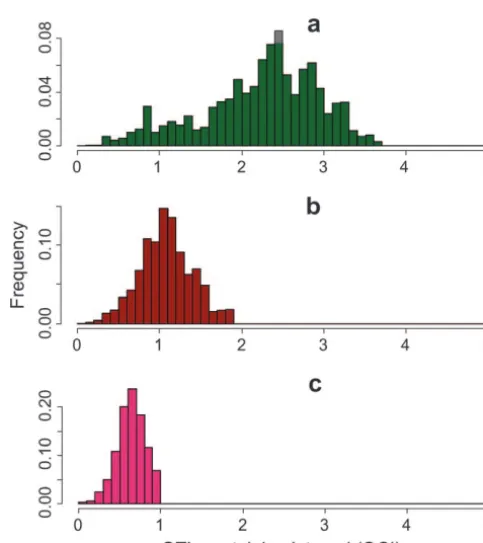
determine the mapping resolution achievable using full se- Figure2.—The distribution of QC I lengths. The QC I was quence information from four specific inbred strains. It is calculated for 22,814 SNPs that were simulated as the causative assumed that a QTL has been mapped using C 57BL/6J (B6) effect. Each SNP was assumed to have been initially mapped and A/J (the most popular strains for QTL mapping) into a to intervals of 5 Mb (a), 2 Mb (b), and 1 Mb (c). Following specific interval. It is further assumed that only one segregating yin-yang crosses using all four inbred strains, the simulation QTL exists in that region and that the effect is caused by a defined a final QC I for each SNP. Here, the distribution of
Figure3.—Examples of two 5-Mb re-gions at the extremes of the QC I length distribution. Thex-axis presents each re-gion divided into 50 intervals of 100 kb. The number of potential SNPs in each 100-kb interval is shown by a solid bar. The first region, at the high mapping resolution extreme (chromosome 16, 10–15 Mb), is presented in a–c for the analysis of two, three, and four strains, respectively. The second region, at the low mapping resolution extreme (chro-mosome 16, 56–61 Mb), is presented in d–f for the analysis of two, three, and four strains, respectively. The total num-ber of potential SNPs in the entire 5-Mb region and the corresponding total QC I length (see text for definition) are pre-sented on top of each figure.
say D2, is then analyzed through yin-yang crosses with A/J and A/J and B6 and between D2 and B6 within the analyzed inter-val. If, however, the allele state of D2 at the simulated SNP B6, its allelic state at the QTL will be determined depending on
whether the QTL segregated in the D2 ⫻A/J or D2⫻B6 was as in B6, the number of potential SNPs was reduced to SNPs divergent between A/J and B6 and also between D2 and cross. The sequence information of D2 will further refine the
QTL location (see Figure 1). Assuming that this process is A/J within the analyzed interval. To estimate the size of the QTL-containing interval (QC I) with 95% confidence, the followed, mapping resolution will be established according to
the sequence variation among the four strains. studied region was divided into adjacent intervals of 100 kb. Then, the minimum number of 100-kb intervals (not necessar-To evaluate this mapping resolution, each SNP polymorphic
between A/J and B6 is successively simulated as the QTL. We ily adjacent) containing 95% of the SNPs defines the 95% QC I (for simplicity we refer henceforth to the 95% QC I and consider cases in which the QTL were previously mapped into
intervals of 1, 2, or 5 Mb. All the SNPs in the determined to its total length as the QC I). The QC I can be composed of several nonadjacent intervals. However, its total length is region were considered to have an equal likelihood of being
the causative polymorphism. The causative SNP was assumed comparable to the length of a standard 95% confidence in-terval.
to be in the center of the interval (except at the chromosome
extremes where the size of the interval, but not the centrality SNP database:We used the public database of SNPs avail-able at the Mouse Phenome Database (MPD 146.2), which is of the causative SNP, was retained). The number of SNPs
diverging between A/J and B6 was set as the initial number based on NCBI mouse genome assembly build 30 for most SNPs (http://aretha.jax.org/pub-cgi/phenome/mpdcgi?rtn⫽ of SNPs for that interval. With the introduction of a new strain,
for example, D2, the allele state of D2 at the simulated SNP projects/details&id⫽146). This data set includes detailed SNP information for chromosome 16 as a result of the public mouse was determined. If the allele was as in A/J, the number of
be expected is an average reduction (of the QC I or the number of SNPs) of 50% with each new strain intro-duced. Thus, for example, the number of SNPs can be reduced by 75% with four strains if the two additional strains are selected from a large panel of strains with sequence information. Generally, the number of SNPs or the QC I can be reduced 2n-fold (nis the number of
strains used for yin-yang crosses) if a sufficient number of strains are available allowing the selection of an opti-mal strain in each stage. While in the initial stages, where the interval is relatively large, finding such strains will obviously be a relatively easy task, when the interval size is smaller, it will be more difficult, perhaps even impossible, to find such optimal new strains. As Table 1 demonstrates, the longer the initial interval, the more pronounced the average reduction becomes in both the number of SNPs and QC I. The same trend was observed for QTL initially mapped to intervals⬎5 Mb (data not shown). Unfortunately, there is limited value in directly applying this approach to QTL that were initially mapped to large intervals (i.e., 10–20 cM). Although the reduction in the QC I and the number of SNPs will
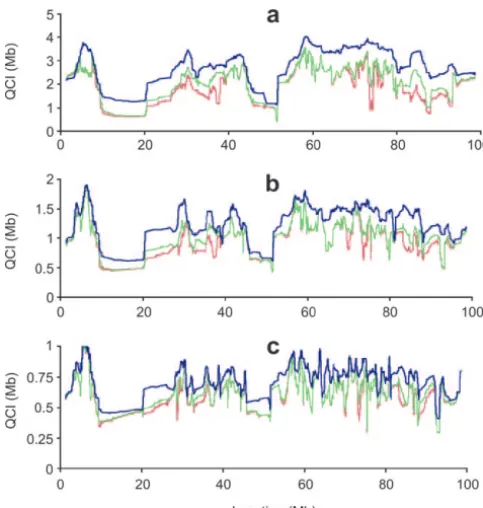
Figure 4.—Average mapping resolution, calculated as a be significant, it will not be sufficient to avoid reducing
moving average of the QC I lengths with a sliding window of the standard confidence interval using other methods 100 SNPs across chromosome 16. The average resolution is
making the yin-yang crosses, in this case, significantly presented for the analysis of the sequence information of
redundant. A/J⫻B6 alone (blue line) or when adding one (green line)
or two (red line) additional inbred strains. We present results Although the average reduction in number of SNPs for QTL initially mapped to intervals of 5 Mb (a), 2 Mb (b), or QC I is quite small, the distribution of the reduction and 1 Mb (c). has a significant variance. Figure 2 presents the
distribu-tion of QC I reducdistribu-tion following the analysis of all four inbred strains. In some regions the QC I is reduced to very short intervals (ⵑ100 kb), while other regions are and Celera’s sequencing project on the strains: DBA/2J (D2),
A/J, 129S1/SvImJ, and 129X1/SvJ (Wiltshire et al. 2003). virtually unaffected by the procedure. Figure 3 presents As is customary in these kinds of analyses, strains 129S1/SvImJ two particular regions, each at a different extreme of and 129X1/SvJ were considered as the same strain (denoted the distribution. In one region, the number of potential 129). This SNP database of chromosome 16 is currently the
SNPs was reduced to 5 SNPs, and in the other, to 1696 most comprehensive, publicly available database. We used a
SNPs, following the analysis of all four strains. Similarly, set of 22,814 SNPs with different alleles at the A/J and B6
strains and also available allele information for the D2 and the QC I was reduced in the high-resolution region from 129 strains. 5 to 0.4 Mb, and in the low-resolution region the reduc-tion was only from 5 to 3.6 Mb. Again, the availability of several inbred strains with sequence information may RESULTS AND DISCUSSION
allow selection of an inbred strain, which will locate us at the desirable extreme of the distribution.
To estimate the mapping resolution of the
sequence-based approach using inbred strains and yin-yang Assessment of the potential of this method to accu-rately locate a previously mapped QTL can be per-crosses, we considered the average number of SNPs that
remain potential candidate SNPs underlying the QTL formed beforehand by examining the sequence infor-mation in the relevant chromosomal region with the as a function of the number of strains analyzed (Table
1). The QC I length also is considered as a function of strains available. Here we present the mapping resolu-tion potential for chromosome 16, where the QTL was the number of strains analyzed. As demonstrated in
Table 1, the reduction in either the number of SNPs initially mapped in an A/J⫻B6 cross. D2 and 129 are subsequently used for additional fine mapping. Figure or the QC I is quite modest on average. The mean QC I
reduction using four strains is 31, 44, and 54% for QTL 4 presents the mapping resolution along chromosome 16 by calculating the average QC I length (a moving initially mapped to 1, 2, and 5 Mb intervals, respectively.
This is not surprising, since the use of only four strains average of 100 SNPs) for two, three, and four strains and for initial QTL-containing intervals of 5, 2, and indeed presents a rather limited amount of information,
regions with modest or poor resolution. It should be proaches should be regarded as “holy grails” enabling identification of the QTL underlying genes. This ap-noted that most of the mapping resolution is achieved
by the initial sequence information of A/J and B6. With proach still requires a significant amount of work and it is likely that the final mapping resolution will not these four strains and for this chromosome, the effect
of adding a fourth strain will virtually always fail to create locate the gene but provide a good starting point for additional technologies to locate and validate the actual a notable effect on mapping resolution.
Rather than providing a specific interval, the se- genes.
quence-based approach supplies a list of potential poly- This study was supported by the Israel Academy of Sciences and morphisms. Obviously the list of polymorphisms can be Humanities and by the Ministry of Science of Israel.
translated into intervals (the QC I), as we present here for illustration purposes. Notwithstanding, the provided
LITERATURE CITED information is the list of potential polymorphisms,
which may be the causative effect, given the inbred Belknap, J. K., S. R. Mitchell, L. A. O’Toole, M. L. Helmsand J. C. Crabbe, 1996 Type I and Type II error rates for quantitative strain allelic state. Additional reduction in the critical
trait loci (QTL) mapping studies using recombinant inbred region consequently can be achieved through
sophisti-mouse strains. Behav. Genet.26:149–160.
cated bioinformatics tools that evaluate the potential Chesler, E. J., S. L. Rodriguez-ZasandJ. S. Mogil, 2001 In silico mapping of mouse quantitative trait loci. Science294:2423. relevance of a particular SNP to the trait in question.
Darvasi, A., 1997 Interval-specific congenic strains (ISCS): an ex-This will result in a significant further reduction in the
perimental design for mapping a QTL into a 1-centimorgan inter-number of SNPs that need to be considered, as well as val. Mamm. Genome8:163–167.
Darvasi, A., 1998 Experimental strategies for the genetic dissection in prioritizing the selected SNPs for further functional
of complex traits in animal models. Nat. Genet.18:19–24.
examination. Darvasi, A., 2001 In silico mapping of mouse quantitative trait loci.
It is important to exercise caution when considering Science294:2423.
Darvasi, A., and M. Soller, 1995 Advanced intercross lines, an this approach. The basic assumption underlying the
experimental population for fine genetic mapping. Genetics141: ability to successfully apply the yin-yang approach is that 1199–1207.
a single biallelic SNP (or haplotype) affects the trait Glazier, A. M., J. H. NadeauandT. J. Aitman, 2002 Finding genes that underlie complex traits. Science298:2345–2349.
under study in the analyzed region. Furthermore, QTL
Grupe, A., S. Germer, J. Usuka, D. Aud, J. K. Belknapet al., 2001 that primarily exhibit epistatic effects will not be suitable In silico mapping of complex disease-related traits in mice. Sci-for this kind of analysis in a straightSci-forward manner. ence292:1915–1918.
Hitzemann, R., K. Demarest, J. Koyner, L. Cipp, N. Patelet al., Nevertheless, situations violating these assumptions,
2000 Effect of genetic cross on the detection of quantitative such as multiple QTL in a region or private
strain-spe-trait loci and a novel approach to mapping QTLs. Pharmacol. cific alleles affecting the trait, will result in inconclusive Biochem. Behav.67:767–772.
Hitzemann, R., B. Malmanger, C. Reed, M. Lawler, B. Hitzemann results of the yin-yang analysis but are unlikely to
pro-et al., 2003 A strategy for the integration of QTL, gene expres-duce false-negative results.
sion, and sequence analyses. Mamm. Genome14:733–747. In the current study we used the data of only four Korstanje, R., andB. Paigen, 2002 From QTL to gene: the harvest
begins. Nat. Genet.31:235–236. strains, reflecting the only extensive public database
Mackay, T. F. C., 2001 The genetic architecture of quantitative currently available. Drawing definitive conclusions re- traits. Annu. Rev. Genet.
35:303–339.
garding the potential of this approach with a large num- Park, Y. G., L. Lukes, H. Yang, M. T. Debies, R. S. Samantet al., 2002 Comparative sequence analysis in eight inbred strains of ber of strains will require further study and the
availabil-the metastasis modifier QTL candidate gene Brms1. Mamm. Ge-ity of sequence information on a large number of strains. nome13:289–292.
On the basis of the results presented here, it can be Talbot, C. J., A. Nicod, S. S. Cherny, D. W. Fulker, A. C. Collins et al., 1999 High-resolution mapping of quantitative trait loci speculated that additional strains may allow the kind of
in outbred mice. Nat. Genet.21:305–308.
mapping resolution over the entire genome, which was Taylor, B. A., 1989 Recombinant-inbred strains, pp. 773–796 in observed here only in limited regions. With sequence Genetic Variants and Strains of the Laboratory Mouse, edited by M. F.
Lyonand A. G.Searle. Oxford University Press, Oxford. information in hand it will be possible to computerize
Wiltshire, T., M. T. Pletcher, S. Batalov, S. W. Barnes, L. M. the strain selection process to achieve optimal mapping Tarantino et al., 2003 Genome-wide single-nucleotide poly-morphism analysis defines haplotype patterns in mouse. Proc. resolution with a minimum number of strains requiring
Natil. Acad. Sci. USA100:3380–3385. yin-yang crosses.