DOI: 10.1534/genetics.107.080101
Efficient Control of Population Structure in Model Organism
Association Mapping
Hyun Min Kang,* Noah A. Zaitlen,
†Claire M. Wade,
‡,§Andrew Kirby,
‡,§David Heckerman,**
Mark J. Daly
‡,§and Eleazar Eskin
††,1*Department of Computer Science and Engineering and†Bioinformatics Program, University of California, San Diego, California 92093, ‡Broad Institute of Harvard and MIT, Cambridge, Massachusetts 02141,§Center for Human Genetic Research, Massachusetts
General Hospital, Boston, Massachusetts 02114,**Microsoft Research, Redmond, Washington 98052 and††Department of Computer Science and Department of Human Genetics, University of California, Los Angeles, California 90095
Manuscript received August 7, 2007 Accepted for publication December 16, 2007
ABSTRACT
Genomewide association mapping in model organisms such as inbred mouse strains is a promising ap-proach for the identification of risk factors related to human diseases. However, genetic association studies in inbred model organisms are confronted by the problem of complex population structure among strains. This induces inflated false positive rates, which cannot be corrected using standard approaches applied in human association studies such as genomic control or structured association. Recent studies demonstrated that mixed models successfully correct for the genetic relatedness in association mapping in maize and Arabidopsis panel data sets. However, the currently available mixed-model methods suffer from compu-tational inefficiency. In this article, we propose a new method, efficient mixed-model association (EMMA), which corrects for population structure and genetic relatedness in model organism association mapping. Our method takes advantage of the specific nature of the optimization problem in applying mixed models for association mapping, which allows us to substantially increase the computational speed and reliability of the results. We applied EMMA toin silicowhole-genome association mapping of inbred mouse strains involving hundreds of thousands of SNPs, in addition to Arabidopsis and maize data sets. We also performed extensive simulation studies to estimate the statistical power of EMMA under various SNP effects, varying degrees of population structure, and differing numbers of multiple measurements per strain. Despite the limited power of inbred mouse association mapping due to the limited number of available inbred strains, we are able to identify significantly associated SNPs, which fall into known QTL or genes identified through previous studies while avoiding an inflation of false positives. An R package implementation and webserver of our EMMA method are publicly available.
W
ITH the recent development of high-throughputgenotyping technologies, genetic variation in many model organisms such as mice, Arabidopsis, and maize is being discovered on a genomewide scale ( Janderet al.2002; Pletcheret al.2004; Flint-Garcia et al.2005; Frazeret al.2007). Genomewide association mapping in model organisms has great potential to iden-tify risk factors for complex traits related to human dis-eases. Despite the disadvantage that direct inferences from model organisms are not always applicable to hu-man traits, model organism association mapping is poten-tially more powerful than human association mapping because it is possible to reduce the effect of environ-mental factors by replicating phenotype measurements in genetically identical organisms (Belknap 1998). In addition, it is often easier and more cost effective to verify associated signals in model organisms than in
human subjects. Moreover, many ongoing genotyping and phenotyping projects in model organisms such as the Mouse Phenome Database (MPD) (http://www.jax. org/phenome), the Mouse HapMap project (http://www. broad.mit.edu/personal/claire/MouseHapMap), and the Perlegen/NIEHS resequencing project (http://mouse. perlegen.com) (Frazer et al. 2007) provide publicly available resources to performin silicomapping of com-plex traits in model organisms (Peteret al.2007).
However, genetic association studies in inbred model organisms are confronted by the problem of inflated false positive rates due to population structure and genetic relatedness among inbred strains caused by the complex genealogical history of most model organism strains. Conventional statistical tests of independence between a genetic marker and a phenotype are prone to spurious associations because the marker and the phe-notype are likely to be correlated due to population structure that violates the independence assumption un-der the null hypothesis. Recent association- or linkage-mapping studies in model organisms attempt to avoid 1Corresponding author:Department of Computer Science and
inflated false positive rates by designing the studies using recombinant inbred lines generated from a small number of parental strains (Bystrykhet al.2005; Zou et al.2005). However, these studies are limited by the variation present in the parental strains and have long regions between recombinations due to relatively few generations between the recombinant inbred strains and the parental strains. Traditional QTL mapping us-ing F2or backcross suffers from the same problem in
fine-resolution mapping in addition to expensive geno-typing cost (Belknap1998; Flintet al.2005).
An alternative approach to reduce the inflation of false positives is to apply a statistical test that corrects for the bias due to population structure or genetic relat-edness. The most widely used methods to reduce such bias in human association mapping are genomic control (Devlin and Roeder 1999), structured association (Pritchard et al. 2000), and principal component analysis (Patterson et al. 2006; Price et al. 2006). However, these methods are inadequate in the case of model organism association mapping. Genomic control suffers from weak power when the effect of population structure is large as in model organisms (Price et al. 2006; Yuet al.2006). Structured association or principal component analysis, which assumes a small number of ancestral populations and admixture, only partially cap-tures the multiple levels of population structure and
genetic relatedness in model organisms (Aranzana
et al.2005; Yuet al.2006; Zhaoet al.2007). Recently, it has been suggested that linear mixed models can effec-tively correct for population structure in the association mapping of quantitative traits (Yuet al. 2006). Linear mixed models incorporate pairwise genetic relatedness between every pair of individuals in the statistical model directly, reflecting that the phenotypes of two geneti-cally similar individuals are more likely to be correlated than genetically dissimilar individuals. Applications of mixed models to association mapping in maize, Arabi-dopsis, and potato panels demonstrate that mixed models obtain fewer false positives and higher power than previous methods including genomic control, structured association, and principal component anal-ysis (Yuet al. 2006; Malosettiet al. 2007; Zhao et al. 2007).
Although mixed models can effectively capture sta-tistical confounding due to population structure, the currently available implementations have several limi-tations in the context of model organism association mapping. First, the variance components numerically estimated by various hill-climbing approaches such
as the Nelder–Mead simplex algorithm (Nelder and
Mead1965; Graseret al.1987; Meyer 1989), the EM algorithm (Smith1990), and the Newton–Raphson
algo-rithm (Lindstrom and Bates 1988; Gilmour et al.
1995; Johnson and Thompson 1995) provide only a
locally optimal solution, which may cause the statistical inferences based on these estimates to be inaccurate.
Second, the computational cost of the numerical opti-mization procedure is substantial, requiring a large number of computationally expensive matrix opera-tions at each iteration. Computational consideraopera-tions are important when large data sets are to be tested. For example, the association mapping with maize panels consisting of hundreds of SNPs over hundreds of strains takes hours for a single run with currently available implementations such as TASSEL (Yuet al.2006) or SAS (SasInstitute2004). A microarray data set tested for genomewide association mapping between thousands of transcripts and tens of thousands of markers would take several years of CPU time. Third, when inferring the genetic variance component referred to as the kin-ship matrix, the importance of a mathematically correct form of kinship matrix estimation is often overlooked. For example, Yuet al.(2006) proposed to infer a kinship matrix using SPAGeDi software, setting negative kinship coefficients to zero. Such a kinship matrix may not be positive semidefinite and thus not be a valid form of variance component. Using a nonpositive semidefinite kinship matrix generates ill-defined likelihood for a subset of parameter space in the estimation of the vari-ance component.
In this article, we propose a new method, efficient mixed-model association (EMMA), which corrects for population structure and genetic relatedness in model organism association mapping. Our method takes ad-vantage of the specific nature of the optimization prob-lem in applying mixed models for association mapping, which allows us to substantially increase computational speed by orders of magnitude and improve the reli-ability of results by achieving near global optimization. Our method improves the efficiency of the mixed-model method by enabling us to perform statistical tests with single-dimensional optimization. Our method’s efficiency is further increased by avoiding redundant computationally expensive matrix operation at each iteration in the computation of likelihood function by leveraging spectral decomposition, reducing the com-putational cost of each iteration from cubic to linear complexity. Due to a substantially decreased computa-tional cost of each iteration, it is possible to converge the global optimum of the likelihood in variance-component estimation with high confidence by com-bining grid search and the Newton–Raphson algorithm even though the likelihood function may not be convex. Our method is related to a similar technique developed in a different context of simulating the null distribution of variance-component test statistics (Crainiceanuand Ruppert2004).
false positive rate as effectively as or more effectively than the kinship matrices generated by previous methods (Yu et al. 2006). We propose an additional method called
phylogenetic controlbased on the assumption that a phylo-genetic tree is a good approximation of the genealogical history of an inbred model organism. In such cases, the phylogenetic tree may be used as a confounding factor, correcting for the complex genetic relations between strains. We show that phylogenetic control can be formu-lated as a linear mixed model and present an algorithm for inferring the phylogenetic kinship matrix. We show that the phylogenetic kinship matrix is always positive semidefinite and its optimal variance components are unique regardless of the choice of root.
One of the important questions in the design of model organism association-mapping studies is estimat-ing the statistical power for any specific set of inbred strains. We performed a simulation study of the power of our EMMA method to identify causal SNPs both on a genomewide scale and within a smaller region such as a QTL interval. Our results show that with a limited number of genetically diverse strains, such as the currently available panel of inbred mice, it is possible to identify causal loci with a genomewide significance only if the locus explains a large portion of phenotypic variance. However, with more strains, the power of these association studies increases dramatically. Our analysis of statistical power in model organism association map-ping demonstrates the dramatic increase in power using multiple measurements of phenotypes from multiple animals for each strain. Study designs that do not rep-licate phenotype measurements and analysis methods that do not take individual measurements into account suffer a significant decrease in statistical power.
We applied our EMMA method to association map-pings of various inbred model organisms. First, we verified that EMMA gives almost identical results to other widely used implementations using the maize panel data sets (Yuet al. 2006). In terms of computa-tional time, EMMA is shown to be orders of magnitude faster than the previous methods while performing near global optimization. Second, we performed a genome-wide association mapping of Arabidopsis flowering-time phenotypes. Our results are consistent with the recently published results (Zhaoet al.2007), reducing most of the inflated false positives. Finally, we used our EMMA method to perform a whole-genome association-mapping study of inbred mouse strains. We analyzed nearly 140,000 mouse HapMap SNPs over 48 strains and three quantitative phenotypes, liver weight, body weight, and saccharin preference, with QTL identified by previous studies. We identified significant associations for the three phenotypes while our results show a significant reduction in the inflation of false positives. Interest-ingly, many of the significantly associated SNPs fall into the known QTL, suggesting the results are likely to be true associations.
An R package implementation of EMMA and the web-server containing the mouse association results are pub-licly available online at http://mouse.cs.ucla.edu/emma.
MATERIALS AND METHODS
Genotypes and phenotypes: Genotypes, phenotypes, SPAGeDi-based kinship matrix, and the STRUCTURE outputs from 277 maize strains across 553 SNPs as described in Yuet al.
(2006) were downloaded from the Buckler lab web site (http:// www.maizegenetics.net). The Arabidopsis genotypes and phe-notypes and the output from STRUCTURE were obtained from the published data sets (Aranzanaet al.2005; Nordborget al.
2005). The 13,416 nonsingleton Arabidopsis SNPs with no more than 10% of genotype calls missing were tested for asso-ciation after imputing the missing alleles using HAP (Halperin
and Eskin2004). The flowering-time phenotypes over 95 strains
were log transformed to fit to a normal distribution.
For inbred mouse association mapping, the Broad mouse HapMap SNP sets were obtained from the mouse HapMap web site. The 106,040 SNPs that have no more than 10% of genotype calls missing were tested after imputing the missing alleles. The initial body weight (MPD10305) and liver weight phenotypes (MPD2907) were downloaded from Jackson Labo-ratory MPD ( JacksonLaboratory2004). They consist of 374
and 308 phenotype measurements over 38 and 34 strains, re-spectively. The saccharin preference phenotypes consist of 280 phenotype measurements in 24 strains (Reedet al.2004).
EMMA:Suppose thatnmeasurements of a phenotype are collected across t inbred strains. A linear mixed model in model organism association mapping is typically expressed as
y¼Xb1Zu1e; ð1Þ
whereyis ann31 vector of observed phenotypes, andXis an n3qmatrix of fixed effects including mean, SNPs, and other confounding variables. b is a q 3 1 vector representing coefficients of the fixed effects.Zis ann3tincidence matrix mapping each observed phenotype to one oftinbred strains.u is the random effect of the mixed model with Var(u)¼s2
gK; whereKis thet3tkinship matrix inferred from genotypes as described in the following section, andeis ann3nmatrix of residual effect such that Var(e)¼s2
eI:The overall pheno-typic variance–covariance matrix can be represented asV ¼
s2
gZKZ9 1s 2 eI:
Instead of solving mixed-model equations by obtaining the best linear unbiased prediction (BLUP) of random effects u via Henderson’s iterative procedure (Henderson 1984;
Arbelbideet al.2006), we directly estimate the variance
com-ponentssgandse, maximizing the full likelihood or restricted likelihood that is defined as full likelihood with the fixed effects integrated out (Dempsteret al.1981). The restricted
likelihood avoids a downward bias of maximum-likelihood estimates of variance components by taking into account the loss in degrees of freedom associated with fixed effects. Under the null hypothesis, the full likelihood and restricted log-likelihood function can be formulated as
lFðy;b;s;dÞ ¼
1 2
nlogð2ps2Þ logjHj
1
s2ðyXbÞ9H
1ðyXbÞ
ð2Þ
lRðy;s;dÞ ¼lFðy;b;ˆ s2;dÞ
11
2qlogð2ps
2Þ1logjX9Xj logjX9H1Xj
(Welhamand Thompson1997), wheres¼s
gandH¼s1V¼ ZKZ9 1dIis a function ofd, defined asd¼s2
e=s2g:
The full-likelihood function is maximized when b is ˆ
b¼ ðX9H1XÞ1
X9H1y;and the optimal variance compo-nent is ˆs2
F¼R=nfor full likelihood and ˆs 2
R¼R=ðnqÞfor restricted likelihood, whereR¼ ðyXbˆÞ9H1ðyXbˆÞ is a function ofdas well.
Using spectral decomposition, it is possible to findjiandls such that
H¼ZKZ9 1dI¼UFdiagðj11d; ;jn1dÞU9F ð4Þ
SHS¼SðZKZ9 1dIÞS
¼ ½URWRdiagðl11d; ;lnq1d;0; ;0Þ½URWR9
¼URdiagðl11d; ;lnq1dÞUR9;
ð5Þ
whereS¼IX(X9X)1X9,U
Fisn3n, andURis ann3(nq) eigenvector matrix corresponding to the nonzero eigenvalues. WR is an n3 q eigenvector matrix corresponding to zero eigenvalues. As shown in theappendix, our decomposition
satisfies the properties of the decomposition suggested by previous studies (Pattersonand Thompson1971). It should
be noted thatUF andURare independent of d. Let U9Ry¼
½h1, h2, , hnq9; then finding maximum-likelihood (ML) or restricted maximum-likelihood (REML) estimates is equiv-alent to optimizing the following functions with respect tod:
fFðdÞ ¼lFðy;b;ˆ s;ˆ dÞ
¼1
2 nlog n
2pnnlog
X
nq
s¼1
h2s ls1d
!
X
n
i¼1
logðji1dÞ
" #
ð6Þ
fRðdÞ ¼lRðy;s;ˆ dÞ
¼1
2 ðnqÞlog nq
2p ðnqÞðnqÞlog
Xnq
s¼1
h2s ls1d
! "
X
nq
s¼1
logðls1dÞ
#
ð7Þ
(see theappendixfor the mathematical details). The
deriva-tives of these functions follow that
f9FðdÞ ¼
n 2
P
sh2s=ðls1dÞ2
P
sh2s=ðls1dÞ
1
2 X
i
1
ji1d ð8Þ
fR9ðdÞ ¼
nq
2
P
sh
2
s=ðls1dÞ2
P
sh2s=ðls1dÞ
1
2 X
s
1
ls1d : ð9Þ
It should be noted that the likelihood functions are continu-ous for all d . 0 if and only if all the eigenvalues ls are nonnegative. Otherwise, such as in the case of the nonpositive semidefinite kinship matrix, the likelihood would be ill de-fined for a certain range ofd.
The suggested procedure in computing likelihood and its derivatives involves only a linear time vector operation at each iteration once the spectral decomposition is computed. The time complexity of the method isO(n31rn), whereris the
number of iterations required. The time complexity of standard EM or Newton–Raphson algorithms isO(rn3), and
the actual ratio of the running time is much bigger thanr because the existing methods typically require a large number of matrix multiplications and inverses at each iteration while EMMA computes spectral decomposition only once. Since the computational cost of each iteration has decreased dramati-cally, instead of obtaining a locally optimal solution during the
numerical optimization, it is now computationally feasible to perform a grid search combining with the Newton–Raphson algorithm in the single-dimensional parameter space consist-ing ofd, which is the ratio of the environmental random effect to the genetic background effect, to optimize the likelihood globally with high confidence.
Furthermore, when a large number of multiple measure-ments are phenotyped per strain,i.e.,n?t, the execution time can be further reduced using the fact that the nonnegative eigenvalues ofZKZ9andSZKZ9Sare the same as those ofKZ9Z and KZ9SZ, respectively. Combining this fact with a simple modification of the Gram–Schmidt process greatly reduces the execution time of eigenvalue decomposition, reducing the time complexity intoO(n2t1rn). When multiple phenotypes
are tested such as in expression quantitative trait loci (eQTL) mapping, the spectral decomposition can be reused, and only a square-time matrix–vector multiplication is required for each phenotype. Thus, the time complexity withmdifferent phenotypes is O(n2t 1 n2m 1 rmn), which is much more
efficient thanO(rn3m) achieved by previous approaches.
In the application of our EMMA method to the various data sets presented in this article, thed’s ranged from 105(almost
pure population structure effect) to 105 (almost pure
envi-ronmental or residual effect) and are divided evenly into 100 regions in logarithm scale to compute the derivatives of likelihood functions. The global ML or REML is searched for by applying the Newton–Raphson algorithm to all the intervals where the signs of derivatives change and taking the optimaldamong all of the stationary points and endpoints. Since the derivatives of both the full- and the restricted-likelihood function are continuous with nonnegative eigen-values, such an optimization technique has guaranteed convergence properties as long as the kinship matrix is posi-tive semidefinite. In the following two sections, we describe different methods to infer a kinship matrixK, based on either a genetic similarity matrix or a phylogenetic tree.
Similarity-based kinship matrix:A number of methods for inferring a kinship matrix from a large number of molecular markers have been suggested, including a simple identical-by-state (IBS) allele-sharing matrix, an allele-frequency weighted IBS matrix (Lynchand Ritland1999), a maximum-likelihood
kinship matrix (Thomasand Hill2000), and a Monte Carlo
simulation-based matrix (Wang2002). Comparisons of
dif-ferent kinship matrices for explaining genetic difdif-ferentiation among populations show similar results with small quantitative differences (Nievergeltet al.2007). Recent studies on the
association mapping ofArabidopsis thalianain a structured pop-ulation show that a simple IBS allele-sharing matrix effectively corrects for confounding from population structure, even better than more sophisticated methods (Zhaoet al.2007).
Although recently suggested estimators of pairwise related-ness have some desirable statistical properties over a simple IBS allele-sharing matrix (Casteeleet al.2001), they are not
guaranteed to be positive semidefinite.
Here we show that a simple IBS allele-sharing matrix based on the assumption of each SNP or haplotype inducing the same level of small random changes on the phenotype guar-antees positive semidefiniteness and convergence if missing alleles are handled appropriately.
Letli,j,h2{0, 1} be a binary variable that has a value of 1 only when the genotype (or haplotype) allele atjth locus in theith strain is h21; j Hjj, where j Hjj is the total number of alleles at thejth locus. Letxh,jbe random variables indepen-dently sampled fromN(0,s2); then the genetic background
ui¼
X
j
XHj
h¼1
li;j;hwjxh;j; ð10Þ
where wj is the weight of each SNP’s contribution to the genetic background effect. If each SNP is assumed to have the same level of random effect, wj ¼ 1 can be assumed. Alternatively, wj can be a function of allele frequency or a function depending on the genomic region of the SNP. Let
j H j ¼maxðj HjjÞ;and letLhbe the matrix whose element at (i,j) isli,j,h; then the overall genetic background effectuis expressed in the form
u¼X
jHj
h¼1
LhWxh; ð11Þ
whereWis a diagonal square matrix withwiat theith diagonal element. Assuming that eachxh,jfollows a normal distribution with zero mean and variance of s2 independently, the
variance–covariance matrix of u becomes VarðuÞ ¼s2P h LhW2L9
h: Since its (i0, i1)th element P
h P
jw 2
jli0;j;hli1;j;h rep-resents the number of shared IBS alleles between thei0th and i1th strains directly ifwj¼1, Var(u) is equivalent to a weighted IBS allele sharing a kinship matrix with the scaling factors2. It
is obvious from Equation 11 that the kinship matrix is positive semidefinite. When missing genotypes exist, we estimateli,j,hto be the square root of the probability of the SNP or haplotype allele at thejth locus having the alleleh. This is so the random effect for each allele is assigned probabilistically. We generated genotype similarity of maize, Arabidopsis, and mouse data sets using uniform weight. When a haplotype similarity matrix is used, the haplotype window size resulting in the largest ML estimates is selected as the optimal window size. In the Arabi-dopsis and mouse association-mapping results of this article, the optimal haplotype window size is set to five in both cases. Phylogenetic control:Evolutionary biologists have modeled interspecific phenotype distribution using various phylogenetic comparative methods (PCMs) (Martins and Hansen1997).
The correlation structure between phenotypes can be effec-tively captured with phylogenetic trees, and PCMs have been applied to evolutionary analysis of quantitative traits such as gene expression (Gu2004; Oakleyet al.2005) or, very recently,
to the association mapping of dichotomous phenotypes (Bhattacharyaet al.2007; Carlsonet al.2007). Felsentein’s
independent contrast (FIC) method (Felsenstein 1985)
models the correlation between phenotypes under the assump-tion of Brownian moassump-tion of phenotypic change along the phylogeny. Since random phenotypic changes occur within a species as well, in cases where the phylogenetic tree is a good approximation of genealogical history, it is reasonable to apply PCMs such as the FIC method in modeling the phenotypic variation in model organisms.
We followed Felsenstein’s assumption of Brownian pheno-typic changes along the phylogeny. Although multiple fluc-tuating selection may lead to a Brownian motion model (Felsenstein1981), here we assume a neutral model where
phenotypic changes are explained by accumulated random pleiotropic effects by the genetic background to mathemati-cally model Brownian phenotypic changes. LetTbe a phy-logenetic tree with tleafs and medges, and let z 2Rmbe
random variables independently sampled fromNð0;s2 gÞ:At each branchiwhose length isbi, we represent the amount of random phenotypic changes along the branch aspffiffiffiffibizi:LetCi denote the set of branches connecting to a leaf nodeifrom the root. Then the accumulated phenotypic changes are equiva-lent toPe2Ci
ffiffiffiffi be
p
ze:IfXbis the ancestral mean at an arbitrarily chosen root node, then the phenotype values at the leaf nodes are expressed in the form
y¼Xb1ZEz1e; ð12Þ
whereEis at3mmatrix whose (i,j)th element ispffiffiffiffibjif branch jexists in the path from the root to the leaf nodeiand zero otherwise. The kinship matrix of random effectu¼EzisK¼
EE9and is proportional to its covariance. If the root of the phylogenetic tree changes,Eis changed intoE11tcT, with1ta vector of ones and another vectorc. However, the restricted likelihood does not change becauseSZ1t¼0 always holds.
In our results, we adjusted the genetic distance matrix using the F84 model (Kishinoand Hasegawa 1989; Felsenstein
and Churchill1996) from the genomewide genotypes and
inferred the phylogenetic tree with the Fitch–Margoliash and least-squares distance method (Fitchand Margoliash1967).
Statistical tests and multiple hypothesis testing:Once the ML or REML variance componentVˆ¼sˆ2
gK1sˆ 2
eIis estimated, a generalF-statistic testing the null hypothesisMb¼0 for an arbitrary full-rank p 3 q matrix M can be constructed as suggested in Kennedyet al.(1992) and Yuet al.(2006),
F ¼ðMbˆÞ9ðMðX9Vˆ
1XÞ1M9Þ1ðMbˆÞ
p ; ð13Þ
withpnumerator degrees of freedom andnqdenominator degrees of freedom. The Satterthwaite degrees of freedom may also be computed, avoiding computationally intensive matrix operations.
The likelihood-ratio test can also be performed on the basis of the estimated ML variance components under different fixed effects. The statistic asymptotically follows ax2
p distribu-tion unless the estimated variadistribu-tion component meets the boundary of parameter space.
When a large number of correlated SNPs are tested, Bonferroni correction may lead to too conservative type I error control. Alternatively, permutation tests or other multi-ple hypothesis-testing procedures can be used (Piepho2001;
Storeyand Tibshirani2003). If permutations of
simulation-based approaches are applied, the computational cost is much larger but can be reduced by reusing the spectral decompo-sition in the same way described in the context of multiple phenotypes. For each permutedy, onlyU9Ry¼ ½h1,h2, ,hnq has to be computed again to compute the full or the restricted likelihood in linear time at each iteration. Thus, the compu-tational cost for a cubic-time spectral decomposition at each permutation can be substituted by a square-time matrix–vector multiplication, reducing the overall time complexity from O(n2t1rn) toO(n21rn).
The variance-component estimation is performed on the basis of REML for theF-test, and ML estimations are used for the likelihood-ratio test and the computation of the Bayesian information criterion (BIC). TheP-values are computed from the asymptotic null distribution.
Simulation studies: We performed two simulation studies for analyzing the statistical power of EMMA. The first sim-ulation is similar to those from other mixed-model studies (Yu
et al. 2006; Zhao et al. 2007). A fixed effect based on a
randomly chosen causal SNP from the genome with minor allele frequency .10% is added to the existing phenotypes, and the statistical power is computed at the causal SNP. At each fixed effect, the simulation study was performed 1000 times to estimate the average power. The variance explained by a SNP is computed assuming that average minor allele frequency of the causal SNP is 0.3.
Next, we generated simulated phenotypes sampled from a multivariate normal distribution. A random noise vector is added according to the contribution of genetic background to phenotypes,h2
g:Ifh 2
background excluding the SNP effect, then the covariance of the simulated data is simulated as Var(y)¼((n1Þh2
g=tr
ðS0ZKZ9S0ÞÞK1ð1h2gÞI; where S0 ¼ I 119/n, where 1 denotes a vector of ones. Similar to the first simulation study, a fixed effect based on a randomly chosen causal SNP is added to the simulated phenotypes and the average power is computed from 1000 independent simulations.
RESULTS
Comparison with previous methods over maize and
Arabidopsis strains:We applied our EMMA method to
the same maize panel data consisting of 553 SNPs and three phenotypes across 277 diverse inbred lines (Flint-Garcia et al. 2005) analyzed with the current mixed-model implementations (Yuet al.2006). We used the genotype similarity matrix defined in materials and methods as an additional variance component. Both the SAS and the TASSEL implementations of a unified mixed model (Yuet al.2006) take nearly 2 hr for a single run over the flowering-time phenotype data set with Intel 2.8-GHz Dual Core CPU, and ASREML, which is known to be more efficient than SAS, takes 20 min (1201 sec) of running time. The execution time of our mixed-model implementation is substantially faster, taking only 2.6 min (157 sec). The comparison of the
P-values obtained from the ASREML package and
EMMA for flowering-time phenotypes shown in Figure 1a shows perfect concordance between the methods, suggesting that both methods provide the same accu-racy. It should be noted that EMMA is much more efficient in spite of using orders of magnitude more of iterations to find the near global REML estimate using a grid search over the entire parameter space. EMMA also shows high stability of the numerical optimization procedure. In our results, TASSEL and ASREML im-plementations failed to provide P-values in 4 and 1 SNPs, respectively, of 553 SNPs, possibly due to the instability of the numerical optimization procedure, while EMMA succeeds for all the SNPs over all the data sets covered in this article.
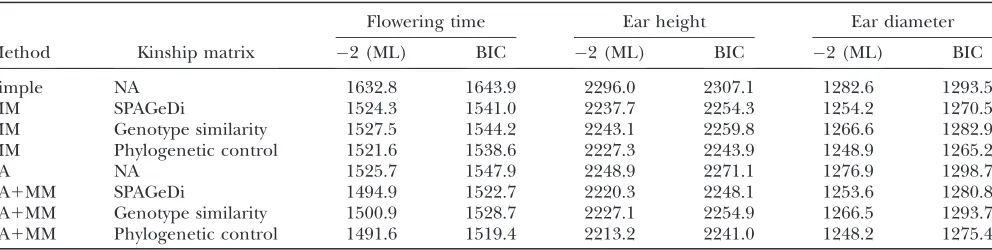
Since the kinship matrix based on SPAGeDi software as suggested by the unified mixed model is not guaran-teed to be positive semidefinite, we explore other ways to estimate the variance components due to genetic background. We use a genotype similarity matrix and a phylogenetic control matrix that guarantee positive semi-definiteness. Haplotype similarity matrices are not appli-cable to this data set due to sparse genotype density. We compared the goodness-of-fit of these kinship matrices in addition to the SPAGeDi-based kinship matrix over three maize phenotypes using the BIC, which provides a measure of how well each model fits the data. Adjusting for the sample size and the number of free parameters, Table 1 shows that the goodness-of-fits of the three kin-ship matrices based on maximum-likelihood estimates are comparable, while all of them were significantly bet-ter than not using a mixed model.
The cumulativeP-value distribution seen in Figure 1b shows that the three kinship matrices correct for the inflated false positives significantly better than the simple linear model. As illustrated by previous studies, the cumulative distribution of P-values is expected to follow that of a uniform distribution with no inflated false positives because only a tiny fraction of all SNPs are expected to be true positives (Aranzanaet al.2005; Yu et al. 2006; Zhao et al. 2007). The genotype similarity matrix performs slightly better than the other two kinship matrices, especially for small P-values. Since
Figure 1.—(a) Direct comparison of P-values between
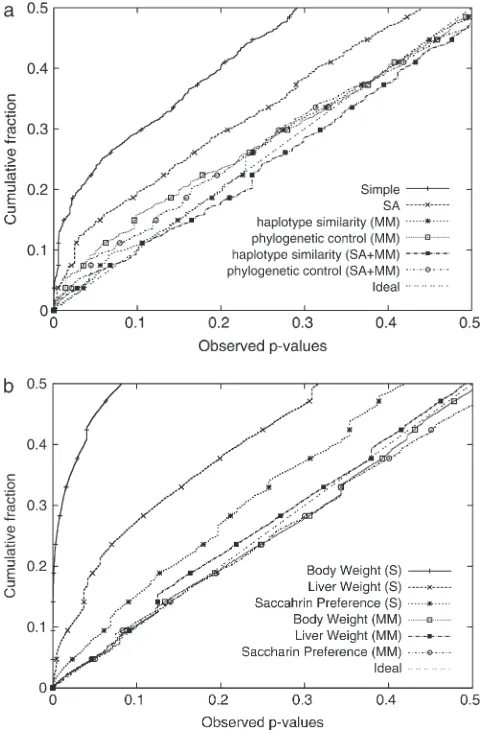
the simpler kinship matrices show comparable or better goodness-of-fit and false positive reduction results while guaranteeing positive semidefiniteness, we apply only these simple kinship matrices in the following sections. We also applied our EMMA method to perform genomewide association mapping of the flowering-time phenotype in which statistically significant associations are reported in previous studies. The cumulative distri-bution of P-values across 13,416 nonsingleton SNPs across 95 strains obtained from EMMA is shown in Figure 2a. The cumulative distribution ofP-values with a haplotype similarity matrix nearly follows the expected distribution, implying that mixed models significantly outperform structured association in eliminating the inflation of false positives for this data set. Phylogenetic control reduces a large portion of inflated false pos-itives, but residual inflation is still observed. Structured association and simple linear regression showed much larger inflation of false positives, consistent with the previous studies. After correction for genetic related-ness, the previously known FRI gene is still found to be significant at a nominal P-value of P ¼ 105 across
different kinship matrices. Our independent analyses are consistent with the more extensive results of Arabi-dopsis association mapping recently published (Zhao et al.2007).
High-resolution genomewide association mapping in
inbred mouse strains:We performed a high-resolution
genomewide association-mapping study using our mixed-model method over inbred mouse strains. We used the Broad mouse HapMap SNPs, containing nearly 140,000 SNPs expected to cover most of genetic variation among 48 inbred strains. For phenotypes, we used initial body weight and liver weight phenotypes downloaded from the Jackson Laboratory mouse phenome database ( JacksonLaboratory 2004). In addition, we used a saccharin preference phenotype where statistically sig-nificant associations were identified in a previous study
(Reedet al.2004). Among 48 genotyped strains, 38, 34, and 24 strains had phenotype values available for body weight, liver weight, and saccharin preference, respec-tively. Each phenotype has on average 10 multiple mea-surements across different individual mice per strain.
The cumulative distributions of observedP-values in Figure 2 show that, without correcting for population structure, the rate of false positives is very high. In particular, the body weight phenotype has a substantial inflation of false positives. When our mixed model is used, the inflation of the statistics is significantly re-duced in all three phenotypes.
Figure 3 shows genomewide association signals for the three phenotypes. Comparing Figure 3a and 3b, it is obvious that, without correcting for population struc-ture, many false positives are observed at a genomewide level of significance due to inflated P-values. Without correcting for population structure, we were able to identify nearly 6000 SNPs at a nominalP-value of 106
and 283 SNPs withP-values,1010. However, none are
significant after applying the mixed model. This strongly supports that most of the significant associations with-out correcting for population structure are indeed false positives. Interestingly, although the strongest signals for the body weight after applying the mixed model are not genomewide significant, they are concentrated in the region around 114 Mb in chromosome 8. This region almost exactly falls into the LOD peak of a
pre-viously known body weight QTL Bwq3 (Annuciado
et al.2001). TheP-value of the most significant locus is 3.83106with theF-test, explaining 49% of the overall
phenotypic variance and 39% of the phenotypic varia-tion due to the genetic variance component. Although it is slightly below the genomewide significance thresh-old with a conservative Bonferroni correction, if utiliz-ing the results from previous QTL studies, the locus can be declared as significant over the region of known body weight QTL.
TABLE 1
Goodness-of-fit of different models and kinship matrices in explaining phenotypic variation of maize quantitative traits
Flowering time Ear height Ear diameter
Method Kinship matrix 2 (ML) BIC 2 (ML) BIC 2 (ML) BIC
Simple NA 1632.8 1643.9 2296.0 2307.1 1282.6 1293.5
MM SPAGeDi 1524.3 1541.0 2237.7 2254.3 1254.2 1270.5
MM Genotype similarity 1527.5 1544.2 2243.1 2259.8 1266.6 1282.9
MM Phylogenetic control 1521.6 1538.6 2227.3 2243.9 1248.9 1265.2
SA NA 1525.7 1547.9 2248.9 2271.1 1276.9 1298.7
SA1MM SPAGeDi 1494.9 1522.7 2220.3 2248.1 1253.6 1280.8
SA1MM Genotype similarity 1500.9 1528.7 2227.1 2254.9 1266.5 1293.7
SA1MM Phylogenetic control 1491.6 1519.4 2213.2 2241.0 1248.2 1275.4
For the liver weight phenotype, we identified a ge-nomewide significant association around the region of 34.5 Mb in chromosome 2. This falls into a previously known liver weight QTLLvrq1(Rochaet al.2004). The region also contains many potentially relevant QTL such as organ weight (Orgwq2) (Leamy et al. 2002), spleen weight (Sp1q1) (Rochaet al.2004), heart weight (Hrtq1) (Rochaet al.2004), and lean body mass (Lbm1) (Masindeet al.2002). The pointwiseP-value of the most significant SNP was 1.23109, which explains 59% of
the genetic variance component. When comparing the genomewide P-values between the simple t-test and mixed models in Figure 3, c and d, we observe that the inflation ofP-values is reduced, but the signals are even more significant around the significant SNP at
chromo-some 2. This demonstrates that mixed-model associa-tion mapping can not only reduce the inflated false positives, but also reveal significant associations that have remained unidentified using conventional statisti-cal methods in the case when the associated SNP is not highly correlated with population structure.
For the saccharin preference phenotype, we were able to identify a SNP 30 kb away from theTas1r3gene that is perfectly correlated with the SNP previously reported to have significant association with the phenotype (Reed et al. 2004). It explains 51% of the genetic variance component, with a P-value of 1.0 3 105. The SNP is
neither genomewide significant nor the most signifi-cant. We believe this is due to the limited power of the study with a small number of strains.
Power of inbred model organism association
map-ping: We evaluated the statistical power of association
mapping of inbred model organisms in two different ways. First, we simulated an additive effect of a causal SNP over the existing phenotypes for mouse, Arabidop-sis, and maize strains, similar to previous studies. Such simulation studies evaluate the SNP effect on the power maintaining the existing correlation structure of phe-notypes. However, they do not change the effect of the genetic background or the number of multiple meas-urements, and no random variable other than the SNP is involved in the power simulation. As an alternative model-driven method for simulation studies, we gener-ated simulgener-ated phenotypes randomly sampled from a multivariate normal distribution with various effects of population structure on the phenotypic variation. A SNP effect is simulated on the randomly generated samples, and the statistical power is evaluated. In this way, we can simulate not only the SNP effect but also different genetic backgrounds and different numbers of replicated measurements. We believe that our simula-tion analysis provide a more extensive understanding of the statistical power of association mapping with model organisms.
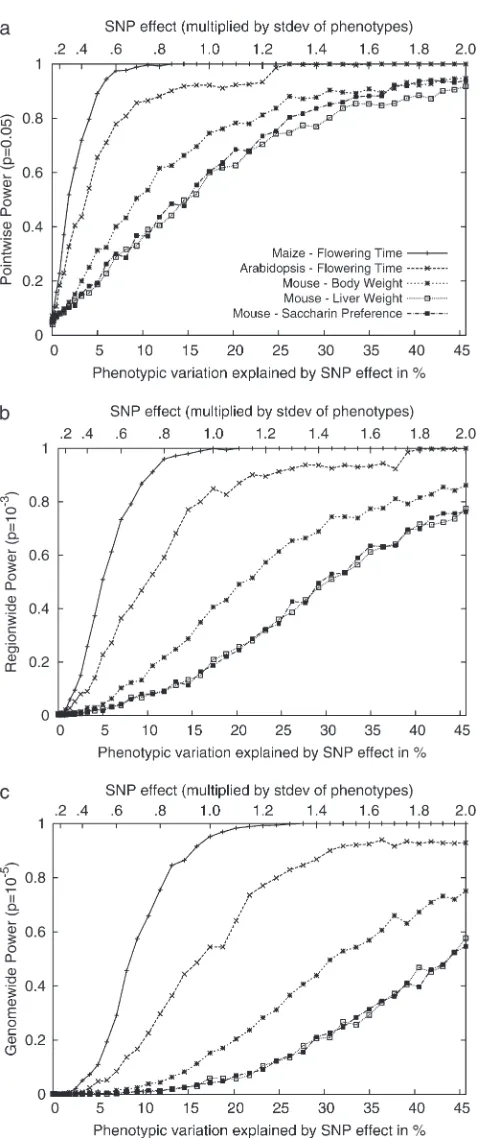
Figure 4 shows the statistical power with respect to the additive SNP effect on the Arabidopsis and maize flowering-time phenotypes and three inbred mouse phenotypes used in this article. The maize panel data set consisting of 277 strains has high statistical power, achieving 80% power with a SNP effect explaining 5% of phenotypic variation. Genomewide significance can also be achieved with high power with 10% of SNP effects. For the Arabidopsis data set consisting of 95 strains, the statistical power is decreased, and roughly twice the SNP effect would be needed compared to the maize panels to achieve the same statistical power. For the inbred mouse phenotypes, genomewide power is achievable only when the SNP explains a very large portion of phenotypic variance. In our results, the plausible significant associations explained .35% of the phenotypic variance. The power to achieve genome-wide power is largely dependent on the number of
Figure 2.—Genomewide cumulative distribution of
available strains. Table 2 summarizes the most plausible associations in these three phenotypes.
Next, we performed simulation studies by sampling phenotypes from multivariate normal distribution on the basis of the kinship matrix of 48 inbred mouse strains with different effects of genetic background due to population structure. We observed a significant in-crease of power when multiple measurements are used. Figure 5a shows the effect of multiple measurements on the statistical power when the variance from the genetic component and the residual component are the same. It suggests that using just a single measurement per strain may result in a significant decrease in power. Even though multiple measurements are used, if only the
phe-notypic mean is used in the analysis and the individual measurements are not taken into account, the statistical power would decrease significantly. Comparing Figure 5b with 5a clearly shows the advantage of using indi-vidual measurements over the phenotypic mean in the statistical analysis. It shows that the statistical power may differ by up to a factor of two between the two methods. Other mixed-model association-mapping studies use only the mean values in their analysis, not fully utilizing the potential of individual measurements.
Figure 5c shows that a large relative effect from genetic background reduces the statistical power. As the genetic background contributes a larger portion of phenotypic variance, the within-strain variance becomes smaller than
Figure3.—Genomewide scans for association with initial body weight, liver weight, and saccharin preference, using simple
the between-strain variance, and this limits the contribu-tion of multiple measurements to the statistical power (Belknap1998). For example, in an extreme case, when h2
g¼1;the residual variance is zero and the replicated
measurement does not increase the power since there is no variability of phenotype within strains.
Figure 5d shows more clearly the effect of genetic background and multiple measurements at a glance. When a SNP explains a fairly large fraction (17%) of phenotypic variance, the genomewide significance level can be achieved with high power only when the phe-notype has very small population structure effect and the number of replicates is large. As the effect from genetic background becomes larger, the advantage of using multiple measurements decreases significantly.
DISCUSSION
In this article, we proposed an efficient statistical method to perform association mapping with struc-tured samples on the basis of a linear mixed model. Our results with maize and Arabidopsis panels show that EMMA robustly reduces the inflated false positives un-der a structured population similar to currently avail-able mixed-model implementations. The accuracy and stability of the numerical optimization in EMMA is greater than others due to global optimization of like-lihood function and guaranteed convergence proper-ties with a smaller search space. Our presentation of the EMMA method is focused on a particular case of a mixed model where two variance components are involved because this is the typical model that previous studies assume, and it is straightforward to correct pop-ulation structure via one kinship matrix inferred from genomewide markers.
The computational efficiency of EMMA is orders of magnitude greater than that of other widely used im-plementations. When multiple measurements per strain are used across different individuals, the relative effi-ciency is further increased. This is of a great importance when the computational cost may be a bottleneck in the statistical analysis of high-throughput data such as genomewide gene expressions. For example, the single run of genomewide association mapping of mouse body weight phenotypes with multiple measurements would take up to a month of CPU time with other implemen-tations, while EMMA takes only a single CPU hour. When hundreds and thousands of phenotypes are available such as in the analysis of whole-genome ex-pression data, the computational cost of previous imple-mentations is prohibitive even with high-performance
Figure 4.—Comparisons of the statistical power of the
EMMA method across three different inbred mouse pheno-types and flowering time of Arabidopsis and maize, by ran-domly selecting causal SNPs across the genomewide SNPs. (a) Pointwise power denotes the power to identify causal SNPs at a nominalP-value of 0.05. (b) Regionwide power assumes 50 hypothetical tagSNPs in a genomic region. With 20 kb be-tween tagSNPs, the genomic region covers up to 1 Mb. (c) Ge-nomewide power is the power to achieve geGe-nomewide significance using theP-value threshold 105, which is
computing. It should be noted that there are other techniques developed for improving computational ef-ficiency of the numerical estimation in a more general context of linear mixed models such as average infor-mation REML (Gilmouret al.1995), but these techni-ques would not provide us with the same improvements on the efficiency of each iterative procedure.
Our results of inbred mouse association mapping show the potential and limitations of genomewide inbred mouse association studies. It is remarkable that we were able to identify significant associations at a genomewide level without inflation of false positives, under the limited statistical power of the method. Although there is a possibility that residual confounding still remains with mixed-model association, we believe that the most sig-nificant SNP associated with liver weight is likely to be a true positive because it explains a large portion of phe-notypic variations between the strains beyond genetic background effect so that the conservative Bonferroni-adjustedP-value still remains significant. The SNP asso-ciated with body weight looks also plausible, but it could possibly be due to residual confounding that is not completely captured by a kinship matrix. Likewise, other significant associations can possibly be due to residual confounding not captured by the kinship matrix, so the identified associations must be verified through inde-pendent analysis.
In a more general context of association mapping that requires the use of multiple variance components, the computational advantages of EMMA are not appli-cable since EMMA can effectively solve a model only with one correlated variance component. For example, when allowing heterozygous alleles for outbred individ-uals, the full model typically takes both additive and dominant variance components in the linear mixed
model (Lynch and Ritland 1999; Arbelbide et al.
2006). Likewise, if strain-specific environmental ran-dom effects or other additional ranran-dom effects are to be considered such as in plant association mapping, mul-tiple variance components need to be used. In such cases where EMMA is not directly applicable, computa-tional bottlenecks may be the biggest obstacles in analyzing large amounts of data such as genomewide
expression profiles. EMMA can still be applied in this case if a reasonable approximation is combined with other standard mixed-model methods taking multiple variance components. Under the null hypothesis, it is possible to estimate the ratio between multiple variance components using the full model, and EMMA can be applied under an alternative hypothesis assuming that the ratio between variance components is preserved. Since variance-component estimation under the null hypothesis needs to be done once across a larger num-ber of alternative hypotheses for each marker, such an approximation procedure provides a large amount of computational efficiency essentially equivalent to EMMA with one variance component. Although the approxi-mated test may lose statistical power slightly, the false positive rates would not be inflated.
There have been several genomewide association-mapping studies with inbred mouse strains. To the best of our knowledge, our results are the first whole-genome association mapping of inbred mice that takes the genetic relatedness into account via a statistical method supported by asymptotic theory. Previous stud-ies either do not take the population structure into account (Cervino et al. 2007) or apply heuristics to reduce the confounding effect from population struc-ture. For example, the weighted version of theF-statistic (Pletcheret al.2004) does not follow the asymptotic null distribution. Redefining the significance level on the basis of the empirical null distribution given the heritability parameter (Liuet al.2006) or the weighted permutation (McClurget al.2007) rescales theP-values only similar to genomic control and will suffer from a lack of power as the genetic background effect becomes larger.
Our power simulation studies provide assistance to the design of the association study under the effect of population structure. Multiple factors are involved in determining the condition for identifying a locus, and it cannot be represented simply by a single value such as phenotypic variance explained by the SNP. Our results show the importance of multiple measurements of phenotypes from multiple animals for each strain and of directly using the individual measurements in the TABLE 2
List of plausible associations in the mouse association mapping
P-value Variance explained (%)
Phenotype Chromosome Position F-test LR test Overall Genetic Alleles MAF Notes
Body weight
8 113,588,970 3.931061.93105 49.0 38.7 A/C 0.27 300 kb from the LOD
peak ofBwq3QTL Liver
weight
2 34,499,435 1.231091.43107 39.1 58.6 G/C 0.50 Genomewide significant,
withinLvrq1QTL Saccharin
preference
4 154,883,600 1.031057.53105 35.9 50.6 G/A 0.31 30 kb fromTas1r3gene
statistics for association mapping. Taking individual measurements into account within the association map-ping is much more computationally intensive. EMMA provides a method for efficiently handling individual measurements. In addition, our results also demon-strate the effect of genetic background on the statistical power. As the population structure explains larger phenotypic variance, the power using multiple measure-ments becomes lower.
Our results show that phylogenetic control can control for population structure as effectively as the linear mixed model based on the genetic similarity matrix in some data sets despite the limited ability of the model to represent complex genetic relatedness. Since genetic similarity matrices are better models when ac-counting for recombination and hybridization, and also are easier to compute, phylogenetic control is not
pre-ferred in association mapping in model organisms. However, it is possible to compute the likelihood of the phylogenetic control model in linear time (Felsenstein 1985), and this may be useful when a very large number of individuals are to be tested.
H.K. is partially supported by a Samsung Scholarship, and N.Z. is partially supported by a Microsoft graduate fellowship. H.K., N.Z., and E.E. are partially supported by National Science Foundation grant nos. 0513612 and 0713455 and National Institutes of Health (NIH) grant no. 1K25HL080079. D.H. is supported by Microsoft Research. Part of this investigation was supported using the computing facility made possible by the Research Facilities Improvement Program grant no. C06 RR017588 awarded to the Whitaker Biomedical Engineering Institute and the Biomedical Technology Resource Centers Program grant no. P41 RR08605 awarded to the National Biomedical Compu-tation Resource, University of California (San Diego), from the National Center for Research Resources, NIH. Additional computa-tional resources were provided by the California Institute of Tele-communications and Information Technology (Calit2). The mouse Figure5.—Comparisons of the genomewide power of the EMMA method applied to inbred mouse associations for simulated
phenotypes with various SNP effects, genetic background effects, and numbers of multiple measurements. The significance threshold isP¼105.tis the number of multiple measurements per strain, andh2
g is the fraction of the variance explained by genetic background among overall phenotypic variances when the SNP effect is not added. (a) Withh2
g¼0:5;varyingb andt. (b) The same as a, using the mean phenotype value per strain instead of individual measurements. (c) With 10 multiple measurements per strain, varyingbandh2
HapMap project is supported by the National Human Genome Research Institute, NIH.
LITERATURE CITED
Annuciado, R. V. P., M. Nishimura, M. Mori, A. Ishikawa, S.
Tanakaet al., 2001 Quantitative trait loci for body weight in
the intercross between SM/J and A/J mice. Exp. Anim. 50:
319–324.
Aranzana, M. J., S. Kim, K. Zhao, E. Bakker, M. Horton et al.,
2005 Genome-wide association mapping in Arabidopsis identi-fies previously known flowering time and pathogen resistance genes. PLoS Genet.1:e60.
Arbelbide, M., J. Yuand R. Bernado, 2006 Power of mixed-model
QTL mapping from phenotypic, pedigree and marker data in self-pollinated crops. Theor. Appl. Genet.112:876–884.
Belknap, J. K., 1998 Effect of within-strain sample size on QTL
de-tection and mapping using recombinant inbred mouse strains. Behav. Genet.28:29–38.
Bhattacharya, T., M. Daniels, D. Heckerman, B. Foley, N. Frahm
et al., 2007 Founder effects in the assessment of HIV polymor-phisms and HLA allele associations. Science315:1583–1586.
Bystrykh, L., E. Weersing, B. Dontje, S. Sutton, M. T. Pletcher
et al., 2005 Uncovering regulatory pathways that affect hematopoi-etic stem cell using ‘genhematopoi-etical genomics’. Nat. Genet.37:225–232.
Carlson, J. M., C. Kadie, S. Mallal and D. Heckerman,
2007 Leveraging hierarchical population structure in dis-crete association studies. PLoS One2:e591.
Casteele, T. V. D., P. Galbuseraand E. Matthysen, 2001 A
com-parison of microsatellite-based pairwise relatedness estimators. Mol. Ecol.10:1539–1549.
Cervino, A. C., A. Darvasi, M. Fallahi, C. C. Maderand N. F.
Tsinoremas, 2007 An integrated in silico gene mapping
strat-egy in inbred mice. Genetics175:321–333.
Crainiceanu, C. M., and D. Ruppert, 2004 Likelihood ratio tests in
linear mixed models with one variance component. J. R. Stat. Soc. B66:165–185.
Dempster, A. P., D. B. Rubin and R. K. Tsutakawa, 1981
Esti-mation in covariance components models. J. Am. Stat. Assoc.
76:341–353.
Devlin, B., and K. Roeder, 1999 Genomic control for association
studies. Biometrics55:997–1004.
Felsenstein, J., 1981 Evolutionary trees from dna sequences: a
max-imum likelihood approach. J. Mol. Evol.17:368–376.
Felsenstein, J., 1985 Phylogenies and the comparative method.
Am. Nat.125:1–15.
Felsenstein, J., and G. Churchill, 1996 A hidden Markov model
approach to variation among sites in rate of evolution. Mol. Biol. Evol.13:93–104.
Fitch, W., and E. Margoliash, 1967 The construction of
phyloge-netic trees—a generally applicable method utilizing estimates of the mutation distance obtained from cytochrome c sequences. Science155:279–284.
Flint, J., W. Valdar, S. Shifmanand R. Mott, 2005 Strategies for
mapping and cloning quantitative trait genes in rodents. Nat. Rev. Genet.6:271–286.
Flint-Garcia, S. A., A.-C. Thuillet, J. Yu, G. Pressoir, S. M. Romero
et al., 2005 Maize association population: a high-resolution plat-form for quantitative trait locus dissection. Plant J. 44:1054– 1064.
Frazer, K. A., E. Eskin, H. M. Kang, M. A. Bogue, D. A. Hindset al.,
2007 A sequence-based variation map of 8.27 million snps in inbred mouse strains. Nature448:1050–1053.
Gilmour, A. R., R. Thompsonand B. R. Cullis, 1995 Average
infor-mation reml: an efficient algorithm for variance parameter esti-mation in linear mixed models. Biometrics51:1440–1450.
Graser, H. U., S. P. Smithand B. Tier, 1987 A derivative-free
ap-proach for estimating variance components in animal models by restricted maximum likelihood. J. Anim. Sci.64:1362–1372. Gu, X., 2004 Statistical framework for phylogenomic analysis of
gene family expression profiles. Genetics167:531–542.
Halperin, E., and E. Eskin, 2004 Haplotype reconstruction from
geno-type data using imperfect phylogeny. Bioinformatics20:1842–1849.
Harville, D. A., 1974 Bayesian inference for variance components
using only error contrasts. Biometrika61:381–385.
Henderson, C., 1984 Applications of Linear Models in Animal Breeding.
University of Guelph, Guelph, ON, Canada.
Jackson Laboratory, 2004 Mouse Phenome Database website.
http://www.jax.org/phenome.
Jander, G., S. R. Norris, S. D. Rounsley, D. F. Bush, I. M. Levin
et al., 2002 Arabidopsis map-based cloning in the post-genome era. Plant Physiol.129:440–450.
Johnson, D. L., and R. Thompson, 1995 Restricted maximum
likeli-hood estimation of variance components for univariate animal models using sparse matrix techniques and average information. J. Dairy Sci.78:449–456.
Kennedy, B. W., M. Quintonand J. A.vanArendonk, 1992
Esti-mation of effects of single genes on quantitative traits. J. Anim. Sci.70:2000–2012.
Kishino, H., and M. Hasegawa, 1989 Evaluation of the maximum
likelihood estimate of the evolutionary tree topologies from DNA sequence data, and the branching order in hominoidea. J. Mol. Evol.29:170–179.
Leamy, L. J., D. Pomp, E. J. Eisenand J. M. Cheverud, 2002
Pleio-tropy of quantitative trait loci for organ weights and limb bone lengths in mice. Physiol. Genomics10:21–29.
Lindstrom, M. J., and D. M. Bates, 1988 Newton-Raphson and EM
algorithms for linear mixed-effects models for repeated-measures data. J. Am. Stat. Assoc.83:1014–1022.
Liu, P., Y. Wang, H. Vikis, A. Maciaq, D. Wanget al., 2006
Can-didate lung tumor susceptibility genes identified through whole-genome association analysis in inbred mice. Nat. Genet.38:888– 895.
Lynch, M., and K. Ritland, 1999 Estimation of pairwise relatedness
with molecular markers. Genetics152:1753–1766.
Malosetti, M., C. G. van derLinden, B. Vosmanand F. A.van
Eeuwijk, 2007 A mixed-model approach to association
map-ping using pedigree information with an illustration of resistance toPhytophthora infestansin potato. Genetics175:879–889.
Martins, E. P., and T. F. Hansen, 1997 Phylogenetics and the
com-parative methods: a general approach to incorporating phyloge-netic information into the analysis of interspecific data. Am. Nat.
149:646–667.
Masinde, G. L., X. Li, W. Gu, H. Davidson, M. Hamilton-Ulland
et al., 2002 Quantitative trait loci (QTL) for lean body mass and body length in MRL/MPJ and SJL/J F(2) mice. Funct. In-tegr. Genomics2:98–104.
McClurg, P., J. Janes, C. Wu, D. L. Delano, J. R. Walkeret al.,
2007 Genomewide association analysis in diverse inbred mice: power and population structure. Genetics176:675–683. Meyer, K., 1989 Restricted maximum likelihood to estimate
vari-ance components of animal models with several random effects using a derivative free algorthm. Genet. Sel. Evol.21:318–340.
Nelder, J. A., and R. Mead, 1965 A simplex method for function
minimization. Comput. J.7:308–313.
Nievergelt, C. M., O. Libigerand N. J. Schork, 2007 Generalized
analysis of molecular variance. PLoS Genet.3:e51.
Nordborg, M., T. T. Hu, Y. Ishino, J. Jhaveri, C. Toomajianet al.,
2005 The pattern of polymorphism in Arabidopsis thaliana. PLoS Biol.3:e196.
Oakley, T. H., Z. Gu, E. Abouheif, N. H. Patel and W.-H. Li,
2005 Comparative methods for the analysis of gene-expression evolution: an example using yeast functional genomic data. Mol. Biol. Evol.22:40–50.
Patterson, H. D., and R. Thompson, 1971 Recovery of inter-block
information when block sizes are unequal. Biometrika58:545– 554.
Patterson, N., A. Priceand D. Reich, 2006 Population structure
and eigenanalysis. PLoS Genet.2:e190.
Peter, L. L., R. F. Robledo, C. J. Bult, G. A. Churchill, B. J. Paigen
et al., 2007 The mouse as a model for human biology: a re-source guide for complex trait analysis. Nat. Rev. Genet.8:58–69.
Piepho, H. P., 2001 A quick method for computing approximate
thresholds for quantitative trait loci detection. Genetics 157:
425–432.
Pletcher, M., P. McClurg, S. Batalov, A. Su, S. Barnes et al.,
Price, A., N. Patternson, R. Plenge, M. Weinblatt, N. Shadick
et al., 2006 Principal components analysis corrects for stratifica-tion in genome-wide associastratifica-tion studies. Nat. Genet.38:904–909.
Pritchard, J., M. Stephens, N. Rosenberg and P. Donnelly,
2000 Association mapping in structured populations. Am. J. Hum. Genet.67:170–181.
Reed, D. R., S. Li, X. Li, L. Huang, M. G. Tordoff et al.,
2004 Polymorphisms in the taste receptor gene (Tas1r3) re-gion are associated with saccharin preference in 30 mouse strains. J. Neurosci.24:938–946.
Rocha, J., E. J. Eisen, L. VanVleckand D. Pomp, 2004 A
large-sample QTL study in mice: Ii. body composition. Mamm. Ge-nome15:100–113.
SAS Institute, 2004 SAS/STAT 9.1 User’s Guide.SAS Institute, Cary, NC.
Smith, S. P., 1990 Estimation of genetic parameters in non linear
models, pp. 190–206 inAdvances in Statistical Methods for Genetic Improvement of Livestock, edited by D. Gianolaand K. Hammond.
Springer-Verlag, New York.
Storey, J. D., and R. Tibshirani, 2003 Statistical significance for
ge-nomewide studies. Proc. Nat. Acad. Sci. USA100:9440–9445.
Thomas, S. C., and W. G. Hill, 2000 Estimating quantitative genetic
parameters using sibships reconstructed from marker data. Ge-netics155:1961–1972.
Wang, J., 2002 An estimator for pairwise relatedness using
molecu-lar markers. Genetics160:1203–1215.
Welham, S. J., and R. Thompson, 1997 Likelihood ratio tests for
fixed model terms using residual maximum likelihood. J. R. Stat. Soc. B59:701–714.
Yu, J., G. Pressoir, W. Briggs, B. I. Vroh, M. Yamasakiet al., 2006 A
unified mixed-model method for association mapping that ac-counts for multiple levels of relatedness. Nat. Genet.38:203–208. Zhao, K., M. J. Aranzana, S. Kim, C. Lister, C. Shindo, et al.,
2007 An Arabidopsis example of association mapping in struc-tured samples. PLoS Genet.3:e4.
Zou, F., J. A. Gelfond, D. C. Airey, L. Lu, K. F. Manlyet al.,
2005 Quantitative trait locus analysis using recombinant inbred intercrosses: theoretical and empirical considerations. Genetics
170:1299–1311.
Communicating editor: J. B. Walsh
APPENDIX: DERIVATION OF RESTRICTED LIKELIHOOD AND ITS DERIVATIVES
A derivation of Equations 6 and 7 from Equations 2 and 3 is presented in Pattersonand Thompson(1971) and Harville(1974). However, their derivation is not straightforward, and it needs to be clarified how exactly it is related to spectral decomposition. Here we describe a more detailed description of obtaining Equations 6 and 7.
Plugging in the optimal parameters ˆband ˆsF¼R=n in Equation 2, it follows that
fFðdÞ ¼lFðy;bˆ;sˆ;dÞ ¼1
2 n log 2pR
n logjHj n
: ðA1Þ
From Equation 4, it is straightforward that logjHj ¼Pn
i¼1logðji1dÞ:AndRcan be rewritten as follows:
R ¼ ðyXbˆÞ9H1ðyXbˆÞ ðA2Þ
¼y9ðI XðX9H1XÞ1X9H1Þ9H1ðIXðX9H1XÞ1X9H1Þy ðA3Þ
¼y9P9H1Py; ðA4Þ
whereP¼I X(X9H1X)1X9H1.
It is straightforward to show that
ðSHSÞðP9H1PÞðSHSÞ ¼SHS ðA5Þ
ðP9H1PÞðSHSÞðP9H1PÞ ¼P9H1P; ðA6Þ
using the factPS¼SandSP¼S. Consequently,
P9H1P ¼ ðSHSÞ1¼
URdiagðls1dÞ1
U9R; ðA7Þ
where ()1denotes the pseudo-inverse of a matrix. Therefore, it follows that
R ¼y9ðP9H1PÞy ðA8Þ
¼ ðU9RyÞ9diagðls1dÞ1ðU9
RyÞ ðA9Þ
¼X
nq s¼1
h2s
From Equations A1 and A10, it follows that
fFðdÞ ¼
1 2 n log
n
2penlog
Xnq s¼1
h2s
ls1d
!
X
n i¼1
logðji1dÞ " #
: ðA11Þ
The restricted likelihood ofyis equivalent to computing the likelihood ofAywhereS¼AA9andA9A¼I:
ðSHSÞðSHSÞ1¼ ð
SHSÞðP9H1PÞ ¼SHP9H1P ¼SP¼S ðA12Þ
(Pattersonand Thompson1971; Harville1974). On the other hand,
ðSHSÞðSHSÞ1¼ ð
URdiagðls1dÞU9RÞ URdiag ðls1dÞ1
U9R
¼URU9R: ðA13Þ
Accordingly,URU9R¼SandU9RUR¼Ihold, and the restricted likelihood ofyis equivalent to the likelihood ofU9Ry
N(0,s2diag(l
s1d)). By plugging in ˆs2Rtos
2, it immediately follows that
fRðdÞ ¼1
2 ðnqÞlog
nq
2pe ðnqÞlog
Xnq s¼1
h2
s
ls1d
!
X
nq s¼1
logðls1dÞ " #