ABSTRACT
LE PECHOUX, BEATRICE. A Pattern Language Describing Apparel Design Creativity. (Under the direction of Trevor Little.)
The apparel design process involves gathering and analyzing information on fashion trends, markets, past line sales and editing ideas for successful combinations of fabric, style and price. These ideas are the result of creativity. Creativity is most often the modeled as a problem solving process involving complex chaotic systems. In the fields of architecture and software design, pattern languages have been developed to help understand the various fundamental components and dynamics of complex systems by using a series of related generic problem-solving patterns empirically proven to be successful in a specified context of forces. Patterns record existing knowledge to make it rapidly and easily accessible and communicated between different users.
Design professionals reviewed the pattern language. Students used it to develop product concepts and storyboards, which were evaluated by a panel of judges. Feedback from these participants indicates the pattern language offers a manual that can be used by all team members to improve design efficiency and effectiveness, i.e. higher success rates of new products in a timely manner. Combining information technology and the pattern language could make an even greater contribution to apparel design, both at an operational level and a strategic planning level.
A PATTERN LANGUAGE
DESCRIBING
APPAREL DESIGN CREATIVITY
by
BEATRICE LE PECHOUX
A dissertation submitted to the Graduate Faculty of
North Carolina State University
in partial fulfillment of the requirements for the
Degree of Doctor of Philosophy
TEXTILE TECHNOLOGY MANAGEMENT
Raleigh
2000
APPROVED BY:
________________________ _________________________
Dr. Cynthia Istook Dr. Charles Joyner________________________ _________________________
Dr. Trevor Little Dr. Samuel WinchesterDEDICATION
To my parents, sister and brothers,
as well as the few friends and professors,
who encouraged me to seek out the signs
and pursue my personal legend
BIOGRAPHY
Beatrice Le Pechoux was born in Milan, Italy, on July 23, 1969. While growing up, she attended schools in Italy, U.S.A., France and Japan, and had many opportunities to travel within and around those countries. In 1987, she graduated from high school with honors at the "Lycee Franco-Japonais" in Tokyo, Japan. She attended Paris-IX Dauphine University in Paris, France, where she complete a Bachelor’s Degree in Business Management and Economics with a major in Marketing and a minor in Management Accounting. On an exchange program with Nichols State University, she moved back to the United States in Thibodeaux, Louisiana, to complete a Master of Business Administration (MBA) in 1992. Internships and short-term job opportunities, allowed Beatrice to gain work experience in various textile and apparel related activities (from quality control, buying and import coordination, to sales, marketing research and public relations) in Japan, India, Korea, U.S.A. and France.
Her interest in the multiple aspects of the textile/apparel industry prompted her to attend the French Fashion Institute in Paris, where she completed a post-graduate program focusing on design, management and technology in 1995. Her thesis research, funded by the French Knitwear Association, focused on the American textile/apparel industry. During her field research trip to the U.S., she visited various organizations on the East Coast and interviewed Dr. Trevor Little, department head at the College of Textiles, North Carolina State University. In August, 1996, Beatrice started the Textile Technology Management Ph.D. program at NCSU.
AKCNOWLEDGMENTS
Many people have contributed in various ways to the accomplishment of this dissertation. First, I wish to acknowledge the insight and support of my committee members. In particular, I am very grateful to Dr. Little who initially provided me with a teaching assistantship position so I could start the TTM Ph.D. program, and then guided and advised me every step of the way while leaving me the freedom to direct the course of my exploration. I also wish to address a very warm "thank you" to Dr. Istook, who always made herself available when I needed help, and whose kindness, friendship and expertise were precious assets for completing many critical phases of this research work. Special thanks to Charles Joyner for his strong interest and his perspective on the subject both from his "design professor" point of view and his "artist" point of view. Thanks to Dr. Winchester for his interest.
Many thanks to all the participants who enabled me to refine and test the validity of this research. I am grateful to the design professionals from academia and industry who shared their expertise: Janet Jackson, Alan Donaldson, Susan Brandeis, Percy Hooper, Charles Joyner, Kim Anderson, Lope Max Diaz, Kathleen Rieder, Susan Beiser, Nancy Powell, Mary Stowe, Candice Foster, and Yvonne Johnson. I also wish to thank the students who devoted time and energy to the storyboard projects: Anna Horton, Dawn O'Neal, Catrelle Hampton, Tiko Thomas, Beverly Coalston, Sarah Anderson, Katie Shearin, and Desiree Morgan. Special thanks to Lisa Parrillo, Karla Simmons and Claudia Deaton for their individual contributions to this field research.
but also the possibility to present my findings to a wider public. Thanks to Dr. Honeycutt, I met "the gang" (Bill, John, Jim, and others) whose feedback and insight shared over on-going weekly morning "coffee-shop talks" are always enlightening and fun!
TABLE OF CONTENTS
LIST OF TABLES ...IX
LIST OF FIGURES ...XI
LIST OF ABBREVIATIONS ...XIV
1 A PATTERN LANGUAGE DESCRIBING APPAREL DESIGN CREATIVITY... 1
2 LINKING MARKETING, DESIGN AND CREATIVITY LITERATURE REVIEW... 3
2.1 MAPPING THE CREATIVE DESIGN PROCESS... 3
2.1.1 Apparel design and development processes... 3
2.1.2 A profitable three dimensional system ... 10
2.1.3 Market Intelligence ... 13
2.2 THE COMPLEX ENVIRONMENT OF DESIGN... 19
2.2.1 Consumers... 20
2.2.2 Fashion environment... 27
2.2.3 External and internal influences ... 32
2.3 CREATIVE DESIGN... 42
2.3.1 Creativity and design definitions ... 42
2.3.2 Value and newness ... 45
2.3.3 Creative design process models ... 52
3 PATTERN LANGUAGES: ORIGINS AND APPLICATIONS... 73
3.1 PATTERN LANGUAGES: RECORDING AND SHARING KNOWLEDGE TO CHANNEL CREATIVITY... 73
3.1.1 Problem solving approach and patterns ... 74
3.1.2 The origin of Patterns ... 75
3.1.3 Application of patterns to software development ... 86
3.1.4 Writing a pattern Language ... 91
3.1.5 Creativity, patterns and pattern languages... 103
3.2 PRELIMINARY INVESTIGATION OF A PATTERN LANGUAGE FOR APPAREL DESIGN... 105
3.2.1 Common issues and possible solutions ... 106
3.2.2 A pattern language for apparel design ... 112
3.3 SUMMARY CONCLUSIONS OF THE LITERATURE REVIEW AND RESEARCH GOALS... 114
3.3.1 Available information on creativity and design ... 115
3.3.2 Shortcomings of the current literature on apparel design creativity ... 116
4 APPROACH TO DEVELOPING A PATTERN LANGUAGE ... 119
4.1 RESEARCH OBJECTIVE... 119
4.2 RESEARCH PROCESS... 120
4.2.1 Literature Review ... 120
4.2.2 Archetype and Pattern Language Development... 122
4.3 RESEARCH PLAN... 124
4.3.1 Phase I: Pattern language review by design experts ... 124
4.3.2 Phase II: Storyboard development... 125
4.3.3 Phase III: Storyboard evaluation by design professionals... 129
5 DEVELOPMENT OF A REFINED PATTERN LANGUAGE... 132
5.1 PRELIMINARY PATTERN LANGUAGE REVIEW... 132
5.1.1 Positive comments... 132
5.1.2 Recommended improvements ... 135
5.1.3 Changes made... 137
5.1.4 Other reviewer comments ... 139
5.2 REFINED PATTERN LANGUAGE USED IN FIELD RESEARCH... 141
5.2.1 Archetype pattern... 142
5.2.2 Problem Solving pattern ... 153
5.2.3 External Discover pattern ... 157
5.2.4 Internal Discover pattern... 163
5.2.5 Internal Refine pattern ... 171
5.2.6 External Refine pattern ... 178
5.2.7 Marketing Mix pattern ... 185
5.2.8 Life Cycle pattern... 189
5.2.9 Trend Analysis pattern ... 195
5.2.10 Target Consumer pattern ... 201
5.2.11 Product Evaluation pattern... 206
5.2.12 Design Team pattern ... 210
5.2.13 Design Elements pattern ... 215
5.2.14 Attribute Ideation pattern... 223
5.2.15 Component Ideation pattern ... 227
6 RESEARCH RESULTS... 236
6.1 PROJECT DATA... 236
6.1.1 PL student questionnaire ... 236
6.2 DATA ANALYSIS... 243
6.2.1 PL student questionnaire ... 244
6.2.2 Post-project student questionnaire ... 253
6.2.3 Evaluation judge questionnaire ... 264
7 CONCLUSIONS AND RECOMMENDATIONS ... 279
8 REFERENCES ... 282
9 APPENDICES ... 290
9.1 MANDALA PATTERN... 291
9.2 COVER SHEET FOR PATTERN REVIEWERS... 301
9.3 PRE-PROJECT STUDENT QUESTIONNAIRE... 303
9.4 SPORT OBERMEYER PROJECT ... 306
9.5 POST-PROJECT STUDENT QUESTIONNAIRE... 309
9.6 PATTERN LANGUAGE STUDENT QUESTIONNAIRES... 311
9.6.1 Pattern Language PLG member questionnaire... 311
9.6.2 Pattern Language CG member questionnaire ... 313
9.7 EVALUATION JUDGE QUESTIONNAIRE... 315
9.8 STORYBOARD PICTURES... 319
9.8.1 PLG Storyboard ... 319
LIST OF TABLES
TABLE 2-1. ACTIVITIES GUIDE FOR APPAREL PRODUCT DEVELOPMENT (WICKETT, GASKILL & DAMHORST,
1999) ... 7
TABLE 2-2. DIMENSIONS OF JUDGMENT (AMABILE, 1996) ... 49
TABLE 2-3. SOCIAL-ENVIRONMENTAL INFLUENCES ON CREATIVITY (AMABILE, 1996)... 64
TABLE 3-1. SIMILARITIES BETWEEN A GARMENT PATTERN AND A PATTERN OF A PATTERN LANGUAGE.... 107
TABLE 3-2. COMPONENTS OF CREATIVE PERFORMANCE FOR APPAREL DESIGN... 110
TABLE 5-1. LEVELS OF NEWNESS RELATIVE TO PRODUCT AND MARKET LIFE CYCLES... 192
TABLE 5-2. SOURCES INFLUENCING SELECTION OF PRIMARY DESIGN ELEMENTS... 221
TABLE 5-3. CHANGES IN ATTRIBUTES AND COMPONENTS RELATIVE TO LEVEL OF NEWNESS TARGETED... 222
TABLE 5-4. EXAMPLE ATTRIBUTE MATRIX... 226
TABLE 6-1. PL STUDENT QUESTIONNAIRE DATA... 238
TABLE 6-2. POST-PROJECT STUDENT QUESTIONNAIRE: DESIGN PROCESS ASSESSMENT DATA... 239
TABLE 6-3. POST-PROJECT STUDENT QUESTIONNAIRE: EVENTS AND/OR SOURCES INFLUENCING DESIGN IDEAS ... 240
TABLE 6-4. EVALUATION JUDGE QUESTIONNAIRE: PROJECT ASSESSMENT DATA... 242
TABLE 6-5. EVALUATION JUDGE QUESTIONNAIRE: PERCENT CONTRIBUTION TO PROJECTS... 243
TABLE 6-6. F-TEST FOR OVERALL ASSESSMENT OF PL METHOD... 245
TABLE 6-7. T-TEST FOR OVERALL ASSESSMENT OF PL METHOD... 245
TABLE 6-8. F-TEST FOR TOTAL PL EFFICIENCY... 245
TABLE 6-9. T-TEST FOR TOTAL PL EFFICIENCY... 245
TABLE 6-10. F-TEST FOR TOTAL PL EFFECTIVENESS... 246
TABLE 6-11. T-TEST FOR TOTAL PL EFFECTIVENESS... 246
TABLE 6-12. F-TEST FOR TOTAL TRAINING EFFECTIVENESS... 246
TABLE 6-13. T-TEST FOR TOTAL TRAINING EFFECTIVENESS... 246
TABLE 6-14. ANOVA: SINGLE FACTOR FOR PLG / INDIVIDUALS... 247
TABLE 6-15. ANOVA: SINGLE FACTOR FOR CG / INDIVIDUALS... 247
TABLE 6-16. ANOVA: SINGLE FACTOR FOR PLG / QUESTIONS... 247
TABLE 6-17. ANOVA: SINGLE FACTOR FOR CG / QUESTIONS... 247
TABLE 6-18. F-TEST FOR OVERALL ASSESSMENT OF CREATIVE DESIGN PROCESS... 254
TABLE 6-19. T-TEST FOR OVERALL ASSESSMENT OF CREATIVE DESIGN PROCESS... 254
TABLE 6-20. ANOVA: SINGLE FACTOR FOR PLG / QUESTIONS... 254
TABLE 6-21. ANOVA: SINGLE FACTOR FOR PLG / INDIVIDUALS... 255
TABLE 6-22. ANOVA: SINGLE FACTOR FOR CG / QUESTIONS... 255
TABLE 6-24. F-TEST FOR TOTAL WORK PROCESS EFFICIENCY... 256
TABLE 6-25. F-TEST FOR TOTAL TEAM PROCESS EFFICIENCY... 256
TABLE 6-26. F-TEST FOR TOTAL EXTRA TRAINING AND INPUT NEEDED... 256
TABLE 6-27. F-TEST FOR TOTAL CREATIVITY COMPONENTS USED... 257
TABLE 6-28. T-TEST FOR TOTAL WORK PROCESS EFFICIENCY... 258
TABLE 6-29. T-TEST FOR TOTAL TEAM PROCESS EFFICIENCY... 258
TABLE 6-30. T-TEST FOR TOTAL EXTRA TRAINING AND INPUT NEEDED... 258
TABLE 6-31. T-TEST FOR TOTAL CREATIVITY COMPONENTS USED... 258
TABLE 6-32. INTER-JUDGE RELIABILITIES (RELIABILITY INDEX: RI)... 267
TABLE 6-33. F-TEST FOR OVERALL AVERAGE JUDGE RATINGS... 268
TABLE 6-34. T-TEST FOR OVERALL AVERAGE JUDGE RATINGS... 268
TABLE 6-35. ANOVA: SINGLE FACTOR FOR PLG / INDIVIDUAL JUDGE RATINGS... 269
TABLE 6-36. ANOVA: SINGLE FACTOR FOR CG / INDIVIDUAL JUDGE RATINGS... 269
TABLE 6-37. ANOVA: SINGLE FACTOR FOR PLG / DIMENSIONS RATED... 269
LIST OF FIGURES
FIGURE 2-1. THE PROCESS OF APPAREL DESIGN AND PRODUCT DEVELOPMENT (CARR & POMEROY, 1992).... 5
FIGURE 2-2. RETAIL PRODUCT DEVELOPMENT MODEL (GASKILL, 1992) ... 6
FIGURE 2-3. LINE PLANNING AND RESEARCH (MAY-PLUMLEE & LITTLE, 1998)... 11
FIGURE 2-4. DESIGN RELATIONSHIPS (KNOX, 1989)... 12
FIGURE 2-5. CREATIVITY AND DESIGN ACTIVITIES (KNOX, 1989) ... 12
FIGURE 2-6. FACTORS INFLUENCING MARKETING STRATEGY (KOTLER & ARMSTRONG, 1994) ... 17
FIGURE 2-7. MODEL OF THE EFFECTS OF SOCIAL COMPARISON ON THE CONSTRUCTION AND EVALUATION OF APPEARANCE (RUDD & LENNON, 1994)... 23
FIGURE 2-8. SCHEMATIC ILLUSTRATION OF SELF, IDENTITIES, AND ROLES (KAISER, 1990) ... 24
FIGURE 2-9. CONTEXTUAL MODEL OF CLOTHING SIGN SYSTEM (DAMHORST, 1990) ... 25
FIGURE 2-10. CONSUMER DECISION PROCESS (ENGEL ET AL., 1995) ... 26
FIGURE 2-11. FASHION ACCEPTANCE: CONSUMERS, PRICES, STORES (PACKARD, 1983) ... 28
FIGURE 2-12. PRODUCT LIFE SPAN OF FASHION (PACKARD, 1983) ... 29
FIGURE 2-13. THEORIES OF FASHION MOVEMENT (JARNOW & DICKERSON, 1996) ... 30
FIGURE 2-14. GEARS OF THE FASHION INDUSTRY (PERNA, 1987)... 34
FIGURE 2-15. INFORMATION NETWORK (PERNA, 1987)... 35
FIGURE 2-16. CRITICAL FRAMEWORK FOR EVALUATING DRESS... 41
FIGURE 2-17. FEA CONSUMER NEEDS MODEL (LAMB & KALLAL, 1992)... 51
FIGURE 2-18. HYPOTHETICAL RELATION BETWEEN CREATIVITY AS A TRAIT AND CREATIVE ACHIEVEMENT (EYSENCK, 1997) ... 54
FIGURE 2-19. COMPONENTS OF CREATIVE PERFORMANCE (AMABILE, 1996) ... 54
FIGURE 2-20. CONCEPTUAL FRAMEWORK FOR CREATIVE EXPERIENCE AND THE INFLUENCE OF DESIGN THEORY (KIMLE, 1994)... 55
FIGURE 2-21. COMPONENTIAL MODEL OF CREATIVITY (AMABILE, 1996) ... 63
FIGURE 2-22. FEA DESIGN PROCESS FRAMEWORK (LAMB & KALLAL, 1992) ... 67
FIGURE 2-23. PRODUCT DEVELOPMENT FRAMEWORK (KALLAL & LAMB, 1993) ... 68
FIGURE 2-24. REVISED APPAREL RETAIL PRODUCT DEVELOPMENT MODEL... 70
FIGURE 2-25. COMPARING THE PHASE OF CREATIVE DESIGN PROCESS MODELS... 72
FIGURE 5-1. INFLUENCES EXTERNAL TO THE ARCHETYPE OF APPAREL DESIGN CREATIVITY... 148
FIGURE 5-2. FOUR QUADRANT MATRIX... 149
FIGURE 5-3. FROM CREATIVE PHASE TO DEVELOPMENT PHASE OF A CONTINUING DESIGN PROCESS... 149
FIGURE 5-4. FROM CREATIVE PHASE OF AN ON-GOING DESIGN PROCESS TO CREATIVE PHASE OF A NEW DESIGN PROCESS... 150
FIGURE 5-6. LINK BETWEEN EXTERNAL DISCOVER AND EXTERNAL REFINE PDCA CYCLES... 151
FIGURE 5-7. COMPARING THE PHASE OF CREATIVE DESIGN PROCESS MODELS... 151
FIGURE 5-8. FEA DESIGN PROCESS FRAMEWORK (LAMB & KALLAL, 1992) ... 152
FIGURE 5-9. COMPONENTIAL MODEL OF CREATIVITY (AMABILE, 1996) ... 152
FIGURE 5-10. PDCA CYCLE... 156
FIGURE 5-11. LINK BETWEEN EXTERNAL DISCOVER AND INTERNAL DISCOVER... 162
FIGURE 5-12. LINK BETWEEN EXTERNAL DISCOVER AND EXTERNAL REFINE... 162
FIGURE 5-13. LINK BETWEEN INTERNAL DISCOVER AND INTERNAL REFINE... 170
FIGURE 5-14. LINK BETWEEN INTERNAL DISCOVER AND EXTERNAL DISCOVER... 170
FIGURE 5-15. LINK BETWEEN INTERNAL REFINE AND INTERNAL DISCOVER... 177
FIGURE 5-16. LINK BETWEEN INTERNAL REFINE AND EXTERNAL REFINE... 177
FIGURE 5-17. LINK BETWEEN EXTERNAL REFINE AND INTERNAL REFINE... 184
FIGURE 5-18. LINK BETWEEN EXTERNAL REFINE AND EXTERNAL DISCOVER... 184
FIGURE 5-19. FACTORS INFLUENCING MARKETING STRATEGY (KOTLER & ARMSTRONG,1994) ... 188
FIGURE 5-20. NEW STYLE, NEW PRODUCT... 193
FIGURE 5-21. OLD STYLE, NEW PRODUCT... 193
FIGURE 5-22. GROWTH IN THE MATURITY PHASE... 194
FIGURE 5-23. GROWTH IN THE DECLINE PHASE... 194
FIGURE 5-24. FROM TREND ANALYSIS TO NEW PRODUCT CONCEPTS... 200
FIGURE 5-25. CONTEXTUAL MODEL OF CLOTHING SIGN SYSTEM (DAMHORST, 1990) ... 205
FIGURE 5-26. FEA CONSUMER NEEDS MODEL (LAMB & KALLAL, 1992)... 209
FIGURE 5-27. DESIGN TEAM MEMBERS AND STRUCTURE... 214
FIGURE 5-28. DESIGN ELEMENTS THAT COMPOSE AN APPAREL PRODUCT... 220
FIGURE 5-29. COMPONENT DIVISION... 234
FIGURE 5-30. COMPONENT FUSION... 234
FIGURE 5-31. COMPONENT REPLACEMENT... 234
FIGURE 5-32. COMPONENT DISPLACEMENT... 235
FIGURE 5-33. COMPONENT CONTROL... 235
FIGURE 6-1. AVERAGE GROUP RESPONSES TO PL QUESTIONNAIRE... 248
FIGURE 6-2. DIFFERENCE BETWEEN AVERAGE GROUP RESPONSES TO PL QUESTIONNAIRE... 249
FIGURE 6-3. AVERAGE GROUP RATINGS FOR THE POST-PROJECT STUDENT QUESTIONNAIRE... 255
FIGURE 6-4. DIFFERENCE BETWEEN AVERAGE TEAM RESPONSES TO PL QUESTIONNAIRE... 259
FIGURE 6-5. NUMBER OF GROUP MEMBERS INFLUENCED BY SOURCES AND/OR EVENTS SUGGESTED IN THE POST-PROJECT QUESTIONNAIRE (SEE APPENDIX 9.5, PAGE 310)... 260
FIGURE 6-6. DIMENSION AVERAGE JUDGE RATINGS FOR PLG AND CG ... 269
FIGURE 6-7. DIFFERENCES IN DIMENSION AVERAGE RATINGS: PLG AVG. - CG AVG. ... 270
LIST OF ABBREVIATIONS
AAMA American Apparel Manufacturers Association
ANOVA ANalysis Of VAriance
CAD Computer Aided Design
CAT Consensual Assessment Technique
CG Control Group
FEA Functional-Expressive-Aesthetic
GoF Gang-of-Four
IT Information Technology
NCSU North Carolina State University
OOPSLA Object-Oriented Programming Systems, Languages and Applications
PDCA Plan Do Check Act
PL Pattern language
PLG Pattern Language Group
PLoP Pattern Languages of Programming
QWAN Quality Without A Name
SKUs Stock Keeping Units
TQM Total Quality Management
TAM Textile Apparel Management
1 A PATTERN LANGUAGE DESCRIBING APPAREL DESIGN
CREATIVITY
Each season apparel manufacturers need to develop new collections. These collections include various lines of garments and maybe accessories. The main objective is to develop a product offer that will satisfy a predicted target consumer demand. These predictions are based on target market research and past sales analysis. They are influenced by trends observed in apparel and related industries (textile, shoes, accessories, home furnishings…), and/or other industries (such as entertainment, sports, music, or automotive) as well as wider environmental movements (cultural, social, technological, economical…). All these elements combined help determine the concepts and themes for the new season. Relevant materials, color palettes and silhouettes are developed and selected accordingly. Trims and details may be added as further embellishments. These former and latter design elements are coordinated and grouped into product lines that meet cost, production, and delivery time requirements.
Most of the literature on apparel product design processes tends to cover the overall pre-production phase without focusing much on the initial conception phase. Despite the importance of creativity for product differentiation, creativity regarding textile or apparel designers, design teams and the design process has not been widely investigated. The greatest amount of research done on creativity and its quantitative assessment has been done in the field of social psychological disciplines (Kidd & Workman, 1999). Analyzing, evaluating and modeling this initial creative design phase may contribute to increasing the efficiency and effectiveness of the apparel design process.
Most of the models reviewed describe the creative process as a problem solving system. Alexander (1977) recognized that in the architectural design process some problems occur over and over again, in a given environment, with a core (generic) solution. From that observation, he was the first to develop a pattern language for a design process, where each pattern describes a problem/solution combination related to a specific context. The patterns are formulated in such a way that they can be used in different sequences and numbers, many times over without ever doing it the same way twice. Therefore the output can always be unique and new, thus defined as creative.
A pattern language for the apparel design process could channel creative efforts and enhance communication between design team members by providing them a common language to work with. Furthermore, pattern languages today are increasingly used in the design of software and user-interface programs (Booch, 1996; Gamma et al., 1994). Setting the ground to develop a pattern language for apparel products, could save resources and time to improve the quality of future customized information technology (IT) tools for the apparel design process.
2 LINKING MARKETING, DESIGN AND CREATIVITY
LITERATURE REVIEW
An initial review of the literature focused on marketing and design models, the complex environment affecting apparel design in a marketing context and, modeling and evaluation of creativity in design processes.
2.1 Mapping the Creative Design Process
The design process generally includes all the steps involved from generation of ideas and concepts to prototype development of the end product (Secor, 1992). It is a multi-disciplinary science that requires teamwork and collaboration between various corporate functions. Marketing and sales information are particularly important in the initial phase of the process. Design, material and process knowledge are necessary to follow through the next phases and ultimately create new products.
2.1.1
Apparel design and development processes
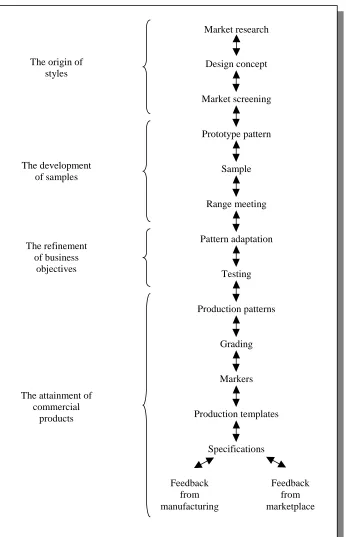
Textile/Apparel design processes in literature are covered from both a theoretical and empirical point of view. Since market and production constraints need to be integrated to the process, a combination of skills and therefore a collaboration of various corporate activities and functions are required. Theoretical models and empirical descriptions attempt to capture the creative design process to make it more tangible for all the design team members and management. The following figures show the product design and development processes from different points of view.
achieve successful product sell through. The business objective is to develop a line plan that can target the right market with the right product mix at the right time. The initial creative design process must be followed by efficient product development generating prototypes, patterns, costing and raw materials selection adequate both for consumer demand and production which also requires specs, grading, marking and operations sequence planning. Thus, design and development is labor and skill intensive. This paper will focus on the “origin of styles” phase, which will always be referred to as the creative design or conception phase for purpose of clarity.
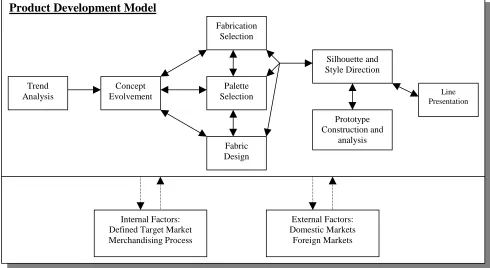
The following models focus more on this conception phase. The first one is based on a case study run by Gaskill (1992) in order to profile the functional activities performed by two specialty retailers carrying 100% private label merchandise. Having previously observed that retailers were increasingly involved in the process of product design by setting up specialized product development divisions. The objective was to differentiate themselves by creating unique products that catered to their target consumer’s specific preferences. Resulting from the study, the Retail Product Development Model (Figure 2-2) shows the sequence of events that take place throughout the creative apparel design process along with its internal and external influences. This model stops at the line presentation phase.
Figure 2-1. The process of apparel design and product development (Carr & Pomeroy, 1992)
Market research
Design concept
Market screening
Prototype pattern
Sample
Range meeting
Pattern adaptation
Testing
Production patterns
Grading
Markers
Production templates
Specifications
Feedback from manufacturing
Feedback from marketplace The origin of
styles
The development of samples
The refinement of business
objectives
The attainment of commercial
Figure 2-2. Retail Product Development Model (Gaskill, 1992)
Phase one includes trend analysis and concept evolvement. Influences come from both external and internal sources, both from the environment and personnel related to the design process directly or indirectly. This first step involves identifying the product styles and categories that are most on demand in the target market. A brief among design team members will usually initiate the process by defining “the garment type, age group, purpose, climate and price range which designers should aim at” (Carr & Pomeroy, 1992). Market research is critical to “starting off right” by capturing the market pulse and direction. The design team needs immersion in “all current means of communication of fashion ideas” (Carr & Pomeroy, 1992): fashion shows, textile/apparel trade shows, recent technological innovations, color and fabric libraries, store visits, opinion of buyers, market data services, trade press, product offer from the competition, etc. Cultural, social and political events should also be considered.
Product Development Model
Trend Analysis
Concept Evolvement
Fabrication Selection
Palette Selection
Fabric Design
Silhouette and Style Direction
Line Presentation
Prototype Construction and
analysis
Internal Factors: Defined Target Market Merchandising Process
External Factors: Domestic Markets
Table 2-1. Activities guide for apparel product development (Wickett, Gaskill & Damhorst, 1999)
Trend Analysis
Sources of trend inspiration:
• Shopping domestic markets
• Shopping international markets
• Media (magazines, television, mail-order catalogs)
• Fashion support services (trade shows, fabric libraries, styles services, runway shows, color services)
• Anywhere
• Internal sources (employees, sales tracking information)
• Competition
Employees involved in search for trends:
• Buying area (buyers, general merchandise managers)
• Design team
• Product development manager
• Fashion director
• Chief executive officer
• Merchandising manager
• Product manager Concept Evolvement
How decision on concept emerged:
• Perceptions gained from traveling to markets
• Evaluation of overall trend information
• Assessment of past sales trends
• Information gained from fashion services
• Instinct Palette Selection
How seasonal color decisions are determined:
• Based on information gained during Trend Analysis Source of color information:
• Color services
• Historical color data
• Color testing results
• New “emerging color stars”
• Purchased garments
• Trends
• Yarn samples
• Color swatches
• Color shows Fabrication selection
Criteria used in selecting product fabrication:
• Structural fabric characteristics (performance, quality, appearance, draping ability, weight, hand)
• Seasonal theme or timing of the line
• Aesthetics
• Marketplace trends
• Past sales history
• Fabric price
• Perceived customer benefits
Fabric Design
Source of fabric design:
• Original designs (prints/plaids) created by the company
• Both pre-developed designs and original designs
• Pre-developed designs from fabric companies Source of fabric design ideas:
• Books and magazines
• Fabric services (fabric libraries, print services, design services, forecasting services)
• Fabric samples
• Fabric mills
• Market trends
• Textile studios
Silhouette and Style Directions
Source of silhouette and styles:
• Original designs
• Branded merchandise (“knock-offs”)
• Both original designs and knock-offs Silhouette and style inspiration provided by:
• Marketplace (domestic and international)
• Current trends
• History (past successful basic style blocks) Line Presentation
Line presentation incorporated:
• Prototype samples
• Sketch-boards
• Computerized renderings
• Storyboards
• Paintings
• Pictures
• Swatches
• Fabrications Line decisions based on:
• Salability judgements
• Testing results
• Perceived customer reaction
• Cost
• Selling history
• Coordination with other apparel groups
• Marketplace trends
• Other (newness, variety, lead time, quality, color, instinct) Intervening Factors:
Internal factors:
• Needs of the defined customer base
• Sales trends
• Input from employees
• Analysis of store performance
• Specific garments being developed External factors:
• Fashion trends
• Domestic and foreign markets
• Competition
•
The second phase includes palette selection, fabric construction and surface design selection, and, silhouette and style directions. These activities are related to more tangible design elements utilizing design principles and skills, along with material and process knowledge to combine them effectively. Note that designers may be constrained by the “supply” end of the textile/apparel pipeline. The availability of fabrics is limited by inventory, production lead times for custom orders which fluctuate according to the raw material, dye colors, patterns, finishes, and quality standards required. Long textile production lead times force apparel companies to forecast long in advance and deal with a high amount of risk (McPherson, 1987).
Once market information has been gathered and directions defined according to all the demand and supply constraints mentioned above, the designer may begin translating concepts into a collection starting from fabric selection or themes by drawing a series of sketches. The result of this product identification phase should lead to a detailed plan outlining the styling concepts of the line, patterns and colors, the coordination of these elements. For apparel, line planning should include the specific fabrics and sundries needed, as well as size ranges required for each group of styles (McPherson, 1987). Generally, storyboards will be set up to display these combinations according to themes or stories (Carr & Pomeroy, 1992). At this final stage of the creative design process, sketches should include overall silhouettes and details such as collars and pockets, and eventually surface decorations such as pleats or fringes.
2.1.2
A profitable three dimensional system
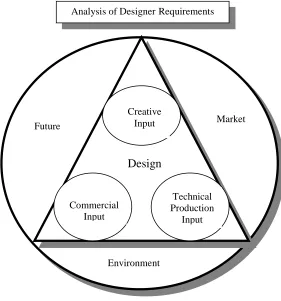
Good design saves and pays, if all the required dimensions are balanced and integrated properly. “Making the best of what we have, not doing extraordinary things, but doing things extraordinarily well” (Donaldson, 1987). A well-designed product should be easy to make, use, look at and buy. When considering one of these aspects, all other aspects should be kept in mind, which proves that design is truly an interdisciplinary science. “The total process of manufacturing and trading needs to be thought of in design terms” (van Praag, 1987). Generally, in both industry and educational organizations, the textile/apparel design process is viewed as a system of combined forces in creativity and aesthetics, production and technology, management and marketing. To develop successful designs, this combination should be reached at both corporate and industry wide level.
For instance, Ferner (1985) fears that in Germany there is a lack of cooperation between industrial enterprises and creative talents that limits his country's success potential in world markets. Trossurelli (1987) on the other hand, believes that the strength of “Made in Italy” comes from its reputation for stylish imagination integrated with industrial efficiency. This double image is due to the fact that Italian companies have been able to combine a very solid industrial experience and a new flexibility towards the market and the styles demanded, along with continuous research to achieve the highest quality and creativity possible. Creativity and efficiency can go hand in hand. Based on his experience at GFT, Trossurelli insists that “being original is not an obstacle to money making”. He attributes GFT’s group survival to working with stylists and designers, which lead them to a “system of flexible specialization”.
Knox then breaks each of these three major fields into groups of activities that directly interface with the designer. In Figure 2-5, he shows how creativity has multifaceted relation ships and affects all areas of company strategy.
Figure 2-4. Design relationships (Knox, 1989)
Figure 2-5. Creativity and design activities (Knox, 1989)
Analysis of Designer Requirements
Future Market
Environment Creative
Input
Commercial Input
Technical Production
Input Design
Creativity Consumer
Presentation
Products
Forecasting
Cost
Technology Research
Planning Design
Donaldson (1987) describes a similar triangular model developed by Willock, a former Design Director for the Courtauld Group, and referred to as the “three worlds of design”. The two base points are “life” and “technology”, and the apex is “business”. This business apex covers all aspects of trade and commerce, including merchandising, marketing, sales and distribution. Technology ranges from simple craft tools to highly sophisticated micro-electronic equipment. Life refers to human emotions and the response to environment, social change, culture, the arts and fashion. Stylists and designers are “inspired to capture, respond to, or reflect the mood of the times” (Donaldson, 1987). They “provide the creative input to the world of fashion, but this ability must go hand in hand with an understanding of marketing strategy in the business environment” (Rogers & Gamans, 1983).
2.1.3
Market Intelligence
Since typically 80-90% of a product’s life cycle cost is determined during the pre-production stages, careful planning is a necessary support to successful effective and efficient product design (AICPA, 1998). Inefficient product design can create bottlenecks for improved product quality and time to market. Ineffective product design can lead to poor quality or non-sellable designs. The starting point to successful product design is in the market and trend analyses.
2.1.3.1 Five Rights objective
Manufacturers seek shorter product development, sourcing, production and delivery cycles. This task is a particularly complicated for apparel due to the high number of Stock Keeping Units (SKUs), the need for constant change and working on at least three seasons and several lines at a time (Remaury, 1996). Development of new apparel products suffers from low success rates and difficulty in compressing time cycles. Currently management focus is set on reducing the later while increasing the former. Compressing time cycles at this stage is crucial to meet calendar deadlines and avoid losing market shares (AAMA, 1991).
Shah (1987) believes that “timing”, i.e. getting new styles to the streets at the precise moment the consumer is susceptible and ready for that design message, is related more to market intelligence and understanding the consumer, than speed and technology. Though a combination of all three elements really seems key to reaching perfect timing, I agree that design team efforts should particularly focus on and build on this market intelligence. "Getting the product right starts with design and trend information”, which over the past decade has triggered “a boom in market and fashion forecasting /consultancy business”. Forecasting is considered critical in apparel and all fashion related industries. McPherson (1987) states that forecasting can be seen as a form of gambling which relies upon “instinct, subtle indications of change, copying, varying, and blind luck”. The following section of this paper will show that this point of view is arguable according to other authors. In any case, McPherson suggests that merchandise planning, which translates marketing objectives into specific product lines, can help control potential losses and rapidly take advantage of favorable sales trends.
2.1.3.2 Marketing and design
consumers…. Figures alone are not enough: we must understand attitudes, interests, and preferences” (Robinson, 1987).
2.1.3.2.1 Identifying market needs
Identifying and understanding market needs is a complicated task, which still needs to be mastered. Currently, most consumers are not satisfied with their shopping experiences. According to Kurt Salmon Associates’ 1996 Annual Consumer Pulse Survey, 68% of the apparel shoppers know what they are looking for but 49% claim being unable to find it (KSA, 1996). They seek instant gratification. Satisfying them has become retailers’ top concern. Having pushed back in the pipeline some of their actions, they are increasing their operation costs for developing systems to better understand and target their customers, hence increasing responsiveness.
Retailers have shifted their focus from return on investment (ROI) to return on customers (Tandem Corp., 1997).Instead of trying to increase the number of individual transactions, they now want to increase the value of long-term customer relationships by supplying many “right” products to one customer rather than one average product to as many customers as possible. The main idea is to increase loyalty, attract old-customers back, and target new ones more efficiently.
To deal with the increasing complexity of market segmentation, marketing has evolved into a new field called “micro-marketing”, which focuses on pinpointing narrow local markets to target customers more efficiently. Based on multi-variable segmentation, Micro-marketing requires collecting a wide variety of data incorporating detailed demographic data as well as consumer information on psychographics, life styles and family life cycles, activities, interests, opinions, purchasing and consumption profiles, media used, etc. (Pitt, 1997; Brown A., 1997). The information may be based on individual consumers or on households (Carr & Pomeroy, 1992).
This detailed micro-data collected will be used to segment and locate target groups, plan relevant marketing mix, map product potential usage and help customize assortments. As a matter of fact, management focus is shifting from product to category (McCann, 1997), a.k.a. “consumption constellation” (Solomon & Englis, 1998), taking into account interaction between, rather than within, product categories to offer creative buying incentives and promotional products on a store-to-store basis. This knowledge is particularly relevant to develop different lines of apparel and accessories they may lead to bundled purchases.
Electronic commerce via the Internet will enable manufacturers to directly communicate with and supply consumers, while monitoring and analyzing the information each customer is individually pulling down from the World Wide Web. Micro marketing will become on a one-on-one basis. This next stage is already being called “relationship marketing”(Brown A., 1997). The Internet will thus greatly contribute to collecting data on the consumers in addition to that collected through current and past POS and marketing tools such as frequent user programs.
2.1.3.2.2 Response to market demand
promotion and place. As shown in Figure 2-6, this mix is centered around the target consumer and helps articulate the whole marketing strategy cycle from analysis and planning, to implementation and control stages. Product refers to the items and services offered by a company to its target market. Price refers to what will be charged for the purchase of the product. Place refers to where the product will be sold. “Promotion includes all the efforts of a company to establish the identity and enhance the demand for specific brands and designer name products or to encourage buying from certain retailers” (Jarnow & Dickerson, 1996).
Figure 2-6. Factors influencing marketing strategy (Kotler & Armstrong, 1994)
Demographic-economic environment
Political-legal
environment
Several authors have given different definitions of the marketing mix, which always include the notions of product, price, place and promotion, while classifying design as a category in itself. Rigamonti (1987) describes the four key areas of marketing mix as being quality, price, performance and design/image. According to Carr and Pomeroy (1992), the marketing mix for apparel companies includes advertising and promotion, the choice and design of retail outlets, and the design of a range of garments. Robinson (1987) adds visual merchandising, and retail staff’s attitude to this mix. Jarnow and Dickerson (1996) consider product design as one of the three stages of the merchandising process, along with product development and promotion to the point of sale, which are all related to the marketing mix.
Carr and Pomeroy define design as creating products for profit and conclude that “designing is an arm of marketing. For a business to make a profit, design must be market led, market driven and market justified”. Design is definitely one of the major marketing tools management has to woo consumers. Design is essential for generating and diffusing a specific image and style, and to differentiate a company’s brand name from that of the competition (Robinson, 1987). As companies seek to differentiate themselves from the increasing global competition, designers are under pressure to create brands and corporate identities. Though market research was initially considered as a potential risk for limiting creativity and destroying design concepts, designers now constantly turn to market data provided instantaneously through IT in order to integrate the consumers’ opinion into their creative process. The use of focus groups, interviews, consumer surveys to assess corporate identity, style and recognition as well as personal opinions on various topics from product design and retail environment to moral beliefs have become widespread (Blyth, 1989).
2.1.3.2.3 Micro and macro environments
survive they must “want to change”, and this change should be based on knowledge of three main categories: the customer, the market and society. This knowledge can help interpret what lies behind the statistics gathered in market research.
Figure 2-6 shows two types of environments in the inner diamond and the outer square. The microenvironment is closest to the company, affecting “its ability to serve its target market”. It includes marketing channels, suppliers, competitors, and public such as “the financial community, the media and the general public”. The macro-environment refers to the larger societal settings in which the company operates. Though there may be a supra-environment that affects all individuals all over the world, note that the environments referred to here may vary from one geographic location to another. Keeping track of the pertinent environments is crucial, especially for a company that designs its product line in New York, sources it in various foreign countries, and sells it to global markets.
The marketing of fashion goods is not an isolated process (Rogers & Gamans, 1983). Socio-economic trends prevail and need to be interpreted. Social, political, environmental, technological, even legal events, are interrelated to the fashions of a country and shape what will be bought and sold, in both an “overt and subliminal” manner. Forecasting is based on observation and analysis of all these factors, their potential synergies and correlations, to help determine what influences they may have on future consumer behavior and fashion (Robinson, 1987). The following section will identify how environmental influences interrelate with consumer wants, fashion cycles, brand image and style, thus influencing the design of new products.
2.2 The complex environment of design
it; we look at it; we read it; we listen to it. Society is permeated with fashion”. The list of possible demographic and social influences on fashion is enormous (Shah, 1987) and dynamic. “Fashion can never stand still” (Rogers & Gamans, 1983). Therefore, fashion changes with everything that is happening around us and is strongly dependent of time and context. Global and local conditions create an atmosphere that triggers feelings, attitudes, pressures among the consumer population that require change. Therefore, any industry that is related to fashion must understand the constantly shifting consumers’ inner emotions at the fastest pace possible. “It is largely psychological motives that encourage the growth, change, and perennial quest for newness in fashion” (Rogers & Gamans, 1983). Carr and Pomeroy (1992) define fashion more specifically as “the complex of activities and attitudes … which influences the behavior of different groups in relation to clothing”. People can relate to it or go against it. Fashion is a reference to follow or to counter. Burns (1998) concludes that fashion can be studied either as an object or idea, or as a process of change. “Although the term “fashion” is often associated with dress and adornment, “fashion” can be related to any object or phenomenon that changes over time based upon individuals’ preferences”.
In any case, it all starts with the needs and wants of individual consumers. As a matter of fact, even Shah (1987) who asserts that designers are actually at the root of it all, also contends that cyclical, socio-political and cultural factors, as well as “the street” interact with fashion. Therefore, he too recognizes that the initial inspiration comes from all members of society, including potential consumers and design professionals.
2.2.1
Consumers
whether they are consumers or designers, and it involves the self and the environment. A complex combination of psychological, social, and economic forces influences consumers in their decision on how to dress.
2.2.1.1 Internal psychological factors
Clothes are both self-protective and self-assertive. Understanding theories affecting individual perceptions, such as personality profiles and the psychology of color, contribute to enlightening “fashion marketers” as do the “principles of need fulfillment” (Rogers & Gamans, 1983).
2.2.1.2 External social factors
Dress is a medium by which we present ourselves to society and therefore constitutes an implicit mean of self-expression. “We are all creatures of our environment and, unless forced to do otherwise, we will express what we are or what we hope to become through the way we live and dress” (Rogers & Gamans, 1983). Dress includes clothing as well as accessories, hair/beard styles and appearance condition. (Damhorst, 1990). “The way we dress is a complex mean of communication, sending out multiple messages on our identity, our values, our mood, and our attitude. Dress messages are non-sequential and non-linear and therefore resist precise cataloging and identification of single cues which trigger the inferences” (Damhorst, 1990). Colors, textures, patterns, and silhouettes come together to create one specific whole message which is different from the simple sum of the visible messages sent by each item individually. The relentless process of fashion adoption and change increases the vagueness and complexity of dress meanings. The potential message transmitted depends on the context of perception, the stimuli of the wearer and the perceiver. Therefore, perception plays a crucial role in the meaning of a garment and its associated value added by a consumer (Solomon & Englis, 1998). Designers have the difficult task to disassociate with their own perceptions and integrate those of the target consumers.
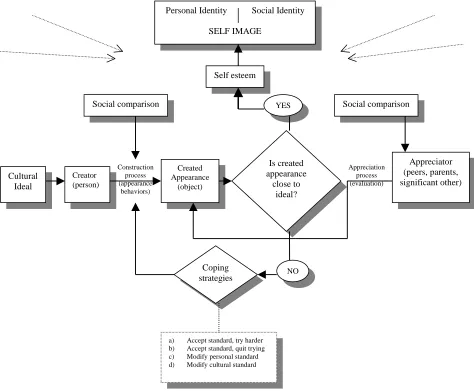
One’s dress involves a social dimension, and at the same time, since self-image results from social interaction with others, it is a social phenomenon (Figure 2-7). Dress is a medium to turn obligatory into desirable (Hamilton & Hamilton, 1989). However, social models such as lifestyles or fashion can be either “aspiration references” or, on the contrary, “avoidance references” (Solomon & Englis, 1998), as suggested in Figure 2-7 under “coping strategies”.
2.2.1.3 Context
multiple factors: age, income, single or married, urban or rural, job, work environment, personal life environment, activities, hobbies, lifestyle, health, etc. During one’s lifetime, these contextual factors will evolve along with individual identities and roles, as defined in Figure 2-8 where the Self refers to a global sense of who one is. This abstract and inclusive concept of Self is composed of a subset of identities [I], which represent the self-in-context. Identities are constructed and negotiated though social processes and composed of a subset of roles [R], or “typified responses to typified expectations”. The concept of roles, which is the most tangible of the three, “refers to performance or enactment (person acting, following a script that is prescribed)”.
Figure 2-7. Model of the effects of social comparison on the construction and
Coping strategies Appreciation process (evaluation) Construction process (appearance behaviors)
Personal Identity Social Identity
SELF IMAGE Self esteem Social comparison Appreciator (peers, parents, significant other) Is created appearance close to ideal? Created Appearance (object) Cultural Ideal Social comparison Creator (person) YES NO
Figure 2-8. Schematic illustration of self, identities, and roles (Kaiser, 1990)
Context, including its associated roles and identities, affects individual perceptions and has a major impact on consumer preferences, selection, use and combination of clothes. Context determines the required priorities set by the user: prestige, comfort, economy, or specific needs such as sportswear, work uniforms, or maternity wear (Carr & Pomeroy, 1992). In a broader scale, context can be associated with culture and society, geography and climate, as well as general economic conditions, which all go through many transitions in time. As demographics change from one generation to the next, so do issues related to gender and age such as morality, health, and social status. Solomon and Englis, (1998) stress the need for companies to consider perception and role differences between consumers depending on their social environments.
The model presented in Figure 2-9 shows the various levels of contexts, embedded within one another and defining the perception of clothes. The model attributes a title at each level along with a few non-exclusive examples of factors influencing that specific context level. The inner layers refer specifically to the complete dress appearance. Clothing, including garment pieces, materials and all perceptual elements are embedded in the larger context of appearance, which includes garment to garment and/or accessory combinations. These are viewed in conjunction with the wearer’s body and personal attributes as defined in the central layers of the model. The outer layers represent the micro and macro environments of the user, referring to his or her roles and identities.
SELF
I I I I
context for viewing his or her appearance, which may be framed in terms of group associations. Culture provides a larger framework for interpreting that appearance according to aesthetic rules, historical context, and fashion” (Kaiser, 1990).
Figure 2-9. Contextual model of clothing sign system (Damhorst, 1990)
Time Fashion Aesthetic rules
Occupation Family Organization Peers
Yard work Business meeting Party Classroom
Near environment Setting
Gender Age Physical attractiveness
Sound of materials Movement of materials
Grooming Fit
• Line
• Shape
• Form
• Color – hue, value, intensity
• Texture, pattern
• Structure of material
• Apparent weight
• Fiber
Identifying the linkages within and across contexts is necessary to understand the similarities and differences in the assignment of meaning to clothing. Defining the contexts that affect the target consumer, and understanding their interactions should be integrated in the creative design process because of the impact they have on the consumer’s perception and selection of dress elements.
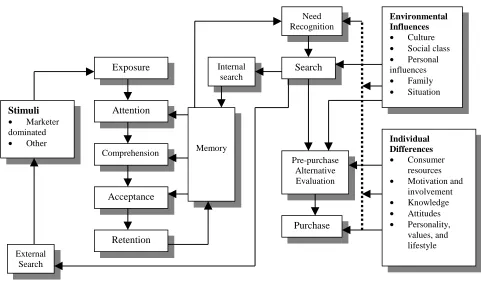
Figure 2-10 shows the multiple processes the consumer goes through prior to making a purchase decision. The first process involves recognizing a need, which will trigger a search for information either stored in memory (internal) or acquired from the environment (external). Preferred alternatives will be evaluated before making a final selection for purchase. The evaluative criteria incorporates “standards and specifications used by consumers to compare different products and brands” based on contextual factors.
Figure 2-10. Consumer decision process (Engel et al., 1995) Stimuli • Marketer dominated • Other Exposure Attention Comprehension Acceptance Retention Memory Internal search Search Need Recognition Pre-purchase Alternative Evaluation Purchase Environmental Influences • Culture
• Social class
• Personal influences • Family • Situation Individual Differences • Consumer resources
This model shows how marketing and other sources of stimuli such as “word of mouth” or Consumer Reports can influence the information processing that takes place prior to storage in memory. This processing starts with exposure, which activates one or more of the senses leading to attention once the consumer has been attracted to the incoming message and considers it relevant to his or her needs. The message is further analyzed against categories of meaning stored in memory, which are influenced by past and present contexts and experiences, until a personal comprehension is achieved. Beliefs and attitudes may be modified if the message is accepted and retained thus being stored itself in memory for future use and evaluation (Engel et al., 1995).
The processes explained in this model help understand the dynamics that lie behind fashion and product life cycles, as well as the creative design process. The success of new products builds on the success of previous products.
2.2.2
Fashion environment
All these contextual and individual factors that affect a person’s or a group’s selection of what they want their appearance to be, interact with fashion. As with dress, fashion both integrates social factors and is itself a social phenomenon. “The cyclic changes of fashion currents are cultural factors which in turn influence culture itself” (Entrada, 1998). Rogers and Gamans (1983) examined fashion in a marketing context. They insist that the fashion cycle must be considered when creating a marketing mix and that market positioning and fashion image are interrelated.
2.2.2.1 Fashion cycle
Figure 2-11 and Figure 2-12 show the process of fashion acceptance and the effect it has on various elements of the marketing mix during the life cycle of a garment style (Packard, 1983). The various stages describe the product's life cycle on the marketplace once it has been designed and developed: introduction, growth, maturity and decline. Today, the introduction stage is increasingly intertwined with the product design and development processes, which integrate continuous market information and consumer feedback. Fashion innovators will adopt the style initially. Opinion leaders and early conformists follow and contribute to increasing the popularity of the style. In the maturity stage the style becomes widely accepted by mass-market consumers, followed by late fashion adopters at the beginning of the decline stage. Finally “fashion isolates” and/or laggards will adopt the style once it has become already obsolete (Kaiser, 1990). Traditionally these consumer groups were associated with specific types of income levels, social status and life styles as can be determined from the associated price and store groups shown in Figure 2-11. Based on the literature reviewed, these consumer group definitions based on the trickle down theory of fashion leadership are no longer restrictively associated with the value, price and store groups defined in Packard’s figures.
Figure 2-11. Fashion acceptance: consumers, prices, stores (Packard, 1983)
Highest prices Initiators 2.5 % Early acceptors 13.5% Early majority 34% Late majority 34 % Laggards 16% High priced
Fine specialty stores
Closeout prices Popular prices Moderate prices Mass distributors, discounters, factory outlets Department and
moderate-priced specialty stores Better department
and specialty stores
Figure 2-12. Product life span of fashion (Packard, 1983)
2.2.2.2 Fashions with an “s”
Current fashions are a reflection of the multicultural societies we live in (Burns, 1998). As the world becomes smaller through worldwide communication and media, all these fashion influences are more complex than ever before because they have become global. Traditional wear is decreasing all over, as casual Western wear becomes the norm (Stuart-Smith, 1987).
Historically, a leading fashion was decided in France, originated and transmitted by a few trendsetters in the royal courts. During the first half of our century, couture houses developed luxurious models, which then trickled down through society thanks to manufacturers who translated the designs into more affordable garments. Today couture no longer dictates a single fashion standard. The world now has a pluralistic outlook and fashions are generated all over the globe instantaneously. As a result, individuals can select and employ a variety of fashions in a manner that they believe best expresses how
Style pioneering
Style growth in popularity
Style maturity
Style abandonment Style
decline
Greatest status value
Status value
“In Style”
Price decline
Closeout prices
they wish to be perceived. According to Shah (1987), this makes the market place a whole lot more dangerous due to extreme unpredictability.
Despite the extreme diversity and individualism in styles of appearance, themes and similarities appear among groups, subcultures, and lifestyles. Today “fashion ideas are selected and promoted among groups in society at all levels. Hence, a number of looks are developed which appeal to different groups” (Carr & Pomeroy, 1992). Trends are generally short-lived “fashion currents” adopted by specific groups. They are really unpredictable in that no one knows when they will come or when they will leave. Some predicted trends never happen while others seem to stick indefinitely (Shah, 1987). Avant-garde fashion trends can pop up anywhere and trickle down, across and/or up as shown in Figure 2-13.
Figure 2-13. Theories of fashion movement (Jarnow & Dickerson, 1996)
2.2.2.3 Style and brand image
Because of its aesthetic component, images have always been important in fashion. “Dress stimuli” are generally of visual format such as photographs, drawings, films, video or live encounters (Damhorst, 1990). The visual aspect of clothing is more crucial than ever in today’s multi-media “visual society” where fashion and marketing both focus on image, and where consumers of fashion have become “consumers of illusion” (Entrada, 1998). Visual images have become more powerful, speaking to a greater number across the globe; aesthetics are critical. Fashion not only focuses primarily on
brand image, but fashion has become a mass media in itself. Designers and top models have become “pop icons” who perform not only on the highly publicized high-entertainment fashion shows, but also in TV shows, advertisements, movies, etc (Walz &Morris, 1977). Since “a picture is worth a 1000 words” and is understood internationally, designers who have managed to efficiently market their image have commanded influence and made huge profits in various market categories. Re-targeting or re-launching an image can stimulate total market demand and expand the life cycle of their products and/or their brand(s). For instance, designers may chose to focus on new age segments, or another “lifestyle product” market, such as cosmetics, household decorative products or car interior design. Indeed, fashion now extends beyond clothing into lifestyles, as the product lines developed by designers in the last 20 years have proven. Even retailers have followed this trend; the main objective of The Limited is to become “the leading retailer of lifestyles fashion for women in the US” (Robinson, 1987).
2.2.3
External and internal influences
Most ready-to-wear designers who cater to mass markets, “work as part of a marketing system which acts as a pluralist decision-making process” (Carr & Pomeroy, 1992). Carr and Pomeroy define four types of professionals who are active members of the design system. The world famous designers originate themes or trends. All the media and consulting agencies predict colors, textures and shapes which make up “the fashion matrix”. The retail buyers ultimately select what their customers will be able to purchase. Finally, the individual consumer will select and wear the garments offered. All these people provide environmental and corporate sources of creative design, interacting through trade shows, “consultancies, fashion shows, media coverage and shop windows” (Carr & Pomeroy, 1992).
2.2.3.1 Environmental sources of creative design
There are now a number of cities around the world considered to be inspirational fashion centers. “Fashion market centers are the places where it all begins” (Rogers & Gamans, 1983). Fashion centers serve as a focal point for new styles and ideas and spread out to the consumers via retail buyers and fashion media. Producers and distributors meet in order to move the resulting promoted goods to the final consumer. Without the exchange of ideas they provide between the different industry members, “the fashion industry would become stagnant.… Even when there is not a seasonal market going on, fashion market centers are hubs of activity”. The experts, who populate these fashion centers, interpret market pulse into new styles and predictions.
includes specialized organizations in fashion professions, as well as those helping capture fashion as a global phenomenon, from societal behavior to marketing research. The creative system refers to well-known designers, fashion streets, boutiques and department stores, as well as a larger context of cultural life such as art exhibits, opera houses, theaters, which prompt an atmosphere and an open-minded society interested by creative expression.
All fashion related industries are subject to fashion movements. However, “the higher the industry ranges in international comparison, the more it is compelled not just to react to design and fashion innovations from outside but, rather, to give appropriate impulses for the future course of fashion trends” (Ferner, 1985). That is the case for instance of the American movie industry or the European apparel industry, which are major sources of inspiration for textile/apparel designers all over the world. Indeed, fashion designers are inspired by worldwide history of costume and fashions as well as trends in other aesthetic areas such as cinema, television, visual arts in general and architecture. “Although working separately and secretly … designers often produce collections with common underlying themes” (Carr & Pomeroy, 1992).
Perna (1987) illustrates how the fashion industry is activated by various “gears” which turn in perpetual motion (Figure 2-14), requiring any fashion related company to be plugged into the multiple check points of the fashion information network (Figure 2-15). Shah (1987) claims that it is actually a small group of people who work for trend services or put together exhibitions like Premiere Vision who make fashion. Not only do they research and rationalize all the information, but also “they coordinate their fashion accordingly and they have the muscle and influence to pass on these ideas in a pure and more personalized format to their own clients, magazines, etc”. According to him, this is what makes Paris the styling center rather than the individualistic Italy.
the color card for a certain season. They meet 20 to 22 months prior. Even though the predicted color chart is known to have flaws, with an expected 70-80% success rate, “everyone takes it because it is the first, the starting point from which more individualistic lines will evolve” (Shah, 1987). Color is indeed considered to be the most powerful basic design element (Donaldson, 1987).
2.2.3.2 Corporate sources of creative design
In the 1990s, companies started having increasingly team-based design structures. The teams include product merchandisers and retail buyers along with designers and stylists. Design managers are also introduced to overlook the whole process. After focusing more specifically on the functions and synergies between these professionals in the creative process of designing products, emerging participants defined in literature will be presented.
2.2.3.2.1 The designer and the market
The key to a designer’s success is the ability to understand people: “their likes and dislikes, their wants and needs, their emotions” (Donaldson, 1987). Designers must be aware of consumer requirements and market influences. Figure 2-7 shows how the designer, “creator”, integrates the system of social influences that intervene on self-image, appearance construction and evaluation.
Designers need “flair” in order to seek new ideas without staying limited by current knowledge alone (Donaldson, 1987; Robinson, 1987). According to Shah (1987) the fashion system has lost its appeal, and the consumer has taken over. People are the key to the marketplace. Consumer watching in malls, department stores and streets has become essential to develop successful design flair. Designers should never be too far ahead of the masses in order to pull them forward in a “mutually appreciative and understandable direction” (Donaldson, 1987).
designers, favorite stores). With the aging of baby boomers, and the increased importance of older consumer markets, it may be interesting to go even further in a micro-marketing mode and consider the occupations and marital statuses of the children, and determine if there are any grand children.
2.2.3.2.2 Designer vs. stylist
Authors have different definitions of designer and stylist. In every case however, both professionals have the lead role in design creativity.
According to Rogers and Gamans (1983), a couture designer creates high-fashion designs, while stylists usually work on adaptations of those styles for mass market. The authors contend that these design professionals do not have the same type of talent. Stylists have a knack for developing garments targeted at volume markets, while couture designers have that “undefinable something that makes the innovators of new fashions”. As a matter of fact, in the apparel industry couture shows are expected to deliver innovative concepts that will trigger the next seasonal trends.