ABSTRACT
RICHARDS, TYLER V. Performance Characterization of IP Network-based Control
Methodologies for DC Motor Applications. (Under the direction of Dr. Mo-Yuen Chow.)
Using a communication network, such as an IP network, in the control loop is
increasingly becoming the norm. This process of network-based control (NBC) has potential
profound impact in areas such as: teleoperation, healthcare, military applications, and
manufacturing. However, limitations arise as the communication network introduces delay
that often degrades or destabilizes the control system. Four methods have been investigated
that alleviate the IP network delays to provide stable real-time control. A performance
measure is defined for a case study on a DC motor with a networked proportional-integral (PI)
speed controller with various network delays and noise levels. Matlab simulation results
show that NBC combined with these techniques can successfully maintain system stability,
BIOGRAPHY
ACKNOWLEDGMENTS
TABLE OF CONTENTS
LIST OF FIGURES. LIST OF TABLES.
CHAPTER 1. Introduction.
CHAPTER 2. Brief description of four NBC methods. 2-1. Gain scheduling middleware (GSM). 2-2. Optimal stochastic methodology. 2-3. Queuing methodology.
2-4. Robust control methodology. CHAPTER 3. Case study: DC motor.
3-1. System description.
3-2. Performance characterization. 3-3. Network delay.
CHAPTER 4. Simulation results.
4-1. Gain scheduling middleware (GSM). 4.1.1 DC motor application.
4.1.2 Results.
4-2. Optimal stochastic method. 4.2.1 DC motor application. 4.2.2 Results.
4-3. Queuing methodology. 4.3.1 DC motor application. 4.3.2 Results.
4-4. Robust control methodology. 4.4.1 DC motor application. 4.4.2 Results.
CHAPTER 5. Noise.
5-1. Gain scheduling middleware.
5-3. Queuing methodology. 5-4. Robust control methodology. CHAPTER 6. Conclusion.
6-1. Benefits table. 6-2. Future work.
REFERENCES. APPENDIX. A1. GSM.
A1.1. Simulink diagram. A1.2. Simulink files.
A1.2.1. find_beta_costs.m A1.2.2. find_weights.m A1.2.3. find_weights_part2.m A1.2.4. test_findcost.m A2. Optimal stochastic method.
A2.1. Simulink diagram A2.2. Simulink files
A2.2.1. run_sim_once.m A3. Queuing methodology.
A3.1. Simulink diagram. A3.2. Simulink files.
A3.2.1. setup_test_sub10_init.m A3.2.2. get_results1.m
A3.2.3. calculations.m A4. Robust control methodology.
A4.1. Simulink diagram. A4.2. Simulink files.
A4.2.1. setup_d1.m A4.2.2. d1_after.m
45 47 49 49 51
A4.2.3. find_cost.m A4.3. dkitgui.
A4.3.1. Setup.
A4.3.2. Sample results.
LIST OF FIGURES
Figure 1. Structure of a network-based control system. 2
Figure 2. Structure of GSM. 6
Figure 3. Configuration of networked control system utilizing queuing methodology.
9
Figure 4. Delay compensation algorithm with predictor blocks. 12 Figure 5. Timing diagram for τsc =τca =δ . 13 Figure 6. Controller-Plant Modeling with Network Delays. 14 Figure 7. Robust analysis for a general interconnection system. 15 Figure 8. Nominal PI controller step response with ( *, *) (25.572,0.995)
I P
K K = . 19
Figure 9. MSE cost vs. β. 21
Figure 10. P.O. cost vs. β. 21
Figure 11. tr cost vs. β. 22
Figure 12. Histogram for η=0.0001sec RTT delay. 24 Figure 13. Cost vs. β for η=[0.0001,0.001,0.005] network delays. 27 Figure 14. Cost vs. β for η=[0.01,0.05,0.1] network delays. 27 Figure 15. Nominal PI controller vs. GSM step responses for a) η=0.0001 b)
0.001
η = c) η =0.005 d) η=0.01 e) η=0.05 f) η =0.1 seconds.
29
Figure 16. Nominal PI controller vs. Optimal stochastic method step responses for a) η =0.0001 b) η =0.001 c) η =0.005 d) η=0.01 e) η=0.05 f) η=0.1 seconds.
32
Figure 17. Nominal PI controller vs. Queuing methodology step responses for a) 0.0001
η = b) η =0.001 c) η =0.005 d) η=0.01 e) η=0.05 f) 0.1
η = seconds.
35
Figure 18. Nominal PI controller vs. Robust control methodology step responses for a) η =0.0001 b) η =0.001 c) η =0.005 d) η=0.01 e) η=0.05 f) η=0.1 seconds.
Figure 19. Noise, w k( ) introduced into the control loop. 41
Figure 20. Noise distributions. 41
Figure 21. Typical step response with 5% noise, 0.0001 sec RTT delay. 41
Figure 22. Performance comparison with noise. 42
Figure 23. GSM noise vs. delay performance. 43
Figure 24. Optimal method noise vs. delay performance. 44 Figure 25. Queuing method noise vs. delay performance. 46 Figure 26. Robust methodology noise vs. delay performance. 47
Figure 27. find_beta_sim.mdl 55
Figure 28. lqr_dc_delay_tweak.mdl 64
Figure 29. queue_comp3_sub10.mdl 68
Figure 30. robust_delay1_K3.mdl 72
Figure 31. dkitgui setup screen. 87
LIST OF TABLES
Table 1. DC motor parameters. 17
Table 2. Optimal β gains for various time delays. 26 Table 3. Performance comparison of four methodologies for different RTT
network delays.
30
Table 4. Queue lengths for various delays. 34
Table 5. Optimal robust controller for each delay. 37 Table 6. Peak µ values for controller generated during each DK iteration. 37
Table 7. GSM noise results. 43
Table 8. Optimal method noise results. 45
Table 9. Queuing method noise results. 46
Table 10. Robust methodology noise results. 48
CHAPTER 1
INTRODUCTION
A recent trend in control systems is to incorporate a network communication medium
into the control loop [1], termed network-based control (NBC). One such medium under
investigation is the Internet because of its attractive advantages such as: affordability,
widespread usage, and availability. For industrial electronics and factory automation areas,
networked control systems (NCS) provide a promising solution by reducing wiring costs,
wiring complexity, and streamlining the use of assets. However, for an Internet Protocol
(IP)-based NCS, the network medium introduces several difficulties that must be resolved for
successful, practical use of NBC. The major challenge is the IP network-induced delay effect
on the control system. It is well known that the delay introduced by the network can degrade
performance and destabilize the control system. Thus, most IP-based control applications
have been limited to non time-sensitive applications. It is important to develop strategies to
compensate or alleviate the network delay effect on real-time applications. Conventional
methods for network-based control address constant network delays. The Internet introduces
stochastic time delays such that these methods may not be applicable. Several advanced
techniques have been presented [2-5] that compensate or alleviate the stochastic network
delay, potentially enough to be used in critical real-time applications. NBC combined with
these techniques aim to eliminate the detrimental delay effect and prevent destabilization of
the closed loop control system in an IP network environment.
the controller to the actuator of the plant as τca, and the time delay from the sensor of the
plant to the controller as τsc. Figure 1 shows the typical structure of a network-based
control system. The terms for NCS and NBC systems are interchangeable. For this thesis,
the delays associated with processing time are assumed constant and much smaller than τca
and τsc, and therefore can be lumped into those terms to simplify the problem.
Additional assumptions include [1]:
z The network traffic cannot be overloaded.
z Network transmissions are error-free.
z Every packet has the same constant length.
z Every dimension of the output measurement or the control signal can
be packed into one single packet.
sc
τ
τ
caController
Plant
Sensor Actuator Network
Stochastic network delays present difficulties when formulating the NBC problem.
Because of this, network delay has been approximated in numerous ways, such as periodic
delays [6], exponential distributions[5], or by using Markov models [7]. Once a satisfactory
model has been established, NBC can be applied on a variety of applications. The real-time
NBC technology has several potential applications including iSpace [8], teleoperation [9],
aiding the elderly, military applications, and other times when a human presence is not
feasible.
Various methodologies have been investigated with the task of maintaining system
stability and limiting performance degradation caused from the network delay. This thesis
selects four methods that have shown optimistic results for viable use as a real-time
network-based control scheme. Preliminary results on a DC motor application show their
performance on the compensation of the network delay for each of these methods.
The four methods are:
1) Gain scheduling middleware (GSM) method [5, 10]
2) Optimal stochastic control methodology [4, 11]
3) Queuing methodology [3, 12]
4) Robust control methodology [2, 13, 14]
Gain scheduling middleware (GSM) retains the nominal controller for the non-delay
case and inserts a middleware that modifies the effective gain applied based on the network
delay data it continuously monitors. The optimal stochastic method approaches the problem
as a Linear-Quadratic-Gaussian (LQG) problem where the LQG gain matrix is optimally
robust control method considers the delays as multiplicative perturbations on the system and
uses robust control to minimize the effect of the perturbations and maintain system
performance.
This thesis is structured as follows: Chapter 2 will present and describe each of the
methodologies. Chapter 3 will introduce the DC motor model and the performance measure
used for the simulations. Chapter 4 will report the results of each method. Chapter 5
addresses the performance when noise is added to the system. Finally, Chapter 6 will
conclude the thesis with closing remarks, pros and cons of each methodology, and suggest
CHAPTER 2
BRIEF DESCRIPTION OF FOUR NBC METHODS
2-1. Gain scheduling middleware (GSM)
Gain scheduling middleware (GSM) uses a previously designed controller in addition
to its middleware to compensate for the network delay [5, 15, 16]. Redesigning a control can
be cost prohibitive. Therefore, by using GSM the original controller is retained and its
output is modified by the GSM middleware to compensate for the network delay.
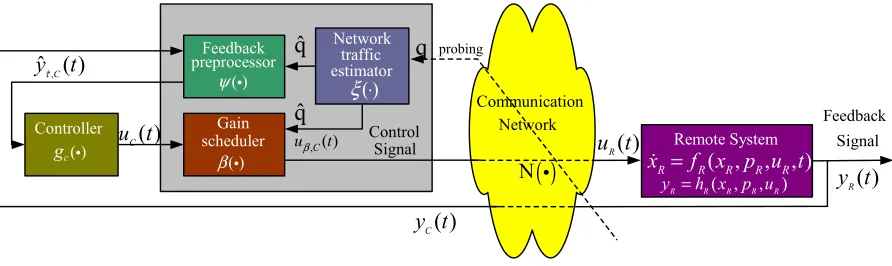
The basic components of GSM, shown in Figure 2, are as follows [15].
1) Network Traffic Estimator: The function of the network traffic estimator
is to estimate the current network conditions. It monitors a probing packet to
find the roundtrip network measurements that are characterized by q. The
variable q is then used by the feedback preprocessor and the gain scheduler to
estimate the current network delays.
2) Feedback Preprocessor: The function of the feedback preprocessor is to
gather the sensor data of the remote system and perform any functions on the
data before passing it to the controller. These functions can include filtering
noise or predicting the state of the remote system.
3) Gain Scheduler: The function of the gain scheduler is to modify the
controller’s output with respect to the current network conditions
( ) R u t ( ) R y t ( ) C y t ( ) ξ ⋅ ( , , , )
R R R R R
x =f x p u t
( , , )
R R R R R
y =h x p u q
( )
N i Network traffic estimator Control Signal probing Communication Network Remote System Feedback Signal ˆq ˆq,C( ) uβ t
Feedback preprocessor ( ) ψ i ( ) C u t , ˆ
ˆ ( )C y tτ
Controller ( ) c g i ( ) β i Gain scheduler
Figure 2. Structure of GSM.
The GSM methodology is adapted to the particular system of interest. In this thesis,
GSM is applied on a networked PI controller for a DC motor.
2-2. Optimal stochastic methodology
The optimal stochastic control methodology treats a networked control system with
random network delays as a Linear Quadratic Gaussian (LQG) problem. This method was
first proposed by Nilsson [4]. To control the system, the methodology assumes that
sc ca T
τ +τ < , in addition to the previous assumptions. Without this condition, the control
signals could arrive at the actuator out of order, making analysis much more difficult. In
addition, if this assumption is violated, the method cannot guarantee system performance.
The system dynamics are assumed to be linear and can be described by:
( ) ( ) ( ) ( )
( ) ( ) ( )
x t Ax t Bu t v t
y t Cx t w t
= + +
= + , (1)
where ( )x t ∈Rn , ( )u t ∈Rm, and ( ), ( )v t w t ∈Rn . A and B are matrices of appropriate
noises with zero means [4]. This system can be discretized into kT sampling periods
resulting with the following dynamics:
0 1
( 1) ( ) ( , ) ( ) ( , ) ( 1) ( )
( ) ( ) ( )
sc ca sc ca
x k x k u k u k v k
y k+ = Φ=Cx k +w k+ Γ τ τ + Γ τ τ − + ,(2)
where
0 0
1
( , ) ( )
( , ) ( 1)
sc ca k k sc ca k k AT T
sc ca As
T
sc ca As
T e
u k e dsB
u k e dsB
−τ −τ −τ −τ Φ = Γ τ τ = Γ τ τ − =
∫
∫
, (3)
and τsc is the network delay from the plant output (sensor) to the controller; τcais the
network delay from the controller to the plant input (actuator), and T is the sampling rate of
the sensor [11].
The goal of the optimal stochastic method is to solve the control problem by
minimizing the cost function in the case that full state information is available.
{
}
10 ( ) ( ) ( ) ( ) ( ) ( ) ( ) T N T N k
x k x k
J k E x N Q x N E Q
u k u k
− = = +
∑
, (4)
where E
{ }
• is the expected value, and QN and Q are weighting matrices. The optimalcontrol law that minimizes the cost function is:
* *
* 1
( sc) k k k x u K u τ − = −
, (5)
where K*
is the optimal gain matrix after solving the formulated LQG problem [4].
In practice, a table for K[0, ](τsc)
∞ , where K[0, ]∞
( )
• is the optimal gain matrix forinterpolated from the tabular values in real-time. This is done because of the calculation
intensive process of finding *( sc)
k
K τ .
This method can be simplified into a suboptimal method that has been shown to give
results close to the optimal method but uses less calculations during runtime [11]. The
control law for this method is given by:
1
[ p p] k
k k k
k
x
u K
u −
= − Φ Γ
, (6)
where
( )
0
sc ca
k k
sc ca
k k
A E
p k
E
p As
k
e
e dsB
τ τ
τ τ
+
+
Φ =
Γ =
∫
. (7)ca k
Eτ is the expected value of τca. K is the optimal LQG gain found from the system without
delay. Thus the non-delay gain, K, is modified by a matrix containing the delay information
for the current step and a prediction of the delay to be experienced from the controller back
to the plant. This operation can be seen as a prediction from the state estimate at the current
time, kT, to a state estimate when the control signal is applied at the plant [11]. This is an
alternative to having the delay information embedded in the K gain matrix. This approach
will be used for this thesis because of its near optimal performance and reduced calculation
2-3. Queuing methodology
The purpose of adding queues into a networked control system is to reshape the
random time delays into deterministic delays. As an effect, the system becomes
time-invariant. One such method is proposed by Luck and Ray [3, 12]. They propose to use an
observer to estimate the plant states and a predictor to compute the predictive control. The
past measurement data and the control data are stored in a First-In-First-Out (FIFO) queue,
defined as Q1 and Q2 of sizes r and α , respectively. The structure of a network control
system utilizing the queuing methodology is shown in Figure 3 [1].
r 1 Q α
2
Q x k( − +α 1) x k r( + )
( ) u k r+ ( )
Z k
( )
y k u k( )
sc
τ
τ
caController
Plant
Sensor Actuator Predictor Observer
Network
Figure 3. Configuration of networked control system utilizing queuing methodology.
The steps for applying this methodology are listed below [1]:
z Using the set of past measurements Z k( )=
{
y k( −φ), (y k− −φ 1,...}
z The predictor uses ˆ(x k− +α 1) to predict the future state ˆ(x k r+ ).
z The controller computes the predictive control u k r( + =) K x k r( (ˆ + )),
where K is the controller gain, and then sends (u k r+ ) to be stored in
1
Q .
The model of the plant must be very precise since the performance of the observer
and predictor depend on it. For a closed-loop NBC system, the various components are
defined below.
Plant model:
1 ,
k k k
x+ = Ax +Bu yk =Cxk; (8)
Observer model:
1|1 |1 ( |1);
k k k k k k
z + =Az +Bu +L y −Cz (9)
δ-step predictor:
1| | 1
k k k
z +δ =Az δ− +Bu for δ ≥2; (10)
Predictive control:
|
k k k
where zk|δ :=xˆk k| −δ is the estimation of xk given the measurement history
{
, 1, 2,}
k k k k
Z −δ = Z −δ Z − −δ Z − −δ … , {A,B,C} are the realization of the plant system, and the
estimation error:
|1
k k k
e = −x z . (12)
k
Γ and Lk represent the proper controller and observer gains, respectively. δ represents the
number of sample times in a given delay time, or
sc ca T
τ τ
δ = + . (13)
Then, the closed loop system equation can be expressed as
1
1 0
k k k k k
k k k
x A B B x
e δ A L C eδ δ
+ − + − − + Γ − Γ Λ = −
, (14)
where 1 1 1 1 1 1 1 1 1 ( ) : ( ) k j j i i
k k k j
i j
A L C
A L C A L C
I δ δ δ δ δ − + − − − − − − − − + − − − − + Λ = × −
∏
∏
∏
if if 2 0 2. δ δ ≥ ≤ < (15)and the plant model is assumed to be exact [3]. Proof of this proposition can also be found in
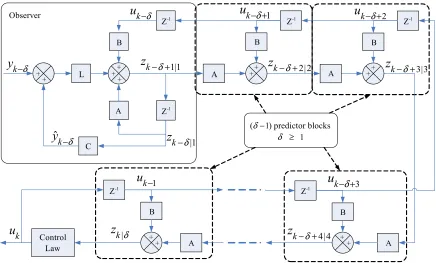
[3].
The schematic diagram of a δ -step delay compensation algorithm is shown in Figure
4, where δ represents the delay length in terms of sampling time steps. The lengths of the
1
k
u − +δ
2|2
k z − +δ
2
k
u − +δ
3|3
k z − +δ
3
k
u − +δ
1
k
u −
4|4
k z − +δ
| k z δ k u + + ++ + + + + k
y −δ
ˆk
y −δ
k
u −δ
|1
k z −δ
1|1
k z − +δ
+ + + + + 1 δ ≥
(δ−1) predictor blocks A
A A
A A
B B B
B B
L
C
-1
Z Z-1 Z-1
-1 Z -1 Z -1 Z Control Law Observer
Figure 4. Delay compensation algorithm with predictor blocks.
If τsc=τca =δ, then the sensor data received at the controller at time k has already
experienced a one time step delay, τsc. That is, it was generated at time (t k−1). In addition,
the controller’s gain must also be delivered through the network experiencing another one
step delay, τca . This will result in the control signal being received at the plant at
timet k( +1). Therefore, the controller must estimate the plant state for the timet k( +1) at
time k so that it can send u k( +1) through the network to be the correct input, u k( ), for the
plant at t k( +1) . This scenario describes a δ =2 compensation algorithm. Figure 5
sc
τ
τ
ca( 1)
y k− u k( +1)
( 1)
t k+
( 1)
t k− t k( )
( )
t k
Plant
Controller
y(k) estimated, y(k+1) estimated, then used to generate u(k+1)
Figure 5 Timing diagram for τsc =τca =δ.
As mentioned before, the performance of the methodology depends greatly on the
accuracy of the model and observer. This structure allows for variable delays as long as the
following constraints are met: (1) τsc+τca =known constant, (2) the sensor and controller
sampling instants are synchronized with no time skew [3].
2-4. Robust Control
The robust control methodology models the two network delays, τsc and τca, as
simultaneous multiplicative perturbations. Using H∞ and µ -synthesis, the perturbations
represent the modeling uncertainties associated with the network delays. The feedback
control system can be modeled in the frequency domain. The purpose of robust control is to
1 W
2 W
3 W 1
x x2
3
x u
y e
r
f
w
b
w
K G
b
∆
f
∆
+
++
++ −
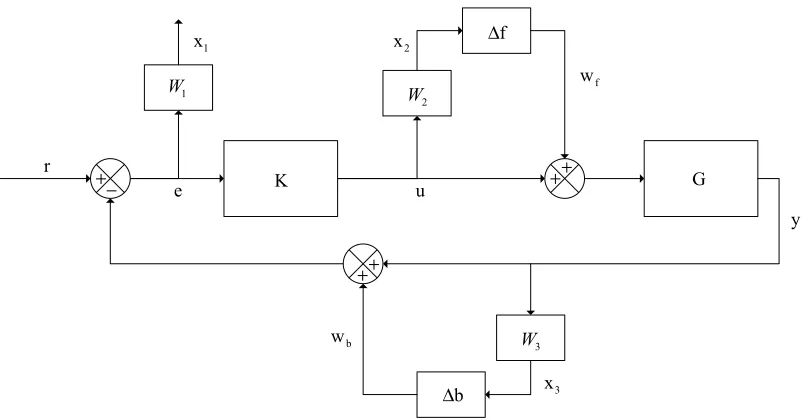
Figure 6. Controller-Plant Modeling with Network Delays.
The controller-plant model with network delays as perturbations is shown in Figure 6.
f
∆ and ∆b represent the network delays τcaand τsc, respectively. The delay uncertainty in
the frequency domain, given as exponential distribution e−τmax∆s
, where 1− < ∆ <1, can be
approximated using a modified Pade approximation with ∆ complex [17]:
max max
max
1 1 ( )
1 2
s s
e W s
s
τ τ
τ
− ∆ ≈ − ∆ = + ∆
+ , (16)
where ∆ ≤1 and
( )
1 3.465
s W s
s
τ τ
=
+ . (17)
Here, ∆ can be either ∆f and ∆b, and τ can be either τcaand τsc. W(s) is suggested by
[17] as an appropriate uncertainty weight that covers the uncertain delay. The factor 3.465 is
Figure 6. W1 represents the performance weight for the system in Figure 6 and is determined by the error signal. It is presented here as a low-pass filter as suggested from [14]:
1 2
0.9 ( )
0.9
W s
s s
=
+ + . (18)
The problem is solved using the H∞ and µ-synthesis toolboxes in Matlab [18]. First,
the problem illustrated in Figure 6 must be formulated into the H∞ framework shown in
Figure 7, where K is the controller gain to be determined by DK iteration during the H∞
process.
2 3 1
x x x
f b
w w r
∆
K P
e u
Figure 7. Robust analysis for a general interconnection system.
The matrix, P, contains the interconnection structure. ∆ =diag
[
∆ ∆ ∆f, b p,]
, where ∆p is afictitious uncertainty block used to incorporate the H∞ performance objective. The
2 2
3 3 3
1 1 1 1 1
0 0 0
0 0
1 1
f b
x W w
x W G W G w
x W G W W W G r
e G G u
=
− − − − − −
, (19)
where W1, W2, and W3 are the weights discussed previously, G is the plant dynamics, and
f
w and wb are introduced to represent the inputs to the system when the perturbations are
omitted during the open-loop formulation of the problem and can be seen in Figure 6. The
necessary condition for robust performance, then, is P K, ∞ <1. This is often measured by
the peak µ value, or ( , ) 1µ P K < . Robust control tries to minimize the effect of a
disturbance on the system as seen by the error signal. This performance measure is given by
( , )P K
µ , which is desired to be driven to zero. If ( , ) 0µ P K = , this would indicate that any
size disturbance would have zero effect on the error, hence displaying ideal robust stability.
CHAPTER 3
CASE STUDY: DC MOTOR
3-1. System Description
The DC motor is governed by the following equations:
1
1
B
a a w a
w a w
K R
i i e
L L L
K B
i F
J J J
ω
ω ω
= − − +
= − +
, (20)
where ea is the armature winding input voltage, L is the armature winding inductance, R is
the armature winding resistance, ia is the armature winding current, KB is the back EMF
constant, K is the torque constant, J is the moment of inertia of the wheel and rotor, B is the
damping coefficient of the wheel and rotor, ωw is the angular velocity of the wheel, and F is
the load torque. Table 1 shows the values used during simulation for these constants that
were modified from [10].
Table 1. DC motor parameters.
K = 2.55e-3 N-m/A R = 6.43 Ω
B
K = .255e-3 V-sec/rad L = 28.8e-3 H
B = 0.1e-3 N-m-sec/rad J = 3.53e-6 Kg-m2
The sampling time, T, for the controller is chosen to be 0.1ms. This is to capture the
4.48 msec
e L R
γ = = . (21)
The load torque is assumed to be zero during the simulations. (20) can be arranged
into the standard state space form shown below:
1
0
b K
R i
i L L
L u b
K
J J ω
ω
−
−
= +
−
. (22)
During the simulations, the plant is considered to be described by (22) that is sampled
every kT seconds. The plant output is assumed to be fully observable.
A PI controller will be used that has been tuned for nominal performance in the
non-delay case for the controller of the system. The control voltage, ea, is assumed to be
bounded by ±12 volts. The optimal PI gains for the non-delay case are determined by the
root locus approach and must satisfy the following design requirements:
Relative damping ratio: 0.707;
Percentage overshoot: . . 5%;
Settling time: 0.0321sec;
Rise time: 0.014sec;
s r
P O t
t
ζ
• =
• ≤
• ≤
• ≤
(23)
Using the above requirements, ( *, *) (25.572,0.995)
I P
K K = will satisfy the conditions above.
This will be used as the baseline performance to compare to. The reference speed is set to
( ) 1
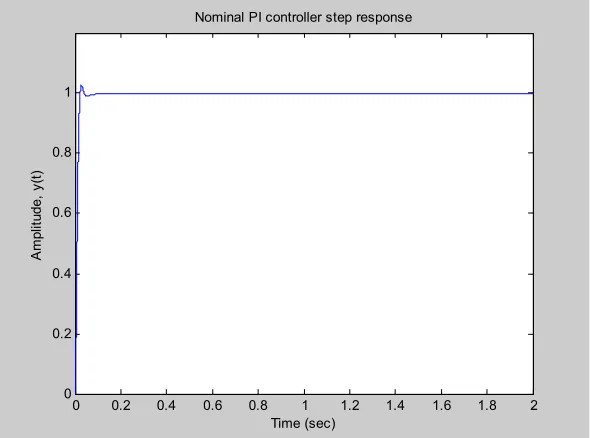
r k = rad/sec. The nominal performance of the PI controller with *
I I
K =K and *
P P
K =K
0 0.2 0.4 0.6 0.8 1 1.2 1.4 1.6 1.8 2 0 0.2 0.4 0.6 0.8 1 Time (sec) A m pl itud e, y (t )
Nominal PI controller step response
Figure 8. Nominal PI controller step response with ( *, *) (25.572,0.995)
I P
K K = .
3-2. Performance Characterization
In order to characterize the performance of each methodology, the following
performance measure is adopted [5, 15]:
1 1 2 2 3 3
J =w J +w J +w J , (24)
2 0 0 1 0 ( ) , 0,
MSE MSE MSE MSE
J
MSE MSE
− >
=
≤
, (25)
2
0 0
2
0
( . . . . ) , . . . .
0, . . . .
P O P O P O P O
J
P O P O
− >
= ≤
, (26)
2 0 0 3 0 ( ) , 0,
r r r r
r r
t t t t
J
t t
− >
= ≤
, (27)
is the mean-squared error, MSE0 is the nominal mean-squared error, P O. .0 is the nominal
percentage overshoot, tr0 is the nominal rise time. The weights w w1, 2,and w3 specify the
relative significance of J J1, 2, and J3, respectively, on the overall system performance.
The error, ( )e k =y k( )−r k( ), is computed by sampling ( )y t every kT time instant. The costs
1, 2,
J J and J3 penalize any degradation in performance from the nominal case. The
nominal performance meets the design specification such that MSE0 =0.003405,P O. .0 =5%,
and tr0 =0.014. MSE0 is determined by simulation or by experiment. In the nominal
non-delay case, the cost function in (24) will equal zero. J1 penalizes tracking error. J2
penalizes higher overshoot. J3 penalizes the slower response time. The weightsw w1, 2,and
3
w are found by simulation using the GSM method with β =
[ ]
0, 2 and no delay with thefollowing equation:
1
1, 2,3 max( ) min( )
i
i i
w for i
J J
= =
− . (29)
When 1β = , the nominal gain is applied to the system and therefore the cost J =0.
Therefore, min( ) 0Ji = for i=1, 2,3 and (29) reduces to
1
1, 2,3 max( )
i
i
w for i
J
= = . (30)
For the DC motor parameters listed in Table 1, w1 =17.4572 , w2 =0.0066771, and
3 0.8777
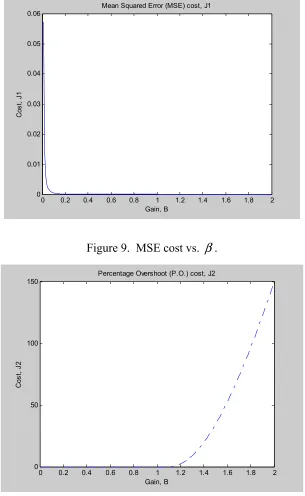
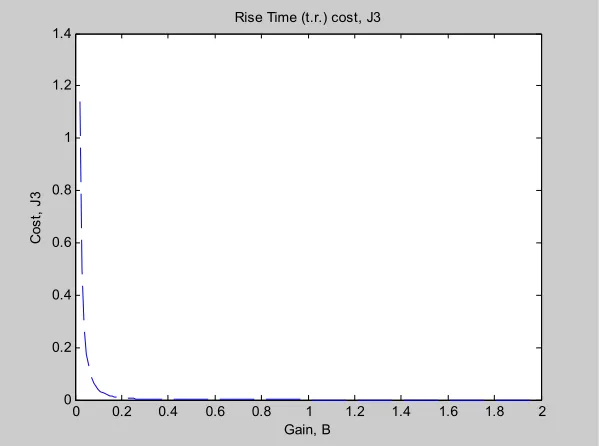
w = . The cost graphs for J J1, 2, and J3 for β =
[ ]
0, 2 are shown in Figure 9,0 0.2 0.4 0.6 0.8 1 1.2 1.4 1.6 1.8 2 0
0.01 0.02 0.03 0.04 0.05 0.06
Gain, B
Cos
t,
J
1
Mean Squared Error (MSE) cost, J1
Figure 9. MSE cost vs. β.
0 0.2 0.4 0.6 0.8 1 1.2 1.4 1.6 1.8 2
0 50 100 150
Gain, B
C
os
t, J
2
Percentage Overshoot (P.O.) cost, J2
0 0.2 0.4 0.6 0.8 1 1.2 1.4 1.6 1.8 2 0
0.2 0.4 0.6 0.8 1 1.2 1.4
Gain, B
Cos
t,
J
3
Rise Time (t.r.) cost, J3
3-3. Network Delay
Each methodology has its specific way of modeling the network delay experienced on
the system. In general, network delay will be modeled as an exponential distribution unless
otherwise noted. The generalized exponential distribution to describe IP network delays is as
follows [15]:
[ ]
1 ( ) ,0,
e P
τ η φ τ η
φ τ
τ η
− −
≥
=
<
, (31)
where η is the minimum transportation delay of the application. The expected value of the
RTT delay is ( )Eτ = +φ η with variance, σ2 =φ2, and median,η..
Keeping in mind the DC motor’s time constant denoted in (21),
[0.0001, 0.001, 0.005, 0.01,0.05,0.1]
η = has been chosen to simulate the RTT IP-network
delay and be representative of a variety of minimum network transportation delays possibly
experienced. The first two delays should have smaller effects on the system performance as
they are less than 0.5γe found in (21) (i.e., can capture the electrical dynamics of the DC
motor), while the larger delays should cause more rapid system degradation. A typical
0 0.2 0.4 0.6 0.8 1 x 10⁻³ 0
1000 2000 3000 4000 5000 6000 7000 8000 9000 10000
Time (sec)
De
ns
ity
Histogram: 0.0001 RTT Network Delay
mean = 0.0001
CHAPTER 4
SIMULATION RESULTS
For all simulations, the final time, tf, is 2 seconds, with a sampling time, T, of 0.0001
seconds. Matlab 7.0 was used to run the simulations. The following sections will present the
results for each of the four methods in alphabetical order when applied to the DC motor
model described previously. Afterwards, the performance of the methods will be
characterized with respect to the other models.
4-1. Gain scheduling middleware (GSM)
4.1.1 DC Motor Application
GSM will be applied on the networked PI controller for a DC motor. The transfer
function of the PI controller is given as:
( )
( ) p C
c
K s z G s
s +
= , (32)
where zC =K KI P is a constant. The optimal PI gains for the non-delay case are determined
by the root locus approach and satisfy the following design requirements as shown in (23).
* *
(K KI, P) (25.572,0.995)= will satisfy the requirements. With this choice of gains,
25.7
C
z = . The response at this gain setting will be the baseline performance to compare to.
Letβ be the gain scheduling parameter that will modify the gain. In this case, β will
modify the PI gain in the following way:
( )
( ) P C
c
K s z G s
s
β
β = + . (33)
By keeping zC a constant, the optimization of β becomes a one-dimensional problem rather
than a two-dimensional problem where KI and KP were allowed to vary independently.
The optimalβ for a given delay is found by minimizing the cost function given in
(24). This can be done for several expected delays. The cost, J, from this optimization is
shown in Figure 13 and Figure 14. GSM can then use a look-up table to select the
appropriateβ for the delay measured by the network traffic estimator. Table 2 shows the
optimalβ for the delay set, η, presented previously using the cost function in (24).
Table 2. Optimal β gains for various time delays.
Delay Time (sec) 0.0001 0.001 0.005 0.01 0.05 0.1
0 0.2 0.4 0.6 0.8 1 1.2 0
0.01 0.02 0.03 0.04 0.05 0.06
Gain, B
C
os
t, J
Cost J from optimization
delay = 0.0001 delay = 0.001 delay = 0.005
Figure 13. Cost vs. β for η=[0.0001,0.001,0.005] network delays.
0 0.05 0.1 0.15 0.2 0.25 0.3 0.35 0.4
0 0.01 0.02 0.03 0.04 0.05 0.06 0.07 0.08 0.09 0.1
Gain, B
C
ost, J
Cost J from optimization
delay = 0.01 delay = 0.05 delay = 0.1
4.1.2 Results
The optimalβ decreases as the network delay increases. This lowers the system
response time in response to an increase in network delay to ensure stable operation. The
cost, J, is more sensitive to variations in delay as the delay time increases, shown in Figure
13 and Figure 14 as the width of the cost curve decreases with higher delays. The step
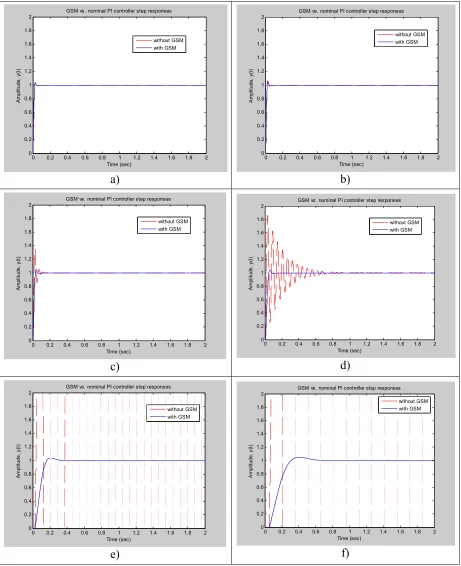
response of the DC motor plant with the nominal PI controller only, and with GSM
implemented, in the presence of the set of network delays, η, is shown in Figure 15.
As the network delay increases past 0.01 sec, the controller is unable to stabilize the
system. Using the optimal β value found offline, the GSM method is able to maintain
system stability at the cost of slower response time. The responses with GSM have fewer
oscillations as they approach the reference value. In all cases, the GSM method is able to
stabilize to the reference value, while the nominal PI controller fails to stabilize for the 0.05
and 0.01 second delays.
Table 3 shows the performance comparison between the nominal case and all four
methods. For all delays, GSM equals or outperforms the uncompensated nominal PI
0 0.2 0.4 0.6 0.8 1 1.2 1.4 1.6 1.8 2 0 0.2 0.4 0.6 0.8 1 1.2 1.4 1.6 1.8
2 GSM vs. nominal PI controller step responses
Time (sec) A m pl itud e, y (t ) without GSM with GSM a)
0 0.2 0.4 0.6 0.8 1 1.2 1.4 1.6 1.8 2 0 0.2 0.4 0.6 0.8 1 1.2 1.4 1.6 1.8
2 GSM vs. nominal PI controller step responses
Time (sec) A m pl itud e, y (t ) without GSM with GSM b)
0 0.2 0.4 0.6 0.8 1 1.2 1.4 1.6 1.8 2 0 0.2 0.4 0.6 0.8 1 1.2 1.4 1.6 1.8
2 GSM vs. nominal PI controller step responses
Time (sec) A m pl itu de, y (t ) without GSM with GSM c)
0 0.2 0.4 0.6 0.8 1 1.2 1.4 1.6 1.8 2 0 0.2 0.4 0.6 0.8 1 1.2 1.4 1.6 1.8
2 GSM vs. nominal PI controller step responses
Time (sec) A m pl itud e, y (t ) without GSM with GSM d)
0 0.2 0.4 0.6 0.8 1 1.2 1.4 1.6 1.8 2 0 0.2 0.4 0.6 0.8 1 1.2 1.4 1.6 1.8
2 GSM vs. nominal PI controller step responses
Time (sec) A m pl itu de, y (t ) without GSM with GSM e)
0 0.2 0.4 0.6 0.8 1 1.2 1.4 1.6 1.8 2 0 0.2 0.4 0.6 0.8 1 1.2 1.4 1.6 1.8 2
GSM vs. nominal PI controller step responses
Time (sec) A m pl itud e, y (t ) without GSM with GSM f)
Figure 15. Nominal PI controller vs. GSM step responses for a) η=0.0001 b) η=0.001 c)
0.005
4-2. Optimal stochastic method
4.2.1 DC motor application
The constraining assumption of the optimal stochastic method is that τsc+τca <T.
Since τsc and τca must be measured and used in the calculation of the LQG gain, timestamps
are added to each packet in order to measure the delay experienced. The standard LQG
problem regulates the plant output around zero. In this case, it is desired for the system to
track a reference input. In order to formulate the regulator as a tracking problem, the output,
( )
y k , must be compared to the reference signal, ( )r k . The goal is then to drive the error
between the output and the reference to zero. A common practice is to add an integrator to
the error signal, ( )e k =y k( )−r k( ), to drive it to zero [19]. The reformulated LQG problem
can then be solved using the Matlab Control System toolbox.
For the DC motor, the LQG control objective is to minimize the cost function:
( ) ( T T 2 T )
J u x Qx u Ru x Nu dt
∞
=
∫
+ + , (34)Table 3. Performance comparison of four methodologies for different RTT network delays.
Delay Time (sec) Control
Scheme 0.0001 0.001 0.005 0.01 0.05 0.1
Nominal 4.68E-09 0.016480118 6.183768417 43.88451303 3.95E+57 2.65E+45
GSM 0 1.53E-06 1.45E-04 6.74E-04 0.019338165 0.079725567
Robust 0.247174844 0.001999007 0.016218814 0.037692917 0.505627477 6.074238664
LQG 0 0.417990105 30.57058632 4.01E+02 1.05E+05 3.61E+07
where (1 6,10,10)Q diag e= , R=1, and N =0, for the augmented plant description with the
integrator on the error signal, where the states are defined as x=
{
e i, ,ω}
T. Q, R, and N aredetermined experimentally by finding the LQR gain whose performance best mirrors that of
the PI controller during a non-delay case trial. This puts the largest penalty on the error
while also keeping the control values within the acceptable limits of ±12V . The white
noises v t( ) and w t( ) are assumed to be zero in order to properly compare the performance of
each methodology. The assumption is that the network delay is the dominating factor of the
system performance and stability.
Using the problem formulation above, the LQG controller is designed without taking
any delays into account. This yields a gain K = −
[
1000,12.404, 7.2913]
.4.2.2 Results
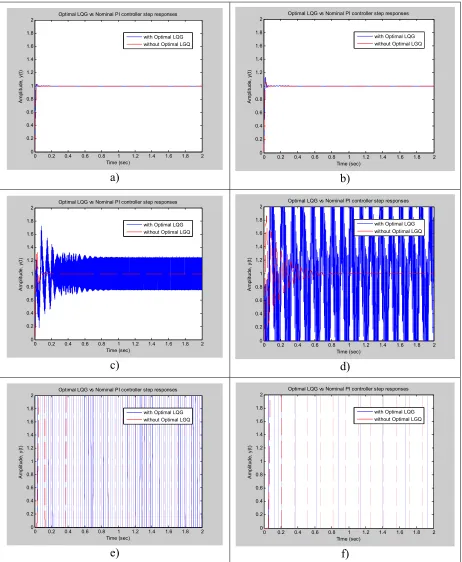
Table 3 shows the comparison of (24) between the nominal PI controller and the LQG
controller. The step response comparisons are shown for the LQG controller versus the
nominal PI controller in Figure 16. It performs very well for 0.0001 sec delay since the
major assumption of τsc+τca <Tis met. Notice that it does manage to lower the cost at the
highest delays of 0.05 and 0.1 seconds even though the tracking performance fails to stabilize.
The performance degrades faster than the nominal case since T is held constant at 0.0001,
0 0.2 0.4 0.6 0.8 1 1.2 1.4 1.6 1.8 2 0 0.2 0.4 0.6 0.8 1 1.2 1.4 1.6 1.8 2
Optimal LQG vs Nominal PI controller step responses
Time (sec) A m pl itude, y (t )
with Optimal LQG without Optimal LGQ
a)
0 0.2 0.4 0.6 0.8 1 1.2 1.4 1.6 1.8 2 0 0.2 0.4 0.6 0.8 1 1.2 1.4 1.6 1.8
2 Optimal LQG vs Nominal PI controller step responses
Time (sec) A m pl itud e, y (t )
with Optimal LQG without Optimal LGQ
b)
0 0.2 0.4 0.6 0.8 1 1.2 1.4 1.6 1.8 2 0 0.2 0.4 0.6 0.8 1 1.2 1.4 1.6 1.8
2 Optimal LQG vs Nominal PI controller step responses
Time (sec) A m pl itude, y (t )
with Optimal LQG without Optimal LGQ
c)
0 0.2 0.4 0.6 0.8 1 1.2 1.4 1.6 1.8 2 0 0.2 0.4 0.6 0.8 1 1.2 1.4 1.6 1.8
2 Optimal LQG vs Nominal PI controller step responses
Time (sec) A m pl itu de, y (t )
with Optimal LQG without Optimal LGQ
d)
0 0.2 0.4 0.6 0.8 1 1.2 1.4 1.6 1.8 2 0 0.2 0.4 0.6 0.8 1 1.2 1.4 1.6 1.8 2
Optimal LQG vs Nominal PI controller step responses
Time (sec) A m pl itude, y (t )
with Optimal LQG without Optimal LGQ
e)
0 0.2 0.4 0.6 0.8 1 1.2 1.4 1.6 1.8 2 0 0.2 0.4 0.6 0.8 1 1.2 1.4 1.6 1.8 2
Optimal LQG vs Nominal PI controller step responses
Time (sec) A m pl itud e, y (t )
with Optimal LQG without Optimal LGQ
f)
Figure 16. Nominal PI controller vs. Optimal stochastic method step responses for
4-3. Queuing methodology
4.3.1 DC motor application
Since full state information is available, the observer block shown in Figure 3 and
Figure 4 is omitted. Thus for a δ -step delay, where δ is the delay measured in terms of the
number of sample times, δ predictor blocks will be needed. For example, the 0.001 RTT
delay will require 0.001/0.0001 or 10 predictor blocks. It should be noted that the queuing
method depends on the accuracy of the model and observer. Since the model is accurate and
no observer is used, we should expect to see very good results.
4.3.2 Results
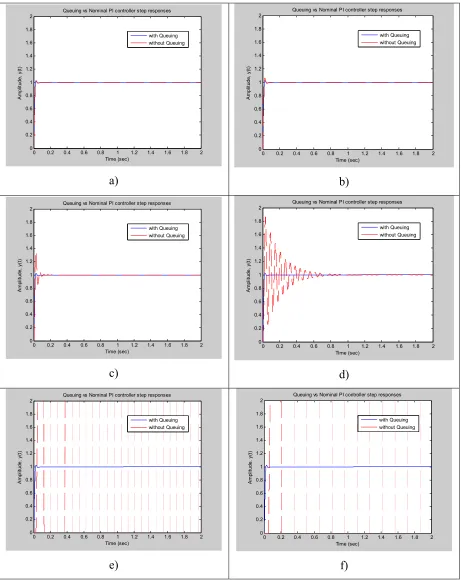
The results of the queuing method versus the nominal PI controller are shown in
Figure 17. Note that the responses for each delay are identical. This is because of the perfect
model and full state information. Table 3 shows the costs associated with the queuing
methodology for the different delays. As noted before, because of the perfect model
accuracy, the predictor block is able to predict the states perfectly regardless of the delay.
However, the queue length increases as the delay increases, as shown in Table 4. This could
provide difficulties when implementing the queuing methodology for a real-time application
since the computation time could be significant. The queuing methodology works well when
the delay is bounded by a constant and the plant model is known. Also, it is more feasible
for time sensitive applications when the sample time is close to the delay time to limit the
Table 4. Queue lengths for various delays.
Delay (sec) Queue Length
0.0001 1
0.001 10
0.005 50
0.01 100
0.05 500
0 0.2 0.4 0.6 0.8 1 1.2 1.4 1.6 1.8 2 0 0.2 0.4 0.6 0.8 1 1.2 1.4 1.6 1.8 2 Time (sec) A m pl itude, y (t )
Queuing vs Nominal PI controller step responses
with Queuing without Queuing
a)
0 0.2 0.4 0.6 0.8 1 1.2 1.4 1.6 1.8 2 0 0.2 0.4 0.6 0.8 1 1.2 1.4 1.6 1.8 2 Time (sec) A m pl itud e, y (t )
Queuing vs Nominal PI controller step responses
with Queuing without Queuing
b)
0 0.2 0.4 0.6 0.8 1 1.2 1.4 1.6 1.8 2 0 0.2 0.4 0.6 0.8 1 1.2 1.4 1.6 1.8 2 Time (sec) A m pl itude, y (t )
Queuing vs Nominal PI controller step responses
with Queuing without Queuing
c)
0 0.2 0.4 0.6 0.8 1 1.2 1.4 1.6 1.8 2 0 0.2 0.4 0.6 0.8 1 1.2 1.4 1.6 1.8 2 Time (sec) A m pl itu de, y (t )
Queuing vs Nominal PI controller step responses
with Queuing without Queuing
d)
0 0.2 0.4 0.6 0.8 1 1.2 1.4 1.6 1.8 2 0 0.2 0.4 0.6 0.8 1 1.2 1.4 1.6 1.8 2 Time (sec) A m pl itude, y (t )
Queuing vs Nominal PI controller step responses
with Queuing without Queuing
e)
0 0.2 0.4 0.6 0.8 1 1.2 1.4 1.6 1.8 2 0 0.2 0.4 0.6 0.8 1 1.2 1.4 1.6 1.8 2 Time (sec) A m pl itude, y (t )
Queuing vs Nominal PI controller step responses
with Queuing without Queuing
4-4. Robust control methodology
4.4.1 DC motor application
G represents the plant dynamics and are given for the DC motor in (22). These will
be used to form the interconnection matrix P. By experimentation, the performance weight,
1
W , was found to be
1 2
25 ( )
20 1
W s
s s
=
+ + . (35)
This gives satisfactory performance for all delays. W2 and W3 are given in (17).
Next the system is analyzed using the dkitgui tool in Matlab. This tool uses DK
iteration to generate controllers for the system and analyze the robustness using µ -synthesis.
For the DC motor, the frequency range 0.001 to 1000 with 1000 points was used. The
uncertainty structure is a 2x2 matrix. Eight iterations were completed for each delay time,
generating eight controllers. Each one was tested for optimal performance based on the
performance measure in (24). The best one was chosen for the final trials. The controller
chosen also had the lowest peak µ value given by the dkitgui tool. A lower µ value
indicates a smaller effect of a disturbance (i.e. network delay) on the system.
Overall, the robust methodology does a great job as compensating for network delay.
The major benefit is that the controller does not need a priori knowledge of the network
delays, nor does it need the past delay measurements as many of the other methods do. It
does, however, require that the weights be carefully set such that they cover the uncertain
4.4.2 Results
The optimal robust controller for each delay is shown in Table 5 . The number
indicates during which iteration the optimal performance, or lowest cost, was achieved. Thus
for the first delay of 0.0001 sec, the 4th D-K iteration controller achieved the best results and
was, therefore, used for the final simulation runs. In all cases but η =0.1sec, the controller
with the lowest peak µ value produced the best performance. The peak µ values for each
of the eight controllers generated for each delay time can be found in Table 6.
Table 5. Optimal robust controller for each delay.
Delay time
(sec) 0.0001 0.001 0.005 0.01 0.05 0.1
Controller
number 4 7 8 7 3 1
Table 6. Peak µ values for controller generated during each DK iteration.
Optimal controller values are shown in italic.
D-K iteration number Delay
time
(sec) 1 2 3 4 5 6 7 8
0.0001 0.029 0.012 0.013 0.012 0.012 0.013 0.018 0.012
0.001 0.111 0.046 0.044 0.046 0.044 0.044 0.044 0.044
0.005 0.317 0.109 0.108 0.106 0.123 0.111 0.109 0.107
0.01 0.516 0.163 0.155 0.157 0.155 0.157 0.155 0.157
0.05 1.9963 0.641 0.641 1.1826 1.9359 0.941 0.934 0.975
The step responses comparing the robust control method and the nominal PI
controller are shown in Figure 18. The cost for the 0.0001 sec delay is larger than the 0.001
delay because the D-K iteration tries to optimize its control to the H∞ performance measure
that differs from the one given in (24). Aside from that result, the cost increases as the delay
time increases, and on the whole, the robust method compensates for the delay as shown by
0 0.2 0.4 0.6 0.8 1 1.2 1.4 1.6 1.8 2 -0.5 0 0.5 1 1.5 2 Time (sec) A m pl itude, y (t )
Robust vs. Nominal PI controller step response results
with Robust without Robust
a)
0 0.2 0.4 0.6 0.8 1 1.2 1.4 1.6 1.8 2 -0.5 0 0.5 1 1.5 2 Time (sec) A m pl itud e, y (t )
Robust vs. Nominal PI controller step response results
with Robust without Robust
b)
0 0.2 0.4 0.6 0.8 1 1.2 1.4 1.6 1.8 2 -0.5 0 0.5 1 1.5 2 Time (sec) A m pl itude, y (t )
Robust vs. Nominal PI controller step response results
with Robust without Robust
c)
0 0.2 0.4 0.6 0.8 1 1.2 1.4 1.6 1.8 2 -0.5 0 0.5 1 1.5 2 Time (sec) A m pl itu de, y (t )
Robust vs. Nominal PI controller step response results
with Robust without Robust
d)
0 0.2 0.4 0.6 0.8 1 1.2 1.4 1.6 1.8 2 -0.5 0 0.5 1 1.5 2 Time (sec) A m pl itude, y (t )
Robust vs. Nominal PI controller step response results
with Robust without Robust
e)
0 0.2 0.4 0.6 0.8 1 1.2 1.4 1.6 1.8 2 -0.5 0 0.5 1 1.5 2 Time (sec) A m pl itud e, y (t )
Robust vs. Nominal PI controller step response results
with Robust without Robust
f)
CHAPTER 5
NOISE
The previous results were conducted under ideal conditions. The performance of
each method was also investigated under noisy conditions. Noise was introduced into the
control loop at the sensor measurement to simulate modeling errors (both state and
measurement). Figure 19 shows how the noise, w k( ), is introduced into the system. The
noise is Gaussian white noise with the zero mean and a given variance, v k( )=G( ,µ σ2).
The mean, µ, is set to zero and the variance, σ2, was chosen so that the distribution effected
between 0 and 10% of the final reference value of 1 rad/sec. This was determined by
3σ
Ψ = , where Ψ stands for the noise level with respect to the final value, and σ is the
standard deviation. 3σ was chosen as it accounts for 99.7% of a normal distribution. Thus
for ψ∈
{
0.5% 1% 2% 5% 10%}
, the variance used is2 2.7778e-06,1.1111e-05, 4.4444e-05,
0.00027778,0.0011111
σ ∈
. (36)
The distributions of the variances are shown in Figure 20. The performance is measured with
the same performance measure described earlier in (24). With noise added, the typical step
K G r
e u
y +
- τca ++
sc
τ
Figure 19. Noise, w k( ) introduced into the control loop.
-0.1 -0.05 0 0.05 0.1 0
50 100 150 200
Data
De
ns
ity
Random Noise Distributions
0.5% 1% 2% 5% 10%
Figure 20. Noise distributions.
0 0.2 0.4 0.6 0.8 1 1.2 1.4 1.6 1.8 2
-0.2 0 0.2 0.4 0.6 0.8 1 1.2
Time (sec)
A
ngu
la
r V
el
oc
ity
(
rad/
se
c)
It is expected that the introduction of noise will decrease the performance of the
system. As the noise increases, the performance should decrease which will be indicated by
a higher cost measured by (24). Figure 22 shows the results for each method with respect to
RTT delay and the noise level.
In general, as the delay and noise increase, so does the cost J. The queuing and GSM
methods have the lowest cost with respect to noise or network delay.
0
5
10
10-4 10-3
10-2 10-1
10-20 10-15 10-10 10-5 100 105 1010
% Noise level (linear) Network delay and noise level performance comparison
RTT Delay time - sec (log)
C
ost
, J (
lo
g)
Queuing Robust LQG GSM
Figure 22. Performance comparison with noise.
5-1. GSM
Figure 23 shows the performance of the GSM methodology with noise. For small
delays (i.e. under 0.01 sec), the noise had a larger effect on the performance than for larger
than the delay, as shown by cost values very similar regardless of the noise level. However,
the total cost at even the worse condition is still much lower than the nominal PI controller.
Table 7 gives the cost, J, for each trial.
0 2
4 6
8 10
10-4 10-3
10-2 10-1
10-20 10-15 10-10 10-5 100
% Noise Level (Linear) GSM Network delay and noise level performance comparison
RTT Delay time - sec (log)
C
ost, J
(
lo
g)
Figure 23. GSM noise vs. delay performance.
Table 7. GSM noise results.
Noise level
Delay 0% 0.5% 1% 2% 5% 10%
0.0001 0 0 0 0 0 0
0.001 1.53E-06 3.0506E-06 1.1818E-05 5.2972E-05 3.6717E-04 1.5607E-03
0.005 1.45E-04 1.4359E-04 1.4355E-04 1.4347E-04 2.0716E-04 6.4517E-04
0.01 6.74E-04 6.7411E-04 6.7402E-04 6.7387E-04 6.713E-04 6.6879E-4
5-2. Optimal stochastic method
Figure 24 presents the performance of the optimal stochastic method with noise. As with the
GSM method, the noise effect is more apparent at low delays, 0.001 sec and smaller, than at
higher delays. This is partly due to the noisy results of the optimal method even without
noise, as shown in Figure 16. Those results are due to the fact that τsc+τca ≤/T, where
0.0001sec
T = in this case. Therefore, additional noise will have little effect on the
performance of the optimal methodology. However, for where τsc+τca ≤T holds true,
increased noise causes an increase in cost which indicates a decrease in performance. Table
8 gives the cost, J, for each trial.
0 2
4 6
8 10
10-4 10-3 10-2 10-1 10-20 10-10 100 1010
% Noise Level (linear) LQG Network delay and noise level performance comparison
RTT Delay time - sec (log)
C
ost, J (
lo
g)
Table 8. Optimal method noise results.
Noise level
Delay 0% 0.5% 1% 2% 5% 10%
0.0001 0 0 0 0 0.028246 0.55458
0.001 0.41799 0.44648 0.49424 0.59705 0.96373 1.769
0.005 30.5706 29.902 30.972 31.712 33.688 24.951
0.01 401.5 427.79 388.85 358.34 383.15 398.74
0.05 1.05E+05 1.0497E+05 1.0506E+05 1.0474E+05 1.0507E+05 1.0528E+05
0.1 3.61E+07 3.6069e+07 3.6068e+07 3.6066e+07 3.606e+07 3.6049e+07
5-3. Queuing method
Figure 25 presents the queuing method’s results with respect to noise levels and
network delay. As mentioned earlier, because of the high accuracy of the model, the queuing
method is able to accurately predict the plant’s state regardless of the delay length. Thus an
increase in delay has no effect on the performance, as the cost does not rise. However, as
noise is introduced, the inputs to the predictor blocks are no longer accurate. This inaccurate
prediction results in an increase in the cost as the noise level increases. Therefore, system
performance degrades as noise levels increase. Similar to the GSM method, the total cost of
the queuing method at the worst condition is still low compared to the nominal PI controller.
0 2
4 6
8 10
10-4 10-3 10-2 10-1 10-20 10-15 10-10 10-5 100
% Noise level (linear) Queuing Network delay and noise level performance comparison
RTT Delay time - sec (log)
C
os
t, J
(
lo
g)
Figure 25. Queuing method noise vs. delay performance.
Table 9. Queuing method noise results.
Noise level
Delay 0% 0.5% 1% 2% 5% 10%
0.0001 0 0 1.1135E-09 3.3109E-08 0.018747 0.14272
0.001 0 0 1.2453E-09 3.4573E-08 0.019001 0.12165
0.005 0 0 1.4832E-09 3.7668E-08 0.017853 0.12
0.01 0 0 1.4457E-09 3.7625E-08 0.016157 0.1236
0.05 0 0 1.2905E-09 3.4895E-08 0.017255 0.11824
5-4. Robust method
Figure 26 shows the performance of the robust methodology for various noise levels
and network delays. Unlike the other methods, regardless of the delay an increase in the
noise level resulted in an increase in the cost, just as an increase in the network delay resulted
in an increase in the cost. Thus, performance degrades as both the network delay and noise
levels increase. However, the increase in the cost, J, at each noise level was less than other
methods as the network delay increased, signifying the methods robustness to disturbances.
Table 10 gives the cost, J, for each trial.
0 2
4 6
8 10
10-4 10-3 10-2 10-1 10-4 10-2 100 102
% Noise level (linear) Robust Network delay and noise level performance comparison
RTT Delay time - sec (log)
C
ost, J (
lo
g)
Table 10. Robust methodology noise results.
Noise level
Delay 0% 0.5% 1% 2% 5% 10%
0.0001 0.247174844 0.27621 0.31253 0.38946 0.6814 1.3254
0.001 0.001999007 0.0020004 0.0020107 0.0020259 0.009546 0.35354
0.005 0.016218814 0.015888 0.015803 0.015502 0.018892 0.35448
0.01 0.037692917 0.037065 0.036059 0.034803 0.034417 0.34935
0.05 0.505627477 0.50487 0.50263 0.50045 0.48733 0.83974
CHAPTER 6
CONCULSION
Four methodologies were investigated for use with real-time applications in a NBC
setting. The simulation results have shown promising results to apply these methodologies
on real-time network-based control systems. The GSM and queuing methods presented the
best performance for various delays and noise levels, as compared to the networked nominal
PI controller. The robust methodology also showed a significant improvement over the
nominal PI controller. The optimal stochastic method showed increased performance over its
limited range set by its delay assumption. Each of the top two performers have certain
drawbacks, namely: GSM has considerable off-line calculations that must be done in order
to schedule the gain for the network traffic conditions, while the queuing method depends
significantly on the plant model’s accuracy. For critical real-time applications, the
appropriate method must be chosen based on the application. All methods have shown the
ability to stabilize the closed loop control system and minimize the detrimental delay effect
in an IP network environment.
6-1. Benefits Table
The purpose of this section is to provide the benefits and drawbacks of the
methodologies so that one may be chosen that best fits the application. Table 11 lists the
pros and cons of each methodology. Gain scheduling middleware is best when the original
![Figure 14. Cost vs. β for η =[0.01,0.05,0.1] network delays.](https://thumb-us.123doks.com/thumbv2/123dok_us/1634464.1203912/37.612.167.463.73.291/figure-cost-vs-b-h-network-delays.webp)