Numerical Study of Concrete Dome Structure
using ANSYS 17.0
Bincy Baby 1, Lakshmy G.Das 2
P.G. Student, Department of Civil Engineering, IIET, Nellikuzhy, Kerala, India1
Assistant Professor, Department of Civil Engineering, IIET, Nellikuzhy, Kerala, India2
ABSTRACT: Dome structures are space structures which cover large area with minimum surface. It is a doubly curved shell structure. Dome is stronger, stable and durable than any other singly curved shell structures which can be applicable to many civil engineering structures like auditorium, exhibition hall, industrial structures top covering of circular water tank etc. This paper deals with numerical analysis of dome structure made of four different geometries where finite element analysis is carried out using ANSYS 17.0 software. Main purpose of this study is to find out the best geometry which can be adopted for dome roofing. Along with this crack analysis for the given loading condition is carried out.
KEYWORDS:Doubly- curved shell, Semi-spherical dome, Tori-spherical dome, Elliptical dome, ANSYS
I. INTRODUCTION
Dome structures made a footprint in the architecture of civilizations from time immemorial. Dome’s character of exhibiting membrane i.e., in-plane forces will be due to its initial curvature. Dome is a doubly curved shell structure which is more stable. A spherical shell roof defines its geometry by rise and span it possesses. Lower the rise, larger will be the radius of curvature. Concrete is strong in compression, so makes it an adaptable material for shell rooftop development. "Dome" is originated from the Greek and the Latin word "domus" which was used up through renaissance to label the revered house due to the shape of its roof.. The surface of a dome might be a piece of a solitary surface, for example, a circle or a paraboloid, and it might comprise of a patchwork or different surfaces. In the current years, thin shell structures find wide applications in many branches of innovation, for example, space vehicle, atomic reactor, weight vessels, tops of modern building and assembly halls. From the perspective of engineering, the advancement of shell structure offers surprising conceivable outcomes and open doors for the joined acknowledgment of practical, monetary and stylish viewpoints.
Dome has high structural strength when properly built and can span large open spaces without interior supports. Dome is more efficient and inherently stable structures by virtue of its spatial form and load-carrying mechanism. In addition to stable form, shell structures, carry applied loads by membrane action, as opposed to the bending action in framed structures. The membrane action consists of in-plane normal and shear stresses only, which enables shell with a small thickness to absorb very large loads with relatively low stress resultants and are able to cover large spans with very small thicknesses. The igloo may be the earliest form of monolithic dome.
II. RELATEDWORK
From the point of view of architecture, the development of shell structures offers unexpected possibilities and opportunities for the combined realization of functional, economic and aesthetic aspects [6]. Investigation related to the analysis of large concrete thin shell domes shows that domes are the best in strength and ductility for high content of reinforcement and smallest in crack width. Besides, saving costs needs less materials with high strength as a result of its membrane characteristics.[1] The increasing of dome diameter causes increasing in ultimate load capacity of the dome structure. Increase in compressive strength and cover of dome also increases the ultimate strength [4].
III.MATERIALSANDMETHODS
Modelling of the dome structures was done using the ANSYS (version 17.0) software which is a finite-element modeling package for numerically solving static/ dynamic, structural analysis (both linear and nonlinear), heat transfer, and fluid problems, as well as acoustic and electromagnetic problems. The domes were modelled as per the dimensions of Algeciras market dome situated in Spain. It is a semi spherical dome with top view of hexagon. Span and rise of this market dome is adopted as the basis and three other geometries were modelled as per it’s dimension. The mass of all four domes were kept fixed. For that purpose thickness changed for each model. The shapes considered include:
1. Geometry of Algeciras market dome 2. Semi-spherical dome
3. Tori-spherical dome 4. Elliptical dome
Fig. 1. Dome shapes of (a) Algeciras Market dome (b) Tori-spherical dome
Semi-spherical dome and elliptical dome where developed by revolving circular curve and elliptical curve respectively about vertical axis. A tori-spherical dome is obtained from the intersection of a spherical cap with tangent torus. The radius of the sphere “R” is called the "crown radius," and the radius “a” of the torus is called the "knuckle radius."Equation of Tori-spherical dome is given below.
Dimensions of Algeciras Market dome is given in table below.
Table 1. Dimensional Details of Algeciras market dome
Shell span 47.60 m
Thickness 9 cm
Radius 44.20 m
Sky light opening diameter 10 m
The material properties of dome structure correspond to concrete with density 2300kg/m3, Modulus of elasticity of 25 x 109 N/mm2 and Poisson’s ratio 0.18. Analysis was done using the Workbench platform of ANSYS 17.0 Finite Element Analysis software. ANSYS simulation software, with its comprehensive multi physics foundation, delivers efficiency and innovation to product design and engineering process. ANSYS Workbench provides an easy and flexible platform to work with. Static structural analysis in which a lantern load provided along the opening edge. Lantern is a structure made at the crown portion of dome for ventilation purpose. Since the dome is supported by columns, dome is fixed at 8 vertices.
IV.MODELLINGOFDOMES
A total of 4 models were created to carry out static analysis and crack analysis. Total span, height and mass of the 4 geometries were fixed according to the dimensions of Algeciras market dome (Spain).Provided thickness for Algeciras market dome, Semi-spherical dome, Tori-spherical dome and Elliptical dome is 90 mm, 80.86 mm, 75.82mm and 74.78 mm respectively.
Fig 2. Modelling of (a) Algeciras market dome, (b) Semi-spherical dome, (c)Tori-spherical dome, (d) Elliptical dome (a) (b)
V. FINITEELEMENTANALYSISOFDOMESTRUCTURES
Structural analysis is probably the most common application of the finite element method. We can perform different types of structural analyses. Such as Static Analysis, dynamic analysis etc. Here Static structural analysis is carried out. In this analysis determined total deflection, maximum principle stress and crack pattern of the different models created. Analysis was performed using ANSYS 17.0.
Fig. 3 Meshing done in (a) Algeciras market dome, (b) Semi-spherical dome, (c)Tori-spherical dome, (d) Elliptical dome
Meshing is done after mesh convergence. The finer the mesh, result will be more accurate. Slicing operations was done in order to make the finer quadrilateral mesh. Meshing was done using quadrilateral mesh elements as shown in Fig. 3
(a) (b)
Fig. 4 Loading and boundary conditions of (a) Algeciras market dome, (b) Semi-spherical dome, (c)Tori-spherical dome, (d) Elliptical dome
Fig. 4 shows loading and boundary conditions. Algeciras market dome have only 3 m height. So that no wind load conditions are considered. A point load of 22000 N is provided along the perimeter of dome opening at top portion. This point load is to provide the presence of lantern.Lantern is a fixed support is provided at 8 vertices.
VI.ANALYSISRESULTS
Structural analysis is probably the most common application of the finite element method. We can perform different types of structural analysis. Such as Static Analysis, dynamic analysis etc. Here Static structural analysis and Topology Optimization were carried out. In this study the analysis determines deflection, maximum principle stress and crack pattern of the different models created.
Fig. 5 Maximum principal stress results of (a) Algeciras market dome, (b) Semi-spherical dome, (c)Tori-spherical dome, (d) Elliptical dome (c) (d)
(a) (b)
Fig 5. is the representation of maximum principal stresses acting on the concrete dome. It can be observe that maximum value lay near the support condition. Table below shows clearly the value obtained.
Table 2. Maximum Principal stress results
Geometry Algeciras market dome
Semi-spherical dome
Tori-spherical dome
Elliptical dome Maximum
Principal Stress (N/mm2)
43.629 40.107 182.06 178.57
Maximum value of principal stress is obtained for spherical dome. Elliptical dome also poses a value near to Tori-spherical dome. Shape of Algeciras market dome and semi-Tori-spherical dome give lesser value compared to the other two. Stress is minimum for semi-spherical dome.
Fig. 6 Total deformation stress results of (a) Algeciras market dome, (b) Semi-spherical dome, (c)Tori-spherical dome, (d) Elliptical dome
Fig 6. is the representation of Total deformation acting on the concrete dome. It can be observe that maximum value lay near the support condition. Table below shows clearly the value obtained.
(a) (b)
Table 3. Total deformation results
Geometry Algeciras market dome
Semi-spherical dome
Tori-spherical dome
Elliptical dome Maximum
Principal Stress (N/mm2)
15.153 20.772 23.73 24.778
Maximum value of Total deformation is obtained for Elliptical dome. Tori-spherical dome also poses a value near to Elliptical dome. Shape of Algeciras market dome and semi-spherical dome give lesser value compared to the other two. Deformation is minimum for Algeciras market dome.
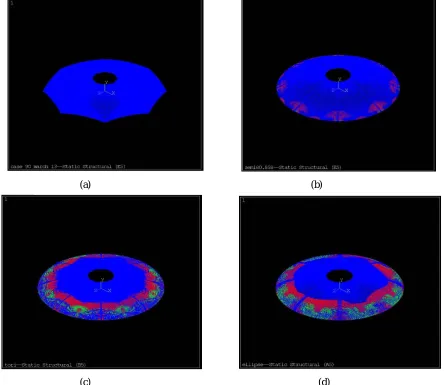
Crack failure is one of the major failures of concrete dome structures. Based on its intensity crack formation is named as 1st crack 2nd crack and 3rd crack. Crack analysis is done using ANSYS software.
Fig. 6 Crack Pattern obtained for (a) Algeciras market dome, (b) Semi-spherical dome, (c) Tori-spherical dome, (d) Elliptical dome (a) (b)
The figures shown above represent the crack pattern obtained from crack analysis. The red dots indicate the 1st crack, green indicates the 2nd crack and sky blue indicates 3rd crack. The result shows that crack possibility for each geometrical shape were different. It can be observing that, for Tori-spherical and for Elliptical dome structures more crack patterns are present compared to semi-spherical dome. But there is no crack formation in Algeciras market dome. It shows that Algeciras dome will not crack for the given loading condition.
VII. CONCLUSION
Structural behaviour of Algeciras market dome shape, Semi-spherical dome, Tori-spherical dome and elliptical dome were studied using finite element software ANSYS 17.0. It is observed from the analysis results that Algeciras market dome and Semi-spherical dome are more efficient, because it posses minimum principal stress value and total deformation compared to Tori-spherical and Elliptical dome shapes. We can prefer these two shapes for dome construction. Crack failure is one of the major failures in concrete structures. Crack pattern of the four domes were analysed for given loading condition and it shows that Algeciras market dome shape have more resistance to crack. Semi-spherical dome also gives a better result than that of Tori-spherical and elliptical dome shapes.
REFERENCES
[1] Hani Aziz Ameen, “Finite Element Analysis of Large Diameter Concrete Spherical Shell Domes”, Dirasat, Engineering Sciences, vol. 38, no. 1, pp. 85-100, 2011.
[2] Ehab Hamed, Mark A. Bradford, R. Lan Gilbert, Zhen- Tian Chang,, “Analytical Model and Experimental Study of Failure Behavior of Thin walled Shallow Concrete Domes”, Journal of Structural Engineering, vol. 137, no. 1, pp. 88-99,2011.
[3] Richard Bradshaw, David Campbell, Mousa Gargari, Amir Mirmiran, Patrick Tripeny, “Special Structures: Past, Present, and Future, Journal of Structural Engineering”, vol. 128, no.6, pp. 691-709, 2002.
[4] Dr.Hani Aziz Ameen, “Effects of boundary conditions on the non-linear long term behaviour of spherical shallow concrete domes”, American Journal Of Scientific And Industrial Research, vol.1, no. 3, pp 472-495, 2010.
[5] Shaik Tahaseen, “Reinforced Cement Concrete (RCC) Dome Design”, International Journal of Civil and Structural Engineering Research ISSN 2348-7607, vol. 3, no. 2, pp. 39-45, 2016
[6] Chandrashekhra, K., “Analysis of Thin Concrete Shells”, New Age International Publishers, 2nd edition, 1995 [7] Chatterjee B. " Theory and Design of Concrete shells" ,3rd ed., Oxford and IBH Publishing, New Delhi, 1998. [8] Habib Sadid, “Finite Element Modeling Of Monolithic Dome Structures”, 2005.
[9] Saraç, Yavuz,”Optimum Design Of Pin Jointed 3D Dome Structures Using Global Optimization Techniques”, 2005. [10] ANSYS – Engineering Analysis System. Theoretical Manual, Swanson Analysis Systems (1998).
[11] Chen W.F. "Experiments on Axially Loaded Concrete Shells", Journal of the Structural Division, Proceeding of the American Society of Civil Engineers, vol.105, no.8,1979.