A Study of Strength and Cost Analysis in
Concrete Using Copper Slag
Regina Mary.I
Assistant Professor, Department of Civil Engineering, MZCET, Tamil Nadu, India
ABSTRACT: Following the increased awareness of climate change issues, it is now generally accepted that there is an urgent need to limit carbon dioxide emissions into the atmosphere. With a worldwide production of 1.4 billion tons a year, manufacture of Portland cement is responsible for five percent of global carbon dioxide emissions. It is highly energy-intensive and the chemical processes inherent in its manufacture release large quantities of carbon dioxide.The use of cement replacements with lower environmental burdens offers opportunities for significant reductions in energy use and carbon dioxide emissions. The most effective alternative to Portland cement is Copper Slag (CS) which typically replaces 30 percent of the Portland cement in a concrete mix. Compared with OPC concrete, CS-concrete has a similar or greater long-term strength, similar shrinkage, lower basic creep, and similar or lower total creep. Normal concrete lacks required strength, workability and durability which are more often required for large concrete structures such as high rise buildings, bridges, and structures under severe exposure conditions. By increasing concrete strength, the required thickness of concrete members and the cost of concrete structures can both be reduced. Therefore, it is felt necessary to improve the strength and performance of concrete to cater present need. In this study, it is planned to use copper slag as partial replacement of cement and various tests were conducted to study the behaviour of copper slag in concrete.
KEYWORDS:copper slag, creep ,shrinkage , durability
I. INTRODUCTION
A. COPPER SLAG
Copper slag is a by-product of copper production from copper ore. During smelting, a molten pool of copper forms at the bottom of the furnace while a layer of impure metal, which is the slag, is drained off from the top. The copper slag is then quenched using industrial or sea water. Sometimes, it is left to cool by the air. For every ton of copper produced about 2.2 ton of slag is generated. The treated spent copper slag can be recycled and put to good use as sand replacement in concrete. For structural usage, the use of copper slag as partial replacement of sand in concrete is allowed for up to 10% by mass. Tests have to be conducted to ensure that chloride and sulphate contents in the slag are within the allowable limits. The technology and process will involve the treatment and re-constitution of the spent copper slag to satisfy all the requirements for its use in making concrete.
B. CHEMICAL ANALYSIS OF COPPER SLAG AND PORTLAND CEMENT
Ordinary Portland cement has a lime content of 63%, whereas copper slag has a very low lime content of <1%. Generally, the free lime content of Copper slag is very low. This indicates that Copper slag is not highly chemically reactive materials in order to be used as cementitious materials. Copper slag must have a sufficient quantity of lime to reach the required rate of hydration and to achieve the required early age strength. Therefore, in this case, in order to increase its Pozzolanic reaction, hydrated lime was added up to 2.0% to the weight of cement. Copper slag has high concentrations of SiO2 and Fe2O3 compared with OPC. In comparison with the chemical composition of natural
pozzolans of ASTM C 618-99, the summation of the three oxides (silica, alumina and iron oxide) in copper slag is nearly 95%, (National council for cement and building materials, Ballabgarh ) which exceeds the 70% Percentile requirement for Class N raw and calcined natural pozzolans. Therefore, copper slag is expected to have good potential to produce high quality pozzolans.
II. REVIEW OF LITERATURE
Bipra Gorai, R.K. Jana, Premchand(2002) studied the characteristics of copper slag as well as various processes such as pyro, hydro and combination of pyro-hydrometallurgical methods for metal recovery and preparation of value added products from copper slag Khalifa S. Al-Jabri , Makoto Hisada , Abdullah H. Al-Saidy , S.K. Al-Oraimi (2008) investigated the performance of high strength concrete (HSC) made with copper slag as a fine aggregate at constant workability and the effect of superplasticizer addition on the properties of HSC made with copper slag.. The results indicated that the water demand reduced by almost 22% at 100% copper slag replacement compared to the control mixture. superplasticizer is very important ingredient in HSC made with copper slag in order to provide good workability and better consistency for the concrete matrix. Khalifa S. Jabri , Makoto Hisada , Salem K. Al-Oraimi , Abdullah H. Al-Saidy (2009) investigated the effect of using copper slag as a replacement of sand on the properties of high performance concrete (HPC). The results also demonstrated that the surface water absorption decreased as copper slag quantity increases up to 40% replacement; beyond that level of replacement, the absorption rate increases rapidly.Mobasher1.B (1996) studied the effect of copper slag on the hydration of cement based materials and concluded that up to 15% by weight of copper slag can be used as a Portland cement replacement. Fracture properties such as critical stress intensity factor, and fracture toughness showed a constant or decreasing trend with the addition slag. Washington Almeida Moura (2010) studied the use of copper slag as pozzolanic supplementary cementing material for use in concrete. The results indicated that the concrete with copper slag addition presented greater mechanical and durability performance.
III. PROPERTIES OF MATERIALS
A. CEMENT
Chettinad OPC 53 grade cement has been used in this investigation.
Table 3.1Properties of cement
S.No Description of Tests Results
1 Specific gravity 3.10
2 Normal consistency 33%
3 Initial setting time 55 mins
4 Final setting time 680 mins
B. FINE AGGREGATE
The fine aggregate used in this investigation is clean river sand passing through 4.75 mm sieve. The sand used in the mix is conforming to zone II as per IS: 383 – 1970.
Table 3.2 Physical Properties of Fine Aggregate Physical properties Values
Specific gravity 2.53
C. COARSE AGGREGATE
Crushed granite stones obtained from local quarries were used as coarse aggregate. The size of crushed granite stone aggregate used in the experiment work is of size 20 mm.
Table 3.3 Physical Properties of Coarse Aggregate Physical properties Values
Specific gravity 2.80
Fineness Modulus 7.53
D. WATER
Potable water is generally considered satisfactory for concreting purposes. The potable water available in the campus has been used.
E. COPPER SLAG
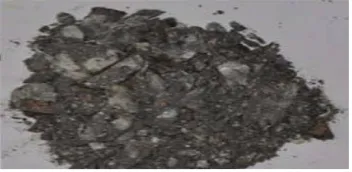
Copper slag from Tuticorin Sterilite Industries was obtained and the results were tabulated below.
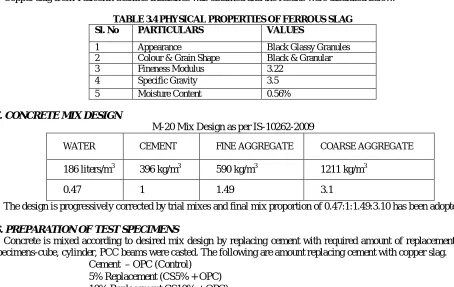
TABLE 3.4 PHYSICAL PROPERTIES OF FERROUS SLAG Sl. No PARTICULARS VALUES
1 Appearance Black Glassy Granules
2 Colour & Grain Shape Black & Granular
3 Fineness Modulus 3.22
4 Specific Gravity 3.5
5 Moisture Content 0.56%
F. CONCRETE MIX DESIGN
M-20 Mix Design as per IS-10262-2009
WATER CEMENT FINE AGGREGATE COARSE AGGREGATE
186 liters/m3 396 kg/m3 590 kg/m3 1211 kg/m3
0.47 1 1.49 3.1
The design is progressively corrected by trial mixes and final mix proportion of 0.47:1:1.49:3.10 has been adopted.
G. PREPARATION OF TEST SPECIMENS
Concrete is mixed according to desired mix design by replacing cement with required amount of replacement and specimens-cube, cylinder, PCC beams were casted. The following are amount replacing cement with copper slag.
Cement – OPC (Control)
5% Replacement (CS5% + OPC)
10% Replacement CS10% + OPC)
15% Replacement (CS15% + OPC)
20% Replacement (CS20% + OPC)
25% Replacement (CS25% + OPC)
30% Replacement (CS30% + OPC)
i. Cube
ii. Cylinder
Cylinder moulds of diameter 150mm and height 300mm were used. The crude oil was applied along the inner surfaces of the mould for easy removal of cylinder from the mould. Concrete was poured throughout its length and compacted well. Totally 64nos of cylinders were casted.
iii. PCC beam
Beam moulds of size 500mm x 100mm x 100mm were used. The crude oil was applied along the inner surfaces of the mould for easy removal of beam from the mould. Concrete was poured throughout its length and compacted well. Totally 64nos of pcc beams were casted.
iv. CURING OF SPECIMENS
The specimens were carefully casted and demoulded after 24 hours, without disturbing the specimens, these were cured in the curing tank for 7, 28, 56 days.
IV. TESTING OF SPECIMENS
A. COMPRESSIVE STRENGTH OF CUBES
Concrete cubes of size 150 mm×150mm×150mm were cast with and without copper slag. The maximum load at failure reading was taken and the average compressive strength is calculated using the equation.
Compressive strength (N/mm 2) = Ultimate load in N
Area of cross section (mm 2)
Figure 4.1 Compression Test
B. SPLIT TENSILE STRENGTH TEST
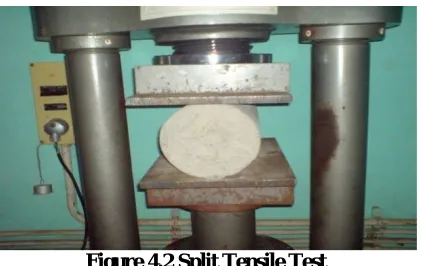
Concrete cylinders of size 150 mm× 300mm were cast using with and without copper slag. The maximum load at failure reading was taken and the average split tensile strength is calculated using the equation.
Split tensile strength (N/mm2) = 2P/ П L D
Where, P=Ultimate load at failure (N),
L=Length of specimen (mm), D=Diameter of cylindrical specimen (mm).
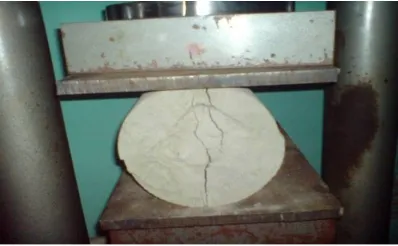
Fig 4.3 shows the failure of cylinder while conducting split tensile test
Figure 4.3 Failure of Cylinder
C. FLEXURAL STRENGTH TEST
PCC beams of size 500 mm x 100mm x 100mm were cast using with and without copper slag. The maximum load at failure reading was taken and the average flexural strength is calculated using the equation.
Flexural strength F= 3Pl/2bd2 F-Flexural strength in N/mm2 P-Maximum Load in N
l- Distance between central lines of supporting rollers in mm.
b- Average width of beam in mm. d- Average Thickness in mm.
V. TEST RESULTS
A. COMPRESSIVE STRENGTH
The average compressive strength and increase in compressive strength values due to replacement of cement with copper slag at various ages of concrete are given in table 5.1 to 5.4.
Table 5.1 Compressive Strength Test Results at 7 Days Replacement of
copper slag %
Average Compressive strength N/mm2
0 23
5 23.3
10 28.44
15 31.2
20 27.1
25 25
30 23.56
From the Table 5.1 it was found that the compressive strength at 7 days increases when the percentage of slag was increased from 0 to 15% and decreases when the percentage of slag was increased from 20 to 30%.
Table 5.2 Compressive Strength Test Results at 28 Days Replacement of
copper slag
Average Compressive strength N/mm2
0% 40.67
5% 41.28
10% 43.12
20% 43.81
25% 42.76
30% 41.26
From the Table 5.2 it was found that the compressive strength at 28 days increases when the percentage of slag was increased from 0 to 15% and decreases when the percentage of slag was increased from 20 to 30%. It is also found that the strength 15% replacement gives high compressive strength.
Table 5.3 Compressive Strength Test Results at 56 Days
Replacement of copper slag
Average Compressive strength N/mm2
0% 49.11
5% 50.12
10% 53.4
15% 54.32
20% 54.12
25% 52.48
30% 52.12
From Table 5.3, it was found that the compressive strength at 56 days increases when the percentage of slag was increased from 0 to 15% and decreases when the percentage of slag was increased from 20 to 30%. It is also found that the strength 15% replacement gives high compressive strength.
Figure 5.4 Age of Concrete Vs. Compressive Strength For 0%CS
From the Figure 5.4 it is evident that there is a steady rate of increase in compressive strength with respect to age of concrete at 0% replacement of copper slag
.
Figure 5.5 Age of Concrete Vs Compressive Strength For 5%CS 0
20 40 60
0 10 20 30 40 50 60
0% replacement of CS
0 20 40 60
0 10 20 30 40 50 60
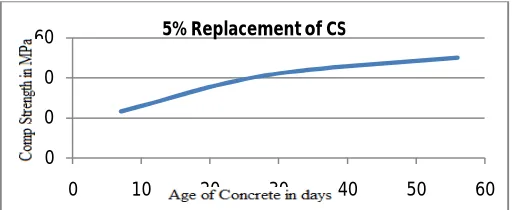
From the Figure 5.5 it is evident that there is a steady rate of increase of compressive strength with respect to age of concrete at 5% replacement of copper slag. It is almost similar to the control specimen.
Figure 5.6 Age of Concrete Vs Compressive Strength For10%CS
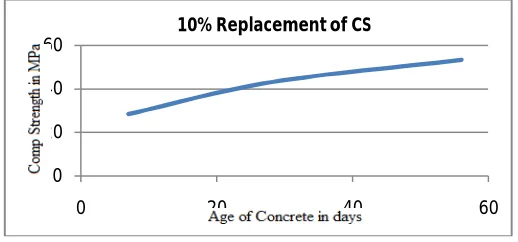
From the Figure 5.6 it is evident that there is a steady rate of increase in compressive strength with respect to age of concrete at 10% replacement of copper slag.
Figure 5.7 Age of Concrete vs. Compressive Strength for 15%CS
From the Figure 5.7 it is evident that there is a steady rate of increase in compressive strength with respect to age of concrete at 15% replacement of copper slag. It is almost similar to that of the control specimen.
Figure 5.8 Age of Concrete Vs Compressive Strength For 20%CS 0
20 40 60
0 20 40 60
10% Replacement of CS
0 20 40 60
0 20 40 60
15% Replacement of CS
0 20 40 60
0 20 40 60
From the Figure 5.8 it is evident that there is a steady rate of increase in compressive strength with respect to age of concrete at 20% replacement of copper slag.
Figure 5.9 Age of Concrete Vs Compressive Strength For 25%CS
From the Figure 5.9 it is evident that there is a steady rate of increase in compressive strength with respect to age of concrete at 25% replacement of copper slag.
Figure 5.10 Age of Concrete Vs Compressive Strength For 30%CS
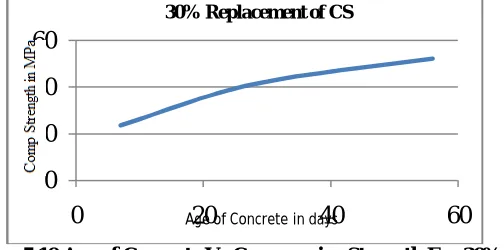
From the Figure 5.10 it is evident that there is a steady rate of increase in compressive strength with respect to age of concrete at 30% replacement of copper slag.
C. SPLIT TENSILE STRENGTH
The average split tensile strength and increase in split tensile strength values due to replacement of cement with copper slag at various ages of concrete are given in table 5.5 to 5.8.
Table 5.5 Split Tensile Strength Test Results at 7 Days
Replacement of copper slag %
Average Split tensile strength N/mm2
0 1.9
5 2.17
10 2.3
15 2.55
20 2.34
25 2.1
30 2.19
0 20 40 60
0 20 40 60
25% Replacement of CS
0
20
40
60
0
20
40
60
30% Replacement of CS
From the Table 5.5, it was found that the split tensile strength at 7 days increases when the percentage of slag was increased from 0 to 15% and decreases when the percentage of slag was increased from 20 to 30%. It is also found that the strength 15% replacement gives high split tensile strength.
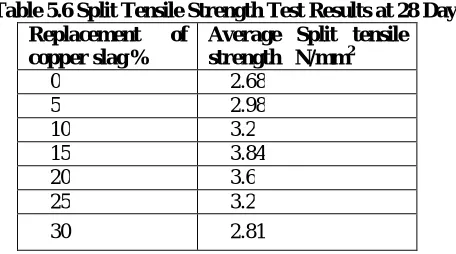
Table 5.6 Split Tensile Strength Test Results at 28 Days Replacement of
copper slag %
Average Split tensile strength N/mm2
0 2.68
5 2.98
10 3.2
15 3.84
20 3.6
25 3.2
30 2.81
From the Table 5.6 it was found that the split tensile strength at 28 days increases when the percentage of slag was increased from 0 to 15% and decreases when the percentage of slag was increased from 20 to 30%. It is also found that the strength 15% replacement gives high split tensile strength.
Table 5.7 Split Tensile Strength Test Results at 56 Days Replacement of
copper slag %
Average Split tensile strength N/mm2
0 3.41
5 3.61
10 3.8
15 4.24
20 4.1
25 3.76
30 3.51
From the Table 5.7, it was found that the split tensile strength at 56 days increases when the percentage of slag was increased from 0 to 15% and decreases when the percentage of slag was increased from 20 to 30%. It is also found that the strength 15% replacement gives high split tensile strength.
D. FLEXURAL STRENGTH
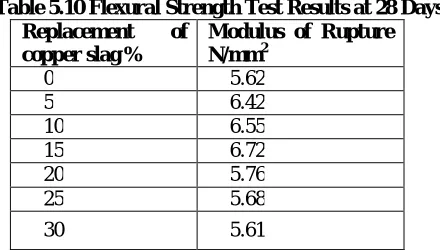
The average flexural strength and increase in flexural strength values due to replacement of cement with copper slag at various ages of concrete are given in table 5.9 to 5.12.
Table 5.9 Flexural Strength Test Results at 7 Days Replacement of copper
slag %
Modulus of Rupture N/mm2
0 4.8
5 5.3
10 5.62
15 5.78
20 5.72
25 5.51
From the Table 5.9, it was found that the flexure strength at 7 days increases when the percentage of slag was increased from 0 to 15% and decreases when the percentage of slag was increased from 20 to 30%. It is also found that the strength 15% replacement gives high flexure strength.
Table 5.10 Flexural Strength Test Results at 28 Days Replacement of
copper slag %
Modulus of Rupture N/mm2
0 5.62
5 6.42
10 6.55
15 6.72
20 5.76
25 5.68
30 5.61
From the Table 5.10 , it was found that the flexure strength at 28 days increases when the percentage of slag was increased from 0 to 15% and decreases when the percentage of slag was increased from 20 to 30%. It is also found that the strength 15% replacement gives high flexure strength.
Table 5.11 Flexural Strength Test Results at 56 Days Replacement of
copper slag %
Modulus of rupture N/mm2
0 6.2
5 6.76
10 6.81
15 6.88
20 6.64
25 6.32
30 6.1
From the Table 5.11 , it was found that the flexure strength at 56 days increases when the percentage of slag was increased from 0 to 15% and decreases when the percentage of slag was increased from 20 to 30%. It is also found that the strength 15% replacement gives high flexure strength.
VI. COST ANALYSIS
The cost analysis plays an important role in deciding the economic design. Cement is the main ingredient of concrete and it is costlier also and its availability becomes rare nowadays. Hence the costlier thing is to be replaced, so it’s necessary to make cost analysis. Material required and their cost for providing per m3 of concrete for M20 grades is shown in Table 6.1
Table 6.1 Material Quantities
S.No Material Rate/Kg Quantity Required (Kg/ m3) M20 Amount(Rs.)
1 Cement 7.0 396 2772
2 Fine Aggregates 0.39 590 230.1
3 Coarse Aggregates 0.41 1211 496.51
Table 6.2 Copper Slag Quantities
% of Copper slag Rate/Kg Quantity Required
(Kg/ m3) M20 Amount(Rs.)
0% 2.0 0 0
5% 2.0 19.8 39.6
10% 2.0 39.6 79.6
15% 2.0 59.4 118.8
20% 2.0 79.20 158.4
25% 2.0 99 198
30% 2.0 118.8 237.6
Table 6.3 Cost Analysis
% of Copper slag Total cost of concrete per m3 in Rupees
0% 3498.61
5% 3399.61
10% 3301.01
15% 3201.61
20% 3102.61
25% 3003.61
30% 2904.61
VII. CONCLUSION
The following conclusions were drawn from this study
Replacement of copper slag in cement replacement reduces the cost of making concrete. The cost of the concrete for the optimum percentage of replacement of copper slag (15%) with partial replacement of cement is 9.28% less than that of normal concrete.
Replacement of copper slag increases the self weight of concrete specimens to the maximum of 15 to 20%.
For higher replacement of copper slag in cement (greater than 20%) the compressive strength decreases.
For higher replacement of copper slag in cement (greater than 20%) the split tensile strength decreases.
For higher replacement of copper slag in cement (greater than 20%) the flexure strength decreases.
The optimum percentage of replacement of copper slag is 15% which gives 10.61% higher compressive strength, 24.34% higher split tensile strength and 8.39% higher flexural strength than ordinary concrete at 56 days.
Since copper slag concrete exhibits good durability characteristics, it can be used as an alternate of cement as a raw material for making blended cements.
REFERENCES
[1]. Akihiko Y, Takashi Y. Study of utilization of copper slag as fine aggregate for concrete. Ashikaya Kogyo Daigaku Kenkyu Shuroku, (1996)79-85.
[2]. Ayano Toshiki, Kuramoto Osamu, Sakata Kenji, Concrete with copper slag fine aggregate. Society of Materials Science, No. 10, (2000) 1097-102.
[3]. Bipra gorai, R.K. Jana, Premchand,” Characteristics and utilisation of copper slag review Resources, Conservation and Recycling,” 39, 2003, pp. 299-313.
[4]. Caijun Shi, Jueshi Qian, High performance cementing materials from industrial slags – a review, Resources, Conservation and Recycling (2000)195–207.
[5]. Khalifa S. Al-Jabri, Makoto Hisada, Salem K. Al-Oraimi, Abdullah H. Al-Saidy. “Copper slag as sand replacement for high performance concrete”, Cement & Concrete Composites, No. 7, 31, 2009, pp. 483–488.
[7]. Mobasher B, Devaguptapu R, Arino AM. “Effect of copper slag on the hydration of blended cementitious mixtures”. In: Chong K, editor. Proceedings of the ASCE Materials Engineering Conference, Materials for the New Millennium; 1996, pp. 1677-1686.
[8]. Report on Utilization of copper slag as performance improver in ordinary Portland cement for M/s Sterlite Industries (India) Ltd., Tuticorin, Tamil Nadu, submitted by National Council for cement and building materials, New Delhi, Jan 2009.
[9]. Washington Almeida Moura Jardel Pereira Gonc¸ alves Monica Batista Leite Lima, “Copper slag waste as a supplementary cementing material to concrete”, Journal of Material Science, 42, 2007, pp.2226–30.
[10]. Zong L. The replacement of granulated copper slag for sand concrete. Journal of Qingdao Institute of Architecture and Engineering, No. 2, (2003)20–22.