Copyight 0 1996 by the Genetics Society of America
A Search for a General Phenomenon of Adaptive
Mutability
Timothy Galitski
and
JohnR. Roth
Departmat of Biology, University of Utah, Salt Lake City, Utah 84112 Manuscript received January 2, 1996
Accepted for publication March 14, 1996
ABSTRACT
The most prominent systems for the study of adaptive mutability depend on the specialized activities of genetic elements like bacteriophage Mu and the F plasmid. Searching for general adaptive mutability, we have investigated the behavior of Salmonella typhimurium strains with chromosomal lacZ mutations. We have studied 30 revertible nonsense, missense, frameshift, and insertion alleles. One-third of the mutants produced 2 1 0 late revertant colonies (appearing three to seven days after plating on selective medium). For the prolific mutants, the number of late revertants showed rank correlation with the residual &galactosidase activity; for the same mutants, revertant number showed no correlation with the nonselective reversion rate (from fluctuation tests). Leaky mutants, which grew slowly on selective medium, produced late revertants whereas tight nongrowing mutants generally did not produce late revertants. However, the number of late revertants was not proportional to residual growth. Using total residual growth and the nonselective reversion rate, the expected number of late revertants was calcu- lated. For several leaky mutants, the observed revertant number exceeded the expected number. We suggest that excess late revertants from these mutants arise from general adaptive mutability available
to any chromosomal gene.
T
HE orthodox neo-Darwinian view of mutability pos- tulates that all mutations occur without regard to their fitness value; in this sense they are “random”. This view excludes the notion of “adaptive” mutability, the preferential production of fitness-enhancing muta- tions. Classical experiments demonstrated that some mutability is random( L u m
and DELBRUCK 1943; LED- ERBERG and LEDERBERG 1952). However, DELBRUCK(1946), SWIRO (1984), and CAIRNS et aL (1988) have pointed out the lack of evidence to exclude the possibil- ity that another fraction of total mutability is adaptive. Reviving this question, SHAPIRO (1984), CAIRNS et al. (1988), and CAIRNS and FOSTER (1991) described ex- perimental systems that appeared to demonstrate adap- tive mutability. However, the participation of complex genetic elements like bacteriophage Mu and the F plas- mid has complicated these prominent bacterial exam- ples. In these systems, the locus under selection shows increased mutability during starvation because it is ex- perimentally coupled to the transposasedependent ex- cision of Mu in one case (SHAPIRO and LEACH 1990; MAENHAUT-MICHEL and SHAPIRO 1994; FOSTER and CAIRNS 1994) or mutationally derepressed transfer functions of F in the other (FOSTER and TRIMARCHI 1995; GALITSKI and ROTH 1995; PETERS and BENSON 1995; RADICELLA et al. 1995a). While these systems have provided examples of adaptive mutability, their singular complexity makes one suspect that they may be exam- ples of limited generality. The evolutionary relevance
Curre~pondingauthor: Timothy Galitski, Department of Biology, Uni- versity of Utah, Salt Lake City, UT 84112.
E-mail: [email protected]
Genetics 143: 645-659 Uune, 1996)
of these novel systems is the subject of lively debate (BRIDGES 1995a; CAIRNS 1995; LENSKI and SNIEGOWSKI 1995; RADICELLA et al. 1995b; ROTH and GALITSKI 1995; SHAPIRO 1995a,b).
Because of the great attention received by the F-based system, some of its most striking characteristics have become associated with adaptive mutability. In particu- lar, mutability of nongrowing cells (CAIRNS and FOSTER 1991; FOSTER 1994) and dependence on homologous recombination functions (CAIRNS and FOSTER 1991;
HARRls
et aL 1994) are cited. Neither of these properties is, apriori,
a characteristic of adaptive mutability. We suggest that adaptive mutability should be a more gen- eral phenomenon. It should be easily detectable with- out resorting to complex genetic systems that require transposon or conjugation functions, and it should op- erate under naturally relevant conditions of slow growth, not only in nongrowing cells.The possibility of adaptive mutability has been investi- gated in various bacterial and yeast systems (reviewed in FOSTER 1991, 1992, 1993; HALL 1992; STAHL 1992; LENSKI and MITTLER 1993; ROSENBERG 1994; SYMONDS 1994; BRIDGES 199513). Since organisms typically exist under relatively adverse or selective conditions, the
po-
tential importance of adaptive mutability is great. Most of what we know of mutational mechanisms involves the study of microorganisms growing rapidly under fa- vorable conditions. A thorough investigation of muta- tional mechanisms under conditions of strong selection and slow growth may reveal new aspects of mutability with evolutionary implications.
sion of a collection of strains carrying various mutant alleles of a single gene, l a d . In this collection, the locus under selection is chromosomally situated; reversion events are not obviously associated with the specialized activities of any extraneous genetic element. The goal was to correlate various characteristics of mutant strains with their ability to revert under selection. We found that leaky lac2 mutants show reversion under selection whereas tight nongrowing mutants generally show no late reversion. Late reversion of leaky chromosomal lac2 mutants does not require homologous recombination functions. This behavior is expected if there is no adap- tive mutability. However, many of these strains produce an excess of revertants under selective conditions com- pared with the number expected based on observed growth and nonselective reversion rates. We suggest that these findings reveal a general phenomenon of adaptive mutability.
MATERIALS AND METHODS
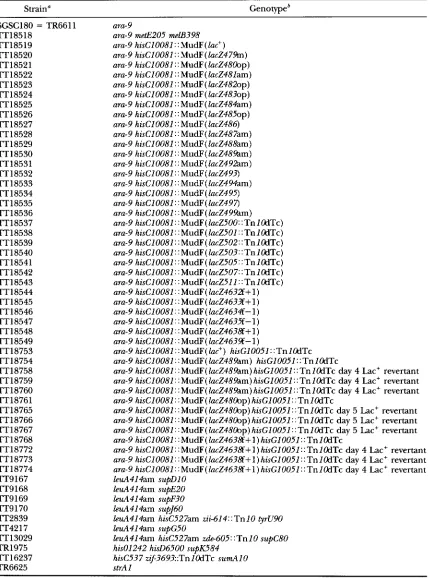
Bacterial strains and growth media: All bacterial strains used in this study (Table 1) are derivatives of Salmonella typhz-
murium LT2.
The defined minimal medium was NCE salts (BERKOWITZ
et al. 1968) with 0.2% of the appropriate carbon source plus auxotrophic supplements at final concentrations recom- mended by DAVIS et al. (1980). The complex medium was nutrient broth, NB, (8 g/liter, Difco Laboratories) with added NaCl (5 g/liter). Solid media contained BBL agar at 1.5%. MacConkey agar was obtained from Difco laboratories and prepared according to the manufacturer's instructions. Final concentrations of antibiotics in complex medium were as fol- lows: tetracycline hydrochloride, Tc, 20 pg/ml; and kanamy- cin sulfate, Km, 50 pg/ml. The @galactosidase chromogenic substrate, 5-bromo-4chlorc-3-indolyl-~-D-galactopyranoside
(Xgal), was added to a final concentration of 25 pg/ml. The nonmetabolizable inducer of the lac operon, isopropyl-P-D- thiogalactopyranoside (IPTG), was used at a final concentra- tion of 1 mM. All incubations were at 37" except as noted. Sterile 0.85% NaCl (saline) was used to dilute cultures except as noted.
Transductional crosses, mediated by the phage mutant P22 HT105/1 int-201 (SCHMIEGER 1971), were performed as de- scribed by ROTH (1970a). Recombinationdeficient derivatives of hcZ mutants were constructed by first introducing the srl- 203::TnlWCm mutation by transduction; the linked recAl mutation was cotransduced into these strains selecting a Srl+ phenotype on NCE sorbitol histidine plates.
Isolation of lac mutants: To reference strain SGSC180 (ara- 9) an insertion of MudF(lad+Z+Y'A+ K m R ) in the hzsC gene
was introduced by transduction, resulting in strain TT18519
( a m 9 hisC10081 ::MudF). The MudF insertion of this strain is oriented such that lac operon transcription is opposite that of the his operon (data not shown; Figure 1). This element is unable to catalyze its own transposition or excision since it lacks all Mu genes, including the Mu A and B transposase genes.
Mutant Lac- derivatives of strain TT18519 were isolated after mutagenesis with either DES (diethyl sulfate) or ICR-191
(2-chloro-6-methoxy-9-[3-(2-chloroethyl) aminopropylamino] acridine dihydrochloride). These mutageneses were carried out as described by ROTH (1970a). Insertion mutations were made using Tn IMTc, the transpositiondefective T n l M e -
rived element No. 11 of WAY et al. (1984). Methods for use of the TnlCMTc element were those of KLECKNER et al. (1991). Independent Lac- mutants were isolated after each mutagen- esis by looking for white mutant colonies among the red colo- nies on MacConkey agar plates. Each lac mutation was trans- ductionally backcrossed to the unmutagenized parent strain SGSCl8O at least once by selecting the kanamycin resistance of the MudF element on NB Km plates. Transductants from these backcrosses were saved for further study. For all mutants used, the Lac- phenotype was 100% linked to the kanamycin resistance determinant. This procedure ensured that only lacZ or LacYmutants were saved and that other unlinked mutations were not present in the isolates saved for further study.
Qualitative P-galactosidase assay: To classify lac mutan& as
either lacZ or lacy types, qualitative assays of P-galactosidase activity were performed. Mutants of lucZ have little or no
0-
galactosidase activity whereas lacy mutants have wild-type lev- els of P-galactosidase activity. Overnight cultures of strains were grown in NCE glycerol histidine IPTG medium. To 0.9 ml of Z buffer (MILLER 1972), 50 pl of CHC1:3 and 0.1 ml of overnight culture were added. These mixtures were vortex mixed for 10 sec and incubated at room temperature for 10 min. Reactions were started by adding 0.2 ml of 4 rng/ml o nitrophenyl-P-D-galactopyranoside (ONPG). After 10 min at room temperature, the development of yellow color (ni- trophenol production) was noted. Assays of lacy mutants pro- duce strong yellow color whereas assays of l a d mutants pro- duce little or no yellow color. The lac operon structure (lacZYA) prevents mistaken interpretations due to polarity- lacZ is the first gene of the operon.Classification of DESiduced mutations: Mutants isolated after DES mutagenesis were classified by testing for informa- tional suppression. The hcZmutations were introduced to s u p pressor strains by transduction crosses selecting the K m R deter-
minant of the MudF element on MacConkey Km plates. Transductant colonies were either white like their donor par- ents (unsuppressed) or red (suppressed). The suppressors (Ta- ble l ) included: four amber (UAG) suppressor tRNA (supD, sup& supE and supj), three ochre (UAA) suppressor tRNAS
(tyrU, supC, and supG), a recessive opal (UGA) suppressor (supK), as well as a missense suppressor, s u d , that suppresses -25% of all missense mutations (WHITFIELD et al. 1966; K HUGHES, L. MIESEL, M. MESERW, and E. ALTMAN, personal communications). Strains classified as amber mutants were s u p pressed by all of the amber and ochre suppressors and by no
others. Recall that ochre tRNA suppressors suppress both ochre (UAA) and amber (UAG) mutations whereas amber tRNA suppressors suppress only amber mutations. No ochre mutations were found in our set. Mutations classified as opal were suppressed by only the supK suppressor. The missense suppressor, s u d , suppressed one allele, lacZ479m. Four other DESinduced mutations were not suppressed by any of these suppressors. These four, as well as lacZ479m, were found to be nonpolar (see below) and thus are likely to be missense alleles. All DES-induced mutations were checked for temperature sen- sitivity of growth on NCE lactose Xgal histidine plates. No temperature sensitivity was found at 30, 37, and 42". This spec- trum of DES-induced mutations coincides closely with that reported previously (LANGRIDGE and CAMPBELL 1969) after mutagenesis of hcZwith MNNG (N-methyl-N'-nitro-N-nitroso-
guanidine, another alkylating agent). All the h c Z alleles of
Table 1 , other than the frameshifts and the TnlOdTc inser- tions, were induced by DES.
Reversion Under Selection
TABLE 1
Bacterial s t r a i n s
Straina Genotypeb
647
SGSC180 = TR6611 ara-9 TT18518 ara-9 metE205 melB398
TT18519 ara-9 hisCl0081: : MudF( laci)
TT18520 ara-9 hisClOO81: : MudF ( lacZ47An) 'IT18521 ara-9 hisClOO81: : MudF( lacZ48oOp) 'IT18522 ara-9 hisC10081: : MudF( lacZ481am) 'IT18523 ara-9 hisClOO81: : MudF( lacZ482op) 'IT18524 ara-9 hisClOO81: : MudF( lacZ483op) 'IT18525 ara-9 hisClOO81: : MudF( lacZ484am) 'IT18526 ara-9 hisClOO81: : MudF( lacZ485op) 'IT18527 ara-9 hisClOO81: : MudF( lacZ486) 'IT18528 ara-9 hisClOO81: : MudF( lacZ487am) 'IT18529 ara-9 hisC1 0081 : : MudF( lacZ488am) TT18.530 ara-9 hisClOO81: : MudF( lacZ489am) 'IT18531 ara-9 hisC10081:: MudF(lacZ492am)
'IT18532 ara-9 h i d l 0081 : : MudF( lacZ493) 'IT18533 ara-9 hisClOO81: : MudF( lacZ494am) 'IT18534 ara-9 hisClOO81: : MudF( lacZ495) 'IT18535 ara-9 hisClOO81: : MudF( lacZ497) TT18536 ara-9 hisClOO81: : MudF( lacZ49Am)
'IT18537 ara-9 hisClOO81: : MudF( lacZ500: : Tn 1 OdTc) 'IT18538 ara-9 hisCl 0081 : : MudF( lacZ501: : Tn 1 WTc) TT18539 ara-9 hisClOO81: : MudF( lacZ502 : : Tn 1 WTc) TT18540 ara-9 hisClOO81: : MudF ( lacZ503: : Tn 1 OdTc) TT18541 ara-9 hisClOO81: : MudF ( lacZ505 : : Tn 1 OdTc) TT18542 ara-9 hisCl 0081 : : MudF( lacZ507: : Tn 1 OdTc) TT18543 ara-9 h i d l 0081 : : MudF( lacZ511: : Tn 1 WTc) TT18544 ara-9 h i d l 0081 : : MudF( lacZ4632f+ 1) TT18545 ara-9 hisC10081:: MudF( lacZ4633f+l)
TT18546 ara-9 hisC10081:: MudF( lacZ4634f- 1) TT18547 ara-9 hisC10081:: MudF( lacZ4635f-1) TT18548 ara-9 hisC10081:: MudF( lacZ4638f+ 1) TT18549 ara-9 hisC10081: : MudF( lacZ4639E- 1)
TT18753 ara-9 hisClOO81: : MudF( lac+) hisGlOO51: : Tn 1 OdTc TT18754 ara-9 hisCl 0081 : : MudF( lacZ485hm) hisGlOO51: : Tn 1 WTc
TT18758 ara-9 hisCl 0081 : : MudF( lacZ485hm) hisGlOO51: : TnlOdTc day 4 Lac' revertant TT18759 ara-9 hisClOO81: : MudF( lacZ485hm) hisGlOO51: : TnlOdTc day 4 Lac+ revertant TT18760 ara-9 hisClOO81: : MudF( lacZ489am) hisGlOO51: : Tn lOdTc day 4 Lac+ revertant TT18761 ara-9 hisClOO81: : MudF( lacZ48Cbp) hisGlOO51: : Tn 1 OdTc
TT18765 ara-9 hisCl0081: : MudF( lacZ48Cbp) hisGlOO51: : Tn 1 OdTc day 5 Lac' revertant TT18766 ara-9 hisClOO81: : MudF ( lacZ48Cbp) hisGlOO51: : Tn 1 OdTc day 5 Lac+ revertant TT18767 ara-9 h i d l 0081 : : MudF( lacZ48Cbp) hisGlOO51: : Tn 1 OdTc day 5 Lac+ revertant TT18768 ara-9 h i d l 0081 : : MudF ( lacZ4638f+ 1) hisGlOO51: : Tn 1 OdTc
TT18772 ara-9 hisClOO81: : MudF (lacZ4638F+ 1) hisGlOO51: : Tn lOdTc day 4 Lac' revertant TT18773 ara-9 hisClOO81: : MudF( lacZ4638f+ 1) hisGlOO51: : TnlOdTc day 4 Lac' revertant 'IT18774 ara-9 hisC10081: : MudF( lacZ4638f+ 1) hisGlOO51: : TnlOdTc day 4 Lac+ revertant
'IT9167 M 4 1 #am supDl0
TT9 168 M 4 1 4 a m supE20
'IT9169 led414am supF30
'IT9 170 l e d 4 1 4am supJ60
'IT2839 led414am hisC527am zii-614::TnlO tyrU90
'IT421 7 led414am supG50
'IT13029 led414am hisC527am zde605::TnlO supC80 TR1975 his01242 hisD6500 supK584
'IT16237 hisC537 zif3693::TnlOdTc sumAl0 TR6625 strAl
"All strains are derivatives of Salmonella typhimurium LT2. Strain SGSCl8O was provided by K. SANDERSON and the Salmonella Genetic Stock Center. Strains TT18518-nl8774 were isolated or constructed during the course of this work. The remainder are from the ROTH laboratory collection.
ara-9
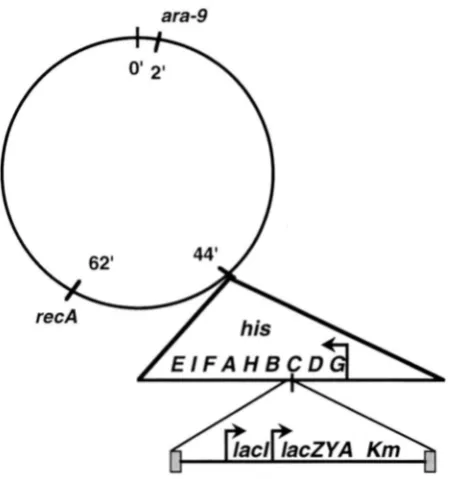
FIGURE 1 .-A map of the Salmonella chromosome illustrat- ing relevant markers (see Table 1). The structure of the his
locus interrupted by an insertion of the Muderived element, MudF, is magnified. MudF is a transpositionally inert element with Mu ends but n o Mu functions. It includes a wild-type lac
locus and a kanamycin resistance determinant (CHACONAS et al. 1981; SONTI 1990). Salmonellae are naturally Lac-; the lac
genes are derived from Esclwn'chia coli K12.
saved for further study. It was also possible to classify frameshift mutations as likely +1 or -1 shifts by screening for an induction of reversion with MNNG. MNNG tends to revert +1 frameshifts but not -1 frameshifts (RIDDLE and ROTH 1970). Two NCE lactose Xgal histidine plates were spread with 0.1-ml aliquots from an overnight culture of each Lac- strain. On one plate a 2 0 4 drop of a 1 mg/ml solution of MNNG in citrate buffer (MILLER 1972) was placed in the center. Similarly, a 1 mg/ml solution of ICR-191 in 70% etha- nol was applied to the other. Solutions and plates with ICR- 191 were handled and incubated in subdued light. Plates were incubated for 3 days and scored for a pronounced induction of revertants around the zone of killing.
Recombinational grouping of TnZOdTc insertions: Since TnlO element5 show insertion site specificity (KLECKNER et al.
1979), some independent lacZ insertion alleles were likely to have the insertion at the same site. To study only insertions at distinct sites, insertion strains were placed into groups of mutants that failed to recombine with each other to give Lac' transductants. Insertion mutants were crossed to each other by transduction selecting Lac+ on NCE lactose Xgal histidine plates. For each strain, a cross with a lac' donor and a self- cross served as positive and negative controls respectively. Seven groups of nonrecombining insertions were found; only one member of each recombination group was tested further. Tests of polarity: Classification of lac% mutations was ex- tended by testing for polarity on the downstream lacy gene. The Lacy permease can substitute for the MelB melibiose permease (KENNEDY 1970). Accordingly, we crossed the MudF elements from the h c Z mutants into a melB deletion strain and screened for utilization of melibiose as a sole source of carbon and energy. MudF elements with lacZ mutations were crossed into strain TT18518 (ara-9metE205 melB398) selecting
K
m
'
on NB Km plates. For each cross, four transductantswere screened for growth on an NCE melibiose histidine me- thionine plate.
Fluctuation tests: The nonselective reversion rate of each
lac% mutant was measured using the fluctuation test of LURIA a n d D E L R R ~ C K (1943). From a single colony, an overnight culture was grown in NCE glycerol histidine medium and diluted 10"-fold in fresh medium. At least 30 0.5ml aliquots of this dilution were dispensed to tubes and incubated to saturation. To verify the independence of mutants found in the 0.5-ml cultures, the original overnight culture was sam- pled (0.1 ml) and plated on an NCE lactose Xgal histidine plate. Revertant colonies were counted after 40 hr of incuba- tion. To determine the total number of colony-forming units in the saturated independent cultures, one was chosen at random. Its volume was measured (some was lost due to evap oration). A sample was diluted and plated on nutrient agar plates. To all cultures, 2.5 ml of molten NCE lactose Xgal histidine with 0.7% agar was added. These were mixed, poured onto an NCE lactose Xgal histidine plate, incubated for 40 hr, and scored for the numbers of Lac' colonies. Since some strains continually produce Lac+ revertants with time, reconstruction control experiments were performed to deter- mine the optimal incubation time to score the number of Lac' mutants present at the time of plating. This time was 40 hr (data not shown). Mutation rates were calculated using the Po method (LURIA and DELBROCK 1943) or the method of the median (LEA and COUISON 1949).
Modified quantitative P-galactosidase assays: Assays were performed, and units of &qalactosidase activity were calcu- lated, as described by MILLER (1972). The following modifica- tions were employed to allow the reliable measurement of low activities: (1) Cultures of assayed strains were grown in NCE glycerol histidine with or without IPTG to 100 Klett. The use of glycerol increases induced fl-galactosidase levels about sixfold (due to Crp/cAMP control) compared with growth on glucose (data not shown). (2) Higher concentrations of bovine serum albumin and 2-mercaptoethanol were used to stabilize P-galactosidase activity. To Z buffer, we added bovine serum albumin to 100 pg/ml, 2-mercaptoethanol to 200 mM, and sodium dodecyl sulfate to 0.005%. (3) Mixtures of Z buffer and culture were prepared in 15ml polypropylene screw-cap tubes to prevent evaporation during extended incu- bations. Cells were permeabilized by vortex mixing with two drops of chloroform per milliliter of mixture. (4) Reactions were started by adding the substrate, ONPG. Reaction times were extended over as much as 3 days to allow sufficient product development. (5) Reactions were monitored by with- drawing 1-ml samples over time, mixing these with 0.42 ml of 1 M Na2C03 in a microcentrifuge tube, centrifuging the sample for 1 min to remove most cellular debris, removing 1 ml of the supernatant to a cuvette, and measuring absorban- ces of 550 and 420 nm light. Sample clarification eliminates most of the experimental error associated with the correction for bacterial absorbance of 420 nm light.
The ability of the modified assay to reliably measure low activities was tested. A culture of the lac' parent strain, TT18519, was diluted lo'-, lo'-, and 10:"fold before assay. The undiluted culture of strain TT18519 had 5700 units of activity, whereas the dilutions were determined to have 5.5,0.42, and 0 units, respectively. All assays that required extended (>40 hr) incubation showed a significant loss of activity (even di- luted wild-type extracts); thus assays of strains with a very low reported activity are likely to underestimate total activity.
Reversion Under Selection 649
saline. From each culture, -5 X
lo8
tester cells (0.1 ml) were spread on a plate of selective medium, NCE lactose Xgal histidine. Histidine was included as an essential nutrient for these auxotrophic strains; it does not provide a carbon or energy source (GUTNICK et al. 1969). The chromogenic sub- strate Xgal was included to facilitate the scoring of Lac+ re- vertant colonies. Plates were incubated at 37" in loosely closed plastic sleeves to minimize drying. New Lac+ colonies were counted each day for 7 days of incubation. Ten independent cultures were tested for each strain. In some experiments (noted in RESULTS), strains were plated with a fivefold excess of scavenger cells to consume carbon and energy sources other than lactose that might be present in the medium or excreted by Lac' revertant cells. Scavenger cells of the Lac- strain SGSC180 (am-9 ) or strain TR6625 (strAI) were pre- pared in the same way as the tester cells. The strains tested both in the presence and absence of scavengers included TT18520 (lacZ479m), TT18521 (lacZ48oOp), TT18522 (lac- Z481am), TT18523 (lacZ482op), TT18524 (lacZ483op), TT18525 (lacZ484am), TT18526 (lacZ485op), TT18527(lacZ486), TT18528 (lacZ487am), and TT18529 (lacZ488am). Growth on selective medium: To determine the number of viable Lac- tester cells per plate over time, agar plugs were taken (avoiding Lac+ colonies) from selective platings described above for reversion experiments. Bacteria on 20 mm2 agar plugs were suspended in saline by vigorous vortex mixing for 15 sec followed by 15 min of benchtop incubation without agitation and another 15-sec vortex mixing. Dilutions were prepared in saline, spread on nutrient agar plates (with kanamycin for assaying tester strains in the presence of a
scavenger strain), and incubated. The numbers of colonies on nutrient agar plates were multiplied by their respective dilution factors and 289 (the ratio of the area of the agar plate to the area of the agar plug) to determine the number of Lac- tester cells on the selective plates.
RESULTS
Experimental system: We have characterized the re- version and residual p-galactosidase levels of 30 lacZ mutants derived from a parental Lac' derivative of Sal-
monella typhimurium LT2. Salmonellae are naturally Lac-; the lac operon was introduced as part of a MudF element inserted in the hisC gene (Figure 1). MudF is a transpositionally inert Mu-derived element with Mu ends flanking a wild-type lac locus and a kanamycin resistance ( K m R ) determinant (CHACONAS et al. 1981; SONTI 1990). Since it lacks all Mu genes, including the A
and B transposase genes, it has no transposition activity. None of the Lacf reversion events occurring in the
his::MudF system was associated with excision or trans- position of Mu; all revertants tested had the original MudF insertion and no others (T. GALITSKI, unpub- lished results). The his::MudF construction was used because its His- K m R phenotype facilitates genetic ma- nipulation. The lac genes can be transduced to a new strain by selecting K m R ; they can be removed from a
strain by selecting Hisf.
The k c 2 mutant set: Independent mutants of the lacZ gene, encoding p-galactosidase, were isolated after mutageneses of strain TT18519 (lac') with one of three different mutagens, DES (diethyl sulfate, an alkylating agent), ICR-191 (a frameshift-inducing acridine com-
pound), and TnlOdTc (a transposition-defective TnlO derivative). Lac- mutants were isolated by screening for white colonies among the red (Lac+) colonies on MacConkey agar plates. Since MacConkey medium in- dicates acid production from lactose catabolism but allows both Lac' and Lac- colonies to grow, white colo- nies isolated from MacConkey plates were checked for their ability to use lactose as a sole source of carbon and energy. The chosen mutants failed to grow over- night when patches were replicated to NCE lactose Xgal histidine plates; extremely leaky lac mutants were ex- cluded. Transductional backcrosses (selecting the K m R phenotype of MudF) to strain SGSC180 ( a m 9 his+) were performed to ensure that the Lac- phenotype w a s
due to a mutation of the lac operon ( l a d , lacZYA) and to eliminate any unlinked mutations incurred during mutagenesis. One transductant from each cross was saved for further study. Mutants of the lacA gene are Lac'; they were systematically excluded. Mutants of the
lacy gene, encoding lactose permease, were eliminated based on the results of a qualitative p-galactosidase assay (see MATERIALS AND METHODS); lacymutants have wild- type levels of p-galactosidase activity whereas lacZ mu- tants show a loss of activity. Rare mutant lacl alleles encoding a noninducible repressor (Lac-) would have been classified in our tests as "polar" missense (most likely) mutations (classifications described below). Since any lad null mutation will suppress these domi- nant mutations, such strains should show nonselective reversion rates 2 100 times higher than the highest rates observed in our set. We found no mutants resembling this description. Also, nonrevertible lac mutants (dele- tions, double mutations) were excluded. Thus, the mu- tant set includes only revertible lac2 alleles.
Classification of k c Z mutations: Various tests were employed to classify lacZ mutations without resorting to sequence determination. These tests included screens for informational suppression, induced rever- sion with different mutagens, polarity on the lacYgene, temperature sensitivity, and recombination (see MATE-
RIALS AND METHODS). The resulting classifications are indicated by allele descriptors (Table 1 and Table
2).
Mutagenesis with DES gave a distribution of alleles in- cluding all the amber (UAG), opal (UGA), and mis- sense types. None of these showed any temperature sensitivity; they had the same Lac- phenotype at 30,37, and 42". Frameshift mutagenesis with ICR-191 pro- duced both
+
1 and-
1 frameshift alleles. Multiple inde- pendent insertions of TnlOdTc were isolated. Inser- tions at distinct sites were identified by recombination tests and included in this study. To further classify the lac2 alleles, polarity on the downstream lacy gene was assessed (see MATERIALS AND METHODS and Table 2).Galitski and
TABLE 2
Polarity, nonselective reversion rate, late revertants, and residual P-galactosidase activity of lac2 mutants
Residual
ZucZ allele" Polarity on lacyb reversion rate' r e v e r t a d activity'
Nonselective Late 0-galactosidase
489am 482op 4 8 0 0 ~
485op
46?8f+ 1
492am 46??f+ 1 46?2f+ 1 488am 487am 4 94am 484am 486 481am 499am
4 7%
505::TnlWTc 500: : Tn 1 OdTc 4 95
4 93 497
501 : : Tn 1 WTc 502::TnlWTc 503::TnlOdTc 507: : T n 1 WTc 51l::TnlOdTc 483013
4635f- 1
4634f- 1
46?%- 1
Polar Polar Polar Polar, weak Polar, weak Polar, weak Polar Nonpolar Nonpolar Polar Polar Polar Nonpolar Nonpolar Nonpolar Nonpolar Nonpolar Nonpolar Nonpolar Nonpolar Polar Polar Nonpolar Nonpolar Nonpolar Polar Polar Polar Polar Polar 1.4 1.7 1.9 2.1 0.82 0.40 7.7 3.7 3.0 0.55 0.89 7.1 1.1 0.39 0.80 2.4 0.76 2.5 2.7 0.24 0.038 0.33 0.15 0.12 0.11 0.20 0.023 0.19 0.19 0.033
345 2 30 85 2 9 72 % 8 71 2 6 61 2 9 40 2 8 30 2 2 17 2 2 17 2 2 11 -t 1
9 2 1 6 2 2 6 2 1 6 ? 1 5 2 1 3 2 1 3 2 1 2 - t l 2 2 1 2 2 1 1 2 1 I t 1 1 2 1 0 2 1 0 2 0 0 2 0 0 2 0
o + o
0 2 0
o + o
13 ~~~ 0.83 1.3 0.37 0.57 2.3 0.09 0.1 1 0.13 0.81 0.17 0.08 0.28 6.7 0.09 0.05 0.45 0.16 0.53 0.08 0 0 0.65 0.29 0.55 0 0 0 0 0
ZucZallele number and type. The abbreviations used represent the following: am, amber (UAG); op, opal (UGA) ; f- 1, - 1 frameshift; f + 1,
+
1 frameshift; m, missense; : : Tn 1 WTc, insertion of a transposition-defective TnlO. The mutations lacking descriptors are likely missense alleles.Polarity of lacZ alleles on Lucy gene expression w a s assessed by screening for melibiose utilization in a m l B deletion background (see MATERIALS AND METHODS).
'Reversion rate to Lac+ (revertants per cell division X 10') during growth without selection for Lac+ (from fluctuation analysis, n 2 30).
dNumber (mean 2 SEM, n = 10) of Lac+ revertant colonies appearing from day 3 through day 7 of incubation on NCE lactose Xgal histidine plates. Error values are the standard error of the mean, SEM =
<(var/n).
'Residual 0-galactosidase activity in Miller units. Note that the modified assay employed here may underesti- mate activities <0.4 units (see MATERIALS AND METHODS).
Prevalence of late reversion: Late reversion was not a universal phenomenon. This has been reported pre- viously by HALL (1991), studying active-site frameshift and missense alleles of lac2 ( CUPPLES and MILLER 1989;
CUPPLES et al. 1990), and by FOSTER (1993), studying 20 ICR-191-induced lac2 and ara mutations (probably frameshifts). Among our set of 30 revertible lac2 mu- tants, only a minority showed a significant number of late revertants first appearing between 3 a n d
7
days of incubation under selective conditions. The panel of l a d m u t a n t s was screened for the accumulation of Lacf revertants during a week of incubation on selective me-d i u m . I n d e p e n d e n t c u l t u r e s w e r e grown nonselectively in NCE glycerol histidine medium, pelleted, and resus- pended in saline. About 5 X 10' cells were spread on plates of selective medium, NCE lactose Xgal histidine. New Lac+ revertant colonies were counted on each of
7
Reversion Under Selection 65 1
80 I I growth, this should be apparent in a reconstruction
7j
6
0 1 2 3 4 5 6 7 8
Days
FIGURE 2.-Reversion kinetics on minimal lactose medium. Strains grown to saturation in NCE glycerol histidine medium were pelleted and resuspended in saline. About 5 X 10' cells were spread on NCE lactose Xgal histidine plates and incu-
bated at 37". Every day, new Lac' colonies were counted. Data points are mean ? SEM, n = 10. The strains represented are TT18526 (lacZ485op, H), TT18548 (ZucZ4638f+l,
A),
and TT18534 (ZucZ495,+
).revertants (first appearing on day 3 through day
7).
The average total number of late revertants from these 10 strains ranged from 11 to 345. Table 2 lists the lucZ mutants in descending order of their late revertant to- tals.
The reversion kinetics of some representative strains are plotted in Figure 2. Most strains, like IT18534 (ZucZ495), showed no accumulation of revertants with time. Others like TT18548 (ZucZ4638f+l), and TT18526 (lucZ485op), produced intermediate or high numbers of revertants during a week of selective incuba- tion. Among the 10 mutants showing 2 1 0 late re- vertants, reversion kinetics varied. Seven of these 10 strains showed increasing rates of revertant accumula- tion early, followed by decreasing rates later [TT18526 (lucZ485op, Figure 2) ; TT18548 (lucZ4638f+ 1, Figure
2 ) ; TT18530 (lucZ48%m, Figure 4); TT18524 (lac-
Z483op, Figure 4); TT18523 (lucZ482op); TT18521 (luc- 2 4 8 0 0 ~ ) ; TT18545 (lucZ4633f+l)]. Three exceptional strains were observed. Strain TT18546 (lucZ4634f-1) accumulated revertants at a constant rate. Strain TT18547 (lucZ4635f- 1) showed exponential reversion kinetics. One strain, TT18531 (lucZ492am), produced a wave of late revertants (94% of the total) during the final day of the experiment.
Late reversion occurring under selective condi-
tions: We tested whether late-appearing Lac' re- vertants were preexisting or arose under selective condi- tions. It was possible that revertants appearing after day 2 were present at the time of selective plating but took longer than 2 days to produce macroscopic colonies. If the late appearance of a colony were due to slow
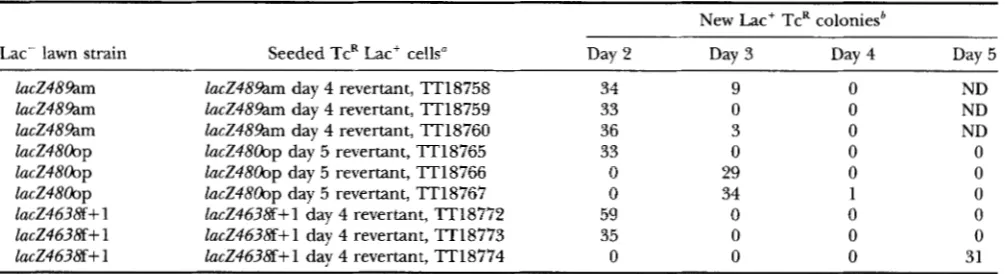
experiment in which revertant cells are seeded and in- cubated selectively with a lawn of their nonrevertant parent strain. Preexisting slow-growing revertant strains would require the same time to form colonies on selec- tive medium as they did at their original isolation; strains that attained a fully revertant genotype after se- lective plating would require less time to form a colony. Three independent late revertants from each of three strains, TT18521 (lucZ4800p), TT18530 (lucZ48%m), and TT18548 (lucZ4638f+l), were picked from selec- tive plates and purified nonselectively on NB Xgal IPTG plates. To these, as well as their Lac- parents and the lucZ+ grandparent, the hisG10051 ::Tn 1OdTc mutation was added by transduction to serve as a marker for use in the reconstruction experiment. This hisG marker was chosen because it would introduce tetracycline resis- tance while disrupting an operon that is already dis- rupted (Figure 1); thus, no unnecessary phenotypes are introduced. About 30-50 of these marked revertant cells were seeded in a suspension of their Lac- parent prepared as described above. Aliquots of these mixtures were spread and incubated on NB Tc plates to deter- mine the approximate numbers of seeded TcR cells (data not shown) and on NCE lactose Xgal histidine plates to observe the time required for marked Lac+ revertant cells to form colonies. Each day, new re- vertants were picked and their phenotypes, including sensitivity to tetracycline, were scored (Table 3 ) . The nine late revertants had originally appeared after
4
or 5 days of incubation on selective plates. For eight of the late revertants TcR Lac+ colonies appeared 2 or 3 days earlier in the reconstruction experiment.We concluded that most late revertants acquired their revertant genotype under selective conditions; they were not preexisting slow-growing revertants. The one exceptional late revertant, strain TT18774, derived from strain TT18548 (lucZ4638f+ 1 ) , was originally iso- lated on day 4 but took 5 days to appear when seeded in a lawn of its parent. This revertant was either preex- isting in the original experiment or perhaps it incurred an unrelated mutation between its isolation and subse- quent testing. Control experiments in which TcR paren- tal Lac- cells were seeded in a lawn of TcS parental Lac- cells showed no TcR Lac' colonies. Like most of the revertants, seeded Zucp TcR cells produced Lac' colonies on day 2 (data not shown). All the TcR marked strains used in these reconstruction experiments grew at normal rates in NCE glycerol histidine medium (data not shown).
TABLE 3
Time of Lac+ colony appearance from seeded late revertant cells
New Lac+ TcR coloniesb
Lac- lawn strain Seeded TcR Lac' cells" Day 2 Day 3 Day 4 Day 5
lacZ489am lacZ489am day 4 revertant, TT18758 34 9 0 ND
lacZ489am lacZ489am day 4 revertant, TT18759 33 0 0 ND
lacZ489am lacZ489am day 4 revertant, TT18760 36 3 0 ND
lacZ48oOp lacZ48oOp day 5 revertant, TT18765 33 0 0 0
lacZ48oOp lacZ48oOp day 5 revertant, TT18766 0 29 0 0
lacZ48oOp lacZ48oOp day 5 revertant, TT18767 0 34 1 0
lacZ4638f+ 1 lacZ4638f+l day 4 revertant, TT18772 59 0 0 0
lacZ4638f+ 1 lucZ4638f+l day 4 revertant, 'IT18773 35 0 0 0
lacZ4638f+ 1 lucZ4638f+l day 4 revertant, TT18774 0 0 0 31
Independent late revertant strains were marked with the hisG10051::TnIOdTc insertion conferring tetracycline resistance. Control strains (not shown; see Table 1 for complete genotypes; see text for results) included: TT18753 (lac+
hzsG10051::Tn1CMTc), TT18754 (lacZ489am hisG1005I::TnlOdTc), TT18761 (lacZ48oOp hisG10051::TnIadTc), and TT18768 (lacZ4638f+ 1 hisG10051: : Tn IOdTc)
.
*
Lawns of lac2 mutant strains seeded with -30-50 TcR revertant cells were spread on NCE lactose Xgal histidine plates and incubated. Each dav. new Lac+ colonies were counted and their sensitivity to tetracycline was scored. The daily counts of Lac+ TcR colonies are tabulated; ND, no data.opal (UGA) mutants are among the top five producers of late revertants. These observations suggested two likely explanations for the differences in late reversion. One possibility was that the differences in late reversion reflect differences in nonselective reversion rates dic- tated by each mutation's particular sequence change. For example, nonselective reversion rates of TnlOinser- tion mutations are relatively low (Table
2).
In this case, the low nonselective reversion rate to Lac' would pre- dict few late revertants. Alternatively, the fact that inser- tion mutations are usually null alleles whereas opal mu- tations are notoriously leaky in S. typhimurium (ROTH 1970b) suggested that the mutants' residual P-galactosi- dase activities might correlate well with their numbers of late revertants.Correlation of late reversion
with
residual P-galacto- sidase activity but notwith
nonselective reversion rate: For all the ZucZmutants, we compared the number of late revertants with the reversion rate during nonse- lective growth and to the residual 0-galactosidase activ- ity (Table 2). Reversion rates during nonselective growth were determined in standard fluctuation tests (see MATERIALS AND METHODS). A 300-fold range of rates was observed. Insertion alleles had the lowest reversion rates; other types varied. Residual P-galactosidase activi- ties were measured in a modified assay based on that of MILLER (1972). This modified assay was designed to measure tiny fractions (less than 1/104) of the wild-type levels of activity (see MATERIALS AND METHODS). The residual activities ranged from 0 units to 13 units. All of the insertions were null alleles; they had no detectable activity. All of the other alleles showed some residual activity.The number of late revertants showed a correlation with residual @-galactosidase activity but not with nonse-
lective reversion rate. HALL (1991) has also reported a lack of correlation between late reversion rate and nonselective reversion rate of lucZ mutants. These pa- rameters were compared using a standard coefficient of correlation as well as the Spearmann rank-correla- tion test. The standard coefficient of correlation be- tween the mean numbers of late revertants and the nonselective reversion rates was close to zero, r = 0.07. The standard coefficient of correlation between the mean numbers of late revertants and the residual
P-
galactosidase activities was high, r = 0.81. These results indicated that late revertant totals correlate with resid- ual enzyme activity but not with the nonselective reverti- bility of a lucZ mutant. However, the high correlation with residual enzyme activity depended on a dispropor- tionate contribution from a single mutant, TT18530 (lucZ48%m, Table 2 ) , which showed the most late re- vertants and the highest residual @-galactosidase activ- ity. Leaving out this extreme example and considering only the other mutants that show 2 1 0 late revertants, the coefficient of correlation was still positive, but much lower ( r = 0.29). Using this restricted data set, late revertant totals still had no correlation ( r = -0.14) with nonselective reversion rate.To further test these correlations, we applied the Spearmann rank correlation test. This test is insensitive to the magnitude of extreme values and provides the probability that two parameters are independent. Since the many mutants with few late revertants cannot be meaningfully ranked, we tested all mutants showing 210 late revertants. For nonselective reversion rate and number of late revertants, there was no correlation (rr
Reversion Under Selection 653
there was a modest positive correlation with late re- vertant number (r, = 0.60) ; the probability that these parameters are independent is low ( P = 0.037).
Whereas there is no strict proportionality between residual /?-galactosidase activity and number of late re- vertants, a trend linking these observations is evident (Table 2). Strains that showed high residual /?-galactosi- dase activity tended to produce significant numbers of late revertants. One exception to this is strain TT18549 (lucZ463%"1), which had 6.7 units of activity but showed only six late revertants. Apparently, high resid- ual activity does not guarantee high numbers of late revertants. Without exception, strains with no detect- able activity produced no late revertants. Note that low residual activities can allow late reversion, e.g., TT18548 (lacZ4638f+ 1), TT18546 (lacZ4634f- 1), and TT18531 (lacZ492am).
Growth and reversion on selective medium: Since late reversion requires residual /?-galactosidase activity, we considered the possibility that mutations were accu- mulating during growth on the selective medium. This was tested by measuring growth of a subset of mutants on NCE lactose Xgal histidine plates (see MATERIALS AND METHODS). This subset of mutants included six of the 10 mutants producing 2 1 0 late revertants and a representative few producing
<lo.
Cells were prepared and plated as in the reversion experiments; the nonre- vertant Lac- populations on these plates were sampled and counted each day during a week of incubation. The numbers of Lac- cells per plate were calculated (Figure 3). For these strains, residual /?-galactosidase activity and growth on selective medium (quantified as cell yield) showed a high rank correlation ( G = 0.82) and a low probability of independence ( P = 0.005). As expected, assayed residual activity predicts residual growth.Among the subset of strains tested, ZucZmutants that grew on minimal lactose medium also produced late revertants. Two of three tested mutants that grew very little produced no late revertants. The exception that showed little growth, strain TT18531 (ZucZ492am), also exhibited exceptional reversion kinetics; its
17
late re- vertants appeared in a final-day burst. A rank correla- tion test confirmed the significance of the association of growth (cell yield) and number of late revertants (see Figure 3; calculations excluded data involving scav- engers). This test showed a modest positive correlation(rs = 0.67) and a low probability of independence ( P
= 0.029). These results extend the coincidence between ability to metabolize lactose (as measured by P-galacto- sidase assays and growth assays) and late reversion. Note, however, there was not a strict proportionality between rate of growth or cell yield and numbers of late revertants (Figure 3).
Since crossfeeding of Lac- cells by revertants could contribute to growth and revertant frequencies, the ef- fect of scavenger cells on late reversion of 10 ZucZ mu-
345
36
85
71
9
0
17 1
-
0 1 2 3 4 5 6 7 8
Days
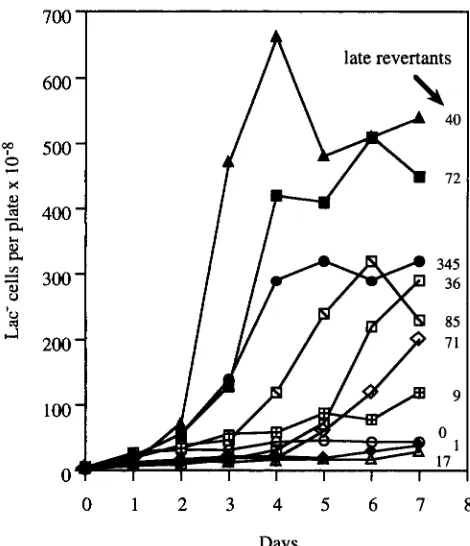
FIGURE 3."Growth on minimal lactose medium. From plat- ings described in Figure 2 (initial populations were -5 X 10' cells), agar plugs were taken avoiding Lac' colonies. Bacteria were suspended in saline, diluted, and spread on nutrient agar plates to determine the number of Lac- cells per plate. Data points are the mean of three or more independent deter- minations; error bars were omitted for clarity. The strains
represented are: TT18521 (lacZ48oOp, M), TT18521 with a fivefold excess of scavenger strain TR6625 (lucZ48oOp with
strAI, O ) , TT18547 (ZucZ4635f-1,
A),
'IT18530 (lacZ48%m,O ) , TT18523 (lacZ482op,
m),
TT18524 (EacZ483Op, 0 ) , TT18544 (lacZ4632f+l, H), TT18539 (lacZ502::TnIOdTc, 0), TT18534 (hcZ495, +), and TT18531 (lucZ49L%m, A). The number at the end of each curve indicates the number of late revertants produced by the strain in reversion tests described in MATERIALS AND METHODS and Figure 2.tants (listed in MATERIALS AND METHODS) was tested. The scavenger strains were naturally Lac- S. typhimu-
n u m strains that do not mutate to Lac+; they were in- cluded to deplete any nonlactose carbon sources either in the growth medium or excreted by Lac+ revertant colonies. Strains were prepared and plated as described above except that a fivefold excess of scavenger cells was included. The addition of scavengers reduced late revertant numbers by approximately one half for all 10 strains (data not shown). This reduction was uniform; the fundamental observations (rankings, correlations,
etc.) were not changed by the inclusion of scavenger cells.
654
TABLE 4
Observed and expected numbers of late Lac+ revertants
Cell divisions Revertants Revertants
lacZ allele xlo-y" expected" observed' S (obs/exp)'l
489am 32 i- 1 45 5 2 345 5 30 7.7
483op 6.0 5 1.4 13 5 3 71 5 6 5.5
492am 1.6 ? 0.3 5 2 1 17 2 2 3
4820p 24 2 1 41 2 2 85 ? 9 2.1
4800p 41 ? 6 78 5 12 72 +- 8 0.92
4800p
+
scavengers' 6.8 ? 2.5 13 2 5 39 5 5 3.04 95 1.8 5 0.2 0.3 +. 0.1 1 5 1 3
46?2f+ 1 8.3 ir 0.5 7 5 1 9 2 1 1
502::TnlQdTc 4.0 5 0.5 0.1 5 0.1 0 5 0 0
4 6?5f - 1 47 2 6 19 5 2 40 ? 8 2.1
"The number of viable cells present on selection plates on day 5 less the number of viable cells originally plated. This number is equivalent to the number of cell divisions occurring on selection plates through day 5. Values are mean 5 SEM ( n 2 3).
*The product of the nonselective reversion rate (revertants per cell division) observed in fluctuation tests (Table 2) and the number of cell divisions on selective plates.
'The observed number of late revertants (from Table 2).
'The coefficient of coincidence of the observed and expected numbers of late revertants.
'The effect of the presence of a fivefold excess of scavenger cells (strain TR6625) on growth and reversion under selection.
of one doubling per day on NCE lactose Xgal histidine medium in the absence of scavenger cells, or 0.9 dou- blings per day in the presence of scavenger cells. This growth rate was typical of strains producing high num- bers of late revertants (Figure 3). Previously, we have shown that our minimal lactose medium allows two or three generations of growth (a four- to eightfold in- crease) within the first 24 hours of incubation. This is probably due to small amounts of carbon sources other than lactose in the medium. After this first day, growth depends on ability to utilize lactose (GALITSKI and ROTH 1995). Thus, the decrease in the yield of ZucZ48oOp tester cells (and the associated decrease in revertant frequency) is probably due to competition with scaven- ger cells for nonlactose carbon sources in fresh selective medium. Scavengers decrease the nonselectively grown cell populations but do not affect lactose metabolism on the selective medium.
An accounting of revertants Thus far, the results were as one might predict if there were no adaptive mutability. A null hypothesis would state that the same mutations are occurring randomly at the same rates regardless of selection; populations that grow on selec- tive plates have more opportunities to accumulate re- vertants (LENSKI and MITTLER 1993). This hypothesis suggests that the accumulation of revertants should mir- ror the kinetics of growth. That is, one should be able to predict the number of late revertants by using the measured nonselective reversion rate of each mutant and the number of cell divisions occurring on the plate (Table 4). We calculated this expected late revertant number for each mutant and compared the expected to the observed value.
Since Lac+ revertants form a visible colony in 2 days, we assumed that each late revertant colony (days 3-7) resulted from a mutation that occurred 2 days earlier (days 1-5). Total late revertants appearing from day 3 to day
7
were thus generated during growth that oc- curred between plating and day5.
We measured the parental cell population on day 5, subtracted the num- ber of plated cells, and thereby determined the number of cell divisions that occurred on the plates. The prod- uct of this and the previously measured nonselective reversion rate (from Table 2) gives a predicted number of total late revertants. If reversion rates during nonse- lective growth apply to cells growing on selective me- dium, then this expected number should equal the ob- served number of total late revertants.These calculations assume that late revertant colonies appear 2 days after the occurrence of late mutations. This is a conservative assumption; it maximizes the po- tential to account for late revertants. Assuming a longer time interval between a reversion event and the appear- ance of a Lac+ colony would reduce expected numbers of late revertants. The expected numbers of revertants debuting on any given day would be proportional to the number of nonrevertant cells three days previous, not the higher number of nonrevertant cells two days previous. The seeding experiments with marked late revertant cells (Table 3) validate the 2-day assumption and illustrate its conservative tendency; most of the late revertant cells formed colonies in 2 days, but some re- quired 3 days.
Reversion Under Selection 655
40 100 late revertants. In experiments performed as described
for the
ret'
parents, the average total number of late 3530
25
20
15
10
5
F
revertants was determined for each R e d - derivative. 80o+
In contrast to the Rec dependence of adaptive reversion3
of an F-plasmid-borne lac frameshift mutation (CAIRNS60
=Id
5
ul mosomally situated lacZ mutations show no depen-
%
&
and FOSTER 1991; H A R R I S et al. 1994), all of these chro-
dence on RecA functions for reversion (data not 40
5
shown). This has been noted previously for other chro-mosomal mutations (reviewed in FOSTER 1993).
20 0
2
'd DISCUSSION
Experimental strategy: Previous systems for study of adaptive mutation have typically involved reversion of
0 1 2 3 4 5 6 7 8 a single mutant allele. Since the best studied examples
Days depend absolutely on the specialized activities of experi- 0
FIGURE 4.-Observed and expected Lac+ revertants of strain 'IT18530 (lucZ489am; circles, left ordinate) and strain TT18524 (lacZ483op; triangles, right ordinate). The observed numbers of revertants (filled symbols, solid lines) are from experiments like those described in Figure 2. The expected curves (open symbols, dashed lines) are derived from the growth data of Figure 3 and the nonselective reversion rates of Table 2 (see RESULTS).
are greater than one. If we exclude the three strains producing
<
10 late revertants (lacZ495, lacZ4632f+ 1, and lacZ502: : Tn 1 OdTc),
five of the remaining six show an excess of late revertants over the expected number. Predicted and observed daily revertant totals of two of these strains [TT18530 (lacZ489am) and TT18524 (Zac- Z4830p)l are plotted in Figure 4. At all points in these plots (after 2 days) the number of observed revertants exceeds the predicted number. It should be noted that the kinetics of revertant appearance do not match the shape of the growth curve for these strains (compare Figures 3 and 4). That is, many revertants appeared early, before much growth had occurred. Also, they continued to appear after growth of the bulk parental population had stopped.We tested the effect of scavenger cells on the account- ability of late revertants for one strain, TT18521 (Zuc-
Z4800p). As seen in Table 4, in the absence of scaven- gers this mutant produced a number of late revertants that matched the expected number. The addition of scavengers increased the S value of this strain threefold by decreasing the yield of Lac- cells sixfold while de- creasing the number of late revertants twofold.
Tests of dependence on R e d functions: The role of R e d function (needed for homologous recombination and SOS induction) was tested by comparing
ret' and
recAl strain pairs for their ability to form late revertants. The S. typhimum'um recAl allele causes recombination deficiency, UV sensitivity (WING et al. 1968), and an inability to induce the SOS response (T. GALITSKI, un- published results). The recAl null allele was introduced to all strains that produced an average of six or morementally introduced selfish genetic elements, we sought evidence of a more general phenomenon. We have em- ployed a chromosome-based system to observe the re- version of 30 revertible lac2 mutants under selective conditions (Figure 1). This system was designed to study reversion events occurring in cells under selection while avoiding the effects of a complex genetic element or the peculiarities of any particular mutant allele. The immediate goal was to identify characteristics of mu- tants that revert under selection us. those that do not. The mutants included a wide range of types including missense, nonsense, frameshift, and insertion alleles. The insertion element used, TnlOdTc, and the MudF element bearing the lac operon in our S. typhimum'um strains are both unable to transpose. Observations made with this system should, in principle, apply to many types of mutations at any chromosomal locus. Ulti- mately, this approach may allow the elucidation of uni- versally relevant mechanisms of adaptive mutability.
between assayed activity and in vivo lactose utilization is the fact that some but not all lac2 mutations have a polar effect on expression of the distal gene, lacy, encoding lactose permease. However, the contribution of lactose permease activity to capacity for lactose utili- zation is probably not limiting in our experiments. The most prolific late-reverting mutants all showed polarity; most of the strains with nonpolar l a d mutations pro- duced few late revertants.
Growth and late reversion: The correlation between residual P-galactosidase activity and the numbers of late revertants suggested that strains producing late re- vertants might be growing on minimal lactose medium. Residual activity and growth showed a high rank corre- lation. Furthermore, we found that mutants producing many late revertants increased their numbers -100- fold on selective medium. This corresponded to a growth rate of about one doubling per day (assuming a negligible rate of death). Tested mutants that did not revert late did not grow on selective plates. Tested mutants that reverted late did grow on selective plates. The one exception to this showed no growth but pro- duced a burst of revertants on the last day of the experi- ment. Since late reversion of other mutants often pre- ceded growth, this strain too might show substantial growth if the experiment were continued longer than 1 week.
As
was observed for residual @-galactosidase activity, there was no strict proportionality between late re- vertant number and growth rate or cell yield on mini- mal lactose medium. However, again as was observed for residual P-galactosidase activity, late reversion was associated with growth on selective plates. These results support and extend our conclusion that the residual ability to use lactose (leakiness) is a requirement of late reversion and that other unknown factors also influence rates of late reversion.Late reversion to Lac+ requiring lactose utilization: It remained possible that growth was primarily the re- sult of crossfeeding (from revertant cells to nonre- vertant cells) accelerating the accumulation of late re- vertants. If this were the case, crossfeeding should intensify with revertant density. This predicts that mu- tants showing more late revertants should show a stronger scavenger effect owing to the interception of nutrients. If the nutrient blockade has limited success, these same mutants should show a weaker scavenger effect. However, scavenger cells caused a uniform two- fold reduction in late reversion for all tested mutants. Moreover, the growth of the lac24800p strain was de- layed more than it was slowed by scavengers. These observations are consistent with scavenging of carbon contaminants initially present in plates and available to all mutants equally. The effect of scavengers on late reversion is through restriction of the nonselective growth of the tester cell population. Thus, it is not likely that crossfeeding is a major determinant of the growth
and late reversion of the lac2 mutants. These results indicate that the ability to metabolize lactose, not cross- fed metabolites, is a requirement for reversion under selective conditions.
This association with leakiness seems to be in contrast with the observations made with an F-plasmid-borne lac frameshift mutation. The Escherichia coli K12 strain, FC40, carrying this allele produces revertants but does not grow on selective plates with an excess of scavengers (CAIRNS and FOSTER 1991; FOSTER 1994). However, when the F plasmid of this E. coli strain is transferred to S. typhimurium strains, it produces the same residual @-galactosidase activity but confers slow growth on selec- tive medium, even in the presence of excess scavengers (GALITSKI and ROTH 1995). Furthermore, if strain FC40 were included in Table
2,
it would rank sixth in terms of the number of late revertants and fourth in terms of residual P-galactosidase activity (CAIRNS and FOSTER 1991; GALITSKI and ROTH 1995). We have suggested previously that leakiness plays an important role in the adaptive reversion of strain FC40 (GALITSKI and ROTH 1995). Experiments of CAIRNS and FOSTER (1991) are consistent with this suggestion. They observed that Lact revertants of a tryptophan-requiring derivative of strain FC40 did not accumulate in the absence of a carbon and energy source or in the absence of tryptophan. We submit that, in both situations, the failure to form revertants was due to inability to benefit from residual /3-galactosidase activity; in one case this was due to ab- sence of lactose and, in the other, to a lack of essential tryptophan. Thus, our conclusion that residual lactose metabolism is a requirement for late reversion to Lac+ applies equally to strain FC40.Accounting for late revertants: Our observations showed that chromosomal ladmutants reverted under selective conditions if they were able to grow, albeit slowly, on minimal lactose medium. These observations suggested a null hypothesis in which growing cells give rise to revertants with a nonselective mutation spectrum and rate of reversion. Thus, there would be no need to postulate the existence of adaptive mutability.
We tested this hypothesis. We attempted to account for late revertants of nine strains by measuring their growth on selective plates and applying their nonselec- tive reversion rates (determined in fluctuation tests) to calculate an expected number of late revertants (Table 4). For three mutants that did not produce >10 late revertants, expected numbers were similar to the o b served numbers. However, in spite of conservative ac- counting, five of six strains that produced >10 late re- vertants showed an excess of late revertants (Table 4 and Figure 4). For these mutations, the null hypothesis fails. We suggest that the excess of late revertants shown by these mutants arises from a general adaptive mutability.
Reversion Under Selection 657
Wild populations of bacteria growing at low rates under adverse conditions would benefit from adaptive muta- bility. We should not expect this ability to require a complete cessation of growth. We suggest that mutabil- ity during limited growth is the appropriate subject of investigation even though it presents some experimen- tal difficulty. Experiments with strain FC40 have been designed to suppress growth to preclude trivial interpre- tations involving standard random mutagenesis during rounds of cell division (CAIRNS and FOSTER 1991; FOS
In our system, efforts to suppress growth by em- ploying scavenger cells prevented neither growth nor late reversion. However, scavengers did affect the ac- counting of late revertants. When tested with the one mutant that produced high but expected numbers of late revertants (lacZ48&p), scavengers reduced growth sixfold and observed revertants twofold. Thus, the pres- ence of scavengers, demanding utilization of lactose (not contaminating or crossfed carbon compounds), resulted in a threefold excess of revertants. This result suggests that the S values of Table 4 and the plots of Figure 4 underestimate the production of excess late revertants. The effect of scavenger cells was to weaken the null hypothesis of a random nonselective spectrum of mutations occurring during rounds of cell division under selective conditions.
The inadequacy of the null hypothesis of simple growth-dependent mutability is further illustrated by the differences in the kinetics of growth and the kinetics of reversion. If late reversion events were simply due to random mutations occurring strictly during rounds of chromosome replication and cell division, then the ac- cumulation of revertants should reflect the growth of the population. That is, the shape of the growth curve should predict the shape of the reversion cuwe (with a 2- or 3-day delay to allow revertant individuals to form macroscopic colonies). This was generally not observed. This was evident both at earlier times when revertants had begun to rapidly accumulate but rapid growth had not begun and at later times when growth had ceased a few days previous but revertants continued to accumu- late rapidly. The addition of scavenger cells exacerbated such discrepancies (data not shown). We conclude that the relationship between growth and reversion under selection is not a simply causal one. Growth and rever- sion under strong selection are parallel manifestations of a nonzero fitness (leakiness). We suggest that the ability to revert under selection is further limited by mechanistic constraints that have yet to be fully ex- plored.
Recombination and adaptive reversion: Adaptive re- version of an F-plasmid-borne lac frameshift mutation has been shown to depend on homologous recombina- tion functions, RecAl3C (CAIRNS and FOSTER 1991; HAR- RIS et al. 1994; reviewed in ROSENBERC et al. 1995). This is an important mechanistic difference between rever-
TER 1994).
sion under selective and nonselective conditions in this F-plasmid-based system. We tested the effect of a recA
null allele on all mutants producing six or more late revertants. In contrast, we found a total lack of RecA dependence for late reversion of chromosomal ZacZmu- tants. The RecA dependence of adaptive reversion in the FC40 system applies only when the mutant allele is on (in cis) a F-prime plasmid with mutationally dere- pressed tra operon functions, not when the lac locus is in the chromosome (FOSTER and TRIMARCHI 1995; GALITSKI and ROTH 1995). The need for homologous recombination results from the conjunction of rather specialized circumstances. Furthermore, apparent adaptive reversion at several chromosomal loci other than lac does not depend on RecA function (reviewed in FOSTER 1993). Overall, dependence on homologous recombination functions for reversion under selection is unusual rather than a defining characteristic.
Mechanisms: The excess revertants produced under se- lection reflect a phenomenon of adaptive mutability. These events are adaptive in the following sense-natural selection is required to produce the revertant genotype. Selection appears to drive this mutability since leakiness is a requirement for the production of excess revertants. The requirement for residual ability to use lactose implies that the presence of lactose is also required. We have confirmed this for the lacZ485hm mutant, which p r e duced the greatest excess of late revertants; that is, it produces no excess Lac+ revertants during slow growth on other carbon sources (T. GALITSKI, unpublished re- sults). The models proposed below describe mechanisms of reversion in which selection promotes formation of the revertant genotype.
1. Models invoking a starvation-induced hypermutable state have been proposed to explain cases of adaptive mutability (HALL 1990). Starvation may induce a small subpopulation of cells to undergo catastrophic hypermutation. Most will die, but some will acquire an adaptive mutation, allowing rapid growth and es- cape from the hypermutable state. While plausible, this model is difficult to reconcile with our data. A starvation-induced state does not predict that rever- sion under selection would require leakiness; one should predict that more stringent starvation would cause heavier mutagenesis. Nonetheless, the hyper- mutable state remains a viable explanation that is neither supported nor excluded by our observations. Moreover, it could be superimposed on a variety of other models including the ones that follow. The strongest prediction would be a high frequency of unrelated mutations among revertants. The spec- trum of late revertant types could be either similar or different from the nonselective spectrum depending on the types of mutations whose rates are increased by starvation.