Combined Dynamic Economic Emission
Dispatch using Teaching Learning Based
Optimization
P. Aravindhababu
Professor, Department of Electrical Engineering, Annamalai University, Annamalainagar, Tamilnadu, India
ABSTRACT: Dynamic Economic Emission Dispatch (DEED) is a computational process of allocating generations to various generation plants so as to simultaneously minimize both fuel cost and emissions subject to load and operational constraints over a scheduling period. This paper proposes a method involving teaching-learning based optimization (TLO), for solving DEED to overcome the drawbacks of classical methods. TLO is inspired from the behavior of the students in improving their performance through gaining the knowledge from the teacher and interacting with other students. The proposed method partitions the DEED problem into as many as the number of sub-problems, and employs TLO in solving each sub-problem. The simulation results on standard test problem demonstrates that the proposed method is able to provide the global best solution.
KEYWORDS: dynamic economic emission dispatch; economic load dispatch; teaching-learning based optimization
NOMENCLATURE
i i ib c
a fuel cost coefficients of the ith generator
oo oB
B
B loss coefficients
DEED dynamic economic emission dispatch
i
DR down-ramp limits of ith generator
i ie
d coefficients of valve point effects of the th
i generator ED emission dispatch
EED economic emission dispatch
Gi
i P
E emission function of the th
i generator
Gi
i P
F fuel cost function of the th
i generator
nt number of intervals
ng number of generators PM proposed method
it G
P real power generation at th
i generator at interval-t max
min
& Gi
Gi P
P minimum and maximum generation limits of th
i generator respectively
Dt
P total power demand at interval-t Lt
P net transmission loss at interval-t i
UR up-ramp limits of ith generator in MW/ h
) (PG
objective function to be minimized
i i
, ,i, i and i emission coefficients of th
I. INTRODUCTION
Dynamic Economic Load Dispatch performs computation of the most economical generations so as to supply the forecasted power demand over a scheduling period at lowered operating cost, while satisfying several operational constraints that includes the ramp-rate limits of the generators. Operating at minimum fuel cost is not the only criterion for dispatching electric power, as the public are more concerned about environmental pollutions. Besides the enactment of the ‘Clean Air Act Amendment of 1990’ force the utilities to change their operating methodologies to meet environmental standards. The power plants using coal, oil and gas, releases pollutions such as sulphur oxides (SOx), nitrogen oxides (NOx) and carbon dioxide into the atmosphere. In the light of the fact that the economic load dispatch leads a large fuel cost savings, it causes large emissions. One of the simplest methodology in reducing the pollutions while at the same time lowering the fuel cost is the Dynamic Economic Emission Dispatch (DEED). Several researchers have considered emissions either in the objective function or treated emissions as additional constraints. Emission function, which is similar to fuel cost function, is the sum of all types of emissions, whose characteristic is sometimes non linear and the slope of the curve is not always positive [1].
Over the years, many methods were suggested in the literature for solving the DEED problems. At earlier stages, mathematical or heuristically-based approaches, such as gradient projection method [2], linear programming [3], interior point methods [4], etc. were developed. Though they have several advantages such as mathematically proven, suitable for large-scale problems and not requiring any problem-specific parameters, they may land at sub-optimal traps, be sensitive to the initial guess, require functions to be differential, not handle non-convex objective function, etc. To overcome these drawbacks, methods involving artificial intelligence, such as neural networks, fuzzy logic, genetic algorithm, differential evolution and particle swarm optimization were employed for solving the DED problems [5-7]. Besides hybrid algorithms combining two or more approaches such as evolutionary programming with sequential quadratic programming [8], and Hopfield neural network with quadratic programming [9] were suggested for better results of DEED problems.
Recently, teaching learning based optimization (TLO), inspired from teaching-learning process in class rooms, was suggested for solving optimization problems by Rao et al. [10]. It mimics the behaviour of the students in improving their performance through gaining the knowledge from the teacher and interacting with other students. This paper attempts to apply TLO in solving the DEED problem by dividing the problem into several sub-problems for reducing the computational burden and improving the robustness.
II. PROBLEM FORMULATION
The DED problem can be formulated as an optimization problem with an objective of lowering the total emissions of all ng generating units over the given dispatch period of nt intervals while satisfying several constraints.
Minimize
nt
t
ng
i
ng
i
it G i it
G i
G w F P w E P
P
1 1 1
) ( ) 1 ( ) ( )
( (1) Subject to
nt t P
P
P Dt Lt
ng
i it
G
0
1
(2)
nt t ng i P
P
PGmini Git Gmaxi ,
(3)
nt t
ng i DR P P
nt t
ng i UR P
P
i it G t i G
i t i G it G
, , 2
, , 2
1 1
(4)
2 sin
( min )
it G Gi i i i it G i it G i it Gi P aP bP c d e P P
F (5)
) exp( )
( Git i Git2 i Git i i i Git
i P P P P
E (5)
00 1 0 1 1 B P B P B P P ng k kt G k ng j jt G ij it G ng i
Lt
(6)
III. PROPOSED METHOD
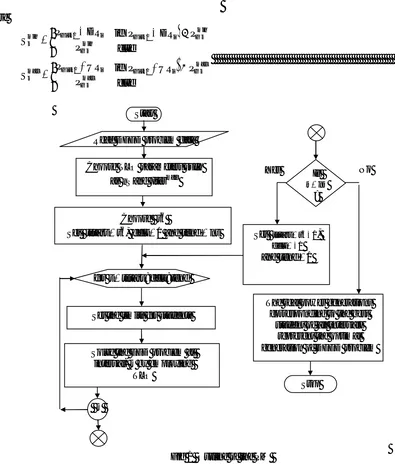
The number of decision variables in DEED problem equals the product of the number of generating plants and the number of intervals over the scheduling horizon, thereby making the solution process very complex involving large computational burden. The proposed method (PM) divides the DEED problem in to a number of sub-problems, each representing an economic emission dispatch (EED) of interval-t and then employs TLO for solving each sub-problem, while at the same time accounting the ramp-rate limits. Each student [10] in the DEED is denoted to represent the real power generations of each sub-problem as
Gt Gt Gngt
i P P P
S 1, 2,, (7) The TLO explores the solution space for optimal solution by maximizing a performance function (F), which is formed as Maximize
ng i Lt Dt Git ng i it Gi P K P P P
E F 1 2 1 1 ) ( 1 1 (8)
At a random initial interval tto, the lower and upper bounds of the student is set as
max max
2 max 1 max min min 2 min 1 min , , , , , , Gng G G Gng G G P P P S P P P S (9)
The TLO is then applied for solving the EED problem of the initial interval-t. Then the same solution process is continues for the subsequent intervals tt1, with the lower and upper limits for the students, set by accounting the ramp rate limits of Eq. (4) and solved using TLO.
max max
Where
else P UR P if P UR P S else P DR P if P DR P S j G i t i G j G i t i G j j G i t i G j G i t i G j max 1 max 1 max min 1 min 1 min (11) StartRead DEED problem data
Choose TLO parameters such as nSand Itermax
Solve the EED problem at interval- t by employing
TLO
Stop Choose to
Set tstartto, delt1 and tendnt
Is
nt t
?
The real power generations corresponding to the best
student of all intervals represent the optimal generation of DEED problem
Yes No
for ttstart:delt:tend
Set the limits for students
t
Set tstartto1, 1
delt
and tend1
Fig 1 Outline of the PM
The above TLO based solution process is repeated by incrementing the interval -t till the last interval-nt of the scheduling horizon. Similarly the preceding sub-problems of the initial interval tto is obtained by decrementing the interval as tt1 and solved using the TLO till the solution for the first interval is obtained. The limits of the students during this phase are modified as
The real power generations obtained for each interval over the scheduling horizon represent the optimal solution of the DED problem. The solution process, requiring TLO [10], of the PM is explained through the flow chart of Fig .1.
IV. SIMULATION RESULTS
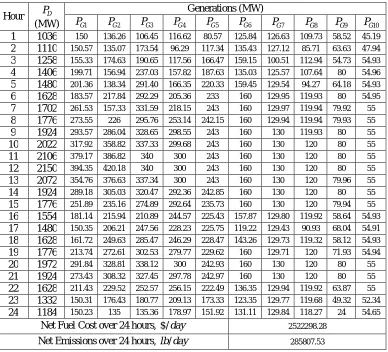
The PM is applied on a test system possessing 10 generating units. The real power generations of DEED, obtained by the PM with w as 0.5 in the objective function, for the test system are furnished in Table 1. The net fuel cost and emissions of the PM is also included in the same table. The solution offered by the PM is the compromised solution.
Table 1 Real power generations of DEED Hour PD
(MW)
Generations (MW)
1 G
P PG2 PG3 PG4 PG5 PG6 PG7 PG8 PG9 PG10
1 1036 150 136.26 106.45 116.62 80.57 125.84 126.63 109.73 58.52 45.19
2 1110 150.57 135.07 173.54 96.29 117.34 135.43 127.12 85.71 63.63 47.94
3 1258 155.33 174.63 190.65 117.56 166.47 159.15 100.51 112.94 54.73 54.93
4 1406 199.71 156.94 237.03 157.82 187.63 135.03 125.57 107.64 80 54.96
5 1480 201.36 138.34 291.40 166.35 220.33 159.45 129.54 94.27 64.18 54.93
6 1628 183.57 217.84 292.29 205.36 233 160 129.95 119.93 80 54.95
7 1702 261.53 157.33 331.59 218.15 243 160 129.97 119.94 79.92 55
8 1776 273.55 226 295.76 253.14 242.15 160 129.94 119.94 79.93 55
9 1924 293.57 286.04 328.65 298.55 243 160 130 119.93 80 55
10 2022 317.92 358.82 337.33 299.68 243 160 130 120 80 55
11 2106 379.17 386.82 340 300 243 160 130 120 80 55
12 2150 394.35 420.18 340 300 243 160 130 120 80 55
13 2072 354.76 376.63 337.34 300 243 160 130 120 79.96 55
14 1924 289.18 305.03 320.47 292.36 242.85 160 130 120 80 55
15 1776 251.89 235.16 274.89 292.64 235.73 160 130 120 79.94 55
16 1554 181.14 215.94 210.89 244.57 225.43 157.87 129.80 119.92 58.64 54.93
17 1480 150.35 206.21 247.56 228.23 225.75 119.22 129.43 90.93 68.04 54.91
18 1628 161.72 249.63 285.47 246.29 228.47 143.26 129.73 119.32 58.12 54.93
19 1776 213.74 272.61 302.53 279.77 229.62 160 129.71 120 71.93 54.94
20 1972 291.84 328.81 338.12 300 242.93 160 130 120 80 55
21 1924 273.43 308.32 327.45 297.78 242.97 160 130 120 80 55
22 1628 211.43 229.52 252.57 256.15 222.49 136.35 129.94 119.92 63.87 55
23 1332 150.31 176.43 180.77 209.13 173.33 123.35 129.77 119.68 49.32 52.34
24 1184 150.23 135 135.36 178.97 151.92 131.11 129.84 118.27 24 54.65
Net Fuel Cost over 24 hours, $/day 2522298.28
Net Emissions over 24 hours, lb/day 285807.53
V. CONCLUSION AND FUTURE WORK
exhibits the robustness and computational efficiency of the proposed method. The method can be extended to include adaptive techniques for tuning the parameters.
ACKNOWLEDGEMENTS
The author gratefully acknowledges the authorities of Annamalai University for the facilities offered to carry out this work
REFERENCES
1. J.W. Lamont and E.V. Obessis, 'Emission dispatch models and algorithms for the 1990’s', IEEE Trans. on Power Systems, Vol. 10, No.2, pp. 941- 946, 1995.
2. G.P Granelli, P Marannino, M Montagna and A Silvestri, 'Fast and efficient gradient projection algorithm for dynamic generation dispatching', IEE Proc Gener Transm Distrib., Vol. 136, No. 5, pp. 295-302, 1989.
3. C.B Somuah and N Khunaizi, 'Application of linear programming redispatch technique to dynamic generation allocation', IEEE Trans Power Syst., Vol. 5, No.1, pp. 20-26, 1990.
4. X.S Han and H.B Gooi, 'Effective economic dispatch model and algorithm', Elect Power Energy Syst., Vol. 29, pp. 113–120, 2007,
5. Basu M, 'Dynamic economic emission dispatch using nondominated sorting genetic algorithm-II', Elect Power Energy Syst., Vol. 30, pp.140-149, 2008.
6. R Balamurugan and S Subramanian, 'An improved differential evolution based dynamic economic dispatch with non-smooth fuel cost function', Journal of Electrical Systems, Vol. 3, No. 3, pp. 151-161, 2007.
7. C.K Panigrahi, P.K Chattopadhyay and R Chakrabarti, 'Load dispatch and PSO algorithm for DED control', Int J Autom Control, Vol. 1, No. 2-3, pp. 182-194, 2007.
8. D Attaviriyanupap, H Kita, E Tanaka and J Hasegawa, 'A hybrid EP and SQP for dynamic economic dispatch with nonsmooth incremental fuel cost function', IEEE Trans Power Syst., Vol. 17, No. 2, pp. 411-416, 2002.
9. AY Abdelaziz, MZ Kamh, SF Mekhamer and MAL Badr, 'A hybrid HNN-QP approach for dynamic economic dispatch problem', Elect Power Syst Res., Vol. 78, No.10, pp. 1784-1788, 2008.