Copyright2001 by the Genetics Society of America
On the Origin of Self-Incompatibility Haplotypes:
Transition Through Self-Compatible Intermediates
Marcy K. Uyenoyama,* Yu Zhang* and Ed Newbigin
†*Department of Biology, Duke University, Durham, North Carolina 27708-0338 and †School of Botany, University of Melbourne, Victoria 3010, Australia
Manuscript received August 7, 2000 Accepted for publication January 10, 2001
ABSTRACT
Self-incompatibility (SI) in flowering plants entails the inhibition of fertilization by pollen that express specificities in common with the pistil. In species of the Solanaceae, Rosaceae, and Scrophulariaceae, the inhibiting factor is an extracellular ribonuclease (S-RNase) secreted by stylar tissue. A distinct but as yet unknown gene (provisionally called pollen-S) appears to determine the specific S-RNase from which a pollen tube accepts inhibition. TheS-RNase gene andpollen-Ssegregate with the classically definedS-locus. The origin of a new specificity appears to require, at minimum, mutations in both genes. We explore the conditions under which new specificities may arise from an intermediate state of loss of self-recognition. Our evolutionary analysis of mutations that affect either pistil or pollen specificity indicates that natural selection favors mutations inpollen-Sthat reduce the set of pistils from which the pollen accepts inhibition and disfavors mutations in theS-RNase gene that cause the nonreciprocal acceptance of pollen specificities. We describe the range of parameters (rate of receipt of self-pollen and relative viability of inbred offspring) that permits the generation of a succession of new specificities. This evolutionary pathway begins with the partial breakdown of SI upon the appearance of a mutation inpollen-Sthat frees pollen from inhibition by any S-RNase presently in the population and ends with the restoration of SI by a mutation in the
S-RNase gene that enables pistils to reject the new pollen type.
S
ELF-incompatibility (SI) systems prevent fertiliza- In the form of GSI expressed in the Solanaceae (and also the Rosaceae and Scrophulariaceae;Broothaertstion of a flowering plant by its own pollen (seede
Nettancourt1977). Under heteromorphic SI, plants et al.1995;Xueet al.1996), an extracellular ribonuclease
(S-RNase) inhibits the growth of incompatible pollen of different mating types exhibit different floral
mor-tubes in the style (McClure et al. 1990; Lush and phologies, which promote between-type and reduce
Clarke1997). In poppy, which lacks a style, GSI
rejec-within-type fertilization. Under homomorphic SI,
differ-tion entails the arrest of pollen tube growth at the ent mating types have similar floral morphologies, with
stigma. The S protein encoded by the poppy S-locus fertilization inhibited upon the expression of the same
appears to act as a stigmatic signal molecule that, upon specificity in pollen and pistil. In gametophytic
self-binding to surface receptors, induces an increase in incompatibility (GSI) systems, a given pollen grain or
calcium ion concentration in incompatible pollen tubes tube expresses the specificities encoded in its own
hap-(Franklinet al. 1995). The striking variety of genetic
loid genome, and in sporophytic self-incompatibility
and physiological mechanisms employed by these sys-(SSI) systems one or more of the specificities of the
tems constitutes compelling evidence for multiple inde-plant that produced it.
pendent evolutionary origins of SI. Model systems for which the characterization of the
Descended from diverse phylogenetic origins, these molecular basis of SI is most advanced include Brassica
systems of SI exhibit a remarkable evolutionary
conver-(Nasrallahet al.1985), the Solanaceae (Andersonet
gence to single-factor regulation at the level of classical
al.1986), and the field poppyPapaver rhoeas(Franklin
genetics. Another shared feature is the very large
num-et al.1995). In the form of SSI expressed in Brassica,
ber of distinct specificities estimated to segregate at the recognition of pollen coat proteins by a receptor kinase
S-locus, ranging from 12 to nearly 200 (Lawrence
that spans the membranes of stigmatic epidermal cells
2000). Classical questions include the nature of the se-induces withholding of hydrating factors required for
lective forces and ecological contexts that permit the pollen germination (Stephensonet al.1997;Schopfer
maintenance of this extraordinary diversity (Wright
et al.1999;Takasakiet al.2000;Takayamaet al.2000).
1939;Fisher 1958, Chap. 4).
In this article, we explore the origin of new GSI speci-ficities through the analysis of population genetic mod-Corresponding author:M. K. Uyenoyama, Department of Biology, Box
els. We address the evolutionary dynamics of mutations 90338, Duke University, Durham, NC 27708-0338.
E-mail: [email protected] that alter SI recognition between pollen and pistil,
which induces a transient or permanent loss of self- riable regions. Upon expansion of the taxonomic sam-pling to include sequences fromPetunia inflataand
Sola-incompatibility.
Bipartite structure: SSI in Brassica: In Brassica, the num chacoense, subsequent analyses confirmed the hypervariability of two regions identified by the previous
S-locus genotype of the pollen parent determines the
specificities expressed by pollen. Proteins borne in the study, designating them HVa and HVb (Ioergeret al.
1991;Tsaiet al.1992). In their study of variation among pollen coating determine pollen specificity (
Stephen-son et al.1997), with a membrane-bound receptor ki- S-RNases from all three families known to exhibit this form of GSI,Ishimizuet al.(1998) detected a significant nase mediating recognition by the stigma (Nasrallah
et al.1994). TheS-locus resides in a structurally complex excess of nonsynonymous over synonymous substitution in four regions: two corresponded to HVa and HVb, and gene-dense region of the genome that appears to
segregate as a single unit (Boyeset al.1997;Suzukiet with each remaining region situated close to another hypervariable region proposed by Kheyr-Pour et al. al. 1999). S-haplotypes include SCR (S-locus
cysteine-rich protein; originally namedSP11;Suzukiet al.1999), (1990). Comparison to homologous fungal RNases for which the crystal structure has been solved indicated which encodes the specificity-determining proteins in
the pollen coat (Schopferet al.1999;Takayamaet al. that the hypervariable regions ofS-RNases likely corre-spond to surface loop structures (Ishimizu et al.1998; 2000), and SRK (S-locus receptor kinase), which
con-trols recognition of pollen specificity by the stigmatic Parryet al.1998).
While many haplotypes show a great number of differ-epidermal cells (Takasakiet al.2000).
GSI in the Solanaceae: Early irradiation studies of GSI ences, some naturally occurringS-RNases that function as distinct SI specificities differ by relatively few nonsyn-systems established the bipartite structure of theS-locus
by generating mutations that separately disrupted SI onymous substitutions (Saba-El-Leilet al.1994). Such observations suggest that the minimum number of sub-expression in pollen and style (Lewis1954; see review
byGolzet al.2000). Pollen-part mutations disrupt ex- stitutions required to generate a new specificity may be relatively low. The large sequence differences observed pression of pollen specificity while preserving stylar
re-jection, and style-part mutations disrupt stylar rejection among currently segregatingS-haplotypes may in large part reflect the antiquity of their most recent common while preserving pollen specificity. Transformation of
solanaceous plants with anS-RNase construct conferred ancestor, estimated at ⬎27 million years (my) in the Solanaceae (Ioerger et al. 1990) and 40 to 50 my in the ability to reject pollen expressing the new specificity,
without affecting the specificity expressed by the pollen Brassica (Uyenoyama1995).
One-mutation models:Fisher(1961) explored recombi-of the transgenic plants (Lee et al. 1994; Murfett et
al.1994). A gene distinct from the gene that encodes nation between the genes that control the pistil and pollen components of SI as a mechanism for the
genera-S-RNase controls the specificity expressed by pollen
(Dodds et al. 1999). This as yet unidentified gene is tion of new S-specificities. On the basis of the
under-standing of the day of the vertebrate immune system, generally calledpollen-S.
Experiments designed to detect recombination be- his model addressed the origin of new antigens ex-pressed by pollen, with recognition by specific anti-tween the loci that control the specificities rejected by
the style and expressed by pollen have yielded negative bodies in the pistil assumed to arise simultaneously. Fisher proposed that a pistil that rejects two pollen speci-results in all SI systems studied to date (seeLewis1949,
for example). Indeed, such recombination would pre- ficities would also reject pollen that expresses a recombi-nant of those specificities. This scheme preserves self-sumably impair SI by permitting the expression of
differ-ent specificities in pollen and style. In the solanaceous incompatibility throughout the rise of the recombinant haplotype. Under Fisher’s model, recombinant pollen system, theS-locus resides in an extensive genomic
re-gion (comprising perhaps 1 Mb of DNA; McCubbin can fertilize all pistils except those that bear the recom-binant or both parental haplotypes, and expression of andKao1999) over which recombination is suppressed
(or generates only unbalanced chromosomes that are the recombinant in the pistil directs rejection against recombinant pollen alone. Fisher showed that the re-immediately eliminated). These findings support the
hypothesis that the origin of a newS-specificity entails duced rate at which recombinant pollen initially en-counters incompatible pistils permits the invasion of the a series of coevolved point mutations at two or more
genes within theS-locus. recombinant haplotype into the population. All speci-ficities segregate at the equilibrium state, though in
Stylar specificity: Sequence comparisons of S-RNases
that determine different stylar phenotypes may afford unequal frequencies: the equilibrium frequency of the recombinant haplotype lies below that of each parental insight into the determination of stylar specificity.S-RN
ases segregating within species show extraordinarily haplotype, which in turn is less common than each nonparental haplotype. Fisher suggested that anS-locus high divergence, with amino acid sequence similarity
ranging from 40 to 80% (Ioerger et al. 1990). In a region comprising several polymorphic antigen genes could generate a very large number of specificities (for comparative study of S-RNases derived from Nicotiana
Charlesworth and Charlesworth (1979) also pollen specificities nonreciprocally. They noted that in the pathway proposed byMattonet al.(1999) the muta-studied the fate of mutations that impair expression in
pollen only, pistil only, or both. An unusual feature of tion that generates the new single-specificity haplotype appears to cause the pistil to accept pollen bearing the their models is that pollen produced by the same plant
(self-pollen) and pollen produced by a different plant dual-specificity ancestral haplotype in a nonreciprocal manner. The ancestral haplotype would drive such a (non-self-pollen) do not appear to compete with one
another for fertilization within pistils. In virtually all mutation to extinction. In contrast, a mutation in
pollen-Sthat distinguishes among formerly neutral varia-other models of SI, the fraction of ovules fertilized by
a given compatible pollen type corresponds to the quan- tions among S-RNases expressing a given specificity would in fact succeed in invading the population and tity of that type of pollen received normalized by the
total compatible pollen received (see, for example, replacing the ancestral haplotype.
In this article, we continue the exploration of the
Wright1939). This construction entails that all plants
set the same number of seeds, reflecting the definition origin of new specificities by expanding consideration to evolutionary intermediates rendered self-compatible of gametophytic self-incompatibility as a prezygotic
pro-cess. TheCharlesworthandCharlesworth(1979) by mutations that affect either pollen or pistil SI func-tion. All mutations considered here are subject to selec-models do not incorporate a normalization of this kind;
further, the fraction of seeds set by self-pollen in plants tion as a consequence of their impairment of SI. We show that the selective pressures generated by reduction that carry mutations with impaired SI function
corre-sponds to a parameter rather than to a function of in pollen susceptibility and nonreciprocal pollination dominate the evolutionary process, even though abso-genotypic frequencies.
Two-mutation models:Mattonet al.(1999) constructed lute linkage between the regulators of pollen and pistil function consigns them to a common evolutionary fate. a “dual-specificity” S-RNase that rejected two pollen
specificities inS. chacoense.Naturally occurringS-RNases
S11andS13differ at only 10 amino acids, including 3 in
MODEL STRUCTURE
HVa and 1 in HVb (Saba-El-Leilet al.1994).
Transfor-mation of plants with anS11 sequence in which the 4 S-haplotypes comprise anAcomponent (analogous to theS-RNase gene), which controls the pollen specificity HVa and HVb residues had been substituted to match
theS13sequence conferred the ability to rejectS13pollen rejected by the pistil, and aB component (analogous to pollen-S), which controls the pistil specificity from
(Matton et al. 1997). Transformants bearing an S11
sequence in which the 3 HVa sites but not the HVb site which pollen accepts inhibition. Fully functional haplo-typeSicorresponds toAiBi, in which the common sub-had been substituted rejected neitherS11norS13pollen
(Matton et al. 2000). Substitution of 2 of the 3 HVa script signifies the mutual recognition of theAand B
components. sites and the HVb site produced the remarkable
dual-specificity construct, which caused the rejection of both We denote the initial population, comprisingn func-tional haplotypes, by {Si,Sn}, foriassuming values from
S11 and S13 pollen (Matton et al. 1999). Matton et
al.(1999) proposed that new S-specificities may arise 1 to n ⫺ 1 and Sn the haplotype in which the new mutation will occur. Mutations within haplotypeSnmay through a pathway that begins with a mutation that
confers recognition by the pistil of both an existing alter only the specificity rejected by the pistil (generat-ing haplotype Sa) or only the specificity expressed in pollen specificity and a pollen specificity not yet present
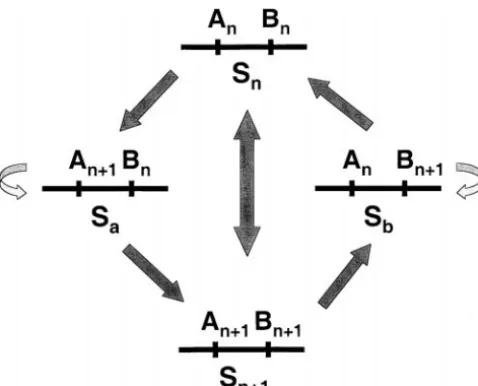
in the population, continues with the appearance of pollen (Sb). Figure 1 summarizes the SI phenotypes asso-ciated with the haplotypes. Pollen tubes bearing haplo-the new pollen specificity, and terminates with a stylar
mutation that restricts rejection to the new pollen typeSa(An⫹1Bn) express specificityBn, which accepts dis-ablement byAnS-RNase, while pistils bearingSaproduce specificity alone. Charlesworth (2000) questioned
whether the multiplicity of mutations required in the a newS-RNase directed against a pollen specificity not yet present in the population. HaplotypeSb(AnBn⫹1) en-same haplotype lineage is too large to explain the
gener-ation of the many specificities known to exist. codes theAnS-RNase and a new pollen specificity that accepts disablement by anS-RNase not yet present in
Uyenoyama and Newbigin (2000) argued that
whether a given pathway can in fact generate new speci- the population.
Upon the successful invasion of the initial mutant ficities depends on the evolutionary dynamics among
the ancestral haplotype, the derived haplotype, and haplotype (SaorSb), the population converges to a new equilibrium state (for example, {Si,Sn,Sa}), comprising their intermediates. Their simple analysis of mutations
that modify elements of the SI reaction in either pollen the single mutant together with all, some, or none of the original haplotypes. We then consider the fate of or pistil while preserving rejection of self-pollen
re-vealed an evolutionary advantage associated with muta- the double mutant haplotypeSn⫹1(An⫹1Bn⫹1), which cor-responds to a new, full-function specificity.
tions that restrict the set ofS-RNases from which pollen
the heterozygote with the ancestral nonmutant haplo-type (for example,SaSn); andc3, the single mutant homo-zygote (for example, SaSa). Frequencies of carriers of the double mutant include c4, corresponding to the heterozygote with any of the nonancestral full-function haplotypes (SiSn⫹1, 1ⱕi⬍n);c5, the heterozygote with the ancestral haplotype (SnSn⫹1); andc6, the heterozygote with the single mutant haplotype (for example,SaSn⫹1). These variables account for the frequencies of all geno-types in the population:
(n⫺1)(c0⫹c1⫹c4)⫹c2⫹c3⫹c5⫹c6⫹G
冢
n⫺2 1冣
⫽1. (1)Self-pollen comprises a proportions(0 ⱕ sⱕ1) of the pollen received by any individual plant. Compatible pollen tubes, irrespective of origin, compete on an equal
Figure 1.—Self-incompatibility phenotypes of S-haplo- basis for fertilization. All plants set the same number types. Arrows indicate the direction of transmission through of seeds. Inbred offspring (derived from self-pollen) pollen. Double-headed arrows join mutually compatible
hap-survive to reproduction at rate (0 ⱕ ⱕ1) relative
lotypes. Single-headed arrows indicate that pollen bearing the
to outbred offspring (derived from non-self-pollen).
haplotype at the base of the arrow fail to accept inhibition by
theS-RNase encoded by the haplotype at the head, while the Pollen-part mutation: A full dynamical description of
reciprocal pollination is incompatible. the genotypic frequencies, with the subsequent
genera-tion denoted by primes, appears in theappendix. Hap-lotypes Si (1 ⱕ i ⬍ n), Sn , Sb, and Sn⫹1 occur in the while permitting arbitrary numbers ofS-haplotypes, we
pollen pool and in the population in frequenciesp,pn, assume that all genotypes of a given class (for example,
pb, andpn⫹1, respectively; S1SnandS2Sn) occur in equal frequency. In a study of the
evolutionary dynamics of sporophytic SI (Uyenoyama p⫽[c0⫹ c1⫹ c4⫹ G(n ⫺2)]/2 (2)
2000), explicit stochastic numerical simulation of the
pn⫽[c0(n⫺ 1)⫹c2⫹c5]/2 (3) full system exhibited negligible departures from the
reduced, fully symmetric system, which assumed equal pb⫽c1(n⫺1)/2⫹c2/2⫹ c3⫹c6/2 (4) frequency among genotypes within class. Variablec0
de-pn⫹1⫽(c4⫹ c5⫹ c6)/2, (5) notes the frequency of a genotype carryingSntogether
with any of the other nonmutant haplotypes (SiSn, 1ⱕ for which
i⬍n); andGdenotes two distinct nonmutant haplotypes
p(n⫺1)⫹pn⫹pb⫹pn⫹1⫽p⬘(n⫺1)⫹p⬘n⫹p⬘b ⫹pn⬘⫹1 other than Sn (SiSj, 1 ⱕ i,j ⬍ n,i ≠ j). Frequencies of
carriers of the single mutant includec1, corresponding ⫽1. (6) to the heterozygote with any of the nonancestral
full-function haplotypes (for example,SaSi, 1ⱕ i ⬍ n); c2, T, the average viability among offspring, corresponds to
TABLE 1
Self-incompatibility genotypes and phenotypes
Alocus mutation Blocus mutation
Variable No. Genotype Rejects Genotype Rejects
c0 n⫺1 SiSn Si,Sn,Sa SiSn Si,Sn
c1 n⫺1 SiSa Si,Sn⫹1 SiSb Si,Sn
c2 1 SnSa Sn,Sa,Sn⫹1 SnSb Sn
c3 1 SaSa Sn⫹1 SbSb Sn
c4 n⫺1 SiSn⫹1 Si,Sn⫹1 SiSn⫹1 Si,Sb,Sn⫹1 c5 1 SnSn⫹1 Sn,Sa,Sn⫹1 SnSn⫹1 Sn,Sb,Sn⫹1 c6 1 SaSn⫹1 Sn⫹1 SbSn⫹1 Sn,Sb,Sn⫹1
G
冢
n⫺1T⫽ 1⫺
冤
c1(n⫺1) 2N1⫹ c2 2N2
⫹ c3 N3
冥
s(1⫺ ); (7) ⫹
冤
c1(n⫺1) 2N1⫹ c2 2N2
⫹ c3 N3
冥
s (13)
and the Ni represent the fractions of the total pollen and the rate through egg cells is received by pistils of genotype classithat are compatible:
E⫽c1(n ⫺1)[s/2⫹(1 ⫺s)(1⫺p⫺ pn)]
2N1 N0⫽(1 ⫺s)(1⫺p⫺ pn)
N1⫽s/2 ⫹(1⫺ s)(1⫺p⫺pn)
⫹ c2[s/2 ⫹(1⫺ s)(1⫺pn)] 2N2
N2⫽s/2 ⫹(1⫺ s)(1⫺pn)
N3⫽s⫹ (1⫺s)(1⫺ pn)
⫹ c3[s ⫹ (1⫺s)(1⫺ pn)] N3
N4⫽(1 ⫺s)(1⫺p⫺ pb⫺ pn⫹1)
N5⫽(1 ⫺s)(1⫺pn⫺pb ⫺pn⫹1) ⫹ c6(1⫺ s)(1⫺pn⫺pb ⫺pn⫹1) 2N6
N6⫽(1 ⫺s)(1⫺pn⫺pb ⫺pn⫹1)
⫽pb ⫺
冤
c1(n ⫺1)4N1
⫹ c2 4N2
⫹ c3 N3
冥
s(1⫺ ). (14)
NG⫽(1 ⫺s)(1⫺2p). (8)
Manipulation of the genotypic recursions provides
This last expression indicates that the number of Sb
expressions for the haplotype frequencies in the next
haplotypes transmitted through egg declines as the rate generation:
of receipt of self-pollen (s) increases and the viability of inbred offspring () decreases. Because one-half the Tp⬘ ⫽p/2⫺sc1(1⫺ )
8N1 genes held by offspring derives from egg cells and
one-half from pollen cells, the total transmitted frequency ofSbis
⫹
冤
(n⫺2)冢
c0 N0⫹ c1 N1
⫹ c4 N4
冣
⫹ c2 N2
⫹ c3 N3
⫹ c5 N5
⫹ c6 N6
G
冢
n⫺2 2冣
NG冥
Tp⬘b ⫽(E⫹ P)/2, (15)
⫻p(1⫺s)/2 (9) which reduces to (11) upon rearrangement. The new frequencies of the functional haplotypes similarly reflect transmission through egg and pollen.
Tp⬘n⫽pn/2⫺
sc2(1⫺ ) 8N2
⫹
冤
c4(n⫺1) N4⫹
G
冢
n⫺2 1冣
NG
冥
Style-part mutation:Genotypic frequencies in the nextgeneration appear in theappendix.In the pollen pool,
⫻pn(1⫺s)/2 (10) haplotype frequenciesp,pn, andpn⫹1are defined in (2),
(3), and (5), andpa (frequency of Sa) corresponds to Tp⬘b⫽pb/2⫺
冤
c1(n⫺1)(1⫺3) 4N1
⫹c2(1⫺3) 4N2
⫹c3(1⫺2) N3
冥
s/2 the right side of (4). T, the average viability among offspring, is
T⫽ 1⫺
冤
c1(n⫺1) 2N1⫹ c3 N3
⫹ c6 2N6
冥
s(1⫺ ), (16)
⫹
冤
(n⫺1)冢
c0 N0⫹ c1 N1
冣
⫹ c2 N2
⫹ c3 N3
⫹
G
冢
n⫺21冣
NG冥
and the Ni give the fraction of compatible pollen
re-⫻pb(1⫺s)/2 (11)
ceived: Tp⬘n⫹1⫽pn⫹1/2
N0⫽(1⫺ s)(1⫺p⫺pn⫺ pa)
N1⫽s/2 ⫹(1⫺ s)(1⫺ p⫺pn⫹1)
⫹
冤
(n⫺1)冢
c0 N0⫹ c1 N1
冣
⫹ c2 N2
⫹ c3 N3
⫹
G
冢
n⫺2 1冣
NG冥
N2⫽(1⫺ s)(1⫺pn⫺pa⫺ pn⫹1)
⫻pn⫹1(1⫺s)/2. (12) N3⫽s⫹ (1⫺s)(1⫺pn⫹1)
N4⫽(1⫺ s)(1⫺p⫺pn⫹1) (These expressions reflect transmission of haplotypes
through pollen and egg cells. Pollen expressing
haplo-N5⫽(1⫺ s)(1⫺pn⫺pa⫺ pn⫹1) typeSb is compatible in pistils of all genotypes except
N6⫽s/2 ⫹(1⫺ s)(1⫺ pn⫹1) those bearing Sn⫹1. The rate of transmission of Sb
through outcross- and self-pollen is
NG⫽(1⫺ s)(1⫺2p). (17)
Among offspring, the frequency (Tp⬘) of a functional haplotype other than Sn corresponds to (9); the re-P⫽
冤
(n⫺1)冢
c0N0
⫹ c1 N1
冣
⫹ c2 N2
⫹ c3 N3
⫹
G
冢
n⫺12
冣
NG
冥
pb(1⫺s)
Tp⬘n⫽pn/2⫹
冤
(n⫺1)冢
c1
N1
⫹ c4
N4
冣
⫹ c3
N3
⫹c6
N6
⫹
G
冢
n⫺2 1冣
NG冥
⫻pn(1⫺s)/2 (18)
Tp⬘a⫽pa/2⫹
冤
(n⫺1)冢
c1
N1
⫹ c4
N4
冣
⫹ c3
N3
⫹ c6
N6
⫹
G
冢
n⫺12
冣
NG
冥
⫻pa(1⫺s)/2
⫺
冤
c1(n⫺1)(1⫺3) 4N1⫹c3(1⫺2)
N3
⫹c6(1⫺3) 4N6
冥
s/2
(19)
Tp⬘n⫹1⫽pn⫹1/2⫹
冤
c0(n⫺1)
N0
⫹
G
冢
n⫺12
冣
NG
冥
Figure2.—Four evolutionary outcomes of the introduction of haplotypeSbinto populations withn⫽10 functional haplo-types. Values of the relative viability of inbred offspring () and self-pollen fraction (s) corresponding to region S permitSb
⫻pn⫹1(1⫺s)/2⫺
sc6(1⫺ ) 4N6
, (20)
to increase both near extinction and near fixation.Sbincreases when rare but not near fixation in region P, decreases near
for which extinction but increases near fixation in region D, and de-creases in both ranges in region E.
p(n⫺1)⫹pn⫹pa⫹pn⫹1⫽p⬘(n⫺1)⫹p⬘n⫹p⬘a⫹p⬘n⫹1
⫽1. (21) limit asnbecomes very large,Sbincreases when rare in {Si,Sn} only if
2s⫺3 ⫹1⬍0. (24) RESULTS
Near the state of fixation ofSb, the mean viability of Pollen-part mutation:Introduction of the single mutant:
offspring (T) lies close to its minimum value: All individuals in the initial population are outbred (T⫽
1) and carry two distinct functional haplotypes, with
1⫺ s⫹s. (25) each genotype occurring in equal frequency (G⫽c0⫽
This state resists the invasion of all original full-function 1/(n
2)). Equations 9–11 indicate that if the viability of
haplotypes if offspring derived by selfing is at least one-half that of
outbred offspring ( ⬎1⁄
2), the per-gene rate of increase
⬎ 1⫺s
3⫺ 2s. (26)
of the nonfunctional haplotype Sb uniformly exceeds that of any of the existing functional haplotypes,
Unlike the condition for the initial increase ofSb(A1),
Tp⬘b/pb ⬎Tp⬘/p,Tp⬘n/pn, (22)
(26) is independent ofn.
In a two-dimensional plot of (ordinate) against s
signifying thatSb increases to fixation upon its
appear-(abscissa), condition (A1) demarcates the region above ance in {Si,Sn} in any frequency.
a monotonically increasing curve and (26) the region Introduced in low frequency, haplotypeSbinvades {Si,
above a monotonically decreasing curve (Figure 2).
To-Sn} forn⬍ 5 and fornsufficiently small to satisfy
gether, the conditions determine four parameter
re-sn2(n ⫺4)⫺ (1⫺s)8(n⫺ 1)(n⫺2)
gions, corresponding to qualitatively different evolu-tionary outcomes: decrease of Sb when rare and when ⫹s(1 ⫺s)(n3⫺2n2 ⫺9n⫹16)⬍ 0. (23)
near fixation (region E), increase when rare and when For larger n, Sb increases only if exceeds the single near fixation (region S), decrease when rare and in-threshold value determined by (A1) in theappendix. crease near fixation (region D), and increase when rare Implicit differentiation indicates that this threshold and decrease near fixation (region P).
value increases with the fraction of self-pollen received Figure 3 depicts the dependence of condition (A1) (s) and the number of functional haplotypes (n). on the number of functional haplotypes. For small n, Higher rates of receipt of self-pollen and greater num- the curve specified by (A1) lies near the right boundary, bers of functional haplotypes tend to oppose the rise minimizing regions D and E. For very largen, the inter-of the single mutant, necessitating higher viability inter-of cept of the curve with the abscissa approaches zero,
2s2(n⫺1)(n ⫺3)⫺ s(n ⫺3)(3n⫺5⫹2s) ⫹ n2s⫺ 2n(2⫹s)⫹8⫺3s⬍ 0. (27) This condition holds uniformly forn⬍6; for largern,
Sbinvades for relative viabilities of inbred offspring () greater than the single root in (0, 1) of the quadratic on the left side of (27). Implicit differentiation confirms that this threshold value ofalso increases withsand
n.The minimum value of that permits the invasion of Sb in the presence of Sn [from (A1)] only slightly exceeds that in its absence [from (27)]; consequently, the simpler condition (27) provides a close approxima-tion to (A1), especially for largen ors.
In the narrow parameter region lying between these two thresholds,Sb invades in the absence ofSnbut not in its presence. Under some conditions,Sbmay initially decline in frequency upon its introduction into {Si,Sn},
Figure3.—Effect of the initial number of functional
haplo-but then increase as its own presence causes the
exclu-types (n) on the condition for initial increase of haplotypeSb.
For n⬍ 5, Sb uniformly invades, with the increasing curve sion ofSn.In such cases, the introduction ofSbcan result corresponding to condition (A1) lying outside the range of in its maintenance even in regions E and D.
valid parameters. Asnincreases, the curve moves upward and Introduction of the double mutant:Region P comprises to the left, signifying greater stringency of conditions required
parameter values that permit the initial invasion ofSb for the invasion ofSb.
but not its fixation, implying that the population con-verges to a polymorphic state ({Si, Sb} or {Si, Sn, Sb}), in whichSbsegregates together with functional haplotypes.
Polymorphic states:Parameter values corresponding to
regions P and S ensure the increase ofSbupon its intro- Expressions (11) and (12) indicate that the per-gene rate of increase ofSn⫹1exceeds that ofSb(Tp⬘n⫹1/pn⫹1⬎ duction in low frequency into {Si,Sn}. Because the
fixa-tion of Sb is unstable in region P, the invasion of Sb Tp⬘b/pb) if the first bracketed term of (11) is positive,
which is clearly true if the viability of outbred offspring implies convergence to a polymorphic state at which all
full-function haplotypes ({Si,Sn,Sb}) or all but the paren- exceeds that of inbred offspring by more than threefold ( ⬍ 1⁄
3). Because the instability of the fixation of Sb tal haplotype Sn ({Si, Sb}) segregate. In region S, the
fixation ofSbis locally stable, suggesting that the invasion [violation of (26)] ensures ⬍1⁄
3,Sn⫹1invades all stable polymorphisms arising under region P, causing the ex-ofSbcan result in complete self-compatibility upon the
extinction of all full-function haplotypes. tinction ofSb and restoring the population to full self-incompatibility.
Deterministic iteration of the recursion system
indi-cates that under almost all parameter combinations in Within regions S and D [satisfying (26)], the fully self-compatible state of fixation ofSbresists the invasion region S, the introduction of Sb ends in its fixation,
corresponding to a total loss of SI. Under parameter of any of the original full-function haplotypes. Expres-sion (12) indicates thatSn⫹1 increases when rare near combinations in a neighborhood close to the
intersec-tion of the increasing curve (invasion ofSb) and decreas- such states [c3⫽1,Tgiven by (25)] only if the viability of outbred offspring exceeds that of inbred offspring ing curve (fixation ofSb; see Figure 2), the population
converges to a state of partial self-compatibility, re- by more than twofold ( ⬍1⁄
2). In the absence of any other full-function haplotypes, carriers of Sn⫹1 express flecting the maintenance of full-function haplotypes
to-gether withSb. incompatibility against all pollen and the entire popula-tion derives from seeds set bySbSbindividuals alone. Our numerical explorations indicate that with the
exception of parameter combinations very close to the Region S also admits stable polymorphisms compris-ingSb together with full-function haplotypes for values threshold (A1) that determines whether Sb increases
when rare in {Si,Sn}, the presence ofSbcauses its parental ofclose to the minimum (A1) required for the inva-sion of {Si,Sn} bySb(see preceding section). Parameter haplotypeSnto decline to extinction. In the exceptional
cases,Sbmay segregate in stable polymorphism withSn combinations under which such polymorphisms arise appear to lie in the neighborhood of the intersection and the other full-function haplotypes.
We examine the conditions that permitSb to invade of the increasing and decreasing curves of the kind depicted in Figure 2. This neighborhood becomes van-{Si}. In the absence of both Sn and Sn⫹1, Sb causes the
rejection of no pollen andSb pollen encounters rejec- ishingly small as n increases. The relative viability of inbred offspring at the intersection itself is always less tion in no pistil. Only three genotypic classes exist:SiSj
(frequencyG),SiSb(c1), andSbSb(c3). In such populations, than one-third ( ⬍ 1⁄3) because the declining curve (26) never exceeds this value. Forn⬎21, the increasing
curve (A1) extends above one-third, but in this range the subregion that admits stable polymorphisms is very small or nonexistent. These findings suggest that the appearance of the double mutantSn⫹1near any polymor-phism that arises in region S will result in the exclusion of the single mutantSband restoration of the population to full self-incompatibility.
Numerical analysis of such polymorphic states in re-gion S indicates that if the initial polymorphism includes
Sn, Sn persists in the population while Sb declines to extinction upon the introduction ofSn⫹1. Through this pathway, the number of full-function S-haplotypes can increase fromnton⫹1. BecauseSndeclines to extinc-tion upon the invasion ofSbunder all but a small set of parameter combinations (see preceding section), we conclude that the number of full-functionS-haplotypes
can increase, but only under restrictive conditions. Figure4.—Three evolutionary outcomes of the introduc-Within regions D and E,Sbdeclines in frequency upon tion of haplotype Sa. For values of greater than one-half (region S), haplotypeSainvades and excludes all functional
its appearance as a rare mutant in {Si,Sn}. However,Sb
haplotypes, causing a permanent and total loss of
self-incom-may in fact succeed in invading after an initial decline
patibility. Parameter combinations in region P give rise to a
if its introduction causes the extinction of Sn. As dis- stable polymorphism including haplotypeS
aand all functional
cussed in the preceding section, the parameter region haplotypes, which corresponds to the permanent coexistence that permits the invasion ofSbin the absence ofSn(27) of self-compatible and self-incompatible genotypes. This state resists the invasion of haplotypeSn⫹1, which bears a mutation but not in its presence (A1) is quite small. Forn⬍21,
that would restore full SI by complementing the mutation of
this region entails ⬍1⁄
3, which would ensure that the
Sa.Extinction ofSaoccurs in region E.
appearance of the double mutantSn⫹1into polymorphic, partially self-compatible, states would restore full SI by excluding Sb. For larger values of n, ⬎ 1⁄
3 in this in- the extinction of all functional haplotypes (Tp⬘a/pa ⬎
tervening region, although the region is very small for Tp⬘/p).
largen.Although we have not thoroughly explored the In the remaining parameter range (1⁄
3⬍ ⬍1⁄2), Sa evolutionary dynamics in cases in which ⬎ 1⁄
3, our increases when rare in {Si,Sn} only under (24), the lim-preliminary results indicate thatSn⫹1excludesSbin this iting condition for the invasion of the pollen-part mu-situation as well. tantSbfor arbitrarily largen.Consequently, the invasion Results of our analytical and numerical studies of the ofSarequires more stringent conditions (higher viability fate ofSb, bearing a pollen-part mutation, indicate that of inbred offspring) than the invasion of Sb. Whether with the delimited exceptions noted, emergence of a Saincreases when rare is independent ofn, unlikeSb. newS-haplotype and restoration of full SI occur primar- These results indicate that the system exhibits three ily in region P (Figure 2). In this region, the appearance qualitative behaviors: substitution ofSafor ⬎1⁄
2(region of the single mutant (Sb) results in convergence to a S in Figure 4), stable polymorphism for ⬍ 1⁄
2 but polymorphic state of partial self-compatibility, with the satisfying (24) (region P), and extinction (region E). parental haplotype (Sn) almost always excluded. Upon In the pistil, Sadirects a rejection response against no the subsequent appearance of the double mutant (Sn⫹1), pollen currently in the population, although it contin-the single mutant declines to extinction, resulting in ues to express theSnspecificity in pollen. In the absence the generation of a new S-haplotype and the return ofSn,Sais indistinguishable from a haplotype that lacks of the population to full SI, generally without an in- all self-incompatibility function. Comparison of Figures crease in the number ofS-specificities. 2 and 4 illustrates that the rejection of Sa pollen by Style-part mutation:Introduction of the single mutant:If pistils carryingSnopposes the introduction of the single the viability of outbred offspring exceeds that of inbred mutantSaand transforms its evolutionary fate.
offspring by at least threefold, the per-gene rate of Polymorphic states: Numerical iteration of the system increase of haplotype Sn uniformly exceeds that of of recursions in the absence of Sn⫹1 indicates that for Sa[Tp⬘n/pn ⬎ Tp⬘a/pa for ⬎ 1⁄3; from (18) and (19)], values of ⬍1⁄2but sufficiently large to ensure the initial which ensures the extinction of Sa. Alternatively, Sa invasion ofSainto {Si,Sn} (24), the population converges drivesSnto extinction if inbred offspring have at least to a stable polymorphism comprising all haplotypes ({Si, one-half the viability of outbred offspring (Tp⬘a/pa ⬎ Sn, Sa}). Numerical analysis of the expressions for the Tp⬘n/pnfor ⬎ 1⁄2). Comparison of (9) and (19) after equilibrium frequencies of the genotypes (see appen-the extinction ofSnand before the entrance ofSn⫹1(c0⫽ dix) confirms the existence of a single polymorphic
state for this range ofvalues.
Introduction of the double mutant: Numerical iteration a copy of a particularSb haplotype through both egg and pollen to their self-fertilized seeds, but through only of the full recursion system indicates that the invasion
of haplotypeSn⫹1near the polymorphic state {Si,Sn,Sa} egg to seeds set by pollen received from other plants. The factor (1⫺2) against thec3term in the expression always fails.
for the transmitted frequency of Sb (11) reflects the classical twofold cost of outcrossing: relative to outbred
DISCUSSION
offspring, inbred offspring survive at a lower rate () but have a twofold higher probability of carrying the Genetic costs of outcrossing:“Cost of meiosis”:Genetic
modifiers that enhance the rate of self-fertilization with- haplotype. In heterozygotes,Sboccurs in one-half of the transmitted egg cells, but in all compatible self-pollen. out affecting contributions through outcrossing
in-crease in frequency provided that the fitness of outbred The factor (1⫺3) against thec1andc2terms in (11) reflects that heterozygotes transmit threefold more cop-offspring exceeds that of inbred cop-offspring by less than
twofold (Kimura 1959; Maynard Smith 1971). This ies of Sb to inbred offspring than outbred offspring. HaplotypeSabears a mutation in the pistil component twofold cost of meiosis (or, more specifically, cost of
outcrossing) reflects that a given gene may be transmit- that directs rejection against only a novel pollen speci-ficity not yet present in the population. Rates of trans-ted through both male and female gametes to an
off-spring derived by selfing, but through only the female mission ofSaalso exceed those of fully functional haplo-types by a factor of two or three [see (19)]. Our finding gamete to an offspring derived by outcrossing. This cost
reflects independence between the rate of self-fertiliza- that higher rates of receipt of self-pollen (s) tend to discourage the invasion of haplotypes with impaired tion and the rate of fertilization of the outbred offspring
of other individuals. Alternatively, the enhancement of function appears to reflect that assincreases, rare haplo-types occur more often in homozygous form, in which self-fertilization may directly affect production of
out-crossed offspring: for example, production of a male they benefit from a twofold rather than threefold advan-tage in transmission.
gamete and a female gamete may require comparable
investment (isogamy;Maynard Smith1978) or greater We now consider transmission through pollen ex-ported to other plants. Pollen bearing any of thenfully self-fertilization may entail reduced pollen export
(pol-len discounting;Holsingeret al.1984). functional haplotypes is incompatible withn⫺1 of the (n
2) common genotypes in the population. BecauseSa Expression of self-incompatibility affects genetic
transmission to offspring derived by outcrossing as well encodes the pollen specificity of Sn, exported pollen bearingSaencounters incompatible pistils at the same as by self-fertilization. Rejection by the pistil of pollen
bearing a similar haplotype ensures that compatible pol- rate as pollen bearing a full-function haplotype. Ex-ported pollen bearingSb, which accepts disablement in len is more dissimiliar than randomly sampled pollen.
This self-targeted rejection tends to inflate the cost no pistils, has higher fertilization success than pollen bearing any full-function haplotype. This advantage in-of outcrossing beyond twin-ofold. The greater than
two-fold cost that opposes the invasion ofS-haplotypes into tensifies as outcrossing rates increase, and becomes neg-ligible as the number of functional haplotypes becomes fully self-compatible populations (see, for example,
Charlesworth and Charlesworth 1979; Uyeno- very large, under which the rate of encounter with
in-compatible pistils becomes vanishingly small even for
yama1988) also arises in systems in which individual
plants partition pollen production into pollen for de- full-function haplotypes. Accordingly, the condition for the invasion ofSb (A1) converges to that forSa(24) as posit on their own stigmas and pollen for export to
other plants (SteinbachandHolsinger1999). napproaches arbitrarily large values.
Extinction of functional haplotypes: Condition (26)
en-Invasion of haplotypes with impaired function: We
de-scribe the transmission through both egg and pollen sures that full-function haplotypes decline to extinction in populations rendered self-compatible by the near-cells of haplotypes that express incomplete SI function.
Our results indicate that the conditions for the invasion fixation ofSb, in agreement with earlier results [see (9a)
ofUyenoyama1988]. In contrast with our findings for
of such haplotypes become more stringent (require
higher minimum viability of inbred offspring) as the the invasion of rare haplotypes with impaired function, lower rates of receipt of self-pollen (s) promote the rate of receipt of self-pollen (s) and number of
func-tional haplotypes (n) increase. maintenance of full-function haplotypes.
We compare the transmission of a rare full-function We first consider the rate of transmission through
seeds set by a focal individual. Haplotype Sb bears a haplotypeSiinSiSbindividuals (frequencyc1) to that of one of theSbhaplotypes inSbSb(frequencyc3). Because mutation in the pollen component that accepts
disable-ment only from a novelS-RNase that is not yet present pollen bearing rare haplotypes encounter incompatible pistils with negligible frequency, full-function and im-in the population. When rare,Sboccurs both in
homozy-gotes (frequency c3) and in heterozygotes, which also paired-function haplotypes have equal rates of transmis-sion through exported pollen.SbSbindividuals may trans-bearSn(c2) or any of the other full-function haplotypes
cells to seeds set by self-pollen, but through only egg The analysis presented byUyenoyamaandNewbigin
(2000) demonstrated that nonreciprocal transmission cells to seeds set by pollen from other plants. The total
rate of transmission of the focalSb haplotype is through pollen engenders a key selective pressure. A clear selective advantage accrues to mutations that cause
s ⫹ (1⫺s)/2. (28) pollen to accept disablement from a smaller set of pistils.
Nonreciprocal pollen transmission disrupts the symmet-In contrast, the expression of SI inSiSbpistils excludes
ric selection pressures that maintain multiple S
-haplo-Si from competition for fertilization among the
self-types in equal frequencies. Natural selection disfavors pollen. As a result, the expected numbers of Si
haplo-mutations that cause pistils to accept pollen from geno-types transmitted to seeds set by self- and non-self-pollen
types that reject their pollen. The mutation that gener-are identical. HaplotypeSbis transmitted to the offspring
atesA2fromA1in pathway I is of the latter kind: while generation at a higher rate than isSionly if
A1rejects bothB1andB*2,A2acceptsB1pollen. In con-trast, the mutation that generatesB2fromB1in pathway s ⫹(1 ⫺s)/2⬎
冤
s/2⫹ (1⫺s)s/2⫹(1⫺ s)
冥
/2, (29) II is of the former kind:B2refuses disablement fromA1 whileB1accepts disablement fromA*2. Consequently, it which reduces to (26). is the ancestral form (A1B1) that replaces the derived Prospects for the origin of new specificities:Mutations form (A
2B*2) in pathway I and the derived form (A*2B2) that maintain SI:UyenoyamaandNewbigin(2000) dis- that replaces the ancestral form in pathway II. Nonrecip-cussed the evolutionary fate of mutations that modify rocal transmission through pollen can exclude modifi-the pollen or pistil components of SI without permitting cations of existing specificities (pathway I) or drive the self-compatibility. Functional interactions between the origin of new specificities (pathway II).
S-RNase gene (A) andpollen-S(B) of a given haplotype Mutations that permit self-compatibility: Major features might be preserved even in the presence of nonsynony- that distinguish the evolutionary scenarios explored mous substitutions in certain regions of the proteins. here from those considered byMattonet al.(1999) and For example,Kakedaet al.(1998) showed that substitu- UyenoyamaandNewbigin(2000) include the partial tion of a number of residues in the hydrophilic surface breakdown of SI and the consequent expression of in-loops of the stigmatic S protein of P. rhoeas had no breeding depression. Only extremely intense inbreed-detectable effect on the activity or specificity of the ing depression, corresponding to regions E and D in rejection response as assessed by anin vitroassay. Substi- Figure 2 (A1) or to region E in Figure 4 (24), ensures tution of even a strictly conserved residue in the region the unconditional exclusion of mutations that impair SI. (hydrophilic loop 6) shown to contribute to pollen rec- Rick’s (1986) survey of natural populations of Lycoper-ognition had little effect on SI expression if replaced sicon peruvianumin Peru included only one self-compati-by a comparably acidic residue (Asp→Glu), although ble accession. Most (49 of 53) of the plants tested from a more basic residue (Asp→His) eliminated activity. We that population were self-compatible, in sharp contrast distinguish mutations that alter functional interactions with all other populations, including a neighboring self-between theAandBcomponents from those that pre- incompatible population that was very similar in mor-serve them. Mutations of the former kind may include, phology and habitat. Genetic crosses between the two for example, substitutions in the B locus that expand populations showed that self-compatible individuals or shift the recognition region in such a way as to permit produce a glycoprotein (Sc) that shares several biochem-discrimination among formerly neutral variants at the ical properties withS-RNases, with the significant
excep-A locus. By affecting SI recognition, such mutations tion of ribonuclease activity (Bernatzky andMiller expose themselves to selection, and also endow the for- 1994;Kowyamaet al.1994). Isolation and characteriza-merly neutral variation at the interacting gene with new tion of the gene that encodes this glycoprotein (Royo functional and selective significance. et al. 1994) revealed that Sc differs from all functional Pathway I of Uyenoyama and Newbigin was intended S-RNases by the substitution of a histidine residue known to depict the generation of a new specificity through to be essential for RNase activity in homologous fungal the segregation of neutral variation inBfollowed by a RNases (Kawataet al.1990). Because RNase activity is mutation in A that affects function (A1B1 → A1B*2 → essential to the stylar SI rejection reaction (Huang et A2B*2, in which the asterisk indicates a variant that is al.1994), Sclikely represents a loss-of-function mutant neutral at the time of its appearance). While the muta- and not a change-of-specificity intermediate from which tion that changesB1toB*2 initially does not affect recog- a new full-function haplotype may eventually arise. nition, it becomes functionally significant upon the ap- Nonetheless, Scserves as an example of a mutant with pearance of A2, which enables pistils to discriminate impaired SI function that appears to have established between pollen that express B1 andB*2. Pathway II in- itself in stable polymorphism with functionalS-alleles. volves neutral variation first in A, followed by a func- Our present analysis of the evolutionary dynamics of tional mutation inB(A1B1→A*2B1→ A*2B2). UnlikeB1, mutations that permit self-compatibility supports the view (UyenoyamaandNewbigin2000) that regulators
of pollen specificity and the stylar rejection reaction ficity shift within anS-haplotype lineage (extinction of
Snbefore invasion ofSn⫹1), but not a bifurcation of that evolve under different selective pressures, even though
absolute linkage commits them to a common evolution- lineage (coexistence ofSnandSn⫹1). We conjecture that the rate of branching ofS-haplotype lineages may de-ary fate. Selection strongly favors mutations that cause
pollen to restrict the set of pistils from which they accept pend critically on population structure. For example, distinctS-haplotypes independently derived in different disablement, even at the cost of incurring substantial
inbreeding depression. If the new equilibrium state of subpopulations from a common ancestral form may co-exist upon their subsequent introduction into the same the population maintains full-function haplotypes
to-gether with such a mutation, selection favors subsequent subpopulation. We are continuing our exploration of these evolutionary processes.
mutations in the mutant haplotype that restore SI by
enabling pistils to recognize and reject the new pollen We thank Ruth Shaw and two anonymous reviewers for their con-specificity. structive and stimulating comments. E.N. receives funding from the Australian Research Council. U.S. Public Health Service grant GM We have described the set of parameter combinations
37841 to M.K.U. provided support for this study. under which a succession of new specificities can arise
through this evolutionary pathway. Mutations of the first kind, generating pollen that express a novel specificity
LITERATURE CITED
rejected by no pistil presently in the population,
in-crease in the population for parameter values corre- Anderson, M. A., E. C. Cornish, S.-L. Mau, E. G. Williams, R. Hoggartet al., 1986 Cloning of cDNA for a stylar glycoprotein sponding to regions P and S in Figure 2. In region S,
associated with expression of self-incompatibility in Nicotiana such self-compatible, single-mutant haplotypes almost alata.Nature321:38–44.
Bernatzky, R.,andD. D. Miller,1994 Self-incompatibility is co-always converge to fixation, rendering the population
dominant in intraspecific hybrids of compatible and self-fully self-compatible. Such states represent the
perma-incompatibleLycopersicon peruvianumandL. hirsutumbased on nent loss of SI, resisting the exclusion of the self-compat- protein and DNA marker analysis. Sex. Plant Reprod.7:297–302. Boyes, D. C., M. E. Nasrallah, J. VrebalovandJ. B. Nasrallah, ible mutant by haplotypes bearing compensating
muta-1997 The self-incompatibility (S) haplotypes of Brassica contain tions that would permit rejection of the novel pollen
highly divergent and rearranged sequences of ancient origin. specificity. In region P, the invasion of the single-mutant Plant Cell9:237–247.
Broothaerts, W., G. A. Janssens, P. ProostandW. F. Broekart, haplotype always results in stable polymorphism with
1995 cDNA cloning and molecular analysis of two self-incompat-full-function haplotypes. In such partially
self-compati-ibility alleles from apple. Plant Mol. Biol.27:499–511. ble populations, selection strongly favors subsequent Charlesworth, D.,2000 How can two-gene models of
self-incom-patibility generate new specificities? Plant Cell12:309–310. mutations that permit pistils to recognize and reject
Charlesworth, D.,andB. Charlesworth, 1979 The evolution
pollen that express the mutant specificity. Such
full-and breakdown ofS-allele systems. Heredity43:41–55. function double-mutant haplotypes uniformly invade de Nettancourt, D.,1977 Incompatibility in Angiosperms.
Springer-Verlag, Berlin. the population and exclude their single-mutant
progen-Dodds, P. N., C. Ferguson, A. E. ClarkeandE. Newbigin,1999 itors, thereby restoring full self-incompatibility.
Pollen-expressedS-RNases are not involved in self-incompatibility Coevolutionary changes in various components of re- inLycopersicon peruvianum. Sex. Plant Reprod.12:76–87.
Fisher, R. A.,1958 The Genetical Theory of Natural Selection, Ed. 2. production may affect prospects for the restoration of
Dover, New York. SI. For example, the predominantly self-compatible
nat-Fisher, R. A.,1961 A model for the generation of self-sterility alleles. ural population described by Rick (1986) showed re- J. Theor. Biol.1:411–414.
Franklin, F. C. H., M. J. LawrenceandV. E. Franklin-Tong,1995 duced flower size relative to a neighboring
self-incom-Cell and molecular biology of self-incompatibility in flowering patible population that was similar in several other
plants. Int. Rev. Cytol.158:1–64.
respects. Further,LewisandCrowe(1957) argued that Golz, J. F., A. E. ClarkeandE. Newbigin,2000 Mutational ap-proaches to the study of self-incompatibility: revisiting the pollen-during a period of self-compatibility, the absence of
part mutants. Ann. Bot.85(Suppl. A): 95–103. selection favoring the preservation of SI may permit
Holsinger, K. E., M. W. FeldmanandF. B. Christiansen,1984 the increase of mutations in the pistil determinant that The evolution of self-fertilization in plants: a population genetic
model. Am. Nat.124:446–453. disable the rejection mechanism altogether. The
conse-Huang, S., H.-S. Lee, B. KarunanadaaandT.-h. Kao,1994 Ribo-quences of adaptation to self-compatibility for the
evolu-nuclease activity ofPetunia inflataS proteins is essential for rejec-tionary fate of compensating mutations in the S-locus tion of self-pollen. Plant Cell6:1021–1028.
Ioerger, T. R., A. G. ClarkandT.-h. Kao,1990 Polymorphism at that would restore SI remain unexplored.
the self-incompatibility locus in Solanaceae predates speciation. Divergence of lineages: Restoration of SI through the
Proc. Natl. Acad. Sci. USA87:9732–9735.
evolutionary pathway we have explored reflects the gen- Ioerger, T. R., J. R. Gohlke, B. XuandT.-h. Kao,1991 Primary structural features of the self-incompatibility protein in Solana-eration of a new full-function S-haplotype, generally
ceae. Sex. Plant Reprod.4:81–87. without an increase in the number ofS-haplotypes. The
Ishimizu, T., T. Endo, Y. Yamaguchi-Kabata, K. T. Nakamura, F. full-function double mutant (Sn⫹1) causes the extinction Sakiyamaet al., 1998 Identification of regions in which positive selection may operate in S-RNase of Rosaceae: implication for of the self-compatible intermediate (Sb) from which it
S-allele-specific recognition sites in S-RNase. FEBS Lett.440:337– descends. With the exception of cases in which the
inva-342.
speci-loop of thePapaver rhoeasS protein that play a crucial role in ics and the evolution of gametophytic self-incompatibility. J. Evol. recognition of incompatible pollen. Plant Cell10:1723–1731. Biol.12:770–778.
Kawata, Y., F. Sakiyama, F. HayashiandY. Kyogoku,1990 Identi- Stephenson, A. G., J. Doughty, S. Dixon, C. Elleman, S. Hiscock
fication of two essential histidine residues of ribonuclease T2 et al., 1997 The male determinant of self-incompatibility in Bras-fromAspergillus oryzae.Eur. J. Biochem.187:255–262. sica oleraceais located in the pollen coating. Plant J.12:1351–1359.
Kheyr-Pour, A., S. B. Bintrim, T. R. Ioerger, R. Remy, S. A. Ham- Suzuki, G., N. Taki, T. Hirose, K. Fukui, T. Nishioet al., 1999
Geno-mondet al., 1990 Sequence diversity of pistil S-proteins associ- mic organization of theSlocus: identification and characteriza-ated with gametophytic self-incompatibility inNicotiana alata. Sex. tion of genes in SLG/SRK region ofS9 haplotype ofBrassica Plant Reprod.3:88–97. campestris(syn.rapa). Genetics153:391–400.
Kimura, M.,1959 Conflict between self-fertilization and outbreed- Takasaki, T., K. Hatakeyama, G. Suzuki, M. Watanabe, A. Isogai
ing in plants. Natl. Inst. Genet. (Mishima) Annu. Rep.9:87–88. et al., 2000 TheSreceptor kinase determines self-incompatibility
Kowyama, M., C. Kunz, I. Lewis, E. Newbigin, A. E. Clarke et inBrassicastigma. Nature403:913–916.
al., 1994 Self-compatibility in aLycopersicon pervianum variant Takayama, S., H. Shiba, M. Iwano, H. Shimosato, F.-S. Cheet al., (LA2157) is associated with a lack of style S-RNase activity. Theor. 2000 The pollen determinant of self-incompatibility inBrassica Appl. Genet.88:859–864. campestris.Proc. Natl. Acad. Sci. USA97:1920–1925.
Lawrence, M. J.,2000 Population genetics of the homomorphic Tsai, D.-S., H.-S. Lee, L. C. Post, K. M. KrellingandT.-h. Kao,
self-incompatibility polymorphisms in flowering plants. Ann. Bot. 1992 Sequence of an S-protein ofLycopersicon peruvianumand
85(Suppl. A): 221–226. comparison with other solanaceous S-proteins. Sex. Plant Reprod.
Lee, H.-S., S. HuangandT.-h. Kao,1994 Sproteins control rejec- 5:256–263.
tion of incompatible pollen inPetunia inflata.Nature367:560– Uyenoyama, M. K.,1988 On the evolution of genetic incompatibility
563. systems. II. Initial increase of strong gametophytic
self-incompati-Lewis, D.,1949 Structure of the incompatibility gene II. Induced bility under partial selfing and half-sib mating. Am. Nat.131:
mutation rate. Heredity3:339–355. 700–722.
Lewis, D.,1954 Comparative incompatibility in angiosperms and Uyenoyama, M. K.,1995 A generalized least-squares estimate for the fungi. Adv. Genet.6:235–285. origin of sporophytic self-incompatibility. Genetics139:975–992.
Lewis, D.,andL. K. Crowe,1957 Unilateral interspecific incompati- Uyenoyama, M. K.,2000 Evolutionary dynamics of self-incompatibil-bility in flowering plants. Heredity12:233–256. ity alleles in Brassica. Genetics156:351–359.
Lush, M. W.,andA. E. Clarke,1997 Observations on pollen tube Uyenoyama, M. K.,andE. Newbigin,2000 Evolutionary dynamics growth inNicotiana alataand their implications for the mecha- of dual-specificity self-incompatibility alleles. Plant Cell12:310– nism of self-incompatibility. Sex. Plant Reprod.10:27–35. 312.
Matton, D. P., O. Maes, G. Laublin, Q. Xike, C. Bertrandet al., Wright, S.,1939 The distribution of self-sterility alleles in popula-1997 Hypervariable domains of self-incompatibility RNases me- tions. Genetics24:538–552.
diate allele-specific pollen recognition. Plant Cell9:1757–1766. Xue, Y., R. Carpenter, H. G. DickinsonandE. S. Coen,1996 Origin
Matton, D. P., D. T. Luu, X. Qin, G. Laublin, M. O’Brienet al., of allelic diversity inAntirhinnumS locus RNases. Plant Cell8: 1999 Production of an S RNase with dual specificity suggests a 805–814.
novel hypothesis for the generation of newSalleles. Plant Cell
11:2087–2097. Communicating editor:R. G. Shaw
Matton, D. P., D. T. Luu, D. MorseandM. Cappadocia,2000 Re-ply: establishing a paradigm for the generation of newS-alleles. Plant Cell12:312–315.
Maynard Smith, J.,1971 The origin and maintenance of sex, pp. APPENDIX
163–171 in Group Selection, edited byG. C. Williams.
Aldine-Atherton, Chicago. Pollen-part mutation: Genotypic frequencies in the
Maynard Smith, J.,1978 The Evolution of Sex.Cambridge University
next generation are denoted by primes Press, Cambridge, UK.
McClure, B. A., J. E. Gray, M. A. AndersonandA. E. Clarke,1990
Self-incompatibility inNicotiana alatainvolves degradation of pol- Tc⬘0⫽
冤
c4
N4
⫹G(n⫺2)
NG
冥
(1⫺s)pn/2
len rRNA. Nature347:757–760.
McCubbin, A. G., andT.-h. Kao,1999 The emerging complexity
of self-incompatibility (S-) loci. Sex. Plant Reprod.12:1–5. ⫹
冤
c0(n⫺2)N0
⫹ c2
N2
⫹c5
N5
冥
(1⫺s)p/2 Murfett, J., T. L. Atherton, B. Mou, C. S. GasserandB. A.
Mc-Clure,1994 S-RNase expressed in transgenic Nicotiana causes
S-allele-specific pollen rejection. Nature367:563–566. Tc⬘ 1⫽
冤
c2 2N2
⫹c3
N3
⫹ c6 2N6
冥
(1⫺s)p⫹
冤
c0 N0⫹G(n⫺2
NG
冥
(1⫺s)pb/2
Nasrallah, J. B., T.-h. Kao, M. L. GoldbergandM. E. Nasrallah,
1985 A cDNA clone encoding anS-locus-specific glycoprotein fromBrassica oleracea. Nature318:263–267.
⫹c1兵s/2⫹(1⫺s)[pb⫹p(n⫺2)]其
2N1
Nasrallah, J. B., J. C. Stein, M. K. KandasamyandM. E. Nasrallah,
1994 Signaling the arrest of pollen tube development in self-incompatible plants. Science266:1505–1508.
Tc⬘2⫽
c0(n⫺1)(1⫺s)pb
2N0
⫹c2[s/2⫹(1⫺s)pb]
2N2
Parry, S., E. Newbigin, C. Craik, K. T. Nakamura, A. Bacicet al., 1998 Structural analysis and molecular model of a self-incom-patibility RNase from wild tomato. Plant Physiol.116:463–469.
Tc⬘3⫽
c1(n⫺1)[s/2⫹(1⫺s)pb]
2N1
⫹c2[s/2⫹(1⫺s)pb]
2N2
Rick, C. M.,1986 Reproductive isolation in theLycopersicon peruvi-anumcomplex, pp. 477–495 inSolanaceae: Biology and Systematics, edited byW. G. D’arcy.Columbia University Press, New York.
⫹c3[s ⫹(1⫺s)pb]
N3
Royo, J., C. Kunz, Y. Kowyama, M. Anderson, A. E. Clarkeet al., 1994 Loss of a histidine residue at the active site ofS-locus ribonuclease is associated with self-compatibility inLycopersicon
peruvianum. Proc. Natl. Acad. Sci. USA91:6511–6514. Tc⬘4⫽
冤
c4(n⫺2)
N4
⫹ c5
N5
⫹ c6
N6
冥
(1⫺s)p/2 Saba-El-Leil, M. K., S. Rivard, D. MorseandM. Cappadocia,1994
TheS11andS13self-incompatibility alleles inSolanum chacoense
Bitt. are remarkably similar. Plant Mol. Biol.24:571–583. ⫹
冤
c0N0
⫹c1
N1
⫹G(n⫺2)
NG
冥
(1⫺s)pn⫹1/2
Schopfer, C. R., M. E. Nasrallahand J. B.Nasrallah,1999 The male determinant of self-incompatibility inBrassica.Science286:
1697–1700. Tc⬘
5⫽
c4(n⫺1)(1⫺s)pn
2N4