DAVID J. MERRELL
Department of Zoology, University of Minnesota, Minneapolis, Minnesota , Received September 11, 1948
LTHOUGH DARWIN (1871) believed that sexual selection was quite dis-
A
tinct from natural selection, the modern definitions of natural selection (HALDANE 1932; HUXLEY 1938, 1942) include the mating process among the forces of natural selection. DARWIN’S emphasis on the importance of male competition and the preferences of the females in sexual selection has been shown to have been misplaced in most cases. However, it is realized that the true measure of success by the individual, in an evolutionary sense, is not merely survival, but the number of offspring produced. Therefore, any under- standing of the nature of the genetic changes occurring within a population requires some knowledge of the sexual behavior and the mating system.Since such diverse factors as mutation pressure, migration, and isolation, as well as selection, can cause evolutionary change, a measuring device applicable to all was desirable. The conditions under which these and other factors are most effective in causing genetic changes, and the results of each acting sepa- rately or in combination have been predicted theoretically by the statistical treatment of gene frequencies in populations (FISHER 1930; HALDANE 1932 ;
WRIGHT 1931, 1940a). The calculations have been greatly simplified by the assumption of random mating within a population. Even in studies of the breeding structure itself (WRIGHT 1940b, 1943, 1946), it has been assumed that, where the opportunities for mating are equal, mating is a t random. The HARDY-WEINBERG formula shows that in a sexually reproducing, random breeding population where the component genotypes are equally successful in surviving, the relative frequencies of various genes in the population remain constant. Hence, the postulation of a random breeding population permits the study of the effects of different forces on a system in equilibrium.
The present study was designed to ascertain whether or not mating actually was a t random between the wild type and four mutant types of Drosophila melanogaster. If mating was found to be non-random, it was desired to deter- mine the mating system. The results of these experiments could then serve to indicate how much of the change in gene frequency in a population is due t o the effects of selective mating. Using the same mutations and their wild alleles in “population bottles’’ (REED and REED 1948), LUDWIN (1948) measured the variations in frequency of the genes during several generations of competition between them. A comparison of his r,esults with the results of these experi- ments should indicate the relative importance of selective mating in changing the gene frequencies in populations.
Adapted from a thesis presented in partial fulfillment of the requirements for the degree of Doctor of Philosophy a t HARVARD UNIVERSITY.
MAT ER I A L S
The stocks used in these experiments were derived from a wild type stock of Drosophila melunogaster known as Lausanne Special (L-S)
,
isolated by BRIDGES in 1938 from a strain collected a t Lausanne, Wisconsin (BRIDGES and BREHME 1944). While this stock was being inbred (brother Xsister) for thirty genera- tions, a male with the sex-linked recessive genes, yellow (y), cut ( c P ) , rasp- berry (rus2), and forked(f)
(ibid.), was crossed to an L-S female every other generation (the L-S female in each case coming from among the offspring of the single L-S pair giving rise to the generation). Thus, all the autosomes of the two stocks were soon identical, and such changes as occurred in the L-S stock during inbreeding were incorporated into the yC P
ras2f
stock a t the same time. The necessity for keeping the four mutants (located at 0.0, 20.0, 32.8, and 56.7) together during the crosses made it probable that sizeable por- tions of the X chromosome were traceable to the y ct6 m s 2 f stock rather than the Lausanne Special.The crosses were as follows:
Y
cl
vas
f
PFi
F2
x
1
Mu ta 11 t Stock Lausanne Special Stock
9 Brother ?Sister
Brother X Sister Y
C l X
r n s
f
SisterBrother/ 9
1
3
BrotherXSister
and so on for thirty generations. From this stock fourteen other stocks (all the remaining possible combinations of the genes), were isolated from cross- over types found in the males. I n these stocks with one, two, or three genes present, there were probably portions of the L-S X chromosome incorporated. All of the flies used in the experiments came from the fifteen basic stocks thus established.
genetic constitution of the flies, crosses were made whereby, in a particular experiment, all the flies used came from the same culture bottle, and all were offspring of the same parental types. The following cross made such a situation possible, with ras used as an example:
1
ras+
Y
ras Y
METHODS
Studies of sexual behavior, sexual selection, and sexual isolation have, in many cases, been designed to determine whether mating is a t random. Three general methods have been used. STURTEVANT (1915) used direct observation exclusively, while STALKER (1942), RENDEL (1945), and MAYR (1946b) supple-
mented their other data by this method. Pair matings have been used exten- sively by the group at the University of Texas (PATTERSON, STONE, and GRIFFEN 1940) to test sexual isolation. A comparison of the proportion of fertilized females in inter-group matings with the proportion in intra-group matings gives an indication of the degree of sexual isolation. The most com- mon method is a multiple choice technique used widely by DOBZHANSKY et al. (DOBZHANSKY and KOLLER 1938). This method consists, essentially, of placing one kind of male with two female types. Examination of the spermathecae for the presence of spermatozoa discloses which females have been inseminated. These three techniques, observation, pair mating, and multiple choice, have been applied to test randomness of mating between species, between sub- species, races, or strains of one species, and between mutant types derived from a single strain.
used in describing the different types of matings. However, the terms are not intended to carry any of the implications ordinarily associated with them.
The flies to be used in the mating tests were removed from the stock cul- tures and etherized. From them were separated virgin females with the ab- domen flat, the abdominal tergites not yet darkened, but with the wings fully expanded. These females were then placed at once with males from the same culture in creamers containing food. The females had, therefore, quite recently eclosed when put with the males. Although the males were generally less than twenty-four hours old, no effort was made to use only those most recently emerged. At the suggestion of DR. DOBZHANSKY, the results obtained by using these young flies were checked by aging both the males and females separately for seven days and then duplicating certain of the experiments. The unaged flies were left together in the creamers for periods ranging from 18 to 72 hours; the aged flies were separated after 2 to 7 hours, the variation in time being due to differences in the length of time needed for fertilization to occur. All experi- ments were carried out a t room temperature.
Matings to test female “choice” were made by placing females of one type, either the mutant or the heterozygous, in a creamer containing food, with both the mutant and wild type males. The three classes were present in equal num- bers, and the males, therefore, outnumbered the females two to one. The actual number of flies of each type did not exceed ten, with five of each type the number most commonly used. After the removal of the males, each female was placed in a separate creamer. The determination of the genotype of the male which had succeeded in mating with the female was made by an examina- tion of her offspring. Since the presence or absence of an entire class depended on which male was successful, it was a relatively easy task to determine the male parent. An example may clarify this technique.
ras
Q ~ with either ras Y or $ + Y
+
c?’ ras Y successful C? + Y successful
\\\
ras+
+
ras
+
+
+
- Y
ras Y
+U
The female offspring indicate the genotype of the successful male. Although females of the wild phenotype appear in both cases, the presence or absence of the recessive female class is a positive indication of the male parent. The male offspring serve as a direct check on the genotype of the mother.
A modification of this method was used in testing the effects of putting two types of mutant males in “competition” with one another. The females were all of the genotype y ct ras
f/+
+ +
+.
Such a change made possible a direct comparison of the relative abilities of the mutant males to fertilize the same type of female. Only an indirect comparison was possible with the results ob- tained from “competition” between the wild type and the mutant males. However, since the females were heterozygous for different mutants in each set of experiments, the comparisons of the mutants thus made were not tooreliable. A disadvantage to the more direct method lay in the fact that the flies came from different culture bottles.
The technique for studying male “preferences” was similar to the method just described, but two female types and only one male type were used. I n no instance did the number of each type exceed ten. Any group in which more than 80 percent of the females were inseminated was not included in the data (except data with aged L-S males mating with
y/y
and y / + females included for another purpose). The number of males was reduced in some cases because the males fertilized such a high percentage of the females. Thus, there were at least twice as many females as males in each mating creamer. After periods comparable to those cited above, the males were removed and each female was isolated in a separate creamer. The proportion of creamers in which larvae and pupae appeared was taken as the frequency of successful matings.I n case any flies died during the period in which the males and females were together, the group was discarded. If, after isolation in a creamer, a female died without leaving any eggs or larvae, the creamer was discarded (or the series if the experiment tested male “choice”).
I n order to eliminate the possibility that the sterility of the parents or the inviability of the zygote or early embryo gave an inaccurate picture of the number of females inseminated, the fertility of certain female types (L-S,
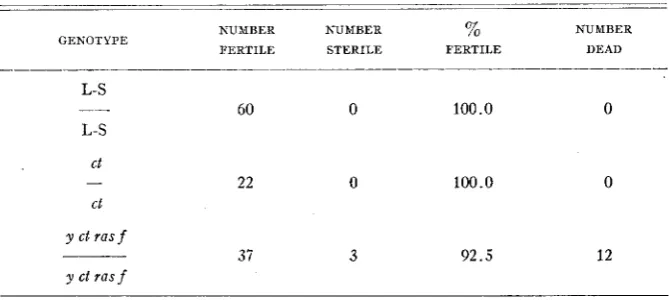
c t l c t , and y ct ras f l y ct ras j ) was tested. The ct/ct and y ct ras f l y ct ras f indi- viduals tested were females failing to show offspring in a previous experiment. Each female was placed with five wild type males to insure fertilization. The results are shown below (Table 1). The mortality among the y ct ras j / y ct
ras f females is probably due to their lower viability and their age since they were a t least ten days old when these tests were begun. These experiments plus the fact that pure stocks were carried with little difficulty indicate that parental sterility and embryonic inviability did not markedly influence the results of the mating tests. I n those cases in which the females produced offspring, the proof that mating had occurred was rather conclusive. It may then be assumed that the production of offspring was, in these experiments, about as reliable a criterion for the occurrence of insemination as the more direct spermatheca1 examination.
SELECTIVE MATING I N DROSOPHILA TABLE 1
Tests for fertility of certain female types
_ ~ ~ ~ _ _ _ _ _ _ _ _ _
NUMBER NUMBER % NUMBER FERTILE STERILE FERTILE DEAD GENOTYPE
ct
ct -
60 0 100.0 0
22 0 100.0 0
y ct ras f
y ct ras f
37 3 9 2 . 5 12
reach sexual maturity. For this reason, other workers have had to separate the females and the males until all groups had reached maturity before the flies could be used in mating experiments. Such separation of the sexes is an arti- licial situation but is unavoidable in such cases if the results are to be signifi- cant. I n these experiments, immature females were placed with the males and reached maturity in their presence. This method more nearly parallels the conditions in the population bottles and in nature.
The presence of food in the mating creamers is again a more natural situa- tion although it might be considered a possible source of distortion in the results. Etherization of the flies may also have affected the data, but the fe- males were so immature that, by the time mating occurred, several hours had passed since the flies had recovered from the ether.
The particular advantage in the methods employed lay in the possibility of studying matings of the female “preference” type on a basis comparable t o matings of the male “preference” type. I n much of the recent work (STALKER 1942; DOBZHAKSKY 1944; MAVR 1946a; T . ~ N 1946; PATTERSON et a1 1947; and
so forth) the latter type has been studied exclusively.
EXPERIMENTAL RESULTS
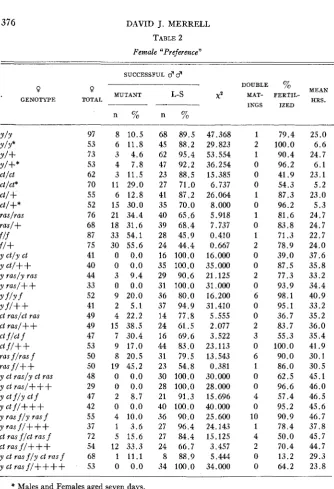
Tables 2 and 4 give the data from matings testing the “preferences” of the females. I n the column headed “Successful Males,” the numbers and per- centages of the total number of successful males are given. I n this column in table 2, the mutant males had the’same mutations as the females in the same row. The column headed “Mean Hours” in all tables gives the average period that the males and females remained together.
J. MERRELL TABLE 2 Female “Preference”
SUCCESSFUL d d
n n ~ _ _ . - _ _
YIY Y/Y* Y/+ Yl+* ctlct ct/ct*
c t / +
ct/+*
raslras
r a d + flf fl+
Y ctly ct Y ctl++
y rasly ras Y rasl++
YflYf Yf/++
ct f /ct f
c t f / + +
ras f l r a s f
ras fl+
+
y ct rasly ct ras y ct rasl+++
Y ct f l y ct f y c t f l + + +
Y ra.5 f l y 7as f
y r a s f l + f + ct ras f/ct ras f
ct ras f / + + +
y ct ras f l y ct ras f
y ct rasfl++++
ct raslct ras ct ras/+
+
97 8 10.5 53 6 11.8 73 3 4.6 53 4 7.8 62 3 11.5 70 11 29.0 55 6 12.8 52 15 30.0 76 21 34.4 68 18 31.6 87 33 54.1 75 30 55.6 41 0 0.0 40 0 0.0 44 3 9.4 33 0 0.0 52 9 20.0 41 2 5.1 49 4 22.2 49 15 38.5 47 7 30.4 53 9 17.0 50 8 20.5 50 19 45.2 48 0 0.0
29 0 0.0 47 2 8.7 42 0 0.0
55 4 10.0 37 1 3.6
72 5 15.6 54 12 33.3 68 1 11.1 53 0 0.0
68 89.5 47.368 45 88.2 29.823 62 95.4 53.554 47 92.2 36.254 23 88.5 15.385
27 71.0 6.737 41 87.2 26.064 35 70.0 8.000 40 65.6 5.918 39 68.4 7.737 28 45.9 0.410 24 44.4 0.667 16 100.0 16.000 35 100.0 35.000 29 90.6 21.125 31 100.0 31.000 36 80.0 16.200 37 94.9 31.410 14 77.8 5.555 24 61.5 2.077 16 69.6 3.522 44 83.0 23.113 31 79.5 13.543 23 54.8 0.381 30 100.0 30.000 28 100.0 28.000 21 91.3 15.696 40 100.0 40.000 36 90.0 25.600 27 96.4 24.143 27 84.4 15.125 24 66.7 3.457
8 88.9 5.444 34 100.0 34.000
1 2 1 0 0 0 1 0 1 0 1 2 0 0 2 0 6 0 0 2 3 0 6 1 0 0 4 0 10 1 4 2 0 0 79.4 100.0 90.4 96.2 41.9 54.3 87.3 96.2 81.6 83.8 71.3 78.9 39.0 87.5 77.3 93.9 98.1 95.1 36.7 83.7 55.3 100.0 90.0 86.0 62.5 96.6 57.4 95.2 90.9 78.4 50.0 70.4 13.2 64.2 25.0 6.6 24.7 6.1 23.1 5.2 23 .O
5.3 24.7 24.7 22.7 24.0 37.6 35.8 33.2 34.4 40.9 33.2 35.2 36.0 35.4 41.9 30.1 30.5 45.1 46.0 46.5 45.6 46.7 37.8 45.7 44.7 29.3 23.8
* Males and Females aged seven days.
(a) Single Mutants
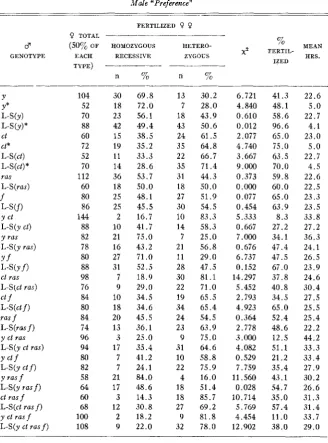
1. Yellow-The wild type male is much more successful than the yellow male when both are in “competition” for either the y / y or the y / + females. I n table 3 i t can be seen that the wild type males mated a t random with either female type while the yellow males mated significantly more often with the
y / y female than with the y / + female. These results agree with those of
(1945) in
D.
subobscura with the y gene or combinations of it. SPETT’S data(1932), which indicated sexual isolation between y and the wild type, were not confirmed.
T o eliminate the possibility that the effect of y was due to the visual effect of the markedly different body color, mating tests were performed in darkness. The results did not differ from those obtained in the light, and are included in
TABLE 3 Male “Preference”
FERTILIZED 0 0 Q TOTAL ____-___-______
3 (5070 OF
GENOTYPE EACH TYPE)
Y Y* L-S(Y)
L-s (Y) *
ct Ct* L-S(ct) L-S(ct)* ras L-S(ras) f
Wf)
Y ct
L-S(y G t )
y ras L-S(y ras) Y f
L-S(Yf)
ct ras L-S(ct ras)
ct f
L-S(ct f )
ras f L-S(ros f )
y ct ras L-S(y ct ras) Y c t f L-S(Y ctf) Y rasf L-S(y ras f )
ct ras f L-S(ct rasf) y ct ras f L-S(y ct ras f )
104 52 70 88 60 72 52 70 112 60 80 86 144 88 82 78 80 88 98 76 84 80 84 74 96 94 80 82 58 64 60 68 100 108 HOMOZYGOUS RECESSIVE n % 30 18 23 42 15 19 11 14 36 18 25 25 2 10 21 16 27 31 7 9 10 18 20 13 3 17 7 7 21 17 3 12 2 9 69.8
72 .O 56.1 49.4 38.5 35.2 33.3 28.6 53.7 50.0 48.1 45.5 16.7 41.7 75.0 43.2 71 .O 52.5 18.9 29.0 34.5 34.6 45.5 36.1 25.0 35.4 41.2 24.1 84.0 48.6 14.3 30.8 18.2 22
.o
HETERO- % MEAN ZYGOUS x2 FERTIL- HRS.
IZED -___-__ n % 13 7 18 43 24 35 2 2 35 31 18 27 30 10 14 7 21 11 28 30 22 19 34 24 23 9 31 10 22 4 18 18 27 9 32 30.2 28.0 43.9 50.6 61.5 64.8 66.7 71.4 44.3 50.0 51.9 54.5 83.3 58.3 25.0 56.8 29.0 47.5 81.1 71 .O 65.5 65.4 54.5 63.9 75.0 64.6 58.8 75.9 16.0 51.4 85.7 69.2 81.8 78.0 6.721 4.840 0.610 0.012 2.077 4.740 3.667 9.000 0.373 0.000 0.077 0.454 5.333 0.667 7.000 0.676 6.737 0.152 14.297 5.452 2.793 4.923 0.364 2.778 3.000 4.082 0.529 7.759 11.560 0.028 10.714 5.769 4.454 12.902 41.3 48.1 58.6 96.6 65.0 75.0 63.5 70.0 59.8 60.0 65.0 63.9 8.3 27.2 34.1 47.4 47.5 67.0 37.8 40.8 34.5 65.0 52.4 48.6 12.5 51.1 21.2 35.4 43.1 54.7 35.0 57.4 11.0 38.0 22.6 5.0
2 2 . 7
4.1 23.0 5.0 22.7 4.5 22.6 22.5 23.3 23.5 33.8 27.2 36.3 24.1 26.5 23.9 24.6 30.4 27.5 25.5 25.4 2 2 . 2 44.2 33.3 33.4 27.9 30.2 26.6 31.3 31.4 33.7 29.0
the totals of table 2. Excellent agreement is shown between the results obtained with unaged and aged flies.
2. Cut-In table 2 it can be seen that the wild type males inseminated a greater proportion of the females than the cut males when the males were in “competition.” Here also the low percentage of homozygous ct females which were fertilized should be noted. The highest percentage of fertilization for females homozygous for cut was 62.5 percent of the y ct ras/y ct ras females after an average period with the males of 45.1 hours. The lowest frequency of fertilization of any of the other female types was 64.2 percent of the y ct ras f/ ++++females after an average exposure of only 23.8 hours. This low mating frequency of the homozygous cut females appears to be responsible for many of the non-random results on male “preferences.” Table 3 shows that neither the mutant nor the wild type males were as successful in mating with homozygous cut females as with the phenotypically wild type. That thislow frequency was due not to sterility but to a lower frequency of mating was proved by testing the fertility of females failing to produce offspring. The results were shown previously in table 1.
Although in table 2 the results with flies aged seven days differ significantly from those with unaged flies in that cut males fertilized a higher proportion of females, mating was not random, with the wild type males still more successful than the cut males. The results in table 3 are not affected by aging.
3 . Raspberry-As shown in table 2, the raspberry males were successful about half as often as the wild type males in mating with either the ras/ras or the ras/+ females. Table 3 shows that the male alone, either wild type or raspberry, fertilized both types of females a t random.
4. Forked-The results with forked show in all cases that mating is a t random. Therefore, with regard to mating the forked gene is the only one of the four that can compete with the wild type on even terms.
(b) Combinations of M u t a n t s
This proportion is much lower than t h a t found with either gene alone. There- fore, with the exception of the effect of ras on ct, the genic influence seemed to be nearly additive.
(c) “Competition” between Mutant Males
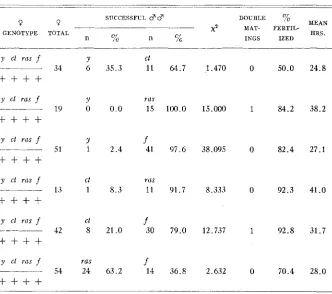
When females heterozygous for y ct ras
f
were placed with two kinds of mutant males, the results, shown in table 4, were close to what might have beenTABLE 4 Female “Preference”
_ ~ _ _ _ _ ~ _____ ~ _ _ _ _ _ _ __ ~ ___-
SUCCESSFUL 3 3 DOUBLE % MEAN MAT- FERTIL-
HRS.
2
0 Q
GENOTYPE TOTAL
n % n % INGS IZED
3’ ct ras f
+ + + +
y ct ras f
+ + + +
y ct ras f
+ + + +
y cl ras f
+ + + +
y ct Ills f
+ + + +
y ct m s f
__-___
+ + + +
Y
34 6 35.3
Y
19 0 0 . 0
Y
51 1 2.4
C t
13 1 8 . 3
Ct
42 8 21.0
ras 54 24 63.2
ct
11 64.7
rfls 15 100.0
f
41 07.6
ras 11 91.7
f
30 79.0
f
14 36.8
1.470 0 50.0
15.000 1 84.2
38.095 0 82.4
8.333 0 92.3
12.737 1 92.8
2.632 0 70.4
24.8
38.2
27.1
41.0
31.7
28.0
expected from the data on the mutants in “competition” with the wild type males. The y and ct males were unsuccessful in the presence of ras or
f
males. The y versus ct and ras versus f experiments showed that these types were mating at random although further data might reveal that even in these cases mating was not completely random. The success of ras in “competition” withf was unexpected because the ras males were not as successful in “competition” with the wild type as the
f
males.DISCUSSION
The Mating System
greater number of significant
x2
values in the experiments on female “choice” than in those on male “choice.” Furthermore, the significantx2
values were much larger in the experiments on female “choice.” Such results indicate that, where the male has an opportunity to mate with more than one type of female, he mates more nearly a t random than is the case if the female is given the opportunity of mating with two different male types. Even the instances in which the males do not mate a t random may be due t o differences in the re- sponse of the females. All the significantx2
values in the male “choice” experi- ments are found in connection with the y and ct genes. The results with ctare due to the lower mating frequency of ct/ct females, clearly seen also in table 2. Although other explanations have been given for the results with y (STURTEVANT 1921), RENDEL (1945) observed that all non-yellow females re- fused the yellow males.
PEARSON and LEE (1903) as a definition of assortative mating stated, “While all classes of males and females find mates, certain classes of males are attracted to certain classes of females.” Assortative mating may therefore be positive (homogamic-DoBzHANsKY and MAYR 1944) or negative (hetero- gamic). Homogamy would be characteristic of sexually isolated groups. They also defined preferential mating, “in which male and female classes with certain values of a character find it less easy to mate than other classes with different values.” I n these experiments, mating was not assortative but was preferential because one type of male was more successful than the other in “competition” for either type of female. I t should be noted that, where mating was not random, the wild type male was always more successful than the mutant type. I n those cases of male “choice” in which the wild type male mated more often with his own type females, the mutant males also were more successful with the wild type females. Under these circumstances, no sexual isolation can exist. Theoretically, there are a great number of possible systems of breeding. The effects of these mating systems can be predicted mathematically by means of calculations of the changes in distribution and frequency of the genes in a population ( JENNINGS 1916; WRIGHT 1921; HOGBEN 1946). Unfortunately, none of the formulae derived were suitable for application to the particular mating system operative in these experiments.
The nature of this mating system can be understood from a consideration of the data. It may be concluded that practically all of the females in a popula- tion will, in time, be fertilized. This conclusion is reached because of numbers of experiments on male “choice” in which practically all females were insemi- nated by a smaller number of males, necessitating discard of the series, and the high percentage of fertilization in the experiments on female “choice.” Even in the case of females homozygous for cut, it is evident from the data in table 1 that all would ultimately be fertilized although their reproductive rate would be lower than normal because of the time lapse prior to fertilization. Under natural conditions, the insemination of the females is also close to 100
tained sperm, and ten of the twelve species had 84 percent or more of the females inseminated.
Furthermore, it must be concluded that, given the opportunity, the males will mate more often than the females. The results indicate that the males generally mated more than once during the period of exposure. The data with seven-day-old L-S males and y/+ and y/y females show that in an average period of just 4.1 hours, the males inseminated 96.6 percent of twice their number of females, a n average of 1.93 matings per male in 4.1 hours. Not shown are the 79 series where the fertilization of more than 80 percent of the females made the results valueless in determining the nature of the male “preferences. ”
On the other hand, if it is assumed that the appearance of two classes of off- spring from a female gives a rough indication of the frequency of double mat- ing, the females seldom mated more than once. Because the detection of double mating b y the heterozygous females is more difficult, a better estimate is gained from the recessive females. From table 2 it can be calculated that only 5.9 percent of the homozygous recessive females mated with both male types. Although double mating with the same male type can not be detected, never- theless it is doubtful that the incidence of double matings including this type would rise above 15 or 20 percent. The frequency of male mating contrasted to the fewer matings by the females would lead to the fertilization of several females by one male while another less successful male might not mate a t all. From these conclusions, the mating system can be deduced. As each female becomes sexually mature or sexually receptive in the population bottle, a number of males will be ready to court and copulate with her. This surplus of males then becomes, in a broad sense, a competing group, the female mating with only one of several available males. Therefore, one male may mate with several females while another male fails to inseminate any. The males, further- more, seem to mate a t random. Random mating in the male “choice” ex- periments is prevented only by two factors: lack of mating success by y males with females other than y/y, and the low mating frequency of the homozygous cut females.
The mating system may therefore be considered to be the partial sex- limited selection of a sex-linked gene. The fertilization of all females means that, in their case, there is no differential elimination of the gene because of
selective mating. gowever, because of the differential mating success of the males and the fact that the males are essentially polygynous so that one male fertilizes as many females as possible, there is a selective elimination of one genotype among the males. Hence, these experiments indicate that the elimi- nation of the recessive sex-linked gene occurs in the males. There should also be a higher proportion of the presumably better adapted wild phenotype than is possible with random mating. The results obtained by LUDWIN (1948) in the population bottles confirm this conception of the mating pattern.
differences but will also affect the genetic structure of populations (STURTE- VANT 1915; LANCEFIELD 1929; DIEDERICH 1941; DOBZHANSKY and MAYR 1944; TAN 1946; etc.). Findings such as these are more basic in their implications than any dispute as to the causes of this non-random mating, for they form the premise on which DARWIN originally constructed his theory of sexual selection. If mating within a species is not a t random, it must follow that the mating process is a very definite and important part of the selective forces acting on each generation. Furthermore, non-random mating is not restricted to Dro- sophila, but occurs in a variety of species, from the Protozoa (JENNINGS 1911) to man (ROBINSON 1934). I t s causes are varied, and its effects range from negligible to extremely large. I n any study of the selective forces acting on a sexually reproducing population, the assumption of random mating without supporting evidence is unreliable.
Courtship Behavior in Drosophila
A number of authors have published descriptions of the mating behavior of different species of Drosophila (STURTEVANT 1915, 1921, 1942-D. melnno- gaster and numerous others; STALKER 1942-D. virilis; RENDEL 1945- D. subobscura; MAYR and DOBZHANSKY 1945, MAYR 1946b-D. pseudoobscura, D. persimilis; SPIETH 1947-D. willistoni species group; SEARS 1947-D. quinaria species group). All these observations showed that, on the whole, the mating behavior within the genus was rather similar, with minor variations occurring among the different species. The descriptions may briefly be sum- marized from STURTEVANT (1915), MAYR (1946b), and SPIETH (1947) by a consideration, first, of the different elements in the male behavior. The court- ing activities of the males are well defined so that it is easy to identify a court- ing male. Most of the following actions are common to most males of the genus Drosophila: vibrating, waving, scissors actions (characteristic wing move- ments); circling of the female by the male; licking; tapping, uppercutting, and stamping (leg movements).
The female behavior is much simpler. If unreceptive, the female will refuse the male by “decamping” (SPIETH 1947), by flicking the wings, by depressing or raising the abdomen, by extruding the genitalia so t h a t the male can not mate, or simply by ignoring the male. If receptive, the female stands still, turns the tip of the abdomen toward the male, and partly spreads the genitalia in the “invitation display.” A ready male will copulate a t once with the female, but the male can not mate if the female is unreceptive.
tion. A failure b y either individual to respond positively a t any point in the chain would delay the progress of the courtship or cause it t o be broken off. Such a concept is of great value since complex behavior patterns can be analyzed in terms of stimuli and responses without resorting to more complex terms such as “recognition” or “preference.”
Such a pattern of behavior undoubtedly exists among many forms, and particularly among birds where it has been most closely studied. However, even though the more recent authors (MAYR 1946b; SPIETH 1947; KING 1947; STREISINGER 1948) have made their observations with this theory as a basis, the evidence for its existence in Drosophila is not clear.
I n an extensive review on sexual selection among the insects, RICHARDS (1927) described and discussed what he termed “female coyness” in insects, the reluctance of the females to mate a t once. The “coyness” of the female, common to many species, was considered to be the cause for the elaborate courtship. According to HUXLEY (1938) the display in many of the lower forms, including Drosophila and other insects, is unilateral, the courtship by the male engendering a readiness to mate in the female. A recollection of the description of courtship above will call to mind that all of the positive actions were made by the inale up to the point a t which the receptive female, b y spreading the wings and genitalia, permits copulation. Prior to this final ac- ceptance, the female shows no activities which might serve as stimuli to the male. If a succession of actions and reactions between male and female were actually the pattern necessary, it is strange that the male courting activities (“circling,” “vibrating,” etc.) are so readily recognized by the observer, but no comparable behavior is seen in the female. If the female is unreceptive, her actions in refusal are more positive than if she is receptive.
A succession of progressive stimuli from the female does not seem to be necessary to produce the copulatory state in the male. Males, apparently driven by a n innate sexual urge, will initiate courtship with any individual, male or female, of the same or closely related species. Several authors (as for example RENDEL 1945, WALLACE and DOBZHANSKY 1946) have observed that males will start to court other males. I n the quinaria species group, SEARS (1947) observed that in interspecific crosses the females showed little or no interest in the males or were even antagonistic while the males courted the females actively and even attempted to copulate despite the hostility of the females. MAYR (194613) noted a n absence of species discrimination in courting males of
D.
persimilis andD.
pseudoobscura. Furthermore, he stated t h a t males will mate without the “invitation display” from the female. Further evidence has been presented by STREISINGER (1948). He found t h a t males ofD.
melano-gaster inseminated etherized “unconscious” females of melanogaster and per-
female.” There must be some constant non-specific stimulus from the females which serves to attract the males. This stimulus alone is enough for the males to complete copulation with the etherized females. The male seems to require no other stimulus or response on the part of the female. However, the unether- ized females must require a series of stimuli from the males before they permit copulation. Furthermore, these stimuli from the males seem to be a character- istic of the species, in contrast to the apparent non-specific nature of the stimulus from the females. The evidence is strong th at the males actually have no preferences in mating with the females, and th at deviations from random mating in experiments on male “choice” are due t o differing responses by the females.
All these results do not seem to fit the idea of a succession of stimuli and responses causing mutual stimulation. Rather it seems that the male attempts to stimulate the female to the point where she allows coition. Hence, in the case of Drosophila, HUXLEY’S idea of unilateral stimulation appears to be more nearly accurate.
This conclusion takes on particular importance because of the recent work on sexual isolation to be discussed below. If it is assumed that mating results from “a chain of interdependent stimuli and reactions,” significant results are obtainable from experiments testing either male or female “choice.” If, how- ever, the role of the male is secondary to that of the female in the occurrence of mating, experiments on female “choice” should be far more revealing than those on male “choice.” Since it is becoming increasingly clear that the males court and mate a t random unless the female responses differ, the continued use of male “choice” techniques in the study of sexual isolation holds less promise of a satisfactory solution to the problem than the use of techniques measuring female “preferences.”
Sexual Isolation
The recent interest in sexual isolation has resulted in considerable experi- mental data. Practically all of these data have been obtained by the multiple choice technique previously described, in which a male type is placed with two female types and a spermatheca1 examination reveals which females have been inseminated. This method makes possible the study of the “preferences” of the males. It is unfortunate that this particular method has been so extensively used because, from the data and the foregoing discussion, it is clear that the males are much more apt t o mate a t random than the females.
The conclusions from the present study make it worthwhile to attempt t o interpret some of the previous data on sexual isolation. STALKER (1942) formu- lated an isolation index as a measure of the sexual isolation between different groups when the multiple choice technique is used.
yo
Homogamic-
yo
Heterogamic matingsyo
Homogamic+
yo
Heterogamic matings Isolation Index =I N 385
t h e value a preponderance of heterogamic mating, with the limits
+
1 and-
1. I n Drosophila, two kinds of selective mating have been observed. I n inter- specific crosses, (such as LANCEFIELD 1929, DOBZHANSKY and KOLLER 1938), true sexual isolation or a preference for homogamic mating has been found to be the rule. For example, groups A and B are sexually isolated if males of A mate chiefly with A females, and B males with B females. However, the efforts to study the origin of this isolation by working with intraspecific crosses of strains, races, or subspecies ( DOBZHANSKY and MAYR 1944; DOBZHANSKY and STREISINGER 1944; PATTERSON, MCDANALD, and STONE 1947) have produced some “unexpected” results due to “one-sided mating preferences” (DOB- ZHANSKY 1944). I n this situation, males of A mate more often with A than with B females (positive isolation index), but B males either mate a t random (isola- tion index close to zero) or mate more often with the A females (negative isolation index). I n some cases, these negative isolation indices, indicative of a “preference” for heterogamic mating, have been as large as -0.5. (Theoreti- cally, males of both types could “prefer” heterogamic mating, but no case of this type is known.)A most interesting fact is that the results showing “one-sided mating pref- erences” in different strains correspond exactly with those obtained with mutant types. Here, too, in many instances, males of mutant type A mate more often with A than B females, but males of mutant type B either mate a t random, or mate more often with the A females (e.g. the data with yellow and cut). I n these experiments, negative isolation indices are also common. The data on sexual isolation give no idea of the “preferences” of the females, but rather of the relative ease with which they mate, since the females were not offered a “choice” between two males. The males, showing little or no discrimi- nation, mate with the females most responsive or least resistant to their court- ship
Viewed in this light, the data of DOBZHANSKY and STREISINGER (1944) with geographic strains of
D.
prosaltans become more understandable. Among seven strains ofD.
prosaltans, they discovered true sexual isolation in a few crosses and “one-sided mating preferences” in many others. A hierarchic series was made up, by which it became generally possible to predict which of any two female types would be inseminated more often. I t seems more reasonable to assume that there are constant differences among the females rather than a hierarchy of sexual “preferences” by the males. The latter assumption de- mands that the males of many different strains exhibit identical “preferences,” which seems less likely than that the results are due to invariable differences in the responses of the females.ing behavior (STURTEVANT 1915; DOBZHANSKY 1944). This hypothesis makes it possible t o interpret much of the information which has been accumulated on sexual isolation. Until more is learned from experiments on female “choice,” there seems to be no reason to interpret the data otherwise.
Experiments on temperature effects by MAYR and DOBZHANSKY (1945) furnish data of interest in this connection. Ordinarily, true sexual isolation exists between
D.
pseudoobscura andD.
persimilis (MAYR 1946a). Thus, the seeming discrimination of the persimilis males against their own females which appettrs a t low temperatures is surprising but perhaps can be explained.D.
persimilis lives in cooler habitats and remains, therefore, more active a t 18’ and 1 6 g C than does
D.
pseudoobscura. The persimilis males, which MAYR (1946b) observed to court either female indiscriminately, must be able to copulate with the pseudoobscura females more easily than their own a t low temperatures since the pseudoobscura females are no longer active enough to repulse them. The persimilis females, however, remain active a t the lower temperatures and are still able t o repulse both persimilis and pseudoobscura males. I n this case, the reciprocal aversion of true sexual isolation has been changedtinto a “one-sided mating preference” by a change in the laboratory conditions.These two mating systems complicate any experiments with hybrids, but such tests may furnish certain information. MAYR (1946a) believes that the F1
hybrid females from
D.
pseudoobscura andD.
persimilis crosses mate very readily because they are more vigorous than the parental types. TAN’S similar results (1946) with weak back-cross hybrid females from the same two species make this interpretation questionable. MAYR’S data show that the perAimilis males inseminated a higher percentage of hybrid females than of persimilis females. The pseudoobscura males, however, inseminated a lower percentage of hybrid females than of pseudoobscura females. These results might be expected since the p q s i m i l i s females do not mate as readily as the pseudoobscura females. Thus it seems more likely that the F1 hybrid females are intermediate to the parental females in receptivity.I n this connection, it is rewarding to examine further TAN’S data (1946).
Although most of the individual
x2
values in tables 3, 4, 5, 6, and 7 are not significant, thex2
for the total in each table is significant. I n every case, the hybrid females are mated with more often than the pure type. The most probable underlying cause for this result is the reduction in vigor of these back- cross hybrid females. TAN suggests that the combination of two non-allelic dominant gene complexes, one from each species, is responsible. This explana- tion is open to question since, if such complexes were present, the hybrid fe- males should be equally acceptable to a male of either type, but not more sothan the females of his own type, and mating would be a t random. Further- more, since it is possible to cross the two species, it is unlikely that they differ greatly in their sexually attractive features. These objections argue against the genetic explanation offered by TAN.
occurs because of genetic factors causing the hybrids to be more desirable, or whether it is due t o the greater weakness of the hybrids with an unbalanced genetic system. The latter seems more probable since persimilis males in table 6 are shown to mate more often with hybrid females than their own females. Furthermore, the greater the number of pseudoobscura chromosomes present in the hybrid, the more pronounced is this tendency.
All this evidence suggests that the “one-sided mating preferences” of mu- tants and of different strains are due t o the same underlying cause. The probability is t ha t physiological differences not directly associated with the mating process are responsible for the results. This hypothesis furnishes an adequate explanation for most of the data although further knowledge may cause i t to be modified. Undoubtedly, the most likely source of knowledge concerning the origin of sexual isolation lies in experimentation on female “choice.”
SUMMARY
1. Matings between the wild phenotype and all of the combinations of four mutants (y, ct6, r a s 2 , f ) of Drosophila melanogaster have been studied. The “pref- erences” of both the males and the females were tested.
2. Deviations from random mating occurred more often and were greater in the experiments on female “preference” than in those on male “preference.”
3 . With a “choice” of two female types, the males mated at random except when homozygous ct or y females were involved.
4. The y, ct, and ras males in “competition” with the wild type males in- seminated significantly fewer females than the wild type males. Mating be- tween
f
and wild type flies was a t random.5. I n combination, the effects of the mutations persisted, except in some cases involving ras.
6. The mating system in populations with these genes and the wild type alleles would be the partial sex-limited selection of a sex-linked gene. Since practically all of the females would be fertilized, a selective elimination of the mutant genotype would occur only among the males.
7. The assumption of random mating can be justified only by supporting evidence. Even in these experiments, the effects of selective mating ranged from negligible to very large.
8. The similarity between the “one-sided mating preferences” found in mat- ing experiments with mutants and in those on sexual isolation suggests that the same cause underlies both. These “one-sided mating preferences” do not seem indicative of incipient sexual isolation, but are probably due to causes not directly related to the mating process.
ACKNOWLEDGMENTS
LITERATURE CITED
BRIDGES, C. B., and K. S. BREHME, 1944 The mutants of Drosophila melanogaster. Carnegie Inst. Wash. Publ. 552.
DARWIN, C., 1871 The Descent of Man and Selection in Relation to Sex. xvi+614 pp. New York: Random House, Modern Library Edition.
DIEDERICH, G. W., 1941 Non-random mating between yellow-white and wild type D. melano- gaster. Genetics 26: 148.
DOBZHANSKY, Th., 1944 Experiments on sexual isolation in Drosophila. 111. Geographic strains of D. sturtmanti. Proc. nat. Acad. Sci. 30: 335-339.
-
and KOLLER, P. CH., 1938 An experimental study of sexual isolation in Drosophila. Biol. Zbl. 58: 589-607.___ and MAYR, E., 1944 Experiments on sexual isdation in Drosophila. I. Geographical strains of D. +llistoni. Proc. nat. Acad. Sci. 30: 238-244.
-and STRErsmGER, G., 1944 Experiments on sexual isolation in Drosophila. 11. Geo- graphic strains of D. puosaltans. Proc. nat. Acad. Sci. 30: 340-345.
FISHER, R. A., 1930 The Genetical Theory of Natural Selection. xiv+272 pp. Oxford: At the Clarendon Press.
HALDANE, J. B. S., 1932 The Causes of Evolution. vii+234 pp. New York and London: Harper and Brothers.
HOGBEN, L., 1946 An Introduction to Mathematical Genetics. xiif260 pp. New York: Nor- ton and Company.
HUXLEY, J. S., 1938 The present standing of the theory of sexual selection Chapter in Evolu- tion, G. R. de Beer Editor. viii+350 pp. Oxford: At the Clarendon Press.
-
1942JENNINGS, H. S., 1911
-- 1916 The numerical results of diverse systems of breeding. Genetics 1: 53-89.
KING, J. C., 1947 Interspecific relationships within the guarani group of Drosophila. Evolution LANCEFIELD, D. E., 1929 A genetic study of two races or physiological species of D. obscura. LORENZ, K. Z., 1935 Der Kumpan in der Umwelt des Vogels (Der Artgenosse als auslosendes Moment sozialer Verhaltungsweisen). Jour. f. Ornith 83: 137-213; 289414. Abbreviated Translation in Auk 54: 245-273.
LUDWIN, I.! 1948 Natural selection in D. mehnogaster under laboratory conditions. Doctoral thesis, Harvard University.
MAYR, E., 1946a Experiments on sexual isolation in Drosophila. VI. Isolation between D. pseu- doobscura and D. persimilis and their hybrids. Proc. nat. Acad. Sci. 32: 57-59.
___
1946b Experiments on sexual isolation in Drosophila. VII. Nature of the isolating mech- anisms between D. pseudoobscura and D. persimilis. Proc. nat. Acad. Sci. 32: 128-137. ___ and DOBZHANSKY, TH., 1945 Experiments on sexual isolation in Drosophila. IV. Modifi-cation of the degree of isolation between D. pseudoobscura and D. persimilis and of sexual preferences in D. prosaltans. Proc. nat. Acad. Sci. 31 : 75-82.
PATTERSON, J. T., MCDANALD, L. W., and STONE, W. S., 1947 Sexual isolation between members of the virilis group of species. Univ. of Texas Publ. 4720: 7-31.
-, STONE, W. S., and GRIPFEN,’A. B., 1940 Evolution of the virilis group in Drosophila. Univ. of Texas Publ. 4032: 218-250.
PEARSON, K., and LEE, A., 1903 REED, S. C., and REED, E. W., 1948
Evolution 2: 176-186. RENDEL, J. M., 1945
D. subobscura. J. Genet. 46: 287-302. RICHARDS, 0. W., 1927
Evolution, the Modern Synthesis. 645 pp. New York: Harper & Brothers. Assortative mating, variability and inheritance of size, in the conjugation of Paramecium. J. Exper. Zool. 11 : 1-34.
1: 143-153.
Z. I. A. V. 52: 287-317.
Assortative mating in man. Biometrika 2: 481498
ROBINSON, C. H., 1934 Birth Rates of Coeducational Graduates. A Decade of Progress in Eu- SEARS, J. W., 1947 Relationships within the quinaria species group of Drosophila. Univ. of Texas SPETT, G., 1932 Gibt es eine partielle sexuelle Isolation unter den Mutationen und der Grund- SPIETH, H. T., 1947 Sexual behavior and isolation in Drosophila. I. The mating behavior of STALKER, H. D., 1942 Sexual isolation studies in the species complex D. virilis. Genetics 27:
STREISINGER, G., 1948 Experiments on sexual isolation in Drosophila. IX. Behavior of males STURTEVANT, A. H., 191.5 Experiments in sex recognition and the problem of sexual selection
___
1921 The North American species of Drosophila. Carnegie Inst. Wash. Publ. 301: 1-150.___
1942 The classification of the genus Drosophila, with descriptions of nine new species. Univ. Texas Publ. 4213: 5-51.TAN, C. C., 1946 Genetics of sexual isolation between D. pseudoobsciwa and D. persimilis. Genetics 31: 558-573.
TIMOFEEFF-RESSOVSKY, N. W., 1934 Uber die Vitalitat einiger Genmutationen und ihrer Kom- binationen bei Drosophila funebris und ihre Abhangigkeit vom genotypischen und vom ausseren Milieu. 2. I. A. V. 66: 319-344.
TINBERGEN, N., 1939 On the analysis of social organization among vertebrates with special reference to birds. Amer. Midl. Nat. 21 : 210-234.
-
1942 An objectivistic study of the innate behavior of animals. Bibliotheca Biotheoretica Series D, Vol. I, Pars 2: 39-98.WALLACE, B. and DOBZHANSKY, TH., 1946 Experiments on sexual isolation in Drosophila. VIII. Influence of light on the mating behavior of D. subobscuro, D. persimilis, and D. pseudo- obscura. Proc. nat. Acad. Sci. 32: 226234.
genics. xi+531 pp. 13altimore: Williams and Wilkins. Publ. 4720: 137-156.
form von D. melanogaster Meig.? 2. I. A. V. 60: 63-83.
species of the willistmi group. Evolution 1: 17-31. 238-259.
with etherized females. Evolution 2: 187-188.
in Drosophila. J. Animal Behavior 5: 351-366.
WRIGHT, S., 1921
_ _ _
1931___
1940a The statistical consequences of Mendelian heredity in relation to speciation. Chapter in The New Systematics, J. S. Huxley Editor. viii+583 pp. Oxford: At the Clarendon Press._ _ 1940b Breeding structure of populations in relation to speciation. Amer. Nat. 74: 232- 248.
1943 Isolation by distance. Genetics 28: 114-138.
-_
1946 Isolation by distance under diverse systems of mating. Genetics 31: 39-59.Systems of matings I-V. Genetics 6: 111-178.