RADIOLOGICAL STUDY OF WHEAT MONOSOMICS. 11. DIFFERENTIAL SENSITIVITY OF 16 MONOSOMICS AND THE DISOMIC
TO A SINGLE DOSAGE OF X-IRRADIATION1
KOICHIRO TSUNEWAKI AND E. G. HEYNE2
Department of Agronomy, Kansas State Uniuersity, Manhattan, Kansas
Received February 17, 1959
radiological study of monosomic X of Triticum aestiuum reported by
TF
SUNEWAKI and HEYNE 1959b) pointed out the merits of irradiating seeds of monosomics as an approach to the study of the functional importance of in- dividual chromosomes as well as a method for screening mutations. In this paper, the results of irradiating 16 monosomics and the disomic are reported.The dosage of a chromosome is different in a specific monosomic than in the disomic or any other monosomic. When the chromosome as a whole has a spe- cific function for a certain developmental stage, a radiological effect should ex- press itself more intensely in a specific monosomic than in other monosomics at that developmental stage. Therefore, a comparative study of radiological re- sponses of various monosomics should provide an experimental approach to the study of specific functions of individual chromosomes at various developmental stages. A moderate dosage of irradiation appears to be favorable for this pur- pose, as a drastic change of any developmental stage may upset the entire de- velopmental process.
MATERIALS A N D METHODS
Radiosensitivities of 16 of the 21 monosomics available in Triticum aestiuum
var. Chinese Spring, were comparatively studied by irradiating dormant seeds with 14 Kr units of X-rays. The X-ray machine was operated at a distance of 15 cm, without a filter, at 80 KV and 18 MA.
The seeds were sown in greenhouse flats, and allowed to grow for four weeks before being transplanted to the field.
The experimental design used was a split plot in a randomized block design with five replications and 17 genetic strains, i.e., the disomic and 16 monosomics, for units and two treatments, namely irradiation and check, for subunits. One hundred seeds were planted for each subunit, so 500 seeds were subjected to the same treatment.
1 Contribution No. 634, Department of Agronomy, Kansas Agricultural Experiment Station,
Manhattan. Condensed from a thesis submitted to Kansas State University by the senior author in partial fulfillment of requirements for the Ph.D.
948 K. TSUNEWAKI A N D E. G . HEYNE
Different radiological responses of the plant were studied at three stages of development, i.e., germination percentage, seedling heights at the first leaf stage, and number of tillers produced.
The results were analyzed by analysis of variance and covariance in which the effect of interaction between the genetic strains and treatments was used as a criterion f o r the differential radiosensitivities of the monosomics.
The monosomics were derived from progenies of self-pollinated monosomics, whose chromosome number had been checked cytologically. The progenies, con- sequently, were mixtures of di-, mono- and nullisomics. Frequencies of the nulli- and monosomics in the mixture were estimated by SEARS (1954) and the authors ( TSUNEWAKI and HEYNE 1959a) for each chromosome. Radiosensitivity of a “pure” monosomic population was estimated from the formula presented in a previous paper (TSUNEWAKI and HEYNE 195913). The effect of nullisomics present in the mixtures was neglected in the estimation because of their low frequencies.
EXPERIMENTAL RESULTS
A marked difference in seed sizes occurred among the 17 strains as the disomic seed came from the greenhouse and the monosomic was grown in the field. Therefore, 100-kernel weights were recorded for each plot. The effects of the irradiation on germination percentage, seedling height at the first leaf stage, and numbers of tillers produced at the tillering stage, along with seed weight, are summarized in Table 1.
Differences of seed weights of the 17 strains were very highly significant. Least significant difference at the five percent level indicated that the disomic was the heaviest, and progenies of monosomics VI, 11, and XVII were the next heaviest class. Progeny of monosomic IX was the lightest and those of mono- somics XIII,
XI,
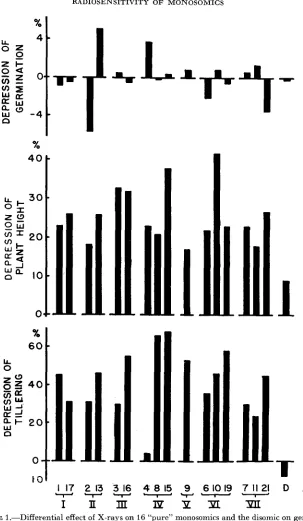
X, and VI11 were the next lightest class. The remaining eight monosomic progenies belonged to the medium class.The differential effect of X-rays on germination percentage of the 17 strains was significant. The percentage germination of the progeny of monosomic XI11 was significantly decreased and that of monosomic I1 was significantly increased by irradiation. The differential radiosensitivity studied on seedling height was highly significant. The progenies of monosomics 111, XV, X and XVI seemed to be more sensitive and the disomic was more resistant than the average. The differential effect of X-rays on tillering was significant. The progenies of mono- somic IV and the disomic were not reduced in comparison with a noticeable re- duction of the number of tillers in the other progenies.
Correlations among the relative radiosensitivities of the 17 strains at the three different developmental stages were studied, including differences of seed weights. The results are shown in Table 2.
RADIOSENSITIVITY O F MONOSOMICS 949 observed for the seedling heights was not accounted for by differences in seed weight. However, consideration of different seed sizes rather improved the level of significance of the differential radiosensitivity through reduction of error variance attributed to seed weight. The result of the covariance together with those of the correlation study suggest that the differences in seed weight were not a main factor in the differential radiosensitivities of the monosomics.
No significant correlations were found between differential radiosensitivities observed in germination and the two later stages of development studied. HOW-
TABLE 3
100-kernel weights and X-ray effects on percentage germination, seedling height ut the first leaf stage, and number of tillers at the tillering stage of the disomic and selfed
progenies of 16 monosomics
100-kernel Seedling No. of Genetic strains; weight Germination height tillers progenies < ~ f (gin) decrease' reduced* reduced'
Disomic s 2.76 -0.20 8.8 - 7.7
Monosomics
I 2.06 -0.68 18.9 30.5
I1 2.23 -4.18 15.2 20.9
I11 2.04 0.40 30.2 25.6
IV 1.97 2.20 17.5 - 0.2
VI 2.24 -1.70 19.6 27.6
VI1 1.85 0.38 18.7 19.3
VI11 1.79 -0.08 17.8 44.6
IX 1.30 0.58 14.9 38.1
X 1.77 0.38 27.9 22.8
XI 1.71 0.80 14.9 13.2
XI11 1.70 3.50 21.0 30.8
xv
1.89 0.14 30.2 47.5XVI 1.94 -0.42 27.3 42.8
XVII 2.18 -0.44. 23.8 26.0
XIX 2.07 -0.42 20.4 47.7
XXI 1.90 -2.58 22.2 30.8
5% L.S.D. 0.10 3.43 10.5 30.8
* Values given in percentages.
TABLE 2
Correlation coefjicients between 100-kernel weights and the radiosensitivities expressed on the germination percentage, seedling height, and number of tillers of the disomic and
selfed progenies of 14 monosomics
100-kernel weight = X, . . . -0.399 -0.222 -0.465 Germination percentage decreased = X, . . . . . . . 0.114 -0.119
Seedling height reduced = X, . . . . 0.522*
Number of tillers reduced = X, . . . . . . . . . . . . . . . . . . .
. . .
950 K. TSUNEWAKI A N D E. G. H E Y N E
ever. a significant correlation was obtained between the sensitivities observed in seedling heights a t the first leaf stage and the number of tillers at the tillering stage.
Estimations of the X-ray effects on each of the “pure” monosomic populatioxs (monosomic selfed progenies corrected for the number of monosomics expected) for the three characters studied, are shown in Figure 1. T h e relative radiosensi- tivities of the monosomic populations were not much different from those of thc selfed progenies (see Table 1 ) . Germination percentage of monosomic XI11 was still reduced more than the others, while that of monosomic I1 was increased by irradiation. Monosomics X, XV, 111, and XVI were more sensitive and the di- somic was more resistant for effects on seedling height. Neither disomic nor monosomic IV showed serious effects of irradiation on tillering in comparison
with a remarkable reduction of tillers in the other monosomics. D I S C U S S I O N
The completion of the four aneuploid series of common wheat, i.e., nulli-. mono-, tri-, and tetrasomics by SEARS (1 954)
,
opened several approaches to the study of the function of individual wheat chromosomes. Nulli- and monosomic analyses and the substitution method are the most widely used at present in wheat genetic studies. The nullisomic analysis (SEARS 1953) is based on the fact that different responses of the nullisomic plants from those of the disomic plants are attributed to the lack of the specific chromosome pair. Complete lack of a group of genes, however, probably interferes with a number of biochemical reactions necessary for normal plant development. Therefore, in the nullisomic condition the functional role of individual chromosomes at different develop- mental steps m a y not be properly evaluated because the upset of earlier de- velopmental stages probably has serious effects on later stages of development. However, by irradiating a monosomic one m a y be able to determine whether a particular effect of the nullisomic is due to one or more genes. Chromosome I1 is known to promote awn growth in wheat but no chromosome I1 is now known which does not promote awns. Mutants obtained by irradiating chromosome I1 might be completely lacking in awn promoting capacity which would suggest a single gene. or if mutants occurred which lost only part of their awn promoting ability, more than one gene would be suggested.RADIOSENSITIVITY O F MONOSOMICS 95 1
%
U
1111
II1
117 213 316 4 8 1 5 9 61019 71121 D
1
I
I
m
‘ I P P P I
PII
+ 1 Y v v - I
952 K. TSUNEWAKI A N D E. G . HEYNE
The substitution method. suggested by SEARS (1953) and further advanced by UNRAU et al. (1956), consists of introducing a pair of chromosomes of a donor variety into a recipient variety by replacing the corresponding chromo- some pair of the recipient through successive backcrosses of the donor variety with mono- or nullisomics of the recipient. A complete series of substitution lines gives information concerning which chromosomes are responsible for only cer- tain characteristics that are different from the donor and recipient varieties.
In comparison with the approaches described above, a radiological study of monosomics with a moderate dosage of irradiation has the unique feature of being able to study the functional role of the individual chromosomes at various developmental stages. A n embryo in a dormant seed consists of a number of cells. Moderate irradiation of the seed deletes or changes genes and/or their products in various cells. When a plant reaches a specific stage. a certain func- tion may not be carried out in a group of cells because of injury to the gene or its products which are responsible for that development. This is expressed by a n apparent radiological damage of the plant at that stage. At later stages of de- velopment of the same plant, other important functions may be blocked in dif- ferent g r o u p of cells expressing irradiation damage at those stages. However, there are generally a number of cells that function normally and allow the plant to recover from the specific irradiation damage. As the genes that are carried on a monosomic chromosome are in single dose, developmental steps for which these genes are responsible must be more seriously inhibited in the critical mono- somic than in disomics. Such changes could occur without influences on later development. As a matter of fact, correlation values indicated that the differential radiosensitivity for the percentage germination was not significantly correlated with the differential sensitivities found in either of two later stages of develop- ment, i.e.. with the seedling height and the number of tillers. However, the cor- relation between the last two was significant. The significant correlation can largely be attributed to the disomic, which showed the most resistance at both stages. T h e correlation coefficient calculated by excluding data on the disomic is 0.320 with d.f. = 14, which is considerably short of significance at the five percent level. These considerations lead to the conclusion that radiological damage ex- pressed on a developmental stage is independent from damage appearing at other stages of development. Thus, the radiological study of monosomics with a mod- erate irradiation is a useful approach to the study of functions of individual chromosomes in each developmental stage without a serious change of the whole process of development.
RADIOSENSITIVITY O F MONOSOMICS 953 tion of monosomic I1 was stimulated and that of monosomic XI11 inhibited. This suggested that both chromosomes are concerned with the process of germination but in opposite ways, e.g., chromosome I1 functions for dormancy of seeds and XI11 for breaking of dormancy.
Two of the monosomics which showed extreme sensitivity at the development of the first leaf belonged to homoeologous group 111, indicating that they have a similar function for leaf development of seedlings. This agrees with results reported by SEARS (1954) using nullisomic analysis. The monosomics belong- ing to homoeologous group IV showed response to X-rays on tillering develop- ment. Monosomic IV was most resistant but VI11 and XV were sensitive, though their sensitivity was not significantly different from the average, indicating some functional divergency among these homoeologous chromosomes. However, SEARS (1 954) observed an increased number of tillers in nullisomic VI11 but not in IV. The disagreement of the results on tillering must be studied further. Al- though these results do not agree exactly with SEARS (1954)
,
they agree in that homoeologous group IV functions by affecting tillering.Concerning the principles involved, moderate irradiation of monosomics in hexaploid wheat facilitates study of chromosome functions i n a rather normal physiology of the plant; it may be applied to other polyploid species and may be useful if trisomics of diploid species are irradiated.
SUMMARY
Comparative studies of radiosensitivity of disomic and selfed progenies of 16 monosomics of hexaploid wheat were made at three stages of devehpment after irradiating dormant seeds with 14 Kr units of X-rays. The differential radio- sensitivity statistically defined in the previous paper ( TSUNEWAKI and HEYNE
1959b) was significant for percentage germination, highly significant for seed- ling heights at the first leaf stage, and significant for number of tillers produced at the tillering stage. Correlation studies and covariance analysis indicated that the difference of seed size found was not responsible for the differential sensi- tivity observed.
Germination rates of monosomics I1 and XIII, both of which belong to homoeologous group 11, were most increased and reduced, respectively, indicat- ing a functional divergence of the corresponding homoeologous chromosomes o n germination. X-ray damage on the seedling height was most pronounced in monosomics X, XV, 111, and XVI. Monosomics I11 and XVI belong to homo- eologous group 111, indicating a similar function of the corresponding chromo- somes on the leaf development of seedlings. Monosomics IV, VI11 and XV, all of which belong to homoeologous group IV, were concerned with tillering. Mono- somic IV was significantly resistant to irradiation effects while the other two were sensitive.
954 K. TSUNEWAKI AND E. G. HEYNE
mental genetics on one hand and the investigation of functional homology and divergence among the homoeologous chromosomes from an evolutionary view- point on the other hand.
ACKNOWLEDGMENT
The authors wish to express their appreciation to DR. VAL. W. WOODWARD for his continuous stimulation and encouragement during the course of the experiment, and for his remarks and suggestions during preparation of this manuscript.
LITERATURE CITED
CAMPBELL, A. B., and R. C. MCGINNIS. 1958
CLAUSEN, R E., and D. R. CAMERON, 1944
HEYNE, E. G., and R. W. LIVERS, 1953
LARSON, RUBY I., 1952
A monosomic analysis of stem rust reaction and awn expression i n Redman wheat. Can. J. P1. Sci. 38: 184-187.
Inheritance in Nicotiana tabacunz. XVIII. Mono- somic analysis. Genetics 29: 347-477.
winter injury and seed color i n Pawnee wheat. Agron. J. 45: 54-58.
Genetics 37: 597-598.
Monosomic analysis of leaf rust reaction, awnedness,
Aneuploid analysis of inheritance of solid stem in common wheat.
SEARS, E. R., 1953 Nullisomic analysis in common wheat. Am. Naturalist 87: 245-252. 1954 The aneuploids of common wheat. Missouri Agr. Expt. Sta. Res. Bull. 572: 3-58. TSUNEWAKI, K., and E. G. HEYNE, 1959a The transmission of the monosomic condition in T r i -
Radiological study of wheat monosomics. I. Differential smsitivity of monosomic X and
The use of monosomes and nullisomes in cytogenetic studies of common
Chromosome substitution in hexaploid
ticum aestiuum var. Chinese Spring. ( I n press).
the disomic to X-irradiation. Genetics 44: 933-946. 1959b
UNRAU, JOHN, 1950
UNRAU, JOHN, CLAYTON PERSON, and JOHN KUSPIRA, 1956 wheat. ,Sei. Agr. 30: 66-89.