(Under the direction of Dr. Eric N. Wiebe).
The purpose of this dissertation study was to explore the experiences of high school
physics students who were solving complex, ill-structured problems, in an effort to better
understand how self-regulatory behavior mediated the project experience. Consistent with
Voss, Green, Post, and Penner’s (1983) conception of an ill-structured problem in the natural
sciences, the ‘problems’ consisted of scientific research projects that students completed
under the supervision of a faculty mentor. Zimmerman and Campillo’s (2003) self-regulatory
framework of problem solving provided a holistic guide to data collection and analysis of this
multi-case study, with five individual student cases. The study’s results are explored in two
manuscripts, each targeting a different audience.
The first manuscript, intended for the Science Education Research community,
presents a thick, rich description of the students’ project experiences, consistent with a
qualitative, case study analysis. Findings suggest that intrinsic interest was an important
self-regulatory factor that helped motivate students throughout their project work, and that the
self-regulatory cycle of forethought, performance monitoring, and self-reflection was an
important component of the problem-solving process. Findings also support the application
of Zimmerman and Campillo’s framework to complex, ill-structured problems, particularly
the cyclical nature of the framework. Finally, this study suggests that scientific research
projects, with the appropriate support, can be a mechanism for improving students’
over a decade’s worth of experience mentoring students doing physics research. His
experience suggests that a successful research experience requires certain characteristics,
including: a slow, ‘on-ramp’ to the research experience, space to experience productive
© Copyright 2016 by Jeffrey David Milbourne
by
Jeffrey David Milbourne
A dissertation submitted to the Graduate Faculty of North Carolina State University
in partial fulfillment of the requirements for the degree of
Doctor of Philosophy
Science Education
Raleigh, North Carolina
2016
APPROVED BY:
_______________________________ _______________________________
Eric N. Wiebe, Ph.D. Melissa G. Jones, Ph.D.
Committee Chair
_______________________________ _______________________________
DEDICATION
I dedicate this dissertation to the memory of my grandfather, Paul L. Holmes. A
teacher, principal, and coach for 49 years, Grandpa Holmes embodied a commitment to
educational excellence and public service that still runs through our family. Educated in the
Quaker tradition at Wilmington College in Wilmington, Ohio, Grandpa Holmes dedicated his
career to the notion that all children in rural Ohio needed science and mathematics
instruction, and were more than capable of learning subjects like Chemistry and Physics.
Despite having six children, as well as a farm to run, Grandpa Holmes found time to take
continuing education courses at the University of Dayton, Wilmington College, and The
Ohio State University. While he had aspirations of doctoral-level work, family came first,
preventing him from pursuing those aspirations. I’d like to think that my graduate experience
BIOGRAPHY
Jeffrey David Milbourne was born and raised in Durham, North Carolina, the son of
Mary Holmes Banner and Robert Earl Milbourne II. A North Carolina Teaching Fellow, Jeff
received a B.S. in Physics and an M.A.T. in Secondary Science from the University of North
Carolina at Chapel Hill. He began his career at Croatan High School in Newport, NC, where
he taught science for three years, before moving back to Durham to teach Physics at his alma
mater, the North Carolina School of Science and Mathematics (NCSSM). Jeff remained at
NCSSM for seven years, during which time he achieved National Board Certification (2009)
and won the Presidential Award for Excellence in Science and Mathematics Teaching
(2013). During the 2014-15 academic year, Jeff served as an Albert Einstein Distinguished
Educator fellow in the office of U.S. Congressman Mike Honda. He is married to Dr.
ACKNOWLEDGMENTS
Thanks to Eric N. Wiebe for his guidance, patience, and support throughout my time
at NCSU. Thanks to Gail Jones, Kathy Trundle, and Alice Churukian for their thoughtful
insight, advice, and ongoing support. Thanks to my colleagues and students at the North
Carolina School of Science and Mathematics for their time, patience, and cooperation as I led
the double life of a teacher and graduate student. Thanks to my mother, for instilling the
Holmes family commitment to educational excellence. Finally, thanks to my wife Chelsea,
both for her support and for providing a positive example of how to get through a doctoral
TABLE OF CONTENTS
List of Tables ... vi
List of Figures ... vii
Introduction ...1
Manuscript: Self-Regulation in the Midst of Complexity: A Case Study of High School Physics Students Engaged in Ill-Structured Problem Solving ...10
Abstract ...11
Introduction ...12
Purpose and Research Question ...29
Methods...31
Results ...46
Discussion ...94
Conclusions ...100
References ...105
Manuscript: Student Research Projects: A Mechanism For Improving Complex Problem-Solving Skills ...114
Abstract ...115
Introduction ...116
Description of the Research Program ...117
Significant Components of the Experience ...119
Studying What Works ...121
Concluding Remarks ...125
References ...127
Conclusion ...129
Appendices ...135
Appendix A: Prospectus ...136
Appendix B: Sample Student Interview Protocols ...216
Appendix C: Sample Mentor Interview Protocols ...217
Appendix D: Student Writing Prompt ...218
LIST OF TABLES
Manuscript: Self-Regulation in the Midst of Complexity: A Case Study of High School Physics Students Engaged in Ill-Structured Problem Solving
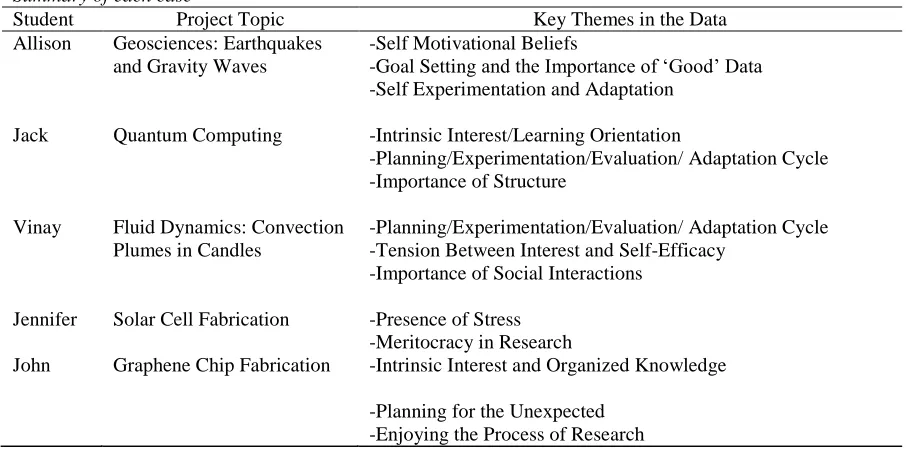
Table 1: Summary of student research projects ...36
Table 2: Schedule of student interviews ...39
Table 3: Levels of comparison for emergent codes ...42
Table 4: Summary of each case ...47
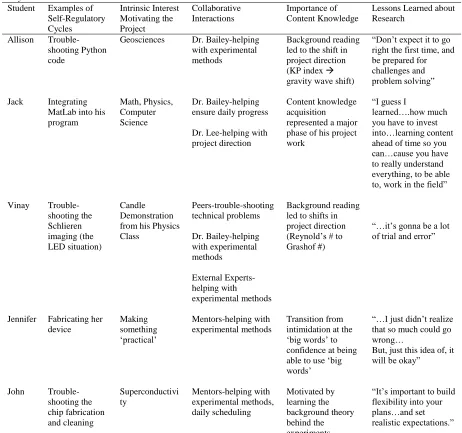
Table 5: Key themes across all cases ...89
Manuscript: Student Research Projects: A Mechanism For Improving Complex Problem-Solving Skills Table 1: Summary of student research projects ...122
LIST OF FIGURES
Manuscript: Self-Regulation in the Midst of Complexity: A Case Study of High School Physics Students Engaged in Ill-Structured Problem Solving
Figure 1: Self-regulatory problem-solving framework ...19
Box 1: Jack’s explanation of how he doesn’t trick himself ...60
Box 2: Jack’s approach to program design ...61
Box 3: Vinay, describing his trouble shooting ...69
Introduction
Problem solving is a fundamental part of the human experience. Regardless of age,
gender, nationality, or profession, people solve problems as part of their daily lives. Given
the ubiquitous nature of problem solving, it should be a critical focus of both educational
research and educational practice. Problem solving does have a rich history of scholarship,
which has focused on themes such as problem characteristics and the differences between
expert and novice problem solvers. The literature makes it clear that content knowledge is a
critical part of the problem solving process, and that self-regulatory behavior plays a critical
role in solving large, complex problems. However, more work is needed.
International benchmarks like the PISA exam paint a sobering picture of how the
problem solving skills of students in the United States compare to those of their international
peers (OECD, 2014). National educational rhetoric has, in turn, sounded the alarm bell about
the economic implications associated with an under-performing educational system (PCAST,
2010). In conjunction with the national conversation, discourse in Science Education has
focused on reforming the education system to promote 21st century skills that align with
work-place demands in a new economy (Bybee & Fuchs, 2006; Dede, 2010), culminating in
the National Research Council’s (NRC), A Framework for K-12 Science Education (National Research Council, 2012). The K-12 framework identifies a series of practices that are
associated with the problem-solving process: asking questions, defining problems,
constructing explanations, designing solutions, planning, analyzing, and arguing from
(NGSS), built upon the principles of the NRC framework (NGSS Lead States, 2013), represent a major reform opportunity for science education (Lynch & Bryan, 2014).
Time will tell whether the NGSS take hold in the American education system,
producing the sort of wide-sweeping change its authors envisioned. However, the NGSS
movement echoes a longer history of instructional/curriculum reform efforts that promote
scientific thinking and problem solving in K-12 education. Inquiry, problem-based learning,
modeling instruction; these instructional approaches represent efforts by educators and
researchers to help students become more scientific in their thinking and more effective in
their ability to solve problems. The advent of NGSS presents researchers, policy makers, and
educators an opportunity to revisit the conversation of how best to help students become
better at solving problems.
Physics educational literature has a rich tradition of problem-solving research,
focusing on themes such as expert/novice differences and physical “intuition” (e.g., Larkin,
McDermott, D. Simon, & H. Simon, 1980; Singh, 2002). However, most of this work focuses
on well-defined problems with clear-cut answers, similar to the problems one might find in a
more traditional textbook. Less work has been done with ill-structured problems; that is,
more open-ended problems that align better with what students might be expected to do
under NGSS. Physics is by no means the only discipline that has this problem: Choi and Lee
(2009) argue that there is a general lack of instructional design literature surrounding
ill-structured problem solving, leaving important questions about how to support students (and
The purpose of this dissertation was to investigate the experiences of high school
physics students who were solving complex, ill-structured problems. In this case, the
‘problem’ was a 12-18 month research project that students completed under the supervision
of a faculty mentor. Consistent with Voss et al.’s (1983) conception of an ill-structured
problem in the natural sciences, these students were doing original, independent research
projects that were, in theory, publishable contributions to the scientific community. The
conceptual framework of this dissertation also draws upon on Zimmerman and Campillo’s
(2003) model of self-regulated problem solving. While there is some evidence that the model
works when applied to smaller, ill-structured scenarios like problem-based learning
(Zimmerman & Lebeau, 2000), questions remain about the model’s ability to explain the
increased complexity of authentic scientific research.
This dissertation is the culmination of a five-year exploration into the
problem-solving process. The author, a veteran physics educator, began graduate studies so that he
could help his students improve their problem solving skills. This initial interest led him to
examine problem solving from both a cognitive and affective perspective in his graduate
coursework. He conducted literature reviews that drew upon work in the Physics Education
Research community, as well as work from Educational Psychologists on affective constructs
such as self-efficacy. In 2012, the author conducted a pilot study of physics novices to learn
more about their solution strategies for solving ill-structured problems, leading to a
conference paper accepted to NARST’s international conference (cf., Milbourne & Wiebe,
so that he could learn more about the role of content knowledge in ill-structured problem
solving. The author used the results of both studies to inform his own practice, implementing
classroom activities informed by what he had learned about ill-structured problem solving.
He also used the results of both pilot studies to write a manuscript for Research in Science Education. After an invitation to revise and resubmit, this manuscript is currently under consideration for publication.
Despite some productive work studying problem solving, the author made an
important realization in the spring of 2014 that led to a methodological shift in his
dissertation: he had been using a well-structured methodology to study ill-structured
problems that were somewhat simplistic. The pilot study problems, while ill-structured, were
small in scope, with students able to complete them in a matter of minutes. Due to his role as
a physics teacher, the author was interested in helping students acquire the skills they needed
to solve real-world problems, which tend to be both ill-structured and complex, often taking
days, weeks, or even months to solve. The disconnect between his pilot study work and
interests as a physics teacher led to a tension that he could only resolve by shifting both the
research context and the methodology. Given his role as a physics teacher at a residential,
STEM focused school, the author had access to a unique population of students who were
conducting high-level research projects that fit his criteria for complex, ill-structured
problems. That student group, as well as his relationship with the on-site mentor, his
This study draws upon the lessons the author has learned throughout his graduate
work, as well as his teaching experience, and seeks to present findings that are relevant to
members of both the education research and classroom practitioner communities.
This dissertation contains two manuscripts. The first manuscript, Self-Regulation in the Midst of Complexity: A Case Study of High School Physics Students Engaged in Ill-Structured Problem Solving,presents a case-study analysis of five students who were working on complex, scientific research projects. Consistent with qualitative research, this
manuscript provides a thick, rich description of the students’ project experiences, which took
place over the course of seven months, and uses self-regulatory theory to inform those
descriptions.
This manuscript targets the Science Education Research community and is intended
for the Journal of Research in Science Teaching (JRST). The manuscript’s focus on ill-structured problem solving is timely, given the current discourse concerning the Next
Generation Science Standards. JRST has also published manuscripts with methodological
similarities to this manuscript (e.g., Zeldin & Pajares, 2008; Polman & Hope, 2014); these
exemplar articles helped inform the structure of this manuscript, which is expected to be
revised, tightened, and focused based on committee feedback.
The second manuscript, Student Research Projects: A Mechanism for Improving Complex Problem-Solving Skills, targets physics practitioners, making the case that research projects are a mechanism for helping physics students get better at ill-structured problem
advice/perspective of the primary research mentor, who has over a decade of experience
mentoring students doing high-level research. While the author of this dissertation was the
primary author of this manuscript, he does plan to work with the research mentor as a
coauthor prior to publication. The manuscript begins with a description of the research
program, followed by the mentor’s thoughts on critical aspects of the program. The
manuscript concludes with a discussion of the cross-case findings from manuscript one.
Manuscript two is intended for publication in The Physics Teacher (TPT), the primary peer-reviewed journal for physics practitioners at the middle, high-school, and university
levels. Both the dissertation author and the primary research mentor have had success
publishing previous manuscripts in TPT (Bennett & Mauney, 2011; Milbourne & Lim, 2015), and both feel the manuscript’s topic and content are appropriate for that journal’s
audience. They feel that the physics practitioner community would benefit from learning
more about the research program, especially as it pertains to potential gains in problem
solving skills and self-regulatory behavior. As with the first manuscript, this manuscript’s
theme is timely, given the current conversations about NGSS, and should find an audience at
TPT. Consistent with publishing guidelines of a typical manuscript for TPT, manuscript two is considerably shorter.
Both manuscripts align with the dissertation prospectus (see Appendix A) from the
standpoint of theme and content, as the prospectus informed both the literature review
process and methodological decisions undergirding manuscript one. Manuscript one, in turn,
from the prospectus needed to be condensed, particularly in the case of manuscript two, to fit
with publication guidelines. The researcher did add literature to manuscript one to
supplement the primary findings.
References
Bybee, R. W., & Fuchs, B. (2006). Preparing the 21st century workforce: A new reform in science and technology education. Journal of Research in Science Teaching, 43(4), 349-352.
Bennett, J., & Mauney, A. (2011). The static ladder problem with two sources of friction. The Physics Teacher, 49(9), 567-569.
Choi, I., & Lee, K. (2009). Designing and implementing a case-based learning environment for enhancing ill-structured problem-solving: Classroom management problems for prospective teachers. Educational Technology Research and Development, 57(1), 99-129.
Dede, C. (2010). Comparing frameworks for 21st century skills. 21st century skills: Rethinking how students learn, 20, 51-76.
Larkin, J., McDermott, J., Simon, D., & Simon, H. (1980). Expert and novice performance in solving physics problems. Science, 208(4450), 1335-1342.
Lynch, S., & Bryan, L. (2014). Supporting the implementation of the Next Generation
Science Standards (NGSS) through research. Introduction to NARST position papers. Milbourne, J., & Lim, H. (2015). Revisiting the Velocity Selector Problem with V Python.
The Physics Teacher, 53(2), 87-89.
Milbourne, J., & Wiebe, E.N. (April, 2013). How do High School Students Approach Ill-Defined Physics Problems? Presented at the NARST Annual Meeting, Rio Del Mar, PR.
National Research Council. (2012). A framework for K-12 science education: Practices, crosscutting concepts, and core ideas. Washington, DC: National Academies Press. NGSS Lead States (2013). Next generation science standards: For states, by states.
Washington, DC: The National Academies Press.
OECD (2014), PISA 2012 Results: Creative Problem-solving: Students’ Skills in Tackling Real-Life Problems (Volume V), PISA, OECD Publishing.
Polman, J. L., & Hope, J. M. (2014). Science news stories as boundary objects affecting engagement with science. Journal of Research in Science Teaching, 51(3), 315-34.
Singh, C. (2002). When physical intuition fails. American Journal of Physics, 70(11), 1103-1109.
Voss, J.F., Greene, T.R., Post, T.A., Penner, B.C. (1983). Problem-solving skill in the social sciences. In G.H. Bower (Ed.), The Psychology of Learning and Motivation:
Advances in Research Theory (Vol.17). New York, NY: Academic Press.
Zeldin, A. L., Britner, S. L., & Pajares, F. (2008). A comparative study of the self‐efficacy beliefs of successful men and women in mathematics, science, and technology careers. Journal of Research in Science Teaching, 45(9), 1036-1058.
Zimmerman, B. J., & Campillo, M. (2003). Motivating self-regulated problem solvers. In J.E. Davidson & R.J. Sternberg (Eds.), The psychology of problem-solving (233-262). Cambridge, England: Cambridge University Press.
Abstract
The purpose of this study was to explore the experiences of high school physics
students who were solving complex, ill-structured problems, in an effort to better understand
how self-regulatory behavior mediated the project experience. Consistent with Voss, Green,
Post, and Penner’s (1983) conception of an ill-structured problem in the natural sciences, the
‘problems’ consisted of scientific research projects that students completed under the
supervision of a faculty mentor. Zimmerman and Campillo’s (2003) self-regulatory
framework of problem solving provided a holistic guide to data collection and analysis of this
multi-case study, with five individual student cases. Findings suggest that intrinsic interest
was an important self-regulatory factor that helped motivate students throughout their project
work, and that the regulatory cycle of forethought, performance monitoring, and
self-reflection was an important component of the problem-solving process. Findings also support
the application of Zimmerman and Campillo’s framework to complex, ill-structured
problems, particularly the cyclical nature of the framework. Finally, this study suggests that
scientific research projects, with the appropriate support, can be a vehicle for improving
Introduction
Solving problems is a common experience for all human beings, and problem solving
plays a key role in professional life, regardless of the profession. Given the importance of
problem solving, it should be a central focus of any educational system. Certain disciplines,
such as mathematics and physics, have acknowledged this importance, doing extensive work
researching the problem-solving process (Larkin & Reif, 1979; Schoenfeld, 1985; McMillan
& Swadener, 1991; Fortus, 2009), with the end goal of improving students’ problem-solving
performance.
Still, much work remains. International benchmark exams such as the PISA, which
test students’ problem-solving skills, demonstrate that the United States lags behind its
international peers in students’ problem-solving ability, particularly in situations demanding
creativity (OECD, 2014). Indeed, national education discourse reflects a sense of urgency
about these results, focusing on the economic implications associated with an
under-performing educational system (PCAST, 2010). Science education discourse has focused
specifically on reforming the system to promote 21st century skills that align with work-place
demands in a new economy (Bybee & Fuchs, 2006; Dede, 2010), culminating in the National
Research Council’s (NRC) report, A Framework for K-12 Science Education (National Research Council, 2012). The K-12 framework identifies a series of scientific practices, or
habits of mind, that are associated with the problem-solving process: asking questions,
defining problems, constructing explanations, designing solutions, planning, analyzing, and
The Next Generation Science Standards (NGSS), based on the NRC framework,
place a similar emphasis on engineering, design-based scenarios, and real-world problems
(NGSS Lead States, 2013). As these standards present a significant opportunity for
improving science education (Lynch & Bryan, 2014), it is critical to provide support to
teachers and students as they begin to implement curricula derived from these standards. One
step in the support process involves helping students and teachers make the shift away from
more traditional, text-book style linear problem solving, and towards more real-world,
open-ended problem solving guided by a design scenario. Such problems often have multiple
solutions, depending upon initial assumptions. Providing this sort of instructional assistance
requires an understanding of problem characteristics, as well as characteristics of effective
problem solvers.
Problems Characteristics
Problems and problem solving have a rich legacy of scholarship, with early work
focused on defining and characterizing different types of problems (Reitman, 1965; Newell
& Simon, 1972; Simon, 1973). While problem solving is a task that transcends disciplinary
boundaries, there are common characteristics that all problems have. Problems involve
unknown situations, requiring novel responses from the individual in the problem situation
(Larkin & Reif, 1979). More colloquially, problem solving is “…what you do when you
don’t know what to do.” (Wheatley, 1984).
Problem situations require an individual to set goals, and determine methods for
methods, indicates that problem solving should be a purposeful process, requiring
self-monitoring behavior like planning (Larkin & Reif, 1979). Problem situations have an initial
state, requiring the individual to perform operations on that initial state to reach the desired
goal state (Newell & Simon, 1972; Chi & Glaser, 1985).
Problems occur within a problem space, which consists of: elements/symbols representing knowledge about the problem, operators, which produce new knowledge states
from old, an initial knowledge state, based on initial conditions, and the total knowledge
available to the solver from both the environment and the solver’s background knowledge
(Newell & Simon, 1972, p810). In a sense, the problem space represents the ‘cognitive’
boundaries that frame the problem. For an introductory physics student, the space may
consist of the problem prompt (words, numbers, symbols, and diagrams), the students’
knowledge of fundamental physics principles (quantitative and qualitative), and mental
heuristics that the student has learned and can apply to physics problem solving (operators).
Problem solving occurs by ‘searching’ the problem space incrementally, often backing up to
previous states and starting over (Chi & Glaser, 1985). Solvers choose specific solution pathways, or branches, and follow those pathways to a solution, where they then determine whether their solution is acceptable.
Given the particular problem, problem spaces can be rather large, so successful
problem solvers need to be particularly adept at extracting the ‘right’ information from the
problem space (Newell & Simon, 1972, p834). In Physics Education Research, this skill is
situation (Larkin, McDermott, Simon, & Simon, 1980; Singh, 2002). To cope with large
problem spaces, solvers may set intermediate goals designed to shrink the size of the problem
space into smaller, more manageable pieces, known as subgoaling (Chi & Glaser, 1985). Solving the problem then becomes an iterative process, as the individual works through each
of the smaller problems in route to the larger problem’s solution.
The way an individual interprets a given problem can have significant impacts on
how that individual proceeds to solve the problem. Problem representation is the process by which the solver understands, and interprets, the problem (Chi & Glaser, 1985). As part of
the representational process, the individual makes decisions about how physical aspects of
the problem (e.g., typed problem instructions in the problem prompt) map to prior
knowledge, influencing the solution space by emphasizing certain information and heuristics
at the expense of others. A physics student might look at a falling object and represent the
situation using energy principles; another might look at the same situation and represent it
using kinematics principles; another may use dynamics. The students’ representational
choices will influence the mathematics they select to solve the problem, and the conceptual
reasoning they use to understand the problem. Representational choices also play a
significant role in determining the solution (Simon, 1973). Depending on how a problem is
framed, one student may represent the problem using qualitative/conceptual heuristics, while
another may use more quantitative heuristics; that representational choice will influence the
A problem is ‘solved’ once the individual reaches the desired goal state (Newell &
Simon, 1972). So in the case of the physics student, the goal state may be a numerical
response for the speed of the ball as it strikes the ground. Note that different problem types
may have different forms of a goal state: the physics student comes up with a numerical
response, but other problems may necessitate ‘yes/no’ answers. ‘Solved’ states may also be
relative, in that the individual may go through a reflective process to evaluate the validity of
the solution, potentially requiring the individual to revisit the problem if the solution is not
acceptable.
Different problems have different characteristics, including complexity and
structuredness. Problem complexity is related to the number of issues, or variables, encompassed in a given problem (Funke, 1991). A physics problem with 3 variables is
obviously less complex than a problem with 20 variables. Complexity can also refer to the
connection between variables, as well as the stability of those variables over time. A
problem’s structuredness refers to the constraints on a given problem’s solutions (Reitman, 1965). Those problems with fewer constraints, or more ‘open’ constraints are considered less
structured, or ill structured, compared to those problems with more constraints, so called well structured. While these characteristics are connected, they also have some independence. It is possible for a problem to be complex, but well structured, or simple and ill structured
(Jonassen, 2004). Given that ill-structured problems have fewer constraints, they may have
multiple solutions, and it may not be clear which solution is ‘correct.’ Such a characteristic,
what an ill-structured problem looks like in the natural sciences. Voss, Green, Post, and
Penner (1983) argue that scientific research projects represent the scientific version of an
ill-structured problem.
A problem’s structuredness is not a binary condition. Rather, a problem’s structure
exists on a spectrum between well structured and ill structured (Reitman, 1965; Jonassen,
1997). While difficult to measure directly, the difference in distance between two problem
solutions acts as a proxy for how well, or ill structured a problem is (Voss & Post, 1989,
p265). The process of solving the problem can also provide structure: as the solver makes
decisions while solving an ill-structured problem, she ‘closes’ certain constraints, making the
problem more structured (Reitman, 1965). Simon (1973) makes the argument that all
ill-structured problems become well ill-structured in the mind of the solver, as the solver goes
through the process of problem representation.
Regardless of problem type, problem-solving expertise demands a variety of skills
and knowledge. Experts must have content knowledge (Reitman, 1965; Shin, Jonassen, &
McGee, 2003), although content knowledge alone is not sufficient (Simon, 1973). Content
knowledge in one particular domain does not necessarily translate to another domain
(Kitchner, 1983; Chi, Glaser, & Farr, 1988), requiring experts to possess content knowledge
germane to the problem domain (Schoenfeld, 1985). Content knowledge should also be
organized into schemata (Chase & Simon, 1973; Chi, Glaser, & Rees, 1982), which influence
how the expert represents the problem (Chi & Glaser, 1985; Hegarty, 1991). Experts utilize
testing/verifying procedures, etc), and make decisions about how and when to select
particular heuristics (Schoenfeld, 1985). Similar to this notion of applying heuristics, experts
employ a variety of self-monitoring techniques, including planning and strategy analysis
(Moore, 1990), careful monitoring of one’s performance (Mayer, 1992), and evaluation of
particular strategies (Voss, Greene, Post, & Penner, 1983).
In addition to cognitive requirements, problem-solving expertise has ties to affective
domains like motivation, interest, or self-efficacy (Bandura, 1997; Schwarz & Skurnik,
2003). Developing expertise often requires a great deal of practice (Ericsson & Charnes,
1994), which in turn requires motivation and interest (Bloom, 1985). In a similar fashion,
ill-structured problem solving requires both self-monitoring and motivation, as the solver needs
to stay focused, and may encounter roadblocks requiring adjustments and effort to overcome
hurdles. (Pressley & McCormick, 1995).
A Self-Regulatory Framework of Problem Solving
Given the demands associated with problem solving, ill-structured problems in
particular, it is useful to have a framework that incorporates both cognitive and affective
domains. Zimmerman and Campillo (2003) created a problem-solving model that integrates
both self-regulation processes and motivational beliefs to explain the problem-solving
process. Zimmerman (1998) defined self-regulation in terms of self-generated thoughts, actions, and feelings, planned and continuously adapted for achieving personal goals like
solving a problem. The cyclical nature of self-regulation, which links to Chi and Glaser’s
performances to make adjustments. Self-regulation and motivation are particularly important
for complex, ill-structured problem solving, as the solver needs to stay focused, and may
encounter roadblocks requiring adjustments. (Pressley & McCormick, 1995).
Zimmerman and Campillo’s (2003) model breaks problem solving down into three
distinct phases: forethought, performance, and reflection. These three phases form a
self-regulatory cycle, governing an individual’s thinking and actions during the problem-solving
process. Forethought processes set the stage for all problem-solving efforts, while the
performance phase occurs during the solution process. Self-reflection occurs after the
individual reaches a solution, and influences the individual’s response to the solution,
potentially sending her back to the forethought phase for another cycle.
Figure 1: Model of self-regulated problem solving. Adopted from Zimmerman and Campillo (2003)
Actions in the forethought phase consist of task analysis behaviors or self-motivation
the goal-setting phase, the problem solver determines an intended outcome of the
problem-solving exercise. The strategic planning phase sees the solver decide which solutions
strategies to use. Self-motivational beliefs help mediate the task analysis behaviors, keeping
the solver focused and ‘on-task.’ Obviously, an individual who has intrinsic motivation will proceed forward with a problem; Jonassen (2004) argues that all problem solving must have
some sort of value, socially, culturally, or intellectually. Zimmerman and Campillo (2003) do
speculate that both internal and external sources can work together to increase motivation.
Self-efficacy, an individual’s perception of her ability to perform effectively (Bandura, 1997),
is another powerful motivational belief that influences the individual’s problem-solving
behavior. An individual who has no expectation of performing well will behave differently
than another individual, with the same knowledge and skill set, who has positive perceptions
of her ability to perform. Indeed, those who are self-efficacious will often work harder than
those who are not; the latter group may even withdraw their efforts in times of struggle
(Bandura & Cervone, 1986). Outcome expectations are similar in concept to self-efficacy, but more closely related to an individual’s beliefs about the consequence of a particular
outcome (Bandura, 1997). Borrowing an example from Zimmerman and Campillo,
self-efficacy refers to an individual’s belief that she can solve fractions on a math test; outcome
expectations relate to her expectation that she will be perceived as ‘smart’ if she does well (p.
competence than short-term successes (Dweck, 1988). Those with performance orientations
measure success against others, focusing on public recognition for success (Ames, 1992).
Activity in the performance phase falls into two categories: control, and self-observation. Self-control activity helps the problem solver focus on the activity at hand, optimizing her solution efforts. Such activities may include: imagery, in which the solver visualizes or imagines a successful effort; self-instruction, which involves ‘thinking out-loud’
or ‘thinking-through’ the task as the individual proceeds; attention focusing, which involves removing distractions, either through environmental controls or conscious mental activity,
can improve performance; or task strategies, involving breaking a problem down to its essential elements, then reorganizing in a strategic fashion. Self-control activities have been
correlated with either expertise or positive performance in a variety of contexts (Pressley,
1977; Kuhl, 1985; Schunk & Rice, 1985; Mach, 1988). Self-observation behavior involves the individual keeping track of her actions, her environment/surroundings, and her
performance. Novices can become quickly overwhelmed in complex situations by the
volume of information at hand, creating chaos in the self-monitoring process (Zimmerman &
Campillo, 2003, p. 242). Self-recording, a form of monitoring, can provide clarity regarding prior solution attempts, which is also valuable due to the fact that novices may not accurately
remember prior solution attempts (Voss et al., 1983). The self-monitoring process may also
lead to self-experimentation, in which an individual tweaks an approach to see if it works,
something experts often do to enhance concentration or find creative solutions (Langer,
The final phase of the framework is self-reflection, a critical phase for complex, ill-structured problems that may require multiple iterations of solution attempts. Actions in this
phase fall into two major categories: self-judgement, and self-reactions. Self-judgement
occurs as the individual evaluates her performance, assigning causal significance to particular
actions or outcomes. Self-evaluation requires measuring one’s progress against a particular
criteria of performance, which is typically easier for well-structured problems. Evaluation
criteria may include mastery, past performance, normative, and collaborative. Experts tend to
set higher performance criteria for themselves, and are more adaptable because of their
ability to accurately evaluate their performance (Zimmerman & Paulsen, 1995; Ericsson &
Lehman, 1996). In ill-structured situations, mastery can be difficult to assess, so past
performance becomes an important factor, as does normative criteria, or comparing one’s
performance to others. Normative criteria do have drawbacks, however: similar to motivation
due to external sources, normative evaluation may shift focus away from the task itself
towards social factors. In team problem-solving settings, collaborative performance criteria
may be used to evaluate how well one fills a particular role on the team (Bandura, 1991).
Causal attributions during self-judgment link a particular outcome to solution efforts, critical to the evaluation process. A student who thinks she got a bad grade on a test because she
didn’t study enough will react differently than a student who thinks she failed a test because
she can’t do math. Indeed, causal attributions that link performance will fixed abilities tend to
provoke negative reactions, and attributions linking performance to solution strategies (how
Dweck, 1988; Zimmerman & Kitsantas, 1997). That is, a student who believes that more
studying will lead to learning and mastery (growth mindset) will take a very different
motivational orientation than a student who believes his math abilities are fixed, regardless of
the amount of studying. In general, more self-regulated problem solvers will attribute errors
to more controllable factors, while novices will attribute errors to more fixed factors.
Self-reaction to problem-solving efforts consist of self-satisfaction and adaptive inferences. As its name suggests, self-satisfaction refers to an individual’s perceptions of satisfaction or dissatisfaction that stem from her performance. In general, people pursue
courses of action leading to feelings of satisfaction and positive affect, while avoiding actions
that lead to dissatisfaction and negative affect (Bandura, 1991). Perceptions of satisfaction
tend to shift in response to how much an individual values the problem. Adaptive or defensive inferences consist of an individual’s assessment of how to alter her strategies for future problem-solving efforts. Adaptive inferences are more positive, leading the solver to
try new strategies that is hopefully more effective than previous strategies. Defensive
inferences, often the result of discouragement, protect the individual from future
dissatisfaction; such behavior may include apathy, procrastination, or task avoidance.
Ironically, these behaviors limit growth and handicap the individual (Garcia & Pintrich,
1994).
This self-regulated framework of problem solving is cyclical, similar to the iterative
nature of other problem-solving frameworks (Bransford & Stein, 1984; Chi & Glaser, 1985).
resulting in ‘course corrections’ to the problem-solving effort. Or, the self-reflection phase
could influence future self-reflection phases by giving the individual additional experience to
use during the evaluation/judgments phases. This cyclical nature of self-regulatory behavior
is especially useful when considering complex, ill-structured problems that are large enough
to require significant subgoaling. Subgoaling may produce different levels of problems
within the larger problem, each of which could require its own self-regulatory cycle.
Problem Solving in Science Education
In addition to the theoretical work undergirding research on problem solving, there is
a solid foundation of scholarship related to how problem solving works in science
educational contexts. Physics Education Research has a rich history of problem-solving
exploration that focuses on differences between experts and novices (Larkin, McDermott,
Simon, & Simon, 1980; Chi, Feltovich, & Glaser, 1981; Zajchowski & Martin, 1993; Kohl &
Finkelstein, 2008), as well as the importance of conceptual/qualitative reasoning in the
problem-solving process (McMillan & Swadener, 1991; Mestre, Dufresne, Gerace,
Hardiman, & Touger, 1993; Ploetzner, Fehse, Kneser, & Spada, 1999). Instructional
approaches like modeling physics have been informed by this rich body of research (Halloun
& Hestenes, 1987), and have demonstrated efficacy in helping high school students learn
physics content knowledge (Wells, Hestenes, & Swackhamer, 1995) and improving students’
attitudes towards science (Brewe, Kramer, & O’Brien, 2009). However, most of this work
focused on well-structured problems, leaving questions about how the literature might apply
The Physics Education Research group at the University of Minnesota has done work
with context-rich problems, problems they define as “…stories that include a reason for
calculating specific quantities about real objects or events” (Heller and Hollabaugh, 1992,
p639). While real-world context is not enough to transform a well-structured problem into
an ill-structured problem, the group has created a framework that helps classify problems.
The framework does not explicitly use the terms well structured and ill structured, but it does
contain specific characteristics that correlate with the well/ill-structured characteristics. Such
characteristics include explicit mentioning of the “target” variable in the problem prompt, as
well as the need to make simplifying assumptions (Xu and Pihlaja, 2011). The latter
characteristic is particularly important, as it requires an individual to redefine the boundaries
of the problem space, transforming it from ill structured to well structured (Reitman, 1964).
Shin, Jonassen, and McGee (2003) examined the cognitive and affective factors
correlating with ninth graders’ success on both well-structured and ill-structured problems in
an astronomy classroom. While each problem type required a different skill set, content
knowledge was a critical predictor for both well-structured and ill-structured problem
solving, consistent with previous findings on the importance of content knowledge to
problem solving expertise (Reitman, 1965; Elstein, Shulman, & Sprafka, 1978; Simon,
1973). This study did not explore the mechanism by which content knowledge facilitates
better ill-structured problem solving.
Fortus (2009) used the IDEAL framework to examine the solution pathways of
postdoctoral fellows, or graduate students at a major research university (p. 89), possessing at
least an undergraduate degree in physics. Presumably, these participants had strong content
knowledge, consistent with Simon’s (1973) recommendations for what an individual needs in
an ill-structured problem scenario. By virtue of their background, these individuals also had
expertise in solving traditional, well-defined physics problems.
As expected, the experts were successful solving three, well-structured problems,
each covering a different content area in physics. However, many experts struggled to reach
solutions for ill-structured problems, in part because they were unable to make assumptions
about values not explicitly listed in the problem prompt (p. 102). This struggle is consistent
with Reitman’s (1965) discussion of open constraints at the beginning of a problem, as well
as related results from Schraw, Dunkle, and Bendixen (1995) and Shin, Jonassen, and McGee
(2003). Only those experts who had prior experience solving ill-structured problems were
successful in making such assumptions.
While Fortus’ (2009) study demonstrates the difficulty experts can have solving
ill-structured problems, it is not clear how physics novices, who lack both relevant physics
content knowledge and well-structured problem-solving expertise, would respond to the
challenges of an ill-structured problem. Yet, it is exactly this combination of content
knowledge and scientific/engineering practices that the NGSS expects students to be able to
master (NGSS Lead States, 2013; Moore, Tank, Glancy, & Kersten, 2015). Shin, Jonassen,
conceptual astronomy problems, but it is unknown whether the results of a 9th grade
astronomy study would generalize to a physics classroom.
Milbourne and Wiebe (2013) explored how physics novices, high school students
taking their first physics course, solved increasingly ill-structured problems. The novices,
who had some training in ill-structured problem solving, were able to strategize and plan
appropriate solution pathways for both well-structured and ill-structured problems. However,
these students experienced a series of obstacles related to their ability to make reasonable
initial assumptions, similar to the experts in Fortus’s (2009) study. The novices also had
issues rooted in content misconceptions, and lacked self-monitoring behavior.
There has been limited work in other areas of science education. Bond, Philo, and
Shipton (2011) explored the reasoning strategies of expert and novice geoscience students in
situations lacking a ‘right’ answer. While the authors did not explicitly use the term
‘ill-structured’ to categorize the problem tasks in which students engaged, these tasks did share
common characteristics with ill-structured problems. Geoscience novices, accustomed to
getting a right answer, struggled to reach solutions for ill-structured tasks. Overton, Potter,
and Leng (2013) conducted a similar study with chemistry students, discovering that students
solving ill-structured problems fall along a spectrum of performance between novice and
expert. Sarsfield (2014) explored ill-structured problem practices in the context of public
health nursing, situating the problem-solving process within an authentic practice. Focusing
suggest that expert nurses create complex problem representations and solutions, compared
to novice nurses who use more superficial representation.
As Sarsfield’s work suggests, ill-structured problem solving can have a direct
connection to ‘real-world’ problem solving, or problem solving situated in an authentic,
professional context. As such, interest has developed in using instructional models that teach
by exploring authentic cases, so called problem-based, or case-based, learning. Popular in
medical schools for over 40 years, most medical schools use some sort of problem-based
instruction (Schmidt, Van der Molen, Te Winkel, & Wijnen 2009). Problem scenarios
typically begin by presenting students with minimal information about a particular patient
(Barrows, 1986), creating an ill-structured problem scenario in which students engage in
self-regulatory processes like strategic planning and self-reflection as they work through the
problem. Problem-based learning has also been used in undergraduate chemistry courses
(Belt, Evans, McCreedy, Overton, & Summerfield, 2002; Hicks & Bevsek, 2011),
engineering (Dahlgren & Dahlgren, 2002), law (Moust & Nuy, 1987), economics, and
business (Gijselaers et al., 1995). While not a panacea for content gains and motivational
improvements, certain types of problem-based instructional interventions have increased
students’ content knowledge (Schmidt, Van der Molen, Te Winkel, & Wijnen 2009; Wijnia,
Loyens, & Devours, 2011), as well as their motivation (Dunlap, 2005; Hwang & Kim, 2006;
Sungur & Tekkaya, 2006; White, 2008).
Zimmerman and Lebeau (2000) explored the role of self-regulation in medical
three-phase, cyclical process, similar to Zimmerman and Campillo’s (2003) model of
self-regulated problem solving. While this conclusion is useful, it remains to be seen how their
model holds up when applied to larger, more complex problems that occur in ill-structured
spaces.
Purpose and Research Question
The last five decades have seen significant progress in understanding human problem
solving. Significant themes in the literature include problem characteristics, problem solving
in science/physics education, and the importance of self-regulation during problem solving.
The literature makes it clear that content knowledge is a critical part of solving any type of
problem, and that experts utilize a variety of self-regulatory behaviors to help them cope with
the demands of complex problems.
However, gaps in the literature remain. Much of the work done on problem-solving
expertise in physics (e.g., Larkin, McDermott, Simon, & Simon, 1980; Chi, Feltovich, &
Glaser, 1981; McMillan & Swadener, 1991; Mestre, Dufresne, Gerace, Hardiman, & Touger,
1993; Zajchowski & Martin, 1993; Kohl & Finkelstein, 2008; Ploetzner, Fehse, Kneser, &
Spada, 1999) has focused on well-structured tasks that are relatively small in scope.
Significant problems, like scientific research projects, are ill structured, complex, and large in
scope. While studies like Fortus’s (2009) begin to shed light on expertise in ill-structured
spaces, those studies focus on relatively small problems, problems that can be solved over the
course of a single interview session. It is also unclear how self-regulatory frameworks like
The literature fails to adequately explain instructional interventions that can help
scaffold students as they transition from novice to expert problem solvers in complex,
ill-structured spaces. This certainly makes sense, as a lack of understanding expertise leads to a
lack of understanding how to develop expertise. Again, there has been good work that
focuses on smaller, more contained problem situations and interventions (e.g., Ge & Land,
2003; Byun, Lee, & Cerreto, 2014), as well as work with problem based learning (e.g.,
Dunlap, 2005; Hwang & Kim, 2006; Sungur & Tekkaya, 2006; White, 2008; Schmidt, Van
der Molen, Te Winkel, & Wijnen 2009; Wijnia, Loyens, & Devours, 2011). However,
questions remain about what happens when students encounter larger, more complex
problems. Choi and Lee (2009) argue that there is a lack of instructional design research and
information relating to ill-structured problem solving.
This study addressed portions of these literature gaps by focusing on students who are
engaged in large, complex, ill-structured problems: in this case, students performing
scientific research projects that took months to solve.
The purpose of this research study was to investigate the experiences of high school
physics students who were solving complex, ill-structured problems. In this case, the
‘problem’ was a research project that students completed under the supervision of a faculty
mentor. Consistent with Voss et al.’s (1983) conception of an ill-structured problem in the
natural sciences, these students were doing original, independent research projects that were,
in theory, publishable contributions to the scientific community. The conceptual framework
problem solving. While there is some evidence that the model works when applied to
smaller, ill-structured scenarios like problem-based learning (Zimmerman & Lebeau, 2000),
questions remain about the model’s ability to explain the increased complexity of authentic
scientific research.
Using a multi-case analysis, this study examined the following research question:
How does a self-regulated problem-solving framework help describe the experiences of high school physics students who are completing complex, ill-structured research projects?
Methods
According to Yin (2009), case study methodology is an appropriate choice when the
researcher seeks to explore the relationship between contextual conditions and theory-guided
data collection and analysis. Qualitative methods are also appropriate when the researcher
seeks to provide a thick and rich description of phenomena in an authentic context (Denzin &
Lincoln, 2005; Creswell, 2009). Case study researchers typically collect a variety of
information types in an effort to understand the different facets of the case, which are
typically bounded by activity and/or time. Case study methodology is also an ideal choice
for studying processes and change (Simons, 2009), given its depth of description of events
unfolding in an authentic setting. This depth gives the research the insight to determine key
factors in a complex environment with multiple factors at play. Finally, case studies are
useful for studying critical events, like the transition into an ill-structured learning
appropriate when each case predicts either similar results (literal replication), or contrasting
results for predictable reasons (theoretical replication) (Yin, 2009).
Given the nature of the research site, participants, and the research question, this
study employed a multiple case-design, with each student’s project serving as the unit of
analysis. The ‘project’ consisted of the student, the mentor, and the resources the student
used during her project, including the research environment. Consistent with Stake’s (2006)
general rules for selecting cases in multi-case design, differences between student projects (in
terms of topic, location, methodology) provided diversity across contexts, and the depth of
the experience provided an opportunity to learn about complexity and contexts.
Participants
The participants group consisted of 5 high school students, participating in a
specialized physics research program. The school is a residential, magnet high school for
high-achieving students interested in science, technology, engineering, and math (STEM).
The school has a state-wide geographic demographic, drawing students from all parts of the
state for their junior and senior years. Students achieve admission through a rigorous
application process, which ensures that all students have a past history of academic success.
Students who gain admission are typically the best students from their respective high
schools. As such, the students in this high school tend to be very motivated, and very hard
working. However, the school’s admissions policy ensures equity with respect to geographic
representation of the student body, leading to differences in student academic preparation and
better prepared, both cognitively and affectively, for the rigors of the school’s program.
Given that this school is a magnet school with a STEM focus, students have rigorous
graduation requirements in all STEM areas. In their two years at this school, they take
approximately two semesters each of physics, chemistry, and biology, as well as two full
years of mathematics, usually at the level of pre-calculus and above. Most students finish
calculus or statistics by the time they graduate. Students also have to take at least one course
in computer science or engineering.
Given the nature of the research question, it was important that the research
participants were engaged in an ill-structured problem-solving experience. As such, the
participants were taken from a population of students participating in specialized, research
programs at the high school site. The first of these programs, called Research in Physics, or R
Phys for short, is a 12-15 month sequence available to a small number of students at the
school. Students apply to participate in this program during their junior year, starting in
November. Dr. Bailey, the R Phys instructor and program coordinator, uses the program
application as an opportunity to select students who demonstrate both an interest in physics
and an ability to work independently. To do so, he uses proxy measures such as grades,
student essays, and one-on-one interviews. Dr. Bailey does not require that students have a
formal background in physics to participate in the program, but he does look for students
who have spent enough time doing background reading that they can articulate specific,
coherent project ideas. As result of the screening process, these students tend to be some of
state. Because of that, they have a high existing interest in physics, and the capacity for
independent learning relative to the general high school student population.
During the first three months of the R Phys program, students learn the basics of the
scientific research process, including how to conduct a literature review, data
analysis/collection strategies, and dealing with experimental uncertainties. Students also
begin doing a literature review on a topic of interest and formulating research
topics/questions. In the next three months, leading up to the summer between students’
junior/senior years, students write a research proposal and, if necessary, find a research
laboratory at a nearby university. Depending on the project topic, some students work with a
mentor off-site, potentially traveling to that laboratory to do their work. Other students
remain on campus, working directly with Dr. Bailey. During the summer period
(approximately 6 weeks), students live on campus and do a bulk of their data collection.
Students conclude the summer work period with an analysis/conclusion process during the
fall of their senior year.
It is worth noting that a typical research project involves multiple levels of problem
solving, many of which were ill structured. The top level, or macro problem, represents the
student’s progress along the ‘arc or scholarship’ associated with the scientific method
(design, data collection, analysis, conclusion). While working in each phase of the macro
problem, students encounter micro problems associated with that particular phase (e.g.,
reading literature to determine a research question in the design phase; trouble-shooting a
analysis and the overall duration of the student projects (12-15 months), the primary focus of
data collection was the macro, students’ overall progress with their projects, with the goal of
creating a thick, rich description of the project experience. However, data collection did
peripherally capture aspects of the micro problem solving as students discussed their
experiences with the projects, adding depth to the macro description.
The second student research program, called summer research experience in physics,
is a compressed version of the R Phys. Students still apply to get into the program, write a
project proposal, and live/work on campus during the same summer period as the R Phys
students. While the summer research students do a capstone presentation at the end of July,
many choose to continue working on their projects into the fall, with the goal of participating
in national research competitions and science fairs. In some cases, students who participate in
the summer program actually transition into the R Phys course during the senior year (at the
request of their mentor).
All students participating in both the R Phys and Summer Research Programs, 10
students total, were invited to participate in this study. Of the 10 students, eight agreed to
participate (5 R Phys students, 3 summer research students), although one summer research
student was uncooperative in the first interview and was excluded from the remainder of data
collection. Two of the remaining seven missed a significant number of interviews due to
scheduling conflicts, making it difficult to incorporate their data into the final analysis. As a
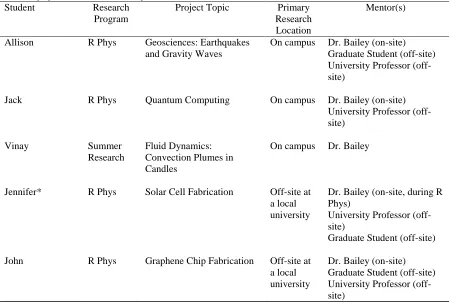
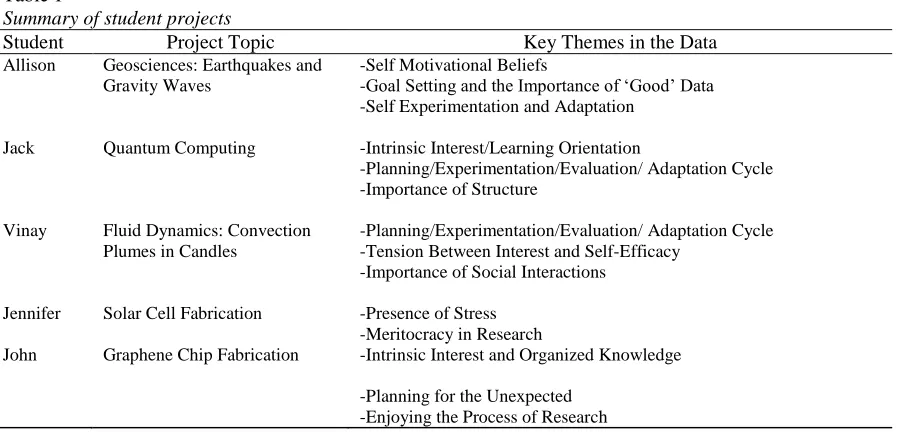
result, five of the original eight participants were included in the results and analysis. Table 1
Table 1
Summary of Student Research Projects
Student Research Program
Project Topic Primary Research Location
Mentor(s)
Allison R Phys Geosciences: Earthquakes and Gravity Waves
On campus Dr. Bailey (on-site) Graduate Student (off-site) University Professor (off-site)
Jack R Phys Quantum Computing On campus Dr. Bailey (on-site) University Professor (off-site)
Vinay Summer
Research
Fluid Dynamics: Convection Plumes in Candles
On campus Dr. Bailey
Jennifer* R Phys Solar Cell Fabrication Off-site at a local university
Dr. Bailey (on-site, during R Phys)
University Professor (off-site)
Graduate Student (off-site)
John R Phys Graphene Chip Fabrication Off-site at a local university
Dr. Bailey (on-site) Graduate Student (off-site) University Professor (off-site)
*Jennifer was the only student not living on-site during the summer work period; she lived at home and commuted to her lab. However, she did still communicate with Dr. Bailey, who helped mentor her in the months leading up to the summer work period
With respect to student demographics, Allison was a Caucasian female from a
rural-suburban area, although she did attend a high-performing school in a neighboring, more
suburban community during her freshman and sophomore years of high school. John, a
Caucasian male, attended the same high school as a freshman/sophomore, although he lived
in the school’s home community. Jennifer was a female of Southeast Asian descent. She
grew up in an affluent, suburban community, attending a high-performing high school in that
grew up in a suburban community but attended a large, urban high school with a diverse
student population. Jack was a Caucasian male who grew up in a suburban area, attending a
high-performing high school in that community during his freshman/sophomore year. None
of these students were identified as low-SES students.
Researcher Positionality
Any researcher carries with him a set of preconceived notions that may influence or
cloud his observation and analysis (DiDomenico & Phillips, 2010). As an alumnus, former
faculty member at the research site, and former colleague of Dr. Bailey, the primary program
mentor, the researcher had a strong bias towards the research program’s positive influence on
students. To deal this bias, the study included steps to offer outside perspectives, including
multiple, peer-checking conversations with external colleagues. These conversations gave the
researcher an opportunity to explore alternative interpretations of the data, and to discuss
alternative themes in the data.
However, the researcher’s positionality was also an asset in the study, as he possessed
a great deal of knowledge about the structure, and culture, of the research site. According to
Treece and Treece (1986), content knowledge enables a researcher to pick up on context
clues or other important data that a novice might overlook. The researcher’s experience with
the site also helped him quickly establish rapport with the students, facilitating more fruitful
Data Collection
Given the complex nature of the research context, as well as the research question,
this study utilized multiple data sources. This approach is typical for a case study researcher,
who collects a variety of information to better understand the different facets of the case
(Yin, 2009). Using a variety of data types opens up different perspectives to the researcher,
perspectives that may not be available using a single source (Hamel, Dufour, & Fortin,
1993). Consistent with a typical case study, this study utilized semi-structured interviews
with both students and Dr. Bailey, as well as student artifacts, consisting of reflective writing
and students’ draft research documents. The student interviews were the primary data source,
as the study focused on their experiences working through the project. The interviews with
Dr. Bailey offered his perceptions of students’ progress, as well as his perceptions of
students’ attitudes towards the project experience, allowing the researcher to compare his
perceptions with student perceptions. Dr. Bailey could also speak to his role in mentoring
students, providing insight into his role in students’ projects, as well as their self-regulatory
behavior.
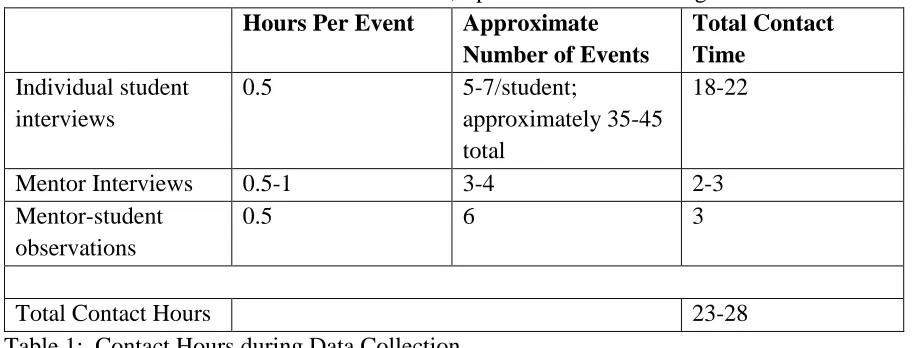
As the students’ project work occurred over a significant time interval, it was
necessary to interview the students over a period of several months, with interviews spaced
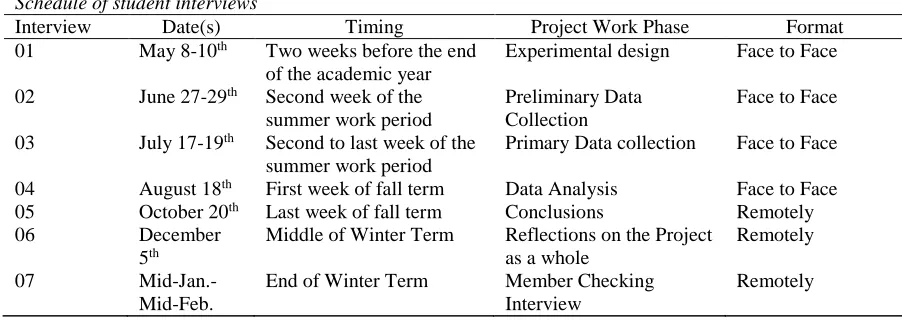
out approximately every 4-6 weeks. The interviews were timed so that they corresponded
with specific phases of the project (Table 2 lays out the interview scheduling), and occurred
at a time of convenience for the students. The final interview provided an opportunity for the