A
Reliable Image Processing based
Agri-Products Defect Detection, analysis and Sorter
System
Venkatesh Anand.S
[1],
Lokeshwaran.R
[2],
Avinash.V
[3]U.G Student,Department of Mechatronics Engineering, Sri Krishna College Of Engineering and Technology,
Coimbatore, India[1]
U.G Student, Department of Electronics and Communication Engineering, SNS College of Technology, Coimbatore,
India[2]
U.G Student, Department of Mechatronics Engineering, Sri Krishna College of Engineering and Technology,
Coimbatore, India[3]
ABSTRACT: Fruits and vegetables are majorly consumed in India and India ranks as the second largest producer of fruits in the world. But the major problem concerned with the post harvest handling is the online sorting according to their features. Manual sorting is a labour intensive and time consuming process whereas automatic recognition of quality is unfeasible to small and medium scale producers due to the high degree of complexity involved in understanding, operating and maintaining the currently available systems. This project aims at developing a simple and easy- to-operate automatic sorting system based on digital image processing for defect detection and sorting. The sorting is based on the features extracted from the images by different image processing techniques. The quality of fruits are frequently referred to its color, firmness and bruises and these form the relevant sorting parameters for classifying the agro-products on ripeness, decaying and growth defects respectively. Results show that the products were successfully sorted.
KEYWORDS: Image processing, Sorting, Fruit Images, Fruit Recognition, Texture, Image Analysis
I. INTRODUCTION
Agriculture plays an important role in the economic development of India. As compared with the development in electronic and automobile sector, development in agricultural sector is very slow. Hence there is a need to come up with some novel techniques so as to fore front the agricultural sector again. Fruits and vegetables production and related activities face significant issues which are closely associated to the lack of appropriate technology. As vegetables play vital role in day to day life, grading of vegetables is necessary in evaluating agricultural produce, meeting quality standards and increasing market value. It is also helpful in planning and packaging. A recognition approach for 2D fruit images is proposed, which combines color-based, shape-based, and size-based methods in order to increase the accuracy of the recognition result. System recognizes provided 2D query fruit image by extracting feature values. Proposed system is developed to research on pattern recognition system, especially on fruits spherical pattern recognition and classification system. In this system, a pattern recognition system is designed that is combination of three different features together, including color, shape, and size to perform sequential pattern classification.
II. RELATED WORK
image contents descriptor which is able to describe the low level visual features or contents of the fruit images. The most popular analysis techniques that have been used for both recognition and classifications of two dimensional (2D) fruit images are color-based and shape-based analysis methods. However, different fruit images may have similar or identical color and shape values. Hence, using color or shape features analysis methods are still not robust and effective enough to identify and distinguish fruits images.
Handling (post harvest) process of fruits is completed in several steps: washing, sorting, grading, packing, transporting and storage. The vegetables sorting and grading are considered the most important steps of post harvest handling. Product quality and quality evaluation are important aspects of vegetable production. Sorting of agri-based-products has been an issue due to the sheer volumes handled and the delicate nature of the fruit. Manual sorting is the most common method for sorting of fruits. The following problems emerge in quality control carried out by humans: high labour costs, labour fatigue, inconsistency and low precision due to various factors such as variations in ambient light intensity, difference in personal perception of quality and scarcity of trained labour. This project aims at developing an easy to operate, efficient system for sorting based on image processing algorithms. The advantages of this technique include non destructiveness, accuracy and consistency. Automation of quality control is highly significant because saving time and expenses is always a necessity in industrial applications.
The important objectives of the project are
1. To develop a machine vision system using image processing algorithms for detecting defects in
agri-based-products.
2.
To develop decision making algorithm to sort the agri-based-products based on image processing results.3. To develop a mechanical segregator using control algorithms to collect the product in respective
collectors.
4. To manufacture a material handling system to aid process automation.
5.
To integrate the above mentioned systems and develop a sorting machine that is quick and easy tooperate.
III. METHODOLOGY
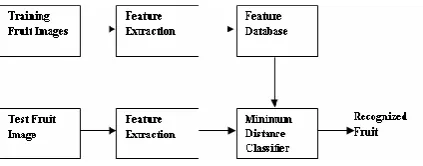
The proposed Fruit recognition system, shown in Figure 1, need a change in the color space of the images, in order to obtain one channel containing the luminance information and two other channels containing chrominance information. The HSV representation is often selected for its invariant properties. The hue is invariant under the orientation of an object with respect to the illumination and camera direction and hence more suited for object retrieval. Texture features are computed from the luminance channel ‘V’, and color features are computed from the chrominance channels ‗H’ and
‗S’ [14]. The component which corresponds to brightness of the color (V) is decomposed using Discrete Wavelet
Transform [15-17] and the co-occurrence matrix is constructed from the approximation sub-band by estimating the pair wise statistics of pixel intensity.
Figure 1: Fruit Recognition System
The use of the co-occurrence matrix [18,19] is based on the hypotheses that the same grey-level configuration is repeated in a texture. Further, co-occurrence features such as contrast, energy, local homogeneity, cluster shade and cluster prominence are calculated from co-occurrence matrix C(i,j), derived for transformed sub-bands and stored in the features library. There exist 5 co-occurrence features i.e., texture features for an image. Statistical features such as
chrominance or color statistical features for an image. Thus a total of 13 features characterize one fruit image. The feature extraction process is illustrated in Figure 2.
Figure 2: Feature Extraction
Primarily the system requirements are listed down based on the application. Then a design concept is created to develop a system that meets the requirements and it is refined to attain a technically and economically feasible design. The system specifications are extracted from the listed requirements corresponding to the final design are done. The part drawings and assembly drawings are drawn using a software tool for the mechanical parts of the system. The electronic circuits are created by circuit simulation software and the programs required to control the system are also developed in a feasible programming platform. The raw materials and the other required components were purchased. Manufacturing of the mechanical parts were carried out using production lathes and sheet metal work tools. The pneumatic control circuit and the electronic control circuits were assembled and their working was tested. The mechanical systems were assembled and necessary interfacing was done to ensure the proper working of the system.
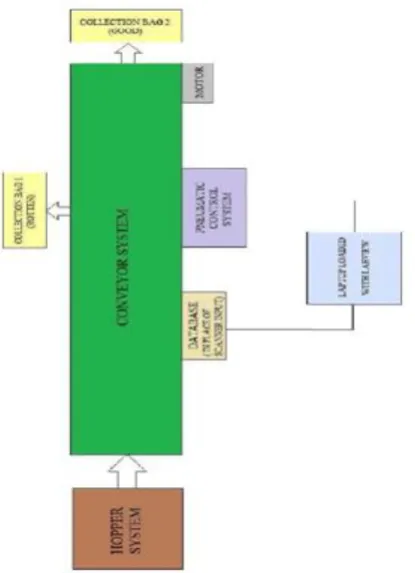
An equipment depicting the various systems and components associated with the proposed agri-based-products sorter is presented below.
IV. RESULTS AND DISCUSSION
Data Set
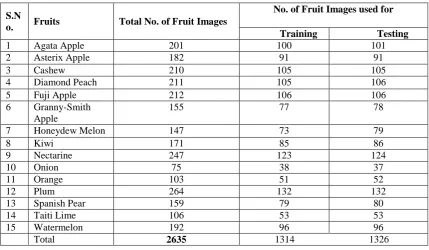
The Supermarket Produce data set comprising 15 different categories: Plum, Agata Potato, Asterix Potato, Cashew, Onion , Orange , Taiti Lime , Kiwi , Fuji Apple, Granny-Smith Apple , Watermelon, Honeydew Melon, Nectarine, Williams Pear and Diamond Peach ; totalizing 2633 images are used for experimental purpose. Fig. 3 depicts some of the classes of the data set. These fruit images are divided into training and testing set, where 50% of the fruit images from each group are used to train the system and the remaining images serves as the testing set. The number of images used for training and classification for each type of fruits is shown in Table I.
Fig. 4 shows an example of Kiwi and Granny-Smith Apple categories with different lighting. The differences are due to illumination, no image pre-processing was performed. The Supermarket Produce data set also comprises differences in pose and in the number of elements within an image.
Figure 4: Extracting Region of Interest from the Image
1. The input fruit image is converted to HSV colour space.
2. Perform thresholding operation on the S component, since S is much less sensitive to lighting variation. 3. Close small holes using the Closing morphological operator with a disk structuring element.
4. Find the area of the Region of Interest from the binary image.
Figure 5: Illumination Differences With in Categories
Figure 6: Variability on Number of elements: Plum
All of the images were stored in RGB color-space at 8 bits per channel. The images were gathered at various times of the day and in different days for the same category. These features increase the data set variability and represent a more realistic scenario. Note that there are variations in the pose of the plum‘s plastic repository. In addition, Fig. 6 shows the variability in the number of elements within an image.
Table 1: List of Images in Database
S.N
o. Fruits Total No. of Fruit Images
No. of Fruit Images used for
Training Testing
1 Agata Apple 201 100 101
2 Asterix Apple 182 91 91
3 Cashew 210 105 105
4 Diamond Peach 211 105 106
5 Fuji Apple 212 106 106
6 Granny-Smith
Apple
155 77 78
7 Honeydew Melon 147 73 79
8 Kiwi 171 85 86
9 Nectarine 247 123 124
10 Onion 75 38 37
11 Orange 103 51 52
12 Plum 264 132 132
13 Spanish Pear 159 79 80
14 Taiti Lime 106 53 53
15 Watermelon 192 96 96
Total 2635 1314 1326
The role of color descriptors has been demonstrated to be quite remarkable in many visual inspection tasks. In some other tasks, texture measurements are needed because of unevenly colored or achromatic surfaces. In many applications, color and texture must be combined to achieve good performance. At the same time, the computational complexity of the methods must be kept as low as possible.
The fruit images are converted to HSV color space and the Statistical features such as Mean, Standard Deviation,
Skewness and Kurtosis are derived from H and S components. Hence there will be 8 color statistical features for an
image. The V component is subjected to one level decomposition using Discrete Wavelet Transform and the
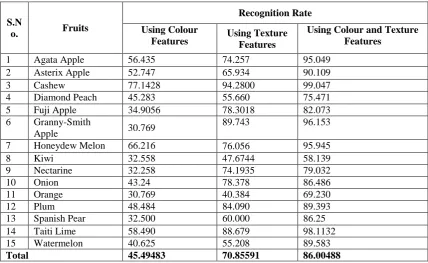
the Co-occurrence matrix constructed from the approximation sub-band. There exist 5 co-occurrence features for an image. First, the fruit recognition system is evaluated with color and texture features individually. With the set of 8 statistical features the recognition rate obtained for the individual fruit images.
S.N
o. Fruits
Recognition Rate Using Colour
Features Using Texture Features
Using Colour and Texture Features
1 Agata Apple 56.435 74.257 95.049
2 Asterix Apple 52.747 65.934 90.109
3 Cashew 77.1428 94.2800 99.047
4 Diamond Peach 45.283 55.660 75.471
5 Fuji Apple 34.9056 78.3018 82.073
6 Granny-Smith
Apple 30.769
89.743 96.153
7 Honeydew Melon 66.216 76.056 95.945
8 Kiwi 32.558 47.6744 58.139
9 Nectarine 32.258 74.1935 79.032
10 Onion 43.24 78.378 86.486
11 Orange 30.769 40.384 69.230
12 Plum 48.484 84.090 89.393
13 Spanish Pear 32.500 60.000 86.25
14 Taiti Lime 58.490 88.679 98.1132
15 Watermelon 40.625 55.208 89.583
Total 45.49483 70.85591 86.00488
Table 2: Results of Fruit Recognition System
V. CONCLUSION
The use of computers to analyze images has many potential applications for automated agricultural tasks. But, the variability of the agricultural objects makes it very difficult to adapt the existing industrial algorithms to the agricultural domain. The proposed method can process, analyze and recognize fruits based on color and texture features. In order to improve the functionality and flexibility of the recognition system shape and size features can be combined together with color and texture features. Further, by increasing the number of images in the database the recognition rate can be increased. This algorithm can be used for smart self service scales.
VI. ACKNOWLEDGMENT
The authors are grateful to acknowledge the support from the faculty of our institutions. The authors are expressing their sincere thanks to the management and principal of our colleges for their constant encouragement and support.
REFERENCES
[1] SapanNaik and Dr. Bankim Patel, ―Usage of Image Processing and Machine Learning Techniques in Agriculture - Fruit Sorting‖, CSI Communications, October 2013.
[2] Jyoti A Kodagali and S Balaji, ―Computer Vision and Image Analysis based Techniques for Automatic Characterization of Fruits – a Review‖, International Journal of Computer Applications (0975 – 8887), Volume 50 – No.6, July 2012.
[3] Zhang, Y., Yin, X., Zou, X., & Zhao, J. (2009). On-line sorting maturity of cherry tomato by machine vision. International Federation for Information Processing, 295, 2223-2230.
[4] Syahrir, W. Md., Suryanti, A., & Connsynn, C. (2009). Color grading in tomato maturity estimator using image processing technique. 2nd IEEE International Conference, 276-280.
[6] Jovitha Jerome, ―Virtual Instrumentation‖ , 2010
[7] Patil S P, ―Machine system design‖, Jaico publishing house, 2012 .
[8] Alfatni MS, Shariff ARM, Abdullah MZ, Ben Saeed OM, Ceesay OM, 2011. Recent methods and techniques of external grading systems for agricultural crops quality inspection — Review. Int J Food Eng 7(3): art. no. 10. doi:10.2202/1556-3758.1932.
[9] Asadollahi H, Kamarposhty MS, Teymoori MM, 2009. Classification and evaluation of tomato images using several classifier. Computer Science and Information Technology - Spring Conf IACSITSC ‗09, pp. 471-474.
BIOGRAPHY
VENKATESH ANAND.Spursuing B.E. final year Mechatronics Engineering at Sri Krishna college of Engineering and Technology, Coimbatore. His area of interests are machine and design, automation and automotive electronics.
LOKESHWARAN.R pursuing B.E final year Electronics and Communication Engineering at SNS college of technology, Coimbatore. His area of interests are circuit designing, communication and digital image processing.