AN
ANALYSISOF
S E E D L I N G M U T A N T S ( S P O N T A N E O U S ,ATOMIC
BOMB-RADIATION-, A N D X RAY-INDUCED)I N BARLEY A N D DURUM W H E A T 1 C. C, MOH AND LUTHER SMITH
Department of Agronomy, State College of Washington, Pullman, Washington
Received December 11, 1950
A
from
G E N E mutation may be defined as a change in or at a single gene locus, although in practice it may be difficult to distinguish such mutations grosser changes involving segments of chromosomes containing more than one gene. Such gene mutations arise spontaneously, o r they may be arti- ficially induced by heat or chemical treatments, aging, or various kinds of ionizing radiations, Most mutations in the strict sense should be transmitted in approximately normal, theoretical ratios. On the other hand, grosser changes, involving chromosomal aberrations, should tend to modify the transmission of affected chromosomes-resulting in abnormal ratios of genes associated with them.
The present studies involve seedling mutant characters of barley and durum wheat. Most of the mutants were induced by X ray and atomic bomb irradia- tion, but in barley a small number of mutants of spontaneous origin was available for comparison.
The observations make possible further comparisons between the genetic effects of X radiation and of atomic bomb-induced radiation, and to some extent, between mutants from these two sources of irradiation and spon- taneously-occurring mutants., Also a considerable body of information was obtained on segregation ratios of individual mutants as well as different types of mutants, which throws some light on whether or not the mutations behaved like gene or " point " mutations.
REVIEW OF LITERATURE
STADLER (1930) reported that about 90 percent of X ray-induced muta- tions in barley were found in the seedling stage, and were chiefly chlorophyll abnormalities. Most of these mutant characters were lethal or unfavorable to growth. The proportion of mutant plants was less than 25 percent in the segregating head progenies of the Xa* generation, and the proportion of heterozygous plants was less than 50 percent in the same generation. In later generations, segregation ratios approached normal.
1 Published as Scientific Paper No. 960, Washington Agricultural Experiment Stations, This study was supported in part by a grant from the AMERICAN CANCER SOCIETY. The writers wish to express their thanks to h h s . H E ~ C A GUNTHARDT for enthusiastic assistance in obtaining data on the large number of progeny tests involved in this study.
*
Plants grown from x-rayed seeds are referred to as the XI. Progenies of these plants are the XI generation; the next generation is the XS, etc.GENETICS 36: 629 November 1951.
630 C. C. MOH AND LUTHER SMITH
GUSTAFSSON (1938, 1941, 1946, 1947), in his extensive X radiation ex- periments on barley, obtained results similar to those of STADLER (1930). H e noted that some of the lines had a deficiency, and some had an excess of recessives. I t was postulated ( 1941 ) that the aberrant segregations resulted from gametic elimination.
The reader is referred to the previous reports by SMITH (1950) for the results of earlier studies on the mutants used in the present tests. This pub- lication also cited several reports on the biological effects of the Test Able atomic bomb. The evidence indicated that atomic bomb-induced radiations and X rays produce genetic changes that are essentially identical as to type. Observations on the X3 generation of these mutants were presented in some- what greater detail by MOH (1950).
The reader is also referred to the review paper by SMITH (1951) for further literature on genetic, irradiation, and other studies with barley. In general it seems that mutants in barley, both induced and spontaneous, behave as simple recessives, although there have been a few exceptions.
MATERIAL AND METHODS
The preseut study involved tests on the X3 and X4 generations of X ray- induced and atomic bomb-induced mutants in Trebi barley and Carleton durum wheat. Some spontaneous mutants were available in the barley for comparison with the radiation-induced mutants.
Samples of 100 seeds were taken from X2 plants which had been shown by previous greenhouse tests to be heterozygous for a mutation. These seed samples were planted in rows which were two feet long and two inches apart. Similar mutants were planted together for convenience of comparisons.
When the seedlings were about one cm in height, observations were re- corded, especially on those mutants most likely to change in appearance. Notes were taken at intervals of one to three days until the seedlings were about 12 cm tall (about the time the second leaf appeared). Then the number of mutant seedlings, and the total number of seedlings in a row (plant prog- eny) were counted.
The X4 tests were much the same as described above for the Xs, except that the samples did not all contain 100 seeds. This was due to the fact that some weak or partially sterile plants were tested.
The nuinber of independent mutants tested in Xa was less than in X4, be- cause, unless an X2 plant had enough seeds for a 100-seed greenhouse plant- ing in addition to the number needed for a planting in the field for later generation studies, the mutant was not scored in X3.
RESULTS O F X3 A N D X4 SEEDLING PROGENY TESTS
T y p e s of seedling mutant characters
SEEDLING MUTANTS 63 1 tinuous series of mutant chlorophyll colors, and any grouping of them must be arbitrary. SMITH (1950) classified the seedling mutants of barley and durum wheat into six major types : White, yellow-green, yellow, virescent, shrivel, and miscellaneous. These mutant types were retained in the present study.
Relation of percentage of kecessives to or@in of mutants and types of mutants
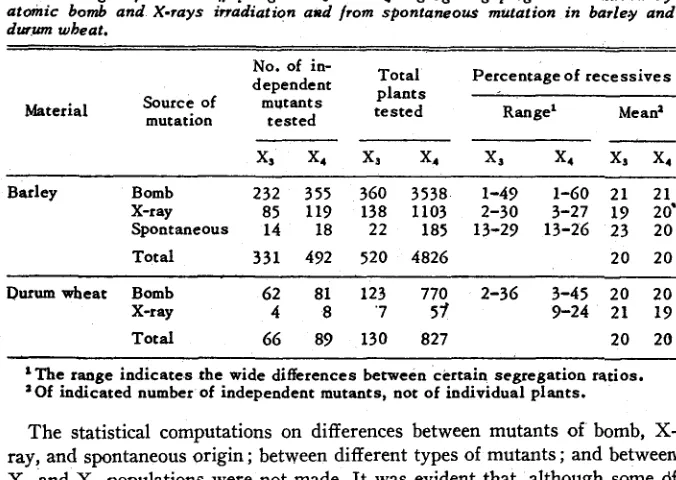
A total of 397 independent mutants represented by 650 heterozygous plants were tested for the proportions of normal and mutant progeny in X3 (table 1 )
.
Of these 397 mutants, 294 were bomb-induced ; 89 were X ray-induced ;and 14 were of spontaneous origin. A total of 581 independent mutants repre- sented by 5,653 heterozygous plants were tested for segregation ratios in X1 (table 1 ) . Of these 581 mutants, 436 were bomb-induced#; 127 were X ray- induced ; and 18 were of spontaneous origin.
TABLE 1
Percentage of mutant offspring in X5 and X , segregating progenies induced by atomic bomb and X-rays irradiation and from spontaneow mutation in barley and durum wheat.
Total Percentage of recessives No. of in-
dependent *Iants
Material Source mutation Of mvtants tested tested Range' Mead
-
x,
x,
x3x4
x 3x,
x, x,
~
Barley Bomb 232 355 360 3538 1-49 1-60 21 21
X-ray 85 119 138 1103 2-30 3-27 19 20'
Spontaneous 14 18 22 185 13-29 13-26 23 20
Total 331 492 520 4826 20 20
Durumwbeat Bomb 62 81 123 770 2-36 3-45 20 20
X-ray 4 8 '7 5 1 9-24 21 19
Total 66 89 130 827 20 20
'The range indicates the wide differences between certain segregation ratios. 'Of indicated number of independent mutants, not of individual plants.
632 C . C . MOH AND LUTHER SMITH
TABLE 2
for m u t a n t s from t h e three s o u r c e s of mutation.
Percentage of emergence Source of
mutant
P e r c e n t a g e of s e e d l i n g emergence in X , progeny t e s t s of p l a n t s h e t e r o z y g o u s
Total Material
60-69 70-79 80-89 90-1.00 number
Barley Bomb 2 12 63 283 360
X-ray 5 16 117 138
Spontaneous 1 21 22
Durum wheat Bomb 2 11 110 123
X-ray 7 7
Total 2 91 538 650
Percent 0.3 l 9 2.9 14.0 82.8
Relation of percentage of recessives to seed germination
Of the 650 heterozygous plants tested in X3 more than 95 percent gave higher than 80 percent germination (table 2). There were 19 of the 650 plants that gave 70-79 percent of seedling emergence. This might be due to the unfavorable growing conditions in the greenhouse, as shown by the fact that three plants, with enough seeds for duplicate plantings, germinated more than 90 percent in the second planting as compared with 70-79 percent in a previous planting. Seeds of only two plants had lower than 70 percent germi- nation. Unfortunately there was insufficient seed of these two plants for duplicate tests. Therefore, failure of seed germination was probably not an important factor in the segregation ratios as a whole, although it was in the case of certain individual mutants. For this reason, the data on the per- centages of seedling emergence in the X4 progenies are not presented here.
TABLD 3
A grouping of mutants on t h e b a s i s of t h e p e r c e n t a g e of r e c e s s i v e progeny in X , a n d X4 populations.
Percentage of recessives Total
x,
x4
mutants<16% 16-34% >34% <16% 16-34% >34% X3 X4
number of
Material Source Of
mutant
Barley Bomb X-ray Spontaneous
Total
Percent mutants
Durum Bomb wheat X-ray
49 178 5 65 284 6 232 355
21 64 28 90 1 85 119
2 12 5 13 14 18
72 254 5 98 387 7 331 492
21.8 76.7 1.5 19.9 78.7 1.4
18 43 1 17 63 1 62 81
4 3 5 4 8
Total
Percent 27.3 71.2 1.5 22.5 76.4 1.1
1 66 89
mutants 18 4 7 1 20 68
SEEDLING MYTANTS 633
Proportion of inutants which segregated in high or low frequencies
Theoretically, a single recessive gene change would give a ratio of 3 normal to 1 mutant seedling in the progeny of a heterozygous plant, i.e., 25 percent of mutants. I n table 3 mutants segregating in the range from 16 to 34 percent are not rejected by the
x2
test for goodness of fit to the 3 : 1 ratio based on 100-seedling populations. There was a considerable number of the mutants tested which did not fall in the range of 16-34 percent. In barley there were 77 of 331 mutants (23.3 percent) with segragation ratios rejected by thex2
test for goodness of fit to the 3 : 1 ratio in X3, and 105 of 492 mutants (21.3 percent) were rejected in X4. In durum wheat there were 19 of 66 mutants (28.8 percent) with segregation ratios rejected by thex2
test for goodness of fit to the 3: 1 ratio in X3, and 21 of 89 mutants tested (23.6 percent) were rejected in X4. Possible explanations for these results will be considered in the discussion.TABLE 4
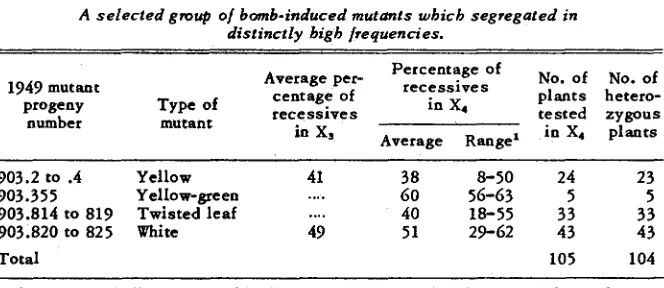
A selected group o/ bomb-induced mutants which segregated in distinctly high /re quen ci es.
No. of No. of plants hetero- tested zygous in X4 plants Percentage of
r e c e s s i v e s Average per-
1949 mutant
progeny Type of r e c e s s i v e s centage Of in X4
number mutant
in
''
Average Range'903.2 to .4 Yellow 41 38 8-50 24 23 903.355 Yellow-green
....
60 56-63 5 5 903.814 to 819 Twisted leaf....
40 18-55 33 33 903.820 to 825 White 49 51 29-62 43 43Total 105 104
The range indicates the wide differences between certain segregation ratios. On the b a s i s of a single recessive factor segregation, the
X
'
value for the rest o f significance of difference between the observed and expected numbers of hetero- zygous plants = 49.5. The P value is much less than 0.01.Percentage of recessives in a selected group of barley mutants which segregated in distinctly high or low frequencies
634 C. C. MOH AND LUTHER SMITH
TABLE 5
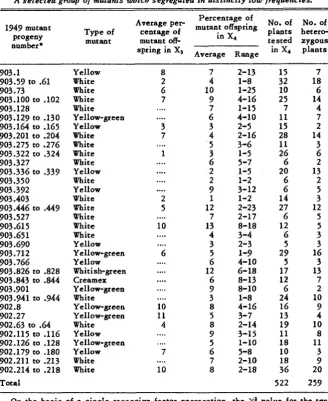
A selected group of mutants which segregated in distinctly low frequencies.
No. of No. of plants hetero- Average pep mutant offspring
tested zygous spring in XI in X4 plants
Percentage of
in X4
Average Range Type of centage of
mutant mutant off-
1949 mutant progeny number*
903.1 903.59 to .61 903.73
903.100 to .lo2 903.128 903.129 to .130 903.164 to .165 903.201 t o .204 903.275 to .276 903.322 to ,324 903.327
903.336 to .339 903.350 903.392 903.403 903.446 to .449 903.527 903.615 903.65 1 903.690 903.712 903.766 903.826 to .828 903.843 to .844
903.901 903.941 to .944 902.8
902.27 902.63 to .64
902.115 to .116 902.126 to .128 902.179 to .180 902.211 to .213 902.214 to .218
Total Yellow White White White White Yellow-green Yellow White White White White Yellow White Yellow White White White White White Yellow Yellow-green Yellow Whitish-green Creamex Yellow-green White Yellow-green Yellow-green White Yellow Yellow-green Yellow White White
8 7
2 4
6 10
7 9
....
7....
63 3
7 4
....
51 3
....
6....
2....
29
2 1
5 12
....
710 13
....
4....
36 5
....
6....
12....
6....
93
10 8
11 5
4 8
9 5
7 6
....
710 8
_...
....
....
....
2-13 1-8 1-25 4-16 1-15 4-10 2-5 2-16 3-6 1-5 5-7 1-5 1-2 3-12 1-2 2-23 2-17 8-18 3-4 2-3 1-9 4-10 6-18 8-13 8-10 1-8 4-16 3-7 2-14 3-1s 1-10 5-8 2-10 2-18 15 32 10 25 7 1 1 15 28 11 26 6 20 6 6 14 27 6 12 6 5 29 5 17 12 6 24 16 13 19 11 18 10 18 36 522 7 18 6 14 4 7 2 14 3 6 2 13 2 5 3 12 5 5 3 3 16 3 13 7 2 10 9 4 10 8 11 3 9 20 259 ~~ ~On the basis of a single recessive factor segregation, the
x'
value for the test of significance of the diEerence between observed and expected numbers of hetero- zygous plants = 68.3. The P value is much less than 0.01.*Mutant numbers of 903 are from bomb irradiation, and of 902 from X-ray irradi- ation.
DISCUSSION
SEEDLING MUTANTS 635
Although there were no marked differences between mutants from the three sources (bomb, X rays, spontaneous) and bctween X3 and X4, there were decided differences in the segregation ratios of mutants from the same source (cf. tables 1 and 3). This phenomenon will be considered in some detail.
Theoretically, a point mutation would give rise to 25 percent of recessives in a segregating population. Mutant segregates forming less than 16 percent or more than 34 percent of the progeny fall outside two standard deviations from the theoretical 25 percent on the normal curve. These upper and lower limits of segregation ratios were calculated by the
2
test based on a 100-plant population. There are a number of possible explanations for such deviations from the expected 3 : 1 segregation ratios that may be considered : (1) Nor- mal chance variations ; (2) duplicate genes (15 : 1 ratio) and complementary genes (9 :7
ratio) ; ( 3 ) low germinability of the XS seeds; and (4) unequal transmission of the normal and mutated chromosomes.The first possibility is based on the statistical point of view. It could happen that some heterozygous plants segregated in simple Mendelian ratios and might by chance give, unexpected proportions of recessives. The normal probability is that such cases would constitute less than
5
percent of the total mutants tested. However, there were over 20 percent of the barley mutants which were tested that gave lower than 16 percent or higher than 34 percent of recessive offspring in X3 and X4. In durum wheat about 25 percent of the mutants showed similar variations from theoretical ratios. It is extremely un- likely that all these aberrant segregation ratios were due to normally-expected extreme chance deviations.Considering the second possibility, duplicate factors would yield a 15 : 1 ratio (6.25 percent> of mutant offspring) and complementary factors would yield a 9 :
7
ratio (43.75 percent of mutant offspring). In diploid species, duplicate genes are not uncommon. In polyploid species, such as durum wheat, it is probable that many segments of chromosomes of a genom, or functions of genes, are duplicated in the other genom. The nature of gene interaction would determine the segregation ratio.636 C. C. MOH AND LUTHER SMITH
A third possibility is that low germination of certain classes of seeds might be a cause for the aberrant segregations. It was evident in table 2 that the percentage of germination of X3 seeds was high. Most of the progenies with aberrant ratios had more than 90 percent seedling emergence ; all had higher than 80 percent seedling emergence. It seemed, therefore, that failure of seeds to grow could not be considered as the important factor influencing the ratios in this study. This was further borne out by the Xq, although these data were not analyzed in detail for this purpose.
A fourth possibility is that the aberrant segregation ratios could result from unequal transmission of the normal and mutated chromosomes. A mutant gene might have, as a result of pleiotropism, an effect on the com- petitive ability of the spore receiving it. That effect might be to give the spore an advantage in fertilization-in which case the gene would be transmitted in higher than normal frequency. On the other hand, and more probably, the gene might have a deleterious effect, resulting in a reduced transmission of the affected chromosome. Chromosomal aberrations, such as deficiencies and duplications, have been shown to change the proportion of recessives by modi- fying the transmission of genes associated with them (cf. SMITH 1948).
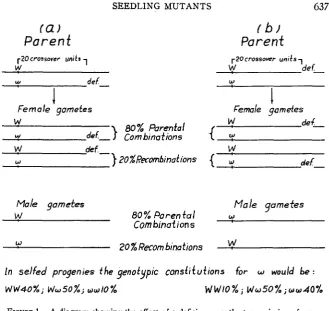
If both a genic change and a deficiency were induced in the same chromo- some, and the microspores were non-functional because of the deficiency, four kinds of female and two kinds of functional male gametes could be produced- including those resulting from crossing over (see fig. 1). Under these con- ditions, a reduced transmission of the mutant gene might result. On the other hand, if the genic change and the deficiency were induced in different chromo- somes of the same homologous pair, a high proportion of the offspring might be mutants. These two cases are diagrammed in figure 1.
Cases more or less extreme than the two diagrammed in figure 1 could be postulated. Thus, if there were no crossing over between the mutated locus and the deficiency, there would be two kinds of female and only one kind of functional male gamete. In case ( a ) of figure 1, mutant gene w would be eliminated entirely by the deficient male gametes in each generation, and could be transmitted only by the female gametes. Since W is dominant to w, there would be no possibility of obtaining a homozygous recessive. All the prog- enies would be phenotypically normal and equally divided among the W W
and
W w
genotypes.SEEDLING MUTANTS
(a)
P a r e n t
637
r b i
Parent
W de[-
Female gametes
w
00% %rental
w de{-) Combinations
w
def.-w ZO%Recombinations
J
,-20crossover units
-,
w
def-w
+
Female gamefes
w
de+-w
t r
{ r
def-Male gametes Male gametes
w
ao%
Parental Uw
Com binaf ion s
20% Recombinations
W
In selfed progenies the
genofypic
constitutions for w would be :W W 4 0 % ; WwSO%j ~ ~ 1 0 % W W I O % j W ~ 5 0 % j w w 4 0 %
FIGURE 1.-A diagram showing the effect of a deficiency on the transmission of a gene. ( a ) Assuming that a deficiency and a gene mutation ( W + w ) were induced in the same chromosome, and that the deficient male gametes were non-functional, there would be four kinds of functional female gametes and two kinds of male gametes. The proportion of functioning male gametes with mutant gene w would be reduced unless recombination approximated 50 percent. The proportion’ would be dependent on the crossover value. If there were 20 percent crossing over, as illustrated above, the propprtion of W to w
would be 4 : 1 among male gametes, thus giving 10 percent homozygous recessives. (b) If the induced gene mutation and the deficiency were on homologues instead of the same chromosome, the ratio of W to w would be 1 : 4 among male gametes, giving
40 percent homozygous recessives.
Four mutants which gave a high proportion of heterozygous plants and a high percentage of recessive offspring (cf. table
4)
rather closely fit the ex- pectation referred to in the preceding paragraph. Of 105 Xq plants, 104 wereheterozygous and almost all gave a high proportion of recessive progeny. One heterozygous plant gave a low percentage (8.2 percent) of recessive progeny. Another plant was homozygous normal. These two plants may have represented recombinations between the mutated gene and the postulated aberration.
638 C. C. M O H AND LUTHER SMITH
in high frequencies, it seems likely that a considerable proportion of them were the result of, or closely associated with, deficiencies or other aberrations, or possibly with pleiotropic effects that reduced the traqsmission of chromo- somes containing the mutant genes.
As pointed out by STADLER ( 1933), genic changes and certain chromosomal aberrations (deficiencies) cannot always be distinguished. GOODSPEED ( 1930) found that pink-flowered plants in Nicotiana tabacum, which arose as a re- sult of irradiation of carmine-flowered plants, resulted from a deletion involv- ing the chromosome segment containing the carmine gene. Genetically i t appeared to be a gene mutation from carmine to pink. A number of mutant characters in Drosophila, such as “ Notch ” and “ Minute,” have been shown
to be the result of segmental deficiencies. MULLER (1935) found that mutants with a two-gene deficiency (yellow and achaete) arose from crossing over between two inverted X chromosomes in Drosophila. Individuals having those deficiencies were extreme yellow and achaete types. MOHR (1938), and MOHR and MOSSIGE (1942) also reported similar phenomena in Drosophila. Gametophytes containing an aberrant chromosomal complement are not necessarily non-functional, although the microgametophytes are usually af- fected more than the corresponding megagametophytes. MCCLINTOCK ( 1931) demonstrated a number of viable deficiencies in maize, and also found that homozygous deficient tissue in corn could be viable (1938). BURNHAM
(1932) noted a plant with a reciprocal interchange which had approximately
25 percent of aborted pollen, instead of the usual 50 percent observed in plants heterozygous for other interchanges. One of the interchanged segments comprised only a few chromomeres of the satellite-chromosome. STADLEK (1933) studied a deficiency in maize involving a terminal or nearly terminal segment of Chromosome 10. The deficient chromosome complement was transmitted through the female gametophyte. The complete failure of trans- mission of deficient chromosome complements through the pollen was proba- bly due to the fast that the second nuclear division was delayed; or to the fact that deficient pollen grains shrivelled quickly, possibly before fertilization was completed.
SEEDLING MUTANTS 639
SUMMARY
1. The study involved atomic bomb- and X ray-induced, and spontaneous seedling mutants in barley and durum wheat. Progeny tests were made of 650 Xz plants, representing 397 independent mutants ; and of 5,653 X3 plants, representing 581 mutants.
2. The mean percentages of recessive offspring in the X3 progenies of het- erozygous plants were: In barley, 1) 21 percent for 232 bomb-induced mu- tants; 2) 19 percent for 85 X ray-induced mutants; 3 ) 23 percent for 14 spontaneous mutants. In durum wheat, 4 ) 20 percent for 62 bomb-induced mutants; 5) 21 percent for 4 X ray-induced mutants. I n X4 progenies the corresponding values were : 1 ) 21 percent for 355 bomb-induced mutants ;
2) 20 percent for 119 X ray-induced mutants; 3) 20 percent for
18
spon- taneous mutants; 4 ) 20 percent for S l bomb-induced mutants; and 5) 19 percent for 8 X ray-induced mutants, respectively.3. Thus, the difference between mutants from the bomb, X ray, or spon- taneous sources were not large enough to be of any apparent biological im- portance. There were also no clear differences in the transmission of mutants in the X3 and X4 generations. This was generally true for the mutants indi- vidually, as well as collectively.
4.
There were no distinct differences in the segregation ratios of the six types of mutants (white, yellow-green, etc.)-with the possible exception of the “ dwarf white,” a sub-group of the white mutants in barley. The meanpercentage of dwarf white seedlings in the progeny of heterozygous plants from both bomb- and X-ray-irradiated material was 10 percent. This consis- tently low transmission of dwarf white mutants may be accounted for by the fact that only a few (10 in X3 and 13 in X4) mutants of the type were avail- able for testing. Otherwise there is no ready explanation for the result.
5.
More than 20 percent of the mutants tested in X3 and X4 segregated in ratios significantly different from the theoretical 3: 1. Most of the mutants segregating in aberrant ratios (34 out of 38 which were considered) were associated with a low transmission of the mutated gene. These results were considered in some detail in the discussion.6. Germinatio~ in most of the progeny tests was over 90 percent. Varia- tions in germination did not seem to be associated with the percentage of recessive segregates except with certain individual mutants. Hence, ap- parently the aberrant segregations were not the result of differential seed germination per se.
7.
It was concluded that chromogomal aberrations (possibly deficiencies) associated with a considerable portion of the mutations, or pleiotropic effects .of the mutant genes, best accounted for the fact that over 20 percent of the mutants tested segregated in ratios that deviated significantly from the theo- retical 3: 1. The results could readily be accounted for‘ if it were assumed that a considerable portion of the mutations were in fact deficiencies rather than gene or “ point ” mutations-an hypothesis which is being checked by640 C. C. MOH A N D L U T H E R S M I T H
LITERATURE CITED
BURNHAM, C. R., 1932 An interchange in maize giving low sterility and chain con- GOODSPEED, T. H., 1930 Mutation-The role of quantitative chromosome alteration.
GUSTAFSSON, A., 1938 Studies on the genetic basis of chlorophyll formation and the figurations. Proc. natl. Acad. Sci. 18: 43.5440.
Proc. Fifth Internatl. Bot. Congr. 193-194.
mechanism of induced mutating. Hereditas 24: 33-93.
1941 Mutation experiments in barley. Hereditas 971 225-242.
1946 The origin of albina and xantha mutations in barley. Acta. Radiol. 227: 300-307.
1947
Cytological observations of deficiencies involving known genes, translocations and an inversion in Zea ~ a y s . Missouri Agr. Expt. Sta. Res. Bull. 163. 30 pp.
1938 The production of homozygous deficient tissues with mutant characteristics by means of the aberrant mitotic behavior of ring-shaped chromosomes. Genetics 23:
315-376.
MOH, C. C., 1950 An analysis of seedling mutants (spontaneous, atomic bomb-radiation-, and X-ray-induced) in barley and durum wheat. M. S. thesis, State College of Washington.
MOHR, 0. L., 1938 The third chromosome deficiency vein in Drosophila nzelanogaster. Avhandlinger Utgittar Det Norske Videnskaps-Akademi i Oslo. I. Matematisk- Naturvidenskpelig Klasse, No. 4. 7 pp.
MOHR, 0. L., and J. C. MOSSIGE, 1942 Cytogenetic analysis of the spontaneous 3rd chromosome deficiency vein in Drosofihilu nzelanogaster. Skrifter Utgittar Det Norske Videnskaps-Akademi i Oslo. I. Matematisk-Naturvidenskapdig, Klasse, No. 7. 51 pp.
MULLER, H. J., 1935
SMITH, LUTHER, 1948 A haplo-viable deficiency-duplication from an interchange in Triticum monococcum. Bot. Gat. 108: 258-268.
1950 A comparison of the effects of ionizating radiations from the “test able” atomic bomb and from X-rays on seeds of barley, wheat, and oats. Jour. Hered. 41: 125-130.
1951 Cytology and genetics of barley. Bot. Rev. 17: 1-51 ; 133-202; 285-355. STADLER, L. J., 1930 Some genetic effects of X-rays in plants. Jour. Hered. 21: 2-19.
1933 On the genetic nature of induced mutations in plants. 11. A haplo-viable deficiency in maize. Missouri Agr. Expt. Sta. Res. Bull. 204. 29 pp.
Mutations in agricultural plants. Hereditas 33: 1-99. MCCLINTOCK, B., 1931