Copyright1999 by the Genetics Society of America
The
REG1
Gene Product Is Required for Repression of
INO1
and
Other Inositol-Sensitive Upstream Activating Sequence-Containing
Genes of Yeast
Qian Ouyang, Monica Ruiz-Noriega and Susan A. Henry
Department of Biological Sciences, Carnegie Mellon University, Pittsburgh, Pennsylvania 15213 Manuscript received June 10, 1998
Accepted for publication February 10, 1999
ABSTRACT
A search was conducted for suppressors of the inositol auxotrophic phenotype of the ino4-8 mutant of yeast. The ino4-8 mutation is a single base pair change that results in substitution of lysine for glutamic acid at position 79 in the bHLH domain of the yeast regulatory protein, Ino4p. Ino4p dimerizes with a second bHLH protein, Ino2p, to form a complex that binds to the promoter of the INO1 gene, activating transcription. Of 31 recessive suppressors of ino4-8 isolated, 29 proved to be alleles of a single locus, identified as REG1, which encodes a regulatory subunit of a protein phosphatase involved in the glucose response pathway. The suppressor mutation, sia1-1, identified as an allele of REG1, caused constitutive INO1 expression and was capable of suppressing the inositol auxotrophy of a second ino4 missense mutant, ino4-26, as well as ino2-419, a missense mutation of INO2. The suppressors analyzed were unable to suppress ino2 and ino4 null mutations, but the reg1 deletion mutation could suppress ino4-8. A deletion mutation in the OPI1 negative regulator was incapable of suppressing ino4-8. The relative roles of the OPI1 and REG1 gene products in control of INO1 expression are discussed.
I
N the yeast Saccharomyces cerevisiae the products of the (Hirsch1987), has been identified upstream of all the INO2 and INO4 regulatory genes are responsible structural genes that are regulated in response to inosi-for the transcriptional activation of a large number of tol and choline (Paltaufet al. 1992;Bachhawatet al. structural genes encoding phospholipid biosynthetic 1995). This repeated element, the inositol-sensitive up-enzymes. The structural genes subject to this regulation stream activating sequence (UASINO), contains within it are repressed in response to the phospholipid precur- the CANNTG motif (i.e., 59CATGTG 39) that has been sors, inositol and choline. These enzymes are maximally shown to be the consensus-binding site for bHLH pro-derepressed in the absence of inositol and choline, par- teins (Lassaret al. 1989;Blackwell andWeintraub tially repressed in the presence of inositol alone, and 1990;Fisher et al. 1991). Indeed, the UASINOcore se-fully repressed when both inositol and choline are quence, CATGTG, is identical to the E-box motif re-added to the growth medium (for review, seePaltauf ported byWang and Sul (1997) as the sequence re-et al. 1992;HenryandPatton-Vogt1998). quired for USF binding and insulin regulation in theThe INO2 and INO4 gene products both contain a mammalian FAS promoter.
basic helix-loop-helix (bHLH) domain (Hoshizaki et When a DNA fragment from the INO1 promoter that al. 1990;Nikoloffet al. 1992), which is characteristic includes two copies of the 10-bp UASINOelement is incu-of a family incu-of proteins involved in transcriptional regula- bated with cell extracts prepared from wild-type cells, a tion and cell-type determination. The bHLH domain protein-DNA complex is formed. This complex is absent has been shown to be responsible for protein dimeriza- when the extracts are derived from ino2 or ino4 mutant tion and DNA binding in a number of transcriptional strains (LopesandHenry 1991). The INO2 and INO4 regulatory proteins in mammalian cells. These include gene products have been demonstrated to bind directly the mammalian oncogene cMyc (Murre et al. 1989; to the UASINOsite on the INO1 promoter (Ambroziak Daviset al. 1990;VoronovaandBaltimore1990) and andHenry1994;NikoloffandHenry1994;Schwank the upstream stimulatory factors (USF) that bind to et al. 1995). The ino2 and ino4 mutants were originally the insulin response sequence of the fatty acid synthase isolated on the basis of an inositol auxotrophic pheno-(FAS) promoter (WangandSul 1995, 1997). A 10-bp type (Culbertson and Henry 1975; Donahue and repeated element (consensus sequence: 59 CATGT Henry1981a), which is due to their inability to dere-GAAAT 39), first found in the promoter of INO1 gene press the INO1 gene, encoding inositol-1-phosphate syn-thase (DonahueandHenry1981b;HirschandHenry 1986). Of 12 ino2 and ino4 loss-of-function mutants ex-Corresponding author: Susan A. Henry, Department of Biological
amined by DNA sequencing, 11 have mutations in the
Sciences, Carnegie Mellon University, 4400 Fifth Ave., Pittsburgh, PA
15213. E-mail: [email protected] basic helix-loop-helix region (Nikoloff1993;
ml antimycin A to stimulate anaerobic conditions. Control ziak1994;NikoloffandHenry1994), suggesting the
plates lacked 2-DG.
importance of the bHLH domain in the functioning of
Mutagenesis and isolation of suppressor mutants:Strains
Ino2p and Ino4p. The ino4-8 allele contains a single SH405 (MATaino4-8) and SH406 (MATa ino4-8) were muta-amino acid change from glutamic acid to lysine in the genized with ethyl methanesulfonate (EMS) as previously
de-scribed (CulbertsonandHenry1975) and screened for cells
loop region of the bHLH domain at the amino acid in
that were able to grow in the absence of inositol (I2plates).
position 79 in Ino4p, while ino4-26 has a single amino
Cells were harvested at stationary phase from 5-ml cultures
acid change from threonine to isoleucine at amino acid
grown on YEPD medium, washed twice with 10 ml of
phos-42 in the basic region of the bHLH domain (Ambroziak phate-glucose solution (0.2mNa
2HPO4, 2% glucose, pH 8.0) 1994). The ino2-419 mutation contains lysine in place of and resuspended in 9.7 ml of phosphate-glucose buffer. Cells
were mutagenized by adding 0.3 ml of EMS and incubating
arginine in the loop region at amino acid 273 (Nikoloff
at 308for 30 min for strain SH405 (31% survival) and 20 min
andHenry1994).
for strain SH406 (37% survival). The EMS was inactivated
To identify additional factors involved in regulation
as previously described (CulbertsonandHenry1975) and
of phospholipid biosynthesis and to acquire more infor- appropriate dilutions were made into liquid YEPD medium mation about the regulatory network, we conducted a and spread onto YEPD plates to achieve a density of about 200 viable cells per plate. Approximately 40,000 colonies were
screen for suppressors of inositol auxotrophy in an
screened by replicating to I2and I1plates. ino4-8 strain. We report here the isolation of suppressor
Yeast genetic manipulations: Genetic techniques such as
mutations which proved to be allelic to the REG1 locus. mating, sporulation, and tetrad dissection were carried out The mutations identified in this screen also suppressed using standard methods (Shermanet al. 1978). The potential ino4-26 and ino2-419. However, these suppressor muta- suppressors were colony-purified and the growth phenotype on I2plates was reconfirmed. Candidates were then crossed
tions do not suppress null alleles of either INO4 or INO2,
to the ino4-8 strain of the opposite mating type (i.e., SH405
while a reg1 deletion mutation can suppress the ino4-8
or SH406), and diploids were scored on I2plates to determine
mutation. reg1 mutants have been identified in numer- whether the suppressor mutation was dominant or recessive. ous previous genetic screens (Matsumotoet al. 1983; Diploids having the parental phenotype of inositol auxotrophy NeigebornandCarlson1987;Tunget al. 1992;Naiket indicated the presence of a recessive suppressor while diploids having the suppressor phenotype growth on I2medium indi-al. 1997) designed to identify regulatory loci controlling
cated a dominant suppressor.
such diverse functions as glucose repression, RNA
pro-The sets of recessive suppressors isolated in strains of
oppo-cessing, and proteinase B expression. reg1 mutants also site mating types were crossed with each other, and the exhibit growth and glycogen storage defects (Frederick resulting diploids were tested on I2 plates to estimate the
and Tatchell 1996). Here we demonstrate that the number of complementation groups. Representatives of each complementation group were crossed to the ino4-8 parental REG1 gene product is also involved in the control of
strain and the diploids were sporulated and the tetrads,
dis-the coordinately regulated genes of phospholipid
bio-sected. In many cases, this first cross yielded low sporulation
synthesis. efficiency and/or poor spore viability. A second backcross to
the ino4-8 parental strain, using spore colonies retrieved from the dissection of the first cross of the primary suppressor-bearing strains to an ino4-8 strain, often resulted in higher MATERIALS AND METHODS
sporulation efficiency and better spore viability. Tetrads from the second cross were scored on I2plates to determine the
Strains, medium, and growth conditions:The genotypes and
sources of strains used in this study are listed in Table 1. The segregation of the suppressor phenotype.
Test for Opi2phenotype:The test for the inositol excretion following growth media were used: YEPD (1% yeast extract,
2% Bactopeptone, 2% glucose); complete synthetic medium (overproduction of inositol, Opi2) phenotype has been de-scribed in detail elsewhere (Greenberget al. 1982b;Swedeet [2% glucose, 0.67% Difco Yeast Nitrogen Base without
vita-mins, vitamin mix, supplements (amino acids, uracil, and ade- al. 1992). Briefly, strains to be tested were spotted or replicated onto I2medium, allowed to grow for 2 days, and then sprayed nine);Greenberget al. 1982a,b], minimal synthetic medium
(same as complete synthetic medium but lacking supple- with an indicator strain, which is an inositol auxotroph. Growth of a halo of the indicator strain around a colony ments); drop-out medium (same as complete synthetic
me-dium but lacking a single supplement); sporulation meme-dium indicated inositol excretion (Opi2phenotype). An opi1 mu-tant strain (SH308) and wild type (W303) were used as positive (0.1% yeast extract, 0.05% glucose, 1% KAc). Solid medium
(plates) contained 2.5% agar in addition to the above ingredi- (Opi2) and negative (Opi1) controls, respectively.
Construction ofreg1D::URA3:Anz4.2-kb EcoRI-XbaI frag-ents. Inositol-free (I2) plates contained complete synthetic
medium with no inositol supplement; inositol-supplemented ment from plasmid pUCsrn1::URA3, kindly provided by A. K. Hopper (Tunget al. 1992), was transformed into the diploid (I1) plates contained complete synthetic medium with 75mm
inositol. For liquid growth studies, derepressing medium (D) strain SH701 and allowed to integrate into the yeast genome by homologous recombination. Southern analysis of four inde-was defined as complete synthetic medium containing 10mm
inositol. This level of inositol has been shown to allow partial pendent Ura1transformants confirmed the integration of this fragment into the REG1 locus. Sporulation and subsequent derepression of the INO1 gene, while still supporting growth
of inositol auxotrophs such as ino4 mutants (Hirsch and tetrad analysis of one of these transformants confirmed 2:2 segregation for Ura1:Ura2and cosegregation of reg1
pheno-Henry1986). Repressing (R) medium contained 75mm
inosi-tol. Yeast cultures were grown at 308. types with the Ura1phenotype. Strains harboring the disrup-tion allele were found to be viable but grew more slowly than To test for sensitivity to 2-deoxyglucose (2-DG), yeast strains
colonies from this cross were also tested for the Opi2pheno- strains carrying recessive suppressors were classified ac-type, as described above, and all reg1Dsegregants were found cording to growth on I2plates. Approximately 31
puta-to be Opi2.
tive suppressor-bearing strains with stronger growth
b-Galactosidase assays:A single copy of an INO1-lacZ gene
phenotypes (showing definite growth within 3–4 days
fusion stably integrated at the URA3 locus was introduced
into strains of interest (Lopes and Henry 1991). To assay after replicating to I2plates) were selected for further
b-galactosidase, cells containing the gene fusion were grown analysis. Because the mutants had been isolated in two under partially derepressing (with 10mminositol) or repress- strains of opposite mating type, it was possible to con-ing (with 75 mm inositol) conditions (Hirsch and Henry
duct an initial complementation analysis crossing the
1986). The use of completely inositol-free medium for the
mutant collections of opposite mating types against each
derepressing condition was not possible because the parental
ino4-8 strains cannot grow in the absence of inositol. Cells other. The recessive mutants were found to fall into
were harvested at midlogarithmic phase. Cell extracts were three complementation groups with one complementa-prepared and b-galactosidase assays were performed as de- tion group (sia1) containing 29 members exhibiting the scribed byLopes and Henry (1991), except that reaction
stronger growth phenotypes. The other two groups had
aliquots were removed at 5, 10, and 15 min.b-Galactosidase
only a single representative each and only one of these
units are defined as (OD420/min/mg total protein)31000.
RNA isolation and analysis:For RNA isolation, yeast cells (sia2) was subjected to further characterization. The
were grown in repressing (75mminositol) and derepressing suppressor mutations representing the sia1 and sia2 (for (10mminositol) medium to midlog phase. Cells from a 10- suppressor of inositol auxotrophy) complementation ml culture were harvested and washed once with 5 ml of RE
groups were subjected to further genetic analysis.
buffer (100 mmLiCl, 100 mmTris-HCl, pH 7.5, 1 mmEDTA)
Two suppressor-bearing strains from the larger (sia1)
and suspended in 0.4 ml RE buffer. This solution was
trans-ferred to a fresh tube containing z2/3 volume of ice-cold complementation group and the single sia2 strain were
glass beads and vortexed four times, 1 min each, being placed backcrossed to the ino4-8 parent strain of the opposite on ice between pulses. Proteins were removed by sequential mating type (i.e., SH405 or SH406; Table 1). Twenty-extractions with 0.3 ml equilibrated phenol, 0.3 ml phenol/
three tetrads with four surviving spores were recovered
CHCl3/isoamyl alcohol (50:49:1), and 0.3 ml CHCl3. RNA was
from the crosses of the two representatives from the
precipitated at2208overnight and suspended in 0.1 ml diethyl
pyrocarbonate-treated water. sia1 complementation group and all exhibited 2:2
segre-Northern analysis was done by electrophoresis of 20-mg sam- gation of the growth phenotype on I2plates. Nineteen ples of RNA loaded onto 1% agarose-6% formaldehyde/13 tetrads with four surviving spores were tested from MOPS gels and run overnight in 13MOPS. Gels were
elec-crosses involving suppressors of the single sia2
represen-troblotted to Nytran Plus membrane in 13TAE at 48for 30
tative, and all showed 2:2 segregation for growth on I2
min at 10 V, followed by an additional 1 hr 30 min at 40 V.
Prehybridization and hybridization conditions were as de- plates, indicative of a mutation in a single gene.
scribed inHirschandHenry(1986). RNA probes for hybrid- sia1 and sia2 are not linked to the INO4 locus or ization were enzymatically synthesized from the following plas- to each other:Strains carrying the sia1-1 or the sia2-1 mids described in Hudak et al. (1994): pAB309D (TCM1);
mutation (i.e., ino4-8 sia1-1 or ino4-8 sia2-1) were crossed
pMH203 (OPI3); pJH301 (INO1); pAB103 (CHO1); pTG109
to wild-type strains SH155 or SH224 (see Table 1 for
(CHO2). The TCM1 RNA, whose expression is unaffected by
the availability of inositol, was used as a loading control. The full genotypes). In 34 tetrads with four surviving spores
results were visualized by autoradiography and quantified by recovered from crosses of an ino4-8 sia1-1 strain to wild a FUJIX BAS2000 phosphoimager using MacBAS version 2.4 type, 22 showed 31:12segregation for inositol
auxotro-software.
phy (i.e., Ino1:Ino2), 10 exhibited 21:22 segregation and 2 segregated 41:02 (Table 2A). In the 17 tetrads with four surviving spores from crosses involving ino4-8
RESULTS
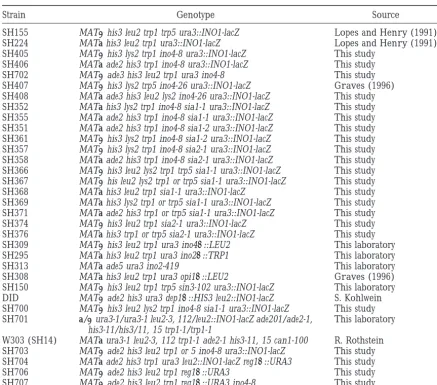
TABLE 1
Yeast strains
Strain Genotype Source
SH155 MATahis3 leu2 trp1 trp5 ura3::INO1-lacZ LopesandHenry(1991)
SH224 MATa his3 leu2 trp1 ura3::INO1-lacZ LopesandHenry(1991)
SH405 MATahis3 lys2 trp1 ino4-8 ura3::INO1-lacZ This study
SH406 MATa ade2 his3 trp1 ino4-8 ura3::INO1-lacZ This study
SH702 MATaade3 his3 leu2 trp1 ura3 ino4-8 This study
SH407 MATahis3 lys2 trp5 ino4-26 ura3::INO1-lacZ Graves(1996)
SH408 MATa ade3 his3 leu2 lys2 ino4-26 ura3::INO1-lacZ This study
SH352 MATa his3 lys2 trp1 ino4-8 sia1-1 ura3::INO1-lacZ This study
SH355 MATa ade2 his3 trp1 ino4-8 sia1-1 ura3::INO1-lacZ This study
SH351 MATa ade2 his3 trp1 ino4-8 sia1-2 ura3::INO1-lacZ This study
SH361 MATahis3 lys2 trp1 ino4-8 sia1-2 ura3::INO1-lacZ This study
SH357 MATahis3 lys2 trp1 ino4-8 sia2-1 ura3::INO1-lacZ This study
SH358 MATa ade2 his3 trp1 ino4-8 sia2-1 ura3::INO1-lacZ This study
SH366 MATahis3 leu2 lys2 trp1 trp5 sia1-1 ura3::INO1-lacZ This study SH367 MATahis leu2 lys2 trp1 or trp5 sia1-1 ura3::INO1-lacZ This study
SH368 MATa his3 leu2 trp1 sia1-1 ura3::INO1-lacZ This study
SH369 MATa his3 lys2 trp1 or trp5 sia1-1 ura3::INO1-lacZ This study
SH371 MATa ade2 his3 trp1 or trp5 sia1-1 ura3::INO1-lacZ This study
SH374 MATahis3 leu2 trp1 sia2-1 ura3::INO1-lacZ This study
SH376 MATa his3 trp1 or trp5 sia2-1 ura3::INO1-lacZ This study
SH309 MATahis3 leu2 trp1 ura3 ino4D::LEU2 This laboratory
SH295 MATa his3 leu2 trp1 ura3 ino2D::TRP1 This laboratory
SH313 MATa ade5 ura3 ino2-419 This laboratory
SH308 MATa his3 leu2 trp1 ura3 opi1D::LEU2 Graves(1996)
SH150 MATahis3 leu2 trp1 trp5 sin3-102 ura3::INO1-lacZ This laboratory
DID MATaade2 his3 ura3 dep1D::HIS3 leu2::INO1-lacZ S. Kohlwein SH700 MATahis3 leu2 lys2 trp1 ino4-8 sia1-1 ura3::INO1-lacZ This study SH701 a/aura3-1/ura3-1 leu2-3, 112/leu2::INO1-lacZ ade201/ade2-1, This laboratory
his3-11/his3/11, 15 trp1-1/trp1-1
W303 (SH14) MATa ura3-1 leu2-3, 112 trp1-1 ade2-1 his3-11, 15 can1-100 R. Rothstein SH703 MATaade2 his3 leu2 trp1 or 5 ino4-8 ura3::INO1-lacZ This study SH704 MATa ade2 his3 trp1 ura3 leu2::INO1-lacZ reg1D::URA3 This study
SH706 MATaade2 his3 leu2 trp1 reg1D::URA3 This study
SH707 MATaade2 his3 leu2 trp1 reg1D::URA3 ino4-8 This study
tetrads was observed, compared to 41:02tetrads, in re- Both thesia1-1and thesia2-1mutations can suppress a secondino4missense allele, but neither can suppress ciprocal crosses (i.e., crosses of strains of the ino4-8 SIA1
or ino4-8 SIA2 genotypes to strains of the INO4 sia1-1 ino4D: Strains SH407 and SH408 carrying the ino4-26 allele, a missense mutation in the basic region of the or INO4 sia2-1 genotypes, respectively; data not shown).
However, the excess of 21:22vs. 41:02tetrads and the bHLH domain at amino acid position 42 (Ambroziak 1994), were crossed to strains SH368 and SH372 car-high proportion of 31:12and 21:22asci shown in Table
2A indicate that it is unlikely that either sia1 or the sia2 rying the sia1-1 or the sia2-1 mutation, respectively, in the INO4 genetic background (Table 2B). The high is closely linked to the INO4 gene.
The sia1-bearing strains were also crossed to sia2 proportions of 31:12and 41:02tetrads recovered from these crosses indicate that the sia1-1 and the sia2-2 muta-strains (Table 2A). Although a relatively small number
of tetrads with four spores surviving were recovered (13 tions can both suppress the inositol auxotrophy of the ino4-26 strain. In contrast, crosses of sia1-1- or sia2-1-in two crosses), the high proportion of 31:12and 21:22
tetrads indicated that sia1 and sia2 mutations are not bearing strains SH369 and SH376 to strain SH309 car-rying an ino4 deletion mutation (ino4D) produced only closely linked. No unusual growth phenotype was
ob-served for sia1 sia2 strains, which were viable and resem- tetrads exhibiting a 21:22segregation for inositol auxot-rophy (Table 2B), indicating that neither sia1-1 nor bled the sia1 and sia2 single mutants in ability to
sup-press ino4-8. In contrast, a cross involving two sia1 alleles sia2-1 can suppress the ino4Dallele.
The sia1 and sia2 mutations can suppress an ino2 (i.e., ino4-8 sia1-1 with ino4-8 sia1-2) produced 21 41:02
tetrads and only 1 tetrad exhibiting a 31:12segregation missense mutation, but not anino2Dallele:Strains har-boring sia1-1 or sia2-1 were crossed to a strain carrying pattern (which could be due to reversion of ino4-8 or
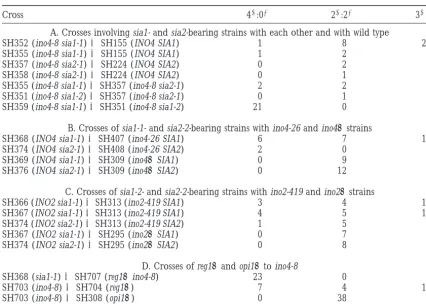
TABLE 2
Crosses of suppressor-bearing strains
Cross 41:02 21:22 31:12
A. Crosses involving sia1- and sia2-bearing strains with each other and with wild type
SH352 (ino4-8 sia1-1)3SH155 (INO4 SIA1) 1 8 20
SH355 (ino4-8 sia1-1)3SH155 (INO4 SIA1) 1 2 2
SH357 (ino4-8 sia2-1)3SH224 (INO4 SIA2) 0 2 7
SH358 (ino4-8 sia2-1)3SH224 (INO4 SIA2) 0 1 7
SH355 (ino4-8 sia1-1)3SH357 (ino4-8 sia2-1) 2 2 3
SH351 (ino4-8 sia1-2)3SH357 (ino4-8 sia2-1) 0 1 5
SH359 (ino4-8 sia1-1)3SH351 (ino4-8 sia1-2) 21 0 1
B. Crosses of sia1-1- and sia2-2-bearing strains with ino4-26 and ino4Dstrains
SH368 (INO4 sia1-1)3SH407 (ino4-26 SIA1) 6 7 16
SH374 (INO4 sia2-1)3SH408 (ino4-26 SIA2) 2 0 8
SH369 (INO4 sia1-1)3SH309 (ino4DSIA1) 0 9 0
SH376 (INO4 sia2-1)3SH309 (ino4DSIA2) 0 12 0
C. Crosses of sia1-2- and sia2-2-bearing strains with ino2-419 and ino2Dstrains
SH366 (INO2 sia1-1)3SH313 (ino2-419 SIA1) 3 4 13
SH367 (INO2 sia1-1)3SH313 (ino2-419 SIA1) 4 5 13
SH374 (INO2 sia2-1)3SH313 (ino2-419 SIA2) 1 5 8
SH367 (INO2 sia1-1)3SH295 (ino2DSIA1) 0 7 0
SH374 (INO2 sia2-1)3SH295 (ino2DSIA2) 0 8 0
D. Crosses of reg1Dand opi1Dto ino4-8
SH368 (sia1-1)3SH707 (reg1Dino4-8) 23 0 0
SH703 (ino4-8)3SH704 (reg1D) 7 4 17
SH703 (ino4-8)3SH308 (opi1D) 0 38 0
Tetrad ratios are given for growth on inositol-free media (Ino1/Ino2) phenotypes.
region of the bHLH domain at amino acid 273;Niko- shown). However, SH368 (sia1-1 INO4) grew slightly more slowly and reached a lower optical density than loffand Henry 1994). A high proportion of tetrads
exhibiting 31:12 and 41:02 ratios was observed, sug- wild type (SH155; Figure 1) in medium containing ei-ther 10mmor 75mminositol.
gesting that neither sia1-1 nor sia2-1 is linked to INO2,
but both are capable of suppressing the ino2-419 allele. INO1gene expression insia1andsia2strains:Strains containing a single copy of an INO1-lacZ gene fusion at Strains bearing the sia1-1 or the sia2-2 mutation were
also crossed to a strain carrying an ino2D null allele. the URA3 locus were used to assay INO1 gene expression (Table 3). As in the growth experiments described The observed 21:22segregation for inositol auxotrophy
(Table 2C) indicates that neither sia1-1 nor sia2-1 can above, medium containing a low amount of inositol (10
mm), which allows partial derepression of INO1, was suppress the ino2Dmutation.
The growth characteristics of suppressor strains: used as the D growth condition and 75mminositol was used as the fully R growth condition (Donahue and Growth of strains carrying the sia1-1 (Figure 1) and
sia2-1 (data not shown) mutations was compared to Henry 1981b; Hirsch and Henry 1986). The wild-type strain (SH155) expressedz155 units of activity in growth of ino4-8 and wild-type strains in medium
con-taining 10mminositol (derepressing, D) and 75mmin- derepressing D medium (Table 3). In fully repressing R medium, the wild-type strain expressed,20 units of ositol (repressing, R). As expected, the
suppressor-bear-ing strain SH352 (ino4-8 sia1-1) grew more rapidly and b-galactosidase. Such repression of the INO1 reporter construct in response to high levels of inositol is consis-reached a higher optical density in D medium
con-taining 10mminositol than did SH406 (ino4-8 SIA1 SIA2; tent with previous reports (Lopes and Henry 1991). Also consistent with previous reports (Hirsch and Figure 1). However, the ino4-8 sia1-1 strain did not grow
as rapidly as wild type or sia1-1 INO4 (SH368) in D Henry1986;Hoshizakiet al. 1990), the ino4-8 parental strain (SH406) exhibited no detectableb-galactosidase medium (Figure 1). Similarly, the sia2-1 ino4-8 strain
grew more rapidly than the ino4-8 (SH406) strain, but activity under either D or R growth condition. In contrast to the ino4-8 parental strain, strains SH352 and SH357 not as rapidly as wild type or SH374 (INO4 sia2-1) in D
medium containing 10mm inositol (data not shown). (carrying the sia1-1 or the sia2-1 suppressor, respectively, in an ino4-8 genetic background) expressed measurable Strain SH374 (INO4 sia2-1) exhibited a growth rate
Figure1.—Growth of sia1-1 (SH368) and sia1-1 ino4-8 (SH352) strains compared to wild-type (SH155) and ino4-8 (SH406) strains in the presence and absence of inositol. Strains were inoculated from overnight cultures into synthetic complete medium with 75mminositol (R;r) and 10mminositol (D;j), as described in thematerials and methods.Growth at 308was monitored by optical density using a Klett-Summerson spectrophotometer. The doubling times of each strain in each type of medium are shown in parentheses on the figure next to the medium designation (R or D).
(Table 3). The level of activity in D medium [z29 units dium in the SH357 strain (ino4-8 sia2-1) were lower than the levels observed in SH374 (INO4 sia2-1; Table 3). in the case of SH352 (ino4-8 sia1-1) and 35 units in the
case of SH357 (ino4-8 sia2-1)] was lower than the level Expression of phospholipid biosynthetic structural genes in sia1-1 and sia2-1 strains: The INO1, CHO1, observed in wild type (SH155), but higher than in the
parental strain (SH406, ino4-8 SIA1 SIA2). CHO2, and OPI3 genes are coordinately regulated in response to inositol (Paltaufet al. 1992). An autoradio-Expression of derepressed levels of b-galactosidase
from the INO1-lacZ reporter construct was observed in R gram of a Northern blot showing the expression of these transcripts in the wild type, sia1-1 INO4, and sia2-1 INO4 medium in the sia1-1 INO4 strain (SH368). Constitutive
expression, but at a lower level, was observed in the strains is shown in Figure 2. Under the derepressing growth condition employed in this study (10mminositol; sia1-1 ino4-8 genetic background (strain SH352). Thus,
the sia1-1 mutation results in constitutive expression of D medium), the wild-type strain exhibited 4-fold dere-pression of INO1 compared to levels observed in cells the INO1-lacZ reporter construct in both genetic
back-grounds (i.e., ino4-8 or INO4). The sia1-1 mutant strains grown under repressing conditions (R). This level of derepression is comparable to previous reports of INO1 were tested for the Opi2phenotype, but none of these
strains was Opi2. expression in cells grown in the presence of 10 mm
inositol, whereas 10-fold or greater derepression is typi-In contrast to the constitutive pattern of INO1
expres-sion observed in sia1-1-bearing strains, expresexpres-sion of the cally seen in cells grown in completely inositol-free medium (HirschandHenry1986). In D medium con-INO1-lacZ gene fusion was repressed in R medium in
sia2-1-bearing strains (SH357 and SH374). Levels of taining 10mminositol, the sia2-1 cells exhibited approxi-mately 9-fold derepression of INO1, a much greater
me-TABLE 3
Expression of theINO1-lacZreporter gene in various strains
b-Galactosidase activity
Strain Genotype D R
SH155 INO4 SIA1 SIA2 155.1615.6 17.469.1
SH406 ino4-8 SIA1 SIA2 #1 #1
SH352 ino4-8 sia1-1 SIA2 28.863.2 22.864.7 SH368 INO4 sia1-1 SIA2 199.3634.6 208.5624.1 SH357 ino4-8 SIA1 sia2-2 35.566.6 3.360.3 SH374 INO4 SIA1 sia2-2 154.8628.1 28.864.4
b-Galactosidase levels were measured in cells grown in the presence of 10mminositol, derepressing condition (D), and in 75mminositol, repressing condition (R).
gree of derepression than observed in the wild-type strain (Figure 2). The sia2-1 strain also had a copy of the INO1-lacZ reporter construct integrated at the URA3 locus, and the transcript from this construct was regu-lated in a pattern comparable to the native INO1
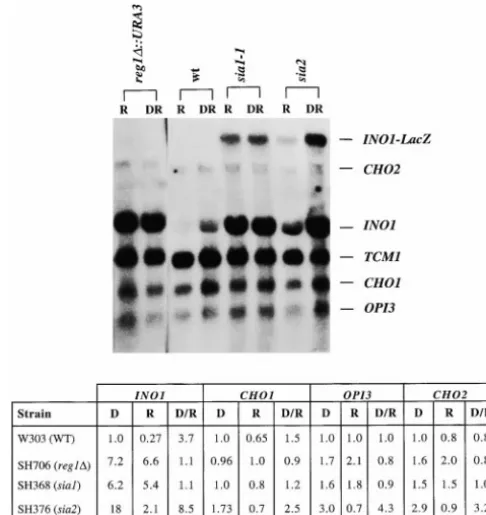
tran-script (Figure 2). Figure2.—Northern analysis of transcripts of genes, INO1, The OPI3, CHO1, and CHO2 transcripts, in general, OPI3, CHO2, and CHO1, encoding enzymes subject to repres-sion by inositol in wild-type, sia1-1 INO4, sia2 INO4, and reg1D
exhibit much less dramatic repression ratios than INO1
INO4 strains. DR denotes partially derepressing growth
condi-and are not fully repressed in medium containing
inosi-tion (10mminositol), as described inmaterials and
meth-tol unless choline is present in addition to inosimeth-tol ods.R denotes fully repressing growth condition (75mm inosi-(Bailiset al. 1987;Gaynoret al. 1991). In the present tol). Ribosomal protein gene TCM1 is included as a control study, no choline was added to the R growth medium for RNA loading. Lanes from left to right: Lane 1, SH706 (reg1D), 75mminositol; lane 2, SH706 (reg1D), 10mminositol;
and, consistent with previous reports, we observed that
lane 3, W303 (wild type), 75mminositol; lane 4, W303 (wild
the OPI3, CHO1, and CHO2 transcripts showed much
type), 10mm inositol; lane 5, SH368 (sia1-1 INO4), 75 mm
less repression than the INO1 transcript under these inositol; lane 6, SH368 (sia1-1 INO4), 10mminositol; lane 7, conditions in both wild-type and sia2-1 cells. Compared SH376 (sia2-1 INO4), 75mminositol; lane 8, SH376 (sia2-1 to the wild-type strain, the sia2-1 strain showed elevated INO4), 10mminositol. Quantification of the Northern blot is depicted below the blot. The numbers were obtained by
derepression of all of these transcripts in D medium.
normalizing to the signal obtained with the TCM1 probe and
The sia1-1 strain exhibited no significant repression of
are expressed as a proportion of the amount of the specific
any of the transcripts tested under these conditions (Fig- RNA present in wild-type cells grown under derepressing (D)
ure 2). growth conditions (i.e., the amount of each RNA in wild type
Analysis ofINO1-lacZexpression in diploid strains:The normalized to TCM1 is set at 1.0 for each of the four probes). The repression ratio (D/R) was obtained by dividing the level
coregulated structural genes of phospholipid
biosynthe-of each transcript expressed in D medium by the level observed
sis are also constitutively expressed in opi1 (Hirschand
in R medium. Henry 1986), sin3 (Hudak et al. 1994; Slekar and
Henry1995), and dep1 (Lamping et al. 1995) mutant
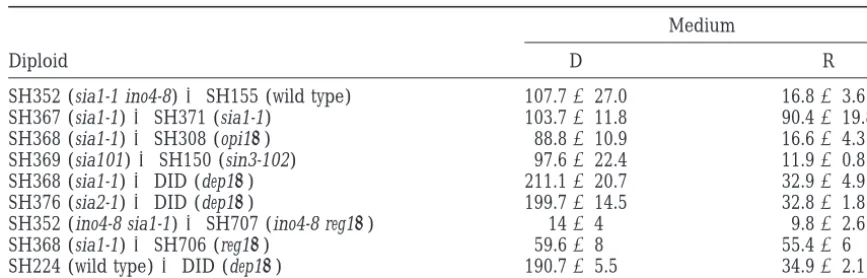
abil-TABLE 4
Expression of theINO1-lacZreporter gene in diploid strains
Medium
Diploid D R
SH352 (sia1-1 ino4-8)3SH155 (wild type) 107.7627.0 16.863.6
SH367 (sia1-1)3SH371 (sia1-1) 103.7611.8 90.4619.8
SH368 (sia1-1)3SH308 (opi1D) 88.8610.9 16.664.3
SH369 (sia101)3SH150 (sin3-102) 97.6622.4 11.960.8
SH368 (sia1-1)3DID (dep1D) 211.1620.7 32.964.9
SH376 (sia2-1)3DID (dep1D) 199.7614.5 32.861.8
SH352 (ino4-8 sia1-1)3SH707 (ino4-8 reg1D) 1464 9.862.6
SH368 (sia1-1)3SH706 (reg1D) 59.668 55.466
SH224 (wild type)3DID (dep1D) 190.765.5 34.962.1
D, 10mminositol, derepressing condition; R, 75mminositol, repressing condition.
different open reading frames (YDR027–YDR031) of inositol prototrophic, indicating that the sia1-1 and reg1Dmutations do not complement. A second diploid which only one corresponded to a previously
character-ized gene, REG1/HEX2/SRN1 (NeigebornandCarl- was constructed by crossing SH368 (sia1-1 INO4) with SH706 (reg1D INO4). Both diploids were analyzed for son1987;Tunget al. 1992;Naiket al. 1997). Subsequent
subcloning of this z10-kb fragment showed that the b-galactosidase expression from the INO1-lacZ reporter gene (Table 4). In both cases, consistent with failure of only complementing subclones were those that carried
a full-length copy of the REG1 gene. Additional REG1 sia1-1 and reg1Dto complement,b-galactosidase expres-sion was constitutive (Table 4). However, the level of clones, kindly provided by M. Johnston and K. M. Arndt,
further confirmed this observation. Thus, it appeared expression of the reporter construct was lower in the strain that was homozygous for ino4-8 (i.e., SH352 3 likely that the SIA1 gene was, in fact, REG1.
To explore this possibility further, we constructed a SH707). This diploid sporulated poorly. Therefore, a diploid heterozygous for ino4-8 was produced by cross-reg1Dmutant as described inmaterials and methods
and examined its growth and other characteristics. The ing strains SH368 (sia1-1) and SH707 (reg1D::URA3 ino4-8). This strain was sporulated and dissected. Among reg1Dmutant exhibited a longer lag period than wild
type or sia1-1 when inoculated into fresh medium. How- 23 tetrads recovered from this cross, all showed 41:02 segregation for growth on inositol-free plates (Table ever, once it reached logarithmic phase, its growth was
no more impaired than the growth of sia1-1 (which is 2D). In addition, all spore colonies were tested for resis-tance to 2-DG (LoboandMaitra1977), a phenotype shown in Figure 1). As previously described (Frederick
andTatchell1996), and similar to the sia1-1 mutant, associated with reg1 mutants (TuandCarlson 1995). The parental strains, sia1-1 and reg1D, and all progeny the reg1D mutant grew slightly more slowly than wild
type under all growth conditions employed in this study. from the cross exhibited 2-DG resistance. In all 23 tet-rads, 2-DG resistance segregated 4R:0Sresistant:sensitive. The doubling time of the reg1D mutant in R medium
containing 75 mm inositol was z2.5 hr compared to Thus, reg1Dand sia1-1 are allelic and we have renamed sia1-1 as reg1-600.
approximately 3 hr for sia1-1 andz2 hr for wild type.
Unlike the sia1-1 INO4 mutant strain, however, the reg1D Theopi1Dmutation cannot suppressino4-8:The ob-servation that a REG1 null allele is able to suppress the INO4 strain had a weak inositol excretion (Opi2)
pheno-type. The reg1Dstrain also exhibited elevated constitu- ino4-8 growth phenotype indicates that the mechanism of suppression does not involve specific contact between tive expression of INO1, comparable to the expression
pattern seen in sia1-1 cells (Figure 2). the REG1 gene product and the mutant ino4-8 gene product. This caused us to question whether the absence Among 28 full four-spore tetrads recovered from a
cross of SH703 (ino4-8) to SH703 (reg1D), 17 exhibited of a negative regulator in the ino4-8 genetic background was sufficient to confer suppression. To determine 31:12 segregation of inositol auxotrophy, 4 showed
21:22segregation, and 7 tetrads exhibited 41:02segre- whether mutations in the negative regulator encoded by the OPI1 gene would have a similar effect, a strain gation (Table 2D). Furthermore, all reg1Dino4-8
segre-gants grew in the absence of inositol. Thus, the null carrying the opi1D mutation (SH308) was crossed to strain SH703 (ino4-8). In all 38 tetrads (Table 2D), from allele, reg1D::URA3, has the same ability to suppress
ino4-8 as does sia1-1 (Table 2A). which four surviving spores were recovered, 21:22 segre-gation for inositol auxotrophy was observed, indicating A reg1Dino4-8 strain (SH707) was crossed with a sia1-1
DISCUSSION sion of the INO1 gene and that the reg1D mutation
confers an Opi2 phenotype. The REG1 gene product INO1 expression is regulated not only in response to
has been shown to be necessary for repression of genes the availability of inositol in the growth medium, but
such as SUC2 which are under catabolite repression by also in response to growth phase (Lampinget al. 1995;
the glucose response signal transduction pathway. The Griacet al. 1996;Jiraneket al. 1998), ongoing
phospha-REG1 gene product is a regulatory subunit of Glc7p, tidylcholine biosynthesis (Griacet al. 1996), and
turn-a type 1 protein phosphturn-atturn-ase thturn-at regulturn-ates the SNF1 over (Patton-Vogtet al. 1997;Sreenivaset al. 1998).
kinase (TuandCarlson1994, 1995). Another compo-Specific regulatory genes shown to affect INO1
expres-nent of the glucose response pathway is SNF4, a regula-sion and regulation include INO2, INO4, and OPI1 (
Pal-tory subunit of the SNF1 kinase (CelenzaandCarlson taufet al. 1992). Under derepressing conditions (absence
1986; Jiang and Carlson 1996). The SNF1 gene en-of inositol), opi1 mutants excrete inositol (Opi2
pheno-codes a serine-threonine protein kinase required to acti-type) due to overexpression of the INO1 gene product,
vate those genes under catabolite repression (Celenza inositol-1-phosphate synthase (Greenberget al. 1982b).
andCarlson1986). opi1 mutants also fail to repress the INO1 gene in
re-In addition to their effects upon glucose-repressible sponse to the presence of inositol or stationary growth
genes, snf1 mutations have Ino2 phenotypes ( Hirsch-phase signals (HirschandHenry1986;Whiteet al. 1991;
hornet al. 1992). The INO1 gene and the other coregu-Jiraneket al. 1998). The INO2 and INO4 loci encode
lated genes, CHO1, OPI3, and CHO2, are all constitu-transcriptional activators of the bHLH class which form
tively expressed in the sia1-1 (reg1-600) mutant (Table a heterodimer that binds to the repeated element
3; Figure 2). These data and the observation that snf1 UASINOfound in the INO1 promoter (Ambroziak and
mutants are Ino2suggest that UASINO-containing genes Henry1994;NikoloffandHenry1994;Bachhawat
require the action of the SNF1 kinase for their expres-et al. 1995). Delexpres-etion of either the INO2 or the INO4
sion and the action of the REG1 gene product for their locus causes inositol auxotrophy (Ino2 phenotype)
repression. Thus, INO1 expression and regulation ap-which is not alleviated by mutations at the OPI1 locus
pear to require a fully functioning glucose response (Graves 1996). However, the precise function of the
pathway. It is curious that insulin regulation of FAS in OPI1 gene product (Opi1p) is not yet established and
mammalian cells acts through an E-box element (Wang Opi1p does not appear to bind to DNA directly (Graves
andSul 1997) homologous to UASINO. The yeast FAS 1996).
(Schu¨ lleret al. 1995) and the acetyl Co-A carboxylase Mutations at a large number of other loci produce
(ACC1) promoters (Hasslacheret al. 1993) also con-Ino2and Opi2phenotypes, indicating defects in INO1
tain UASINOsequences. Thus, it is tempting to speculate expression and/or regulation (reviewed inHenryand
that the regulatory mechanisms controlling fat metabo-Patton-Vogt1998). For example, mutations in RNA
lism in response to glucose availability in animals and polymerase II (Scafeet al. 1990a,b,c), the TATA binding
fungi might have had a common ancestry. However, protein (Arndtet al. 1995), and the global regulatory
INO1 and other coregulated genes of phospholipid bio-factors SWI1/ADR6, SWI2/SNF2, and SWI3 (Peterson
synthesis are expressed and regulated by inositol in the andHerskowitz1992;Petersonet al. 1994;Peterson
presence of glucose, as shown by the experiments re-and Tamkun 1995) all cause inositol auxotrophy. In
ported here, all of which were conducted in glucose-contrast, mutations in the SIN3 (Hudak et al. 1994;
containing medium. Furthermore, in a related report, Slekar and Henry 1995) and UME6 (Jackson and
ShirraandArndt(1998) report that glucose has little Lopes1996) regulatory factors result in Opi2
pheno-effect on INO1 expression. Thus, it appears that the types and/or constitutive expression of INO1. The Ino2
glucose response signal transduction cascade is required phenotypes of the SWI/SNF genes are caused by the
for INO1 expression and regulation. However, the REG1 dependence of INO1 transcription on the SWI/SNF
com-gene product must function via a mechanism that is plex (Peterson et al. 1994; Peterson and Tamkun
distinct from that by which it governs classical catabolite 1995), which is involved in chromatin remodeling.
Fur-repressible genes such as SUC2, which is not measurably thermore, mutations in histone H4 can bypass the
re-expressed in wild-type cells grown in the presence of quirement for the SWI/SNF complex, thus permitting
glucose. INO1 expression (Santistebanet al. 1997) in Swi2or
Furthermore, the expression of INO1 is influenced Snf2strains. The Ino2and Opi2phenotypes described
by at least one other signal transduction cascade. The above are all associated with mutations that affect the
ire1 and hac1 mutations (NikawaandYamashita1992; general transcription apparatus and/or chromatin
struc-CoxandWalter1996;Nikawaet al. 1996;Cox et al. ture, suggesting that expression of the INO1 gene is
1997) have also been reported to cause inositol auxotro-highly sensitive to perturbation in the general state of
phy. The IRE1 locus encodes a protein kinase involved cellular transcription.
in the unfolded protein response pathway and HAC1 In this study, we have demonstrated that mutations
1996). Regulation of INO1 expression must, therefore, tated residual Ino2p/Ino4p complex permitting it to function, at least partially, in vivo. We propose that integrate inputs from several transduction pathways.
In an independent study,ShirraandArndt(1998) Reg1p affects INO1 transcription, via its role in regulat-ing the SNF1/SNF4 complex, by influencregulat-ing the interac-report the isolation of suppressors of the inositol
auxot-rophy of the spt15-328 mutation in the TATA binding tion of Ino2p/Ino4p with each other and, thus, with UASINO. This, in turn, affects the interaction of the INO1 protein (TBP). Consistent with our findings that reg1
mutants can suppress the inositol auxotrophy of certain promoter with the SPT15 gene product, TBP. opi1 muta-tions, including opi1D, do not suppress ino4-8 and, thus, ino4 and ino2 missense alleles, Shirra and Arndt isolated
a recessive suppressor of the inositol auxotrophy of we believe that the mechanism of Opi1p action does not influence the activity of the Ino2p/Ino4p complex spt15-328 that proved to be an allele of REG1. They also
identified a dominant suppressor that is an allele of or its binding to UASINO. Because opi1 mutations sup-press spt15-328, Opi1p could function as a mediator SNF4. Shirra and Arndt also reported that one of their
suppressors is an allele of OPI1. However, we found that between TBP and its recruitment to UASINOby the active Ino2p/Ino4p complex.
the opi1Dallele does not suppress the inositol
auxotro-phy of ino4-8 (Table 2D). One explanation for the differ- We are indebted to Peggy Shirra and Karen Arndt for ongoing ent effects of opi1 mutants on the Ino2 phenotypes of discussion and for providing strains during the progress of this work. This work was supported by a National Institutes of Health grant
GM-the ino4-8 and spt15-328 mutations could be that Opi1p
19629 to S.A.H.
represses transcription of INO1 (and other genes whose transcription is dependent on the binding of the Ino2p/ Ino4p complex) via an interaction with the TBP.
Curi-ously, however, Shirra and Arndt report that the expres- LITERATURE CITED
sion of INO1 transcript is regulated by inositol in the Ambroziak, J.,1994 Analysis of the regulatory nature of the product opi1 spt15-328 double mutant. Yet, in the opi1 SPT15 of the yeast INO4 gene, a positive regulator of phospholipid biosynthesis. Ph.D. Thesis, Biological Sciences, Carnegie Mellon
strain, INO1 expression is constitutive (Shirra and
University, Pittsburgh.
Arndt1998). This result suggests that Opi1p attenuates Ambroziak, J.,andS. A. Henry,1994 INO2 and INO4 gene products, the level of transcription of INO1 via TBP but does not positive regulators of phospholipid biosynthesis in Saccharomyces
cerevisiae, form a complex that binds to the INO1 promoter. J. actually control the regulatory response to inositol.
Biol. Chem. 269: 15344–15349.
If this hypothesis is correct, then the regulation in Arndt, K. M., S. Ricupero-HovasseandF. Winston,1995 TBP response to inositol by INO1 is mediated by regulatory mutants defective in activated transcription in vivo. EMBO J. 14:
1490–1497.
factors working at a point in the regulatory cascade that
Bachhawat, N., Q. Ouyang andS. A. Henry,1995 Functional
precedes the steps mediated by both Opi1p and the characterization of an inositol-sensitive upstream activation se-TBP. The Ino2p/Ino4p complex is a possible target for quence in yeast: a cis-regulatory element responsible for inositol-choline mediated regulation of phospholipid biosynthesis. J. Biol.
such regulation. The ino4-8 mutation is a point
muta-Chem. 270: 25087–25095.
tion, glutamic acid to lysine at residue 79 in the loop Bailis, A. M., M. A. Poole, G. M. CarmanandS. A. Henry,1987 region of the bHLH motif (Ambroziak1994). The re- The membrane-associated enzyme phosphatidylserine synthase is regulated at the level of mRNA abundance. Mol. Cell. Biol. 7:
cessive suppressors isolated in this study, sia1-1 (reg600)
167–176.
and sia2-1, proved to have the unusual property that Blackwell, T. K.,andH. Weintraub,1990 Differences and similar-they suppressed not only the inositol auxotrophy of ities in DNA-binding preferences of MyoD and E2A protein com-plexes revealed by binding site selection. Science 250: 1104–1110.
ino4-8 strains and ino4-26 (threonine to isoleucine in
Celenza, J. L.,andM. Carlson,1986 A yeast gene that is essential
the basic region of the bHLH motif;Ambroziak1994), for release from glucose repression encodes a protein kinase. but also ino2-419 (arginine to lysine in the loop region of Science 233: 1175–1180.
Cox, J. S.,andP. Walter,1996 A novel mechanism for regulating
the bHLH motif;NikoloffandHenry1994). However,
activity of a transcription factor that controls the unfolded protein
neither the sia1-1 nor the sia2-1 mutations were able to response. Cell 87: 391–404.
suppress either the ino4Dor the ino2Dmutation (Table Cox, J. S., R. E. Chapman andP. Walter, 1997 The unfolded protein response coordinates the production of endoplasmic
re-2). Thus, the suppression mechanism appears to
de-ticulum protein and endoplasmic rede-ticulum membrane. Mol.
pend on some residual function of the mutated Ino2p/ Biol. Cell 8: 1805–1814.
Ino4p complex. Culbertson, M. R.,andS. A. Henry,1975 Inositol-requiring mu-tants of Saccharomyces cerevisiae. Genetics 80: 23–40.
Cell extracts prepared from strains carrying ino2-419,
Davis, R. L., P.-F. Cheng, A. B. LassarandH. Weintraub,1990
ino4-8, or ino4-26 point mutations have very low or
unde-The MyoD DNA binding domain contains a recognition code
tectable ability to heterodimerize and bind DNA as a for muscle-specific gene activation. Cell 60: 733–746.
Donahue, T. F.,andS. A. Henry,1981a myo-Inositol-1-phosphate complex (Ambroziak1994;NikoloffandHenry1994).
synthase. J. Biol. Chem. 256: 7077–7085.
However, when wild-type Ino2p is cotranslated in vitro
Donahue, T. F.,andS. A. Henry,1981b Inositol mutants of
Saccharo-with the ino4-8 or ino4-26 mutant gene products, the myces cerevisiae : mapping the ino1 locus and characterizing alleles
of the ino1, ino2 and ino4 loci. Genetics 98: 491–503.
heterodimers formed have some residual ability to bind
Fisher, F., P.-S. JayaramanandC. R. Goding,1991 C-Myc and
UASINO in vitro (Ambroziak 1994). The mutation in the yeast transcription factor PHO4 share a common CACGTG-REG1, which deregulates the protein kinase activity of binding motif. Oncogene 6: 1099–1104.
Frederick, D. L.,andK. Tatchell,1996 The REG2 gene of
mu-romyces cerevisiae encodes a type 1 protein phosphatase-binding teins generate complexes that bind specifically to a common DNA sequence. Cell 58: 537–544.
protein that functions with Reg1p and the Snf1 protein kinase
to regulate growth. Mol. Cell. Biol. 16: 2922–2931. Naik, R. R., V. Nebes andE. W. Jones,1997 Regulation of the proteinase B structural gene PRB1 in Saccharomyces cerevisiae. J.
Gaynor, P. M., T. Gill, S. Toutenhoofd, E. F. Summers, P. McGraw
et al., 1991 Regulation of phosphatidylethanolamine methyl- Bacteriol. 179: 1469–1474.
Neigeborn, L.,andM. Carlson,1987 Mutations causing constitu-transferase by phospholipid precursors in Saccharomyces cerevisiae.
Biochim. Biophys. Acta 1090: 326–332. tive invertase synthesis in yeast: genetic interactions with snf muta-tions. Genetics 115: 247–253.
Graves, J. A.,1996 Analysis of the role of the OPI1 gene product
in the negative regulation of the phospholipid biosynthetic path- Nikawa, J.-I.,andS. Yamashita,1992 IRE1 encodes a putative
pro-tein kinase containing a membrane-spanning domain and is re-way of Saccharomyces cerevisiae. Ph.D. Thesis, Biological Sciences,
Carnegie Mellon University, Pittsburgh. quired for inositol prototrophy in Saccharomyces cerevisiae. Mol. Microbiol. 6: 1441–1446.
Greenberg, M., P. GoldwasserandS. Henry,1982a
Characteriza-tion of a yeast regulatory mutant constitutive for inositol-1-phos- Nikawa, J.-I., M. Akiyoshi, S. HirataandT. Fukuda,1996 Saccharo-myces cerevisiae IRE2/HAC1 is involved in IRE1-mediated KAR2
phate synthase. Mol. Gen. Genet. 186: 157–163.
Greenberg, M. L., B. ReinerandS. A. Henry,1982b Regulatory expression. Nucleic Acids Res. 24: 4222–4226.
Nikoloff, D. M.,andS. A. Henry,1994 Functional characterization mutations of inositol biosynthesis in yeast: isolation of
inositol-excreting mutants. Genetics 100: 19–33. of the INO2 gene of Saccharomyces cerevisiae. J. Biol. Chem. 269: 7402–7411.
Griac, P., M. J. SwedeandS. A. Henry,1996 The role of
phospha-tidylcholine biosynthesis in the regulation of the INO1 gene of Nikoloff, D. M., P. McGraw andS. A. Henry, 1992 The INO2 gene of Saccharomyces cerevisiae encodes a helix-loop-helix protein yeast. J. Biol. Chem. 271: 25692–25698.
Hasslacher, M., A. S. Ivessa, F. PaltaufandS. D. Kohlwein,1993 that is required for activation of phospholipid synthesis. Nucleic Acids Res. 20: 3253.
Acetyl-CoA carboxylase from yeast is an essential enzyme and is
regulated by factors that control phospholipid metabolism. J. Nikoloff, M.,1993 Cloning and characterization of INO2, a positive regulator of phospholipid biosynthesis. Ph.D. Thesis, Biological Biol. Chem. 268: 10946–10952.
Henry, S. A., andJ. L. Patton-Vogt,1998 Genetic regulation of Sciences, Carnegie Mellon University, Pittsburgh.
Paltauf, F., S. KohlweinandS. A. Henry,1992 Regulation and phospholipid metabolism: yeast as a model eukaryote, pp. 133–
179 in Progress in Nucleic Acid Research and Molecular Biology, edited compartmentalization of lipid synthesis in yeast, pp. 415–500 in
The Molecular and Cellular Biology of the Yeast Saccharomyces, edited
byW. E. CohnandK. Moldave.Academic Press, San Diego.
Hirsch, J. P.,1987 cis- and trans-acting regulation of the INO1 gene by J. Broach, E. Jonesand J. Pringle.Cold Spring Harbor Laboratory Press, Plainview, NY.
of Saccharomyces cerevisiae. Ph.D. Thesis, Albert Einstein College
of Medicine, New York. Patton-Vogt, J. L., P. Griac, A. Sreenivas, V. Bruno, S. Dowdet al., 1997 Role of the yeast
phosphatidylinositol/phosphatidyl-Hirsch, J. P.,andS. A. Henry,1986 Expression of the Saccharomyces
cerevisiae inositol-1-phosphate synthase (INO1) gene is regulated choline transfer protein (Sec14p) in phosphatidylcholine turn-over and INO1 regulation. J. Biol. Chem. 272: 20873–20883. by factors that affect phospholipid synthesis. Mol. Cell. Biol. 6:
3320–3328. Peterson, C. L.,andI. Herskowitz,1992 Characterization of the yeast SWI1, SWI2, and SWI3 genes, which encode a global activator
Hirschhorn, J. N., S. A. Brown, C. D. ClarkandF. Winston,1992
Evidence that SNF2/SWI2 and SNF5 activate transcription in of transcription. Cell 68: 573–583.
Peterson, C. L.,andJ. W. Tamkun,1995 The SWI-SNF complex: yeast by altering chromatin structure. Genes Dev. 6: 2288–2298.
Hoshizaki, D. K., J. E. HillandS. A. Henry,1990 The S. cerevisiae a chromatin remodeling machine? Trends Biochem. Sci. 20: 143– 146.
INO4 gene encodes a small, highly basic protein required for
derepression of phospholipid biosynthetic enzymes. J. Biol. Peterson, C. L., A. DingwallandM. P. Scott,1994 Five SWI/SNF gene products are components of a large multisubunit complex Chem. 265: 4736–4745.
Hudak, K. A., J. M. LopesandS. A. Henry,1994 A pleiotropic required for transcriptional enhancement. Proc. Natl. Acad. Sci. USA 91: 2905–2908.
phospholipid biosynthetic regulatory mutation in Saccharomyces
cerevisiae is allelic to sin3 (sdi1, ume4, rpd1). Genetics 136: 475–483. Santisteban, M. S., G. Arents, E. N. Moudrianakis and M. M. Smith,1997 Histone octamer function in vivo: mutations in
Jackson, J. C.,andJ. M. Lopes,1996 The yeast UME6 gene is
re-quired for both negative and positive transcriptional regulation the dimer-tetramer interfaces disrupt both gene activation and repression. EMBO J. 16: 2493–2506.
of phospholipid biosynthetic gene expression. Nucleic Acids Res.
24:1322–1329. Scafe, C., D. Chao, J. Lopes, J. P. Hirsch, S. Henryet al., 1990a
RNA polymerase II C-terminal repeat influences response to
tran-Jiang, R.,andM. Carlson,1996 Glucose regulates protein
interac-tions within the yeast SNF1 protein kinase complex. Genes Dev. scriptional enhancer signals. Nature 347: 491–494.
Scafe, C., C. Martin, M. Nonet, S. Podos, S. Okamuraet al., 1990b
10:3105–3115.
Jiranek, V., J. A. GravesandS. A. Henry,1998 Pleiotropic effects Conditional mutations occur predominantly in highly conserved residues of RNA polymerase II subunits. Mol. Cell. Biol. 10: 1270– of the opi1 regulatory mutation of yeast: its effects on growth
and on phospholipid and inositol metabolism. Microbiology 144: 1275.
Scafe, C., M. NonetandR. A. Young,1990c RNA polymerase II 2739–2748.
Lamping, E., F. Paltauf, S. A. HenryandS. D. Kohlwein,1995 mutants defective in transcription of a subset of genes. Mol. Cell. Biol. 10: 1010–1016.
Isolation and characterization of a mutant of Saccharomyces
cerevis-iae with pleiotropic deficiencies in transcriptional activation and Schu¨ ller, H.-J., K. Richter, B. Hoffmann, R. Ebbert and E. Schweizer,1995 DNA binding site of the yeast heteromeric repression. Genetics 137: 55–65.
Lassar, A. B., J. N. Buskin, D. Lockshon, R. L. Davis, S. Apone Ino2p/Ino4p basic helix-loop-helix transcription factor: struc-tural requirements as defined by saturation mutagenesis. FEBS
et al., 1989 MyoD is a sequence-specific DNA binding protein
requiring a region of myc homology to bind to the muscle creatine Letters 370: 149–152.
Schwank, S., R. Ebbert, K. Rautenstrauss, E. Schweizer and kinase enhancer. Cell 58: 823–831.
Lobo, Z.,andP. K. Maitra,1977 Resistance to 2-deoxyglucose in H.-J. Schuller,1995 Yeast transcriptional activator INO2 inter-acts as an Ino2p/Ino4p basic helix-loop-helix heteromeric com-yeast: a direct selection of mutants lacking
glucose-phosphorylat-ing enzymes. Mol. Gen. Genet. 157: 297–300. plex with the inositol/choline-responsive element necessary for expression of phospholipid biosynthetic genes in Saccharomyces
Lopes, J. M., and S. A. Henry,1991 Interaction of trans and cis
regulatory elements in the INO1 promoter of Saccharomyces cerevis- cerevisiae. Nucleic Acids Res. 23: 230–237.
Sherman, F., G. R. Fink andC. W. Lawrence, 1978 Methods in iae. Nucleic Acids Res. 19: 3987–3994.
Matsumoto, K., T. Yoshimatsuand Y. Oshima, 1983 Recessive Yeast Genetics. Cold Spring Harbor Laboratory Press, Cold Spring
Harbor, NY. mutations conferring resistance to carbon catabolite repression
of galactokinase synthesis in Saccharomyces cerevisiae. J. Bacteriol. Shirra, M. K.,andK. M. Arndt,1999 Evidence for the involvement of the Glc7-Reg1 phosphatase and the Snf1-Snf4 kinase in the 153:1405–1414.
Murre, C., P. S. McCaw, H. Vaessin, M. Caudy, L. Y. Janet al., regulation of INO1 transcription in Saccharomyces cerevisiae. Genet-ics 152: 73–87.
pro-Slekar, K. H., and S. A. Henry, 1995 SIN3 works through two is identical to HEX2/REG1, a negative regulatory in glucose re-different promoter elements to regulate INO1 gene expression pression. Mol. Cell. Biol. 12: 2673–2680.
in yeast. Nucleic Acids Res. 23: 1964–1969. Voronova, A.,andD. Baltimore,1990 Mutations that disrupt DNA
Sreenivas, A., J. L. Patton-Vogt, V. Bruno, P. GriacandS. A. binding and dimer formation in the E47 helix-loop-helix protein
Henry,1998 A role for phospholipase D (Pld1p) in growth, map to distinct domains. Proc. Natl. Acad. Sci. USA 87: 4722– secretion, and regulation of membrane lipid synthesis in yeast. 4726.
J. Biol. Chem. 273: 16635–16638. Wang, D.,andH. S. Sul,1995 Upstream stimulatory factors bind
Swede, M. J., K. A. Hudak, J. M. LopesandS. A. Henry,1992 Strate- to insulin response sequence of the fatty acid synthase promoter. gies for generating phospholipid synthesis mutants in yeast, pp. J. Biol. Chem. 270: 28716–28722.
21–34 in Methods in Enzymology: Phospholipid Biosynthesis, edited by Wang, D.,andH. S. Sul,1997 Upstream stimulatory factor binding
D. E. VanceandE. A. Dennis.Academic Press, San Diego. to the E-box at265 is required for insulin regulation of the fatty
Tu, J., andM. Carlson,1994 The GLC7 type 1 protein phosphatase acid synthase promoter. J. Biol. Chem. 272: 26367–26374. is required for glucose repression in Saccharomyces cerevisiae. Mol. White, M. J., J. P. HirschandS. A. Henry,1991 The OPI1 gene Cell. Biol. 14: 6789–6796. of Saccharomyces cerevisiae, a negative regulator of phospholipid
Tu, J., andM. Carlson,1995 REG1 binds to protein phosphatase biosynthesis, encodes a protein containing polyglutamine tracts
type 1 and regulates glucose repression in Saccharomyces cerevisiae. and a leucine zipper. J. Biol. Chem. 266: 863–872. EMBO J. 14: 5939–5946.