ISSN: 2319-8753
I
nternational
J
ournal of
I
nnovative
R
esearch in
S
cience,
E
ngineering and
T
echnology
(An ISO 3297: 2007 Certified Organization)
Vol. 2, Issue 11, November 2013
Dynamic Stability Analysis of Compliant
Offshore Structures
–
A Case Study of Single
Hinged Articulated Tower
Atreya, Prashant
1; Islam, Najrul
2; Alam, Mehtab
3; Hassan, Syed Danish
4Research Scholar, Department of Civil Engineering, Jamia Milia Islamia, New Delhi, India-1100251
Professor, Department of Civil Engineering, Jamia Milia Islamia, New Delhi, India-1100252
Professor, Department of Civil Engineering, Jamia Milia Islamia, New Delhi, India-1100253
Reader, University Polytechnic, Aligarh Muslim University, India-2020014
Abstract: All the researchers in past have carried out dynamic response analysis of the structure under Wave, Earthquake or Wind loads or a combination of these loads and studied its behavior. Very few investigations have been reported which effectively incorporate hydrodynamic drag nonlinearity and study its effect on the stability of the systems. As oceanic waves are better modeled as stochastic process, there is a need to investigate the stochastic stability of flexible offshore structures as well. Present study have been carried out to determine seismic response of single hinged Articulated Tower under Wave and Earthquake loads followed by its dynamic Stability analysis. Dynamic stability analysis of compliant offshore structures constitute an interesting area of research because of their inherent non-linearities. The study has explored dynamic instabilities existing during the different phases of wave / earthquake loading on SHAT. A simple method of two-dimensional phase plots and bifurcation assessment has been used to identify phases of dynamic instability existing within the responses of SHAT under various conditions of loading.
Keyword: Single Hinged Articulated Tower, Earthquake, Time History, Phase Plot
I.INTRODUCTION
Complex non-linear and chaotic responses are observed in various types of compliant offshore structures. These structures have large displacements with inherent non-linearities, so prediction of behavior of these structures in oceanic environment is difficult and is met with many challenges. These systems are characterized by strong geometric non-linearity, non-linear excitation forces in form of waves and earthquake and non-linear restoring forces. The non-linear restoring forces arising due to fluid structure interaction finally leads to the possibility of dynamic instability of the systems. On account of these non-linearities, numerical investigations of compliant offshore structures have revealed complex behavior involving sub-harmonic, super-harmonic and aperiodic solutions[1,2 & 3].
ISSN: 2319-8753
I
nternational
J
ournal of
I
nnovative
R
esearch in
S
cience,
E
ngineering and
T
echnology
(An ISO 3297: 2007 Certified Organization)
Vol. 2, Issue 11, November 2013
base. As the articulated tower is compliant in nature, it moves with the waves and thus the wave force and bending moment along the tower will be less compared to a fixed structure. Efforts have been made to use simplified realistic mathematical models to gain important insight into the response behavior of these structures and to explore the possibility of their dynamic instability and chaotic motion.
II. STRUCTURE IDEALIZATION AND SYSTEM MODEL
SHAT has been modeled as a stick. The universal joint at base has been modeled as mass-less rotational spring of zero stiffness. The main piles are assumed to cluster near the centre of the tower cross-section, hence soil reaction at the sea-bed is modelled as rotational spring of fairly small stiffness, considered as zero (Fig. 2). The problem has been solved using Finite element method. The submerged elements of the tower have been subjected to time dependent hydro-dynamic loading and elements of the tower above still water level have been exposed to wind forces. Due to non-linear forces acting on the tower, the number of submerged elements also varies with respect to time. Drag force has been assumed to be proportional to the relative water particle velocity w.r.t. the structure, oscillating under wave and ground motion. The structural damping of the system has been specified as a fraction of the critical damping corresponding to the un-deflected configuration of the tower.
ISSN: 2319-8753
I
nternational
J
ournal of
I
nnovative
R
esearch in
S
cience,
E
ngineering and
T
echnology
(An ISO 3297: 2007 Certified Organization)
Vol. 2, Issue 11, November 2013
III. SOLUTION APPROACH TO DYNAMIC STABILITY ANALYSIS OF SEISMIC RESPONSE OF SHAT
In Articulated Towers, due to large rotations, displacements and relative structural and water particle velocities, equation of motions become highly non-linear. Since at each time step, the instantaneous submergence, inclination and geometry of the tower changes appreciably, the buoyancy, added mass, stiffness, hydrodynamic forces and damping also changes. Due to
combined effect of instantaneous tower’s orientation, current and variable free water surface profile, this variation is much
pronounced. Lagrange’s method has the capability of relating the Kinetic, Potential energies and work of the conservative
and non-conservative forces in terms of generalized rotational degrees of freedom. So, Lagrange’s approach has been used to arrive at non-linear dynamic formulation of articulated tower.
Wave forces on the submerged part of the tower have been estimated by the modified Morison’s equations, which duly takes into account the relative motion of the structure and water. Seismic inputs have been applied using El-Centro / Northridge spectra. The water particle velocities and accelerations has been stipulated by Airy’s Linear wave theory. To
incorporate the effect of variable submergence, Chakrabarti’s approach [4 & 5] has been adopted. The transformation matrix has been used to compute the normal and tangential component of the hydrodynamic forces on each element of the tower corresponding to instantaneous deformed configuration of the tower. The updated mass-moment of inertia of the
tower has been incorporated in the consistent mass and damping matrices. Newmark’s Beta integration scheme has been
deployed to solve the equation of motion taking into account all non-linearities involved in the system. The responses obtained were subjected to dynamic stability assessments.
ISSN: 2319-8753
I
nternational
J
ournal of
I
nnovative
R
esearch in
S
cience,
E
ngineering and
T
echnology
(An ISO 3297: 2007 Certified Organization)
Vol. 2, Issue 11, November 2013
(Chart 1 – Flow Chart for solution to Dynamic Stability problem of SHAT)
ISSN: 2319-8753
I
nternational
J
ournal of
I
nnovative
R
esearch in
S
cience,
E
ngineering and
T
echnology
(An ISO 3297: 2007 Certified Organization)
Vol. 2, Issue 11, November 2013
IV. DYNAMIC STABILITY SOLUTION USING CONCEPT OF PHASE PLOT &BIFURCATION
A phase portrait is a collection of trajectories that represent the solution of these equations in the phase space. To obtain phase plots, velocities are plotted on abscissa and displacement / rotation are plotted on x-axis. In general, a phase portrait contains information about both the transient and the asymptotic behaviors of the solutions of a system. The phase plots are extensively used to identify transitions of solutions from stable to unstable zone[8]. In Phase Plots, instability phenomenon is shown in form of symmetry breaking bifurcations caused by nT sub-harmonic / super-harmonic oscillations and aperiodic responses. The bifurcation concept is a mathematical study of changes in qualitative or topological behavior of structure[6]. Without occurrence of bifurcation, the system seems to be quiet stable. In reality bifurcations may occur in both continuous and discrete systems. In a dynamical system, a bifurcation occurs when a small smooth change made to the bifurcation parameter causes a sudden qualitative or topological alteration in structural behavior. When the symmetry of a Phase Plot is disturbed, bifurcation is termed as symmetry breaking bifurcation. Sub-harmonic oscillations occur when the time period of subsequent cycle lessens by 1/n times than the previous time period. When the time period of subsequent cycle increases n times of previous time period, the oscillation is super-harmonic.
No Bifurcation and Stable System Bifurcation and Unstable System (Fig-4 – Phase Plot of Stable and Unstable System)
V. RESULTS AND DISCUSSION
A Single Hinged Articulated Tower with following structural parameters was subjected to longer duration (2000 sec.) of moderate regular sea wave load having height as 2.15m and time period as 4.69 sec[7]. Wave load was applied at 0 sec. and after the excitation impact due to wave load got stabilized due to hydrodynamic damping, Northridge Earthquake load was applied at 498.4 sec. To assess the dynamic behavior of Tower at various stages, analysis was done for a longer duration of 2000 sec. of wave load.
Height of Tower (l) 400 m
Water depth (d) 350 m
Height of Ballast (HBL ) 120 m
Height of Buoyancy chamber (H) 70 m
Position of Buoyancy chamber (PBC ) 310 m
X
Ẋ
X
ISSN: 2319-8753
I
nternational
J
ournal of
I
nnovative
R
esearch in
S
cience,
E
ngineering and
T
echnology
(An ISO 3297: 2007 Certified Organization)
Vol. 2, Issue 11, November 2013
The Responses obtained in form of various parameters are given in Table I, II & III. The Time period of SHAT was obtained as 29.4 sec.
Table- I – MAXIMUM AND MINIMUM VALUES OF RESPONSES
Heel Angle (deg/rad.)
Deck Displ.
(m)
Time (sec.)
Shear Force (N)
Axial Force (N)
Bending Moment (Nm)
Base Shear Force
(N)
Base Axial Force
(N)
Maxm 3.23 deg./
0.5665E-01rad
0.2265E+2 505.50 0.9341E+7 0.5108E+8 0.1961E+12 0.9338E+7 0.1653E+7
Minm
-4.34deg
/-0.7618E-01rad
-0.3044E+2 498.78 -0.1021E+8 -0.2412E+9 -0.2069E+12 -0.1006E+8 -0.2200E+9
Table- II – MEAN,RMS AND STANDARD DEVIATION OF RESPONSES
Mean RMS SD
Heel Angle(deg.) 0.1264E-03 0.2420E-01 0.2419E-01
Tip Displacement(m) 0.5059E-01 0.9675E+01 0.9674E+01
Base Shear Force(N) 0.2032E+05 0.1432E+07 0.1432E+07
Base Axial Force(N) -0.1924E+09 0.1926E+09 0.8092E+07
Table- III – STABILIZING AND DESTABILIZING MOMENTS
Stabilizing Moment(Nm)
Maxm. Moment due to Drag and Inertia(Nm)
Moment of Tower Weight and
Deck(Nm)
Total Destabilizing Moment(Nm)
Net Stabilizing Moment(Nm)
8.65E+10 3.65E+09 2.87E+10 3.23E+10 5.42E+10
ISSN: 2319-8753
I
nternational
J
ournal of
I
nnovative
R
esearch in
S
cience,
E
ngineering and
T
echnology
(An ISO 3297: 2007 Certified Organization)
Vol. 2, Issue 11, November 2013
(Fig.5- Time History plot for Heel Angle rotation for 2000 sec.)
(Fig.6- Time History plot for Deck Displacements for 2000 sec.)
-1.0E-01 -8.0E-02 -6.0E-02 -4.0E-02 -2.0E-02 0.0E+00 2.0E-02 4.0E-02 6.0E-02 8.0E-02
0 200 400 600 800 1000 1200 1400 1600 1800 2000
TIME (sec.)
AN
GULAR
AN
GULAR
RO
TATION
(rad
.)
Time History for Regular Wave H-2.15m, T-4.69s - Heel Angle Rotation
-4.0E+01 -3.0E+01 -2.0E+01 -1.0E+01 0.0E+00 1.0E+01 2.0E+01 3.0E+01
0 200 400 600 800 1000 1200 1400 1600 1800 2000
TIME (sec.)
AN
GULAR
AN
GULAR
RO
TATION
(rad
.)
ISSN: 2319-8753
I
nternational
J
ournal of
I
nnovative
R
esearch in
S
cience,
E
ngineering and
T
echnology
(An ISO 3297: 2007 Certified Organization)
Vol. 2, Issue 11, November 2013
(Fig.7- Time History plot for Heel Angle Rotation from 0 – 450 sec.)
(Fig.8- Time History plot for Heel Angle Rotation from 450 – 1100 sec.)
Fig.5 and Fig.6 show the Time History plots for complete duration of 2000 sec. of loading. Fig.7 and Fig.8 give the enlarged view from 0 – 450 sec. and 450 – 1100 sec. As the motion got stabilized after 300 sec. of wave load, the shape of
-1.0E-02 -5.0E-03 0.0E+00 5.0E-03 1.0E-02
0 50 100 150 200 250 300 350 400 450
TIME (sec.)
AN
GULAR
AN
GULAR
RO
TATION
(rad
.)
Time History for Regular Wave H-2.15m, T-4.69s - Heel Angle Rotation
-8.0E-02 -6.0E-02 -4.0E-02 -2.0E-02 0.0E+00 2.0E-02 4.0E-02 6.0E-02
450 500 550 600 650 700 750 800 850 900 950 1000 1050 1100
TIME (sec.)
AN
GULAR
AN
GULAR
RO
TATION
(rad
.)
ISSN: 2319-8753
I
nternational
J
ournal of
I
nnovative
R
esearch in
S
cience,
E
ngineering and
T
echnology
(An ISO 3297: 2007 Certified Organization)
Vol. 2, Issue 11, November 2013
the wave became uniform. After impact of Earthquake load at 498.4 sec., system took another approx. 300 sec. to settle down, but not fully. The dynamic stability phenomenon during various phases of loading is more visible in the following Phase Plots for Heel Angle rotation which are given from Fig.9 to Fig.14.
(Fig.9- Phase Plot from 0- 300 sec. showing motion under wave load only)
The Phase Plot from 0 - 300 sec. shows the motion as aperiodic, non-harmonic and asymmetric having closed path. This phase shows dynamic instability. The hydrodynamic damping slowly brings the system back to normalcy and as shown in Fig.9, the system becomes dynamically stable from period 300 – 498 sec. During this duration, the motion became periodic, harmonic and symmetric with no bifurcation. With the application of Earthquake load at 498.4 sec, due to excitation impact, bifurcations are visible in the phase plot (Fig.10). The responses are non-harmonic, asymmetric and aperiodic in nature. The sub-harmonic / super-harmonic characteristics induced by non-linearities of the of system are visible in the motion. Therefore, during this phase from 498 – 538 sec., the motion is dynamically unstable in terms of bifurcation of responses as well as nT harmonics. Maximum heel angle displacement during earthquake has been 4.34 degrees, which fall very much outside the serviceability limits for providing drilling and mooring operations by the Tower. But throughout the duration of loading, there have been net positive stabilizing forces acting on the Tower, which have the tendency to bring the Tower back to its mean position.
-4.0E-03 -3.0E-03 -2.0E-03 -1.0E-03 0.0E+00 1.0E-03 2.0E-03 3.0E-03 4.0E-03
-1.0E-02 -8.0E-03 -6.0E-03 -4.0E-03 -2.0E-03 0.0E+00 2.0E-03 4.0E-03 6.0E-03 8.0E-03
Heel Angle Rotation - Phase Plot from 0- 300 sec.
Datenreihen1
HEEL ANGLE (rad.)
AN
GULAR
VEL
OCITY
(
rad
/s)
HEEL ANGLE (rad.)
AN
GULAR
VEL
OCITY
(
rad
ISSN: 2319-8753
I
nternational
J
ournal of
I
nnovative
R
esearch in
S
cience,
E
ngineering and
T
echnology
(An ISO 3297: 2007 Certified Organization)
Vol. 2, Issue 11, November 2013
(Fig.10- Phase Plot from 300- 498 sec. showing Stable motion under wave load only)
(Fig.11- Phase Plot from 498-538 sec. showing Unstable motion under wave and Earthquake load)
-2.0E-03 -1.5E-03 -1.0E-03 -5.0E-04 0.0E+00 5.0E-04 1.0E-03 1.5E-03 2.0E-03
-2.0E-03 -1.5E-03 -1.0E-03 -5.0E-04 0.0E+00 5.0E-04 1.0E-03 1.5E-03 2.0E-03
Heel Angle Rotation - Phase Plot from 300- 498 sec.
Datenreihen1
HEEL ANGLE (rad.)
AN
GULAR
VEL
OCITY
(rad
/s)
HEEL ANGLE (rad.)
AN
GULAR
VEL
OCITY
(rad
/s)
-1.0E-02 -8.0E-03 -6.0E-03 -4.0E-03 -2.0E-03 0.0E+00 2.0E-03 4.0E-03 6.0E-03 8.0E-03
-1.0E-01 -8.0E-02 -6.0E-02 -4.0E-02 -2.0E-02 0.0E+00 2.0E-02 4.0E-02 6.0E-02 8.0E-02
Heel Angle Rotation - Phase Plot from 498 -538 sec.
Datenreihen1
HEEL ANGLE (rad.)
AN
GULAR
VEL
OCITY
(rad
/s)
HEEL ANGLE (rad.)
AN
GULAR
VEL
OCITY
(rad
ISSN: 2319-8753
I
nternational
J
ournal of
I
nnovative
R
esearch in
S
cience,
E
ngineering and
T
echnology
(An ISO 3297: 2007 Certified Organization)
Vol. 2, Issue 11, November 2013
(Fig.12- Phase Plot from 538-838 sec. showing motion trying to stabilize after impact of Earthquake is over)
The motion as shown in Fig.12, from 538 – 838 sec. shows recovery from excitation impact of Earthquake. The motion although seems to be non-harmonic, aperiodic and asymmetric, but seems to be moving towards limit cycle. The phase plot shows the dynamically unstable period.
(Fig.13- Phase Plot from 838-1000 sec. showing motion trying to further calm down after Earthquake)
Motion in above Fig.13 shows the periodic behavior of motion with closed path and without bifurcations. The phase from 838 – 1000 sec. shows the dynamically stable period.
-1.2E-02 -1.0E-02 -8.0E-03 -6.0E-03 -4.0E-03 -2.0E-03 0.0E+00 2.0E-03 4.0E-03 6.0E-03 8.0E-03
-4.0E-02 -2.0E-02 0.0E+00 2.0E-02 4.0E-02 6.0E-02
Heel Angle Rotation - Phase Plot from 538 -838 sec.
Datenreihen1
HEEL ANGLE (rad.)
AN
GULAR
VEL
OCITY
(rad
/s)
HEEL ANGLE (rad.)
AN
GULAR
VEL
OCITY
(rad
/s)
-2.5E-03 -2.0E-03 -1.5E-03 -1.0E-03 -5.0E-04 0.0E+00 5.0E-04 1.0E-03 1.5E-03 2.0E-03 2.5E-03-3.00E-03 -2.00E-03 -1.00E-03 0.00E+00 1.00E-03 2.00E-03 3.00E-03
Heel Angle Rotation - Phase Plot from 838 to 1000 sec.
Datenreihen1
HEEL ANGLE (rad.)
AN
GULAR
VEL
OCITY
(rad
/s)
HEEL ANGLE (rad.)
AN
GULAR
VEL
OCITY
(rad
/s)
HEEL ANGLE (rad.)
AN
GULAR
VEL
OCITY
(rad
/s)
HEEL ANGLE (rad.)
ISSN: 2319-8753
I
nternational
J
ournal of
I
nnovative
R
esearch in
S
cience,
E
ngineering and
T
echnology
(An ISO 3297: 2007 Certified Organization)
Vol. 2, Issue 11, November 2013
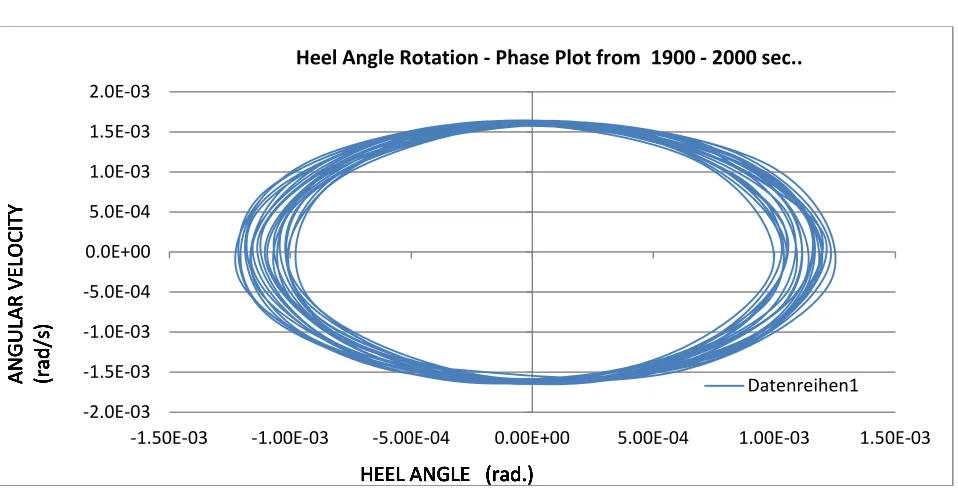
(Fig.14- Phase Plot from 1900 - 2000 sec. showing Stabilized motion under Wave load after recent Earthquake)
Fig. 14 shows that after longer duration of loading, the motion under influence of regular wave becomes dynamically stable after settling down with the excitation impact of Northridge Earthquake. The phase plot shows the motion as harmonic, periodic and symmetric.
VI. CONCLUSIVE REMARKS ON STABILITY ANALYSIS OF SHAT
In addition to above load case, the SHAT model was also subjected to a vide variety of regular waves with different Earthquake loading combinations. Few conclusions drawn are given below:
1. It has been seen that subsequent to application of wave load at 0 sec., due to damping effects, the impact of regular wave excitations gradually die out over a period of approx. 8-10 times the time period of the structure.
2. In all the regular wave cases evaluated under the study, it has been seen that dynamic instability is visible during the initial period pertaining to onset of waves or period pertaining to Earthquake loading. During these periods / shorter duration loadings, system is non-harmonic, asymmetric and aperiodic. Sub-harmonics / super-harmonic are existent in system and bifurcations are easily visible in the phase plots confirming the dynamic instability.
3. With the passage of time, the hydrodynamic dampening effects reduce excitation responses. During larger duration loadings, the motion becomes harmonic, periodic and symmetric. No bifurcations are visible on the phase plots and the structure show dynamic stability. The larger size waves dampen out excitations much early as compared to smaller size waves and system becomes dynamically stable at an early duration which gets clearly visible in the Phase plots.
4. The net positive stabilizing forces acting in the system bring the SHAT back to its mean position, thereby assuring stability in all respects.
REFERENCES
[1] Banik, A.K.and Datta T.K “Stochastic response and Stability of Single leg Articulated Tower”, Proceeding of International Conference on Offshore Mechanics and Arctic Engineering (OMAE), Cancun, Mexico, June 8-13, pp. 431-438, 2003
-2.0E-03 -1.5E-03 -1.0E-03 -5.0E-04 0.0E+00 5.0E-04 1.0E-03 1.5E-03 2.0E-03
-1.50E-03 -1.00E-03 -5.00E-04 0.00E+00 5.00E-04 1.00E-03 1.50E-03 Datenreihen1
HEEL ANGLE (rad.)
AN
GULAR
VEL
OCITY
(rad
/s)
HEEL ANGLE (rad.)
AN
GULAR
VEL
OCITY
(rad
/s)
HEEL ANGLE (rad.)
AN
GULAR
VEL
OCITY
(rad
/s)
HEEL ANGLE (rad.)
AN
GULAR
VEL
OCITY
(rad
/s)
HEEL ANGLE (rad.)
AN
GULAR
VEL
OCITY
(rad
/s)
HEEL ANGLE (rad.)
AN
GULAR
VEL
OCITY
(rad
/s)
ISSN: 2319-8753
I
nternational
J
ournal of
I
nnovative
R
esearch in
S
cience,
E
ngineering and
T
echnology
(An ISO 3297: 2007 Certified Organization)
Vol. 2, Issue 11, November 2013
[2] Banik, A.K. and Datta, T.K., “Stability Analysis of an Articulated Loading Platform in Regular Sea” Journal of Computational Nonlinear Dynamics, ASME, Vol. 3, Issue 1, 011013 (9 pages) doi:10.1115/1.2815332, 2009.
[3] Banik, A.K. , “Dynamic Stability Analysis of Compliant Offshore Structures”, PhD. Thesis, IIT, Delhi, 2004
[4] Chakrabarti S.K., “Stability Analysis of Interaction of an articulated tower with waves”, Proceedings of Fluid interaction, Heikidiki, Greece. Vol.1, pp.281-292, 2001.
[5] Chakrabarti, S. And Cotter, D., “Motion Analysis of Articulated Tower” Journal of Waterway, Port, Coastal and Ocean Division, ASCE, Vol.105, pp.281-292, 1979.
[6] Islam Saiful, A.B.M, “Nonlinear Dynamic Behaviour of Fully Coupled SPAR Platform”, PhD. Thesis, Deptt. Of Civil Engg., University of Malaya, Kuala Lumpur, 2013.
[7] Jameel, M., & Ahmad, S., “Fatigue Reliability Assessment of Coupled Spar- Mooring System”. Paper presented at the ASME 30th International Conference on Ocean, Offshore and Arctic Engineering(OMAE 2011-49687), Rotterdam, Netherlands, 2011.