Statistical Optimization of
Dynamic Importance Sampling
Parameters for Efficient Simulation of
Communication Networks
Michael Devetslkiotls
J.
Keith Townsend
J':~Center
for Communications and Signal Processing,
Department of Electrical and Computer Engineering
~
North Carolina State Universily
~~
7.k5/t!1
HI
77~
7aj9
/1'13
TR-93j9
To appear (with revisions) in the A eM/IEEE Transactions on Networking
Statistical Optimization of Dynamic Importance
Sampling Parameters for Efficient Simulation of
Communication Networks
Michael Devetsikiotis, Student Member IEEE
J.
Keith Townsend, Member IEEECenter for Communications and Signal Processing,
Department of Electrical & Computer Engineering,
North Carolina State University, Raleigh, NC 27695-7914
Abstract
Importance sampling (IS) is recognized as a potentially powerful method for reducing sim-ulation run times when estimating the probabilities of rare events in communication systems
using Monte Carlo simulation. Of special interest is the probability of buffer overflow in
networks of queues.
When simulating networks of queues, regenerative techniques make the application of IS feasible and efficient. The application of regenerative techniques is also crucial in obtaining correct confidence intervals for the estimates involved. However, using the most favorable IS settings very often makes the length of regeneration cycles infinite or impractically long. We discuss here a methodology that uses IS dynamically within each regeneration cycle, in order to drive the system back to the regeneration state, after an accurate estimate has been obtained.
To obtain large speed-up factors in simulation run time using IS, the modification, or bias of the underlying probability measures must be carefully chosen. Analytically or numerically minimizing the variance of the IS estimator with respect to the biasing parameters or finding
the optimal exponential change of measure is only possible under certain conditions. We
extend in this paper a technique we developed for finding near-optimal biasing parameters for link simulations to discrete-event simulations of queueing systems, especially in the case of
complex systems with bursty arrival processes. We also present a methodology for simulating
realistic systems which optimizes IS parameter settings using the mean field annealing (MFA) optimization algorithm in conjunction with statistical estimates of the IS estimator variance. We demonstrate the combination of these techniques by evaluating blocking probabilities
for the M/M/l/K, M/D
nt«,
GI/D/l/K,
Geo/Geo/1/K, and IBP /Geo/l/K queues, a 16x 16synchronous Clos ATM switch, and a 4 x 4 ATM switch with priority and push-out. Run
time speed-up factors of two to eleven orders of magnitude over conventional Monte Carlo are
obtained for these examples.
1. This work was supported by the Center for Communications & Signal Processing as a core project.
2. Portions of this paper have been presented at the 30th ACM Annual Southeast Conference, Raleigh, NC,
Statistical Optimization of Dynamic Importance... , M. Devetsikiotis and J. K. Townsend 1
1
Introduction
A significant problem when using Monte Carlo (MC) simulation for the performance analysis of communication networks is the large run times required to obtain the desired results with
acceptable accuracy. Under proper conditions, Importance Sampling (IS)
[1]
is a techniquethat can speed up simulations involving rare events, of both physical layer (link) and network (queueing) systems [2, 3, 4, 5, 6, 7, 8]. Such an event of special interest is the event of a buffer overflow in networks of queues.
Regenerative techniques make the application of IS feasible and efficient [5]. An important issue we address in this paper is that static IS parameter settings and regenerative simulation
are in conflict - near-optimal but static IS parameter settings typically result in impractically
long regenerative cycles. Thus, dynamic IS techniques are required [9, 10]. The idea behind dynamic IS is to use initially, in each regeneration cycle, the IS settings that will lead to an accurate estimate with maximum efficiency and then change IS values during the simulation so that the system will be driven to regeneration as quickly as possible. Thus the benefits of optimal IS and of short regeneration periods are achieved simultaneously.
In contrast, when IS is used in the customary, static way, regeneration cycles will most likely be impractically, or even infinitely long. Using static IS, the only techniques to circumvent this
are either to force regeneration at chosen instants - which may not always be theoretically
justifiable, or choose IS parameter values under the constraint that regeneration cycles be of
manageable length - which may decrease the efficiency dramatically.
To obtain large speed-up factors in simulation run time using IS, the modification, or bias of the underlying probability measures must be carefully chosen, otherwise the run times may increase. Most promising IS biasing schemes are parametric. Analytically minimizing the vari-ance of the importvari-ance sampling estimator with respect to the biasing parameters [3, 11], or
analytically finding the optimal exponential change of measure
[4,
6, 8], has typically yieldedresults for systems which could either be solved analytically or utilized restrictive assumptions (e.g., Poisson arrivals or independent inter-arrival times). These approaches utilize exact or approximate analytical knowledge of the variance expression or the "large deviation" rates which for many realistic systems is not available. As a result, efficient simulation methodolo-gies have not yet been proposed for B-ISDN systems, which are characterized by correlated, bursty arrivals.
To overcome these difficulties, we have previously presented a technique for finding near-optimal biasing parameter values, based on repetitive, short simulation runs and statistical measures of performance, which were statistical estimates of the estimator variance [12].
For the general problem of optimizing IS parameter values using statistical measures of performance, we are faced with the task of minimizing a stochastic cost function over a pa-rameter space of higher dimensionality. Conventional optimization techniques (e.g., gradient descent, Fletcher-Powell, Newton) do not work well when applied to noisy cost functions. MFA [13] is a deterministic approximation to the simulated annealing (SA) optimization algo-rithm [14]. MFA works well for noisy objective functions of moderate or high dimensionality. A brief overview of SA and MFA are given in Section 4.
(1)
Statistical Optimization of Dynamic Importance... , M. Devetsikiotis and J. K. Townsend 2
m~t~od that us.es IS dynamically in order to allow maximum improvement while still
main-taining a~ effi.clent ~egenerative evolution of the system. Three major advantages of using
rege~eratIvesimulations are: Overcoming the deleterious effects of system memory on the efficiency of IS, no need for a warm-up period, and improved accuracy of confidence interval
calculations [15].
Second, we extend our method of estimating optimal IS biasing parameter values presented in [16, 12] to queueing system simulation. In fact, we combine statistical measures of
per-formance and our underestimation theory from
[12]
with MFA to obtain near-optimal sets ofIS parameter values in cases where analytical and numerical methods are intractable as dis-
,
cussed in Section 4. We use this technique to evaluate very low blocking probabilities for seven
finite queueing systems, M/M/1/K, M/D /l/K, Geo/Geo/l/K, GI/D /l/K, IBP /Geo/1/K, a
16 X 16 synchronous Clos ATM switch, and a 4 X 4 ATM switch with priority and push-out.
The last five systems are characterized by bursty, correlated arrivals, as discussed in Sections 5 and 6.
2
Formulation
2.1
Me
Estimates
We will restrict our attention to formulations based on discrete-time Markov chains. Even
when the actual process under study is a continuous-time Markov chain, simulation of the em-bedded, discrete-time Markov chain leads to lower estimator variance (see [5, 9] and references within). Furthermore, any discrete-event system simulation can be modeled as a generalized semi-Markov process (GSMP) [5]. Finally, simulations involving simple i.i.d. observations, e.g., BER estimation for communication links, can be thought of special cases of discrete-time
Markov chains.
Using the formulation of [9], let {Xih~o be the discrete-time Markov chain with finite
state space £ and transition matrix P. Assume that {Xih~ohas a steady-state distribution,
and converges in distribution to X. The goal is to estimate the expectation
E[f(X)]
of somefunction
f(X)
=
h(X)jg(X).
The expectation off
can be estimated asE(f]
=
l:~~:
h(Xd
l:i=O
g(X
i )where
h(Xd, g(X
i) , i=
0, ...,N
-1 are observations of hand9 obtained during a simulationrun. Although this estimator is consistent, it is also, in general, biased because of the strong
correlation ofh's and g's to the initial state. In order to obtain i.i.d. observations and hence,
correct confidence intervals, regenerative techniques [15] exploit the fact that there exists a state that is visited infinitely often, such that the process starts afresh probabilistically each time this state is visited. Let r be a such a regeneration state, and s denote a sample path in
the evolution of the system under study. Let
H(s)
= l:r;,(ilh(X
i ) and G(s) = l:r;,(ilg(X
i ) ,where
X
o = r, and 1'1 is the first time i greater than zero that
Xi
= r. LetEp[G(s)]
denoteStatistical Optimization of Dynamic Importance ... , M. Devetsikiotis and
J.
K. Townsend 3of
f
above can be written asThis leads to the MC estimate
E[J]
=
E
p[H(5)]
E
p[G(s)]
(2)
(3)
where
Hk(s)
andGk(s)
are i.i.d. observations ofH(s)
andG(s),
respectively. This estimatoris still biased but asymptotically consistent, with variance
ut-c(P),
and can be used to deriveasymptotically correct confidence intervals
[5, 15].
2.2
Efficient Simulation Using IS
Conventional MC simulation techniques require extremely long simulation runs when used to estimate the steady-state probability of rare events. Importance Sampling (IS) has been proposed [1] as a variance reduction technique. Let P* be an alternative, sampling transition
matrix, with
P*(
s) the induced probability measure. IS is based on the observation thatEp[G(s)]
=Ep.[G(s)L*(s)],
whereL*(s)
=P(s)/P*(s),
and provided thatP*(s)
=f
0when-ever
G(s)
P(s)
=f
o.
L*
is a likelihood ratio and, in the language of IS, a weight function.Clearly,
E[f]
can then be estimated as(4)
where
E*[f]
denotes an estimate ofE[f]
using IS. WriteH*(s)
=
LT~Olh(Xi)Li
andG*(s)
==
Lr~ol
g(Xi)Li.
Then, an equivalent [5] IS estimator is(5)
where
Lik
==
P(XOk ' • • •,Xi k ) / P*(XOk ' • • •,Xi k ) . Due to the Markov chain assumption,P(XOk ' • . • ,Xi k ) /P*(XOk ' ••• 'Xi k ) = I1~~~p(Xj k ,Xj+ 1 ,k ) / I1~~~p*(Xj k ,Xj+ 1
,k),
wherep(Xj ,Xj+1 ) are the transition probabilities of the Markov chain. Call the variance of this
estimator
uJs(P, P*).
In (5) above, the likelihood ratio (or weight) at time i during the simulation depends on
all random transitions (e.g., arrivals or service completions) which previously occurred in the same regeneration cycle (RC). Thus, from the IS standpoint, the "memory" of the system is increasing within each RC. An additional motivation to use regeneration techniques is in order to avoid the deleterious effects of large system memory on the efficiency of IS. In fact, as was shown in [5], at least one version of non-regenerative IS breaks down as the length of the simulation approaches infinity.
In (5) it is implied that IS is implemented in a static way, where the modified or biased
Statistical Optimization ofDynamic Importance ... , M. Devetsikiotis and
J.
K. Townsend 4certain conditions for the simulation of Markov chains, the optimal IS is dynamic. When using IS dynamically, the modified transition probabilities p.(X" XJ' J"+1) becomep.X·X·+ (X" X '+1)
1 J' J ,
to denote the dependence of the modified probabilities on the specific state t'ra~sition.
We focus on the problem of estimating the probability that an arriving customer (i.e., cell or packet) will be blocked (lost) because the queue capacity is exceeded. In this case, 9(Xi )
==
1 if an arrival occurs at time i, and 0 otherwise, and h(Xi )==
1 if a cell arrives andis blocked at time i, and 0 otherwise. Then, G( s) is the number of arrivals in aRC,
H(
s) isthe number of blocked cells in a RC, and E[f]
==
Pr[blocking]==
Ep[H(s)]/Ep[G(s)].
Thisblocking probability can be estimated by (3). Clearly, for very low blocking probabilities,
conventional MC estimation is very inefficient and IS (as in (5)) can be used to improve the
statistical accuracy and speed up run times. Note that the denominator in (5) should be
estimated conventionally, since it does not involve a rare event [7].
3
A Dynamic IS Methodology
3.1
Motivation
Consider a single-queue, single-server system. Denote the length of the queue by K
>
o.
Let the number of cells in the system, at instant k be denoted by
Xk,
and assume that aregenerative state r is chosen such that .J'Y/c
==
o.
We distinguish here between two types ofregeneration: Type I regeneration occurs when the system revisits r without ever reaching
{X/c
==
O}.
Type II regeneration occurs when {X/c==
O}
is encountered at least once beforevisiting r again.
Denote the utilization factor by p
==
A/j.L, where1/
Ais the average inter-arrival time and1/
J.L the average service time, and let p" be the utilization factor when IS is used. For theoriginal system (no IS), under light traffic conditions
(p
«
1.0) and with K large, it is clearthat the system will be relatively empty most of the time, regeneration will occur frequently but blocked arrivals will be rare events. That is, type-I regenerations will be frequent but type-II regenerations will be rare, as illustrated in Fig.
1-(
a).A necessary condition for speed-up when using IS is an increased frequency of "important events" (i.e., blocked arrivals). This implies increasing the effective arrival rate and decreasing the effective service rate of the system. As illustrated in Fig. l-(b), when IS settings are chosen so that the traffic load is light (say,p
<
p"<
1.0), the system will still visit {X/c==
O}
although with reduced frequency. In this case, the proportion of type-II regenerations will be increased. On the other hand, when IS statically modifies the probability measures so that the systemtraffic load becomes excessively large (say, p"
>
1.0) the average length of RC's, which isat least as long as the mean recurrence time To of {X/c
==
O},
grows to an impractical size(Fig. l-(c)). In this case, nearly all regenerations will be of type II but the duration of the
regeneration cycle will become very long. As an example, To would be infinite for practically
any GI/GI/I queue with p"
>
1.0 (unstable system). Furthermore, for theM/M/l/K
systemTo
=O(p*K),
which shows the exponential increase ofTo
whenp"
>
1.0. Other queueingsystems behave similarly, demonstrating the requirement for low p*'s.
Statistical Optimization of Dynamic Importance... , M. Devetsikiotis and
J.
K. Townsend 5x
•k
No IS
t
Beginning of RC UMild" static ISt
Beginning of RCK ••••••••••••••••••••••••••••••••••••••• -- •. - ••••••••••..••••.•••. -••••• K -... ••••••••••••••••••••••••• -- •••.•••••••
RC N2
(a) (b)
"Severe" static IS
t
Beginning of RC Dynamic ISt;
Beginning of RCK •••••••••••••••••••••••••••••••••_
-RC #2 IS IMPRACTICALLY LONG ~ k
(c) (d)
Figure 1: Example system trajectories with no IS, mild static IS, severe static IS, and dynamic IS.
after the first blocked arrival (as in
[4,
8]), under static IS we are required to maintain at least moderate load conditions. This can limit dramatically the potential improvement that can be realized with IS; analytical results for simple systems have shown that the optimal biasing typically corresponds to p">
1.0[4],
a fact that is supported by our empirical findings.3.2
Dynamic Application of IS
To circumvent these difficulties, and efficiently combine IS with regenerative simulation we propose a technique in which IS is implemented dynamically. IS parameter settings are var-ied during each RC initially set to allow important events (i.e., blocked arrivals) to occur frequently, and then changed to facilitate driving the system back to regeneration.
At the beginning of a RC, during the phase we call "Efficient Estimation" or EE phase, a high utilization factor PEE is used (the search for optimal IS values during this phase is
further discussed in Section
4)
causing the queue to fill-up quickly, and blocked arrivals tooccur frequently. It will be shown below that
Ei
h(XiJc)Lik
converges a.s. within each cyclek (given enough time). Thus, after such convergence has been detected (usually after a finite
number of blocked arrivals, less than 50, have been observed), the "Accelerated Regeneration"
or AR phase can be entered, where IS settings can be changed to PAR
<
P to favor there-occurrence of the regenerative state (Fig.
1-(
d)). This second phase regards the achievementof the regenerative state as the important event and modifies the probability measures in order
Statistical Optimization ofDynamic Importance ... , M. Devetsikioiis and
J.
K. Townsend 63.3
Justification and Discussion
Recall that, under the IS scheme described previously, the empirical estimate of
Ep[H(s)]
becomes
N 'Tl-l
E;.[H*(s)]
==liNE
E
h(Xile)Lilc
1e=1i=O
(6)
(7)
During the EE phase of the RC, the likelihood of the observed system trajectory becomes increasingly smaller with respect to the trajectory under the unmodified measures. Therefore, the weight function decreases within each RC since weights smaller than 1.0 dominate, and the effect of successive important events on the cumulative estimate decreases as well. Eventually, the weight function becomes so small that blocked arrivals contribute insignificant amounts
to the summation in
(6).
As Glynn and Iglehart show in
[5],
in both the cases of a discrete-time Markov chain andthe previously mentioned GSMP, the cumulative weight (likelihood ratio)
i-I
t;
==
II
p(Xj ,Xj+1 )I
PX;X;+l(Xj ,Xj+1 ) j=Ogoes to zero (a.s.), as i ~ 00. It is straightforward to extend their approach to show that not
only
Lilc
but also i2Lilc
goes to zero (a.s.):Theorem: Let {Xi}i>O be an irreducible Markov chain, on a finite state spaceEunder transi-tion matrix P. Let P* be the IS transition matrix. Let
Li
==
P(X
o, . · ·,Xi)1
p*(Xo, . · .,
Xi)
==
I1;~~p(Xj,Xj+1)/ I1;~~p*(Xj,Xj+l). Then, unless
p(.,.)
=
p*(., .),
limi_ooi2u
=
o.
Proof:
If
p(u,
v) vanishes whenp*(u,
v)is positive, for some state (u, v) E £, then the result is immediate, since the finite state space and the irreducibility of the Markov chain guaranteethat such a state
(u, v)
will eventually be visited. Otherwise, observe thatJim i2
t;
==
limi--+ooexp[1:
¢(Xj, Xj+1 )
+
2logi]
\--+00 j=O
1 i-I 210gi
-:- E
¢(X
j , Xj+1 )+
- i- ~E
7r(u)p*(u,
v)¢(u, v)
1, ;=0 u,v
P*-a.s.
(8)
where
(7r(
u)
log(· ),
U E
£)
are the stationary probabilities ofp*(., .).
By the strict concavity of~
7r(u)p*(u, v)
log(;\:,~))
<
log(~7r(U)p(U'
V))
=
0• ( ) -I- p*(u
v)
By (7)
"i.-l""(X· X
·+1)+
2
logi --+ -00 and thus limi-+ooi2Li
==0
SInce p u, v -r , . , L...J,=oVJ " ,
Statistical Optimization of Dynamic Importance... , M. Devetsikiotis and
J.
K. Townsend 7It follows from the theorem above, that L:~o
Li
converges(P·-a.s.),
and since 0 :::;h(X
i ) :::;1, L:~o
h(X
i )Li
also converges P*-a.s. asM
~ 00. We can therefore choose to switch to theAR phase after the difference between the summation values at two successive blocked arrival
instants, M1 , M2 within the kth RC becomes smaller than a prespecified tolerance €:
M] M1
o
<
L
h(Xik)L:k -
L
h(Xik)L:k
==
LM2k
<
ei=O i=O
In practice, this usually occurred only after 10 or 20 blocked arrivals had been collected. This behavior has been consistently verified in our experimental observations.
4
Optimal IS
4.1
N
e
ar-O'pt imal IS Based on Statistical Estimates
The general, non-parametric, globally optimal IS measure can easily be found but it represents
essentially a tautology, since it requires knowledge of the quantity to be estimated,
E[f]
[17,5].Most useful and practical IS schemes are parametric [2, 3, 18].
In the parametric case, the optimal IS problem can be posed as a multidimensional, non-linear optimization problem, where the values of the IS parameters must be set to optimize
some measure of performance, usually the estimator variance
crJs(P, P*).
When an exactclosed-form representation of the variance is available, the calculus of variations can be used to minimize the estimator variance [2, 3, 11]. Similarly, analytical methods can be used when
optimizing the exponential change of measure
[4,
6, 8]. Still, these approaches utilize exactor approximate analytical knowledge of the variance expression or the "large deviation" rates which for most realistic systems is not available.
To overcome this fundamental difficulty we have presented in [12] statistical measures of
performance, which are statistical estimates of the variability and/or scatter of the Me
obser-vations involved. In other words, instead of minimizing the true estimator variance
crJs(P, P*)
which is usually unknown in closed form, our approach minimizes statistical estimates, of the
variance,
uJs(
P,p.),
with respect to the IS parameter values:-minp.
cr
ls(P,
P*)
The estimates we developed can be obtained during each simulation run with minimal com-putational overhead.
Under certain conditions, the dimensionality of the optimization problem can be reduced to unity. This happens when the search in the parameter space for optimal settings can be
confined on a direction (line) or trajectory
[11]
in the search space. In such cases, ourone-dimensional algorithm from [12] has been shown to provide excellent performance in finding
near-optimal IS parameter settings. Furthermore, for one- and two-dimensional problems,
Statistical Optimization of Dynamic Importance ... , M. Devetsikiotis and
J.
K. Townsend 84.2
M ultidirnensional Optimization Methods for the IS Problem
For the general problem of optimizing IS using statistical measures of performance, we are faced with the task of minimizing a stochastic cost function over a parameter space of higher
dimensionality. Specifically, let the non-negative cost function
C(a)
=
;;];(P,p*) be definedas the estimated IS variance given as a function of dIS parameters, aI, . . . ,ad. In this setting,
C is a random variable with distribution parameterized by the vector
a
== [aI, ...
,ad].In order to optimize the IS speed-up factor we wish to find aopt E Rdthat minimizes
C(
a)==
;;];( P, P*). Conventional optimization techniques (e.g., gradient descent, Fletcher-Powell, Newton) do not work well when applied to noisy (random) cost functions, since "uphill" moves are not allowed.
Simulated annealing (SA) [14] is a widely used optimization method, which employs
stochastic techniques to avoid becoming trapped in local optima. While changes to a which
decrease the cost function are always accepted, a move which causes an increase of D.Cwill be
taken with probability Pr[uphill move
==
D.C] == exp(-D.CIT) that depends on a parameterT called the temperature, thus providing a mechanism for escaping from local minima. Over
time, the temperature is lowered from Tmaz to Tmin,thus lowering the probability of accepting
uphill moves and forcing the system into a global optimum.
The mean field annealing (MFA) algorithm
[13]
is a variation of simulated annealing thatretains the ability of SA to avoid local minima and arrive at optimal or near-optimal solutions
while demonstrating more rapid convergence.
In
applying MFA, a randomly selectedparame-ter i is stepped through the entire set of M quantized values in the range (Amin,i, Amaz,i) and
the cost function Cj, 0 ::;j ::; M - 1, is determined at each value. The selected parameter is
then set to a weighted average of the quantized values
(9)
where bins with a larger cost function contribute less to the average. This procedure is
performed for every parameter and, as the temperature decreases, each parameter increasingly avoids values with a high cost function.
4.3
Optimization of IS Parameters Using MFA
MFA combines the effectiveness of SA with reduced run times, therefore we select it over
SA
to minimize the above noisy cost function,
C(a) ==
irJs(P, p.)
with respect toa.
OurMFA-based algorithm that estimates near-optimal IS parameter settings aI,opt,· • • ,ad,opt is given in
Fig. 2. . . .
In the algorithm we also exploi.!.. a theoretically justifiable r~latlOnshIp, for small
sa~-Ie sizes between the IS estimate
E.[/]
and the amount of IS bias. As we have proven In[12],
for 'a wide range of biasing schemes, small sample sizes andincreasi~g biasin~ amo~nts
("over-biasing"),
E:[f]
increasingly underestimates the ~nkno~nexpectation EV]I~a givensimulation run with probability asymptotically approaching unity, From an algorithmic
P,um <=P,um
+
exp(-CjIT) a,um <=a,um+
~.
exp(-CjIT)Statistical Optimization ofDynamicImportance ..., M. Deveisikioiis and
J.
K. Townsend 91*
Initialize parameters to random values */for(i ~1; i:::; d; i ~i
+
1)~ <=random(Amin,iJAma~,i)
1*
Anneal (i.e., reduce) T from Tm a Zl to Tmin using "'I<
1*/
for(T <= Tm a Zl ; T>
Tmin; T <="'IT)NEQ ~ E
1*
Initialize equilibrium counter*
I
/*
Repeat until equilibrium is established*
I
do until(NEQ=
0)i ~ random(l, 2, ... ,d)
1*
Randomly pick one of thedparameters*
I
a,um <=0/*
Reset weighted amplitude accumulator*1
P,um <= 0
1*
Reset exponential weight accumulator*I
1*
Compute estimated variance C and estimate Ep -[f] for each quantized parameter level*1
for(i<=:O; i<M; i<=i+1)
Q.i <=:Amin,i
+
iq1*
Compute next parameter level*/
(Gj ,E;:[f]) ¢::simulate(a,N)
1*
Simulate using parameter vector a and samplesize N to find new cost function Gj and estimate E;:[f]
*/
ir(E;:[f]
<
Th) thenc,
=
MAX/*
Ifestimate less than threshold, set cost function to maximum value*/
1*
Accumulate exponentials*
I
1*
Accumulate weighted level*
I
Q.i <=:a,umlP,um
NEQ ¢::N E Q - 1
/*
Update parameter with its new value*
I
1*
Decrement equilibrium counter*
I
Figure 2: Pseudo-code for MFA-based algorithm used to minimize
C(a)
respect to the IS biasing parameter vector, a.
Uls(P,
P*)
withthat when the estimate is lower than this threshold, the cost function is set to a very large
value (MAX in Fig.
2).
This practically eliminates the corresponding biasing parametersas possibilities for the optimal settings, thus reducing the search space drastically. A priori
knowledge in the form of (at least loose) lower bounds on the probability to be estimated
is usually available. Note that this type of a priori knowledge is very different from the
"analytical" type of knowledge required in other IS optimization methods.
For each simulation run (i.e., cost function evaluation) in the algorithm, the sample size
N should be made as large as practically possible, since larger sample sizes result in less noisy
cost function observations.
5
Calculation of Speed-Up Factors
To estimate the speed-up factor over conventional
Me
simulation provided by importance(10)
Statistical Optimization of Dynamic Importance... , M. Devetsikiotis and J. K. Townsend 10
NR
~ndependen~
runs of NRC RC's each. Denote the probability estimate corresponding tothe tth run be Pi, i
=
1, ... , NR . Our overall probability estimate is then the sample meanA 1 ~R A
P==-LPi
NR i=l
We estimate the variance of
Pi
by the sample variance(11)
Based on the normal assumption we obtain the 95% confidence interval for
Pi:
(12)
as in [20], where 1.96 is the upper 1 - a/2 critical point for the standard normal random
variable, a
==
0.05.Let NRc,MC be the number of conventional Monte Carlo RC's required to achieve the same
confidence level as given by
(12).
Then the speed-up factor RIS in terms of number of RC'sis the ratio RIS
==
NRc,MC/NR C.To estimate NRC,MC we first assume that in each conventional Monte Carlo RC there is a
constant number of arrivals, equal to the expected number
A
of arrivals per RC. This is anapproximation we make to simplify the calculations. Furthermore, we conservatively assume
that successive customer losses are independent. This means that, in our calculation, NRC,MC
conventional Monte Carlo RC's are assumed equivalent to NRc,MC x
A
i.i.d. observations, Wethen calculate the NRc,MC required to make the confidence interval in equation (8) of
[21]
equal to the confidence interval in
(12)
above.In reality, successive losses are far from independent, especially when traffic is bursty. Our assumption is conservative because, in general, a greater number of observations is required
when observations are dependent. In
[21],
page 158, an example is given that illustrates howthe variance of the estimator increases when observations are correlated. The implication for our calculation is that, in actuality, a greater number of conventional Monte Carlo RC's would have to be run in order to achieve the same accuracy.
Note that this measure of comparison is based on the number of RC's, not the actual
simulation run time that would have to include the length of RC's as well. Assuming the
computational effort required to complete the simulation of the i-th RC to be equal to its
length Di in number of arrivals, the total run time required to obtain an estimate based on
NRC's
isD
==
E~lD
i . Then,iJ
==
E{D}
==
N E{D
i } . ~ fair comparison of simulationefficiency can then be based on the time-reliability product D
u;,
where u; is the variance ofHt(s),
the number of (weighted) blocked cells during the i-th RC. In the case of conventionalMe,
since the queue rarely fills up, RC's are extremely short at the cost of a very large17;.
Under favorable IS settings, the (expected) length of RC's increases but17;
decreasesso that the resulting time-reliability product can be orders of magnitude smaller than that
Statistical Optimization of Dynamic Importance ... ,M. Devetsikiotis and
J.
K. Townsend 11increasing
u;.
Hence, while the purpose of the EE phase is mainly to makeu;
low, the ARphase ensures that regeneration will occur frequently, keeping
Di'S
short.When IS is applied in order to increase the frequency of losses, the length of RC's inevitably increases over its value under unbiased conditions. In the following, we denote the factor of
increase (in time units) in the expected length of a RC under IS by
R
t • Denoting the speed-upin number of RC's by
RIS,
the net run time improvement over conventional MC simulationis then Rnet
==
RIS/ R
t .6
Application to Continuous-Time Queueing Systems
We focus here on continuous-time queueing models. In this section we use the dynamic and regenerative IS techniques discussed earlier in order to estimate the average probability of blocked arrival for M/M/1/K, M/D /l/K, and GI/D /l/K systems. IS performance is opti-mized using the one-dimensional methods mentioned in Section 4.1 [12, 16].
6.1
The M/M/1/K Queue
The M/M/1/K system had an average arrival rate A
==
1.0, an average service rate JL==
1.333,and a system capacity K
==
101. The blocking probability could be calculated analytically andwas found to be 6.01 X 10⁻¹⁴. For this system RC's coincided with busy cycles. The average
number of arrivals per RC was calculated analytically to be
Ep[G(s)]
==
4.0. As discussedearlier, we only needed to use IS to estimate the average number blocked per RC,
Ep[H(s)].
For this example,
Ep[H(s)]
==
2.41 X 10⁻¹ 3, and this is the number that we estimated by (6)using our technique.
Under IS, the inter-arrival and service times were still exponential, but the rates
A
and J.Lwere independently multiplied by biasing parameters. Using our algorithm in [12], optimal parameter values were estimated to be 0.73 and 1.36 for the interarrival time multiplier and service time multipliers respectively. Shown in Figs. 3 and 4 are cross-sections of a 3-D plot of
E
p •[H*( s)]
vs. the IS parameter values, through this optimal point. Each point on theseplots represents one simulation run of N
==
100 RC's. Also shown in these figures are plots ofthe corresponding variance estimators. As discussed in [12], the algorithm minimizes a cost
function which combines the local scatter of the
Ep.[H*(s))
curve and the sample variancefor each estimate. The effectiveness of the algorithm is clearly evident in the figures. Our estimated near-optimal IS settings were similar to those analytically calculated in [4] for the M/M/1/00 queue.
Based on NR
==
100 runs with NRC == 1000 RC's per run, using the above estimated optimalIS values, we obtained
E
p •[H*(s)]
== 2.41 X 10⁻¹³, corresponding to a blocking probabilityof 6.025 x 10⁻¹ 4
. The 95% confidence coefficient for this set of runs was calculated to be
7.44 x 10⁻¹ 6 .
Using the procedure in Section 4 we calculated a speed-up factor of 1.057 X 101 2, i.e.,
our simulation estimated the average number blocked in aRC,
Ep.[H*(s)],
with a factor ofStatistical Optimization ofDynamic Importance... , M. Devetsikiotis and J. K. Townsend 12
o.~
0.9 1.0
1000rC's /Run
I
!
~vg.Service! >.Time Mull.
~ =: =1.3333
~
r..
:
~.i
~AV!. BlockedI RCj;
~fli ~:~~dm
•.
i
f ./
¥
\~
'",.1 ..
I "
." U~ Copt
.1.
:::
...
=0.73 ," ."1xJ.0 -19+ - -...---.----...~...- ...0 • 0
1.0 0.8 0.6 0.4 0.2 0.0
Avg. InterArnval Time Multiplier 1xJ.O-1 8
1x1.0 -13
U 1x1.0 -14 a:
-~ 1x1.0 -15
o
o
~ 1x1.0 -16
C)
> -c
Figure 3: Cross-section of the 3-D plot of
Ep.[H*(s)]
overlaid with estimated sample variance,as a function of the interarrival time multiplier at the near-optimal value for the service time multiplier. 0.2 ~ c eu .~ 0.4 > 0.8 CD cu E
O. 6 .~ 1.0
Avg. BIock.cl1 AC
" '. " '. "
'.
"'.
"....!
:...1\./\
..--..100RC's I Run Avg.
InterAmvaJ Time Multiplier = 0.75
,I
"
.
"... \..
lx10- 1 5
lx1 0 -16 -IL---~~-...Io1~---'---r'"---r--o.0 lxl0- 1 1
lx1.0- 1 2
o a::
1.0 1.2 1.4 1.6 1.8 2.0
Avg. service Time Multiplier
Figure 4: Cross-section of the 3-D plot ofE;.[H*(s)] overl~dwith estimated ~ample ;aria~ce,
as a function of the service time multiplier at the rrear-optirna] value for the interarrival time
Statistical Optimization of Dynamic Importance ... , M. Devetsilciotis and
J.
K. Townsend 13Note:
Runlime becomes impracticaJly long when p* =p. =1.863P
AR EE
1 ' - - - _ . . I - _ - - ' - - _ - . a . . . - - '
1.22 1.0 0.01 5.0e-4 5.0e-7 5.0e-9
* /
PAR P
U
QJ 3J----+.--...---+----1---+----i
~
QJ
.§
~
=
~ 21---P.---+---+---+----i
4
Figure 5: Plot of the average simulation run time in seconds versus P~R expressed as a
fraction of the original utilization p, Run times are based on starting with the optimal PEE
and switching to PAR after 20 lost cells, N
==
100 RC's per run.In our example M/M/1/K system,
R
t was estimated to beR
t==
38.97, leading toRnet
==
2.712 X 101 0•
To see the effect of AR settings on the simulation length, refer to Fig. 5, which corresponds
to the same M/M/1/K system above. As P~R decreases, the RC average length and hence,
the total run time, becomes shorter, as would be expected. The value of PAR shown on
the rightmost point is the value used in all simulation results reported in this section. The
advantage of dynamic IS is most evident in the case PAR
==
PEE==
1.863p. In this case, RC'swould be impractically long, as discussed earlier.
One other characteristic alluded to earlier was that, as the system trajectory in the kth
RC evolves under IS, E~o
h(XiJe) LiJe
converges a.s. asM
~ 00. This can be seen in Fig. 6,which shows
E;':[H*(s)]
for the same M/M/1/K system above as a function of the numberof blocked arrivals observed in the RC before switching to the AR phase. After 10 to 20
blocked arrivals have been observed in an RC, the estimate has converged to a desired level of precision.
6.2
The
M/D/l/K
Queue
The next example is an M/D /1/K queue where
A
==
1.0, the deterministic service rate, wasfixed at 1.333, and the system capacity was K
==
59. Again for this system, RC's coincidedwith busy cycles. The average number of arrivals per RC was estimated to be
Ep[G(s)]
==
4.0.Under IS, the inter-arrival times were still exponential, but the rate
A
was multiplied bya biasing parameter. A plot of
Ep.[H*(s)]
and the sample variance estimate as a functionof the interarrival time multiplier is shown in Fig. 7. As before, the optimal IS biasing
parameter value was estimated using our algorithm. It is clear from Fig. 7 that the chosen
Statistical Optimization of Dynamic Importance... , M. Deveisikiotis and
J.
K. Townsend 14Mll\1Il/K Queue
A. =1.0 Il=1.3333 K=101
3e-13
True
.~!~!~:~~~!..~~~~~~~.
,... 2e-13t---,~t__---+__--__1
"'0 ~ ~ ~ S <~
1 e-13 t - # - - - - t - - - + - - - I
1000 100
10
0 " - - - 1 . . . - - - - 1 - - - 1
1
# of Blocked Arrivals Before Switching to the AR Phase
Figure 6: Plot of
t;.
[H*(s)]
as a function of the number of blocked arrivals observed beforeswitching to the AR phase.
0.2 Q) (ij .§ (j) 0.6 Q) Q) o c .s (ij 0.4 > 0.8 1.0
100 RC's / Run , ;:- ...
.: .~
1.1L1
li
~
MIII;ll
:: : ~::Avg. BlockedIRC
g :
i~---':. : Vanance esbmate
l!~
j
.
N~~I
:
....~....:....:!
'"'" :::{
1x10 -18 1X10⁻¹ 41x10 -19 ~----'---..,..----"'---...,.~0 . 0 1X10- 1 3
o
~ 1x10- 1 5
"'0
.s
o~1x10 -16
en
> -c
1x10- 17
1.0 0.5 0.0
Avg. InterArrival TIme Multiplier
Figure 7: Plot of
E;:[H·(s)]
overlaid with estimated sample variance, as a function of theStatistical Optimization of Dynamic Importance... , M. Devetsikiotis and
J.
K. Townsend 15100 RC's I Run
1.0
0.8
(])
cu
.§
0.6 iii(]) (])
0
c
ro
"C
ro
0.4 >
0.2
-~ lxlO- 1 3
g
CDen
~ lx10- 1 4 o
a:
1x10 -16 - f - -...-...-....--...,..-~...---...,....0 • 0 1x10- 1 1
lx10- 1 5 lxlO- 1 2
1.0 0.8 0.6 0.4 0.2 0.0
Importance Sampling Multiplier
Figure 8: Plot of
Ep.[H*(s)]
overlaid with estimated sample variance, as a function of themultiplier m for an GI/D
/l/K
system.the same procedure as above in the
M/M/1/K
case, we obtained an estimate ofE;.
[H*(s)J ==1.16
x
10-14, corresponding to a blocking probability of 2.9x
10-15. The 95% confidencecoefficient for N R == 100 runs at NRC = 1000 RC's per run was 2.88 x 10⁻¹⁷. From the same
set of 100 runs we obtained RIS = 3.38 X 10¹³, R, = 47.34, and
Rnet
== 7.15 X 1011.6.3
A
GI/D/1/K
Queue
The last example we present is an GI/D
/l/K
queue, where Pr[interarrival time=
a1]
== p,and Pr[interarrival time
=
a2]
=
1 - p, 0<
p<
1. In this example, al == 2.1, a2=
0.7,p == 0.6, the deterministic service rate is fixed at 1.25, and the system capacity is K == 19.
RC's coincided with busy cycles. The average number of arrivals per RC was estimated to be
Ep[G(s)]
= 2.213.Under IS, p was multiplied by m to obtain the biased distribution Pr*[interarrival time
==
0:1]
==p*
==
pm,
and Pr*[interarrival time==
0:2] ==
I-pm,
0<
m<
lip.
A plot ofE;.[H*(s)]
and the sample variance estimate as a function of the multiplier m is shown in Fig. 8. The
optimal IS biasing parameter setting was found to be mopt
==
0.33. At the optimal IS settingwe estimated R;
==
38.13. Using N R==
100 runs at NRC==
1000 RC's per run, the estimateof the average blocked per RC, blocking probability, 95% confidence coefficient, and speed-up
factors over conventional MC simulation were estimated to be
E;.[H*(s)]
== 3.87 x 10-13,1.75 X 10-13, 1.29 X 10⁻¹⁵,R1S
==
1.85 X 10¹², andRnet
==
4.85 X 10¹⁰, respectively.7
Application to Slotted-Time Queueing Systems
Statistical Optimization of Dynamic Importance... , M. Devetsikiotis and J. K. Townsend 16
2.4
2.2 2.3
p*/ p 2.1
1.8
----'----...L..-__
...I-_ _- J2 2.2 optimal
/
2.1 .-- 0-I ~" - '
start
--
.r-2 0-I ~ '-" 1.92
3
p*/ p 2.1 2 ~ 0"" I ~ ' - '--
1.9*'
~ I ~' - " 1.8
1.7
start
1.6
0 1
Figure 9: Trajectories of the IS parameters moving towards the near-optimal solution for the Geo/Geo/l/K queue examples.
IS technique, to optimize the IS parameter settings. Four systems are studied, in order of increasing complexity and practical significance:
7.1
Non-bursty Syst em , Geo/Geo/1/K
The Geo/Geo/l/K queue [22] is the simplest finite capacity slotted queueing system, the
equivalent of the M/M/l/K queue. Both the arrival process and the service process are
memoryless. There is a probability p in each slot that a cell will arrive, and a probability q in each slot, when the server is busy, that a cell will depart. Arrivals and service completions
are independent. There is a finite capacity of K cells in the system.
Under regenerative IS, we choose the empty state as the regeneration state and the times that a cell arrives to an empty system as the regeneration points. In each RC, we bias initially
p and q to
pi
and q;, until a cell has been blocked, then change IS parameters to pi,qi
inorder to allow fast regeneration (dynamic IS, [10, 19]).
In our experiments, we set p; = p, q; := q, and optimized with respect to the settings of
pi, q;
using MFA. In applying our MFA-based algorithm (Fig. 2) we set al :=pi,
a2 := 1 -q;,
A m a z ,1
=
1.0, Amin,l=
0.8p, Am a z ,2 := 1.0, Am i n ,2 := 0.8(1 - q), / := 0.8, M := 100, E == 5, N ==100, Tm a z := 3.0, and Tm i n := 3.0 X 10⁻²• Results were obtained for two queue configurations:
(p
=
0.3, q=
0.64853,K
:= 10) and (p := 0.3, q == 0.64853,K := 20). The thresholdTh
inFig. 2 was set to 10-9 and 10-1 5
, respectively.
Fig. 9 shows an example of the trajectory of the IS parameters moving towards the near-optimal solution for the Geo/Geo/l/K queue. Table 1 summarizes the results, including the near-optimal IS parameters found by MFA, the corresponding estimated blocking probabilities,
Statistical Optimization ofDynamic Importance ... , M. Devetsikiotis and
J.
K. Townsend 17Buffer Pr[loss] IS values P~[loss] 95% Confidence RIS
Rnet
K == 20 1.121 X 10- 13 2.1684 1.161 x 10⁻¹³ (1.136 X 10⁻¹³, 5.62 X 10¹² 3.88 X 10¹¹
2.0042 1.186 X 10⁻¹³)
K == 10 2.455 X 10⁻⁷ 2.2930 2.494 X 10⁻⁷ (2.427 X 10⁻⁷, 1.70 X 10⁶ 2.21 X 10⁵
2.1173 2.560 X 10⁻⁷)
Table 1: Blocking probabilities and speed-up factors using the proposed algorithm for the
Geo/Geo/1/K queue, with p == 0.3, q== 0.64853. For these estimates: N R
==
100, NRC == 100.simulation. For these estimates we used N R == 100, NRC == 100. We estimated
R,
== 7.69 whenK == 10, and Rt == 14.5 when K == 20. Estimated blocking probabilities are in agreement with
the known, analytically calculated probabilities.
7.2
Bursty System, IBP /Geo/l/K
The IBP /Geo/1/K queue is the slotted equivalent of the IPP /M/l/K queue and a special case of the MMBP /Geo/1/K queue. For this queue, although the service process is memoryless, the arrival process is bursty. This makes this queue a useful and widely used model for the bursty processes involved in B-ISDN and ATM analyses.
There are two states of the arrival process: active and inactive. In the active state, an
arrival can occur with probability a while in the inactive state no arrivals can occur. While
the arrival process is in the active state, there is a probability p at each slot that the state
will remain active and a probability 1 - p that it will change to inactive. While the arrival
process is in the inactive state, there is a probability q at each slot that the state will remain inactive and a probability 1 - q that it will change to active. When the server is busy, there
is a probability 1 - (3 in each slot that a cell will depart. Arrivals and service completions are
independent. There is a finite capacity of K cells in the system. In our experiments, a was
assumed to be equal to 1. Let
i
denote the random interarrival time. The squared coefficientof variation c2 ==
Var(i)/[E(i)]2
of the interarrival times is used to measure the burstiness ofthe arrival process. Typical values are c2 == 1 corresponding to Poisson arrivals, c2 ~ 20 for
voice and c2 ranging from 10 to 10,000 for video.
Under regenerative IS, we choose the times that a cell arrives to an empty system and the arrival process has just changed to active, as the regeneration points. In each RC, we bias
initially
p, q
and (3 topi, q;
and (3;, until a cell has been blocked, then change IS parametersto
p;,
q;
and(3;
in order to empty the queue and, finally, change topi,
qi
and/3i
in order toallow fast regeneration.
In our experiments, we set
p;
==p;
==p, q;
==qi
==q,
(3; ==/3;
== {3 and optimized withrespect to the settings of
pi,
q; and (3;using MFA. In applying MFA we set a1 ==pi,
a2 == q~,a3 ==
(3;,
Amaz,l == 1.0, Am i n,l == P, Am a z,2 == q, Am i n,2 == 0.5q, A m a z,3 == 2.0{3, Am i n,3==
{3,, ==
0.8, M==
100, E == 6, N == 100, Tm a x == 8.0 X 10⁻², and Tm i n==
1.0 X 10⁻³. Resultswere obtained for three queue configurations that corresponded to three different values of
Statistical Optimization of Dynamic Importance ... , M. Devetsikiotis and J. K. Townsend 18
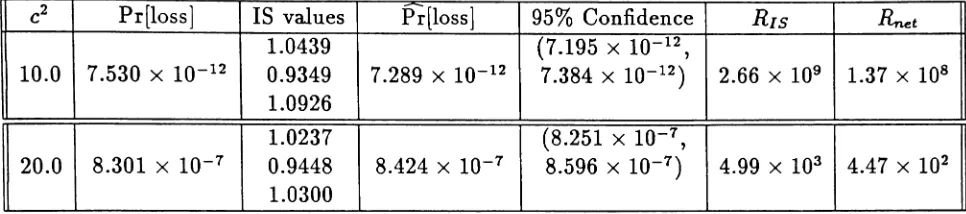
c2 Pr[loss] IS values ~[loss] 95% Confidence RIS
Rnet
1.0439 (7.195
x
10-12,10.0 7.530 X 10⁻¹ 2 0.9349 7.289 X 10⁻¹² 7.384 X 10⁻¹²) 2.66 X 10⁹ 1.37 X 10⁸
1.0926
1.0237 (8.251
x
10-7,20.0 8.301 X 10⁻⁷ 0.9448 8.424 X 10⁻⁷ 8.596
x
10-7) 4.99 X 10³ 4.47 X 1021.0300
Table 2: Blocking probabilities and speed-up factors using the proposed algorithm for the
IBP /Geo/1/K queue, with {3
==
0.35147, K==
200. For these estimates: N R==
100 NRC=
500.
'
(p
==
0.965048543,q==
0.976699029,{3==
0.35147,K==
200), and (p==
0.976470588,q0.984313725,{3
==
0.35147,K==
200). The threshold Th of Fig. 2 was set to 10-13, 10-8 and10-6, respectively.
Table 2 summarizes the results, including the near-optimal IS parameters found by MFA, the corresponding estimated blocking probabilities, the estimated confidence intervals and the speed-up factors with respect to conventional MC simulation. For these estimates we used
N R
==
100, NRC==
500. We estimated Rt==
19.38 when c2==
10.0, and R;==
11.16 whenc2
==
20.0. Estimated blocking probabilities are in agreement with the known, analyticallycalculated probabilities, as illustrated in Fig. 10.
7.3
Realistic System:
ATM
Switch
The Asynchronous Transfer Mode (ATM) appears to be the evolving standard for broadband
ISDN. We consider an ATM switch with buffers at the input ports. The switch fabric is a
Clos three-stage interconnection network. For a detailed description of the switch and an
approximate model for its operation see [23] and references within. Such an NL x NL Clos
cell switch is shown in Fig. 11.
The bursty arrival process to each input port is modeled as a discrete time Interrupted Bernoulli Process (IBP), described in the previous segment. For this type of switch an
ap-proximation algorithm was constructed in [23].
Under regenerative/dynamic IS, we choose the times that a cell arrives to an empty buffer and the arrival process has just changed to active, as the regeneration points. Note that this is an approximation, required here due to the impractical length of the "true" regeneration cycles based on all the buffers being empty, and all the arrival processes just changing to
active and producing an arriving cell. Our approximation is supported by the fact that
these approximate RC's (ARC's) are long enough to allow us to consider events across cycles
"practically independent". It is also supported by the extensive experimental correlation
analysis we conducted, i.e., estimates of the correlation existing ARC's were consistent with
our assumption of independence.
Statistical Optimization of Dynamic Importance ... ,M. Devetsikioiis and
J.
K. Townsend 19~
»:
/
/
I
-/
- -
Exact results,
-I
II
IS simulation-I
I
-,
•
1
0.1
~ 0.01
==
0.001~
0.0001.c
e
1e-05~Of} 1e-06
:i
1e-07.2
1e-08 ~ 1e-09 1e-10 1e-11 1e-1210 100
1000
10000
Figure 10: Estimated blocking probabilities and analytically calculated probabilities vs. the squared coefficient of variation, c2, for the IBP /Geo/l/K queue.
2
n
1
2
n+1
2n
N-n+1
N
Statistical Optimization of Dynamic Importance... ,M. Devetsikioiis and J. K. Townsend 20
1
s art
0.9
0"'
--*
0"'0.8
0.7
0.6
0.5
0.6
0.7
0.8
0.9
1 1.1p" / p
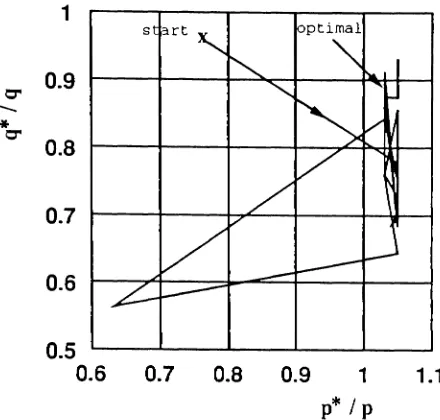
Figure 12: Trajectory of the IS parameters moving towards the near-optimal solution for the
ATM switch model.
model, there is no explicit service probability 1 -
f3
available to be modified. In each ARC,we bias initially p and q to
pi
and q;, until the weight function (likelihood L*) decreases to aprespecified minimum, then change IS parameters to
p;
andq;
in order to empty the queueand, finally, change to
pi
andqi
in order to allow fast regeneration.In our experiments, we set p; == 0.3p,
pi
== p, q; == 1.045q,qi
== q, and optimized withrespect to the settings of
pi
andq;
using MFA. The number of input lines was NL == 16,with input buffers of length
K
== 200 each. In applying MFA we set a1 ==pi,
a2 ==qi,
A17la z ,1 == 1.07p, Am i n , l == O.lp, Am a z ,2 == 1.045q, Am i n ,2 == O.lq, I == 0.8, M == 50, E == 5,
N == 100, Tm a z == 8.0 X 10⁻², and Tmin == 8.0X 10⁻⁵• Results were obtained for a configuration
that corresponded to c2 == 10.0: (p == 0.932075471,q == 0.954716981,N
L == 16,K == 200).
Symmetric traffic conditions over the 16input lines were assumed. The threshold Th of Fig. 2
was set to 10-13 •
Fig. 12 shows an example of the trajectory of the IS parameters moving towards the
near-optimal solution for the ATM switch model. Table 3 summarizes the results, including the near-optimal IS parameters found by MFA, the corresponding estimated blocking probability, the estimated confidence interval and the speed-up factor with respect to conventional MC
simulation. For these estimates we used NR == 50, N
nc
== 100. We estimated H, == 25.0.Statistical Optimization ofDynamic Importance... , M. Devetsikiotis and
J.
K. Townsend 21Pr[loss] IS values P~[loss] 95
%
Confidence RISRnet
unknown 1.0504 1.93 x 10⁻¹⁰ (1.501 X 10⁻¹⁰
, 4.15 X 10⁶ 1.66 X 10⁵
0.8938 2.356 x 10⁻¹⁰)
Table 3: Blocking probabilities and speed-up factors using the proposed algorithm for the
16 x 16 ATM switch, with p
=
0.932075471, q=
0.954716981, c2=
10.0, and K=
200. Forthese estimates: N R
==
50, NRC=
100.Approx. results
Brute-force
Me
10.1
>, 0.01
.a.J
:::: 0.001 ]eu 0.0001
~ 1e-05
~
1e-06g
1e-07~o 1e-08
~ 1e-09
"' 1e-10 1e-11 1e-12
10
o
II
100
IS simulation
1000
10000
Figure 13: Plot comparing the approximation results with conventional
Me
results (where itwas possible) and the simulation result obtained using IS. Blocking probabilities are plotted
vs. the squared coefficient of variation c2• IS results are consistent with conventional MC
Statistical Optimization of Dynamic Importance... , M. Devetsikiotis and J. K. Townsend 22
Buffer Pr[loss] IS values P~[loss] 95% Confidence RIS
Rnet
K -70 unknown 1.0905 1.042
x
10 9 (6.978 X 10⁻¹⁰, 2.63 X 10⁴ 2.17 X 1030.8683 1.381
x
10-9)K -
85 unknown 1.0905 2.19x
10 11 (1.307 X 10⁻¹ 1, 8.89 X 10⁵ 7.06 X 1040.8683 3.073
x
10-11)
Table 4: Low priority cell blocking probabilities and speed-up factors for the 4 x 4 ATM
switch, with p
==
0.908411, q==
0.960747, c2==
10.0, and PH==
0.3. For these estimates:N
R==
20, NRC==
10,000.7.4
N
L XN
LATM Clos Switch with Head-of-Line Priority and
Push-Out
Again, we consider an ATM switch with buffers at the input ports, modeled as a slotted-time
queueing system. Such an NL
x
NL Clos cell switch is shown in Fig. 11. Furthermore, weassume that there exist two classes of cells, high priority and low priority cells, and that
the switch operates with head-of-line priority and push-out. For a detailed description of the
switch and an approximate model for its operation see [24] and references within.
The ATM switch we study here has NL
==
4 input lines, symmetric traffic overall
inputlines, two classes of cell priority (high and low), average rate of arrival in each line A
==
0.3,probability that a cell has high priority PH
==
0.3, and buffers of length K==
70.A pproximate regeneration cycles (ARC's) were again used, as described in the previous
section.
IS biasing was done dynamically. In each ARC, we biased initially p and q to p~ and q;,
until the weight function (likelihood
L*)
decreased to a prespecified minimum, then changed IS parameters top;
andqi
in order to empty the queue and, finally, changed topi
andq;
in order to allow fast (approximate) regeneration. In our experiments, we set p;
==
p;==
p,qi
==
q~==
q,PH
==
PH·We optimized IS performance with respect to the settings of p~ and q; using MFA, in a way similar to [19]. The blocking probability for low priority cells were estimated that corresponded to c2
=
10.0: (p=
0.908411,q=
0.960747,NL=
4,PH=
0.3,K=
70). Weused the same IS values to estimate the blocking probability for c2 = 10.0: (p = 0.908411, q =
0.960747, NL
=
4,PH=
0.3, K=
85). This demonstrates a certain robustness of the optimal IS setting with respect to the queueing capacity, when all other coefficients remain fixed. Table 4 summarizes the results. For these estimates we used NR = 20, NRC = 10,000. Weestimated
R;
=
12.1 whenK
=
70, andR
t=
12.59 whenK
=
85.8
Conclusions
Statistical Optimization ofDynamic Importance ... ,M. Devetsikiotis and J. K. Townsend 23
periods can be achieved simultaneously.
In most realistic systems, the IS estimator variance is not known in closed form. For these cases, minimizing statistical estimates of the variance with respect to the IS parameters can be a useful alternative. The SA and MFA optimization algorithms are appealing because of their increased resistance to the noisiness of the cost function and their ability to escape local minima. We have presented a methodology that uses the MFA algorithm in conjunction with statistical estimates of the IS estimator variance, to obtain near-optimal IS parameter settings.
Run time speed-up factors of two to eleven orders of magnitude over conventional MC sim-ulation are obtained using our methodologies for a wide variety of queueing systems, including systems with correlated arrivals and multiple queues.
References
[1] H. Kahn and A. W. Marshall. Methods of Reducing Sample Size in Monte Carlo Com-putations. Opere Res. Soc. of Amer., 1:263-278, Nov. 1953.
[2] K. S. Shanmugan and P. Balaban. A Modified Monte-Carlo Simulation Technique for the Evaluation of Error Rate in Digital Communication Systems. IEEE Trans. Commun.,
COM-28(11):1916-1924, Nov. 1980.
[3] D. Lu and K. Yao. Improved Importance Sampling Technique for Efficient Simulation of Digital Communication Systems. IEEE J. Select. Areas Commun., 6(1), Jan. 1988.
[4] S. Parekh and
J.
Walrand. A Quick Simulation Method for Excessive Backlogs in Net-works of Queues. IEEE Trans. Automat. Contr., AC-34(1):54-66, Jan. 1989.[5] P. W. Glynn and D. L. Iglehart. Importance Sampling for Stochastic Simulations. Man-agement Science, 35(11):1367-1392, Nov. 1989.
[6]
J.
S. Sadowsky and J. A. Bucklew. On Large Deviation Theory and Asymptotically Efficient Monte Carlo Estimation. IEEE Trans. Inform. Theory, IT-36(3):579-588, May1990.
[7] V. S. Frost and Q. Wang. Efficient Estimation of Cell Blocking Probability for ATM Systems. In Proc. of IEEE Int. Conf. Commun., Denver, CO, 1991.
[8] M. R. Frater, T. M. Lennon, and B. D. O. Anderson. Optimally Efficient Estimation of the Statistics of Rare Events in Queueing Networks. IEEE Trans. Automat. Contr.,
AC-36(12):1395-1405, Dec. 1991.
[9] A. Goyal, P. Heidelberger, and P. Shahabuddin. Measure Specific Dynamic Importance Sampling for Availability Simulations. In Proc. 1987 Wint. Simul. Conf., pages 351-357,