An Accurate Subpixel Shift Registration in
Noisy Image Using a Kernel Regression
Method
Hossam Eldeen M. Shamardan
Assistant Professor, Depart ment of Information Technology, Faculty of Co mputers and information, University of Helwan, Egypt.
ABSTRACT: In th is paper, a new accurate subpixe l registration for pure shift estimation is proposed. The noise effect, which d isturbs the quality of registration process , is taken into account. The kernel reg ression method which represents the fie ld of nonpara metric statistics is used as a tool for the estimat ion process due to its powerful capabilit ies in the fie ld of both denoising and interpolation. The kernel regression depends on studying a local region intensities distribution and gradients. By applying gradient descent method, the global translation parameters can be estimated. Expe rimental results show that our proposed method can estimate the translation parameters accurately. Furthermore, our method performs well in noisy images.
KEYWORDS: Dig ital image processing, Pattern recognition, Nonlinear spatial filters, Subpixe l reg istration, Kernel regression.
I. INTRODUCTION
Image processing often requires processing of mu ltip le images of the sa me v iew captured fro m d ifferent positions with one or mu ltiple ca me ras or maybe even with co mplete ly d iffe re nt types of sensors. Before this can be achieved, the pixe ls in the images must be somehow aligned to each other and this is achieved using registration. Image registration is the problem of finding a geometric transformation that maps the coordinate plane of one image to another using the image data itself.
What makes this proble m harder is the fact that many applications demand quic k, and prec ise registration. For so me applications, it is crit ical to register input images with accuracy down to part of p ixe l leve l. Sub-pixe l registration can also be hampered by the fact that the images may be contaminated by noise and aliasing, both of which may have a considerable effect, as well as possible lack of conformity of the image data to the proposed transforma tion model. In this paper a novel subpixe l reg istration method based on kernel regression [6] is proposed. The kernel regression is used not only as tool for interpolation but also for restoration and enhancement of noisy and possibly degraded images. Therefore, the ke rnel regression was adopted to estimate the p ixe ls intensities. The steepest decent optimization is used in conjunction with the ke rnel regression to reach the required objective.
The paper is structured as follows. In section 2 a related work for subpixe l reg istration is provided in addition to a background for the kernel regression for univariate data. In section 3 the proposed algorithm will be presented and e xpla ined. In section 4 the e xperiments and results will be shown. Finally the conclusion will be given in section 5.
II. RELATEDWORK
Image registration methods Image registration methods may be classified in many ways but it has been suggested that nine-dimensional scheme would provide an e xce llent categorizat ion [19].
Subpixel represents a special case of image reg istration since it is required in application where the high accuracy up to limits within the length of the pixel is required. A survey paper [16] described the most important methods for subpixel image registration. Ho wever, the most commonly used approach for subpixe l reg istration is categorized based on interpolation [21]. Interpolat ion methods can be in form of corre lation interpolation [16, 18], intensity interpolation [16], phase correlat ion interpolation [10, 16] and the geo metric methods [3, 18]. It is obvious that the accuracy of these methods depends highly on the quality and efficiency of the interpolation algorithms [7].
The kernel regression as an effective tool for both denoising and interpolation in image processing was described in [6]. Its domain of applications are including fields of image reconstruction, and denoising. The kernel regression can be applied for both univariate and bivariate data. For the proposed algorithm in here, the bivariate version of the kernel regression was used.
The measurement model for image pixels is given by:
(1) Where
z
(
)
is the regression function, and i's are the independent and identically distributed zero mean noise values. In order to estimate the value of the function at any pointx
given the data, we can rely on a generic local expansion of the function about this point. Specifically, ifx
is near the sample at,x
iwe have the N–term Taylor series:
Nx i x x N z N x i x x z x i x x z x z i x
z ( )( )
! 1 2 ) ( ! 2 1 ) ( ) ( )
( (2)
Ni N i
i
x
x
x
x
x
x
2
2 1
0 (3)
The parameters
N n N 1
will provide localized information on the nth derivatives of the regression function. A least-squares formulation capturing this idea is to solve the following optimization problem:
h
x i x K h P i N x i x N x i x x i x i y ) ( 1 2
1 ( )
2 ) ( 2 ) ( 1 0 }
{min (4)
Where h is a smoothing parameter (also called the “bandwidth”).
For the 2-D Case, it is similar to the 1-D case in (1), the data measurement model in 2-D can be modified from (1) where the coordinates of the measured data
y
i is now the (2 *1) vector. Correspondingly, the local e xpansion of the regression function is given by:
T i i T i T i T i i T i x x x x vec x z vec x x x z x z x x x z x x x x x z x z x z ) )( ( ) ( 2 1 ) ( ) ( ) ( ) ( ) ( ) ( 2 1 ) ( ) ( ) ( ) ( (5)Where
and
are the gradients (2 *1) and Hessian (2 * 2) operators respectively. vec(·) is the vectorization operator which lexicographically orders a matrix into a vector. Defining vec(·) as the half-vectorization operator of the “lower-triangular” portion of a symmetric matrix. Exa mple:
T
Ti
f
e
c
b
a
i
f
c
f
e
b
c
b
a
vec
d
b
a
d
b
b
a
vec
&
(6)Considering the symmetry of the Hessian matrix, equation (5) simplifies to:
1,...,P
i
,
)
z(x
T i i T i Ti
x
x
vec
x
x
x
x
x
z
(
)
0
1
2 (7)A comparison of (5) and (7) suggests that
0
z
(
x
)
, is the pixel value of interest and the vectors
1 and
2 are: Tx
x
z
x
x
z
x
z
2 1 1)
(
,
)
(
)
(
(8) Tx
x
z
x
x
x
z
x
x
z
2 2 2 2 1 2 2 1 2 2)
(
,
)
(
,
)
(
2
(9)As in the case of univariate data, the
nis computed from the following optimization problem:
(
)
2 1 2 1 0min
y
x
x
vec
x
x
x
x
K
Hx
ix
P i T i i T i T i n
(10) With)
(
)
det(
1
)
(
1t
H
K
H
x
x
K
H i
(11)Where K is the 2-D rea lization of the kernel function, and H is the (2 * 2) smoothing matrix, It is also possible to e xpress (10) in a matrix fo rm as a weighted least-squares optimizat ion proble m [6]:
y
X
b
y
X
b
b
X
y
b
x x T x b x x b
W
W
min
arg
min
arg
ˆ
2 (12) Given that:
T
TN T T
b
y
,
,
,
,
,
,
1 0
y
1y
2y
P(13)
K
(
x
1x
),
K
(
x
2x
),
,
K
(
x
x
)
diag
H H H Px
W
(14)With “diag” defining a diagonal matrix.
T P P T T P T T T T T Tx
x
x
x
vec
x
x
x
x
x
x
vec
x
x
x
x
x
x
vec
x
x
x
)
)(
(
)
(
1
)
)(
(
)
(
1
)
)(
(
)
(
1
2 2 2 1 1 1X
(15)Regardless of the estimator order (N), since our primary interest is to compute an estimate of the image (pixe l values), the necessary computations are limited to the ones that estimate the parameter. Therefore, the least -squares estimation is simplified to:
X
W
X
X
W
y
e
1T TX x x 1 TX x
β
0Where
e
1is a column vector with the first element equal to one, and the rest equal to zero. Of course, there is a fundamental difference between computing
0for theN
0
case, and using a high-order estimatorN
0
and then effectively discarding all estimated
Nexcept
0. Unlike the former case, the latter method computes estimates of pixel values assuming aN
th-order locally polynomial structure is present.III. THEPROPOS EDALGORITHM
Subpixel image registration by iterative algorithm to a least squares error norm is a form of gradient -descent. It is an established method that has been implemented in multiple researches [2, 5, 13, 15, 17].
The proposed algorithm assumes that any regular algorithm for shift estimation method is applied to obtain the shift at integer-pixel level as a preprocessing step. To estimate the subpixel shift in an image, the gradient-descent optimization is used for minimizing the square differences in image intensities. The algorithm depends on the derivatives in both horizontal and vertical directions.
An image with subpixel shift in directions
x
1andx
2is assumed to have shifts
x
1,and
x
2, therefore to find the shifts the next minimization cost function should be solved:
2
pixels all i trans i ref iy
y
F
(17)Where F is the function to be min imized and represents the summation of square difference in intensities.
y
irefis the reference image at p ixe li
, andy
itransis the translated image,y
itransis defined as:
1 x1,
2 x2
i trans
i
y
x
x
y
According to the gradient descent algorith m [11], the values of 1
x
and2
x
are updated according to the following equations: 2 1 2 2 11
&
x
F
x
F
old x new x old x new x
(18)Determining
y
itrans and the differentia l values
F
x
1 and
F
x
2 can be found through the following derivation:
1 1 2 1*
*
2
x
y
y
y
x
y
y
x
F
trans i pixels all i trans i ref i pixels all i trans i ref i
(19)
2 2 2 2*
*
2
x
y
y
y
x
y
y
x
F
trans i pixels all i trans i ref i pixels all i trans i ref i
(20) Applying the kernel in equation (16) provides both estimated image due to translationy
itrans in addition to the derivations in both directions1
x
y
trans i
and 2x
y
trans i
. The updated 1
x
and2
x
1 x
x2
ref i
y
trans i
y F x1
2
x F
1
x
x2
Fig. 1 A flow chart describes the proposed algorithm for obtaining the estimated shifts in both horizontal and vertical directions.
IV. EXPERIMENTSANDRES ULTS
Two e xperiments were carried out to show the performance of the kernel regression. The first is to compare the accuracy results with well-known methods and the second it to show the impact of the bandwidth Factor h one the performance of the ke rnel method.
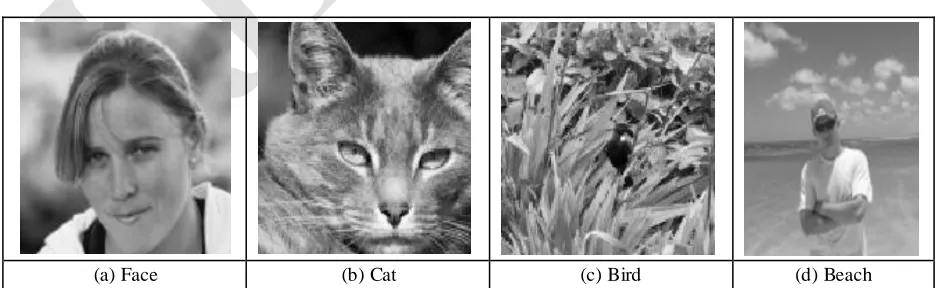
The first experime nt: Four images, each of resolution 154 * 154 were taken as test images: Face, Cat, Bird, and beach as shown in Figure 2.
(a) Face (b) Cat (c) Bird (d) Beach
The images presented in Figure 2 were taken as reference images fro m [20]. The images were translated in both horizontal and vertical directions in specific subpixel values which are vary ing fro m 0.1 to 0.9.A linear interpolation method was used for generating the shifted images. Besides the shifting effect an additive white noise of ze ro mean and varying standard deviation was added to the shifted images. The measurements were taken also simila r to in [20]. The subpixel registration erro r is determined as follo wing:
2
22
2 1 1 2 2
ˆ
ˆ
x x x
x
e
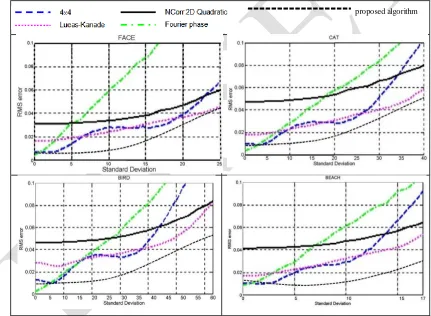
(21)The equation above represents the RMS error for the estimated shift for single estimated shift in both directions . To evaluate the proposed algorithm, a plot of the average of the root mean square registration errors for all va lues of the estimated shifts in both directions versus the noise strength (standard deviation) is plotted in Figure 3. Figure 3 plots not only the proposed algorithm results, but also compares between itsperformance against four methods for subpixel registration. Those methods were taken also as reference for evaluating subpixel registration in [20]. Those methods are Lucas-Kanade, the Fourie r phase-based, Ncorr 2D quadratic, and global space-invariant resampling filter of size 4 * 4.
proposed algorithm
Fig. 3 The resulted RMS error against range of noise strengthes. The results are obtained after applying the proposed algorithm for the four test images
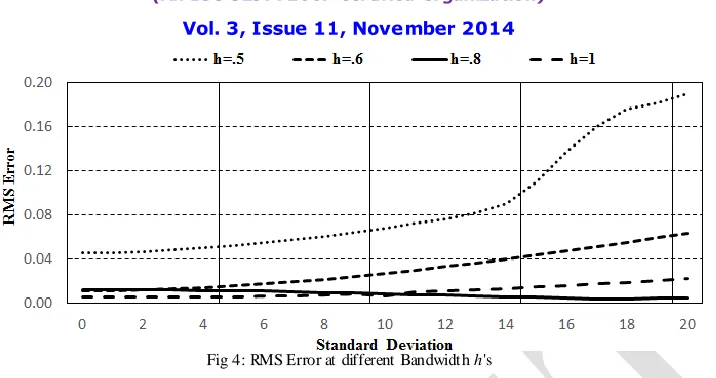
Fig 4: RMS Error at different Bandwidth h's
Figure 4 shows the effect of diffe rent values of bandwidth h=.5, .6, .8, 1. Those values were chosen to show how the proposed algorithm wou ld be affected. The perfo rmance was taken also as RMS error resulted after applying the kernel. It is obvious that the bandwidth h affects the performance of the resulted accuracy and its perfo rmance varies at diffe rent values of standard deviation. For e xa mp le, when h = .8 gives the best results at standard deviation of 11 wh ile as h = 1 acts better in the first range of the standard deviation. That gives idea why is the motive for the use of the steering kernel regression
V. CONCLUS IONANDFUTUR EWORK
The subpixe l registration is obvious an ill-posed problem where the translation model para meters is required. The solution for most of ill-posed problems can usually solved by optimization methods. To do so, we define a goal, a lso known as an objective (cost) function, for the inverse proble m. The goal is a functional that measures how close the estimated data fro m the recovered model fits the observed data. The kerne l regression has proved its superiority in the estimation for 2D images intensities and gradients. Another benefit for using the ke rnel is its ability to absorb the noise effect and the edge change since it is relying on the local structure of the pixe ls. The bandwidth factor has its own effect on the accuracy. It was set manually however it can be changed automatically if apply ing the steering kernel regression
As a future work to this paper, the author suggests applying steering kernel regression [6] in order to find the best bandwidth automatically.
REFERENCES
[1] Wade, A., and Fitzke, F.,“ A fast, robust pattern recognition asystem for low light level image registration and its application to retinal imaging”, Optics Express, Vol. 3, issue 5, pp. 190-197, 1998.
[2] Lucas, B. D., and Kanade, T., “An iterative image registration technique with an application to stereo vision”, DARPA Image Understanding Workshop, 1981.
[3] Bernstein, C.,Kanal, L. ,Lavin, D., and Olson, E., “ A geometric approach to subpixel registration accuracy,” Computer Vision, Graphics, and Image Processing, Vol. 40, pp. 334–360, 1987.
[4] Thinzar, C. and Aye, N.,”Detecting the Storm Movement by Sub Pixel Registration Approach of Newton Raphson Method,” International Journal of e-Education, e-Business, e-Management and e-Learning, Vol. 4, No. 1, pp. 28-31, 2014.
[5] Keren, D., Peleg, S., Brada, R., “ Image sequence enhancement using sub-pixel displacement”, IEEE Conference on Computer Vision and Pattern Recognition, pp.742-746, 1988.
[6] Takeda, H., Farsiu, S., and Milanfar, P.,"Kernel Regression for Image Processing and Reconstruction" , IEEE T ransactions on Image Processing, Vol.16, No. 2, pp. 349-366, 2007.
[7] Karybali, I.,Psarakis, E., Berberidis, K., and Evangelidis, G., "Efficient image registration with subpixel accuracy”, 14th European Signal
Processing Conference (EUSIPCO),2006.
[8] Hajnal, J., Saeed, N., Soar, E. J.,Oatridge, A., Young, I. R., and Bydder, G. M., “ A registration and interpolation procedure for subvoxel matching of serially acquired MR images,” Journal of Computer Assisted Tomography., Vol. 19, No. 2, pp. 289–296, 1995.
[9] Inglada, J.,Muron,V., Pichard, D., and Feuvrier, T.,”Analysis of artifacts in subpixel remote sensing image registration”, Geoscience and Remote Sensing,Vol. 45, pp. 254-264, 2007.
[10] Pearson, J. J., Hines, D. C., Golosman, S., and Kuglin, C. D., “ Video rate image correlation processor,” Proc. SPIE , Vol. 0119, pp. 197–205, 1977.
[12] Albinet, M., Camarero, R., Isnard, M., Poulet, C., andPerret, J., “ Improving multispectral satellite image compression using onboard subpixel registration “, Proc. SPIE 8871, Satellite Data Compression, Communications, and Processing, 2013.
[13] Balci, M., “ Sub-pixel registration in computational imaging and applications to enhancement of maxillofacial CT data”, University of Central Florida, Ph.D. thesis, 2008.
[14] Pritt, M. D., “Image registration with use of the epipolar constraint for parallel projections”, Journal of the Optical Society of America, Vol. 10, Issue 10,pp. 2187–2192,1993.
[15] Irani, M. and Peleg, S., “ Improving resolution by image registration”, CVGIP: Graph. Models Image Process. Vol. 53, issue 3, pp. 231-239, 1991.
[16] Tian, Q. and Huhns, M. N., “ Algorithms or subpixel registration” Computer Vision, Graphics, and Image Processing., Vol. 35, pp. 220–223, 1986.
[17] Eastman, R. and Moigne, J., "Gradient -descent techniques for multi-temporal and multi-sensor image registration of remotely sensed imagery", 4th Int. Conf. Information Fusion, 2001.
[18] Dvorchenko, V., “ Bounds on (deterministic) correlation functions with applications to registration” IEEE Trans. Pattern Analysis and Machine Intelligence , Vol. PAMI-5, No. 2, pp. 206–213, 1983.
[19] Maintz, J. B. and Viergever, M. A., “A survey of medical image registration”, Medical Image Analysis, Vol. 2, pp. 1–36, 1998.
[20] Gilman, A. and Leist, A., “ Global Illumination-Invariant Fast Sub-Pixel Image Registration”, Proc. of the 8th International Multi-Conference on Computing in the Global Information T echnology (ICCGI'13). pp. 95 – 100, 2013.
[21] Foroosh, H., Zerubia, J. B., and Berthod, M., “Extension of phase correlation to sub-pixel registration”. IEEE Trans. Image Proc., Vol. 11, No. 3, pp. 188–200, 2002.