S
For Product Service on this Model Please Call:
(603) 865-2442 (See p. 26)
STURM, RUGER & Company, Inc.
Southport, Connecticut 06890 U.S.A.
THIS INSTRUCTION MANUAL SHOULD ALWAYS ACCOMPANY THIS FIREARM AND BE TRANSFERRED WITH IT UPON CHANGE OF OWNERSHIP, OR WHEN THE FIREARM IS LOANED OR
PRESENTED TO ANOTHER PERSON.
MVQ & KMVQ-50/11-04 C
READ THE INSTRUCTIONS AND
WARNINGS IN THIS MANUAL CAREFULLY
BEFORE USING THIS FIREARM
BLUED
CALIBER
.357 Magnum
50th Anniversary
New Model Blackhawk
®SINGLE ACTION REVOLVER
INSTRUCTION
State-By-State Warnings
Certain states require by law that their own specified warning
notices in larger-than-normal type be conspicuously included
by the manufacturer, distributor, or retail dealer with firearms
sold in that state. Sturm, Ruger sells its products in
compliance with applicable laws and regulations. Because our
products may be sold in these states, we include the following:
California:
Connecticut:
“UNLAWFUL STORAGE OF A LOADED FIREARM MAY
RESULT IN IMPRISONMENT OR FINE.”
Florida:
“IT IS UNLAWFUL, AND PUNISHABLE BY
IMPRISONMENT AND FINE, FOR ANY ADULT TO
STORE OR LEAVE A FIREARM IN ANY PLACE WITHIN
THE REACH OR EASY ACCESS OF A MINOR UNDER 18
YEARS OF AGE OR TO KNOWINGLY SELL OR
OTHERWISE TRANSFER OWNERSHIP OR POSSESSION
OF A FIREARM TO A MINOR OR A PERSON OF
UNSOUND MIND.”
WARNING
“Children are attracted to and can
operate firearms that can cause
severe injuries or death. Prevent
child access by always keeping
guns locked away and unloaded
when not in use. If you keep a
loaded firearm where a child
obtains and improperly uses it,
you may be fined or sent to
prison.”
Maine:
“ENDANGERING THE WELFARE OF A CHILD IS A
CRIME. IF YOU LEAVE A FIREARM AND AMMUNITION
WITHIN EASY ACCESS OF A CHILD, YOU MAY BE
SUBJECT TO FINE, IMPRISONMENT OR BOTH. KEEP
FIREARMS AND AMMUNITION SEPARATE. KEEP
FIREARMS AND AMMUNITION LOCKED UP. USE
TRIGGER LOCKS.”
Maryland:
“WARNING: Children can operate firearms which may cause
death or serious injury. It is a crime to store or leave a loaded
firearm in any location where an individual knew or should
have known that an unsupervised minor would gain access to
the firearm. Store your firearm responsibly!”
Massachusetts:
“WARNING FROM THE MASSACHUSETTS ATTORNEY
GENERAL: This handgun is not equipped with a device that
fully blocks use by unauthorized users. More than 200,000
firearms like this one are stolen from their owners every year
in the United States. In addition, there are more than a
thousand suicides each year by younger children and
teenagers who get access to firearms. Hundreds more die from
accidental discharge. It is likely that many more children
sustain serious wounds, or inflict such wounds accidentally on
others. In order to limit the chance of such misuse, it is
imperative that you keep this weapon locked in a secure place
and take other steps necessary to limit the possibility of theft
or accident. Failure to take reasonable preventive steps may
result in innocent lives being lost, and in some circumstances
may result in your liability for these deaths.”
“IT IS UNLAWFUL TO STORE OR KEEP A FIREARM,
RIFLE, SHOTGUN OR MACHINE GUN IN ANY PLACE
UNLESS THAT WEAPON IS EQUIPPED WITH A
New Jersey:
“IT IS A CRIMINAL OFFENSE TO LEAVE A LOADED
FIREARM WITHIN EASY ACCESS OF A MINOR.”
New York City:
“THE USE OF A LOCKING DEVICE OR SAFETY LOCK
IS ONLY ONE ASPECT OF RESPONSIBLE FIREARMS
STORAGE. FIREARMS SHOULD BE STORED
UNLOADED AND LOCKED IN A LOCATION THAT IS
BOTH SEPARATE FROM THEIR AMMUNITION AND
INACCESSIBLE TO CHILDREN AND OTHER
UNAUTHORIZED PERSONS.”
North Carolina:
“IT IS UNLAWFUL TO STORE OR LEAVE A FIREARM
THAT CAN BE DISCHARGED IN A MANNER THAT A
REASONABLE PERSON SHOULD KNOW IS
ACCESSIBLE TO A MINOR.”
Texas:
“IT IS UNLAWFUL TO STORE, TRANSPORT, OR
ABANDON AN UNSECURED FIREARM IN A PLACE
WHERE CHILDREN ARE LIKELY TO BE AND CAN
OBTAIN ACCESS TO THE FIREARM.”
Wisconsin:
“IF YOU LEAVE A LOADED FIREARM WITHIN THE
REACH OR EASY ACCESS OF A CHILD YOU MAY BE
FINED OR IMPRISONED OR BOTH IF THE CHILD
IMPROPERLY DISCHARGES, POSSESSES, OR EXHIBITS
THE FIREARM.”
WHY ARE WE INCLUDING A FIRED CARTRIDGE CASE
WITH EVERY RUGER PISTOL AND REVOLVER?
Certain states and jurisdictions now require that all newly manufactured pistols and revolvers must be accompanied by a cartridge case, which has been test fired from that gun at the factory. The case must be placed in a sealed container bearing certain information concerning this test cartridge.At the time of retail sale in those jurisdictions, firearms dealers must forward such test cartridge to a designated destination such as their State Police Laboratory. As independent Ruger Distributors have nationwide markets without territorial restrictions, we have decided to include a fired cartridge case with all new Ruger pistols and revolvers, to minimize the possibility of inadvertent non-compliance with these laws.
Retail customers located in other states, where laws or regulations do not require the dealer to so act, may be assured that the fired cartridge case they receive with the firearm at the time of retail purchase is proof that your new Ruger firearm has undergone our normal test firing procedures during manufacture.
• Always keep your firearm pointed in a safe direction, including when you are installing or removing your locking device.
• Always verify that your firearm is completely unloaded
before installing your locking device.
• Do not install locking devices in the trigger guard; always keep your fingers and locking device outside the trigger guard during device installation and removal. • Store firearms, ammunition and keys separately and
securely, away from children and careless adults; do not store your firearm with the keys in the locking device. • Do not attempt to work the action of your firearm with
the locking device in place; this may damage your firearm.
• While locking devices are an important aid to security measures, they are not a substitute for safe firearm handling and proper storage. Remember that any mechanical device can be bypassed with enough time, knowledge, determination and equipment.
LOCKING DEVICES MUST BE USED
SAFELY AND RESPONSIBLY
EXTERNAL LOCKING DEVICE
INSTALLATION INSTRUCTIONS
Correct Installation of Lock For
Ruger
®New Model Blackhawk Revolvers
Use the Correct Lock:
While the basic locking device is substantially similar for
all Ruger
®firearms, due to the different shapes of the many Ruger
®firearms,
some firearms utilize different locking devices.
50th ANNIVERSARY
NEW MODEL BLACKHAWK
®revolvers utilize a 2 1/2” lock.
It is very
important to use the correct locking device!
To Install the Factory-Supplied External Locking Device:
1.
Keep the muzzle pointed in a safe direction and your fingers outside the trigger
guard at all times!
2.
Be sure the firearm and its cylinder are completely unloaded and contain no
cartridges or cartridge casings!
3. Completely remove the cylinder by opening the loading gate, pressing the
basepin latch, pulling the basepin fully forward, and rotating the cylinder out
of the frame.
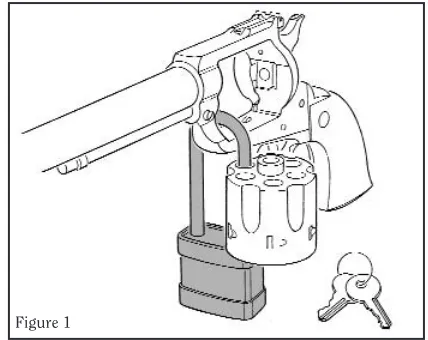
4. Loop the shackle through the cylinder window in the frame. Next slip the
cylinder onto the shackle of the lock as shown in Figure 1.
5. Close the lock by pressing the shackle into the body of the lock (the part that
receives the key) as tightly together as possible. The lock has bumpers and the
shackle is coated with a non-marring material that will not harm the metal
finish of your firearm; be careful not to dent the frame or grip panels of the
revolver.
6. Once the lock is securely closed, remove the key and pull firmly on the lock to
test the connection and be sure it is locked.
Do not leave or store your firearm
with the key in the lock!
Store your locked, unloaded firearm and the key in
secure, separate locations, away from ammunition, children, or unauthorized
adults.
OPERATION OF INTERNAL LOCK
Never rely upon any safety mechanism or mechanical device to justify unsafe or careless handling of a firearm. When securing your revolver or to preventunauthorized access, you should rely first and foremost on the key-operated locking device supplied with your pistol. (See Page 6.) However, for added security, and to
comply with certain state and local laws, your RUGER®50th ANNIVERSARY
NEW MODEL BLACKHAWK®revolver also is equipped with a manually operated internal lock. When actuated, this internal lock will secure the hammer in the uncocked or “full down” position.
Before activating the internal lock on your revolver, first visually inspect the chambers to verify that they are empty and do not contain any cartridges.
To activate the internal lock, make sure that the revolver is pointed in a safe direction and that the hammer is in the full down position. Using a small scewdriver, remove the screw securing the grip panels and remove the right grip panel to expose the internal lock. (See p.12.) Insert the key into the keyway and rotate the key fully clockwise (about 180º from the fully unlocked position) until it stops. NOTE:The key will not rotate the full 180º if the hammer is not in contact with the cylinder frame. Make sure the hammer is in the “full down” position before turning the key. (See Figure 2.) After you have fully rotated the key 180º clockwise until it stops, remove the key and verify that the internal lock is engaged by attempting to cock the hammer. If the internal lock is engaged, you will not be able to cock the hammer.
OPERATION OF INTERNAL LOCK
REMOVE KEY AFTER LOCKING OR UNLOCKING
Place Hammer
in “Full Down”
Position
Lock “On”
Lock “Off”
INSTRUCTIONS FOR ACCESSING
INTERNAL LOCK THROUGH RIGHT GRIP PANEL
If you would like to access the internal lock on your 50th ANNIVERSARYNEW MODEL BLACKHAWK®without removing the grips, you can drill a small hole through the right grip panel as follows:
1. Remove the right grip panel by unscrewing the grip panel screw.
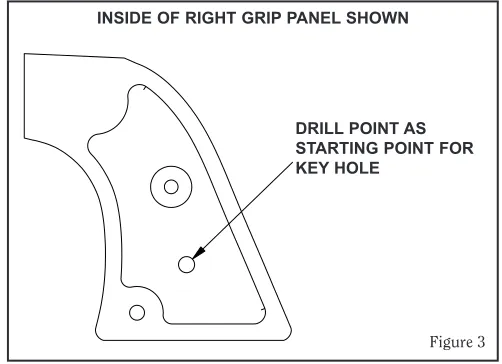
2. On the inside of the right grip panel is a drill point (see Figure 3, below). On the inside of the grip panel, drill a 1/8” hole starting at the drill point.
3. Turn the grip panel over and, using the 1/8” hole you just drilled as a guide hole, enlarge the hole using a 3/16” bit, this time drilling from the outside of the panel inward.
4. Reattach the right grip panel and tighten the grip panel screw. The 3/16” hole will allow key access to the internal lock without removing the grip panel.
Figure 3
DRILL POINT AS STARTING POINT FOR KEY HOLE
INSIDE OF RIGHT GRIP PANEL SHOWN
To deactivate the internal lock, place the internal lock key into the internal lock keyway (see p. 12) and rotate the key counter-clockwise (about 180º from the fully locked position) until it stops. (See Figure 2, p7.)
Reinstall right grip panel and reinstall and retighten grip panel screw to conceal the internal lock.
FIREARMS SAFETY-YOUR RESPONSIBILITY
SAFETY MUST BE THE FIRST AND CONSTANT CONSIDERATION
OF EVERY PERSON WHO HANDLES FIREARMS AND
AMMUNITION.
This Instruction Manual is designed to assist you in learning how to use and care for
your RUGER®50th ANNIVERSARY NEW MODEL BLACKHAWK®
revolver properly. Please contact us if you have any questions about it.
Only when you are certain you fully understand the Manual and can properly carry out its instructions should you practice loading, unloading, etc. with live
ammunition. If you have any doubts about your ability to handle or use a particular type of gun safely, then you should seek supervised instruction.
Such personalized instruction is often available from gun dealers, gun clubs or police departments. If none of these sources can help you, write to the National Rifle Association, 11250 Waples Mill Road, Fairfax, VA 22030-7400. They will assist you. The person with a gun in their possession has a full-time job. You cannot guess; you cannot forget. You must know how to use your firearm safely.Do not use any firearm without having a complete understanding of its particular characteristics and safe use. Remember: There is no such thing as a foolproof gun.
TABLE OF CONTENTS
Page
External Locking Device . . . .5 - 6 Operation of Internal Lock . . . .7 - 8
General Information and Mechanical Characteristics . . . 10
Nomenclature . . . .11
Ammunition . . . 13
Handling . . . 14
To Load and Fire . . . 14
To Uncock (Decock) The Revolver . . . 17
To Unload or Eject Cartridge Cases . . . .18
To Remove or Replace Cylinder . . . 19
Disassembly . . . 19
Reassembly . . . 22
Care and Cleaning . . . 24
Storage . . . .25
Adjustable Sights . . . 26
Service and Parts Policy . . . 26
Shipping Firearms for Repair . . . .27
Ordering Parts . . . .28
Parts List . . . .30 - 32 Parts Drawing . . . 33
The Basic Rules of Safe Firearms Handling . . . .34 - 37 Warranty Information . . . 40
Locking Devices 5 Disassembly 20
Alterations 10 Lubrication 24
Lead Exposure 13 Storage 25
Ammunition 13 Shipping Firearms 27
Handling 14 Parts Purchasers 28
Firing 15 Malfunctioning Parts 29
Safe Carrying Position 16
OTHER CAUTIONS AND WARNINGS APPEAR
THROUGHOUT THE MANUAL.
WARNING–ALTERATIONS
This product was designed to function properly in its original condition. Alterations can make it unsafe. Do not alter any part or add or substitute parts or accessories not made by Sturm, Ruger & Co. Inc.DO NOT ALTER ANY GUN
FIREARMS ARE DANGEROUS WEAPONS–
READ THE INSTRUCTIONS AND WARNINGS IN THIS
MANUAL THOROUGHLY AND CAREFULLY BEFORE USING.
GENERAL INFORMATION
AND MECHANICAL CHARACTERISTICS
The mechanism of the RUGER®50th ANNIVERSARY NEW MODEL
BLACKHAWK®, like the other Ruger New Model single action revolvers, differs significantly from that of any other single action revolver. The information
and instructions which follow apply only to the 50th ANNIVERSARY NEW
MODEL BLACKHAWK®revolver.
The 50th ANNIVERSARY NEW MODEL BLACKHAWK®has an adjustable micro rear sight, a blued finish, and incorporates an additional new “reverse indexing cylinder mechanism” for ease of loading and unloading.
Your 50th ANNIVERSARY NEW MODEL BLACKHAWK®is equipped with the patented Ruger New Model single action revolver mechanism including a transfer bar. The transfer bar – which is raised into firing position as the trigger is pulled to the rear – transmits the energy of the hammer blow to the firing pin. This transfer bar mechanism makes a “safety” notch unnecessary.
The gate (loading gate) can be opened only when the hammer and trigger are fully forward. Opening the gate immobilizes the trigger, hammer, and transfer bar. When the gate is opened the cylinder is unlatched and can be turned for loading or ejection. When the gate is closed, the cylinder latch functions in the normal manner. The loading notch is therefore unnecessary in the New Model design. Unlike the earlier single action revolvers which have four hammer positions – “cocked,” “loading,” “safety” and “all the way forward” – the New Model has only two hammer positions – “cocked” and “all the way forward.”
IMPORTANT SAFETY NOTE
OWNERS OF ALL “OLD MODEL” (PRE-1973) RUGER SINGLE ACTION REVOLVERS, INCLUDING BEARCATS WITH SERIAL NUMBERS BELOW
93-00000, SHOULD WRITE FOR DETAILS CONCERNING OUR FREE SAFETY CONVERSION, WHICH CAN HELP PREVENT ACCIDENTS CAUSED BY A BLOW TO THE HAMMER IF THE USER HAS FAILED TO
TAKE THE BASIC SAFETY PRECAUTION OF KEEPING AN EMPTY CHAMBER UNDER THE HAMMER. See Page 29.
NOMENCLATURE
50th ANNIVERSARY NEW MODEL BLACKHAWK®
Frame Hammer
Barrel Basepin Latch
Grip Panel Screw
Hammer Pivot
Trigger Pivot
Trigger
Ejector Basepin
Cylinder Frame Gate (Loading Gate) Adjustable Rear Sight
Grip Frame
Mechanism shown at rest. Transfer bar is not in line between hammer and firing pin. This is the carrying position.
Mechanism shown with trigger pulled and hammer beginning to fall. Transfer bar is in firing position, between hammer and firing pin.
The mechanism of theRUGER®50th ANNIVERSARY NEW MODEL
BLACKHAWK®provides maximum security against accidental discharge. As with any other firearm, however, the New Model must be used with strict attention to correct safety practices. In addition, the revolver should be inspected frequently to assure that it is working properly.
The Ruger New Model revolver mechanism is illustrated below. The same basic mechanism is found in the entire line of Ruger New Model single action revolvers – Single-Six, Blackhawk, Super Blackhawk, Bisley, Vaquero, Bisley Vaquero, and New Vaquero Models.
Internal Lock
Internal Lock Keyway Transfer Bar
Transfer Bar
Hammer Pivot
Mainspring Strut
Trigger
Cylinder Latch
Trigger & Cylinder Latch Pivot
Ejector Housing Firing Pin
Firing Pin Trigger Spring
Trigger Spring
Gate Detent Spring Basepin
AMMUNITION
The table below shows the correct type of ammunition for use in each of the revolvers listed.
Model
Caliber
Ammunition
50th Anniversary Blackhawk .357 Magnum .357 Mag and .38 SPL
WARNING - LEAD EXPOSURE
Discharging firearms in poorly
ventilated areas, cleaning
firearms, or handling
ammunition may result in
exposure to lead and other
substances known to the state of
California to cause birth defects,
reproductive harm, and other
serious physical injury. Have
adequate ventilation at all times.
Wash hands thoroughly after
exposure.
SHOOTING OR CLEANING GUNS MAY EXPOSE YOU TO LEAD
Notes on Cartridges listed in the table above:.357 Mag is 357 Magnum. .38 SPL is .38 Special.
WARNING – AMMUNITION
Death, serious injury, and damage can result from the use of wrong ammunition, bore obstructions, powder overloads, or incorrect cartridge components. Always wear shooting glasses and hearing protectors.IMPROPER AMMUNITION
DESTROYS GUNS
Any time the revolver is loaded, the hammer is cocked and the trigger is pulled and held to the rear, it will fire. Cocking the gun or pulling the trigger should only be done when you are ready to fire immediately.
NEVER DROP OR STRIKE ANY REVOLVER – COCKED OR UNCOCKED. CARRY AND HANDLE THE REVOLVER IN SUCH A MANNER THAT THE HAMMER WILL NOT BE STRUCK.
NEVER CARRY ANY REVOLVER
WITH THE HAMMER COCKED.
WARNING – HANDLING
HANDLING
CARRYING:Unlike “old model” single action revolvers, which should always be carried with the hammer down on an empty chamber to prevent accidental discharges caused by a blow to the hammer, the Ruger 50th Anniversary New Model Blackhawk may be carried with all chambers loaded. When the hammer and trigger are fully forward at the same time, the transfer bar is lowered out of firing position and the hammer rests directly on the frame, not on the firing pin.
AMMUNITION (CARTRIDGES) NOTICE
WE SPECIFICALLY DISCLAIM RESPONSIBILITY FOR ANY DAMAGE
OR INJURY WHATSOEVER OCCURRING IN CONNECTION WITH, OR
AS THE RESULT OF, THE USE IN RUGER REVOLVERS OF FAULTY, OR
NONSTANDARD, OR “REMANUFACTURED” OR HANDLOADED
(RELOADED) AMMUNITION, OR OF CARTRIDGES OTHER THAN
THOSE FOR WHICH THE FIREARM WAS ORIGINALLY CHAMBERED.
TO LOAD AND FIRE
1. Do not load the revolver until you are ready to use it.2. Note – The loading gate cannot be opened unless the hammer and trigger are fully forward, and the hammer cannot be cocked once the gate is opened.
3. Open the gate. This permits the cylinder to rotate.
4. Turn cylinder clockwise, by hand, and insert cartridges in chambers. In the 50th Anniversary New Model Blackhawk, the cylinder can be rotated counter-clockwise and will stop when a chamber is aligned with the loading gate cutout in the frame.
6.NOTE– To help prevent scoring of the cylinder, when closing the loading gate be sure that a chamber is directly aligned with the barrel. This can be achieved by rotating the cylinder so that a cylinder flute is equally spaced on either side of the topstrap, closing the loading gate, and then verifying that the cylinder is locked in place.
7. Cocking – To fire the revolver, the hammer must first be manually cocked. When cocking the hammer, have a firm hold on the grip with the shooting hand, and DO NOT TOUCH THE TRIGGER WHILE COCKING THE HAMMER. TOUCH THE TRIGGER ONLY WHEN YOU ARE READY TO FIRE. With the fore portion of your thumb firmly on the hammer spur, draw the hammer fully to the rear until it stops. Then permit the hammer to move forward (it will only move slightly) until the trigger engages in the hammer at full cock.
8. Firing – Once the hammer has been cocked, a light pressure on the trigger will disengage the trigger from the hammer. The hammer will fall forward striking the transfer bar and the revolver will fire.
9. After firing, the hammer will remain down. To fire subsequent shots, fully release the trigger and repeat steps 7 & 8 above for each shot.
CAUTION:
The recoil of any centerfire caliber causes the
muzzle of the gun to flip upward with substantial force. The
shooter need not be apprehensive, but be prepared. Keep a firm grip
on the revolver and hold it away from your face when firing.
WARNING – FIRING
When firing any revolver, be sure all persons are a safe distance to the rear of the shooter. When fired, all revolvers discharge gas and particles through the clearance gap between the cylinder and the rear of the barrel. These particles of lead, powder grains or lubricant are projected broadly sideways at high speed and thus can injure a person who is standing too close to the revolver. When firing any revolver, always be certain that nothing – including either of your hands – is in the path of the hot gas and particles which are discharged from the front and sides of the cylinder. When shooting, adequate eye protection is essential. Shooters and bystanders must wear shooting glasses. Hearing protection must also be worn. Exposure to shooting noise can damage hearing.
Never carry revolvers cocked! The safe carrying position for the New Model Blackhawk Revolver is with the hammer fully down and the trigger forward. In this position the hammer does not contact the firing pin. See page 11. In older (1953-1972) single action revolvers, the hammer, when in the full forward position, does rest against the firing pin. Accordingly, never carry an “old model” revolver with the hammer fully forward and the cartridge in line with the firing pin because a light blow to the hammer can readily cause discharge.It is always safest to carry the hammer down over an empty chamber regardless of the revolver type. See page 29 for details about our free safety conversion offer for “old model” Ruger Single Action Revolvers.
DRY-FIRING: Going through the actions of cocking, aiming, and pulling the trigger of an unloaded gun is known as “Dry Firing.” It can be useful to learn the “feel” of your revolver. Be certain the revolver is unloaded and that the gun is pointing in a safe direction even when practicing by dry-firing.The Ruger New Model revolvers can be dry-fired without damage to the firing pin or other components.
“FANNING”: NEVER fan any revolver. Fanning is an unsafe way to fire a gun and it is abusive to the revolver mechanism.
ALWAYS CARRY
NEW MODEL SINGLE ACTIONS
WITH HAMMER DOWN.
TO ‘UNCOCK’ (DECOCK) THE REVOLVER
If your revolver is cocked, and you wish to let the hammer down to its forward position (against the frame), proceed as follows: USE EXTREME CARE WHEN ATTEMPTING TO DECOCK THE REVOLVER, AS THE THUMB SLIPPING DURING THIS PROCESS CAN RESULT IN AN ACCIDENTAL DISCHARGE IF THE TRIGGER IS HELD TO THE REAR.1.Make certain that the revolver is pointing in a safe direction (see Rule 2, Page 34).
2. Make certain both hands are dry and not impeded in any way – gloves, bandages, cold, etc.
3. Grasp the revolver (if right-handed) so that the thumb and forefinger of your left hand are firmly holding the frame, forward of the trigger guard. Thus, your left hand is in full control of the revolver (See Figure a, below).
4. Place your right thumb firmly on the hammer spur and, with your thumb securely in control of the hammer, squeeze the trigger only enough to permit the hammer to ‘break free’ of the trigger. At that instant, IMMEDIATELY RELEASE THE TRIGGER and then slowly permit the hammer, STILL SECURE UNDER YOUR THUMB, to move fully forward to its resting position against the frame. NOTE: It is imperative that finger pressure be removed from the trigger just as soon as it is free of the hammer. Then, properly, the trigger and hammer will move towards their fully forward rest positions together (See Figure b, below).
Practice this important gun handling skill with an unloaded revolver until you have developed the proper control and ‘touch’ to decock your revolver safely. The key to safe decocking is having the weight of the revolver controlled with one hand, while the thumb and forefinger of the ‘shooting hand’ control the hammer and trigger.
4
3 1
2
a.
b.
a.With the thumb controlling the hammer as shown above (1), squeeze trigger to permit hammer to ‘break free’ (2).
b.When hammer is free, IMMEDIATELY release trigger (3). Then lower hammer slowly to its resting position completely down against frame (4).
The revolver is now in its normal carrying condition -- hammer and trigger fully forward and transfer bar lowered out of firing position.
CAUTION:The hammer must be carefully eased fully forward before the hammer is drawn back to the full-cock position for the first shot. The hammer should be drawn with a firm positive motion to the full-cock position for each shot, thus actuating the working parts for complete indexing. Unless this procedure is followed in any single-action revolver, the cylinder is apt to be out of index when fired.
TO UNLOAD OR EJECT CARTRIDGE CASES
Keep revolver pointed in a safe direction!Do not attempt to unload when the hammer is cocked.
If the hammer is cocked, it must first be decocked. (See “To Uncock The Revolver”, p. 17.)
Then:
1. Open the gate. This permits the cylinder to rotate.
2. Turn cylinder clockwise, by hand, to align a chamber with the ejector rod. Your RUGER®50th ANNIVERSARY NEW MODEL BLACKHAWK®is equipped with a specially designed reverse indexing cylinder mechanism (patent pending). This unique device will ease and hasten unloading by allowing you to reverse rotation of the cylinder (counter-clockwise until it stops) and
automatically align a chamber with the ejector rod and loading gate cutout in the frame. See “Correct Unloading Sequence,” below.
3. Push the ejector rod rearward, by means of the thumb-piece on its forward end, so that it slides through the chamber to push out the cartridge or fired case. Release the spring-loaded ejector rod. Repeat until all chambers are empty. 4.Check to be certain that all cartridges have been removed, then close the gate.
CORRECT UNLOADING SEQUENCE
1
2
4
3
5
DISASSEMBLY
(Make Sure Revolver is Unloaded!)
The user of a RUGER®50th ANNIVERSARY NEW MODEL
BLACKHAWK®revolver should carefully read all disassembly directions and study all the illustrations and the Parts List in this manual before attempting to take the gun apart. Know the names and location of the parts before removing any of them. Although the Ruger New Model single action revolver mechanism is composed of only a few parts, it is essential that the disassembly and reassembly operations be carried out with knowledge and care.
Only a few tools are required: A screwdriver or two to remove the grip panel and grip frame screws, and a drift punch to remove the hammer and trigger pivots (pins). A small plastic-faced hammer can be useful in drifting the trigger pivot out and in.
The tip of the screwdriver blade should perfectly fit the grip frame screw slots. A tip too large will scrape away metal, while too small a tip will damage the screw slots.
Before taking the gun apart, set up to do it properly. Cover the work surface with a soft cloth so that the gun finish (and sights) will not be damaged, and provide a tray into which the parts can be put as they are removed from the gun.
WARNING: Never remove, replace or carry a loaded cylinder.
The cartridges can fire if their primers are struck.
TO REMOVE OR REPLACE CYLINDER
1. Open the gate. This lowers the cylinder latch into the frame.
2. Press base pin latch (on left side) and withdraw base pin fully forward.
3. Remove cylinder from loading gate side of frame.
1
2
4
3
5
Never clean, lubricate, disassemble or work on a revolver while it is loaded. Never install or remove a loaded cylinder. A loaded cylinder can discharge if dropped or struck. Read instructions before
disassembling gun.
UNLOAD BEFORE CLEANING
1. With the revolver pointed in a safe direction, open the gate and rotate the cylinder. Examine every chamber in the cylinder to be certain the revolver is unloaded. Leave the gate open.
2. Press in fully on the left side of the base pin latch, and while holding it in that position, withdraw the base pin. Remove the cylinder and close the gate. This is as far as you need to go for routine cleaning.
DETAILED DISASSEMBLY:
1. Remove grip panel screw and remove grip panels. Unlock the internal lock. (See page 7 & 8 for instructions regarding internal lock usage.)
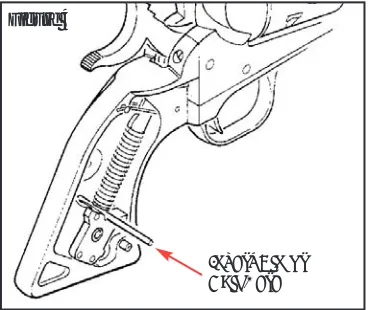
2. Draw the hammer rearward to full cock position. Insert a short length (about 1”) of nail or pin into the small hole at the lower end of the hammer strut. the hole is visible between the mainspring and the top of the internal lock assembly. (See Figure 4, below.) The purpose of inserting the pin or nail is to confine the mainspring when the hammer is released.
3. While maintaining thumb pressure on the hammer spur, squeeze the trigger and ease hammer down to full forward position.
4. Remove the five (5) screws that fasten the grip frame to the cylinder frame.
Figure 4
WARNING – DISASSEMBLY
7. Remove cylinder latch, gate detent spring, and gate.
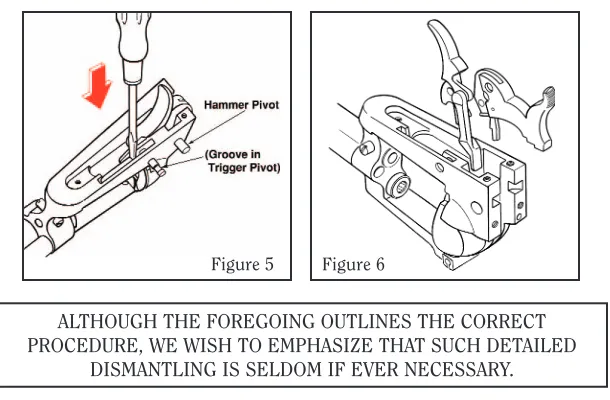
8. Remove hammer pivot. Then remove the hammer/pawl assembly and the trigger/transfer bar assembly. (Note that the hammer is attached to the pawl and the transfer bar is attached to the trigger. See Figure 6).
The revolver is, at this stage, disassembled as far as it needs to be for major cleaning and maintenance. However, if it is necessary to go beyond the above steps, the following cautions and suggestions should be useful:
CAUTION: The preload on the cylinder rotation stop is factory set. do not alter the position of the cylinder rotation stop screw (part no. KMVQ04501).
Figure 5 Figure 6
ALTHOUGH THE FOREGOING OUTLINES THE CORRECT
PROCEDURE, WE WISH TO EMPHASIZE THAT SUCH DETAILED
DISMANTLING IS SELDOM IF EVER NECESSARY.
CAUTION: Press the screwdriver blade tip against the spring
carefully and be certain the blade does not slip off the spring
and damage the frame or injure the person holding the gun.
5. Pull the grip frame rearward and downward to separate it from the cylinderframe. (If the grip frame does not readily separate from the cylinder frame, draw the hammer rearward a short distance.) Remove the mainspring assembly and internal lock assembly from the grip frame, but do not remove the small pin that is confining the mainspring. (The mainspring assembly will later be reassembled into the frame as it is.) The internal lock assembly is removed from the grip frame by lifting it up and then out.
Do not ‘lose’ the pawl spring and plunger (located in a hole in the rear of the left side of the cylinder frame, just above the grip frame screw hole) or the cylinder latch spring and plunger (located in the hole above front of the trigger guard bow in the grip frame).
Ejector/Ejector Housing:Wrap one hand firmly around barrel and housing when loosening the screw. Remove screw, then carefully lift housing (which contains compressed spring and ejector rod) away from the barrel.
Base Pin Latch/Nut and Spring: The nut must be held firmly (with jaw-protected pliers) while the latch is being unscrewed. Don’t lose the spring. When
reassembling, be certain the nut and spring are on the left side of the frame. (See Parts Drawing, p. 33).
REASSEMBLY
(Make Sure Revolver is Unloaded!)
1. Assemble pawl to hammer and transfer bar to trigger as shown in Figure 5, p. 21. Partially insert hammer/pawl assembly in its recess in the frame. Insert trigger/transfer bar assembly in its slot in the frame. Then simultaneously complete insertion of the two assemblies into the frame.
2. (Refer to Figure 5, p. 21.) Align hammer in frame and insert hammer pivot with the grooved end of the pivot opposite the gate side of the frame. The long screw, XR01901, when also inserted opposite the gate side, will intersect the groove and lock the pivot in place. (See step number 11, p. 23.)
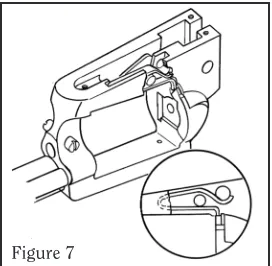
3. Replace cylinder latch and gate detent spring as shown in Figure 7. Note that the lug on the cylinder latch fits between the arms of the gate detent spring and that the end of one of the arms of the spring is formed at a 90 degree angle. The projection thus formed, is designed to fit through the square hole in the bottom of the frame and to ride on the cam surface of the gate pivot. Note also that this projection holds the loading gate back and in place.
4. (Refer to Figure 5, p. 21.) Depress the upper arm of the gate detent spring with tip of screwdriver blade and install trigger pivot. Pivot should be inserted from the gate side of the frame. The non-grooved end of the pivot should be inserted first. (It may be necessary to manipulate the trigger, the gate detent spring, and the cylinder latch to align them to receive the trigger pivot.)
5. Insert the base pin. The base pin must be fully inserted and locked in position by the base pin latch. If the base pin is not fully inserted and locked, the transfer bar may catch under the firing pin when the hammer is being cocked.
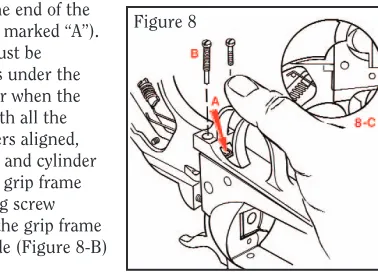
6. (Refer to Figure 8, below.) Unhook the ends of the trigger spring
(KMVQ03700) from the grooved retaining pin on both sides of the grip frame.
7. Insert cylinder latch spring and plunger in hole in grip frame. (The spring goes in first so that the plunger is on top.)
8. Insert pawl spring and plunger (plunger goes in the hole first) in the hole in the left side of the cylinder frame just above the left rear grip screw hole.
9. Install mainspring assembly and internal lock assembly which should be visible when viewing the right side of the grip frame. Be certain the strut is positioned properly. See the Parts Drawing for correct strut positioning.
10. (Refer to Figure 8, below). Draw hammer to the rear slightly and place the grip frame loosely on the cylinder frame. Before pushing the grip frame forward to mate with the cylinder frame, be certain that:
(a) the cylinder latch spring plunger (XR07700) is positioned so that is will contact the bottom of the cylinder latch (rather than either side of the latch),
(b) the pawl spring is aligned to contact the left ‘ear’ of the grip frame (and not be bent as the ear contacts it).
11. See Figure 8, and note the end of the trigger spring (the arrow marked “A”). This end of the spring must be depressed so that it slides under the rear portion of the trigger when the grip frame is forward. With all the above springs and plungers aligned, fully mate the grip frame and cylinder frame and install the five grip frame screws. Note that the long screw (XR01901) should go in the grip frame hole opposite the gate side (Figure 8-B) of the revolver.
12. Hook the two ends of the trigger spring over the trigger spring retaining pin (KMVQ06300) as shown in Figure 8-C.
13. Be certain the internal lock is correctly positioned on its step in the grip frame. Then, draw the hammer back to the full cock position and remove the small pin from the mainspring strut. Pull trigger and allow hammer to fall.
14. Open the gate, withdraw base pin and install the cylinder. Reinsert the base pin and be certain it is fully seated and locked in position.
15. Before loading cartridges into the chamber, cycle the revolver several times. Check to be sure that cylinder rotates and locks correctly, that trigger returns in a positive manner when released, and that loading gate opens and closes normally.
Firing a revolver with oil, grease, or any other material even partially obstructing the bore may result in damage to the revolver and serious injury to the shooter and those nearby.
Do not spray or apply lubricants directly on ammunition. If the powder charge of a cartridge is affected by the lubricant, it may not be ignited, but the energy from the primer may be sufficient to push the bullet into the bore where it may become lodged. Firing a subsequent bullet onto the obstructed bore may damage the revolver and cause serious injury or death to the shooter and those nearby. Use lubricants properly. You are responsible for the proper care and maintenance of your firearms.
IMPROPER LUBRICATION
DESTROYS GUNS
CARE AND CLEANING
MAKE SURE GUN IS UNLOADED!
Always be certain the revolver is completely unloaded before cleaning. At regular intervals or when the revolver has been exposed to sand, water or other adverse conditions, disassemble, clean and oil it.
To clean the revolver after firing:
1. Remove the cylinder as described on p. 19.
2. Clean the barrel from the muzzle by running a cleaning rod with a solvent coated patch through the bore several times. A bronze wire brush, of a size appropriate to the bore size, attached to the cleaning rod should then be pushed the full length of the bore several times.
3. Again swab the bore with a solvent coated patch. Then wipe the rod clean and, using a dry patch, swab the bore until it is clean.
4. Repeat the above procedure for each of the six chambers.
5. Run a lightly oiled patch through the bore and each chamber.
Some cartridges with lead bullets deposit metal fouling in the chamber throats, in the forcing cone of the barrel, and in the bore. If ‘leading’ is noted in your revolver, clean it out before it builds up and interferes with reliable functioning and accuracy. A special ‘lead removing’ cleaning tool (for bore and chambers) is available from gun stores.
The revolver’s internal mechanism can be lubricated without disassembly. A few drops of light oil recommended as suitable for firearms, applied periodically about the various frame openings, will work its way into the mechanism parts. The exterior of the revolver should be cleaned with a solvent and then wiped with an oily cloth.
STORAGE
GUNS SHOULD NOT BE STORED LOADED!
Do notkeep the revolver in a leather, fabric or canvas holster when it is stored. These materials attract moisture, even though the holster may appear to be perfectly dry.
TO RENDER THE REVOLVER INOPERATIVE FOR SAFE STORAGE
With the muzzle pointed in a safe direction, open the loading gate and check all chambers of the cylinder to be sure the revolver is completely unloaded! Depress the basepin latch on the side of the frame and remove the basepin by pulling it toward the muzzle and out of the frame. Next, remove the cylinder from the frame.
Store the cylinder and frame in different locations. When disassembled in this manner, this revolver is inoperable. It is impossible to fire the revolver until the cylinder and basepin have been correctly replaced.To reassemble the revolver for firing, open the loading gate and reinsert the cylinder. Next, press the basepin latch on the frame and fully reinsert the basepin. Check to be sure the cylinder rotates freely in a clockwise direction. With the muzzle pointed in a safe direction, close the loading gate. The revolver is now reassembled and can be loaded and fired.
While the revolver is less likely to be used by unauthorized persons when disassembled in the above manner, it is always safest to store any firearm with the supplied locking device correctly installed, or to store the firearm in a gun safe or other secure location away from children and unauthorized adults. Guns should always be stored securely, unloaded and separate from their ammunition.
Never place or store any firearm in such a manner that it may be dislodged. Firearms should always be stored securely and unloaded, away from children and careless adults. Use the locking device originally supplied with this firearm for storage.
The use of a locking device or safety lock is only one aspect of responsible firearms storage. For increased safety, firearms should be stored unloaded and locked in a location that is both separate from their ammunition and inaccessible to children and any other unauthorized person.
STORE SECURELY & UNLOADED
WARNING – STORAGE
LOADED
SERVICE AND PARTS POLICY
If you have any questions with regard to the performance of your RUGER® 50th ANNIVERSARY NEW MODEL BLACKHAWK®revolver, please write or call (603-865-2442) our Newport, New Hampshire Product Service Department, fully describing all circumstances. If you should return your revolver to the factory for repair, or order parts for it, please comply with the following suggestions for prompt service:
ADJUSTABLE SIGHTS
ADJUSTMENT –Each click of the sight adjustment screw (either windage or elevation) will move the point of impact of the bullet approximately 3/4” at a range of 25 yards. The height of the front sight has been set to take advantage of the elevation adjustment in the rear sight, considering the various ranges at which the gun is most likely to be used. Barrel length and load used affects trajectory. Therefore the shooter should determine sight settings by firing trials.
To raise point of impact: turn screw counterclockwise.
To lower point of impact: turn screw clockwise.
To move the point of impact to the right: turn screw counterclockwise.
To move the point of impact to the left: turn screw clockwise.
SUGGESTED SIGHT PICTURE
Top of front sight even with top of rear sight blade. Front sight centered in notch of rear
sight blade. Target bullseye centered on top of front sight.
ELEVATION
WINDAGE
RIGHT
LEFT
SHIPPING FIREARMS FOR REPAIR
RUGER®50th ANNIVERSARY NEW MODEL BLACKHAWK® revolvers returned to the factory for repair should be sent to: Sturm, Ruger & Company, Inc., Product Service Department, 411 Sunapee Street, Newport, New Hampshire 03773. Telephone (603) 865-2442. The complete revolver should be shipped. Please do not send your holster, custom grip panels or other accessories with any revolver being shipped to us. Guns should be sent prepaid;. We will not accept collect shipments.
The Federal Gun Control Act, as well as the laws of most States and localities, do not prohibit an individual (who is not otherwise barred from purchasing or possessing a firearm) from shipping a firearm directly to the manufacturer for repair. However, before shipping your firearm to us, be certain that your State or locality does not have a law or regulation which will prohibit you from receiving it from us after it has been repaired. If such receiving is prohibited, then please have a Federally Licensed Firearms dealer ship the gun to us. If your gun is sent to us by a dealer, it will be returned to him after being repaired. If a handgun (pistol or revolver) is shipped by an individual who does not hold a Federal Firearms License, it must be shipped for overnight delivery via U.P.S., Federal Express, or other similar private overnight service. NOTE: Firearms may not be shipped via U.S. Mail. Persons who do not hold a Federal Firearms License are prohibited by Federal law from shipping a handgun by mail. Handguns mailed in violation of the law are impounded by the Post Office.
Please do not include revolver case, sling, telescopic sights or custom accessories with a firearm being shipped to the factory for service. DO NOT SEND GUN BOXES OR LITERATURE THAT YOU CONSIDER TO BE COLLECTOR’S ITEMS – THESE ARE INVARIABLY DAMAGED OR DESTROYED IN SHIPMENT.Always insure your shipment.
Enclose a letter which includes your name, address, telephone number, serial number and model of the firearm. Describe in detail the trouble you have experienced with your firearm, or the work you wish to have done. Merely stating that the firearm “needs repair” is inadequate information.
Work performed will bear a net minimum labor charge of $20.00 plus a $20.00 shipping and handling charge. The charge for rebluing the RUGER®50th ANNIVERSARY NEW MODEL BLACKHAWK®revolvers is $50.00 plus a $20.00 shipping and handling charge. We cannot apply the “color case finish” of the Ruger Vaquero to any other single action revolver. Custom gunsmithing service or nonstandard alterations are NOT AVAILABLE from Ruger Service Departments.
WARNING: BEFORE SHIPPING ANY
WARNING –PARTS PURCHASERS
It is the purchaser’s responsibility to be absolutely certain that any parts ordered from the factory are correctly fitted and installed. Firearms are complicated mechanisms and IMPROPER FITTING OF PARTS MAY RESULT IN A DANGEROUS MALFUNCTION, DAMAGE TO THE FIREARM, AND SERIOUS INJURY TO
THE SHOOTER AND OTHER PERSONS. The
purchaser and installer of parts must accept full responsibility for the correct adjustment and functioning of the revolver after such installation.
PARTS MUST FIT CORRECTLY
ORDERING PARTS
Please contact the New Hampshire Product Service Department for parts availability and current prices. All parts orders for the RUGER®50th ANNIVERSARY NEW MODEL BLACKHAWK®revolvers should be sent to : Sturm, Ruger & Co., Inc., Product Service Department, 411 Sunapee Street, Newport, New Hampshire, 03773, 603-865-2442.
We cannot comply with open account or C.O.D. orders. Payment in the form of a check, money order, Visa or Mastercard must accompany your order. Credit Card orders must include the account number, expiration date and whether it is a Visa or Mastercard account. Minimum parts order is $1.00 plus $3.50 shipping and handling charge. Order parts by Part Name and Part Number and include the entire serial number of the firearm for which the parts are being ordered.There is a minimum net labor charge of $20.00 plus $20.00 shipping and handling charge if the parts are factory fitted. All factory fitted parts are fit on an exchange basis only. We will not return the replaced parts.
Barrels, cylinders and a number of other component parts must be fitted at the factory. Company policy is to proof-test and/or function fire all barrels after fitting to the receivers in which they are to be used. This procedure ensures maximum protection to our customers. The special proof-test ammunition used in this testing is sold only to bonafide firearms manufacturers and is not available to gun shops, gunsmiths, or individuals.
Because it is a serial numbered part, the cylinder frame of RUGER®50th ANNIVERSARY NEW MODEL BLACKHAWK®revolvers is defined as a ‘firearm’ by Federal Law and is not offered for sale as a component part.
CAUTION: A gun containing modified, broken, malfunctioning,
or badly worn parts should not be fired.
CYLINDER NOTE: Cylinders are only available for installation in the model in which they were manufactured and fitted.
BARREL NOTE: All barrels are marked with a safety message, (“Before using gun, read warnings in Instruction Manual available free from Sturm, Ruger & Co. Inc., Southport, CT, USA”).
SHIPPING REVOLVERS FOR
INSTALLATION OF A SAFETY CONVERSION KIT:
If you would like to have any “old model” (pre-1973) Bearcat, Single-Six, Blackhawk, or Super Blackhawk revolver factory fitted with a free Conversion Kit (to help prevent accidents caused by a blow to the hammer if the user has failed to keep an empty chamber under the hammer)please write to Sturm, Ruger & Co., Dept. KC, 1 Lacey Place, Southport, CT 06890 for a box and shipping instructions. Be sure to include information as to model, caliber, and serial number. Please do not send your old model single action revolver until you receive shipping instructions and a box from us.Please note that the Kit will be fitted at our Newport, New Hampshire facility. All other servicing of “old model” single actions will also be performed at our Newport facility, but only after a Conversion Kit is first installed.RUGER
®50th ANNIVERSARY NEW MODEL BLACKHAWK
®PARTS LIST
Design, prices and specifications subject to change without notice.
SPECIFY MODEL AND CALIBER WHEN ORDERING
(See Exploded Views on Page 34)
Key No. Part Name Part No. Model
* 1 Barrel – 4 5/8”, .357 cal. MVQ00603 50th Anniversary Blackhawk
2 Grip Frame MVQ00301 50th Anniversary Blackhawk
3 Cylinder Frame MVQ00206 50th Anniversary Blackhawk
4 Front Sight – .357 cal. MR-36-30 50th Anniversary Blackhawk
5 Loading Gate MVQ02401 50th Anniversary Blackhawk
6 Recoil Plate KMR02000 50th Anniversary Blackhawk
7 Firing Pin KMR02100 50th Anniversary Blackhawk
8 Firing Pin Rebound Spring KE-48 50th Anniversary Blackhawk
9 Recoil Plate Cross Pin XR04900 50th Anniversary Blackhawk
10 Base Pin Assembly TBMR02901 50th Anniversary Blackhawk
11 Base Pin Latch Nut XR02800 50th Anniversary Blackhawk
12 Base Pin Latch Body XR02700 50th Anniversary Blackhawk
13 Trigger Spring Retaining Pin KMVQ06300 50th Anniversary Blackhawk
14 Trigger Spring Pivot Pin KMVQ02800 50th Anniversary Blackhawk
15 Base Pin Latch Spring XR04700 50th Anniversary Blackhawk
16 Trigger Spring KXR03700 50th Anniversary Blackhawk
* 17 Cylinder – .357 cal. MVQ00105 50th Anniversary Blackhawk
18 Internal Lock Assembly MVQ20900 50th Anniversary Blackhawk
31
Key No. Part Name Part No. Model
Hammer Assembly (Includes Key Nos. 19 - 22) MVQ14002-1 50th Anniversary Blackhawk
19 Hammer, only MVQ04002-1 50th Anniversary Blackhawk
20 Hammer Plunger Cross Pin KXR04200 50th Anniversary Blackhawk
21 Hammer Plunger KXR04100 50th Anniversary Blackhawk
22 Hammer Plunger Spring KXR04300 50th Anniversary Blackhawk
23 Pawl Spring Plunger XR05100 50th Anniversary Blackhawk
24 Pawl Spring XR05000 50th Anniversary Blackhawk
25 Cylinder Latch Spring Plunger XR07700 50th Anniversary Blackhawk
26 Cylinder Latch Spring XR04600 50th Anniversary Blackhawk
27 Trigger Pivot Pin XR03400 50th Anniversary Blackhawk
28 Grip Frame Screw - A - Front XR01700 50th Anniversary Blackhawk
29 Hammer Pivot Pin XR01601S 50th Anniversary Blackhawk
30 Hammer Strut MVQ01500 50th Anniversary Blackhawk
31 Mainspring MVQ00400 50th Anniversary Blackhawk
32 Ejector Alignment Pawl KMVQ04502 50th Anniversary Blackhawk
33 Cylinder Rotation Stop Spring KMVQ04500 50th Anniversary Blackhawk
34 Cylinder Rotation Stop Screw KMVQ04501 50th Anniversary Blackhawk
35 Trigger XR03902 50th Anniversary Blackhawk
36 Grip Frame Screw & Pivot Lock XR01901 50th Anniversary Blackhawk
37 Grip Frame Screw - C - Bottom XR01900 50th Anniversary Blackhawk
38 Grip Frame Screw - B - Back (2 req’d) XR01800 50th Anniversary Blackhawk
39 Gate Detent Spring MR07300 50th Anniversary Blackhawk
40 Cylinder Latch Assembly KXR04500 50th Anniversary Blackhawk
41 Transfer Bar KMVQ07201 50th Anniversary Blackhawk
42 Pawl KMVQ00701 50th Anniversary Blackhawk
43 Ejector Rod Assembly XR-55 50th Anniversary Blackhawk
32
Key No. Part Name Part No. Model
45 Ejector Housing Screw XR03300 50th Anniversary Blackhawk
46 Ejector Housing Spring XR04400 50th Anniversary Blackhawk
47 Rear Sight Assembly with Springs MVQ25900 50th Anniversary Blackhawk
48 Rear Sight Pivot Pin MR05600 50th Anniversary blackhawk
49 Grip Panel Ferrule, right XR01101 50th Anniversary Blackhawk
Grip Panel Ferrule, left, Not Illustrated XR01201 50th Anniversary Blackhawk
50 Medallion XR-52 50th Anniversary Blackhawk
51 Grip Panels, with Medallion, Sold in Pairs Only MVQ11001 50th Anniversary Blackhawk
52 Grip Panel Screw MVQ01300 50th Anniversary Blackhawk
53 Grip Panel Dowel KXR01400 50th Anniversary Blackhawk
54 Internal Lock Key KMVQ00908 50th Anniversary Blackhawk
Also Available, but Not Illustrated
Case Only – 4 5/8” barrel RGC-MRED 50th Anniversary Blackhawk
RUGER
®50th ANNIVERSARY
NEW MODEL BLACKHAWK
®THE BASIC RULES OF SAFE FIREARMS HANDLING
We believe that Americans have a right to purchase and use firearms for lawful purposes. The private ownership of firearms in America is traditional, but that ownership imposes the responsibility on the gun owner to use his firearms in a way which will ensure his own safety and that of others. When firearms are used in a safe and responsible manner, they are a great source of pleasure and satisfaction, and represent a fundamental part of our personal liberty.
Firearms do not cause accidents! Firearms accidents are almost always found to have been the result of carelessness or ignorance on the part of the shooter of the basic rules of safe gun handling.
The following rules must be observed by gun users at all times. Safe gun handling is not just desirable, it is absolutely essential to your safety, the safety of others, and the continuation of gun ownership and sport shooting as we know it today.
1. LEARN THE MECHANICAL AND HANDLING
CHARACTERISTICS OF THE FIREARM YOU ARE USING.
Not all firearms are the same. The method of carrying and handling firearms varies in accordance with the mechanical provisions for avoiding accidental discharge and the various proper procedures for loading and unloading. No person should handle any firearm without first having thoroughly familiarized himself with the particular type of firearm he is using, and with safe gun handling in general.
2. ALWAYS KEEP THE
MUZZLE POINTED IN A
SAFE DIRECTION.
Be sure of the bullet stop behind your target, even when dry-firing. Never let the muzzle of a firearm point at any part of your body or at another person. This is particularly important when loading or unloading a firearm. In the event of an accidental discharge, no injury can occur as long as the muzzle is pointing in a safe direction. A safe direction means a direction which will not permit a discharged bullet to strike a person, or to strike an object from which the bullet may ricochet.
RUGER
®
INSTRUCTION MANUAL
READ THE INSTRUCTIONS
AND WARNINGS IN THIS MANUAL CAREFULLY BEFORE
A safe direction must take into account the fact that a bullet may
penetrate a wall, ceiling, floor, window, etc., and strike a person or
damage property. Make it a habit to know exactly where the muzzle of
your gun is pointing whenever you handle it, and be sure that you are
always in control of the direction in which the muzzle is pointing, even
if you fall or stumble. Keep your finger off the trigger until you are
ready to shoot!
3. FIREARMS SHOULD BE UNLOADED WHEN NOT IN
USE
.
Firearms should be loaded only
when you are in the field or on the
target range or shooting area,
ready to shoot. Firearms and
ammunition should be securely
locked in safes, racks or cabinets,
or by using the locking device
supplied with the firearm, when
not in use. Ammunition should be
safely stored separate from
firearms. Store your firearms out
of sight of visitors and children. It
is the gun owner’s responsibility to
be certain that children and
persons unfamiliar with firearms cannot gain access to firearms,
ammunition, or components.
4. BE SURE THE BARREL IS CLEAR OF OBSTRUCTIONS
BEFORE SHOOTING.
Even a bit of mud, snow or excess
lubricating oil or grease in the
bore may cause the barrel to
bulge, or even burst on firing, and
can cause serious injury to the
shooter and bystanders. Be sure
that you are using ammunition of
the proper caliber and loading for
the gun you are using. If the
report or recoil on firing seems
weak, or doesn’t seem quite right,
CEASE FIRING IMMEDIATELY,
unload your firearm, and check to
be sure that no obstruction has
become lodged in the barrel.
1
5. BE SURE OF YOUR
TARGET BEFORE YOU
SHOOT.
Don’t shoot unless you know
exactly where your bullet is going
to strike. Be sure of the bullet
stop behind your target, even
when dry-firing with an unloaded
gun. If you are in the field
hunting, do not fire at a
movement or noise. Take the time
to be absolutely certain of your
target before you pull the trigger.
6. WEAR SHOOTING
GLASSES AND HEARING
PROTECTORS WHEN
YOU SHOOT.
All shooters should wear
protective shooting glasses and
adequate hearing protectors when
shooting. Exposure to shooting
noise can damage hearing, and
adequate eye protection when
shooting is essential.
7. NEVER CLIMB A TREE
OR FENCE WITH A
LOADED FIREARM.
8. DON’T SHOOT AT A
HARD SURFACE, OR AT
WATER.
Bullets can glance off many
surfaces like rocks or the surface
of water and travel in
unpredictable directions with
considerable velocity.
9. NEVER TRANSPORT A
LOADED FIREARM.
Firearms should always be
unloaded before being placed in a
vehicle. A suitable carrying case
or scabbard should by used to
carry an unloaded firearm to and
from the shooting area.
10. AVOID ALCOHOLIC
BEVERAGES WHEN
SHOOTING.
A BRIEF ACCOUNT OF AN EXTRAORDINARY
ACHIEVEMENT: RUGER FIREARMS
One of the few American firearms manufacturers whose management
has remained in the same family since starting in business, Sturm,
Ruger & Company, Inc., had its beginning in a small machine shop
occupying a rented frame building in Southport, Connecticut. In
January, 1949, with an initial investment of only $50,000 and an idea,
William B. Ruger and Alexander M. Sturm started production of a 22
caliber autoloading pistol–a design which was so successful that it
became the cornerstone upon which one of the most comprehensive
lines of sporting firearms ever made in America was established. After
Alex Sturm’s death in 1951, William B. Ruger continued to direct the
Company until his death in 2003. Today, William B. Ruger, Jr. continues
to provide guidance which has made this Company a sound and
successful enterprise.
Sturm, Ruger & Company, in this relatively short time, has established
itself as a leading small arms design organization, developing a unique
and broad line of fine quality sporting, military and police firearms to
become one of the world’s most famous producers of revolvers, pistols,
rifles and shotguns. Since 1949 Ruger craftsmen have built many
millions of firearms.
During its five decades of growth and progress under the leadership of
William B. Ruger, the Company developed a business philosophy and
implemented policies which represent a constructive influence in the life
of modern America. From the beginning, Sturm, Ruger & Company
played a positive role in conservation efforts and has supported the
interests of shooters through such groups as the National Rifle
Association, National Shooting Sports Foundation, and many regional
sportsmen’s organizations.
The Company has always endeavored to market its firearms for
constructive and recreational purposes, to emphasize the traditional
aspects of shooting, to render meaningful public services and to
encourage shooters in constructive, responsible, and safe participation in
the shooting sports. Its motto is “Arms Makers For Responsible
Citizens.”
Today, Sturm, Ruger & Company is particularly mindful of those
elements which have contributed to the creation of its success, and
extends heartfelt thanks to its many loyal employees and customers.
WHY NO WARRANTY CARD HAS BEEN
PACKED WITH THIS NEW RUGER FIREARM
The Magnuson-Moss Act (Public Law 93-637) does not require any
seller or manufacturer of a consumer product to give a written
warranty. It does provide that if a written warranty is given, it must be
designated as “limited” or as “full” and sets minimum standards for a
“full” warranty. Sturm, Ruger & Company, Inc. has elected not to
provide any written warranty, either “limited” or “full”, rather than to
attempt to comply with the provisions of the Magnuson-Moss Act and
the regulations issued thereunder. There are certain implied warranties
under state law with respect to sales of consumer goods. As the extent
and interpretation of these implied warranties varies from state to
state, you should refer to your state statutes. Sturm, Ruger &
Company wishes to assure its customers of its continued interest in
providing service to owners of Ruger firearms.
STURM, RUGER & Company, Inc.
Southport, Connecticut 06890 U.S.A.
www.ruger.com
Arms Makers For Responsible Citizens
®A COPY OF THE INSTRUCTION MANUAL FOR ANY RUGER
FIREARM IS AVAILABLE FROM THE FACTORY FREE ON REQUEST, OR IT MAY BE DOWNLOADED FROM OUR WEBSITE AT WWW.RUGER.COM.
THESE INSTRUCTION MANUALS CONTAIN IMPORTANT WARNINGS WHICH MUST BE UNDERSTOOD
BEFORE USING THESE FIREARMS.
“10/17,” “22/45,” “Model 96,” “P90,” “P91,” “P93,” “P94,” “P95,” “P97,” “P345,” and “Super Redhawk Alaskan” are RUGER TRADEMARKS. “RUGER,” THE STURM, RUGER LOGO, “AC-556,” “Arms Makers For Responsible Citizens,” “10/22,” “All-Weather,” “Bearcat,” “Bisley,” “Blackhawk,” “Gold Label,” “GP100,” “Hawkeye,” “M77,” “Mini Thirty,” “Mini-14,” “Old Army,” “P85,” “Redhawk,” “Ruger Titanium,”
“77/17,” “77/22,” “77/44,” “77/50,” “SP101,” “Vaquero,” “Security-Six,” “Service-Six,” “Single Six,” “Speed-Six,” the “SR” Design and “Target Grey” are REGISTERED U.S. TRADEMARKS.