Modelling and Project Planning Of a
Structure by Implementing 5D BIM
Technique
Mudasir Amin Chowdary1, Dr. Rajendra .S2, Vijay .K3, Vidyashree .M4
P.G Student, Dept. of Civil Engineering, NCET, VTU, Bangalore, India1
Professor and Head (P.G) Student, Dept. of Civil Engineering, NCET, VTU, Bangalore, India2 Associate Professor, Dept. of Civil Engineering, NCET, VTU, Bangalore, India3
Assistant Professor, Dept. of Civil Engineering, NCET, VTU, Bangalore, India4
ABSTRACT: Traditional methods of building construction process lack proper task scheduling and planning of the ongoing project work at site resulting in poor monitoring of the whole process. The concept of building information modeling (BIM) creates a platform where all the information of every single element of the construction process can be virtually integrated. The integration of 3D elements of a building model with its scheduled time and cost parameters results in 5D BIM. This feature enables the visualization, scheduling, planning, monitoring and clash detection of all pre-construction, construction and post-construction processes of a building. The present study used the information of a live project of traditionally built residential building which was remodeled using 5D BIM technique. The purpose of this study was to compare and analyze the impact of 5D BIM on time and cost parameters of the live project. This paper also explains methodology and uses of various softwares to create 5D model.
KEYWORDS: 5D, BIM, Microsoft project,Modeling, Navisworks manage, REVIT, Scheduling, Visualization.
I. INTRODUCTION
The construction industry is emerging with various new advancements being included in every technique used. Earlier, stakeholders used to employ the 2D technique to get the constructions done. This practice required 2D drawings for dimensional details of all the construction elements, which in turn needed the access to many different documents. This process was not of great use as it was prone to human error, mistakes and cumbersome. These reasons paved the way for other accurate and simplified options to overcome the problems experienced by a professional using the 2D technique. The development of efficient techniques which could be engaged throughout the lifecycle of a construction project was highly required. Researchers and engineers worldwide have continuously made their valuable contributions in this field. Recently, Building information modelling (BIM) has been developed and gaining popularity in this area.
BIM is a primary digital representation of a 3D building and its intrinsic physical and functional characteristics which forms a reliable basis for decision making during the life-cycle of a construction project [1]. It is a database and creates a perfect platform to share knowledge and communicate information between project participants.The term BIM does no longer sound strange and has become an integral part of construction industry. BIM is a wonderful, intelligent, object-oriented and data-rich technology where the appropriate data can be extracted and analysed according to the need of a user who then makes decisions to improve the process of delivering the facility. In the light of the above explanation, BIM is not just software but it is a combination of both process and software which makes substantial changes in the workflow and project delivery processes.
and suppliers to collaborate moremeticulously and efficiently than traditional processes. The team members could constantly refine and adjust their work portions according to project requirements and design changes to ensure the model is as accurate as possible, while the model is being created. This could be achieved way before the physical start of the project.
In recent years, the various technologies like 3D (which represents and visualizes an object by height, length and width in a space coordination system) and 4D (4D is a mix of 3D coordinates and the time as 4th dimension)BIM have been employed in many construction projects where significant improvements in these tools to enhance the building process have been observed. Although, 3D and 4D techniques improve the execution of construction in the multidisciplinary and multi-organizational field to a great extent, but using these tools on an actual project is a complicated process where a great deal of coordination is required. These problems have paved the way for many new concepts such as 5D BIM, which is the combination of 4D and cost estimation as 5th dimension.
The primary focus of this study was: A) To introduce 5D BIM technique for pre-construction modeling, planning, and management of a construction project. B) To integrate and simulate 3D model, time and cost factors using this technique. C) To check the effectiveness of this technique in controlling cost and time. D) To compare the conventional project execution technique with 5D BIM technique to estimate the accuracy and efficacy of both. E) To identify and check for the feasibility of this methodology or technique in delivering the project.
II. BACKGROUND
Many research studies have focused on the application of BIM in the construction industry, and various advancements in BIM-based construction scheduling and cost estimation tools have been carried out. Researchers and engineers worldwide have continuously made their valuable contributions in this field.
Koo and Fischer, 2000 showed the effectiveness of 4D models in evaluation and execution of a construction schedule. They also emphasized on the need for further advancement of 4D tools in their study. They also showed that 4D models are superior to previous tools like critical path method (CPM) networks and bar charts [2]. Chau et al., 2004 developed a 4D visualization model which was aimed at helping construction site managers to plan the activities efficiently on a day-to-day basis by keeping the site management elements into consideration [3].
Goyal and Jha, 2007 focused their study on developing a prototype 4D model which was generated by linking 3D geometrical model with scheduling data, which would ensure the project stakeholders to visualize and follow the process of construction with the progress of time. This study was basically aimed at developing this program which would enable the users to eradicate all the flaws at any instant of the project and also before the execution of the project. Though this test was done on a simple construction project but the results were promising and overall helped to improve the project strategy and planning [4]. Staub-French and Khanzode, 2007 discussed the importance of guidelines for the implementation of 3D and 4D techniques in multidisciplinary projects as these techniques are highly complicated and require an excellent coordination and teamwork [5].
Tsai et al., 2010 estimated the time taken in a live project by recording the 2D data and simulating it into Autodesk Revit software, MSProject, and BIM application and created 3D and 4D models. These techniques enabled the stakeholders and builders to determine the human resource requirements as well as the time cost of the construction project. Using these tools also increase the understanding of their application procedure [6]. Saini and Mhaske, 2013 used the BIM-based technique to compare the scheduling processes with that of achieved using traditional methods. They have also explained the methodology by which 4D softwares can be used to estimate the scheduling process of a building project. This study also shows how BIM can help in following a construction process in real time while helping in acquiring an accurate data which also contributes to speed up the process. They have also proposed an idea of integrating various other dimensions such as materials, cost, resources, site, etc. with BIM to create 5D or nD models [7].
This paper has also emphasized on the importance of having 5D knowledge in the professionals of construction industry [9].
Chandar and Shree, 2015 conducted a study which was focused on benefits that a construction project manager and the construction industry can draw from carrying out the 4D planning. The platform was based on integrating components of 3D model with that of scheduled time which will generate 4D planning methodology which significantly have proved to be fruitful in on-time-delivery of the project. Reanalysis of the project completed in traditional method was done by using 4D planning to avoid all the discrepancies of the same project [10].
Patil and Bhirud, 2015 examined in the study the implementation of BIM and its impact on traditional conventional building design method. BIM a technical tool in which a virtual project is built that creates consistent, coordinated construction project with computable information which can thus be used to produce quality construction documents, decision making for design, cost estimation, planning, and for managing and operating the facilities. Further, they mentioned the extension of BIM methodology to create 4D and 5D models taking time and cost in consideration [11].
III.SCOPEOFTHESTUDY
The traditional scheduling and monitoring methods which are employed quite frequently in the construction industry have proved to be challenging, and it has been realized that such implemented practices need significant improvements in both quality and efficiency. The failure of current scheduling and progress reporting methods has encouraged the researchers to put an effort to incorporate visualization into scheduling and monitoring. Therefore, various technologies such as 5D BIM technique have been introduced to fill these voids. To monitor the activities and cash flow of the project, stakeholders with different backgrounds involved can use the visualization features at any stage of the project. These features of 5D BIM allows all stakeholders to get the accurate information of the project and monitoring of activities.
IV.PROPOSED METHODOLOGY
To achieve the objectives of this study, the below mentioned methods were followed: A) This study analyzed a live multi-storey residential building construction process.
Live project details:
Building type: G + 3 Residential
Builder: Hi-Tech Constructions
Location: Nagashetyhelli, Bhubsandra Hebbala, Sanjay Nagar, Opposite Flourence School
Plot area: 2560 ft2
Plinth area: 1757.22 ft2
Project status: completed
Total project value: 1.86 crores
Planned Project Duration: 2 years
Planned Start: 15-05-2014
Planned Finish: 15-05-2016
B) Different softwares such as Autodesk REVIT, MSProject (MSP), and Naviswork manage were used to create 5D model. The steps are mentioned as follows:
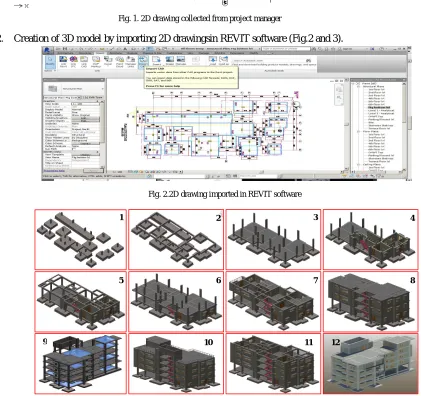
2. Creation of 3D model by importing 2D drawingsin REVIT software (Fig.2 and 3).
1 2 3 4
5 6 7 8
9 10 11 12
Fig. 1. 2D drawing collected from project manager
Fig. 2.2D drawing imported in REVIT software
C) Conversion of the REVIT 3D model into Naviswork readable (.nwf) format by using an extension tool in REVIT.
D) Preparation of work breakdown structure for the project and creation of task schedule using the quantity data from REVIT in Microsoft project (Fig. 4).
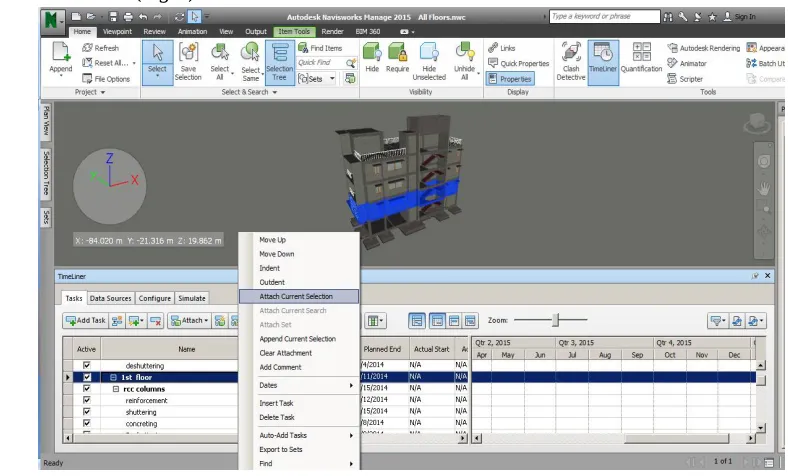
E) Creation of 5D model by importing and attaching 3D model and the MSP schedules (time and cost)in Naviswork software (Fig. 5).
Fig. 4.Preparation task schedules in MSP
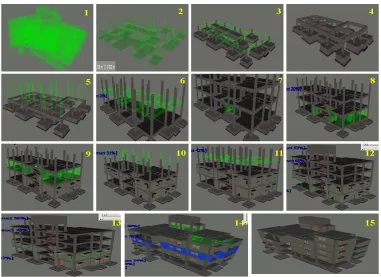
F) Simulation and visualization of 5D model in Naviswork software as illustrated in Fig. 6 and Fig. 7.
V. RESULTS AND DISCUSSION
The results of this study show that the concrete quantities calculated by both traditional and5D BIMmethods were approximately similar, therefore, the quantities generated by the software were preferred to create the construction schedules throughout the project.Based on the rates of resources and work assignments, the budgeted cost of the project was estimated in MSP software which was used to plan and schedule the construction process.
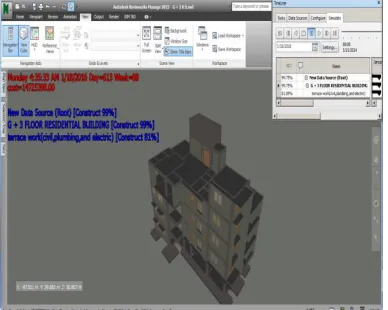
After planning and scheduling the construction process it was observed that the cost estimated using traditional method was 1.86 crores as clearly illustrated in Fig.8 below, which exceeded about ~ 20% from the cost estimated by using 5D BIM method, where it was estimated about1.47 crores (Fig.8). Also the duration of the construction which was of about 2 years according to the traditional method, it was also reduced by six and a half months using 5D BIM method. Fig. 9 below shows the simulation process of the construction of the active tasks undergoing at a particular time point with the cumulative estimated costs and the percentage of work progress that could be clearly viewed for that particular day.
Naviswork software also enables the planning of additional data such as material order and their delivery dates by efficiently allowing the procurement of the material before the commencement of the work at any level of the construction without any delay. Fig. 10 below demonstrates the generation of automatic schedule for material procurement achieved by entering the dates manually into the REVIT model.
0 2000000 4000000 6000000 8000000 10000000 12000000 14000000 16000000 18000000 20000000
Q2 Q3 Q4 Q1 Q2 Q3 Q4 Q1
C
o
st
(R
s)
Time (Quarters)
5D BIM METHOD TRADITIONAL METHOD EARNED VALUE
Fig.9. Snap shot of 5D simulation process on day – 18/01/2016
VI.CONCLUSIONANDFUTUREWORK
5D BIM is very helpful in the integration of information that could be visualized on the day-to-day basis on computer monitors. Therefore, 5D BIM makes a perfect visualization tool to monitor the project progress. It is very easy and appropriate tool to be used for construction cost and resource management. All the steps of construction could be modified and managed at any point of time by simply clicking on the element and activity. Using this technology, time, cost and labour management becomes smooth and feasible. This technology also allows the integration of different sophisticated softwares which are very instrumental and appropriate in generating the outputs for a particular type of task. This technology enables the collaboration and allows the integration of information from all the fields on a single platform, hence generating the most accurate outputs. Since the 5D BIM is a complex process involving the contribution of people from different fields to work on a single model, therefore, this technology fosters collaboration among different project teams. These techniques are user friendly and could be easily adopted by quantity surveyors, engineers, project managers etc. 5D BIM utilizes the dynamic linkage between the 3D elements and the corresponding activities in the schedule thus, detecting the problems and logical errors in the schedule sequence prior to the construction, which is not possible in traditional methods.
Although, 5D BIM technology employed in this project considered time as 4th and cost as 5th dimension, further other dimensions are also described as the subsets of BIM such as 6D as operation, 7D as sustainability and even 8D as safety. Furthermore, the BIM modelling could be modified using resources, materials, site conditions, global information system (GIS), etc. as one of the dimensions to create nD models.
REFERENCES
1. Forgues, D., Iordanova, I., Valdivesio, F.,and Staub-French, S., “Rethinking the cost estimating process through 5D BIM: A case study”, 2012.
2. Koo, B., and Fischer, M., “Feasibility Study of 4D CAD in Commercial Construction”, Journal of Construction Engineering and Management, ASCE, Vol. 126, Issue 4., pp. 251-260, 2000.
3. Chau, K.W., Anson, M., and Zhang, J. P., “Four-dimensional visualization of construction scheduling and site utilization”, J constr Engg Manage, ASCE, pp. 598-606, 2004.
4. Manish, Goyal., and K. N., Jha, “Development of a 4D model for application in construction management”, 24th international symposium on automation and robotics in construction, (ISARC), pp. 289-294,2007.
5. Sheryl, Staub-French., and Atul, Khanzode, “3D and 4D modeling for design and construction coordination: issues and lessons learned”, ITcon Vol. 12, pp. 381-407, 2007.
6. M. H., Tsai, C. H., Wu, A. Matin Md., S. L. Fan, S. C. Kang and S. H. Hsieh, “Experiences using building information modeling for a construction project”, Proceedings of the international conference on computing in civil and building engineering, pp. 1-7, 2010.
7. Saini, Vijay Kumar., and Mhaske, Sumedh, “BIM based Project Scheduling and Progress Monitoring in AEC Industry”, International Journal of Scientific Engineering and Research, (IJSER), pp. 94-96, 2013.
8. Hexu, Liu., Ming, Lu., and Mohamed, Al-Hussein, “BIM-based Integrated Framework for Detailed Cost Estimation and Schedule Planning of Construction Projects”, The 31st International Symposium on Automation and Robotics in Construction and Mining, (ISARC), pp. 1-9, 2014.
9. Peter, Smith., “BIM & the 5D Project Cost Manager”, Procedia - Social and Behavioral Sciences, Vol. 119, pp. 475 – 484, 2014.
10. Prakash Chandar, S., and Dhivya Shree, G., “Integrating Building Information Modeling (BIM) and Construction Project Scheduling to Result in 4D Planning for a Construction Project with Relevant Illustrations”, International Journal of Emerging Engineering Research and Technology, Vol. 3, Issue4., pp. 67-74, 2015. 11. Pravin, B., Patil, and Abhijit, N., Bhirud, “Application of building information modeling for the residential building project”, International Journal of Engineering
Research, Vol. 3, Issue 4., pp. 13-18, 2015.
BIOGRAPHY
Mudasir Amin Chowdary is a Post-graduate student in the Department of Civil Engineering (Dept. CE), Nagarjuna College of Engineering Technology (NCET), Visvesvaraya Technological University (VTU), Bangalore, India. He received Bachelor’s degree in Civil Engineering (B.E) from D. Y. Patil College of Engineering, Akurdi, University of Pune, India in 2013. His research interests are Computer and software applications in construction field, Construction technology, Geoscience etc.
Dr. Rajendra S is currently working as Professor & Head of the Dept. CE, NCET, Bangalore. He holds a B.E, M.E, MS and PhD degree in engineering and a great teaching track record from past 30 years.
Vijay K is associate professor at Dept. CE, NCET, Bangalore. He holds B.E, M.E degree and an excellent 20 years of teaching experience. His valuable critical comments have been beneficial for this study.