Trace Miniature Objects Using Internet of
Things
Shivenkumar Parmar
Bachelor of Engineering Student, Department of Information Technology, Vishwakarma Government Engineering
College, Gujarat Technological University, Gujarat, India
ABSTRACT: In day to day life, People have to find something which they kept carefully somewhere like keys, kitchen, glasses and so on. It’s very frustrating when they don't find their things. So, the aim of this paper is to introduce a device which can find things fast and effectively. This device can find things using Arduino or DTMF. It helps to find things those are in the range of Arduino or DTMF with the help of transmitter and receiver. So, basically, this device trace the things using Radio Frequency. This device is beneficial to trace the smaller things which people forgot somewhere and don’t remember. So, this device does tracing of objects.
KEYWORDS: TMT, Trace Things, Arduino Tracing, DTMF Tracing, Find Things, IOT Tracing,
I. INTRODUCTION
There exists a need for better electronic location systems, particularly systems that can accommodate the tracking of individual personal belongings such as handheld computing devices, eyeglasses, wallets, keys, pen drives and any other object subject to being misplaced.There also exists a need for systems and methods that would permit tracing lost property, as well as permit immediate or real-time location and retrieval of objects in diverse environments.The present invention comprises in one aspect a system for returning lost objects to their owners using RF technology. Here we make use of DTMF (dual tone multi-frequency) signals as the control codes for passing appropriate code for the lost object onto Arduino board which in turn processes the result and passes it on to the RF transmitter. The RF transmitter generates radio frequency signals through the antenna which are received by appropriate RF receiver attached to the lost object on the other side. The system is confined to a limited region, say for example a house.The present system and method for identifying and returning an object include affixing to the object a passive two-way communication circuit.
An object locating, identifying, and tracking system is provided for managing physical objects such as pen drives, keys, and various other miniature things. The system employs RFID technology, computer programming and database applications, networking technologies, and hardware elements. On receiving the input from DTMF, it passes the generated bits to RF transmitter which in turn generates radio frequency signals through the antenna which are received by appropriate RF receiver attached to the lost object.The system is confined to a limited region, say for example a house. It employs exemplary components such as RF transceiver, DTMF keypad, antennas, and computers to facilitate tracking of objects as needed.So the main of our system is to construct such a device which is useful for people to not waste their time in searching such miniature things which might be placed somewhere close only.
II. RELATEDWORK
any lost object by the finder to any specified locations and/or package delivery service location, reading the RFID tag identification code number, accessing the corresponding owner information from the computer system, returning the object to the owner, and using the owner's billing account information to charge the owner for the return of the object to the owner.
Earlier, Location system for misplaced items.This device is made by the author Gorzelic Michael and meant to locate a misplaced item.A switch and a button are provided to a control unit. The button will initiate the signals to the receiver (device to be found). And a switch to decide whether we want a sound to beep or an LED to glow to indicate the missing item.After pressing the button, a wireless paging signal is generated from the control unit, and the beacon unit has the capability to receive the paging signal. [1]
Object Finder. This is a device for enabling persons to locate lost or misplaced objects and items in households, offices, and other workplaces with the help of wireless technology This uses wireless transmission which sends unique signals or packets for receiver coded to only specific transmitter assigned to it.It causes a receiver to produce an audio signal or sound for indication.The only limitation with this device is that its area is limited.[2]
Apparatus and method for locating, tracking, controlling and recognizing tagged objects using active RFID technology.The objective of this invention relates to intermittently active radio frequency identification (RFID) tags to locate, track, control, and recognize animate or inanimate objects. The only limitation is, this current technology is not miniature because it contains three antenna coils, one in each direction, and each must be directional, as required by the invention. Hence, the tracking devices are larger than RFID tags using an omnidirectional antenna.[3]
Multi-path mitigationinrangefindingandtrackingobjectsusingreducedattenuation. This is a method and system for identification, tracking and locating in wireless communications and wireless networks. The method and system use reference signals that are present in wireless communications and wireless networks which are used to indicate the regions and to travel through that.This is a location-finding system which suffers from certain inaccuracies when locating the objects in closed (i.e., indoor) regions, as well as outdoors (specified). It uses Radio Frequency signals which uses Real-time Locating Service (RTLS) which is a disadvantage of this system at a certain point.[4]
III. PROPOSED ALGORITHM
In the proposed system, The circuit makes use of radio frequency to transmit the control signals and hence it can be used for control from almost anywhere in the house. Here we make use of DTMF (dual tone multi-frequency) signals (used in telephones to dial the digits) as the control codes. The DTMF tones are used for frequency modulation of the carrier. At the receiver unit, these frequency modulated signals are intercepted to obtain DTMF tones at the speaker terminals. The frequency modulated DTMF signals are received by the RF receiver and the output (DTMF tones) are fed to the dedicated IC. This IC when fed with the DTMF tones gives corresponding BCD output; for example, when digit 1 is pressed, the output is 0001 and when digit 4 is pressed the output is 0100.
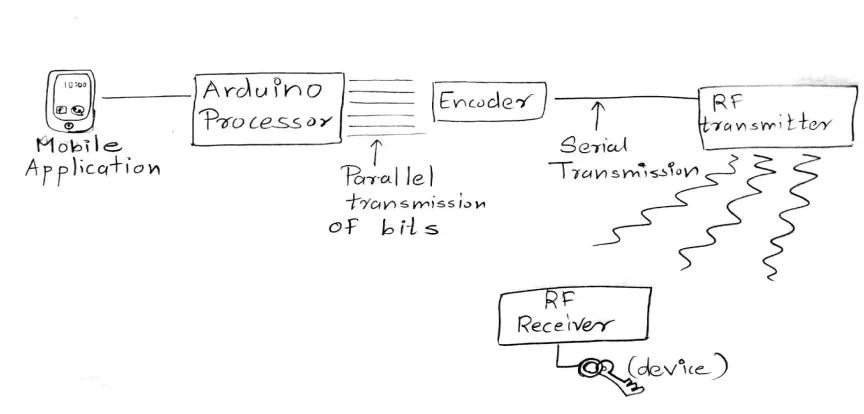
The implementation of the system is, to begin with, the frequency generator application. It can be DTMF(dual tone multi-frequency) or an Android application that is connected to an Arduino board.
• That application will be used by our system user who can initiate the call for their misplaced device by operation on that application.
• If DTMF is used, then the frequency generated by the DTMF encoder will be directly used and if an android application is used, then to connect software application and hardware device, Arduino processor is used, that will be coded on respective platform.
• Arduino processor manages the input frequencies given to an encoder. Here encoder is used because the input data is parallel and for transmission of data, serial data is needed. So, the work of encoder is to convert parallel data to serial data. The input of this encoder is 4-bit parallel data generated by a particular frequency generator either DTMF or mobile application.
• The encoded data is serial data that will be input to RF transmitter that is responsible for the particular radio frequency transmission.
• Radio frequency is used here because in this project the work is being done with the limited area. That means radio frequency zone will be one constraint. RF transmitter will transmit signals over the wireless network through an antenna. The signals will travel in air.
Fig. 2. Tracing using Arduino
• At the receiver side, there is an RF receiver attached with the thing which can be misplaced. RF receiver receives the serial data and gives it to the decoder that will again convert the serial data to parallel data. Hence original signal will be captured at receiver's side.
Encoder:
Encoder IC gets parallel data in the form of address and control bits.
The control signals from remote switches along with 8-bits constitute a set of 12 parallel signals. The encoder converts the parallel inputs into a serial set of signals.
These signals are serially transmitted through RF to the response point Transmission is permitted by providing ground to pin-14 which is active low.
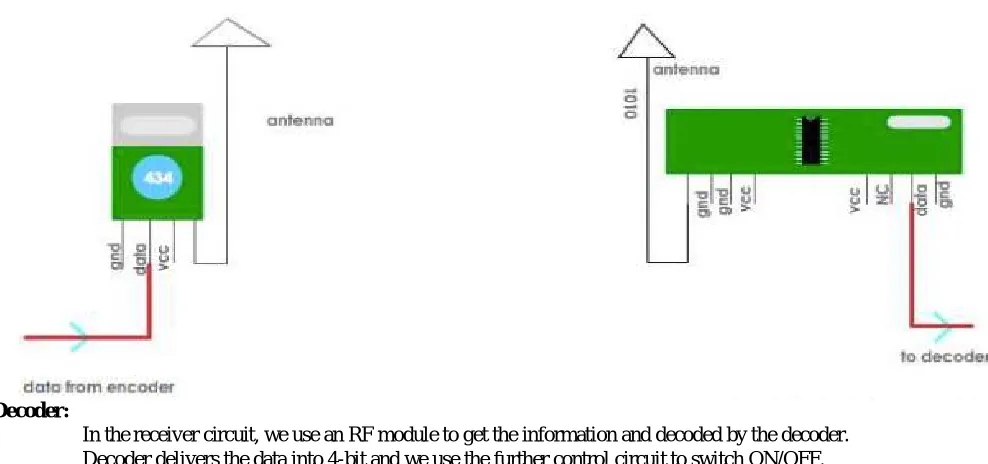
Fig. 3. Block diagram of encoder and decoder
Decoder:
In the receiver circuit, we use an RF module to get the information and decoded by the decoder. Decoder delivers the data into 4-bit and we use the further control circuit to switch ON/OFF.
The decoder is used after the RF receiver to decode the serial format and regain the original signals as o/ps. This o/p can be observed on equivalent LEDs.
IV. CONCLUSIONANDFUTUREWORKS
The existing system employs the method for identifying and returning an object using a passive two-way communication circuit such as a radio security tag or smart label. The tag or label, when operational, is arranged to receive a remotely generated request for status information and, responsive to the request, to transmit status information to a remote device. If desired, the radio tag can be incorporated into a printed label, each label having an adhesive side and a printable side with information to notify the ‘finder’ of a tagged item to coordinate return to its registered owner by contacting a courier, postal or other delivery service network.
This circuit uses an RF module to make a wireless remote, which could be used to drive an o/p from a distance place. As the name suggests, RF module uses radio frequency to send signals, which are transmitted at a specific frequency & a band rate.This circuit makes use of radio frequency to transmit the control signals and hence it can be used for control from almost anywhere in the house. Here we make use of DTMF (dual tone multi-frequency) signals (used in telephones to dial the digits) as the control codes. The DTMF tones are used for frequency modulation of the carrier. At the receiver unit, these frequency modulated signals are intercepted to obtain DTMF tones at the speaker terminals.
tracking at the URL of the vendor's Web site through the Internet.Moreover, simple systems for locating and/or retrieving objects can be incorporated into a conventional express courier, postal or other commercial data processing or communications infrastructure which would likewise enhance efficiency while also achieving a cost economy as a result of integration with existing hardware and/or software.
REFERENCES
[1] GORZELIC MICHAEL,”LOCATION SYSTEM FOR A MISPLACED ITEM”,IPC: G08B21/24-H04W68/00,Publication Info: US2016035212(A1),2016-02-04.
[2] HOLBROOK PAUL ROBERT & LOW DAVID ROBERT,”OBJECT FINDER”,IPC:G08B21/24-(IPC1-7):G08B13/14-H04Q7/00,Publication Info:US6674364(B1),2004-01-06.
[3] ROBINETTE JAMIE & GERNANDT TASSILO, "APPARATUS AND METHOD FOR LOCATING, CONTROLLING AND RECOGNIZING TAGGED OBJECTS USING ACTIVE RFID TECHNOLOGY", IPC: G06K7/10, Publication Info: US2014240088 (A1), 2014-08-28.
[4] MARKHOVSKY FELIX & PREVATT TRUMAN, “MULTI-PATH MITIGATION IN RANGEFINDING AND TRACKING OBJECTS USING REDUCED ATTENUATION RF TECHNOLOGY”, IPC:H04W4/02-H04W4/90, Publication Info:US2018295470(A1), 2018-10-11. [5] https://electrosome.com/wireless-transmitter-and-receiver-using-ask-rf-module/
[6] https://www.arduino.cc/reference/en/ [7] https://worldwide.espacenet.com [8] https://www.arduino.cc/
[9] https://www.udemy.com/?utm_source=adwords-brand&utm_medium=udemyads&utm_campaign=NEW-AW-PROS-Branded-Search-World-
EN-ENG_._ci__._sl_ENG_._vi__._sd_All_._la_EN_._&tabei=7&utm_term=_._ag_48933380294_._ad_239097867570_._de_c_._dm__._pl__._ti_ kwd-310556426868_._li_9032529_._pd__._&gclid=Cj0KCQjwguDeBRDCARIsAGxuU8bZG6xrsyv6KzmSdYK7ec8So9kzqFixFW4o1-ALy6Ktnieh3aN2x4AaAslkEALw_wcB
[10] https://scholar.google.com/scholar?q=PATENT+PAPERS+ON+RFID&hl=en&as_sdt=0&as_vis=1&oi=scholart [11] https://en.wikipedia.org/wiki/Radio-frequency_identification
[12] Playing with Sensors. Making a decision taking the device, http://letslearnelectronics.blogspot.in/2012/06/playing-with-sensors-making-decision.html