BLE: BluePrint Finder through Android
Application
Shashidhara D
1, Poornima M
2P.G. Student, Department of Computer Network Engineering, SJB Institute of Technology, Bangalore,
Karnataka, India1
Associate Professor, Department of Information Science and Engineering, SJB Institute of Technology, Bangalore,
Karnataka, India2
ABSTRACT: The Bluetooth 4.1 is a Bluetooth Low Energy (BLE) IEEE 801.11n Standard which facilitates the development of Internet of (IOT) Applications. BLE Finder device is a Bluetooth enabled external device which transmits the TSSI (Transmission Things Signal Strength Indicator) signal to Android application and receives the RSSI (Receiving Signal Strength Indicator) Signal, It Shows the distance and coordinates of that device by indicating LED and Buzzer sound. BLE Finder Radar Android Application transmits the TSSI signal to BLE Finder Device, Receives the RSSI signal to track the Smart phone. BLE Finder is a mechanism to find the Devices using signature based algorithm like Near, Middle, Far, Out distances of objects. Signature based algorithm works based on RSSI
Signal table to calculate approximate distances of the devices. Android framework provides Bluetooth API’s for getting
the best signals.
KEYWORDS: API, RSSI, TSSI, blueprints, Signature Based Algorithm.
I. INTRODUCTION
Bluetooth is a wireless network, it is one of the media for communication between two Bluetooth enabled electronic devices. Bluetooth 4.1 module is used for implementing two way communications between the Bluetooth enabled objects and Android radar application. Object Consists of Bluetooth 4.1 module which has to be integrated in the electronic device that enables the communication between the Object and Android application. The Bluetooth Low Energy (LE) radio is intended for low power operation, Operation rate at the speed of 2.4 GHz frequency band used for transmission and receiving data signals. The Bluetooth LE radio gives designers a colossal measure of adaptability, including various PHY alternatives that help data rates from 125 Kb/s to 2 Mb/s, numerous power levels from 1 mW to 100 mW, and additionally numerous security alternatives up to government review. Bluetooth LE supports multiple network topologies, including a point-to-point option used for data transfer, a broadcast option used for location services and a mesh topology used for creating large-scale device networks. Bluetooth Low Energy is a power-checking variety of Bluetooth personal area network (PAN), intended for use by Internet enable machines and Application. BLE is marketed as Bluetooth Smart, Bluetooth LE was presented in the Bluetooth 4.0 detail as a contrasting option to Bluetooth Classic. Like its antecedent, Bluetooth LE utilizes frequency hopping remote innovation in the 2.4 GHz unlicensed radio band to interconnect nearby BLE enabled devices. Bluetooth LE maximizes at only 1 Mbps while consuming only 0.01 to 0.5 watts. That is dependent upon 33% of the speed of Bluetooth Classic close to a large portion of the power. Bluetooth LE was introduced in the year 2004. Bluetooth LE is used for developing the Internet of Things (IoT). For instance, Internet enabled devices utilized for individual healthcare, entertainment, sports, etc. now utilize Bluetooth LE to speak with contemporary Smartphone's and tablets, including
Iphones, Android, Windows, and Blackberry's phones. Battery life depends on device hardware’s, transmit separation
cost, long battery life, and ease of deployment, and facilitates infrequent short range wireless data communication between devices.
The Bluetooth SIG (Special Interest Group) introduced a Bluetooth 4.1 with several solid improvements over 4.0.
Improving Usability: Bluetooth 4.1 extends the Bluetooth brand and Major usability updates come in three areas:
Co-existence: engineered to work seamlessly and cooperatively with the latest generation cellular technologies like LTE. Bluetooth and LTE radios can impart to guarantee transmissions composed and thusly lessen the likelihood of close band obstruction. The coordination between the two technologies happens automatically, while the consumer experiences the high quality they expect.
Connections: Bluetooth 4.1 helps to designers control over making and keeping up Bluetooth associations by influencing the reconnection to time interim adaptable and variable. This enhances the buyer encounter by enabling gadgets to reconnect naturally when they are in closeness of each other.
Enhanced Data Transfer: Bluetooth Smart innovation gives mass information exchange. For instance, through this new ability, sensors, which assembled information amid a run, bicycle ride or swim, exchange the information all the more proficiently when the consumer returns home.
Developer Innovation: Bluetooth 4.1 extends the Bluetooth Smart development environment by providing product and application developers with even more flexibility to create products that can take on multiple roles. With this new capacity, a solitary gadget goes about as both a Bluetooth Smart fringe and a Bluetooth Smart Ready center point in the meantime. For instance, a savvy goes about as a center social event data from a Bluetooth Smart heart rate screen while
all the while going about as a fringe to a smart phone — showing new message notification from the telephone. As the
Bluetooth Smart community develops, the Bluetooth SIG anticipates that more arrangements will play both a centre point and fringe part. Bluetooth 4.1 passes on this kind of versatility to Bluetooth Smart gadgets and application developer.
Empowering the Internet of Things: By adding a standard intends to make a dedicated channel, which could be utilized for IPv6 interchanges in the Core Specification, the basis is laid for future conventions giving IP availability. With the quick market determination of Bluetooth Smart and the coming extension of IP accessibility, all signs point to Bluetooth as a major remote connection in the Internet of Things.
II. RELATED WORK
[1] Explains the lower level Bluetooth Open Source Stack (BOSS) and explains the Bluetooth communication layers for the IOT Devices. [2] In this work, the BLE standard specifications are investigated to derive the required RF transceiver specifications. and also, Defines the Approximate Bluetooth full signal strength as -70dbm. [3] Detect the
position of the Bluetooth point for both people and objects. While BLE is a key enabling technology, In general,
Man in the middle (MITM), channel jamming, denial of service (DoS) and battery exhaustion. [6] Discussing various security levels of smart Bluetooth, Data transfer between the two devices secure seamless connectivity to BLE-capable
mobile IoT devices. [7] In this paper, author show how backscatter signals can be designed for compatibility with the
Bluetooth 4.0 low energy (BLE) chipsets already present in billions of smart phones and tablets. author present a prototype microcontroller-based “BLE-Backscatter” tag that produces band-pass frequency-shift keying modulation at 1 Mb/s, enabling compatibility with conventional BLE advertising channels. [8] in this paper, The energy saving brought by the use of non-connectable devices saved energy up to 30%. [9] Introduce a new BLE-based tracking technique called Blueprint which makes utilization of a recognition component called NUFO (Near, Uncertain, Far and Out). It consolidate a Straight forward unique finger impression technique with manage based calculation to Evaluate positions.
III.PROPOSED ALGORITHM
A. Signature Based algorithm:
We look to build up a basic strategy with sensible positioning estimation. Initially, RSSI estimation will be changed over into approximate zone, specifically near, middle, far and out. Keeping in mind the end goal to change over the RSSI adequately, finger print testing will be taken at various separations. The signature based algorithm uses RSSI and TSSI as a reference signals to calculate the estimated position. A BLE fingerprint outline to build the whole testing area, while we expect that the RSSI is comparable at a similar separation towards distance based on signals strength we build separate buckets for specific Near, Middle, Far and out buckets then will calculate approximate distance.
1. Reading the Data
Bluetooth BLE module is connected to Android mobile then paired with that module. Android radar application receiving the Bluetooth RSSI signals for estimating the distance. In the event quantify higher quality information exchange between the devices like connecting two or more BLE devices. Reading RSSI signal strength store it buckets for estimating the position. Reading signals and estimated distances is to be calculated in the form of milliseconds.
Reading Data = Window size/interval × c (RSSI signal strength)
2. RSSI Conversion with Noise Filtering
After receiving the RSSI Signals from multiple BLE devices, first Step is filtering the noise from that window. However, if there is profoundly fluctuating signals, it means the data is influenced by the noise. Each Data signals depend on window of RSSI signal. For example, if 50 Bluetooth devices send a TSSI signals in mesh topology, Signals are combined with noise during transmission of the signals from mesh topology. Each node communicates at the speed of 100ms interval, in the best case noise levels up to 90% can be removed and it requires 3.25 second at the maximum to filter the signals. The wireless RSSI Signal conversion is very difficult, approximate value conversion is done in this experiment. Use table 1 to finding distances. Android applications receives the RSSI signal and removes the noise levels in that signals using simple signal pre-processing.
a. Discretization
We proposed that the RSSI be discretized into various approximate containers. For instance, containers can be Near,
Middle, Far, Out ( = { , M, 𝐹, }). A general case can be: RSSI under greater than -40 to -50dbm is near, in Between
-51 to -64dbm as Middle, -63 to -70dbm is characterized as Far and above -70dbm is out.
b. RSSI Table
Finding distance function 1:getDistance(int rssi, int txPower)
2:return Math.pow(10.0d, (((double) txPower) - ((double) rssi)) / 20.0d):
RANGE APPROXIMATE
DISTANCE
APK MESSAGE BUCKETS
RSSI> -40 0 Meters getDistance() Near
-40 >RSSI >= -47 1 Meters getDistance() Near
-46>RSSI>= -51 2 Meters getDistance() Near
-50>RSSI>= -53 3 Meters getDistance() Middle
-53>RSSI>= -56 4 Meters getDistance() Middle
-56>RSSI>= -60 5 Meters getDistance() Middle
-60>RSSI>= -64 6 Meters getDistance() Middle
-63>RSSI>= -65 7 Meters getDistance() Far
-65>RSSI>=-68 8 Meters getDistance() Far
-67>RSSI>=-70 9 Meters getDistance() Far
RSSI> -70 Out Out Out
Table 1. Experimental RSSI Values
3. Approximate Location bucket
Approximate Location estimation based on signal regions. The signal is produced in Omni-directionally, the scope region of the signals each bucket can be characterized by the span of each signal region and the condition of a circle:
( − 𝑏 )2 + ( − 𝑏 )2 = 𝑠 (1), Where 𝑠 is distances of regions, 𝑏 , 𝑏 is the x and y co-ordinates of the signal.
Based on distances of the region Calculated and decide a weather region belongs to near region, middle region, Far region or Out region.
4. Algorithm
To compute the position, given the information cluster of beacon zone sets, first we have to sort the cluster in light of the RSSI in diving request. Based on RSSI signals we form a 4 bucket or cluster, each bucket contains device signals strength, distances and their regions. After converting RSSI into the discrete esteem using Table 1, decide approximate location of that device, the assessed area will be the area of the reference point discharging signals in Near region or
other regions. Recursively calculate and convert RSSI signal to discrete values for example N instances 𝐾 = {𝑘1, 𝑘2, . .
, 𝑘𝑛}, algorithm calculate the distance in meters for every BLE enable device. The calculation is composed as a
recursive capacity as appeared in table 1. After checking all points for all beacons in the input array, the resulting points will be the estimating area.
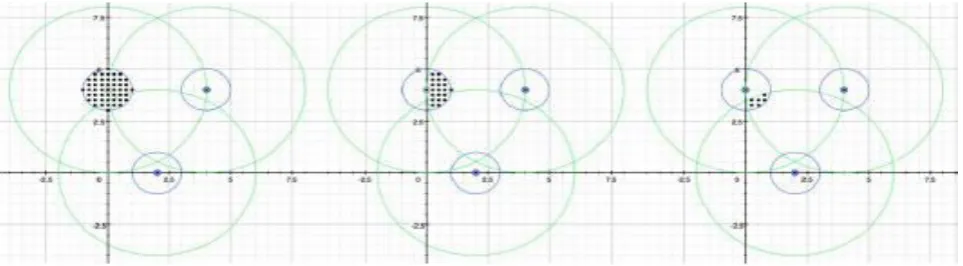
Figure 1 shows the Iterative function call the search function in our experiment and pair that device and find out the Distances between them up to 50 devices.
INPUT: All paired devices (RSSI Signal). OUTPUT: Approximate distance.
1: For all paired n devices in N do. 2: If(Get(n,RSSI)) Then
3: Distance(n,RSSI) 4: else
5: store Out bucket 6: end If.
7: end For.
//Distance Distance(n,RSSI) 1:create a four buckets
2:converting RSSI values into integer 3:If(RSSI<40) Then
//read the corresponding Table 1 values. // Store it in Near bucket.
4: else If(40>RSSI>=47) Then
//read the corresponding Table 1 values. // Store it in Near bucket.
5: Compare upto 46>RSSI>51 Then
//read the corresponding Table 1 values. // Store it in Near bucket.
6: else if Compare upto 50>RSSI>=64 Then
//read the corresponding Table 1 values. // Store it in Middle bucket.
7: else if Compare upto 63>RSSI>=70 Then
//read the corresponding Table 1 values. // Store it in Far bucket.
8: end if.
9: Return Bucket values.
IV.SIMULATION RESULTS
Experimented Mobile Application: The BluePrint technique has been implemented as an Android application for
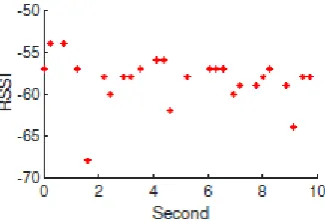
Figure 2: Our Android application reading one mesh topology.
Figure 2 represents android application receives that device signals up to 50 devices. For example, in a 10-second examining period, given a telecom interim of 100 milliseconds, there ought to have been 100 readings, or 10 readings for each second. We found that generally gadgets can get around 80% of the readings, as appeared in Figure 2. Based on the experimental results, we found that most devices can receive about 90% of the readings. One can abbreviate the broadcasting interim to expand the quantity of estimations or on the other hand drag out the estimation window, in this manner diminishing the battery life of reference hubs or decreasing the responsiveness of computations, which are the separate outcomes.
Figure3. Finding the BLE Enable Device
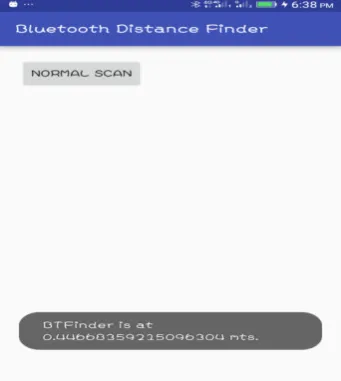
Figure 4. BLE Enable Device Distance
Figure 4 shows Distences between the two BLE enabled Devices and android Appliction by usig the creating the connection betwwen them by using Socket System calls. Once extablish the connection recieve RSSI Signals refer the Table 1 find out the Distances Using Algorithm.
V. CONCLUSION
BLE:BluePrint Finder through Android Application gives a best result due to Low cost, low energy and easy to setup objects. We proposed signature Based algorithm for positioning or finding the distance of the Bluetooth enabled devices and their corresponding regions like the device can be near, middle, far, out regions. Our Android application shows the detailed results about the Bluetooth enabled objects.
REFERENCES
1. Ahmed Salem, Tamer Nadeem,” Exposing Bluetooth Lower Layers for IoT Communication” in 2016.
2. HShinill Chang and Hyunchol Shin, “Measurement and Analysis of Weather Phenomen CMOS RF Transreceivers for IOT” in 2012. 3. Yik Him Ho and Henry C B Chan “ BluePrint: BLE Positioning Algorithm based on NUFO Detection.” In 2017.
4. Marco Terán, Juan Aranda and Henry Carrillo “IoT-based System for Indoor Location using Bluetooth Low Energy” IN 2017.
5. Khatod Varsha Ritesh, Agata Manolova,Maria Nenova “Abridgment of Bluetooth low energy (BLE) standard and its numerous susceptibilities for Internet of Things and its applications” in 2017.
6. Syed Rafiul Hussain, Member, IEEE, Shagufta Mehnaz, Member, IEEE, Shahriar Nirjon, Member, IEEE, and Elisa Bertino, Fellow, IEEE
“Secure Seamless Bluetooth Low Energy Connection Migration for Unmodified IoT Devices” in 2017.
7. Joshua F. Ensworth, Student Member, IEEE, and Matthew S. Reynolds, Senior Member, IEEE “BLE-Backscatter: Ultralow-Power IoT Nodes Compatible With Bluetooth 4.0 Low Energy (BLE) Smartphones and Tablets” in 2017.
8. D. Giovanelliy, B. Milosevicy, D. Brunelli_, E. Farellay “Enhancing Bluetooth Low Energy with wake-up radios for IoT applications” in 2017. 9. Sorin Zamfir_, Bogdan-Alexandru Lupu_, George-Alex Stelea_ and Dan-Nicolae Robu_”Extending Linux Controllability of Bluetooth Low Energy Devices in the IoT” in 2017.
10. S. Subedi, G. R. Kwon, S. Shin, S. seung Hwang, and J.-Y. Pyun, “Beacon based indoor positioning system using weighted centroid” in 2017. 11. Yik Him Ho and Henry C B Chan “ BluePrint: BLE Positioning Algorithm based on NUFO Detection.” In 2017.
12. Marco Terán, Juan Aranda and Henry Carrillo “IoT-based System for Indoor Location using Bluetooth Low Energy” IN 2017.
13. Khatod Varsha Ritesh, Agata Manolova,Maria Nenova “Abridgment of Bluetooth low energy (BLE) standard and its numerous susceptibilities for Internet of Things and its applications” in 2017.
14. Atis Elsts, Xenofon Fafoutis, James Pope, George Oikonomou, Robert Piechocki and Ian Craddock “Scheduling High-Rate Unpredictable Traffic in IEEE 802.15.4 TSCH Networks” in 2017.
15. T.Shanthi, Anushree.S.V “DAC To Monitor Solar Powered Home Appliances And Usage Control Using Bluetooth Enabled Mobile Application And IoT” in 2017.
17. Radek Krejˇci Ondˇrej Hujˇnak Marek Švepeš, “Security Survey of the IoT Wireless Protocols” in 2017.
18. Syed Rafiul Hussain, Member, IEEE, Shagufta Mehnaz, Member, IEEE, Shahriar Nirjon, Member, IEEE, and Elisa Bertino, Fellow, IEEE
“Secure Seamless Bluetooth Low Energy Connection Migration for Unmodified IoT Devices” in 2017.
19. Alireza Zolfaghari, Mohamed El Said, Michael Youssef, Gang Zhang, Tom(Tong) Liu, Federico Cattivelli, Yannis (Ioannis) Syllaios, Faisal Khan, Fang (Qiang) Fang, Jun Wang, Kuang-Yu (Jason) Li, Fafa (Hsin-Fa) Liao, Devin (Shengyu) Jin, Vincent Roussel, Dong-U Lee, and Farooq (Muhammad) Hameed” A Multi-Mode WPAN (Bluetooth, BLE, IEEE 802.15.4) SoC for Low-Power and IoT Applications” in 2017.