ABSTRACT
BYFIELD, Grace E. The effect of temperature on fatty acid desaturase gene expression and fatty acid composition in developing soybean seeds (Under the direction of Dr. Robert G. Upchurch).
Temperature also plays an important role in the final lipid content of oil seed plants. In this study, we designed and used gene-specific primers to the following fatty acid desaturases; stearoyl-ACP desaturase (SACPD), omega-6 fatty acid desaturase (FAD2-1), and omega-3 fatty acid desaturase (FAD3), to characterize soybean varieties. We further determined the effect of temperature on the expression of these desaturase genes by quantifying transcript accumulation at various stages of seed development.
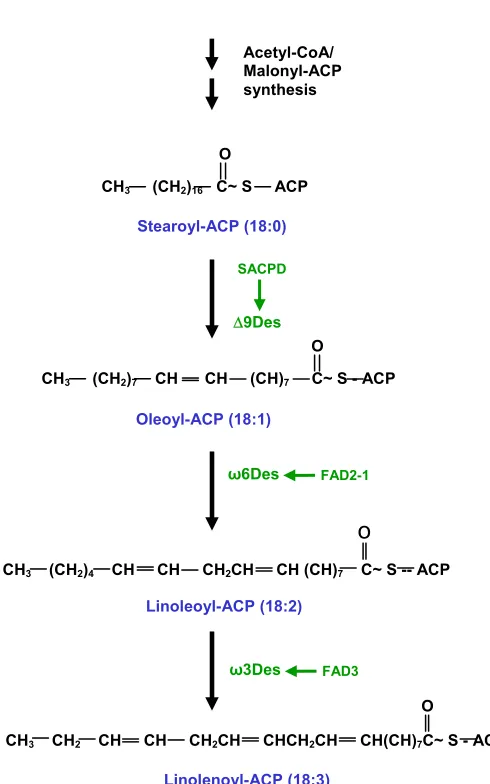
We surveyed 51 soybean lines and found each contained two SACPD genes (A and B) with distinguishing amino acid variations in exon 3. The varieties also had two FAD2-1 (A and B) and three FAD3 (A, B, C) genes. Soluble ∆9 stearoyl-ACP desaturases introduce the first double bond into stearoyl-stearoyl-ACP (18:0-stearoyl-ACP) between carbons 9 and 10 to produce oleoyl-ACP (18:1∆9-ACP). Microsomal ω-6 desaturase catalyzes the first extra-plastidial desaturation and converts oleic acid to linoleic acid. Microsomal ω-3 fatty acid desaturases (FAD3s) catalyze the insertion of a third double bond into the linoleic (18:2) acid precursor to produce linolenic (18:3) acid.
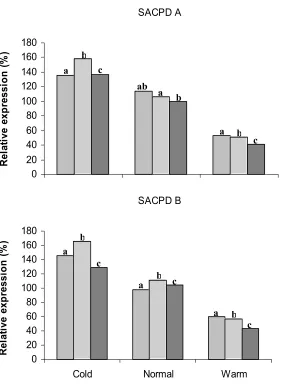
crucial factor for regulating oleic acid content in soybean. FAD2-1A and FAD2-1B gene expression in stage 4 seeds was comparable at the normal temperature, but a change in growth temperature to either side of the norm resulted in increased expression of FAD2-1B over FAD2-1A, slight at the warm temperature, but more pronounced at the cold temperature. The three omega-3 fatty acid desaturase genes exhibited the highest levels of transcript accumulation in stage 4 seeds at the cold temperature, with FAD3A levels 1.3 to 1.8 fold higher than 3B and 3C.
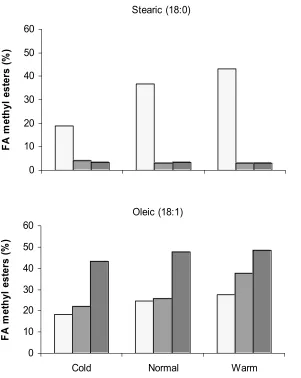
The fatty acid composition of the seeds at different stages of development was determined in conjunction with steady state transcript levels. Results show that the stearic acid content of A6 had the most dramatic response of the three soybean lines to temperature manipulation. Stearic acid content increased at the warmer temperature for all stages of A6, but for Dare and N01-3544 the percentage change in 18:0 was slight and net negative. Conversely, growth at the cold temperature resulted in the most dramatic reduction (48%) of stearic acid content in A6. The oleate (18:1) concentration increased at the higher growth temperature compared to normal across all varieties and stages, with Dare showing the most dramatic (32 %) increase in oleic acid content at the warm temperature. The increase in FAD2-1B transcript accumulation with decreasing temperature was associated with increasing 18:2 content in two of the three varieties. Increased GmFAD3A transcript accumulation was accompanied by an increase in 18:3 in all three soybean varieties examined.
THE EFFECT OF TEMPERATURE ON FATTY ACID DESATURASE GENE EXPRESSION AND FATTY ACID COMPOSITION IN DEVELOPING SOYBEAN
SEEDS
by
GRACE ELEANOR BYFIELD
A dissertation submitted to the Graduate Faculty of North Carolina State University
in partial fulfillment of the requirements for the degree of
Doctor of Philosophy
MICROBIOLOGY Raleigh, NC
2005
APPROVED BY:
___________________________ __________________________
Chair of Advisory Committee Co-Chair of Advisory Committee
BIOGRAPHY
ACKNOWLEDGMENTS
I sincerely thank my advisor Dr. Robert G. Upchurch for affording me the opportunity to combine two of my passions; plants and science, in what turned out to be a great learning experience. His constant optimism even in times of despair provided the extra drive that made this research project successful. I am cognizant that without his input, none of this would have been possible.
Special thanks to the other members of my advisory committee; Dr. Ralph E. Dewey, Dr. Amy M. Grunden, and Dr. Hosni M. Hassan, for the valuable advice they provided throughout my entire research experience. The support they provided was immeasurable.
My appreciation to Bill Novitzky for fatty acid analyses, Dr. Joe W. Burton for insight and seed material, and the staff of N.C. State Phytotron for greenhouse and growth chamber space. Thanks to the staff of the Microbiology Department office Dawn, Annette, Cindy, Cathy, and Brenda (former staff) who took care of certain aspects of my welfare and made my N.C. State sojourn truly memorable.
None of this would have been possible without the love, support and sacrifices of my family. I am forever grateful to my husband Brian for his understanding and reassurance every step of the way. My son Bakari was a constant source of joy and my family back in Jamaica helped to keep my life in even keel.
TABLE OF CONTENTS
Page
LIST OF TABLES...vii
LIST OF FIGURES... x
LITERATURE REVIEW Introduction ...1
Fatty Acid Biosynthesis...2
Fatty Acid Desaturases (FADs) ...6
Stearoyl-ACP Desaturases...6
Microsomal ω-6 Desaturases (FAD2)...7
Microsomal ω-3 Desaturases (FAD3) ...8
Altering Soybean Fatty Acid Composition...9
Soybean Seed Development ... 10
Temperature and Fatty Acid Desaturases ... 11
Rationale and Objectives ... 13
LITERATURE CITED... 14
TWO GENES FROM SOYBEAN ENCODING SOLUBLE ∆9 STEAROYL-ACP DESATURASES... 22
Abstract ... 22
Introduction ... 23
Materials and Methods... 25
Discussion... 34
Acknowledgments ... 37
References... 38
TEMPERATURE MODULATES THE EXPRESSION OF ∆9 STEAROYL-ACP DESATURASE GENES AND THE OLEIC/STEARIC ACID CONTENT IN SOYBEAN SEEDS... 51
Abstract ... 51
Introduction ... 52
Materials and Methods... 54
Results ... 57
Discussion... 59
Acknowledgments ... 62
References... 63
EFFECT OF TEMPERATURE ON MICROSOMAL ω-6 DESATURASE GENE EXPRESSION AND LINOLEIC/OLEIC ACID CONTENT IN SOYBEAN SEEDS Abstract ... 74
Introduction ... 75
Results and Discussion... 77
Materials and Methods... 80
Acknowledgments ... 84
EFFECT OF TEMPERATURE ON OMEGA-3 FATTY ACID DESATURASE GENE
EXPRESSION AND LINOLENIC/LINOLEIC ACID CONTENT IN SOYBEAN
SEEDS... 93
Abstract ... 93
Introduction ... 94
Results and Discussion... 96
Materials and Methods... 99
Acknowledgments ... 102
Literature Cited...103
APPENDICES APPENDIX A: HETEROLOGOUS EXPRESSION OF SOYBEAN STEAROYL-ACP DESATURASE (SACPD) GENES IN ESCHERICHIA COLI... 113
Materials and Methods... 114
Current Results ... 118
Discussion and Future Work ... 123
References... 125
APPENDIX B: REAL-TIME RT-PCR... 126
LIST OF TABLES
Page
LITERATURE REVIEW
Table 1. Stages of soybean seed development ... 11
MANUSCRIPT I
Table 1. Detection of SACPD-A and –B alleles in Glycine cultivars and lines that were typed by PCR and gene-specific primer pairs ... 42
MANUSCRIPT II
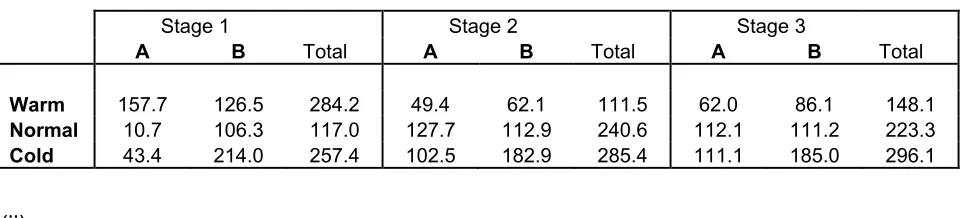
Table 1A. Changes in actin normalized SACPD gene expression (i) and the oleic/stearic acid ratio (ii) in response to temperature
in A6 ... 68
Table 1B. Changes in actin normalized SACPD gene expression (i) and the oleic/stearic acid ratio (ii) in response to temperature
in Dare... 68
Table 1C. Changes in actin normalized SACPD gene expression (i) and the oleic/stearic acid ratio (ii) in response to temperature
MANUSCRIPT III
Table 1A. Changes in actin normalized FAD2-1 gene expression (i) and the linoleic/oleic acid ratio (ii) in response to temperature
in N01-3544... 88
Table 1B. Changes in actin normalized FAD2-1 gene expression (i) and the linoleic/oleic acid ratio (ii) in response to temperature
in Dare... 88
Table 1C. Changes in actin normalized FAD2-1 gene expression (i) and the linoleic/oleic acid ratio (ii) in response to temperature
in N99-3170... 89
MANUSCRIPT IV
Table 1A. Changes in actin normalized FAD3 gene expression (i) and the linolenic/linoleic acid ratio (ii) in response to temperature
in N99-3170...107
Table 1B. Changes in actin normalized FAD3 gene expression (i) and the linolenic/linoleic acid ratio (ii) in response to temperature
Table 1C. Changes in actin normalized FAD3 gene expression (i) and the linolenic/linoleic acid ratio (ii) in response to temperature
in N83-375... 108
APPENDIX B
Table 1. Real-Time RT-PCR thermocycle protocols... 126 Table 2. Threshold (CT) values and calculations ... 127
APPENDIX C
LIST OF FIGURES
Page
LITERATURE REVIEW
Fig. 1. Representation of the fatty acid synthetic pathway in
soybean...4 Fig. 2. Flow diagram of lipid desaturation in plants ...5
MANUSCRIPT I
Fig. 1A. Gene structural organization of the soybean SACPD gene... 45 Fig. 1B. Alignment of Glycine max cultivar Dare SACPD-A and
SACPD-B protein sequences ... 46 Fig. 2A. SACPD exon 3 nucleotide (Blastn) sequence alignment... 47 Fig. 2B. SACPD exon 3 protein (Blastx) sequence alignment ... 47 Fig. 3. Ethidium bromide stained gel showing amplicons produced
by PCR ... 48 Fig. 4. Southern blots of Dare soybean cultivar genomic DNA... 48 Fig. 5. Relative expression of cultivar Dare GmSACPD-A and
GmSACPD-B at four stages of soybean seed development
(between R5 and R6) at 18, 23, 28, and 35 DAF ... 49
MANUSCRIPT II
Fig. 1. Relative expression of ∆9 stearoyl-ACP desaturase A and B
Fig. 2. Changes in stearic (18:0) and oleic (18:1) acid composition of stage 4 soybean seeds as affected by temperature ... 72
MANUSCRIPT III
Fig. 1. Expression of microsomal ω-6 fatty acid desaturase FAD2-1 genes in stage 4 soybean seeds grown at various
temperatures ... 90 Fig. 2. Oleic (18:1) and linoleic (18:2) acid content of stage 4 soybean
seeds grown at cold (22/18oC), normal (26/22oC), and warm
(30/26oC) temperatures ... 91
MANUSCRIPT IV
Fig. 1. Relative expression of ω-3 fatty acid desaturase genes in stage 4 soybean seeds across cold (22/18oC), normal (26/22oC), and warm (30/26oC) temperatures ...110 Fig. 2. Linoleic (18:2) and linolenic (18:3) acid content of stage 4 soybean
seeds grown at cold (22/18oC), normal (26/22oC), and warm
(30/26oC) temperatures ... 111
APPENDIX A
Fig. 3. PCR amplification of SACPD-A and -B coding sequence with
added restriction sites... 120 Fig. 4. Restriction analysis of SACPD-A and -B reamplified insert ... 120 Fig. 5. Expression Vector pTrc 99A...121 Fig. 6. Diagnostic digests used to verify SACPD inserts in pTrc 99A
in the BL21-RIPL E. coli background... 121 Fig. 7. SDS-PAGE of SACPD-A and -B following heterologous
expression in E. coli and coomassie blue staining ... 122
APPENDIX B
Fig. 1. Pre-determined seed stages (1-4) between R5 and R6 ... 128 Fig. 2. Ethidium bromide stained agarose gel showing amplicons
for soybean desaturase genes produced by PCR ... 128 Fig. 3. Standard curves generated by real-time RT-PCR for soybean
LITERATURE REVIEW
Introduction
Soybean [Glycine max (L.) Merr.] is the largest oilseed crop produced and
consumed worldwide, accounting for 56 percent of the world oilseed production in
2003 (Soy Stats 2004). As an oilseed soybean provides high quality protein for
livestock and poultry feed. The oil is used extensively in the cooking and food
manufacturing industries across the world. The major nonfood market for vegetable
oils is the production of soaps, detergents, and other surfactants. The United States
has been for some time, and continues to be the leading producer of soybean.
Soybean producers have targeted improved oil traits as a priority area of research to
enhance the market share of U.S. soybean. The expanded use of soybean oil for
additional industrial applications and renewable chemical feedstock is hampered by
the physical and chemical properties of conventional soybean oil. In Nature, the
vast majority of important food crops have a limited range of fatty acid. Palmate,
oleate and linoleate represent approximately 80 percent of the total fatty acid with
laurate, myristate, stearate, and linolenate, a further 15 percent (Harwood, 1998).
Soybean seed is approximately 18% oil and standard commodity soybean oil is a
mixture of five fatty acids; palmitic (11%), stearic (4%), oleic (22%), linoleic (53%),
and linolenic (8%). These fatty acids differ greatly in melting points, oxidative
stabilities, and chemical functionalities (Cahoon, 2003). Oils high in
monounsaturated fatty acids possess increased oxidative stability which negates the
containing trans-fatty acids are currently a major health concern and as such,
soybean breeders and molecular geneticists have been challenged to increase
monounsaturates to satisfy specific health concerns.
Fatty Acid Biosynthesis
In plants, lipids play important roles in energy storage, membrane structure,
biological activity, and surface coverings, in addition to some specialized functions
such as light harvesting during photosynthesis. Plants are fundamentally different
from other eukaryotes in the molecular organization of the enzymes of fatty acid
synthesis. The predominant plant fatty acids found in nature consist of just six or
seven structures that have chain lengths of 16 or 18 carbons and one to three
double bonds. These fatty acids are synthesized from acetyl-CoA by a series of
reactions that are localized in the plastids. Acetyl-CoA carboxylases (ACCase),
along with fatty acid synthase (FAS) facilitate the de novo synthesis of long chain
fatty acid from acetyl CoA. The central carbon donor for fatty acid synthesis is the
malonyl-CoA produced by ACCase. In the initial reactions, desaturases act on the
preformed long-chain acyl esters, with O2 and a reduced compound such as
ferredoxin or cytochrome b5 as cofactors. The assembly of fatty acids and the
introduction of the first double bond occurs while these structures are attached to
protein cofactor, acyl carrier protein (ACP). ACP is a small (9 kD) acidic protein that
contains a prosthetic group to which the growing acyl chain is attached as a
16- or 18-carbon product is ready for transfer to glycerolipids or export from the
plastid (Ohlrogge, 1995).
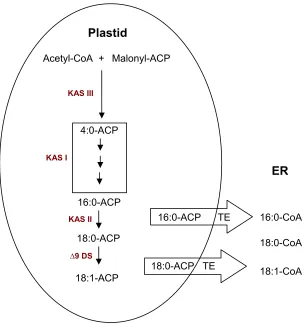
At least three separate condensing enzymes (3-ketoacyl-ACP synthases - KAS) are
required to produce an 18-carbon fatty acid (Fig. 1). KAS III catalyzes the first
condensation of acetyl-CoA and malonyl-ACP to form a 4-carbon product. KAS I
produces chain lengths from six to sixteen carbons. The elongation of the 16-carbon
palmitoyl-ACP to stearoyl-ACP is catalysed by KAS II. The initial product of each
condensation is a 3-ketoacyl-ACP. This is followed by three additional reactions
(reduction, dehydration, reduction) to form a saturated fatty acid. After each round
of four reactions, the precursor fatty acid is lengthened by two carbons. The
elongation of fatty acids in the plastids is terminated when the acyl group is removed
from ACP.
Substrate selectivity of acyl-ACP thioesterase dictates that palmitate and stearate
are the two products formed. The major fate of 16:0 and 18:0 acyl chains produced
in the plastid is to form the hydrophobic portion of glycerolipid molecules which are
components of all cellular membranes. Subsequent desaturation of these lipids to
the highly unsaturated forms typical of plant cell membranes is carried out by
membrane-bound desaturases of the chloroplast and the endoplasmic reticulum
Figure 1. Representation of the fatty acid synthetic pathway in soybean. (Modified from Wilson et al., 2004).
KAS III
Malonyl-ACP
KAS I
Acetyl-CoA +
4:0-ACP
16:0-ACP
18:0-ACP
18:1-ACP
KAS II
∆9 DS
Plastid
16:0-ACP TE
18:0-ACP TE
16:0-CoA
18:1-CoA 18:0-CoA
Figure 2. Flow diagram of lipid desaturation in plants. Acetyl-CoA/ Malonyl-ACP synthesis
O
CH3 (CH2)16 C~ S ACP
Stearoyl-ACP (18:0)
CH3 (CH2)7 CH CH (CH)7 C~ S - ACP O
Oleoyl-ACP (18:1)
FAD2-1
ω6Des
Linoleoyl-ACP (18:2)
CH3 (CH2)4 CH CH CH2CH CH (CH)7 C~ S -- ACP
o
FAD3
ω3Des
Linolenoyl-ACP (18:3)
CH3 CH2 CH CH CH2CH CHCH2CH CH(CH)7C~ S - ACP O
SACPD
Fatty Acid Desaturases (FADs)
Fatty acid desaturases are enzymes found in microbes, plants and animal cells and
are essential in a number of physiological processes. They are responsible for the
insertion of double bonds (normally in the Z or cis conformation) into alkyl chains,
following the abstraction of two hydrogen atoms. Desaturases regulate the fluidity
of membrane lipids and are also key enzymes in the biosynthesis of a variety of
signaling molecules. The physical properties and nutritional value of many animal
and plant storage lipids are determined by desaturases. Plant desaturases fall into
two categories; soluble and membrane-bound. Membrane-bound desaturases are
located in both ER and chloroplast membranes while soluble plant desaturases are
localized in the chloroplast stroma. There is considerable sequence conservation
among the membrane-bound desaturases (Shanklin, Whittle, and Fox, 1995). Each
individual desaturase tends to be specific in the chain length and the double bond
insertion position of its fatty acid substrate. All of the soluble desaturases use
acyl-ACP substrates.
Stearoyl-ACP Desaturases
Soluble ∆9 stearoyl-ACP desaturases (SACPD) are found in all plant cells and are
essential for the biosynthesis of unsaturated membrane lipids. This enzyme
introduces the first double bond into stearoyl-ACP (18:0-ACP) between carbons 9
and 10 to produce oleoyl-ACP (18:1∆9-ACP). SACPD is unique to the plant kingdom since all other known desaturases are integral membrane proteins (Ohlrogge and
form of the castor bean ∆9 stearoyl-ACP desaturase (Lindqvist et al., 1996). This
showed a homodimeric protein with two 37kDa subunits each having a diiron center
which represents the active site of the desaturase. During the reaction, the reduced
iron center binds oxygen and a high valent iron-oxygen complex likely abstracts
hydrogen from the C-H bond (Whittle and Shanklin, 2001). SACPD occupies a key
position in C18 fatty acid biosynthesis since perturbation of SACPD gene expression
and/or enzyme activity may modulate the relative level of both stearic and oleic acid
in soybean oil. Down-regulated SACPD expression or enzyme activity could
produce oil with greater stearic acid, while increased expression of SACPD or
enzyme activity could produce oil with greater oleic acid content.
Microsomal ω-6 Desaturases (FAD2)
Oil-producing crop plants such as soybean synthesize and store energy in the form
of triacylglycerols (TAG), which are composed of a glycerol backbone molecule
esterified by three saturated and/or unsaturated fatty acyl groups. In plants, the
microsomal ω-6 desaturase-catalyzed pathway is the primary route of
polyunsaturated lipid production. This membrane-bound enzyme catalyzes the first
extra-plastidial desaturation in plants and converts oleic acid esterified to
phosphatidylcholine to linoleic acid. FAD2 genes showing tissue-specific expression
have also been identified in cotton (Liu et al., 1997), and sunflower (Martinez-Rivas
et al., 2001). Arabidopsis thaliana has a single FAD2 gene (Okuley et al., 1994).
Two different microsomal ω-6 desaturase genes, FAD2-1 and FAD2-2, have been
expressed in developing seeds while the FAD2-2 is constitutively expressed in both
vegetative tissue and developing seeds. In a more recent study, Tang et al., (2005)
identified two seed-specific isoforms of FAD2 designated FAD2-1A and FAD2-1B in
the soybean genome. This seed-specific FAD2-1 gene is likely to play a major role
in the conversion of oleic acid to linoleic acid within storage lipids during seed
development.
Microsomal ω-3 Desaturases (FAD3)
Omega-3 fatty acid desaturases catalyze the insertion of a third double bond into
linoleic acid precursors to produce linolenic acid. Seed linolenic acid levels have
been shown to be determined by microsomal ω-3 desaturases (Yadav et al., 1993).
Arabidopsis thaliana has one FAD3 gene (Yadav et al., 1993), while three
independent microsomal ω-3 desaturase genes (GmFAD3A, GmFAD3B and
GmFAD3C) have been identified in soybean (Bilyeu et al., 2003). These three
genes showed tissue-specific expression and the absence of FAD3A was linked to
the low linolenic acid phenotype in the A5 soybean line. In another study (Vriten et
al., 2005), identified two FAD3 desaturase genes (FAD3A and FAD3B) that control
the level of linolenic acid in Flax. Analysis showed that in a low-linolenic-acid line,
both genes contained point mutations leading to premature stop codons and
consequently inactive truncated protein. These FAD3 transcripts are seed specific
with peak abundance approximately 20 DAF. In the low linolenic line, there was a
dramatic reduction in the transcript levels of both genes.
Altering Soybean Fatty Acid Composition
Over 30 years ago, Howell et al. (1972) cited evidence that the enzymatic
degradation or spontaneous oxidation of linoleic acid forms secondary products that
give the oil a bad odor and flavor. Because linolenic acid results from the
consecutive desaturation of oleic acid and linoleic acid, concentrations of oleic and
linolenic acid are negatively correlated. So far, genetic approaches have been
employed to reduce linoleic (18:2) and linolenic (18:3) acids while increasing oleic
acid (18:1), to improve the stability of soybean oil. In addition, several natural gene
mutations have been discovered that enable genetic flexibility in tailoring the fatty
acid composition of soybean (Wilson, 2004). The process involves directed control
of metabolic enzyme activity via gene manipulation as well as melding the functional
combination of genes to produce novel fatty acid profiles.
A crude soybean oil having low- palmitic (16:0), mid to high- 18:1, and low- !8:3
concentration offers competitive market opportunities in numerous edible and
industrial applications. Such oils would be widely used in salad/cooking oil, baking
and frying fats. Soybean with a much higher 18:1 concentration could also be used
in the manufacture of lubricants and hydraulic oil base stocks including soy diesel.
In addition, a high 18:1 level should extend the utility of soybean oil in the
manufacture of pharmaceuticals and cosmetic products including; bath oils, lipstick,
make-up bases, aftershave lotions, detergents, shampoo and clear gels (USDA,
1996). Stearic acid concentration in soybean is genetically determined by
elevated 18:0 concentration. The FAM94-41 (9% 18:0) is the only known soybean
germplasm that carries a natural mutation presumably at Fas (Pantalone, 2002).
Soybean Seed Development
Soybean seed ontogeny begins with a fertilized ovule and continues until seed
maturity. The primary endosperm nucleus divides almost immediately following
fertilization and these cycles of division continue for several days. By 8 days after
fertilization, the heart-shaped embryo is completely embedded in cellular endosperm
(Prakash and Chang, 1976). As the ovule continues to enlarge, both embryo and
endosperm continue to grow at approximately the same rate until about day 14. The
rapidly growing cotyledons rotate about 90o and accumulate food reserves derived
from the endosperm which is reduced to a thin aleurone layer and a few crushed
cells by 20 days after fertilization (Pamplin, 1963).
The developing seed structure is attached to two large vascular bundles in the pod
placenta. An embryonic sac separates the seed coat from the cotyledons of the
developing embryo (Thorne, 1981). The total growth period for soybean may range
from 108 to 144 days (Gay et al., 1980) and the duration of seed fill (seed growth
prior to maturation) may range from 18 to 70 days (Reicosky et al., 1982). During
this time, seed development progresses through at least five discernable stages
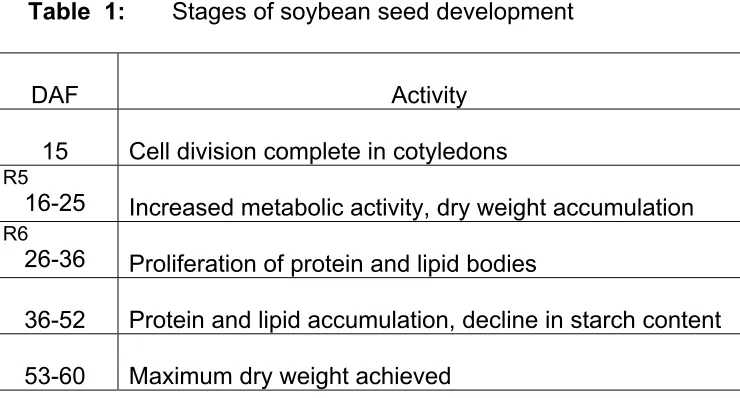
shown in Table 1 below (Bils and Howell, 1963). The glycerolipid composition of
soybean oil changes during seed development as does the concentration of
constant, the concentration of oleic (18:1) peaks between 30 and 45 days after
flowering (DAF) then declines, linoleic acid (18:2) increases linearly throughout seed
development, and linolenic acid (18:3) declines until about 60 DAF then increases
slightly during the final stages of seed maturation (Simmons and Quackenbush,
1954; Hirayama and Hujii, 1965).
Table 1: Stages of soybean seed development
DAF Activity
15 Cell division complete in cotyledons
R5
16-25 Increased metabolic activity, dry weight accumulation
R6
26-36 Proliferation of protein and lipid bodies
36-52 Protein and lipid accumulation, decline in starch content
53-60 Maximum dry weight achieved
Temperature and Fatty Acid Desaturases
The composition of saturated and unsaturated fatty acids of both membrane and
storage lipids varies depending on environmental temperature (Heppard et al.,
1996). There is a general inverse relationship between polyunsaturation of fatty
acids and growth temperature; polyunsaturated fatty acids increase with decreasing
temperature in membranes as well as seed storage lipids (Neidleman, 1987; Rennie
and Tanner, 1989; Thompson, 1993). The overall reason for the increased enzyme
maintain membrane fluidity, which is directly affected by the extent of unsaturation of
the acyl lipid components of the bilayer (Murphy and Piffanelli, 1998). The
mechanism of low-temperature adaptation in plants probably involves both
transcriptional and/or post-translational regulation of the desaturases involved in
polynsaturate formation. A direct effect of temperature on desaturase enzyme
activity has been shown in developing soybean seeds (Cheesbrough, 1989). There
are reports suggesting the existence of cold-inducible ω3 and ∆12 desaturase genes
in soybean (Kinney, 1994) and another identifying an isolated soybean ∆12
desaturase gene that is not regulated by low temperature (Heppard et al., 1996).
There is a twenty-four amino acid difference between the FAD2-1A and FAD2-1B
identified in soybean. Yeast expression studies revealed that the former is more
unstable, particularly in cultures maintained at a higher growth temperature (Tang et
al., 2005). Further, the results show that modulation of FAD2-1 enzyme activity may
involve regulation at the post-translational level. Since many desaturases are
encoded by multigene families, it is possible that some plant species may have both
cold-inducible and non-cold-inducible forms of the same class of desaturase enzyme
and/or gene (Murphy and Piffanelli, 1998). The leaves of transgenic tobacco plants
with additional desaturase genes showed significant increase in chilling tolerance
compared to their wild-type counterparts (Kodama et al., 1994, 1995;
Rationale and Objectives
The quality of soybean oil is of paramount importance both economically and from a
nutritional stand point and depends to a large extent on the ratio of polyunsaturated
to monounsaturated fatty acid. It is also a known fact that temperature plays a role
in the final lipid content of oil seed plants. The hypotheses on which this research
project is based are as follows:
• Desaturase gene expression partially governs seed fatty acid composition.
• Stearoyl ACP Desaturase (SACPD) genes may differ in enzyme activity.
• Temperature regulates desaturase gene expression and seed fatty acid
composition.
Based on these, the following objectives were set out:
(i) Develop gene-specific primers for SACPD and the FAD genes involved in
the C18 fatty acid biosynthetic pathway in soybean seed.
(ii) Use gene-specific primers to type soybean cultivars.
(iii) Determine the effect of temperature on the expression of different
desaturase genes by quantifying transcript accumulation at various stages
of seed development in five soybean cultivars.
LITERATURE CITED
American Soybean Association, (2004). SoyStats 2004. Available on the World
Wide Web: http://www.soystats.com/2004.
Bils, R.F. and Howell, R.W. (1963). Biochemical and cytological changes in
developing soybean cotyledons. Crop Sci. 3, 304-308.
Bilyeu, K., Palavalli, L., Sleper, D.A. and Beuselinck, P.R. (2003). Three microsomal
omega-3 fatty acid desaturase genes contribute to soybean linolenic acid levels.
Crop Sci. 43, 1833-1838.
Browse, J. and Sommerville, C. (1991). Glycerolipid metabolism, biochemistry and
regulation. Annu. Rev. Plant Physiol. Plant Mol. Biol. 42, 467-506.
Bustin, S.A. (2003). Quantification on mRNA using real-time reverse transcription
PCR (RT-PCR): trends and problems. J. Mol. Endocrin. 29, 23-39.
Cahoon, E.B., (2003). Genetic Enhancement of Soybean Oil for Industrial Uses:
Prospects and Challenges. AgBioForum, 6(1&2): 11-13.
Cheesbrough, T.M. (1989). Changes in enzymes for fatty acid synthesis and
desaturation during acclimation of developing soybean seeds altered growth
Gay, S., Egli, D.B. and Reicosky, D.A. (1980). Physiological aspects of yield
improvement in soybeans. Agron. J. 72, 387-391.
Heinz, E. (1993). Biosynthesis of polyunsaturated fatty acids. In: T.S. Moore, Jr.,
(ed.), Lipid Metabolism in Plants. Boca Raton, FL: CRC Press, pp 33-90.
Heppard, E.P., Kinney, A.J., Stecca, K.L. and Miao, G-H. (1996). Developmental
and growth temperature regulation of two different microsomal
ω-6 desaturase genes in soybean. Plant Physiol. 110, 311-319.
Hirayama, O. and Hujii, K. (1965). Glyceride structure and biosynthesis of natural
fats III. Biosynthetic process of triglycerides in maturing soybean seed. Agri. Biol.
Chem. 29, 1-6.
Howell, R.W., Brim, C.A. and Rennie, R.W. (1972). The plant geneticist’s
contribution toward changing lipid and amino acid composition in soybeans. J. Am.
Oil Chem. Soc. 49, 30-32.
Ishizaki-Nishizawa, O., Fujii, T., Azuma, M., Sekiguchi, K., Murata, N., Ohtani, T.
and Toguri, T. (1996). Low temperature resistance of higher plants is significantly
enhanced by a nonspecific cyanobacterial desaturase. Nature Biotechnology 14,
Kinney, A.J. (1994). Genetic modification of the storage lipids of plants. Current
Opinion in Biotechnology 5, 144-151.
Kodama, H., Hamada, T., Horiguchi, G., Nishimura, M. and Iba, K. (1994). Genetic
enhancement of cold tolerance by expression of a gene for chloroplast ω-3 fatty acid
desaturase in transgenic tobacco. Plant Physiol. 105, 601-605.
Kodama, H., Horiguchi, G., Nishiuchi, T., Nishimura, M., and Iba, K. (1995). Fatty
acid desaturation during chilling acclimation is one the factors involved in conferring
low-temperature tolerance to young tobacco leaves. Plant Physiol. 107, 1177-1185.
Lindqvist, Y., Haung, W., Schneider, G. and Shanklin, J. (1996). Crystal structure of
∆9 stearoyl-acyl carrier protein desaturase from castor seed and its relationship to
other di-iron proteins. The EMBO Journal 15, 4081-4092.
Liu, Q., Singh, S.P., Brubaker, C.L., Sharp, P.J., Green, A.G. and Marshall, D.R.
(!997). Isolation and characterization of two different microsomal ω-6 desaturase
genes in cotton (Gossypium hirsutum L.). In: J.P. Williams, M.U. Khan and N.W.
Lem (eds.), Physiology, Biochemistry and Molecular Biology of Plant Lipids.
Martinez-Rivas, J., Sperling, P., Luhs, W. and Heinz, E. (2001). Saptial and
temporal regulation of three different microsomal oleate desaturase genes (FAD2)
from normal-type and high-oleic varieties of sunflower (Helianthus annuus L.). Mol.
Breeding 8, 159-168.
Murphy, D.J. and Piffanelli, P. (1998). Fatty acid desaturases: structure, mechanism
and regulation. In: John L. Harwood, (ed.), Plant Lipid Biosynthesis, Fundamentals
and Agricultural Applications. Society for Experimental Biology Seminar Series: 67.
Cambridge University Press, pp 95-130.
Neidleman, S.L. (1987). Effects of temperature on lipid unsaturation. Biotechnol.
Genet. Eng. Rev. 5, 245-268.
Ohlrogge, J. and Browse, J. (1995). Lipid Biosynthesis. The Plant Cell 7, 957-970.
Okuley, J. Lightner, J., Feldmann, K., Yadav, N., Lark, E. and Browse, J. (1994).
Arabidopsis FAD2 gene encodes the enzyme that is essential for polyunsaturated
lipid synthesis. Plant Cell 6, 147-158.
Pamplin, R.A. (1963). The anatomical development of the ovule and seed in
Pantalone, V.R., Wilson, R.F., Novitzky, W.P., and Burton, J.W. (2002). Genetic
regulation of elevated stearic acid concentration in soybean oil. J. Am. Oil Chem.
Soc. 79, 549-553.
Peirson, S.N., Butler, J.N. and Foster, R.G. (2003). Experimental validation of novel
and conventional approaches to quantitative real-time PCR data analysis. Nucleic
Acids Res. 31, 1-7.
Prakash, N. and Chang, Y.Y. (1976). Embryology of Glycine max.
Phytomorphology 26, 302-309.
Reicosky, D.A., Orf, J.H. and Poneleit, C. (1982). Soybean germplasm evaluation
for length of the seed filling period. Crop Sci. 22, 319-322.
Rennie, B.D. and Tanner, J.W. (1989). Fatty acid composition of oil from soybean
seeds grown at extreme temperatures. J. Am. Oil Chem. Soc. 66, 1622-1624.
Shanklin, J., Whittle, E.J. and Fox, B.G. (1995). Membrane bound desaturases and
hydroxylases: structure function studies. In: J.C. Kader and P. Mazliak (eds.), Plant
Simmons, R.O and Quackenbush, F.W. (1954). Comparative rates of formation of
fatty acids in soybean seed during its development. J. Am. Oil Chem. Soc. 61,
601-603.
Tang, G.Q., Novitzky, B., Griffin, C., Huber, S., and Dewey, R. (2005). Functional
characterization of two closely related Soybean (Glycine max) oleate desaturase
enzymes: Evidence of regulation through differential stability and phosphorylation.
Plant J. (In press).
Thorne, J.H. (1981). Morphology and ultrastructure of maternal seed tissues of
soybean in relation to the import of photosynthate. Plant Physiol. 67, 1016-2025.
Thompson, G.A., Jr. (1993). Response of lipid metabolism to developmental change
and environmental perturbation. In: T.S. Moore Jr. (ed.), Lipid Metabolism in Plants.
Boca Raton, FL: CRC Press, pp 591-619.
U.S. Department of Agriculture (1996). Industrial uses of agricultural materials
situation and outlook report. IUS-6, 22-23.
Vriten P., Hu, Z., Munchinsky, M., Rowland, G., and Qiu, X., (2005). Two FAD3
desaturase genes control the level of linolenic acid in flax seed. Plant Physiol. 139,
Whittle, E. and Shanklin, J. (2001). Engineering ∆9-16:0-Acyl carrier protein (ACP)
desaturase specificity based on combinatorial saturation mutagenesis and logical
redesign of the castor ∆9-18:0-ACP desaturase. J. Biol. Chem. 276, 21500-21505.
Wilson, R.F. (2004). Seed Composition. In: H.R. Boerma and J.E. Specht (eds.),
Soybeans: improvement, production, and uses. American Society of Agronomy
Publishers, Madison, WI, pp 621-677.
Winer, J., Jung, C.K.S., Shackel, I. and Williams, P.M. (1998). Development and
validation of real-time quantitative reverse transcriptase-polymerase chain reaction
for monitoring gene expression in cardiac myocytes in vitro. Anal. Biochem. 270,
41-49.
Yadav, N.S., Wierzbicki, A., Aegerter, M., Caster, C.S., Perez-Grau, L., Kinney, A.J.,
Hitz, W.D., Booth, J.R., Jr., Schweiger, B. and Stecca, K.L. (1993). Cloning of
Two genes from soybean encoding soluble ∆9 stearoyl-ACP desaturases
Grace E. Byfield, Microbiology Department, N.C. State University, Raleigh 27695.
Huiqin Xue, Crop Science Department, N.C. State University, Raleigh, 27695.
Robert G. Upchurch, USDA-ARS Soybean and Nitrogen Fixation Unit and Plant
Pathology Department, N.C. State University, Raleigh 27695.
Accepted: August 2005
Abbreviations: FAD fatty acid desaturase
RT-PCR reverse transcription-polymerase chain reaction
SACPD stearoyl acyl carrier protein desaturase
ABSTRACT
The ∆9 stearoyl acyl-carrier protein desaturase (SACPD) gene of soybean [Glycine
max (L.) Merrill] encodes a soluble enzyme that converts stearic to oleic acid.
Understanding the regulation of SACPD expression and enzyme activity are thus
important steps towards developing soybean lines with altered stearic or oleic acid
content. Using primers designed to a G. max SACPD cDNA sequence, a 3648 bp
product was cloned and sequenced from the genome of cultivar Dare. Comparison
of the third SACPD exon protein sequence with other available Glycine SACPD
sequences revealed unique amino acid variability at positions 310 and 313.
Sequence-specific primers were designed for real-time RT-PCR (reverse
transcriptase-polymerase chain reaction) for this region of exon 3. Diagnostic and
specific products were recovered with these primers using Dare cDNA template and
Dare genomic DNA. Sequencing of a second genomic clone from Dare confirmed
that there were two SACPD genes, designated A and B, in this cultivar. Survey of
the genomes of 51 soybean lines and cultivars with PCR and the gene-specific
primers indicated that all 51 had both A and B. Differences between SACPD-A and
-B transcript abundance in soybean tissues while quantifiable were not dramatic.
SACPD-A and -B transcript accumulation for three seed developmental stages
between R5 and R6 was essentially equal. Biochemical analysis of the proteins
encoded by these two SACPD genes may reveal whether the amino acid variability
INTRODUCTION
Soybean oil is a mixture of five fatty acids (palmitic, stearic, oleic, linoleic, and
linolenic) that differ greatly in melting points, oxidative stabilities, and chemical
functionalities (Cahoon 2003). Although seed fatty acid composition is controlled by
quantitative genetic traits, current research also includes a strong focus on the
contribution and manipulation of fatty acid desaturase genes. The goal of efficiently
altering fatty acid composition to meet the specific needs of industry therefore
requires the efforts of soybean breeders and molecular geneticists.
Increasing the stearic acid content of soybean oil is desirable for certain
food-processing applications since increased stearic acid content offers the potential for
the production of solid fat products without hydrogenation (Spencer et al. 2003).
This would reduce the content of trans-fat in food products and reduce a current
health concern. High stearic acid oil could also be used as a replacement for
tropical oils that are also high in palmitic acid which poses a heart disease risk.
Stearic acid concentration in soybean is genetically determined by alterations
at the Fas locus. In addition to FAM94-41 (Pantalone 2002), a high stearic acid line
carrying a natural mutation (fasnc), five other soybean germplasm lines have been
reported to carry mutated stearic acid alleles that increase stearic acid: A6, fasa
(Hammond and Fehr 1983); FA41545, fasb (Graef et al. 1985a); A81-606085, fas
(Graef et al. 1985b); KK-2, st1 (Rahman et al. 1997) and M25, st2 (Rahman et al.
1997). Fasa (30% stearic acid), fasb (15% stearic acid), and fas (19% stearic acid) are allelic and represent different mutations in the same gene (Burton et al. 2004;
soybean, is the ∆9 stearoyl-acyl carrier protein (ACP) desaturase (Wilson 2004).
The ∆9 stearoyl-ACP desaturase enzyme (SACPD), through the insertion of a
double bond at C9, converts stearic to oleic acid. Thus, SACPD occupies a key
position in C18 fatty acid biosynthesis since perturbation of SACPD gene expression
and/or enzyme activity may modulate the relative level of both stearic and oleic acid
in soybean oil. Down-regulated SACPD expression or enzyme activity could
produce oil with greater stearic acid, while increased expression of SACPD or
enzyme activity could produce oil with greater oleic acid content.
In this study, we determined that there are two SACPD genes in soybean, a
situation not previously recognized. The objective of this research was to
characterize SACPD gene structure, determine the distribution of the SACPD genes
MATERIALS AND METHODS Amplification, cloning, and sequencing
Genomic DNA was prepared form liquid nitrogen-frozen, powdered soybean
leaves using the DNeasy Plant Mini kit from Qiagen (Valencia, CA) following
manufacturer’s protocol. Soybean leaves were harvested from five-week-old
greenhouse grown plants. DNA samples were resuspended in sterile water.
Soybean genomic SACPDs were amplified using oligonucleotide primers
5’GCGCCTTACATCACATAC 3’-forward and 5’GCTGCCCCTAACTGC 3’-reverse
that were based on the GenBank mRNA sequence (accession number L34346) for a
Glycine max, soluble stearoyl-acyl carrier protein desaturase (SACPD). In other
experiments, SACPD exons 2 and exons 3 were amplified. Primers for exon 2
amplification were 5’CATCCTTACCCTATACCTG3’-forward and
5’CTACCATTGCGGAAGACC3’-reverse. Primers for exon 3 were
5’GATTCTTCATAGCTGCTGC3’-forward and 5’GCTGCCCCTAACTGC3’-reverse.
Amplification reactions (25µl) contained 50 ng genomic DNA, 250 nM each primer,
2.5 µM each dNTP, 1 unit Taq DNA polymerase (Fisher, Atlanta, GA), and 1X PCR
buffer (300 mM Tris-HCL, 75 mM (NH4)2SO4, 7.5 mM MgCl2, pH 8.5). Reaction
conditions were 940C for 2 min (1 cycle), then 940C for 1 min, 550C for 2 min, 720C for 3 min (30 cycles), then 720C for 7 min.
Primers were also designed to a region of variability in exon 3 of SACPD.
PCR with these primers produced products that discriminated between SACPD gene
A (133 bp) and gene B (111 bp). These gene-specific primers were used to type
real-time RT-PCR. Gene-specific primers for SACPD-A (primer set A) were
5’CCTGTTTGATAACTACTCTGCC3’-forward and
5’TCTTCCCTCACCTGAAAGTCCG3’-reverse. Gene specific primers for SACPD-B
(primer set B) were 5’CCTGTTTGATAGCTACTCTTCG3’-forward and
5’GTTAGCTGCTCCACCTCC3’-reverse. Primers for the soybean housekeeping
gene actin were 5’GAGCTATGAATTGCCTGATGG3’ forward and
5’CGTTTCATGAATTCCAGTAGC3’ reverse derived from GenBank accession
number U60500 (Moniz de Sa and Drouin 1996). Amplification of actin was done
according to the protocol outlined above for SACPD. Amplification reactions (25µl)
for PCR with SACPD gene-specific primers contained 50 ng of EcoRI restricted
genomic DNA, 2 µM each primer, 250 µM dNTPs, 1 unit Taq DNA polymerase
(Fisher, Atlanta, GA), and 1X PCR buffer (300 mM Tris-HCl, 75 mM (NH4)2SO4, 7.5
mM MgCl2, pH 8.5). Reaction conditions were 940C for 2 min (1 cycle), then 940C
for 1 min, 66.8 0C for 2 min, 720C for 3 min (40 cycles), then 720C for 7 min.
PCR amplification reactions were performed in a MJ Research PTC-100
thermocycler (Watertown, MA). PCR products were analyzed on ethidium bromide
stained, 1% agarose gels after electrophoresis with a 100 bp DNA ladder molecular
wt. markers (Invitrogen, Carlsbad, CA). Amplicons were cloned into the sequencing
vector pCR 2.1 using the TOPO TA cloning kit supplied by Invitrogen (Carlsbad,
CA). Both strands of each PCR clone were sequenced at the Iowa State University
Biotechnology Center, Ames, IA. Contigs were assembled using Vector NTI
Advance 9.1 (Invitrogen). Assignment of open reading frames, translation to amino
mining (Gish and States, 1993; Altschul et al., 1990) and with Chromas
(Technelysium.com.au). Sequences were aligned using Blossum62
Divide–and-Conquer Multiple Sequence Alignment v. 1.0 (BiBiServ, Bielefeld University
Bioinformatics Server). Assignment of SACPD exons and introns was done using
MacVector v. 7(IBI, New Haven, CT) and NetGene2 WWW Server (Center for
Biological Sequence Analysis, The Technical University of Denmark).
Genomic DNA Blot Analysis
Genomic DNA (6 µg) was digested with restriction enzymes, electrophoresed
through a 0.8% agarose gel, and transferred to Nytran Plus ( Schleicher & Schuell,
Keene, NH) membranes. The membranes were probed with [α-32P] dCTP-labeled
DNA fragments that correspond to an exon 3 region for either SACPD-A or
SACPD-B, and exposed to x-ray film. Membrane hybridization and washing procedures
were those described for Ultrahyb™ solution (Ambion, Austin, TX).
RNA Isolation and Processing
Glycine max Dare plants were grown under greenhouse conditions and plant
tissues (pod, leaf, lateral root) harvested at 18 and 35 days after flowering (DAF).
Dare plants were also grown under controlled day/night temperatures of 26/220C
and seeds were harvested at four stages (18, 23, 28, and 35 DAF) of development
between R5 and R6. Tissues and seeds were quickly frozen in liquid nitrogen and
RNeasy Plant Mini kit (Valencia, CA) following the manufacturer’s protocol. The
RNA extraction was repeated on two other pooled samples. RNA samples were
DNase treated with Ambion DNA-free (Austin, TX) according to the manufacturer’s
protocol. RNA concentrations were determined spectrophotometrically using
absorbance at 260 nm. Samples were diluted to 50 ng/µl in sterile water and
aliquots stored at -800C until use. To verify RNA integrity, 500 ng of total RNA of
each sample was examined on a 1% agarose gel after electrophoresis stained with
ethidium bromide.
Real-time reverse transcriptase PCR
Real-time reverse transcriptase PCR (Winer, J. W., et al. 1998; Bustin, S. A.,
2002) was performed with the iCycler iQ™ (Bio-Rad, Hercules, CA) using the
QuantiTech™ SYBR Green RT-PCR kit (Qiagen, Valencia, CA). Each reaction
contained 12.5 µl of 2X SYBR Green PCR master mix, 250 nM forward and reverse
gene-specific primers for SACPD gene A or gene B, 0.25 µl MgCl2 (25 mM), 0.25 µl
RT mix, 250 ng RNA, and nuclease-free water to 25 µl. The reactions were
performed in a 96-well plates (0.2 ml tube volume) sealed with optical tape. Reverse
transcription was carried out at 500C for 30 min followed by 950C for 15 min to inactivate the reverse transcriptases and to activate the HotStar Taq™ DNA
comparison of individual cycle threshold (Ct) values with a standard curve generated
from serial dilutions of a PCR standard (Peirson, S. N., et al. 2003) from soybean
genomic DNA. PCR efficiency ranged from 93 to 98% and negative control
reactions did not produce any products. Targets (copy number), initially determined
per microgram of total RNA isolated, were normalized as a percent of soybean actin
gene expression level.
Determination of seed fatty acid composition
Fatty acid methyl esters (FAME) of mature soybean seed samples were
prepared using acid methanolysis. Seed tissue, ground to a powder, was heated at
85°C for 90 min. in a 5% HCl-95% methanol solution. FAME was partitioned 2x into
hexane and transferred to 2ml vials for analysis. The FAMEs were separated by gas
chromatography using an HP 6890 GC (Agilent Technologies, Inc., Wilmington, DE)
equipped with a DB-23 30 m x 0.53 mm column (same source). Operating
conditions were 1 µl injection volume, a 20:1 split ratio, and He carrier gas flow of 6
RESULTS
Structural organization of the soybean soluble ∆9 stearoyl-ACP desaturase
Two 3648bp genomic fragments were identified from soybean cultivar Dare in
a shotgun cloning experiment using PCR primers designed to terminal sequences of
a soluble, ∆9 stearoyl-ACP desaturase cDNA (accession no.L34346) from soybean.
Sequencing and analysis of these fragments revealed the Glycine SACPD gene
structure (Fig.1A) to be the following: a 111 bp exon 1 sequence encoding a putative
37 amino acid transit sequence; a 1763 bp intron 1; a 504 bp exon 2 sequence
encoding 168 amino acids; a 423 bp intron 2; and a 618 bp exon 3 sequence
encoding 206 amino acids. The nucleotide and amino acid sequence data of the
Dare SACPDs can be found at the GenBank database as accession numbers
AY885234 (SACPD-A) and AY885233 (SACPD-B).
Translation of the 1233 bp transcript predicts a protein of 411 amino acids
with a molecular mass of 47.2 kDa and a pI of 6.02. The amino acid sequence of
the Dare SACPDs was scanned with the program TMpred (Hoffman and Stoffel
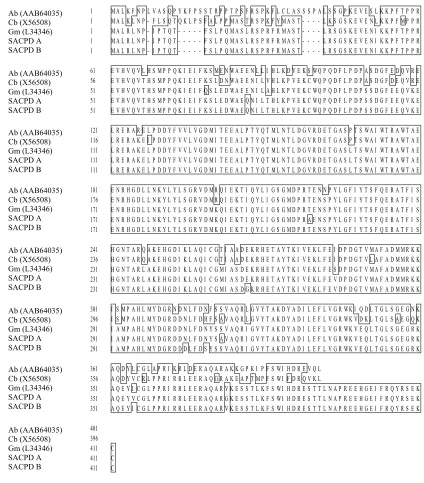
1993) and found not to contain transmembrane spanning sequences. Alignments of
Glycine max SACPD deduced amino acid sequences (Fig. 1B) with SACPDs from
Arabidopsis and Ricinus (Castor bean) indicates a high degree of sequence
conservation. The Dare SACPDs have 67 and 71 percent sequence identity with A.
thaliana (AAB64035) and R. communis (X56508) SACPDs, respectively. G. max
SACPD-A and -B have 83 percent sequence identity with the database G. max
sequence L34346. SACPD-A and SACPD-B are 98 percent identical in amino acid
the two Dare SACPDs. At position 210, SACPD-A has alanine; SACPD-B has
threonine. At position 258, SACPD-A has glutamic acid; SACPD-B has glycine. At
position 306, SACPD-A has asparagine; SACPD-B has aspartic acid. At position
310, SACPD-A has asparagine; SACPD-B has serine. At position 313, SACPD-A
has alanine; SACPD-B has serine. At position 356, SACPD-A has valine; SACPD-B
has isoleucine. At position 374, SACPD-A has glycine; SACPD-B has valine. These
findings suggest that there are at least two SACPD genes, GmSACPD-A and
GmSACPD-B in cultivar Dare. Interestingly, the primary sequence of G. max
accession L34346 fits neither the amino acid substitution pattern SACPD-A nor -B
exactly.
Alignment of other soybean SACPD exon 3 sequences
To assess the significance of the amino acid variability found in the SACPD
exon 3s of Dare, other Gm SACPD exon 3s were PCR cloned and sequenced. We
sequenced an exon 3 from Gm cultivar Bragg and an exon 3 from N01-3544, a
mid-oleic acid Gm line. To these sequences were added 5 soybean cDNA exon
3-derived sequences from the GenBank database. Nucleic acid alignments for bp
positions 3183 to 3211 in exon 3, depicted in Fig. 2A, show that the nine 9 SACPD
exon 3 sequences can be differentiated into two groups: Dare-A , Bragg, N01-3544,
AW 755581, and BG 882246 (Williams) designated group A, and Dare-B, AI 941223
(Williams), BI 471396 (also Bragg), and BG 363272 designated group B. Amino
acid alignments of the corresponding region of the exon 3s (position 307 to 321)
same group A and B differentiation. Moreover, both SACPD-A and -B sequences
were represented for cultivars Bragg (our sequence and BI 471396) and Williams
(BG 882246 and AI 941223). Based on these results we hypothesized that soybean
possesses at least two SACPD genes.
Detection of SACPD-A and -B in Glycine
PCR primers specific for SACPD-A and -B were designed based on the
nucleic acid sequences encompassing the region of variability in exon 3. These
primer sets were also designed to be used for real-time reverse transcriptase PCR
to assess A and B transcript accumulation. The gel in Fig. 3 shows that
amplification of Dare genomic DNA with primer set A produces a PCR product of
133 bp diagnostic for SACPD-A, and amplification of Dare genomic DNA with primer
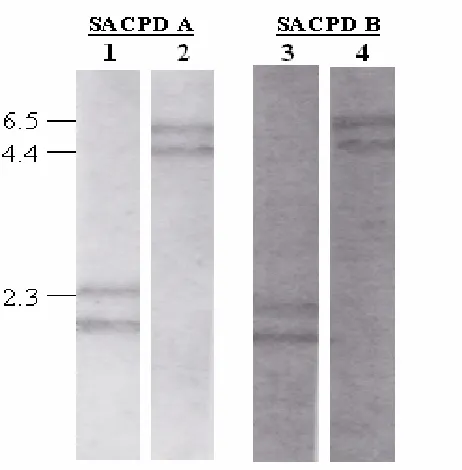
set B produces a product of 111 bp diagnostic for SACPD-B. Two distinct bands
were observed when Dare genomic DNA, digested with either BamHI or EcoRI (Fig.
4), was hybridized with SACPD-A and SACPD-B exon-specific probes. These
results suggest that there are at least two copies of each gene in the Dare soybean
genome. Soybean is considered to be a stable allo-tetraploid with diploidized
genomes [2n = 4x = 40] (Singh and Hymowitz 1988). As an allo-tetraploid, modern
soybean was produced by the hybridization of two species resulting in the union of
two separate chromosome sets and their subsequent doubling giving the
appearance of a normal diploid. Thus, duplication (two copies) of each SACPD
structural gene was not unexpected. Since our data suggested that the genome of
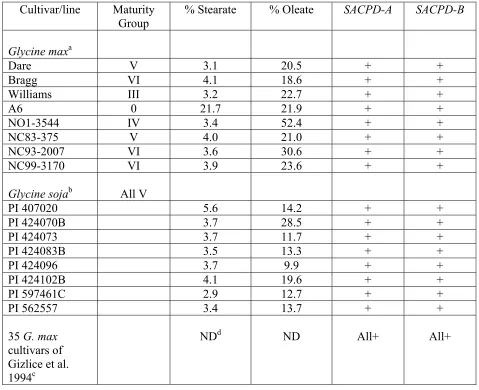
lines and cultivars was undertaken to determine gene A and B distribution. Glycine
lines and cultivars in the survey (Table 1) represent different maturity groups,
different stearate and oleate seed fatty acid compositions, include G. soja ancestral
lines, and include the main contributors to the gene pool of modern G. max through
1988 (Gizlice et al. 1994). Table 1 shows that both SACPD gene A and B were
present in all 51 Glycine lines and cultivars.
Relative expression of GmSACPD-A and GmSACPD-B in stages of seed development and tissues
For seed stage expression experiments, seeds and roots were harvested
from plants grown under near optimal moisture, light and temperature conditions
provided by a growth chamber in the Southeastern Environmental Research Center
at N.C. State University, Raleigh. We measured steady-state transcript levels for
SACPD-A and –B, a condition that reflects the maintenance of a constant transcript
level, to determine whether the expression of one gene might differ from the other.
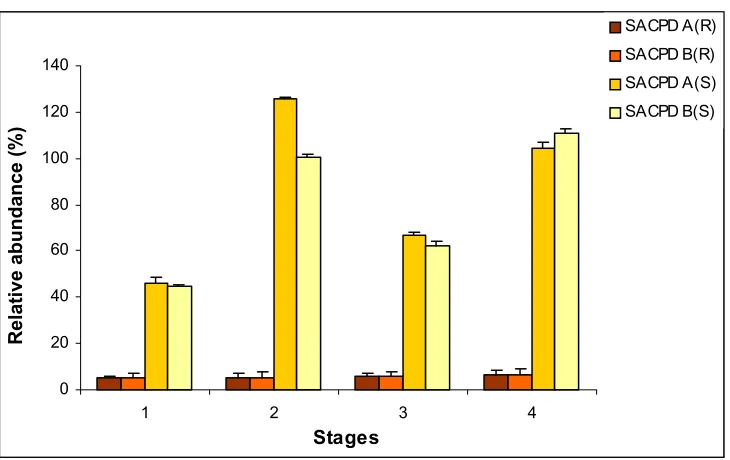
The actin normalized pattern of SACPD-A and -B transcript accumulation at three
seed developmental stages of cultivar Dare at 18, 28, and 35 DAF was essentially
parallel and transcript accumulation equal (Fig. 5). At stage 2, 23 DAF however,
SACPD-A transcript accumulation was approximately 30% greater than -B. By way
of comparison, both SACPD-A and -B stage- specific accumulation were equal but
of very low abundance (5-6%) in root tissue. Differences between SACPD-A and -B
transcript accumulation in greenhouse-grown, non seed tissues while quantifiable,
abundance than -A (70% and 68%) in pod tissue at 18 and 35 DAF, respectively.
SACPD-A and -B transcripts were similar in abundance (72%) in both young and
mature leaves.
DISCUSSION
The soluble ∆9 stearoyl-ACP desaturase of soybean, like all the soluble
desaturases using acyl-ACP substrates, is localized to the stroma fraction of plastids
in developing seeds (Murphy and Piffanelli 1998). A short N-terminal transit peptide
of 37 amino acids was identified for the soybean SACPDs that is presumably
responsible for stroma targeting (Fig. 1A). Most of our knowledge about plant ∆9
stearoyl-ACP desaturases (SACPDs) comes from the study of the soluble enzyme
from castor seed (Lindqvist et al. 1996). Structure analysis of the crystallized protein
shows it to be a µ-oxo-bridged di-iron enzyme that belongs to the structural class I of
large helix bundle proteins that catalyzes the NADPH and O2-dependent insertion of
a cis-double bond between C-9 and C-10 positions in stearoyl-ACP (Moche et al.
2003). The enzyme is a homodimer with each mature subunit of 41.6 kDa
containing an independent binuclear iron cluster. At the core of the desaturase
structure, two iron atoms are coordinated within a central four helix bundle in which
the motif (D/E)-E-X-R-H is present in two of the four helices (Ohlrogge and Browse,
1995). During the desaturation reaction, the two-electron reduced, di-iron center
binds oxygen and the high valent iron-oxygen complex formed abstracts hydrogen
Inspection of G. max SACPD exon 3 protein sequences derived from cDNA
data suggested that soybean contains two SACPD genes (Fig. 2A and B). Based on
the amino acid variable region of exon 3, what we now call SACPD-A and -B were
found in cultivar Williams. Further sequence analysis of exon 3 clones from cultivars
Dare and Bragg indicated that they also contained SACPD-A and -B. Sequence
analysis of Dare genomic clones confirmed that there are two different, soluble
SACPD genes in this cultivar. Amino acid variability was found only in the Dare
protein sequence of exon 3 and not in the transit peptide region (exon 1) or in exon
2. Previously, multiple plant genes were identified only for microsomal desaturases.
For example, three different microsomal ∆12 oleate desaturase genes (FAD2s) were
reported for sunflower (Martinez-Rivas et al. 2001), two microsomal FAD2s were
reported each for soybean (Heppard et al., 1996) and for cotton (Liu et al., 1997),
while three different microsomal ω-3 desaturase genes (FAD3s) were reported for
soybean (Bilyeu et al., 2003).
Rather dramatic differences in microsomal desaturase gene expression levels
and gene distribution have been found in soybean. Of the two soybean FAD2
genes, FAD2-1 was expressed specifically in seeds, and FAD2-2 was expressed in
all tissues (Heppard et al., 1996). Only one of the three soybean FAD3 genes,
FAD3A, was predominatly expressed in developing seeds (Bilyeu et al., 2003). In
the same study, Bilyeu et al. found that the low linolenic acid breeding line A5
contained two of the FAD3 genes, but lacked a third gene, FAD3A. In our study we
found that the differences between the transcript abundance of the soluble
However, both soybean SACPDs were much more highly expressed in seeds than
in roots.
We thought that Glycine lines/cultivars might be identified that lacked one of
the SACPD genes, however, both A and B genes were found in the genomes of all
51 Glycine lines/cultivars examined (Table 1). Group I consisted of eight G. max
cultivars and lines of varying maturity, including the high stearic acid mutant A6 and
the mid-oleic acid line NO1-3544, group II consisted of eight maturity group V G.
soja lines varying in oleic acid content, and group III consisted of the 35 soybean
cultivars of Gizlice, et al. (1994). Group III genotypes were chosen because they
define the genetic base of North American soybean cultivars and represent 95% of
the genes found in modern cultivars. Although GenBank accession L34346 may be
indicative of a third soybean SACPD gene, efforts to find this sequence in cultivar
Dare were unsuccessful. Since the primary sequence L34346 fits neither the amino
acid substitution pattern SACPD-A nor -B exactly, L34346 may represent an allelic
form of one of the two SACPD genes.
The manipulation of fatty acid desaturases to achieve a desired fatty acid
composition in soybean oil has a strong rationale. Support for this rationale comes
from research that has shown that down-regulation of the ∆-12 fatty acid desaturase
gene FAD2-1 elevates oleic acid content in the oil. Transgenic seeds with oleic acid
content of approximately 75-80% of the total oil have been recovered after this gene
was silenced in somatic embryos (Kinney, 1997) or the gene transcript was
ribozyme-terminated (Buhr et al. 2002). As mentioned previously, the low linolenic
soybean (Bilyeu et al. 2003). In addition, FAM94-41 (Spencer et al. 2003), a high
stearic acid line was found to carry a natural mutation, fasnc, at the Fas locus.
Based on our findings, we will continue to characterize the enzymatic activity of the
two soybean ∆9 soluble desaturases from both the wild type Dare cultivar and the
high stearic acid mutant line A6. Results from these experiments may provide a
means to achieve the stable production of high stearic acid soybean oil.
ACKNOWLEDGMENTS
We thank W. Novitzky (USDA-ARS, N.C. State University, Raleigh) for the analysis
of soybean seed fatty acid composition and J. Rich (N.C. State University, Raleigh)
for excellent technical assistance. Mention of trade names or commercial products
in this article is solely for the purpose of providing specific information and does not
REFERENCES
Altschul, S. F., W. Gish, W. Miller, E. W. Myers, and D. J. Lipman. 1990. Basic local alignment search tool. J. Mol. Biol. 215:403-410.
Bilyeu, K. D., L. Palavalli, D. A. Sleper, and P. R. Beuselinck. 2003. Three microsomal omega-3 fatty-acid desaturase genes contribute to soybean linolenic acid levels. Crop Sci. 43:1833-1838.
Buhr, T., S. Sato, F. Ebrahim, A. Xing, Y. Zhou, M. Mathiesen, B. Schweiger, A. Kinney,P. Staswick, amd T. Clemente. 2002. Ribozyme termination of RNA transcripts down-regulate seed fatty acid genes in transgenic soybean. Plant J. 30:155-163.
Burton, J. W., J. F. Miller, B. A. Vick, R. Scarth, and C. C. Holbrook. 2004. Altering fatty acid composition in oil seed crops. Advances in Agronomy. 84:273-306.
Bustin, S. A. 2002. Quantification of mRNA using real-time reverse transcription PCR (RT-PCR): trends and problems. J. Mol. Endocrin. 29:23-39.
Cahoon, E. B. 2003. Genetic enhancement of soybean oil for industrial uses: prospects and challenges. AgBioForum. 6:11-13.
Graef, G. L., E. G. Hammond, W. R. Fehr. 1985a. Inheritance of three stearic acid mutants of soybean. Crop Sci. 25:1076-1079.
Graef, G. L., L. A. Miller, W. R. Fehr, E. G. Hammond. 1985b. Fatty acid development in a soybean mutant with high stearic acid. J. Am. Oil Chem. Soc. 62:773-775.
Hammond, E. G. and W. R. Fehr. 1983. Registration of A6 germplasm line of soybean. Crop Sci. 23:192-193.
Heppard, E. P. A .J. Kinney, K. L. Stecca, and G-H. Miao. 1996. Development and growth temperature regulation of two different microsomal ω-6 desaturase genes in soybeans. Plant Physiol. 110:311-319.
Hoffman, K. and W. Stoffel. 1993. Tmbase-A database of membrane spanning protein segments. Biol. Chem. Hoppe-Seyler. 347:166.
Kinney, A. J. 1997. Genetic engineering of oilseeds for desired traits. In: Genetic Engineering, Principals and Methods. Setlow, J. K. (ed.), Plenum Press, New York, Vol.19, pp. 149-166.
Lindqvist, Y., W. Huang, G. Schneider, and J. Shanklin. 1996. Crystal structure of
Liu, Q., S. P. Singh, C. L. Brubaker, P. J. Sharp, A. G. Green, and D. R. Marshall.
1997. Isolation and characterization of two different microsomal ω-6 desaturase
genes in cotton (Gossypium hirsutum L.). In: Williams, J. P., Khan, M. U., and Lem, N. W. (eds.), Physiology, biochemistry and molecular biology of plant lipids. Kluwer Academic Publishers, Dordrecht, Netherlands, pp. 383-385.
Martinez-Rivas, J. M., P. Sperling, W. Luhs, And E. Heinz. 2001. Spatial and temporal regulation of three different microsomal oleate desaturase genes (FAD2) from normal and high-oleic varieties of sunflower (Helianthus annuus L.). Molecular Breeding 8:159-168.
Moche, M., J. Shanklin, A. Ghoshal, and Y. Lindqvist. 2003. Azide and acetate
complexes plus two iron-depleted crystal structures of the di-iron enzyme ∆9
stearoyl-acyl carrier protein desaturase. J. Biol. Chem. 278: 25072-25080.
Moniz de Sa, M. and G. Drouin. 1996. Phylogeny and substitution rates of angiosperm actin genes. Mol. Biol. Evol. 13:1198-1212.
Murphy, D. J. and P. Piffanelli. 1998. Fatty acid desaturases: structure, mechanism, and regulation. In: J. L. Harwood (ed.), Plant Lipid Biosynthesis, Cambridge University Press. pp. 95-130.
Ohlrogge, J. and J. Browse. 1995. Lipid Biosynthesis. The Plant Cell. 7:957-970.
Peirson, S. N., J. N. Butler, and R. G. Foster. 2003. Experimental validation of novel and conventional approaches to quantitative real-time PCR data analysis. Nucleic Acids Res. 31:1-7.
Rahman, S., Y. Takagi, T. Kinoshita. 1997. Genetic control of high stearic acid content in seed oil of two soybean mutants. Theor. Appl. Genet. 95:772-776.
Singh, R.J. and T. Hymowitz. 1988. The genomic relationship between Glycine
max (L.) Merr. and Glycine soja Sieb and Zucc. as revealed by pachytene
chromosome analysis. Theor. Appl. Genet. 76: 705-711.
Spencer, M. M., V. R. Pantalone, E. J. Meyer, D. Landau-Ellis, D. L. Hyten, Jr. 2003. Mapping the Fas locus controlling stearic acid content in soybean. Theor. Appl. Genet. 106:615-619.
Whittle, E. and J. Shanklin. 2001. Engineering ∆9-16:0-Acyl Carrier Protein (ACP) desaturase specificity based on combinatorial saturation mutagenesis and logical redesign of the castor ∆9-18:0-ACP desaturase. J. Biol. Chem. 276:21500-21505.
Wilson, R. F. 2004. Seed Composition. In: Boerma, H. R. and Specht, J. E. (eds.), Soybeans: improvement, production, and uses. American Society of Agronomy Publishers, Madison, WI, pp. 621-677.
Table 1. Detection of SACPD-A and –B genes in Glycine cultivars and lines that
were typed by PCR with gene-specific primer pairs.
Cultivar/line Maturity Group
% Stearate % Oleate SACPD-A SACPD-B
Glycine maxa
Dare V 3.1 20.5 + +
Bragg VI 4.1 18.6 + +
Williams III 3.2 22.7 + +
A6 0 21.7 21.9 + +
NO1-3544 IV 3.4 52.4 + +
NC83-375 V 4.0 21.0 + +
NC93-2007 VI 3.6 30.6 + + NC99-3170 VI 3.9 23.6 + +
Glycine sojab All V
PI 407020 5.6 14.2 + +
PI 424070B 3.7 28.5 + +
PI 424073 3.7 11.7 + +
PI 424083B 3.5 13.3 + +
PI 424096 3.7 9.9 + +
PI 424102B 4.1 19.6 + +
PI 597461C 2.9 12.7 + +
PI 562557 3.4 13.7 + +
35 G. max cultivars of Gizlice et al. 1994c
NDd ND All+ All+
aG. max cultivars and lines from J.W. Burton, USDA-ARS, Raleigh, NC. bG. soja lines from E. Peregrine, University of Illinois, Urbana-Champaign, IL. cThe 35 G. max cultivars of Gizlice et al.(1994) from T.A. Carter, USDA-ARS,
Raleigh, NC.