An indexing Technique to Speed up
XML Query Processing: PLIT
Ajit Pratap Singh1, Er. Narendra Kumar Gupta2
M .Tech Student, Dept. of CSE, S.H.I.A.T.S -Deemed University, Allahabad, India1
Asst. Professor, Dept. of CSE, S.H.I.A.T.S -Deemed University, Allahabad, India 2
ABSTRACT: The XML format has become the standard for data exchange because it is self-describing and it stores not only information but also the relationships between data. Therefore it is used in very different areas. To find the right information in an XML file, we need to have a fast and an effective access to data. Similar to relational databases, we can create an index in order to speed up the querying for the information. There are several ways of indexing XML data but previous research showed that one of the most effective approaches is to index root-to-leaf paths in the input file. So we took the inspiration from existing path-based indexing concepts, enhanced those ideas, and created a new native XML indexing method derived from the combination of existing approaches in order to improve the evaluation time of regular path expressions in XPath queries.
KEYWORDS: Indexing XML, path-based indexing, XPath queries, regular path expressions.
I. INTRODUCTION
In past few years there has been an expansion of semi-structured data mostly stored as XML files and used for saving and exchanging information over the Internet. The simplicity is only one of the factors why the format became so popular. As more and more files occurred in this format, we wanted to access the stored data and search for the specific information according to prior criteria. For this purpose languages such as XPath [19] or XQuery [20] have been created. They allow searching for elements, attributes, or text values based on either specific values or regular expressions. If there are multiple conditions in an XPath query, we can combine them, and we get the regular path expression pattern.The path expression usually matches several elements in the input XML file (the result set). The challenge is to find these elements quickly and efficiently, especially in large files with a high number of elements and with different structures. One came with an idea of indexing the XML data in order to quickly get the the results for any query.
No matter which indexing technique we use, if we had an XPath expression, the most problematic queries would be those with '//' (relative paths) or (wildcards). These queries match numerous distinct elements and are difficult to handle compared to expressions with absolute paths only.
In this paper, our goal is to combine the best concepts of existing indexing methods and enhance them in order to improve the evaluation time of XPath queries. To achieve this, we make contributions to these areas:
—The previous research showed that indexing paths is one of the effective ways of indexing XML documents, so we use this approach and we create a new indexing method based on indexing paths (Section 2).
—Additionally, we combine it with one of the numbering schemes in order to accelerate the evaluation of XPath regular path expressions (see Section 3).
—Finally we compare the new concept with existing solutions in terms of time complexity while evaluating sample XPath queries (Section 4).
known data structure, e.g. the Patricia tries [12] are used in [7] or [9], but more often they use custom structures. The method of labeling nodes in the tree with numbers might help with discovering ancestor-descendant (A-D) relationships. Dietz's numbering scheme [1] inspired us to design our numbering scheme based on intervals that evaluates A-D relationships in constant time. We found also motivation in XISS for the decomposition of XPath expressions, producing the intermediate results (called candidates in our approach), and element joins.
Specializing on paths, the DataGuide [2] handles raw paths and provided the basis for future path indexing methods such as XDG (Extended DataGuide [4]) or Index Fabric [7].
The interesting work of mapping all root-to-leaf paths into multi-dimensional points (MDX [3] or UB-trees [10]) influenced us on designing our indexing method. These concepts try to avoid using structural joins because of their time complexity compared to indexing paths. We understand the inefficiency of element-based approaches but we also see the potential slowdown for the multidimensional mapping methods when evaluating queries with multiple wildcards and relative paths. In this case, the domain used for finding matching tuples might grow faster.
The aim of the proposed indexing scheme is to follow the multi-dimensional techniques and leverage the path-based indexing with focus on grouping paths according to common characteristics, path labels (see Section 2.2). We expect this idea to eliminate many unsuitable paths and, as the result, to speed up the evaluation of any query (especially those problematic ones; see Section 3).
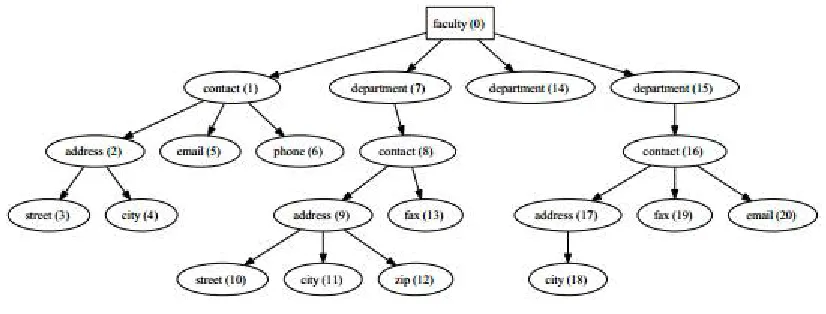
Fig. 1. The sample XML file
III. PATH-BASED INDEXING
First of all, we assign elements in the source file the unique identification numbers (NodelDs) and convert the element (tag) names into integers (TaglDs). We prefer numbers over strings because the comparison of integers is faster than comparing strings with variable lengths although it brings some memory overhead. We use the numbering method that assigns a node the NodelD when the corresponding element is visited for the first time (using the SAX parsing method). The root has the number 0, while the number of following nodes is always incremented by 1 (see the sample XML file with element names and NodelDs in Figure 1).
The path label is stored only once but one path label can contain several Path references. Moreover, we convert the path label into Path Template ID (PTID) that groups similar Path references together (for the detailed specification of used terms see Table 1).
Example 1. If we take the sample XML file from the Figure 1 and we visit a leaf node fax (13), the Path reference (sequence of NodelDs) will be (0,7,8,13). Converting element names "/faculty/department/contact/fax" to TagIDs, we get the path label '/0/7/1/9'. For details about the conversion, see the Table 2(a) (NodeTags table) and the Section 2.3.
a) NodeTags table (b) Paths table
Table 2. Structures with data for the sample XML
Structures: While we parse the input XML file, we maintain several structures that store the root-to-leaf paths and other necessary information that we will later use when we evaluate queries. There are three major data structures: the NodeTags table, the Paths table, and the Prefix Tree. While the first two are more like database tables, the last one is definitely a tree structure (inspired by a Patricia trie [12]).
NodeTags table: This table provides conversion between the Tag Name and the TaglD. Furthermore it saves all path template IDs (PTIDs) where the given TagID appear; see the Table 2(a).
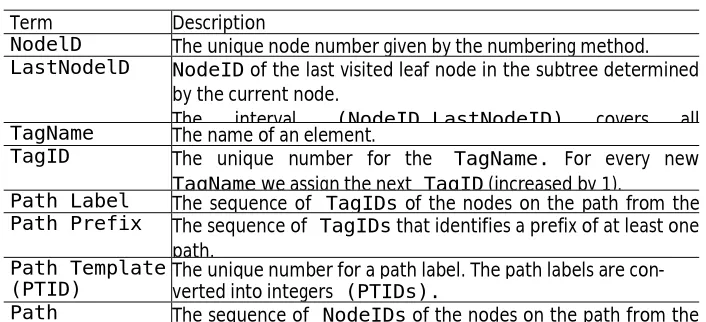
Table 1. Terms definition and description
Term Description
NodelD The unique node number given by the numbering method. LastNodelD NodeID of the last visited leaf node in the subtree determined
by the current node.
The interval (NodeID,LastNodeID) covers all
TagName The name of an element.
TagID The unique number for the TagName. For every new
TagName we assign the next TagID (increased by 1).
Path Label The sequence of TagIDs of the nodes on the path from the
Path Prefix The sequence of TagIDs that identifies a prefix of at least one path.
Path Template The unique number for a path label. The path labels are con- (PTID) verted into integers (PTIDs).
and the path from the root to a given node represents the path prefix. Nodes also contain all PTIDs which do have the selected prefix. We use this structure to find all PTIDs to which a specific NodeID might belong ..
Fig. 2. PrefixTree for the sample XML file
Example 2. If we take the node contact (1) from the sample XML (see Figure 1), it belongs to almost all PTIDs (according to the NodeTags table). And using the PrefixTree, we find the prefix of '/0/1' that matches the PTIDs {0,1,2,3}. So the chosen node occurs only on paths with these path labels.
Evaluating XPath queries:
Before we start evaluating an XPath query, we need to parse and prepare the query. We describe these steps in the following sections in more detail.
Parsing XPath expressions:
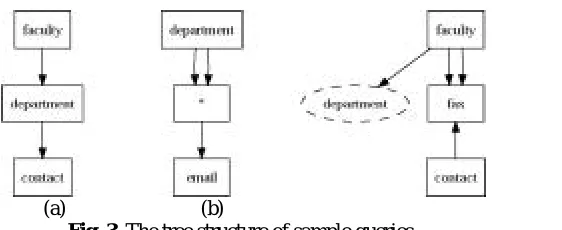
In the beginning, we convert the string query, that describes a regular path expression, into the structure that is appropriate for the evaluation. We selected the graph structure (XPathTree) created by two types of nodes (XPathNodes): steps and predicates .
Steps: If we divide the path expression into sequence of step expressions, they will be represented by these nodes.
Predicates: We express the further filter expressions by the Predicate nodes. While the Step nodes cannot be added as sub nodes, each node in the tree might contain one or more Predicate sub nodes.
(a) (b) (c)
Fig. 3. The tree structure of sample queries.
IV. XPATHTREE PRE-PROCESSING
After we parse the XPath expression and create the corresponding XPathTree, we need to convert the stored element names into TaglDs. While converting, we check element names whether they exist in the index. If a name does not occur in the NodeTags table, the result is instantly available because no nodes will be in the result set and no further evaluation is needed (we suppose all predicates to co-exist at the same time).
Algorithm 1 Visit procedure for evaluating a node in the XPathTree Require: xnode is the current XPathNode in the XPathTree that is being visited :
1: xnode.Candidates = GetCandidates() 2: for all (predicate in xnode.Predicates) do 3: Visit(predicate) {recursive call for a predicate} 4: xnode.VoteForCandidateNodes(predicate.Candidates)
5: end for
6: if xnode.HasPredicates then
7: xnode.FilterCandidateNodes()
8: end if
9: if (xnode.IsStepNode) then
10: MergeCandidates (lastNode, xnode) 11: if (xnode.NextStepNode is not null) then
12: Visit(xnode.NextStepNode)
13: end if 14: end if
V. XPATH TREE EVALUATING
When we build and validate the XPathTree, we can start the evaluation. We use slightly different evaluating methods according to the type of the current XPathNode. When traversing the XPathTree, the Step nodes are evaluated with the top-down approach, while the Predicate nodes are processed in the bottom- up style (from the lowest level upwards using depth-first search). The reason for distinct methods is that all predicates must be resolved before we can continue with the next XPathNode.
The Algorithm 14 describes the procedure that we apply to all XPathNodes. There are several steps that we need to explain in more detail but the main principle is that we save candidate nodes (NodelDs) for each XPathNode we visit. So the candidate nodes of the last node represent the result set.
1. Save candidates
The first step is to save candidate nodes for the current node. We store them in the table called candidates (line 1). It contains PTIDs, where the XPathNode occur, with corresponding NodelDs. Each PTID is stored only once but one NodeID might be saved for more PTIDs. It is because we focus later on merging candidates according to PTIDs rather than NodelDs. To identify the PTIDs, we try to find the smallest PTID set that is common for as many XPathNode nodes as possible (using the NodeTags table). For a predicate node, this means to take PTIDs that are common for XPathNodes on the path from the last Step node. Because we evaluate predicates bottom- up, we create the set of PTIDs on the way "down". For a Step node we take the path from the first Step node. This holds only if all axis directions on the path are the same. If we have an alternating1 XPathNode,.
of positions to be skipped when searching for positions in the next XPathNode. The numbers are determined by the current axis: (1,1) for the direct relative (parent, child), and (1, TO) for other axes (ancestor, descendant).
Example 3. If we take the Query 3 in Figure 3(c), the alternating XPathNode is the fax node. Therefore the minimal PTID subset can be computed only for set of nodes {faculty,fax} and {fax,contact}. The candidates for this XPathNode are shown in Table 3.
Table 3. Candidates table for the fax node in Figure 3(c)
2. Evaluate predicates and voting:
If there are any predicates for the current XPathNode, we need to handle them before we continue with the next XPathNode. Because predicates give additional filtering criteria, not all candidate nodes from the current XPathNode's candidates will meet the new criteria. Therefore we use voting for candidate nodes (line 4). Every predicate gives a vote for all candidate nodes in the current XPathNode's candidates table (no matter of their PTIDs) that are reachable from a NodeID stored in the predicate's candidates. The reachability is dedicated from the axis type and the NodeIDs. Because we consider only tree structures, we can use the interval (NodeID,LastNodeID) that is available to any NodeID to test whether a path between two NodeIDs exists. The path from a node n1 to a node n2
exists only if
(n2.NodeID > ni.NodelD) and (n2.NodeID < ni.LastNodelD). (1) 3 .Filter candidates:
Whenever we use the voting mechanism, we need to finalize the candidates. We call this
action filtering candidates (line 7). The candidate nodes that have not received enough votes will be removed. Number of votes needed for being kept equals the number of predicates that has been included in voting. After we eliminate unsuitable candidate nodes, we need to update the PTIDs for the next step. By updating PTIDs we mean find all PTIDs where a NodelD might occur. If the axis of the next XPathNode has the same direction, we take the PTIDs only from the smallest PTID set for the current XPathNode. Otherwise, we need to consider potentially all PTIDs. To take only correct PTIDs, we use the PrefixTree that determines only such PTIDs in which the given NodeID might occur. We cannot use only the Paths table because we will find PTIDs for any NodeID with the same TagName and that produces bigger set than we need for a specific NodeID. So we use the PrefixTree instead. The path prefix that we need for navigation in the PrefixTree is defined by the current NodeID.
4.Merge candidates:
If we have two Step XPathNodes, we need to merge their candidate nodes (line 10). Usually we take the candidates of the last Step XPathNode and apply the same voting mechanism on the current XPathNode as with predicates. After voting, we automatically filter candidates. The result for the current XPathNode contains previous candidate nodes that received votes.
VI.CONCLUSION AND FUTURE WORK
In this paper, we have proposed a new XML indexing method based on storing root-to-leaf paths and grouping them according to common Path labels in order to enhance the evaluation time of regular path expressions in XPath queries. The experimental results showed that there is an improvement of the evaluation time in the category of small and medium-sized files. Although handling medium files is still comparable to other approaches, evaluating large files and complex queries did not bring the anticipated results.
For the future, there are still several issues in the current prototype that we would like to improve, such as speeding up the branch queries or optimizing the tree structure that stores the XPath query before evaluating. Next, we want to design an optimal structure for saving the PLIT index to a hard drive. Furthermore, we would like to provide support for graph-oriented XML files (not only trees) which means to replace the interval-based path testing with a more general structure (such as Rho-index [15]). Finally, we aspire to use our indexing method in the environment of distributed XML processing.
PTID NodeIDs
2 9 {5}
REFERENCES
1. Paul F. Dietz: Maintaining a Order in a linked list. Proceedings of the 14th Annual ACM Symposium on Theory of Computing. San Francisco, California (1982) 122127.
2. R. Goldman, J. Widom: DataGuides: Enable query formulation and optimization in semistructured databases. Proceedings of 23rd International Conference on Very Large Data Bases. Athens, Greece (1997) 436-445.
3. M. Kratky, R. Baca, V. Snasel: On the Efficient Processing Regular Path Expressions of an Enormous Volumne of XML Data. Lecture Notes in Computer Science, Vol. 4653. Springer-Verlag, Germany (2007) 1-12.
4. J.M. Bremer, M.Gertz: An Efficient XML Node Identification and Indexing Scheme. Technical Report CSE-2003-04. Dept. of Computer Science, University of California at Davis, (2003).
5. G.Marks, M.Roantree: Pattern Based Processing of XPath Queries. IDEAS 2008 - International Symposium on Database Engineering and Applications. Coimbra, Portugal (2008).
6. S. Trifil, U.Leser: Fast and Practical Indexing and Querying of Very Large Graphs. Proceedings of the 2007 ACM SIGMOD international conference on Management of data. Beijing, China (2007).
7. B.f. Cooper, N. Sample, M.J. Franklin, G.R. Hjaltason, M. Shadmon: A Fast Index for Semistructured Data. Proceedings of the 27th International Conference on Very Large Data Bases. San Francisco, USA (2001) 341-350.
8. Torsten Grust: Accelerating XPath Location Steps. Proceedings of the 2002 ACM SIGMOD international conference on Management of data. New York, USA (2002)
109- 120.
9. D. Barashev, B. Novikov: Indexing XML to Support Path Expressions. Proc. of the 6th East European Conf. on Advances in Databases and Information Systems (ADBIS 2002), Vol. 2: Research Communications. Bratislava, Slovakia (2002) 1-10.
10. M. Kratky, J. Pokorny, V. Snasel: Indexing XML Data with UB-trees. Proc. of the 6th East European Conf. on Advances in Databases and Information Systems (ADBIS 2002), Vol. 2: Research Communications. Bratislava, Slovakia (2002) 155164.
11. Quanzhong Li, B.Moon: Indexing and Querying XML Data for Regular Path Expressions. Proceedings of the 27th VLDB Conference. Roma, Italy (2001) 361-370.
12. Donald Knuth: The Art of Computer Programming. Volume III, Sorting and Searching, Third Edition. Addison Wesley, Reading, MA (1998).
13. Wolfgang Meier: eXist: An Open Source Native XML Database. Lecture Notes in Computer Science, Vol. 2593/2009. Springer Berlin, Heidelberg (2003) 169-183.
14. A. Schmidt, F. Waas, I. Manolescu, M. Kersten, R. Busse, M.J. Carey: XMark: A Benchmark for XML Data Management. Proceedings of the 28th VLDB Conference. Hong Kong, China (2002) 974-985.
15. S. Barton, P. Zezula: Rh,o-i,nd,ex, - An Index for Graph Structured Data. 8th International Workshop of the DELOS Network of Excellence on Digital Libraries. Schloss Dagstuhl, Germany (2005) 57-64.
16. M. Yoshikawa, T.Amagasa, T. Shimura and S. Uemura: XRel: a Path-based Approach to Storage and Retrieval of XML Documents Using Relational Databases. ACM Transactions on Internet Technology (TOIT). New York, NY, USA (2001)
110- 141.
17. Zhiyuan Chen and G.J. Korn and F. Koudas and N. Shanmugasundaram and J.D. Srivastava: Index Structures for Matching XML Twigs Using Relational Query Processors, Data & Knowledge Engineering. Amsterdam, The Netherlands (2007) 283-302.
18. Chen, T. and Lu, J. and Ling, T.W.: On Boosting Holism in XML Twig Pattern Matching Using Structural Indexing Techniques, Proceedings of the 2005 ACM SIGMOD international conference on Management of data. New York, NY, USA (2005) 455-466.
19. XML Path Language (XPath) 2.0. http://www.w3.org/TR/xpath20.
20. XQuery 1.0: An XML Query Language. http://www.w3.org/TR/xquery.
21. eXist-db Open Source Native XML Database. http://exist.sourceforge.net.
22. Albrecht Schmidt: xmlgen - The Benchmark Data Generator. http://www.xml- benchmark.org.
23. Qizx, a fast XML repository and search engine fully supporting XQuery. http://www.xmlmind.com/qizx.
24. Microsoft SQL Server 2005. http://www.microsoft.com/sqlserver/2005.
BIOGRAPHY
Ajit Pratap Singh is born in Uttar Pradesh, India, in 1990. He has received B.Tech degree in Computer Science & Engineering in 2013 from UPTU and currently perusing M.Tech degree in CSE from Sam Higginbottom Institute of Agriculture, Technology & Science, Technology & Science, and Deemed to- be- University in Allahabad (U.P).