Page 1
The Function of Rural Service Center
in Tourism Activities
1
MOHAMAD AZAL FIKRY BIN ALI 2
HAMID BIN SAAD, PH.D
1&2 Department of Urban and Regional Planning, Universiti Teknologi Malaysia E-mail Address: [email protected], [email protected]
ABSTRACT
The concentration of facilities in an ordinary service center shows gaps between tourism product and facilities in the area. As a result, some rural service centers are not able to support the tourism activities in the area. The focus of this study is to review the rural service center function whether it offers a comprehensive or limited basic function to tourism activities. Thus, the service centers located on the east coast of Johor and south of Pahang are focussed because of their location in the Special Tourism Zone based on the National Physical Plan. Field observation techniques and estimations using location coefficient analysis were conducted to obtain detailed information about the function and interaction between the service center and tourism activities. Otherwise, opinion and reaction on the tourism provision in catchment area was getting from tourist using interview technique. Preliminary findings show that not all service centers are able to fulfill the tourism activities. As a result, others function like commercial, transportation, financial and others social facilities are still required to keep the tourism function in order to support tourism activities in rural areas.
KEY WORDS: Rural Service Center, Tourism Function, Tourism Facilities
1. INTRODUCTION
Page 2
2. RURAL SERVICE CENTER: FUNCTION AND ROLE
Basically, settlement area divides by two types: urban and rural area (Carter, 1990). The two types of settlement have their own characteristics and specification. For examples, agriculture is the main economic activities in rural areas and the rural center just provide limited service. While, non-agriculture is the main economic activities in urban areas and provided a good service and facilities. This paper was focused on the rural service center. According E. Zabardast (2004), the main characteristics of rural service center are as follows:
A considerable proportion of their labor force has non-agricultural jobs.
The administrative role of these towns is relatively minimal and they are generally center for low-level facilities and service such as a health center and school.
Their contribution to regional and national production is relatively small, but they are deemed as an important center for offering goods and services to the residents.
Via rural service center, the rural population can establish most communication with mass public service.
There is no exact method to determine the rural service center. In principle, we basically emphasize the size of population to determine the hierarchy of town because our information about characteristics and specification are limited and different from variant country. Based on Department of Town and Country Planning Peninsular Malaysia (1988), population size of the rural service center area in Malaysia is 10,000 to 100,000 people in intermediate town and less than 10,000 people in small town. This study focused on the intermediate and small town as a study area.
Figure 1: Part of Hierarchy in Malaysia Town
Source: Modified from Department of Town and Country Planning Peninsular Malaysia
(1998)
MAIN TOWN -METROPOLITAN (100,000-300,000 people)
INTERMEDIATE TOWN (10,000-30,000 people)
SMALL TOWN (< 10,000 People)
VILLAGE (< 5,000 People)
• JOHOR BAHRU • IPOH
• KLUANG • KOTA TINGGI • MERSING
• PALOH • KAHANG
Page 3
Small town plays a very important role as “Rural Development Center” in the growth process of villages and provide service in different field of marketing, providing, agricultural inputs such as fertilizer and agriculture machinery, civic service such as educational facilities, medical care for rural region in their surroundings (Amakichi, 2004). Rural service center actually don`t just provides the social facilities like infrastructure, but the center becomes an industrial, business, transportation and financial activities link between rural and urban area.
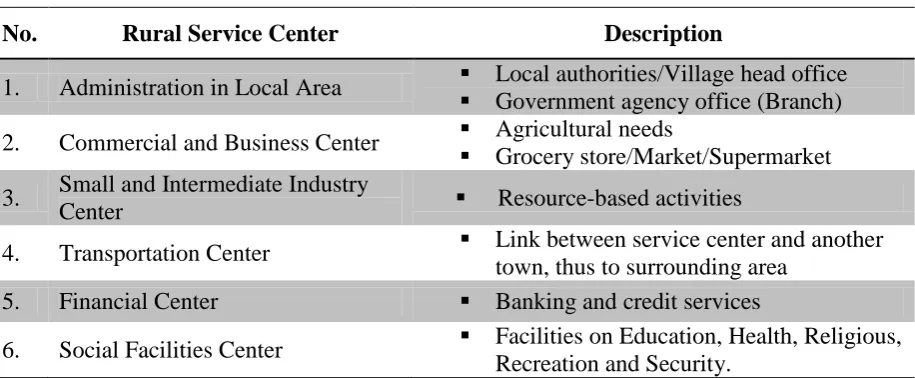
According to research by Conen, English and Brookfield (1977), Rodinelli (1984), Azman Awang (1984), Baked (1990) and Katiman Rostam (1991), the basic function of the rural service center can be concluded in the Table 1. This basic function categorized the service center as “semi-complete”. However, some rural service center provides various and more than the basic functions in the town and we categorized it in “complete center”.
Table 1: The Basic Function of Rural Service Center
No. Rural Service Center Description
1. Administration in Local Area Local authorities/Village head office Government agency office (Branch) 2. Commercial and Business Center Agricultural needs
Grocery store/Market/Supermarket 3. Small and Intermediate Industry
Center Resource-based activities
4. Transportation Center Link between service center and another town, thus to surrounding area
5. Financial Center Banking and credit services
6. Social Facilities Center Facilities on Education, Health, Religious, Recreation and Security.
Source: Conen, English and Brookfield (1977), Rodinelli (1984), Azman Awang (1984),
Baked (1990) and Katiman Rostam (1991)
3. TOURISM FUNCTION IN RURAL SERVICE CENTER
As rural service center experience economic and social restructuring, many are pursuing tourism opportunities as one component of a more diversified local economy strategy. In many cases, this change is usually associated with the restructuring of the basic sector industry predominant in each locale. Associated with economic restructuring a concomitant process of social change. This social change is often linked to the out-migration by working age resident, in situ population aging and in cases where new potential economic activities are identified.
Page 4
4. METHODOLOGY
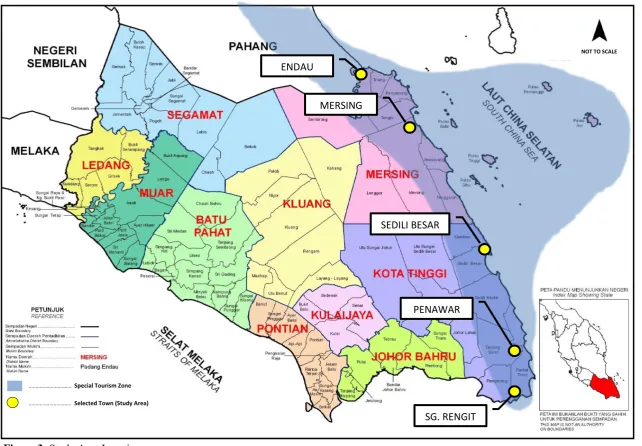
The area of study focus at the service centers located on the east coast of Johor and south of Pahang also included in Special Tourism Zone based on the National Physical Plan. Along that corridor zone, a few rural service centers were selected based on the population and town hierarchy level. Table 2 and Figure 3, show the selected town. Selected town justification is to study the Special Tourism Zone approach in rural service center on providing facilities in tourism activities.
Table 2: Selected Town
No. Town Hierarchy Population Size (people)*
1. Mersing Intermediate Town 10,301
2. Penawar Intermediate Town 6,145
3. Endau Small Town 3,236
4. Sg. Rengit Small Town 2,018
5. Sedili Besar Small Town 878
*Source: Population and Housing Census of Malaysia (2010)
Field observation and estimation techniques were conducted to obtain detailed information about the function (economy activities) interaction between the rural service center and tourism activities. While, opinion and reaction on the tourism provision in catchment area was getting from tourist using interview technique. Interview sample was chosen randomly and the sample will be representing the tourist’s reaction. The boundaries of the town (determined by local authority) become the limitation of this study.
On the other hand, to obtained information about a function in the rural service center, location coefficient analysis was used. This analysis to determine the contribution function either the function dispersed in the area or concentrated in the service center (Katiman & Khaw, 1985). Higher value of location coefficient indicates concentrated function in the rural service center and the signify as the higher order economic activities. Habitually, this higher order activity just offered in certain service center. While the lower value of location coefficient indicates the higher offered function in the settlement area. Figure 2 below shows the formula to determine location coefficient value.
Figure 2: Formula to Determine Location Coefficient Value
Source: Modified from Yazid Salleh, Katiman Rostam & Mohd Yusof Hussain (2011)
C = t_
C = Location coefficient (level of concentration) t = Concentration center (equals with 1) T = Total function in the study area
T
Page 5
Figure 3: Study Area Location
Source: Population and Housing Census of Malaysia, 2010
ENDAU
MERSING
SEDILI BESAR
PENAWAR
SG. RENGIT
………. Special Tourism Zone
………. Selected Town (Study Area)
Page 6 5. RESULT AND FINDINGS
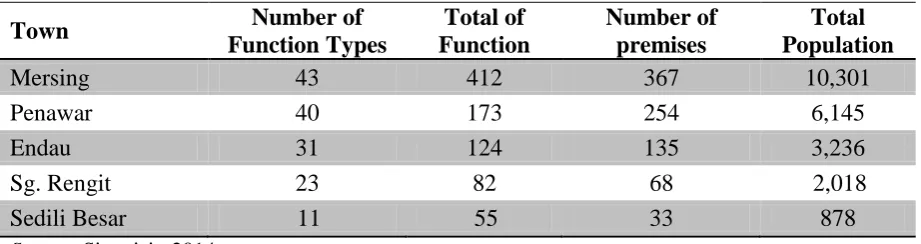
The fundamental factor in urban and regional planning/studies is observance of the economic condition of the region or area is being studied. Overall, result from the observation and simple census on 857 commercial premises shown 52 types of function in study areas. From 52 function types, there are contributing to 846 functions in the study areas. Mersing service center is the highest rank with 43 functions among the service center in this study. While Sedili Besar service center become a lower rank with 11 function provide in the area (refer Table 3)
Table 3: Function Types, Total Function and Commercial Premises in Study Areas.
Town Number of
Function Types
Total of Function
Number of premises
Total Population
Mersing 43 412 367 10,301
Penawar 40 173 254 6,145
Endau 31 124 135 3,236
Sg. Rengit 23 82 68 2,018
Sedili Besar 11 55 33 878
Source: Site visit, 2014
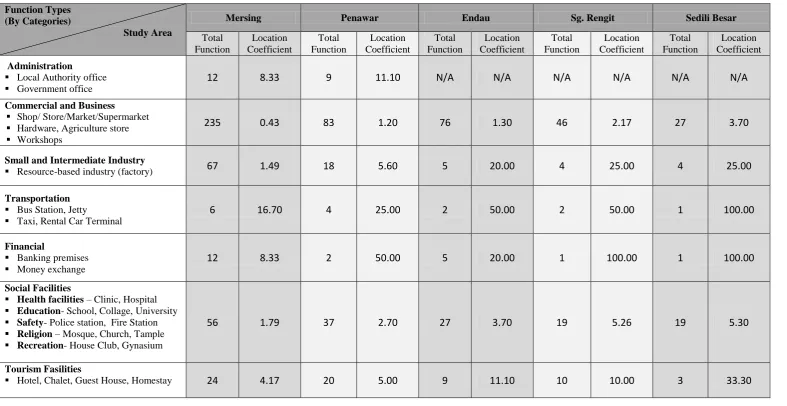
As the result, Table 4 and Figure 4 below show the findings. Mersing and Endau service center provide higher offered in commercial and small industries function while Penawar, Sg.Rengit and Selili Besar higher offered in commercial, social facilities and small industries. This situation showed all service centers already support the tourism activities with commercial and business function. Mersing and Sedili Besar has lowest offered in transportation facilities and others service center was not offered comprehensive function in administration and financial. This situation can be a threat to rural service center, especially for tourism activities.
Figure 4: Location Coefficient Analysis Result Commercial and Business &
Small Industries MERSING Transportation
Commercial , Small Industries &
Social Facilities PENAWAR Transportation & Financial
Commercial and Business &
Social Facilities ENDAU
Administration, Financial & Small Business Commercial & Social Facilities
SG. RENGIT Administration, Financial
Commercial & Social Facilities
SEDILI BESAR Administration, Financial & Transportation
LOWEST LQ’s VALUE,
HIGHER OFFERED FUNCTION
Page 7
Table 4: Location Coefficient for Study Area
Function Types
(By Categories) Mersing Penawar Endau Sg. Rengit Sedili Besar
Total Function
Location Coefficient
Total Function
Location Coefficient
Total Function
Location Coefficient
Total Function
Location Coefficient
Total Function
Location Coefficient Administration
Local Authority office
Government office
12 8.33 9 11.10 N/A N/A N/A N/A N/A N/A
Commercial and Business
Shop/ Store/Market/Supermarket
Hardware, Agriculture store
Workshops
235 0.43 83 1.20 76 1.30 46 2.17 27 3.70
Small and Intermediate Industry
Resource-based industry (factory) 67 1.49 18 5.60 5 20.00 4 25.00 4 25.00
Transportation
Bus Station, Jetty
Taxi, Rental Car Terminal
6 16.70 4 25.00 2 50.00 2 50.00 1 100.00
Financial
Banking premises
Money exchange
12 8.33 2 50.00 5 20.00 1 100.00 1 100.00
Social Facilities
Health facilities – Clinic, Hospital
Education- School, Collage, University
Safety- Police station, Fire Station
Religion – Mosque, Church, Tample
Recreation- House Club, Gynasium
56 1.79 37 2.70 27 3.70 19 5.26 19 5.30
Tourism Fasilities
Hotel, Chalet, Guest House, Homestay 24 4.17 20 5.00 9 11.10 10 10.00 3 33.30
Page 8
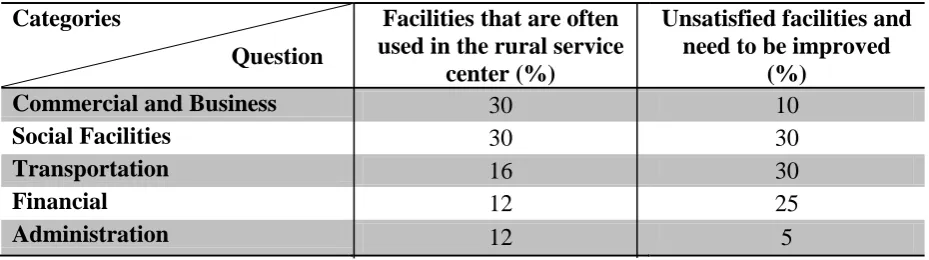
The interview was randomly conducted to tourist to get their opinion and reaction to the rural service center influence to tourism provision. In order to get some opinion and reaction, the same question provided to 25 samples (tourist). The majority (30%) tourist often used commercial and social facilities function in the rural service center, while 12% tourist less used the financial and administrative function. Otherwise, there still hope the financial facilities (banking and money exchanges) can be more easy to access. Tourist also unsatisfied with limited social facilities and lack of transportation function in the study areas (refer Table 5).
Table 5: Tourist opinion and reaction in the study areas.
Categories Facilities that are often
used in the rural service center (%)
Unsatisfied facilities and need to be improved
(%)
Commercial and Business 30 10
Social Facilities 30 30
Transportation 16 30
Financial 12 25
Administration 12 5
6. CONCLUSION
Finally the result confirmed that not all service centers are able to fulfill the tourism activities demand. However, the variance function in every service center contributes to supporting the tourism activities in rural areas. The potential element in supporting tourism activities in rural areas is:
The strategic places to stay for tourist in the rural area
The most importance facilities in tourism is an accommodation. Tourist in urban area usually can acsess to this facilities anytime and anywhere in term of higher facilities supplies. Otherwise, usually in rural area, accommodation facilities are limited provided because of lowest demand rather than in urban area. For the solution, the rural service center is suitable places to provided the fasilities and it can be support with onather function in the center. This situation will create a variety of function in the rural service center
As comprehensive transportation hub for tourist
Major problem in rural tourism facilities is transportation. Transportation development and planning in rural area quite slow compared an urban transportation. Well planning with comprehensive system must be provided such as a clear road map for tourist to visit, create a road tour to attractive product and special bus/taxi for tourism activities in rural areas.
Page 9
As center to fulfill tourist’s demand for their needs and goods.
Concentration is assumed to reduce costs and improve access to a variety of services, both public and private and for both rural households and enterprises. Hence, services include agricultural extension, health and education (and access to other government services), as well as banking, post, services of professionals such as lawyers and accountants and lower order services such as bars and restaurants, and wholesale and retail sales of manufactured goods from within and outside the region.
As center financial and credit services for tourist to easy access
Rural service center must be a center to tourist get easy access for financial and credit services. Otherwise, with this important function nowadays, it can attract more tourist come because of an affectively the financial services and tranding.
Figure 5: Potential Function of Rural Service Center in Tourism Activities
Reference
Amakchi H (2004). Central Cities And Their Role In National Development. Publish by Journal of Geography and Regional Planning Vol.2 (9), September, 2009. The Role and function of small town in rural development using network analysis method case: Roniz rural district (Esthban City, Province Fars, Iran)
Azman Hj.Awang (1984) Small towns, olds new: their status in the national settlement structure in West Malaysia. Dlm Kammeier, H.D& Swan, P.J (pnyt.). Equity with Growth?planning perspective for small own in developing countries, hlm 248-259. Bangkok: Asian Institute of Technology.
Potential Function Of Rural Service
Center In Tourism Activities Accommodation center
to tourist stay
As center financial and credit services for tourist to easy
access
As comprehensive transportation hub for
tourist.
As center to fulfill tourist’s demand for their needs and
Page 10
Baker, J. (1990) The growth and function of small urban centers in Ethiopia. Dlm. Baker,J. (pnyt.) Small town Africa: studies in rural-urban interaction, hlm. 209-227. Uppsala: The Scandinavian Institute of African Studies.
Carter,H (1990) Urban and rural settlement. Landon, Longman Group Ltd.
Cohan,M, English,J. &Brookfield,H (1977) Functional diversity at the base of the urban system in Peninsular Malaysia. The Jurnal of Tropical Geoghraphy 45; 12-25
Department of Statistic Malaysia (2010) Population and housing census of Malaysia 2010. Kuala Lumpur
Department of town and county planning peninsular Malaysia (1998), National Physical Plan, Kuala Lumpur
E.Zabardash (2004). Size of a City. Iran Center for Achitecture and City Planning, Tehran, p.36
G. Halseth & C. Meiklejohn (2009) Indicator of small town tourism development potential:the case of Fouriesburg, South Afrika. Urban Forum (20) 293-317
Katiman Rostam (2001) Dasar dan Strategi petempatan dalam pembangunan negara. Penenrbit Universiti Kebangsaan Malaysia, Bangi
Katiman Rostam, Khaw Loo Bean (1985) Hierarki kefungsian pusat peringkat rendah: Contohdari Hulu Terengganu. Ilmu Alam Bil 14 & 15. Mei 1985, 15-34.
Katiman Rostam (1991) The roles of service center on rural development:a study of the settlement of Hilir Perak,Malaysia, Akademia 38: 29-58
Katiman Rostam (2000) Pembandaran dalam era globalisasi: Beberapa kesan terhadap ruangekonomi desa di pinggiran metropolitan. Prosiding Seminar Antarabangsa Alam, Manusiadan Pembangunannya di Malaysia: Dasar Starategi dan Kelestariannya. Anjuran PersatuanKebangsaan Geografi Malaysia dan Jabatan Geografi Universiti Kebangsaan Malaysia, pada19 Jun 2000 Bangi. Tidak diterbitkan.
Lal,N (1989). Rural Settlement Planning and Developmant.Allahabad;Chugh Publication.
Oppermann, M & Kyle-Sung Chon (1997) Tourism in developing countries. London: International Thomson Business Press.
Tacoli C.(1998) Rural- urban interaction: A guide to the literature. Enviroment and Urbanazation 10 (1) (April), 147-166