Electronic Theses and Dissertations
Theses, Dissertations, and Major Papers
8-13-1965
Analysis and Analogue Computer Representation of commutating
Analysis and Analogue Computer Representation of commutating
machines and its application to control systems.
machines and its application to control systems.
Tilak Raj Sahni
University of WindsorFollow this and additional works at: https://scholar.uwindsor.ca/etd
Recommended Citation
Recommended Citation
Sahni, Tilak Raj, "Analysis and Analogue Computer Representation of commutating machines and its application to control systems." (1965). Electronic Theses and Dissertations. 6402.
https://scholar.uwindsor.ca/etd/6402
ANALYSIS AND ANALOGUE COMPUTER REPRESENTATION
OF COMMUTATING MACHINES AND ITS
APPLICATION TO CONTROL SYSTEMS
by
TILAK RAJ SAHNI
A Thesis
Submitted to the Faculty of Graduate Studies through the Department of Electrical Engineering in Partial Fulfillment
of the Requirements for the Degree of Master of Applied Science at the
University of Windsor
Windsor, Ontario
INFORMATION TO USERS
The quality of this reproduction is dependent upon the quality o f the copy
submitted. Broken or indistinct print, colored or poor quality illustrations and
photographs, print bleed-through, substandard margins, and im proper
alignm ent can adversely affect reproduction.
In the unlikely event that the author did not send a com plete m anuscript
and there are m issing pages, these will be noted. Also, if unauthorized
copyright m aterial had to be removed, a note will indicate the deletion.
®
UMI
UMI Microform EC52583
C opyright 2008 by ProQ uest LLC.
All rights reserved. This microform edition is protected against
unauthorized copying under Title 17, United States Code.
ProQuest LLC
789 E. Eisenhow er Parkway PO Box 1346
APPROVED BY:
a . l
The purpose of the present study is two-fold:
i) to present a unified approach for the analysis of both D.C.
and A.C. commutating machines,
li) to present the rigorous mathematical model and Analogue Computer
Representation of both D.C. and A.C. commutating machines.
I
The analysis begins for an ideal machine with the following
assumptions:
i) The air-gap flux density wave to be sinusoidal
ii) The effects of the coil short-circuited undergoing commutation
to be ignored.
iii) The magnetic path to be unsaturated
But in the actual machine, the following problems are encountered:
i) The air-gap flux density wave is non-sinusoidal
ii) A coil undergoing commutation is short-circuited
iii) The magnetic path is saturated
To overcome these problems, the voltage-current equations are
modified as stated below:
i) The presence of space harmonic components in the air-gap flux
density wave modifies the voltage coefficient in the
speed-voltage terms.
ii) The proper choice of the rotor and stator axes takes care of the
effect of short-circuited coil undergoing commutation.
iii) The saturation in the magnetic path causes the non-linearity in
coefficient by a factor S which is found from the open circuit
characteristic of the machine. This non-linearity can be
simulated in the Analogue Computer Representation by a function
generator.
Finally, an application of D.C. commutating machines is shown in
the position control system.
The sincerest appreciation of the author is extended to Dr. H.H. Hwang
for his generous provision of guidance and encouragement, and for the
wealth of knowledge which he made available to this work. Thanks are
due to Dr. P.A.V. Thomas for the encouragement from time to time during
the work.
Special thanks are directed to the National Research Council which
TABLE OF CONTENTS
Page
ABSTRACT... iii
ACKNOWLEDGEMENTS... v
TABLE OF C O N T E N T S ... vi
Chapter I. INTRODUCTION... 1
II. Generalized Theory... 2
III. D.C. COMMUTATING MACHINE... 13
IV. A.C. COMMUTATING MACHINE... . . . . . 36
V. CONCLUSION... 45
REFERENCES... 46
The characteristics of variable speed with change of armature
voltage of a D.C. machine have led to its many important uses. Its
superiority is shown over other types of machines in the control system
application. In the position and velocity control, D.C. machines are
used in mose cases.
Therefore, such a need of a D.C. machine has led to its rigorous
study and its representation by a mathematical model. The analysis is
proceeded with two axes (d-q axes) theory and, therefore, a most general
D.C. machine, having field and armature windings and brushes placed on
both the axes is studied.
In the study of commutating machine, the following three difficulties
are encountered:
1. The Air-gap flux density wave is non-sinusoidal.
Z. A coil undergoing commutation is short circuited,
3. The Magnetic path is saturated.
In the present study, all these factors are taken into special
consideration. The Analogue Computer representation has been presented
for a general machine known as a Metadyne and then for an Amplidyne. An
application of the D.C. Commutating machine is shown in the position
control system.
Further analysis has been proceeded to study the A.C. Commutating
machines, such as the Repulsion Motor and the Single phase A.C. Series
CHAPTER I I
GENERALIZED THEORY
2.1 Ideal Machine
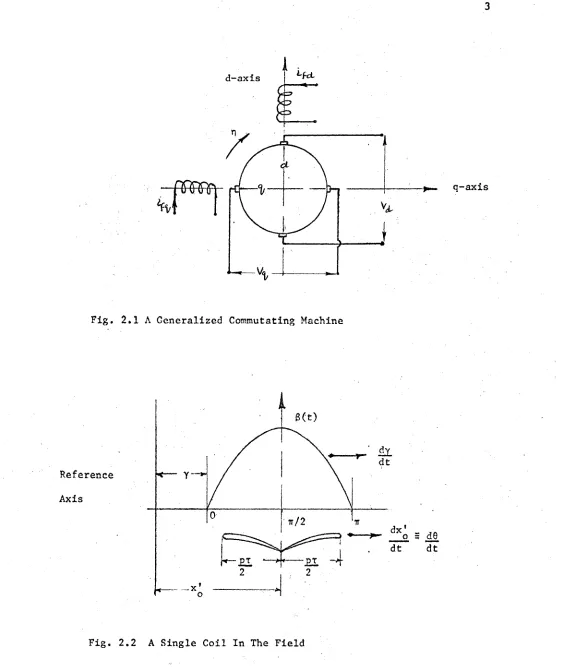
A most general commutating machine, shown in Fig.2.1, represents
windings as equivalent coils placed on two orthogonal axes. All the
windings shown either exist physically or represent an equivalent of
some phenomena occuring in the machine. It is possible that there may be
more or less number of windings that those shown on each axis. There are
also two sets of brushes placed 90 electrical degrees apart on the commuta
tor for generalization, which are actually present in the cross-field
machines.
The two orthogonal axes shown in Fig.2.1, are chosen as stationary
axes and defined as
i) Direct Axis (or Pole axis) - Axis of the main field winding.
ii) Quadrature Axis (or Interpolar axis) - An axis 90 electrical degrees
ahead of Direct-axis. Sometimes it is known as the Brush Axis.
The analysis begins with an idealized machine and later is modified
when actual difficulties are encountered. Hence it proceeds with the
following assumptions:
i) The Air-gap flux density wave to be sinusoidal
ii) The Magnetic path to be unsaturated
iii) Hysteresis and Eddy current losses to be neglected
iv) Effects of the coil to be short-circuited as commutation is to be
ignored.
With the above stated assumptions, the voltage induced in the coil
Fig. 2.
Reference
Axis
Fig. 2.
d-axis Lfd,
>»_ q-axis
L A Generalized Commutating Machine
rr/2
£ 1 £ 1
de
dt4
whose centre is located at x^ from the reference axis is to be found.
Here the most general case is considered so that
i) flux density is a function of time
ii) flux density is moving with the velocity of d^ dt
iii) A coil of short pitch pT is placed on the armature which rotates with
a velociey d 6 . dt
To find the voltage induced in the coil, the flux-linkage with the
coil is first found and then its time-derivative is taken to find the
induced e.m.f.
Therefore, flux embraced with the coil,
1 v ti
2 X
3 dx dy
JL
2 x . .2.1
1 - axial length of armature
x ? and x" - distances of two ends of the coil from the
reference axis
6 - flux density which is a function of time and space; and
it is given as
3 ■ 3 sin
m firx + y
2t . K K 3 sin d> = — 1 p s m T ir
t tx' + y
where K " sin ^ - pitch factor
p 2
2t 1 . firl .
K ■ — --- sin j— tan s irl tan a
..
2 . 2..2.3
..2.4
tan aj- skew factor ..2.5
or 6 « K K 1 sin P 8 ®
2t
where $ “ — I B ....
Tm ir m
..
2 . 6..2.7
from the equation 2.6, it is seen that flux embraced by the coil is a
function of <b , x", v i.e., Tm ’ o ’
f * f
. .
2 . 8The voltage induced in the coil,
c
..2.9
-N K K p s
U L a dt
firx' \ sin}— j a + Y ).
m
dx1
1T_ _0 + i x cos __ o + TTX* y
x 5t • dt
J
. T..
2.10Consider a group of q coils uniformly distributed in slots separated by
a slot angle a and the centre of the group is located at xq from the
reference axis. The voltage induced in the group of coils is,
e - -N K K K q f ^ m sin p s d
dt
TTX o + y
+
m7f dx
— o
«
+ «±- cos
f *
TTX ,
o + y } •*2*11
T dt dt y
, T
and - winding factor
Effective number of turns
. .
2.126
ip * N <p - flux linkage
m e m ..2.14
The equation 2.11 can be rewritten as
e * - ( ^ m sin
fit
fix
TTX
o + y
m T 51 fit
0 ,
cos
/
— + Y
> 4
..2.15
The three terms in equation 2.15 are interpreted as
i) The term 6^ represents transformer e.m.f.
fit"
ii) The term fixQ represents speed e.m.f. due to movement of conductors.
fitT
iii) The term fix represents speed e.m.f. due to movement of field.
f i t . .
In all the commutating machines, the field must be stationary while
the armature is rotating.
Thus dx “ 0 ..2.16
dt
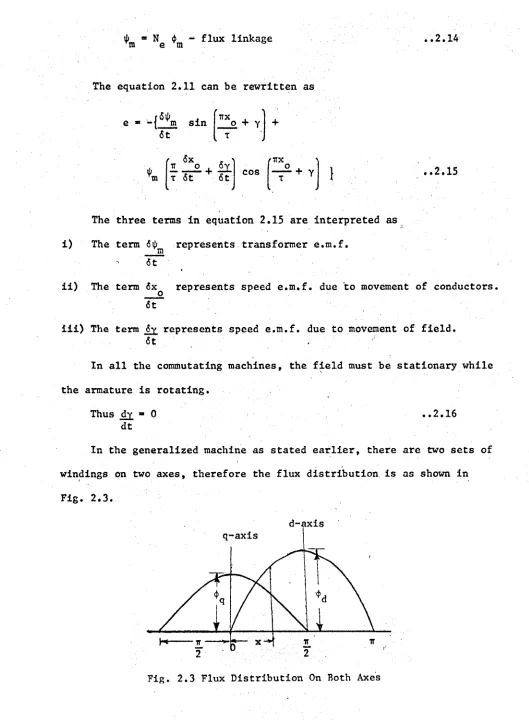
In the generalized machine as stated earlier, there are two sets of
windings on two axes, therefore the flux distribution is as shown in
Fig. 2.3.
q-axis
or
Thus the flux at any point is
<|>(x) “ <j)^ sin + <}><j s i n ,.2.17
4
,(x) ■ ^ sin ^ sin ..2.18The voltages e^, e^ induced in the windings placed on d-axis and
q-axis are respectively
1 ^ 4 . , - 4 a
ed " dt *q dt ..2.19
dfl d»c
e, * - * d d ? - d T ..2.20
The armature terminal voltages are
^ d d A
v ■ e - i r * - -j— + ii — - i r . .2.21
d d d a dt dt d a .
r)A
v - - e - i r ■ - ♦ . f - / - i r ..2.22
q q q a a dt dt q a
The flux linkages ^ and can be written in terms of self and
mutual inductances of the coils on the two axes, for in the unsaturated
magnetic path, a linear relation between flux linkage and the current
exists.
2.2 Practical Machine and Problems Encountered
In the previous section, theory is developed for an ideal machine
under the assumptions made, but the machine is not ideal and a number of
problems are encountered in the actual machine. It is difficult to
develop the theory for an actual machine, therefore, a theory is first
developed for an ideal machine where the equations are obtained in
correct form and then certain factors are modified for the actual
machine. The following problems are encountered in the actual commutating
machine:
8
2. The coil undergoing commutation is short-circuited
3. Saturation of the magnetic path
1) Space-harmonics in the air-gap flux
density:-The flux density distribution in the air-gap is not sinusoidal but
it contains space harmonics. The equations for e.m.f. induced are
derived on the assumption of a fundamental air-gap flux density. By
inspecting the voltage equations (nos. 2.21 and 2.22), it is found that
they contain two terms - (a) Transformer-voltage - and (b) speed-voltage
, a e
d t
The speed-voltage term is more predominant than the
transformer-voltage term. Thus the correction for transformer-transformer-voltage is not of
much importance. To modify this term a lot of problems are involved in
finding the exact flux density wave shnpe, its harmonic component and
the voltage due to each component. This process is very labourious and
the result can be obtained with sufficient accuracy by considering only
the fundamental component.
d 0
The second term is speed-voltage, — where flux linkage \f/ is of
the form ip = Mi ..2.23
where M is mutual inductance in the case when only fundamental component
is considered. For for non-sinusoidal flux density M does not remain as
the mutual inductance coefficient but is to be modified. This coefficient
is known as speed-voltage-coefficient-G which is to be found experimentally.
Thus the voltage equations (2.21) and (2.22) become
• •2.24
2.25
where X , and X are of the form X
2) Short-circuited Coil Under Commutation.
During the process of commutation, coils are being short-circuited.
These short-circuited coils set up a field in the air-gap. The coils
short-circuited by brushes placed in the d-axis produce a field in the
q-axis, and vice-versa. Thus the effects of short-circuited coils can
be considered along with the fields in both the axes while measuring the
constants of the machines. This line of approach is true only when the
axes of the rotor are chosen to coincide with the corresponding axes of
the stator.
3) Saturation of Magnetic Path.
In the actual -machine, the magnetic path is considered saturated
&nd in fact in the self-excited D.C. machine the magnetic circuit must be
saturated). The saturation has two effects: (1) reduction of inductance
and (2) reduction of voltage generated in the armature circuit.
The effect of saturation can be considered with the approximation
that there is no interaction between the flux at the d-axis and that at
the q-axis. Recalling the relation
^mdf * ^ ^Vqa^oc ..2.26
n
where ^ “ field flux linking with d-axis circuit
A - Constant of proportionality
(Vqa)oc “ Open-circuit armature voltage in q-axis
n - speed in radians per sec.
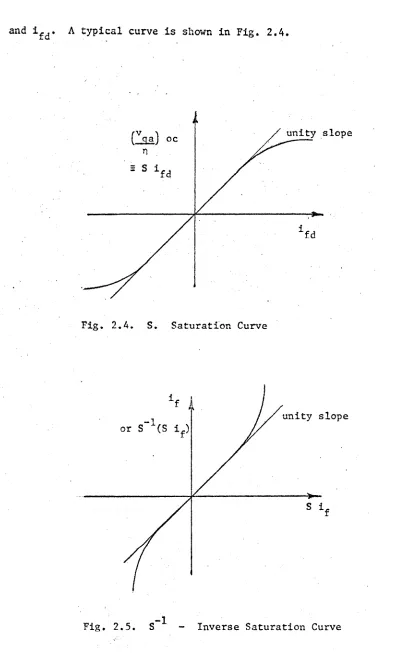
A curve between the d-axis field current, and the q-axis open-circuit
armature voltage per radian per second of speed will give the measure
and ifd« A typical curve is shown in Fig. 2.4.
unity slope fVqa) oc
Fig. 2.4. S. Saturation Curve
unity slope
The self inductance of the field winding is related as
Lfd " Lfld + Lmfd
where 1 ^ ^ is inductance due to leakage flux which does not link with the
armature circuit and L is the inductance due to mutual flux and it is m f d .
Lm f d " ^ ..2.28
h i
Hence, a relation between open circuit voltage and inductance is
established as given below.
A jlga] ~ T -• - L
— " A i d f H Lmfd xfd = ifd ..2.29
n mfd
a S i
& I fd
" I s L if j
g7: fd
af
where is inductance of unsaturated portion and is considered to be
constant.
Because of saturation, the flux is reduced and hence the speed
voltage is also reduced. This is allowed for by the speed-voltage
coefficient G ^ , and which is a constant speed-voltage coefficient
found from the unsaturated conditions. Therefore, by finding S which is
a function of field current, the values of
Lmfd * S Lmfd
and G . * S G',
af af
can be obtained.
Thus in the voltage equations, mutual inductance coefficients and
1 2
CIS
for finding the differentials, the term “ is assumed to be negligible.
Hence the effect of saturation is appropriately accounted for. In
Analogue representation, the inverse saturation factor S ^ is required
which is defined by interchanging the axes of Fig. 2.A. Thus S ^ is
obtained in the Fig. 2.5. In the analogue representation, this can be
represented by a function generator.
In the two axes machines, two saturation factors S, and S
d q
(or S, * and S are defined for two axes. The S,1 is determined from
a q a
(v ) versus the direct axis field current i,,, and S ^ is determined
qa oc fd q
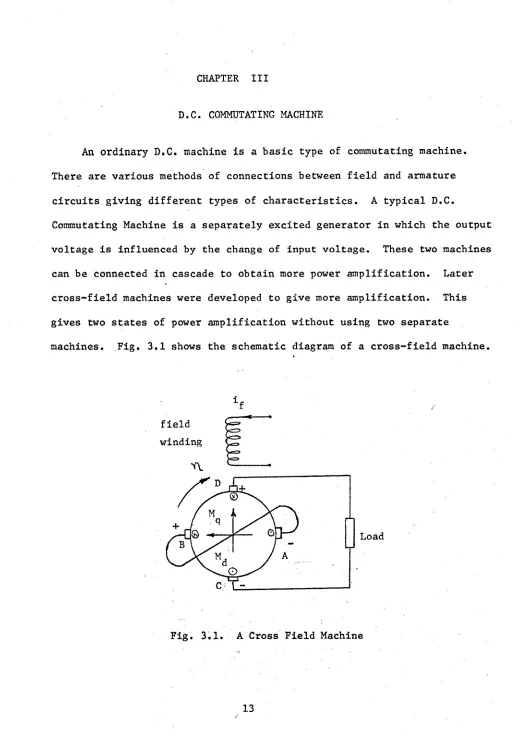
An ordinary D.C. machine is a basic type of commutating machine
There are various methods of connections between field and armature
circuits giving different types of characteristics. A typical D.C.
Commutating Machine is a separately excited generator in which the output
voltage is influenced by the change of input voltage. These two machines
can be connected in cascade to obtain more power amplification. Later
cross-field machines were developed to give more amplification. This
gives two states of power amplification without using two separate
machines. Fig. 3.1 shows the schematic diagram of a cross-field machine.
i f
field
winding
Load
1 4
With the armature running in clockwise direction, voltage of marked
polarity is induced in the brushes A and B. If these brushes are short
circuited, a large amount of current flows in the armature conductors,
setting up a M.M.F. - M in/the'direction shown, which produces flux
perpendicular to the main flux. If a pair of brushes C and D are placed
perpendicular to the axis of AB, voltage is induced in these brushes
C and D due to rotation of armature. The load can be connected across
the brushes C and D. This in short is a principle of cross-field machine.
These can be classified as two-stage machines also.
In general, a Metadyne generator can represent a cross-field machine.
Another type of cross-field generator is the Amplidyne in which compensating
windings are provided on the stator. These compensating windings carry
the load current and produce an M.M.F. equal and opposite to M^ (due to
armature reaction). Thus, the net flux remains constant. Therefore, the
Amplidyne is known as a constant-voltage generator. In the Metadyne, lack
of compensating winding results in negative feedback. The negative
feedback introduces two serious problems. There is much less power
amplification in Metadyne compared to Amplidyne. The problem of
oscillation is overcome by providing additional damping winding.
Another difference is that speed of response of Metadyne Generator
is rapid in comparison to the response of either a separately excited
D.C. machine or an Amplidyne. Eddy currents in the iron path, though
minimized by lamination, can . r ;., . :> -,ort circuited winding. Eddy currents have a small effect in transient response. Eddy currents,
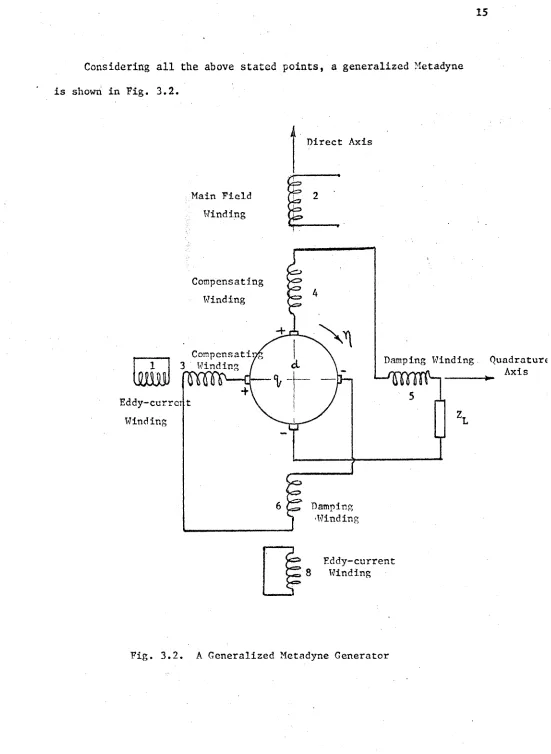
Considering all the above stated points, a generalized Metadyne
is shown in Fig. 3.2.
Direct Axis
Main Field
Winding
Compensating
Winding
Compensating
3 Winding ( Damping Winding
l o t
Eddy-currcr
Winding
Damping ■Winding
Eddy-current 8 Winding
Fig. 3.2. A Generalized Metadyne Generator
1 6
Direct Axis Windings:
2 - Main Field Winding
4 - Compensating Winding in series with the d-axis armature winding.
It produces an M.M.F. in the same direction as the M.M.F. of the
d-axis armature winding,
d - Direct axis armature winding
$ - Damping winding connected in series with the q-axis armature winding
and placed in the d-axis
8 - Short-circuited fictitious winding f o r eddy current path in the
d-axis
- Load Circuit
Quadrature Axis Windings:
1 - Short circuited fictitious winding for eddy current path in the q-axis
3 - Compensating Winding in series with .the q-axis armature winding. The
M.M.F. is in the direction of the M.M.F. due to the q-axis armature
winding.
q - Quadrature-axis armature winding
5 - Damper winding in series with the d-axis winding and placed in the
q-axis
As found out in the previous chapter, the voltage induced in the
d-axis and q-axis windings are of the form 2.24 and 2.25, under the
condition of non-sinusoidal flux density distribution. But still, two
these e q u a t i o n si
1) Speed of Metadyne is constant
2) Magnetic circuits are unsaturated
Rewriting the equations 2.24 and 2.25
v, « - ^ d + X d0 - i,r , .
v 0 _ x i i . ^ ! a _ i r
v A , . « i r o o
q d dt dt q a ..3.2
Thus, to derive the voltage equations, first the flux-linkage with
each circuit is found. The subscript denotes the corresponding circuit;
*2 " L 2i2 + M 42x4 + M d2id + M 62i6 + M 821 8 ” 3,3
*4 " M 2Ai2 + V 4 + '^d4id + *64*6 + M 84i8 ‘ ‘3 ‘4
^d " ^ d ^ + ^ ^ 4 + + M 6di6 + M 8di8 •*3 ‘5
^6 " M 62i2 + M 64i4 + M 6did + L 616 + M 68i8 **3,6
^8 “ M 82i2 + + M 8did + M 86i6 + L 818
t|>, - L.i, + M , 0i0 + M, i + M.-i. ..3.8
1 1 1 13 3 lq q 15 5
- M,.i. + L,i_ + i + M,-i. ..3.9
3 31 1 3 3 3q q 35 5
ip = M _i. + M _i_ + L i + M i ..3.10
q ql 1 q3 3 q q q5 5
■ M-.i. + M c0i0 + M c i + L ci c ..3.11
5 51 1 53 3 5q q 5 5
Coefficients for speed terms:
X, = G i + G i + G i + G i + G i ..3.12
d 2 2 4 4 d d 6 6 8 8
X - G i + G i + G i + G i ..3.13
S 1 1 3 3 q q 5 5
Now voltage equation for each of the circuits is shown in the
V 2 “ V 2 + P L 212 + pM42^4 + pMd2*d + pM6216 + pM82i8
..3.14
v 4 ““pM 24i2 “ pL4i4 “ pMd41d” pM64i6 " M 84i8 “ r4*4
..3.15
vd “ ”pM2di2 “ pM4di4 “ pLd Ad ** pM6di6 " pM8d18
+ ( + 03i3 + Oqiq + G5i5) n - idrd •-3 -16
v 6 “ “ pM62i2 “ pM64i4 " pM6did “ pL6A6 "pM 86i8“ i6r6
•..3,17
v 8 * “pM82i2 ” pM8414 “ pM 8did “ pM8616 -‘pL8i8* i8r8
..3.18
V 1 “ *pLlil ~ pM1313 “ ^ V q “ pM15£5 “ V l ,,3,19
v3
“ *"pM31il * pL3i3 ~ pM3q1q “ pM35i5 ” 13r3• * 3 * 20
v q - -<G2i2 + Ga14 + Gdid + G 61 6 + Gglg) D
" ^ q l 1* “ ^ 3 * 3 “ pLq *q ~ “ V a ..3.21
v 5 - - •pM51i1 - pM53l3- pM5qiq - pL5l5 - i5r5 ..3.22
..3.23
L
For open-circuits^and steady state case, speed voltages are:
v ■ - (G0i0 + G.i. + G.i, + G,i, + G Qi_) n ..3.25
qo v 2 2 4 4 d d 6 6 8
when saturation is considered, the equations 3.24 and 3.25 are modified
to:
v do - (+ ‘H 1! + «313 + " S, ••3 ‘26 '
v - - + * % + ° ; ° 6 + ^ s ) 11 sd ••3 -27
3.2 Analogue Representation of Metadyne
The Metadyne with all these windings can be simulated on an Analogue
Computer. For the Analogue representation, the equations 3.14 through
3,23 are modified under the following conditions:
1) The self-inductance of each winding can be written as a sum of
leakage inductance and mutual inductance. Hence for Kth winding
^ " LK1 + LKK ..3.28
where is leakage inductance of winding due to leakage flux, and it
is assumed to be constant, and L v is mutual inductance of winding K due KK
to mutual flux. The mutual inductance is defined as * ^m
h
..3.29
where - mutual flux and i^ - current in the winding.
2) Same mutual flux links with all the windings on the same axis. This
assumption is reasonable because all the field windings are physically
wound on the same structure. This condition results in the following
relations:
- p - LK1 o
t
LKi - LKK ..3.302 0
where N„ and N are the number of turns in windings K and j respectively.
K j
3) Since the speed voltage is proportional to mutual flux, and mutual
flux being the same for all the windings, a relation among speed
coefficients is;
o f i NK n .
..3.31
4) Speed of amplidyne is constant
5) The equations and Analogue representation diagram are first derived
on the assumption of no saturation and then are modified later for satura
tion according to Chapter II.
By substituting equations 3.24, 3.25, 3.28, 3.31 into equations
3.14 to 3.23, the following relations are obtained
©x
VA
*- p
f z z i f v JL // v, “ p 44 4 K p—
4 v _a° h
(i
„3’.3'2 or\ G i - - °414 + p ^44 _V2° n .
,3.33
or
v, « ^^dd
d
^7
v_3° + v do - Z id d
V d “ Vdo G, - - G.i, + pLdd
_ _ _ d d d
v qo n
or
16
G Z6
6
p L 66 - G
616
+ p ZV go.
n ..3.35
v
8
G,“ G 8 i 8 +
pL
88 -3° ..3.36
Adding equations 3.32 through 3.36,
- V
2
+ V 4 + V d " V d o ' + 'l6
rZ2 Z4 Zd d
Z6
6
Z8
8
”G2i2” G4i4 ” Gdi8 ~ G6±6 ~ G8i8 + pL22 + pL44
Z2
Z4+ pLdd + pL55 +
pI88
Z 4 d zd , z *
6
v
v
+ P
L22
+ pL44 + pLdd +pL66
+p~88
Z2
Z 4 ZdiL ~Z, V qo n ..3.37 Quadrature-Axis pL v = - l.Z.
1
11
11 do
n
or v pL.. ! v
~ ' Gi = - V i " T T
zi 1
do
n
..3.38
v 3 i3Z3 "
2 2
or
or
or
12
g3
- - i3
c3
pL33 dov * v - P^qq K do
q
q°
LA
- i Z q q
pL 33.
v do
V 5 =
v
5g5
55
- irG do
pL 55 ■5 5 . Z t
do
.3.39
.3.40
.3.41
Adding equations 3.38 through 3.41,
v. v,G_ v - v
3 3 , q qo V s
c„ + H r
2
q 7..li.G. + i.G, + i G + i-GJl 1 1 1 3 3 q q 5 5J
+
PL11
+ pL33 + pLqq + pI55 - Vdo7
_
1
Z3 Z q Z.5
. n j.„„
*
--V do + pLll + pL33 + pLqq + r h i '
li, v ido
n Z1 Z3 Zq Z5 _ q .
**• ..3.42
Referring to Fig. 3.2, the following relations also exist.
..3.43
-v x -
0
; v g -0
*3 " *6 * \
v- + v + v- =
0
3 q
6
..3.44
..3.45
or
v. + v, + v_ + v_ “
0
4 d 5 L
v4 + v5 + Td ..3.47
Thus the equations 3.37 and 3.42 are modified to:
v oG o j.v /g / j. " v j o j. v c.G a - 2 2 + 4 4 + d do G, +
6
6
T-
~ hP^oo . Pk/,/, , P^jj P
l-sf-7. z.
2 4
V
m +
h
pL88~
_SL°VV
n
J.48
V _ G _ v - V
3 3 + q . £ £ q + 5 G rG j. v c r
Z5
= _
V do pLll + pL33 + pLao + pL55~ V do
n z z z z
3 3 9
5
_n ..3.49
Effect of
Saturation:-As discussed in Chapter II, the effect of saturation is considered
in the analysis of the machine. In this case saturation is effective on
both axes and so the coefficients of saturation (S) are found out
separately for the d-axis (S^) and the q-axis (S^). is found by
measuring the rotor open circuit voltage on the q-axis when a current is
passed in the stator-circuits of the d-axis, and similarly is found by
the d-axis open circuit voltage with a current in the q-axis stator circuits,
Thus the equations 3.32 through 3.49 are rewritten, taking the
saturation into account.
or
v2 - z2i2 - I k
p
*2
V
L n .
_a°
. .3.50a
2 4
T '
v 4~ ' Z 4i4 + - i i P G 4
v go
n ,3.51a
or
V ' i G.'i. + L«i
4 — p
4 4
V
22
..3.51bv jd ~ do d d + ^dd P—x t G d
v
_22
n ..3.52a
or v j " v j
d d
v
_22
..3.52b
L ' v, '■ - Z-l- +
66
6 6 6 “t t t P 6
v - 3 2
n ..3.53a
or
V 6G6
Z6 16i6 +
L 6 6
Z6 P
_ n j
0
*T • +
88
G8
PV
qo
_ h - ..3.54a
or
.
0
" ~G8i8
T * +8
RG8
Pfv ^
_22
. n _ ..3.54b
Adding equations 3.50b through 3.54b:
- V£ + Vi + v vdo G- + Vi
Z2
Z4 Zd h5*2
+ Gi
*4
+ CPd
+
GiV
+ %]
T t T » T * Y » T *
Z 2 1 + l i l dd +
l66
88
Z2 Z4 Zd
Z6
Z8
( \
V
P qo
I
^-1
_3L2 + ~ ~~ +
[L22
L 44 -I— ~ 'L66
+ L88
| i M.2 4 6 8 Z d
V p _ 3 2
Quadrature axis:
0 = - Z.i, - L11
1 1
-prr
p do . .3.56aor 0 ** - G'i,'- L 11
1
1
— pI .
v, * - Z_i„ - ^33
3 3 3
-pr
P3
v do L n J
do
..3.56b
.,3.57a
or
do
v n ' ■ ■ T 1
3 3 » - Gli, - “33
— 3 3 — p
3
f < V
v - v = ! - Z - i - qq
q qo .
q q
-jit Pq
.3.57b
..3.58a
or
Vq Vqo G ’ = - G'i - *Jqq
z q q q
q q
do
V , = ~.Z
1
.i(. - ^555 5 5 pT p
5
do
..3.59a
or
V 5G5 , . , L55 5 5 ' ^ p
do
..3.59b
Adding equations 3.56b through 3.59b,
V 3C 3 + vq ~ t' + V 5C 5 '
z ,
z
q
z
3 q 5
- - (Gii, + Gli, + G'i + G'i ] ' ■ 1 1 3 3 q q q q 5 5 V
L' L' L' L ’ ~
JL3L + - 1 1 + + z, z , z z ,
1 3 q 5
R
v do- - S
-1
do _ l i + L , - 2 1 + -SSL + - 2 1L' L' L'z, z ,
z
z .- 1 3 q
5-do
..3.60
26
F W H — --A'
jo I in
►4 It
81
J
■
^i
q.
3
.1
A
n
a
l
n
q
u
e
Poo
re
sc
n
ta
t
i
o
n
of
‘to
t
a
/V
Thus with the help of equations 3.50 through 3.60, Fig. 3.3 shows
the Analogue representation for the Metadyne. The effect of saturation
on both the axes is considered in this representation. It contains two
integrators only, and the non-linear portions in the feedback paths can
be implemented with function generators*
Amplidyne
As stated earlier, the Amplidyne is a special type of Metadyne in
which compensating windings provide complete compensation in both the
axes. This results in a circuit without feedback. Thus in the absence
of feedback, the machine will be stable, contrary to the Metadyne, which
may be unstable. Therefore, damping windings are not required for the
2
Amplidyne. From the experiments conducted by Fegley , it is observed
that the effect of the eddy current circuit is negligible and thus the
fictitious short-circuit winding representing eddy currents can be
neglected. Therefore, the Amplidyne windings 5,
6
, 1 and8
can be omittedand the following relations apply:
Direct Axis:
V 2 " Z 2 ± 2 + pL22i2 " (R2 + 3.61
v 4 " “ pM24i2 " pL4414 " pKd ^ d ~ Z4i4 3.62
Vd " " p M
2
di2
‘ p^4di4 “ ^ d d ^ + ( S S + V q J i r V d• •3.63
v, + v, + vT *
0
or
or
0
“ “ pM24i2 " pM2d12 “ pL44i4 “ ^ d ^ “ ^ 4 ^ “ pLdd1d
- V 4 - 5 S - [G 3 +
Gq)V
+ VI.2 8
or
(
v 3 g, + G ) n i
q J q2. + Z, + Z_
4 d L
..3.64
Quadrature axis:
v
3
- -pL3
l3
- - R3
i3
..3.65V q ” " (G
2*2
+ G 4i4 + G did^n ~ ,’M q3i3 “ pLqiq ” *q q
R..3.66
0
» v- + v3
q- pL_i« - pM i - R„i_ - pM ,i_ - pL i - i R G i. n
r 3 3 3q q 3 3 r q3 3 q q q q
2
L0 » - (R_ + R +
1
3
<1
pI3 + pLq) *q ' G2
i2
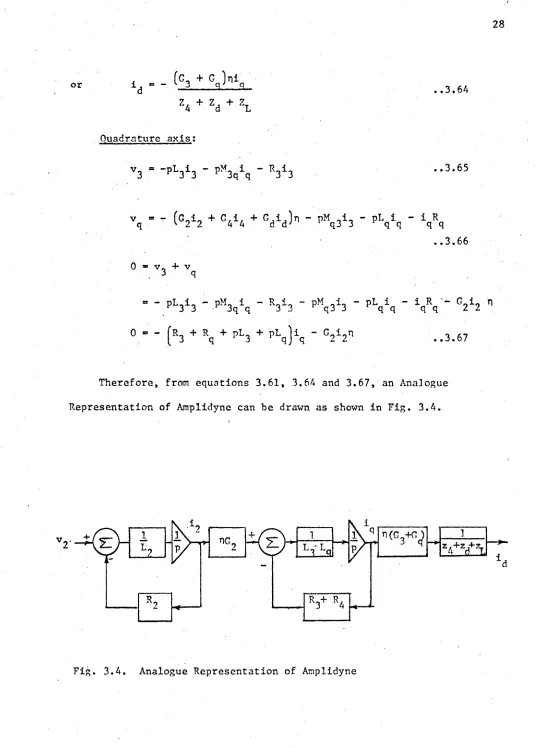
P ..3.67Therefore, from equations 3.61, 3.64 and 3.67, an Analogue
Representation of Amplidyne can be drawn as shown in Fig. 3.4.
V
2
‘ z,+z ,+z,Normally the magnetic circuit is not saturated, so the effect of
saturation is not shown in the Analogue representation, but if required,
it can be shown as discussed in Chapter II.
3.3 Experimental Work
Among the many applications of the Amplidyne as a rotating amplifier,
it is commonly used for voltage regulation, speed control, position
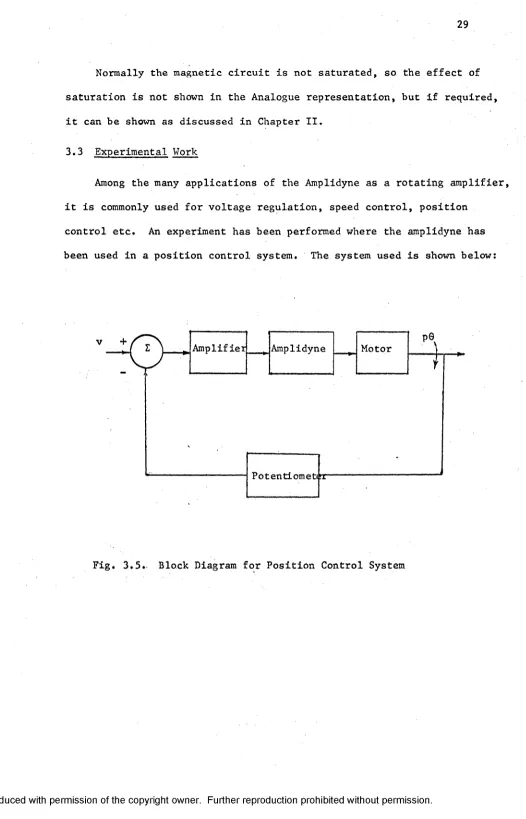
control etc. An experiment has been performed where the amplidyne has
been used in a position control system. The system used is shown below:
Amplifier Amplidyne __ Motor
p
6
PotentLomehir
3 0
The components of the system are:
1) Amplifier - Working on the linear portion
2) Amplidyne - Without winding No.3
3) D.C. Motor - Separately excited
4) Potentiometer - With reduction gears
The system can be described by the following relations:
The Amplifier is working on the linear portion and the time constant
of the field winding connected to the output of amplifier is negligible.
Thus the amplifier with field winding gives 6.2 mA/volt as a constant
transfer function.
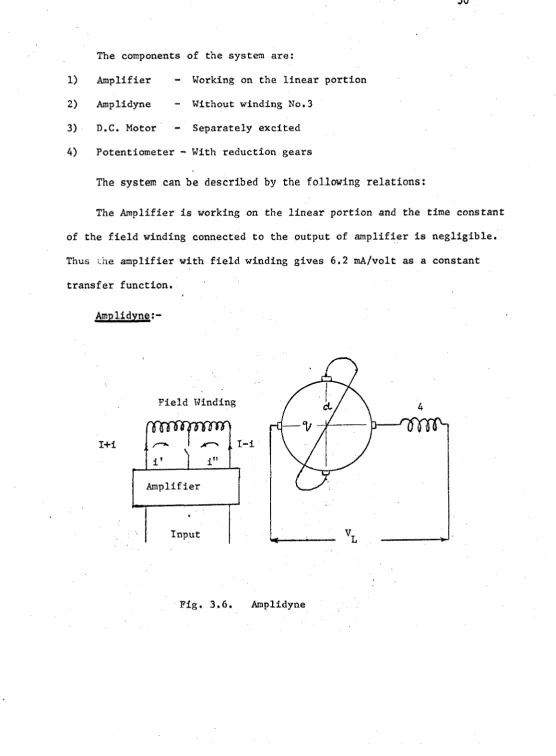
Amplidyne:-Field Winding
i n n n n f | T m r
I+i
Amplifier
Input
I - Direct current in the field winding when amplifier is balanced,
i - Signal current (alternating current in this case, because
‘input to the system is sinusoidal).
In this type of field connection, the flux-linkage with d-axis wind
ing is found.
to. - - L.i, + M.-i' -'M.-i" + M.i.
rd d d df df 4 4
i* * I + i i" » I - i
*d - - V d + M df2i + M 4*4 ..3.68
Thus the equivalent field current is 2i. i.e. ±2 = 2i.
i, - 2 K.(v - K 0) . , ,Q
2 A p ..3.69
v, ® - p G i ..3.70
d q q
0 = - fR + pL } i - n G
0
i_ ..3.711 9 9J 9
2
2
In the direct axis curcuit, the resistance and inductance are
taken in series with the armature of D.C. motor.
v j “ [Rj + R/ + R + Ph. + pL, + ph )i, + v
_0
d I d 4 m * d1
4 ,1
c i d b ..3.72- (R + pL) id + vb
« ^ P G ..3.73
» J P20 + ape ..3 .74
v = Sin u)t input signal to the system ..3.75
Taking the Laplace Transformation for both sides and sloving the
where . K ■- ( n G j .S,«2) 21^
a ■» JLL
q
b * aLL + RJL + JLR
q
q
q
3.77
c « RR J + aLR + RaL + K? L
q
q
q V qd « R R o + K ? R
q
oq
The output of the system, i.e. the angular position 0, is found in
the time domain by taking the inverse Laplace transformation of the
equation 3.76.
The constants of the system components were found experimentally and
are listed below:
Amplifier: = 6.2 mA/volt
Amplidyne: R , = R * 25.A ohms L, = L ■ 0.765 H
Nw. metre, sec/rad.
Potentiometer: K = 0.0198 volts per radian P
Input Voltage: 0.27 v at f ■ 0.1 c/s peak
These constants are substituted in the equations 3.76 and 3.77 and
Motor R^ * 24.2 ohms, = 0.58 volt sec./rad.
m
-4 2 -4
n >t ' r \ \ i i r>
t v - i I V »/ ^ . S '
,/ ,vnv \<
.;r ''. / . r ': :f'^ •" vs.*:
/ 7 A S
|r '
1
~ * ”ir v* a\ 7 /' ~'\ ip - <4 T V. u i { 7 x
Sr -a ,* u n
t / / \ \
/' J $
' ■* -£ £'T u V . a \ v -;;
r 7 r’ n " ' / ■ v* u ;-' \ '*v -j;
l L h V*« // 7 V '.
*■ / A \ t \v // . t ■■■. 5 >< A I \ \ Vi /r < ’ V:>,
Y J f , / iV V . / / " *\
s*«r • -r v v
B E ’ ' v '' '
BC t U
gu- ' \
BSSV J \ ‘'
1
\in"-' v "i !
I? \
jr. • v \ '
ir * \ < \
, yf .
liv^* ,? ^ , *v'^-' ,>
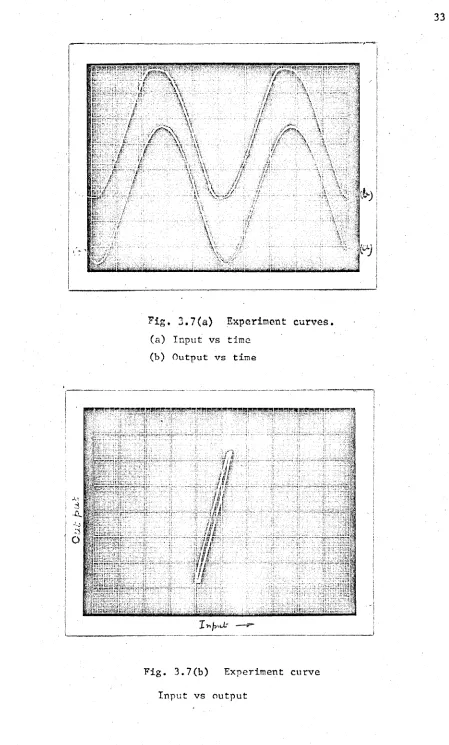
Fig, 3.7(a) Experiment curves,
(a) Input vs time
(b) Output vs time
j & )
<Pj
A‘
' n r r ^ ' n
-;T ir l i i s l
.
Inr* '-'r'j
1
j?4n^ *? ’I L : , , ; .
* -^Frr
ln .. (
l-r--:;-Jt li mx
jca.
t i p
u r . i f ;/h
>j'x ’
i t i
m " f/IC ’
r nr
/if i idl
' i t
u r '1/
i< /if
1 7 r-r
r
i«p
77:i|
, Jl
'11*4
j. 4
X »
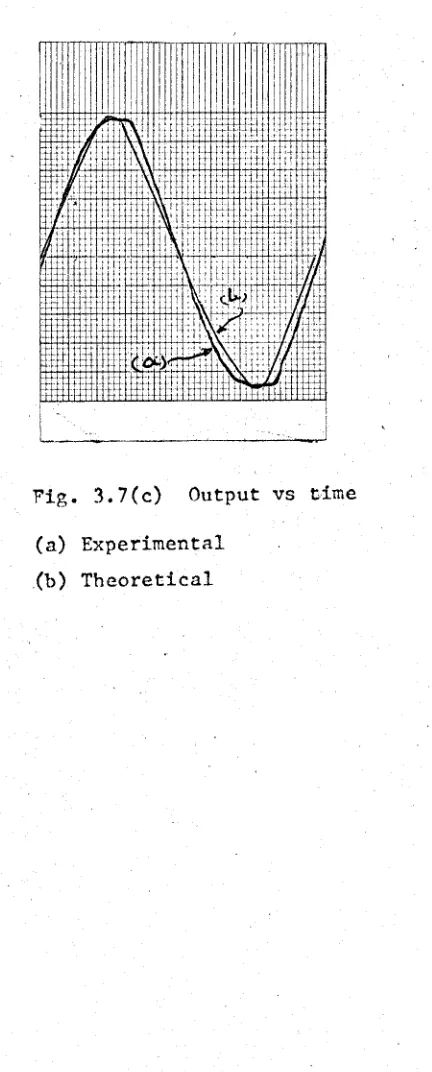
Fig. 3.7(b) Experiment curve
Fig. 3.7(c) Output vs time
(a) Experimental
0
(t) is calculated.0
(t) in terms of the voltage is plotted againsttime and compared with the experimental results in Fig. 3.7. From the
experimental results, it Is observed that the output curve is flat topped, while in the theoretical results, it is sinusoidal, but the
difference between the results is only 5 - 6 % maximum.
A curve between input and output is traced experimentally on the
CRO, and it appears like a hysteresis loop. It is found that the area
CHAPTER IV
A.C. COMMUTATING MACHINES
Though D.C. commutating machines were developed earlier and have
been commonly used, later A.C. commutating machines were developed and
used especially in traction and domestic appliances. A.C. commutating
motors have two advantages over the other A.C. motors: (i) its high
starting torque and (ii) its variable speed. These can be single-phase
and three-phase motors. Three-phase motors are used in traction while
single-phase motors are most commonly used in the domestic appliances.
The A.C. series motor is commonly known as a ‘Universal Motor*.
Series Motor
If instead of a D.C. supply, an A.C. supply is applied across the
terminals of a D.C. series motor, the motor will run, because the direction
of both flux and armature current changes simultaneously. But it is
observed that with the A.C. supply, the performance is poor - less
torque and poor power factor. The performance can be improved by reducing
the inductance of the windings. The field inductance can be reduced by
decreasing the number of turns on the field winding which results in less
flux and thus less torque. To get the same torque, the number of armature
turns is required to be increased. In this way, the armature inductance
is increased. A compensating winding can be provided on the q-axis which
produces an ra.m.f. opposite to that of the armature, and thus reduces
the effective inductance. Therefore, the performance will improve, i.e.
better speed regulation, more torque and better power factor.
Field Winding
q-axis
Compensating Winding
38
The A.C. series motor is shown in Fig. 4.1. The voltage equations
are given below:
v 2 ’ ‘ " V i ' V 2 ..4.1
5 J ’ ' ' V i ' V l ..4.2
Vq * •pMq313 " PV q * V ? + ^ 2 "
"''•3
T - Jpn + an - Iqr,2i2
i„ “ i _ = i .= i ..4.5
2 3 q
- V «* V « + V , + V
,
,
2 3 q , . .4.6
Substituting the equations 41., 4.2, 4.3 and 4.5 in equation
4.6, it is obtained,
v * p|l
2
+ L3
+ L q^ + 2Mq3 Ji + [r2
+ r3
+ rq ji - G 2ni..4.7/
With the help of these equations, an Analogue representation can be OWL
drawn,in Fig. 4.2 for an A.C. Series motor. A
Equivalent circuit:
Referring to equation 4.7, which gives the performance equation of
series motor, ai\ equivalent circuit can be drawn as shown in Fi^. 4.3.
Steady State Analysis:
Let the voltage applied to the motor as v = Sin wt,
and the current be i = I Sin (wt +cj>) m
forsteady state, the equations 4.4 and 4.7 are modified as
V - (r2 + r3 + *,)
1
- S ”1
+ i h + L3 + Lq + 2Mq 3 )4 0
2 2
The Electrical Torque developed T^ = G^I Sin (wt +<(>)
..4.9
1 2
and the average torque T = — G I
av
2
2
m 4.10Repulsion Motor:
Another type of single phase A.C. commutating machine is the Repulsion
Motor. In this machine, the brushes on the commutator are short circuited.
The brush axis makes an angle with the field axis [neither 90° nor zero
degree]. The field winding is supplied with A.C. voltage. The m.m.f.
produced in the air-gap induces e.m.f. in the armature winding. Thus
the current in the short circuited armature winding reacts with the
air-gap field and produces torque. The amount of voltage induced in the
armature depends upon the angle between the two axes. The rotation of
the armature is in the direction of the brush-axis shift.
A schematic diagram of the Repulsion Motor is given in Fig. 4.4.
In the figure shown, the brush axis makes an angle y with the pole
axis and this angle is independent of time i.e. d£ * 0. The short
circuited coils undergoing commutation produce a field which is perpendic
ular to the brush axis. The relationships of the flux linkage and the
voltage induced in the windings are given below. dt
V>1 _ + M J
2
i2
cosy +^ ^ 3
cos (90 + y)*2 - V l cos1r + L2I2 4.12
^3 ■ M 13il C0S
^90
+ + L3i3
4.1342
v
3
-0
- -p*j - i3
r3
- n G ^ i j cosy - nG.,.,1
.,__416
Analogue Representation:
The equations 4.11 through 4.16 are manipulated and rewritten to
facilitate the Analogue Representation of Repulsion Motor.
or
+ Lj cos^Y + sin^y -
21
*i
L ..4.17
*2
“*2
£i : + f C0SY ,,
4.11
*3 * ^3 - sinY ..4.19
l
3
Lvx - v - + i rx ^ 4>2Q
JLi
*2
0 ‘
' U '2 - t '2 « - V - ,(G12 + C32) £ -l-T
" ^ 3 2
1
“ "3or p*2 - - ^ _ i r2COS r _ ^ ± Blny + Cj2 lij
..4.21
> ( r jl r> Vh r
0 “ -p^3 - 3 r3 - i
r3
sinY -n fG 13+ G23
)^L cosY -n G 32 —L 3 L L L2
P *3 ' " i j r3 - L r 3 sinY - " S ' L COSY + °32 t^)
..4.22
4 3
In the.derivation of the above equations, following assumptions
are m a d e :
1
)1
,1
-« i , - A « !
2 3
2
)
12-
13With the help of equations 4.20 through 4.23, an Analogue Representa
tion is drawn in Fig. 4.5. In this representation four integrator, two
multipliers and potentiometers are required. No trignometrical function
-generator is required because the performance is shown for the fixed
angle y.
Steady State Analysis;
The equations 4.14 through 4.16 are solved for the steady-state
analysis of the machine. The voltage applied to the field is v *> V^cos cot
and assuming the currents i^ = I ^ c o s (ust +<j>)
*2
" *m2
cos +<^*3 = ^mS
008
Hence, substituting these values in equations 4.11 through 4.16 for
steady state solution;
V - j w L ^ + J
“m12I2
cosY ~ j(oMi3I3
siny + - 1 ^ 240
• -jo)M12I cosy - jwL2
I2
- I2
r2
- n G ^ I j S i n y - n C3->I3
..4.250 * d-juM^I^ siny - - 1 ^ - n G.^1^ cosY
Solving these three equations, values of 1^, ^ and
1
^ are found out.2
2
2
nT _ v[r.r- - a L,L. - n G-. + jw(r,L_ + r . L j ]
..4.27
2 2 2 2 r
*2
" + v t+w M ^ s i n y + r3
nG12sinY “ w I ^ M ^ c o s y + j ( w M ^ n G ^ s i n Y c osy+ w L 3n G 12 sin Y - w M 1 2r 3 c o s y}J
..4.28
2
2
I
3
- v[(n G12c32
sinY ~ r2
nG^3cosY - u ^ M ^ s i n y )+ j(a)M^
2
nG32
C0
SY - U)L2
nG^3cosY + wMx3r2sinY^..4.29
where
D - (r
3
+ io)L2
)(r2
+ jwL2> (r^ + juL3) - + J“ L i>+ (r
3
+ jc»)L3
)jwM12cosY (r)G12sinY + JuM^cos y)2 2
-
2
(o M12
M13
nG32sinY cos y ~ nG32
ju>M ^ G ^ c o s y2
2
• + jun " G32G 12M 13 sin y +
(r2
+ J uM^3
sinY ^ G i3
C0SY “ juM^sinY)..4.30
The equations for torque will be
T “ G , T , I* sinY sin(cot + 0) sin(tot + <f>) e
12
ml m2
- G, _ I I c o s y sin(tot + G) sin(tot + <f>)
CHAPTER V
CONCLUSION
In the present study, a rigorous mathematical presentation of a
most general D.C. machine, the Metadyne has been presented. All the
possible difficulties encountered in the analysis of commutating machines
have been overcome. The Analogue computer representation has been formu
lated. No attempt has been made to check the Analogue representation on
the actual Analogue- computer, because of the non-availability of such a
computer in our Laboratories. But it is expected the constants of the
machine will produce scaling difficulties in the representation. It is
suggested that these difficulties can be.overcome by taking the constants
on a per unit basis where the rated voltage and rated current are taken
as base values. The inverse saturation curves can be simulated by
function generators.
The D.C. commutating machines have been used in a position control
system. The results have been verified with an error of 5-6% with a
sinusoidal input to the system.
Finally, the single phase A.C. series motor and the Repulsion Motor
have been studied and their Analogue Computer representations have been
presented.
1. West, H.R. - The Cross Field Theory of Alternating Current Machines, A.I.E.E. Trans., Vol.45; Feb.1926, Pp.466-474.
2. Fegley, K.A. - Metadyne Transients,
A.I.E.E. Trans., Vol.74, Pt.Ill, Dec. 1955, . Pp.1179-1188.
3. Barton, T.H. &
- A Practical Commutator Primitive for Generalized Machine Theory, A.I.E.E. Trans., Vol.79, Ft.Ill, June 1960, Pp.227-281.
- Application of General Equations of Induced Voltage and Armature Reaction. Part I. Performance of an Induction Machine. C.P.61-1030.
- Application of General Equations of Induced Voltage And Armature Reaction. Part II. Performance of A Synchronous Machine. C.P.63-1004.
- The Impedance Matrix and Analysis of Commutator Machines, I.E.E.E. Trans., Paper No.31 TP 65-61.
7. Jordon, H.E. - Analysis of Induction Machines in Dynamic Systems, I.E.E.E. Trans., Paper No. 31 TP 65-109.
8
. Saunders, R.M.- Measurement of D.C. Machine Parameters, A.I.E.E. Trans. Vol.70, 1951, Pp.700-706.Electromechanical Energy Conversion (Book), John Wiley & Sons, Inc., New York 1959.
10. Thaler, G.J. &
Brown, R.G. - Analysis and Design of Feedback Control Systems (Book), McGraw-Hill, 1960.
9. White and Woodson
Jones, C.V.
4. Hwang, H.H.
5. Hwang, H.H.
VITA AUCTORIS
1938 Born on February 28, in Thatta, India.
1955 Completed InterScience at G.N.K. College, Kaupur.
1959 Graduated from Birla Engineering College, Pilani, India, with the degree of B.E. in Electrical Engineering.
1960 Graduated from University of Roorkee, Roorkee,
with the degree of M.E. in Electrical Machine Design.