Ostensible Scholastic System – A Next
Generation e-learning Environment
K. Meena1, V. Sathiya Prabha2
Assistant Professor,Department of Information Technology, Periyar Maniammai University, Thanjavur, Tamilnadu, India1
M.Sc. Student, Department of Software Engineering, Periyar Maniammai University, Thanjavur, Tamilnadu, India2
ABSTRACT: E-learning is one of the emerging technologies in the education industry and today it indulges to the needs of modern day learners. This system is a powerful blend of social networking and E-learning, which provides an online collaborative platform for teaching and learning. It facilitates the next generation classroom, which would provide a structured access to information, a forum to discuss and assimilate the information, online lectures, a faculty to moderate discussions, and 24/7 access to classrooms & learning anywhere anytime. This system can provide a platform to create a classroom anywhere at any time in one place and collaborate with teachers and students. It also provides the facilities to share content, send announcements, assessment, share video class, live lecture, send message & mail, and view result. The users can able to discuss in forum and chat with their friends and faculty who all are in the chat list. It has a facility to make a video call and group chat.
KEYWORDS: E-learning, social network, learning anywhere anytime, 24/7 access
I. INTRODUCTION
E-learning provides the facilities to share material in any formats like documents, video, audio etc. Traditional learning is expensive, takes a long time and the results can vary. E-learning reduces the traditional education cost so that it will be affordable to the developing nation. In general E-learning is faster, cheaper, and potentially better. This is a powerful blend of social networking and e-learning, which provides an online collaborative platform for teaching and learning. It facilitates the next generation classroom, which would provide a structured access to information, a forum to discuss and assimilate information, online lectures, a faculty to moderate discussions, and 24/7 access to classrooms anywhere anytime. We can create a classroom anywhere and at any time and collaborate with teachers and students. Everything we need in one place. We can share content, send announcements, assessment, share video class, live lecture, send message and mail, view result. We can also able to discuss in forum. Collaboration is a big-time word. It’s been used in all walks of life and it’s critical in education. We provide you with rich set of tools to collaborate and engage your students online. Notifications: our notification engine notifies critical information at the right time through (sms/ mobile alerts and sms). Peer learning – [1] actively engages students through discussion among the peers across the globe. Live lecture and meeting rooms provide you rich video based communication tools. Content curtain is the process of collecting, organizing and displaying information relevant to a particular topic or area of interest. Give us the topic that you would teach and we will crawl and curate the best content from the top scholars for absolutely free. You can also share your own notes to your student community.
II. RELATED WORK
A. E-LEARNING:
telecommuting, taking all the awesome features of e-learning on the road is a reality with smartphones and other portable devices. Technologies such as social media are also transforming education constantly.
Generally speaking, learning is expensive, takes a long time and the results can vary. E-learning has been trying for years now to complement the way we learn to make it more effective and measurable. The result now being that there are a number of tools that help create interactive courses, standardize the learning process and/or inject informal elements to otherwise formal learning processes. Several e-learning trends can give us a clear view on how the future of e-learning and learning tools will be shaped.
B. MICRO-LEARNING:
It focuses on the design of micro-learning activities through micro-steps in digital media environments, which already is a daily reality for today's knowledge workers. These activities can be incorporated into a learner's daily routines. Unlike "traditional" [2] e-learning approaches, micro-learning often tends towards push technology through push media, which reduces the cognitive load on the learners. Therefore, the selection of micro-learning objects and also pace and timing of micro-learning activities are of importance for didactical designs. Micro-learning is an important paradigm shift that avoids the need to have separate learning sessions since the learning process is embedded in the daily routine of the end-user. It is also perfectly suited for mobile devices where long courses can be overkill.
C . T H E B E N E F I T S A N D D R A W B A C K S O F O N L I N E L E A R N I N G :
Whether the high-school teacher looking to engage their students in a more interactive way, or a corporate trainer hired by a large company to design training curricula, e-learning packs a punch when it comes to benefits that make the creation and delivery processes easier and hassle-free.
D. NO B OUNDAR IES, NO R EST R IC T IONS :
Along with locational restrictions, time is one of the issues that learners and teachers both have to face in learning. In the case of [3] face-to-face learning, the location limits attendance to a group of learners who have the ability to participate in the area, and in the case of time, it limits the crowd to those who can attend at a specific time. E-learning, on the other hand, facilitates learning without having to organize when and where everyone who is interested in a course can be present.
E. C OST EFF EC T IV E:
This is directed to both learners and teachers, but there is a [4] good chance that whatever your role you had to pay exorbitant amounts of money at some point to acquire updated versions of textbooks for school or college. While textbooks often become obsolete after a certain period of time, the need to constantly acquire new editions is not present in e-learning.
III.METHODOLOGIES
A. MODULEIDENTIFICATION:
Web Registration
Administrators
Faculty
Students
Live chat and discussion
forum
Online Test
Reports
B. MODULE DISCRIPTION:
1. Web Registration:
that user id and password we can log into the system. If registration process is completed successfully an email remainder is generated and sends to the concern person.
Fig. 1. (a) Web Registration Form for Faculty
Fig. 1. (a) is mainly used for the purpose of faculty registration. Each faculty must be registered. The registered faculty only allows to access this software.
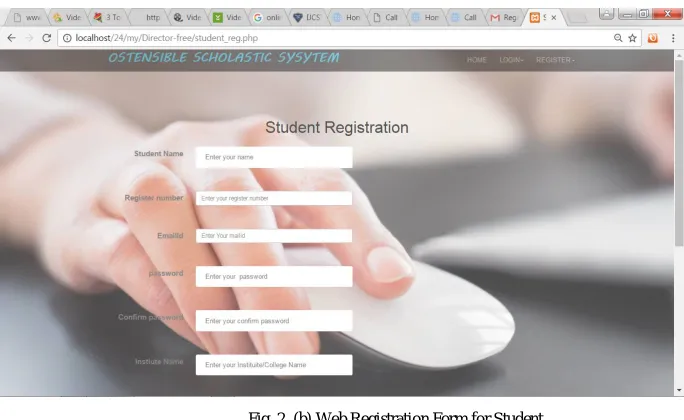
Fig. 2. (b) Web Registration Form for Student
Fig. 2. (b) is mainly used for the purpose of student registration. Each student must be registered. The registered student only allows to access this software.
2. Administrators:
Fig. 3. Administrators (add events)
Fig. 3. is used to add events. This event is added by the admin. An admin only can able to edit and delete these events. All the users can able to view these events. Events are look like the collage functions and holidays details.
3. Faculty:
Faculty can take lectures, uploads assignments task and question bank, announcements, send message, mail and other discussions in various formats as in the form of videos and power point presentations.
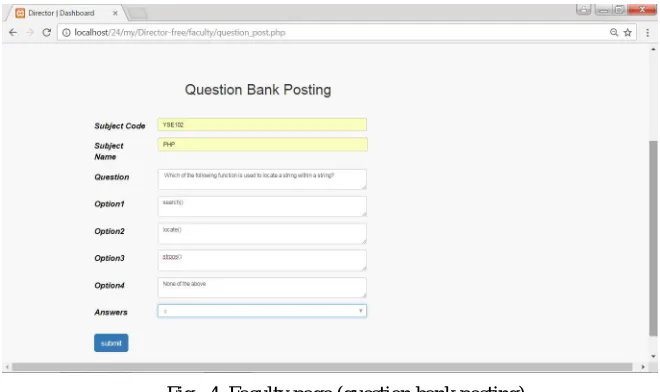
Fig. 4. Faculty page (question bank posting)
Fig. 4. is used to post the questions by faculty. The faculty can able to post the question for their subjects. Based on this question bank automatically generate the question papers.
4. Students:
Fig. 5. Student page (Assignment Upload)
Fig. 5. is used to upload assignment by student. The student can able to upload their assigned assignments only. They can able to apply doc, docx, ppt and pdf documents only.
5. Live chat and discussion:
Asynchronous communication in the form of emails, discussion boards, discussion that enable communication to occur at “convenient-times”.
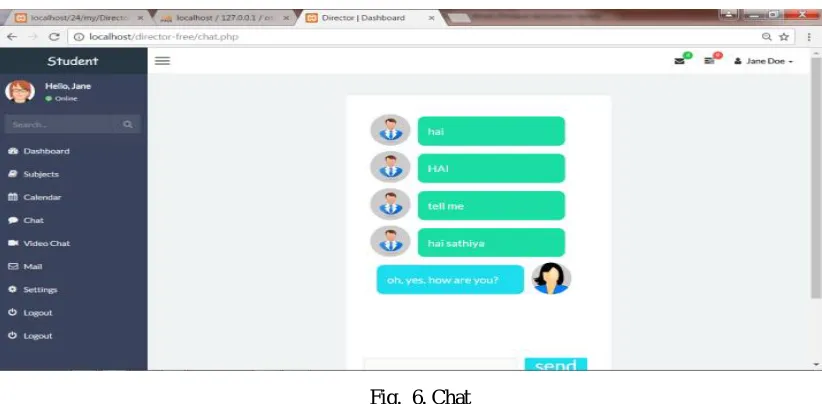
Fig. 6. Chat
Fig. 6. is maillly used for communication purpose. All user can interact ith each at anytime, any where. The User Can able to chat with who are all in their friend list.
6. Online Test:
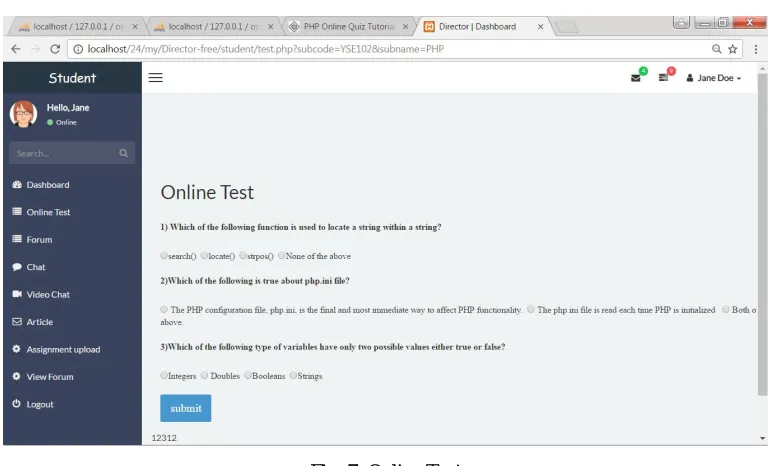
Fig. 7. Online Test
Fig. 7. is used for test purpose. This online test is very useful to evaluate the each student’s. This online test question papers are automatically generated from question bank given from faculty.
7. Reports:
Different kind of reports is generated by the system such as Student Progress report Request, Faculty performance report and attendance reports for the students.
Fig. 8. Test Report
C. MERITS :
• Accessed over the Internet.
• Forum discussion, live chat facility.
• Integrate all things (system) into one.
• Mobile friendly.
• Able to access it from anywhere at any time.
• Easily calculate the student and staff individual activities and performance. IV.CONCLUSION AND FUTURE WORK
Futuristic e-learning will probably involve technologies and platforms that derive from current trends. Through this system we assess our students can really make a difference to know how students learn. It provides an online collaborative platform for teaching and learning communities with the blend of social networking and E-learning. It provides all kind of facilitates for the next generation classroom. It ensures that decisions about assessment strategies are based on the best available evidence-based research on assessment, rather than on custom and practice or what is easy to do. So we need to keep abreast of new developments, evaluate tried and tested ones and experiment with our own initiatives, preferably within a supportive learning community of fellow practitioners. In most organizations, social learning and informal learning happens around eLearning experiences. There is great power in social polling, where learners can give their opinion or rate something, like a video, and then see what everyone else thinks. This enables learners to explore the gray spaces rather than the strict black and white or right and wrong spaces eLearning has often limited itself to in the past.
REFERENCES
1. Salomon, Gavriel., ”Individual and social aspects of learning: Review of research in education”, Washington, D.C.: American Educational Research Association. pp. 1–24, 1998.
2. McClanahan, Lorna., ”Training Using Technology in the Adult ESL Classroom”, Journal of Adult Education. 43 (1): 22–27,2014.
3. Reinhardt, Jonathon; Zander, Victoria., “Social Networking in an Intensive English Program Classroom: A Language Socialization Perspective”, CALICO Journal. 28 (2):326-344. JSTOR calicojournal.28.2.326, 2011.
4. Murray, Liam; Triona Hourigan., “Blogs for specific purposes:expressivist or socio-cognitivist”, ReCall. 20 (1): 82–97. doi:10.1017/s0958344008000719.2008. 5. Carney, Nathaniel., "Language study through blog exchanges", Education and Mobile Assisted Learning: 109–120.
6. Dieu, Barbara., “Blogs for language learning”, Essential Teacher. 1 (4): 26–30.2004
7. Thorne, Steven., ”Community, semiotic flows, and mediated contribution to activity”, Lang. Teach. 42 (1): 81–94. doi:10.1017/s0261444808005429.2009. 8. Wu, Hui-Ju; Pai-Lu Wu., “Learners' perceptions on the use of blogs for efl earning”, US-China Education Review A3: 323–330.2011.
9. Torne, Steven; Rebecca Black., “Language and literacy development in computer-mediated contexts and communities”, Annual Review of Applied Linguistics. 27: 1–28. doi:10.1017/s0267190508070074.2007.
10. Rankin, Yolanda; Rachel Gold; Bruce Gooch., ”Evaluating Interactive Gaming as a Language Learning Tool”, Proceedings of EuroGraphics. 25 (3).2006. 11. Rankin, Yolanda; Deidra Morrison; Mckenzie McNeal; Bruce Gooch; Marcus W. Shute., ”Time will tell: In-game social interactions that facilitate second language
acquisition”. Proceedings of the 4th international conference on foundations of digital games: 161–168.2009.
12. deHaan, Jonathan William., “Acquisition of japanese as a foreign language through a baseball video game”, Foreign Language Annals. 38 (2): 278– 282. doi:10.1111/j.1944-9720.2005.tb02492.x.2005.
13. Thorne, Steven., “Transcultural communication in open Internet environments and massively multiplayer online games”, Mediating Discourse: 305–327.2008. 14. Lam, Wan Shun Eva., “Second language socialization in a bilingual chat room: global and local considerations”, 8 (3).2004.
15. Thorne, Steven; Rebecca Black; Julia Sykes., “Second language use, socialization, and learning in internet interest communities and online gaming”, The Modern Language Journal. 93: 802–822. doi:10.1111/j.1540-4781.2009.00974.x.2009.
16. Wolfram, Alpha., “Livemocha Statistics”, Retrieved 19 July 2012.
BIOGRAPHY
K. Meena is an Assistant Professor in the Information Technology Department, Periyar Maniammai University, Thanjavur, Tamilnadu, India. She received Master of Engineering (M.E.,) degree in 2011 from PMU, Thanjavur, Tamilnadu, India. Her research interests are Multimedia, Big Data Analytics, Cloud Computing etc.