ISSN(Online): 2320-9801
ISSN (Print): 2320-9798
I
nternational
J
ournal of
I
nnovative
R
esearch in
C
omputer
and
C
ommunication
E
ngineering
(An ISO 3297: 2007 Certified Organization)
Vol. 4, Issue 2, February 2016
Headlight Intensity Control Methods
– A Review
Devashree Chilla1, Manasi Joshi 1, Sanjyot Kajale 1, Seema Deoghare2,
BE Student, Dept. of ENTC, Pimpri Chinchwad College of Engineering, Pune, Maharashtra, India1 Assistant Professor Dept. of ENTC, Pimpri Chinchwad College of Engineering, Pune, Maharashtra, India2
ABSTRACT: While driving vehicle on road during the night time, a clear perception of the road and traffic is obligatory. The probability of accidents has been increased considerably nowadays especially during night due to the heavy traffic and inappropriate night vision. In order to ensure safety of the drivers and passengers, various viable techniques can be employed in automobiles. A lighting control system establishes communication between various system inputs and outputs associated with lighting control with the help of central computing device. These systems impart right amount of luminance during night. The excessive headlight glare from the oncoming traffic deteriorates the eye sight of the driver resulting to temporary visual impair. To overcome this difficulty, an adaptive headlight intensity control system can be equipped in vehicles. This paper presents assorted effective methods to supervise the intensity of headlights.
KEYWORDS: Intensity Control, Fuzzy Logic, Wireless Sensor Network, Image Processing, Pulse Width Modulation.
I. INTRODUCTION
ISSN(Online): 2320-9801
ISSN (Print): 2320-9798
I
nternational
J
ournal of
I
nnovative
R
esearch in
C
omputer
and
C
ommunication
E
ngineering
(An ISO 3297: 2007 Certified Organization)
Vol. 4, Issue 2, February 2016
II. LDR BASED INTENSITY CONTROL
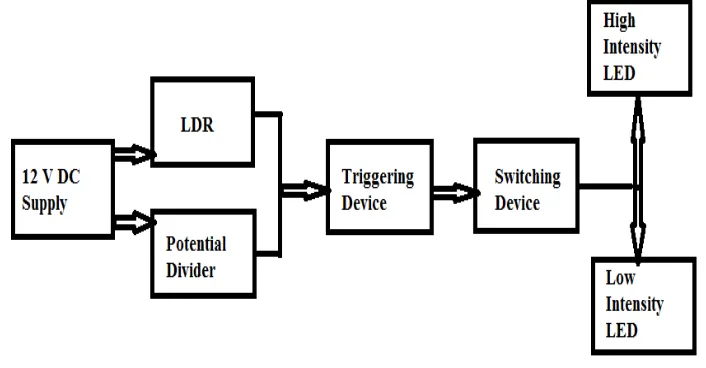
In this method, LDR is used to control the intensity of headlight. Block diagram of LDR based intensity control is as shown in Fig 1. Resistance value of LDR will vary according to intensity of light that is incident upon it. Potential divider consists of resistors which are used to control gate current given to triggering device. Transistors like BJT or MOSFET can be used as triggering device. Relay is used as switching device that has two contacts. Normally open contact is connected to low intensity LED of vehicle while normally closed contact is connected to high intensity LED. DC power supply of 12V is required, which is taken from vehicle’s battery. Two LED’s are taken, one is for high intensity light and other LED is for low intensity light as per the block diagram shown in fig. 1.
Fig 1. Block diagram of LDR based intensity control
LDR acts as a variable resistor. Current in circuit is decided by LDR and two resistors that form a potential divider. If the resistance of LDR changes due to light source, then transistor gets trigger pulse to its base/gate due to voltage imbalance in circuit. When high intensity light falls on LDR, its resistance reduces, thus it creates an unbalance in potential divider. Hence transistor gets trigger pulse. It gets into conduction mode and switches relay. Hence NO contact will be switched and NC contact will get disconnected. So vehicle’s headlight with high intensity (LED1) gets turned off and headlight with low intensity (LED2) gets turned on by relay. Thus as oncoming vehicle comes closer, intensity of that beam will increase and will switch out high beam light to low intensity. As it moves away, LDR will be turned away from moving vehicle. So the LDR resistance increases and bridge balances. There will be no trigger current and relay switches back to its normal position. This will again turn on bright beam LED in our vehicle.
III. FUZZY LOGIC BASED INTENSITY CONTROL
ISSN(Online): 2320-9801
ISSN (Print): 2320-9798
I
nternational
J
ournal of
I
nnovative
R
esearch in
C
omputer
and
C
ommunication
E
ngineering
(An ISO 3297: 2007 Certified Organization)
Vol. 4, Issue 2, February 2016
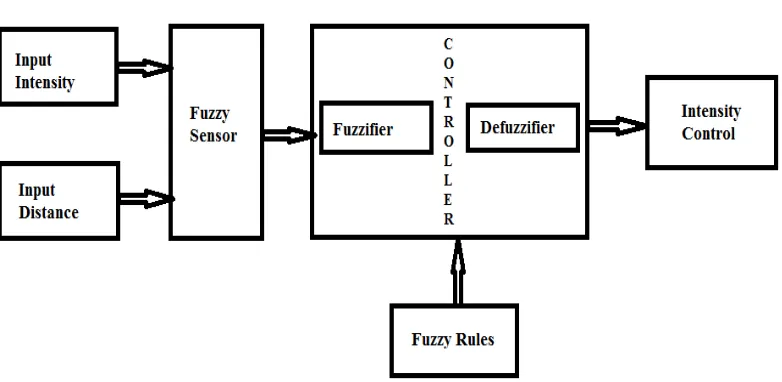
Fig 2. Block diagram of fuzzy logic based intensity control
Fuzzy inference process: It follows steps as shown:
Fuzzification of input variables
Defining membership function
Fuzzy inference
Defuzzification
Numerical value of input data is mapped to fuzzy sets using fuzzy linguistic variables, fuzzy linguistic terms, and membership function. Linguistic variable can be decomposed into set of linguistic terms. To fuzzify OI, D, I different linguistic variables are used.
Membership function:
It is used to map numerical input values to fuzzy linguistic terms and vice versa. After fuzzification is carried out, the next process is to define the membership functions in the fuzzy sets for the input and output parameters. The Triangular membership function is used for constructing the fuzzy sets. Triangular membership function is calculated for all fuzzy sets of input parameters and sensor output
Fuzzy rule:
To control output variable rule, base is constructed. Fuzzy rule is simple IF-THEN rule with condition and conclusion. Fuzzy input values are processed using fuzzy rule set. In order to construct fuzzy rule, we construct rule matrix and rule bases. Row and column of rule matrix contains values of input distance (D) and input intensity (I) respectively. And each cell is resulting command when input variables take values in that row and column.
IV.WIRELESS SENSOR NETWORK
ISSN(Online): 2320-9801
ISSN (Print): 2320-9798
I
nternational
J
ournal of
I
nnovative
R
esearch in
C
omputer
and
C
ommunication
E
ngineering
(An ISO 3297: 2007 Certified Organization)
Vol. 4, Issue 2, February 2016
Fig 3. Architecture of Wireless Sensor Network
As shown in Fig. 3, the WSN consists of a Sensor Network, Transmit Network and a Base Station. Sensor Network includes assorted sensor nodes, also called as detection stations. These sensor nodes are competent to communicate within them as well as with the gateway. Sensor Nodes are adept of effectuating some processing, collect the sensory information and communicate with other nodes in the network. Gateway is an interconnecting system capable of welding together two networks having different base protocols. Transmit network serves the purpose of consigning and propagating analog or digital information. The transmission media can be wired or wireless and the transmission may be point to point or point to multipoint. The transmitted information reaches the base station and is stored in data store. The transmitted and received information is sent to or from the base station.
ISSN(Online): 2320-9801
ISSN (Print): 2320-9798
I
nternational
J
ournal of
I
nnovative
R
esearch in
C
omputer
and
C
ommunication
E
ngineering
(An ISO 3297: 2007 Certified Organization)
Vol. 4, Issue 2, February 2016
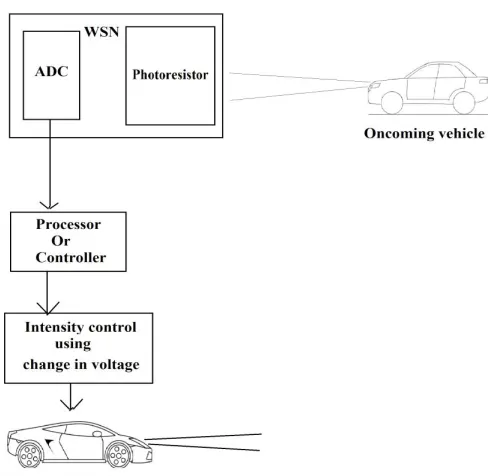
As per Fig. 4, the detection nodes are equipped with a photo resistor which is interfaced with analog to digital converter. When a vehicle is approaching, its headlight strength is apprehended by the sensor node. The collected information is then processed and transformed into required digital information. This information is transmitted to the base station which may be a processor or controller using wired or wireless media.
To stabilize the luminance and avoid the temporary blindness we need to adjust the strength of the light emitted by the headlamp of our car. A mileage for exemplary luminance is set up in the controller. The apprehended light strength is compared with the threshold value set for required equilibrium. The controller regulates the intensity by alteration in the voltage reaching to the headlight. The process is replicated until the craved value of the light is attained.
V. IR TRANSMITTER-RECEIVER
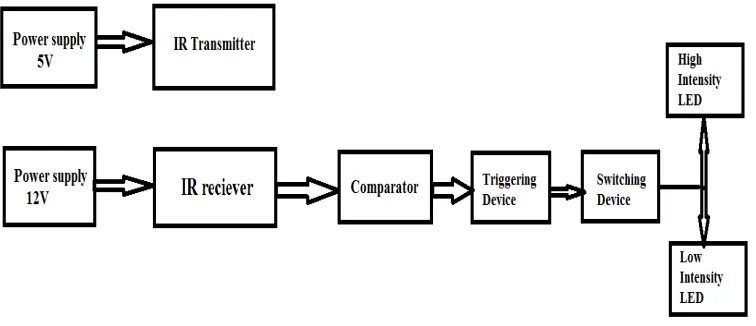
The IR transmitter consists of the LED that emits the IR (Infrared) radiation. This is received by the photo diode, which acts as IR receiver at the receiving end. Since the IR radiation is invisible to human eye it is perfect for using in wireless communication. Block diagram for Headlight intensity control using IR sensor is shown in the Fig 5.
Fig 5. Intensity control using IR transmitter receiver
As shown in Fig. 5, power supply is equipped to deliver the power to IR transmitting and receiving circuit. Transmitting circuit requires 5V for operation and the circuit equipped for receiving requires 12V. Transmitting device emits IR rays which are reflected back to receiving end. On reception of IR rays the receiving device turns on. An input voltage is generated at the receiver which is given to a comparator. Comparator is used to compare the received voltage with a predefined threshold value of voltage. According to the signal generated by the comparator the triggering device turns on or off. Triggering device can be a transistor or a MOSFET. Switching device i.e. Relay depends on the turning on and off of the triggering device. If the triggering device turns on then the switching device switches to the low intensity LEDs and when the transistor turns off the switch points towards the high intensity LEDs. In this way the headlight intensity is controlled using the IR transmitter and receiver.
VI. CAMERA BASED INTENSITY CONTROL SYSTEM
ISSN(Online): 2320-9801
ISSN (Print): 2320-9798
I
nternational
J
ournal of
I
nnovative
R
esearch in
C
omputer
and
C
ommunication
E
ngineering
(An ISO 3297: 2007 Certified Organization)
Vol. 4, Issue 2, February 2016
Fig 6. Block diagram of camera based intensity control
A monochrome or colour camera is installed in the vehicle The camera captures the images of approaching vehicles as well as vehicles coming from opposite side. The camera is basically of sensor type which can sense black and white as well as colour pictures. The lenses used are of 4.3mm focal length because they are compatible with human vision. From the Fig.6 we can see that the images undergo various image processing techniques where information about the nearby vehicles is obtained. This results in extracting the features from the images taken.
After extracting the needed information, the system analyses the level of intensity of the image taken. The headlight intensity should be switched from high level to low level and vice versa as per the image characteristics. A high level intensity light can be used especially during night time and when there are no vehicles surrounding. Whereas when the numbers of vehicles are more high intensity headlights can cause vision problem to drivers hence at that time low level light beams are activated. So as per the intensity parameters captured by the camera, a light beam controller act as an intensity control system and maintains the appropriate level of light emitted from the headlights. So in this manner we can control the intensity of headlight using a camera and image processing techniques.
VII. PWM BASED INTENSITY CONTROL SYSTEM
ISSN(Online): 2320-9801
ISSN (Print): 2320-9798
I
nternational
J
ournal of
I
nnovative
R
esearch in
C
omputer
and
C
ommunication
E
ngineering
(An ISO 3297: 2007 Certified Organization)
Vol. 4, Issue 2, February 2016
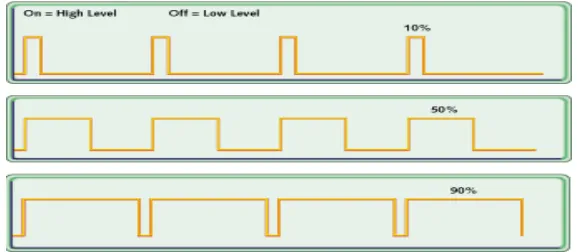
Pulse width modulation is a technique used for controlling the analog circuits with the help of a microcontroller. The signal remains digital throughout the processor to controlled system hence noise does not affect much as its effect is appreciable only when the noise is strong enough to change the logic 1 to logic 0 and vice versa. PWM provides increased noise immunity over the analog control methods, hence it is used in most of the applications nowadays.
The light intensity which is emitted by the headlights can be controlled by adjusting the power which is delivered to it. The PWM technique provides varying power to these headlights by taking into consideration the outputs of the microcontroller. As per the duty cycle of the PWM, the power is delivered to headlights and they glow accordingly. For example, if the duty cycle of PWM is 50 % then headlights will appear as half bright. The most important factor here is the pulse width. The gradual on and off of the headlights will cause their flashing to become dimmer and not with a constant focused light beam. The PWM resolution also plays an important role as it decides the accuracy with which we can control the duty cycle of the PWM. The high resolution PWM can give better results in terms of brightness. Also, the microcontroller actions should be as faster as possible which would enhance the immediate actions taken for controlling the intensity of headlights. So in this manner we can control the intensity of headlights of vehicle by using PWM technique along with a microcontroller.
VIII. CONCLUSION
In this paper, we have emphasized on various methods and techniques that can prove beneficial in monitoring the headlight intensity of vehicles. The light intensity parameter should be within the human vision comfort zone so as to avoid blind spot to the driver at night and to be less prone to accidents usually occurring due to excess glare of headlamps. If such methods are implemented by manufacturers the device will automatically switch to low beam from high beam as per the headlight intensity of approaching vehicle.
REFERENCES
1. Muralikrishnan.R, “Automatic Headlight Dimmer A Prototype For Vehicles”, IJRET: International Journal of Research in Engineering and
Technology, Volume: 03 Issue: 02, Feb-2014.
2. Mrs. Niraimathi.S, Dr.Arthanairee A. M, Mr.M. Sivakumar, “A Software and a Hardware Interface for Reducing the Intensity Uncertainties
Emitted by Vehicular Headlight on Highways”, IJITCE: International Journal Of Innovative Technology & Creative Engineering, Vol.1 No.11 November 2011.
3. Victor Nutt, Shubhalaxmi Kher, “Headlight Intensity Controller Design using Wireless Sensors (HIC-WSN)”, Special Issue of International
Journal of Computer Applications (0975 – 8887) on Issues and Challenges in Networking, Intelligence and Computing Technologies – ICNICT 2012, November 2012
4. A.S.M Asaduzzaman, Mohammad Mahmudul Islam, Shuva Paul, Md Farhat Alam, Md Mashuker Rahman, “Automatic High Beam Controller
for Vehicles”, IJSER International Journal of Scientific & Engineering Research Volume 4, Issue3, March-2013.
5. P. F. Alcantarilla · L. M. Bergasa · P. Jiménez ·I. Parra · D. F. Llorca · M. A. Sotelo · S. S. Mayoral, “Automatic LightBeam Controller for driver assistanc Machine” Vision and Applications, Received: 25 May 2009 / Revised: 26 November 2010 / Accepted: 10 February 2011.
6. http://www.embedded.com/electronics-blogs/beginner-s-corner/4023833/Introduction-to-Pulse-Width-Modulation