University of Windsor University of Windsor
Scholarship at UWindsor
Scholarship at UWindsor
Electronic Theses and Dissertations Theses, Dissertations, and Major Papers
2018
Performance Evaluation of Weighted Greedy Algorithm in
Performance Evaluation of Weighted Greedy Algorithm in
Resource Management
Resource Management
Harjeet Singh
University of Windsor
Follow this and additional works at: https://scholar.uwindsor.ca/etd
Recommended Citation Recommended Citation
Singh, Harjeet, "Performance Evaluation of Weighted Greedy Algorithm in Resource Management" (2018). Electronic Theses and Dissertations. 7397.
https://scholar.uwindsor.ca/etd/7397
This online database contains the full-text of PhD dissertations and Masters’ theses of University of Windsor students from 1954 forward. These documents are made available for personal study and research purposes only, in accordance with the Canadian Copyright Act and the Creative Commons license—CC BY-NC-ND (Attribution, Non-Commercial, No Derivative Works). Under this license, works must always be attributed to the copyright holder (original author), cannot be used for any commercial purposes, and may not be altered. Any other use would require the permission of the copyright holder. Students may inquire about withdrawing their dissertation and/or thesis from this database. For additional inquiries, please contact the repository administrator via email
Performance Evaluation of Weighted Greedy
Algorithm in Resource Management
By
Harjeet Singh
A Thesis
Submitted to the Faculty of Graduate Studies through the School of Computer Science in Partial Fulfillment of the Requirements for
the Degree of Master of Science at at the University of Windsor
Windsor, Ontario, Canada
2018
Performance Evaluation of Weighted Greedy
Algorithm in Resource Management
by
Harjeet Singh
APPROVED BY:
H. Wu
Department of Electrical and Computer Engineering
J. Lu
School of Computer Science
J. Chen, Advisor School of Computer Science
DECLARATION OF ORIGINALITY
I hereby certify that I am the sole author of this thesis and that no part of
this thesis has been published or submitted for publication.
I certify that, to the best of my knowledge, my thesis does not infringe
upon anyone’s copyright nor violate any proprietary rights and that any ideas,
techniques, quotations, or any other material from the work of other people
included in my thesis, published or otherwise, are fully acknowledged in
accordance with the standard referencing practices. Furthermore, to the extent that
I have included copyrighted material that surpasses the bounds of fair dealing
within the meaning of the Canada Copyright Act, I certify that I have obtained a
written permission from the copyright owner(s) to include such material(s) in my
thesis and have included copies of such copyright clearances to my appendix.
I declare that this is a true copy of my thesis, including any final revisions,
as approved by my thesis committee and the Graduate Studies office and that this
thesis has not been submitted for a higher degree to any other University or
ABSTRACT
Set covering is a well-studied classical problem with many applications across
different fields. More recent work on this problem has taken into account the
parallel computing architecture, the datasets at scale, the properties of the datasets,
etc. Within the context of web crawling where the data follow the lognormal
distribution, a weighted greedy algorithm has been proposed in the literature and
demonstrated to outperform the traditional one. In the present work, we evaluate
the performance of the weighted greedy algorithm using an open-source dataset in
the context of resource management. The data are sampled from a given roadmap
with 1.9 millions of nodes. Our research includes three different cost definitions
i.e. location cost, driving cost and infrastructure cost. We also consider the
different coverage radius to model possible parameters in the application. Our
experiment results show that weighted greedy algorithm outperforms the greedy
DEDICATION
Dedicated to my parents Jaswant Singh and Paramjeet Kaur
ACKNOWLEDGEMENTS
I would like first like to thank my thesis advisor Dr. Jessica Chen for her valuable
guidance and continuous support during my research. She always steered me in the
right direction, and this work would not have been accomplished without her help.
I would also like to thank my thesis committee members Dr. Huapeng Wu and Dr.
Jianguo Lu for their valuable comments and professional assistance.
I would also like to thank Karen Bourdeau and the entire faculty of School
of Computer Science for their continuous support throughout the program. I would
like to express my profound gratitude to my parents and family members who were
the motivation and strength behind this work. Finally, I want to thank every one of
my friends who remained by amid great and awful circumstances.
TABLE OF CONTENTS
DECLARATION OF ORIGINALITY ... iii
ABSTRACT ... iv
DEDICATION ... v
ACKNOWLEDGEMENTS ... vi
LIST OF TABLES ... x
LIST OF FIGURES ...xi
LIST OF ABBREVIATIONS/SYMBOLS ... xii
CHAPTER 1 INTRODUCTION ... 1
1.1 Overview ... 1
1.1.1 Set Covering Problem and Its Applications ... 1
1.2Motivation ... 2
1.3Problem Statement ... 4
1.4Thesis Organization... 4
CHAPTER 2 REVIEW ... 5
2.1Dataset ... 5
2.2Matrix ... 6
2.3Coefficient of Variation ... 7
2.4Sampling... 7
2.5Set Covering Algorithms ... 10
2.6Literature Review ... 13
2.6.1 Deep Web Crawling Using a New Set Covering Algorithm ... 13
2.6.1.1 Hidden Web or Deep Web ... 13
2.6.1.2 Deep Web Crawling ... 14
2.6.1.3 Query Selection ... 14
2.7Set Cover Algorithms for Very Large Datasets ... 18
2.8Set Covering in Locating Facilities ... 22
CHAPTER 3 PROPOSED APPROACH AND EXPERIMENTAL SETUP ... 25
3.1Introduction ... 25
3.2Greedy Algorithm ... 25
3.3Weighted Greedy Algorithm ... 28
3.4Roadmap... 30
3.5Setup Procedure... 30
3.5.1Raw Dataset ... 31
3.5.2Connected Subgraph ... 32
3.5.3Coverage Graph ... 33
3.5.4Calculation of Coefficient of Variance ... 34
3.5.5Comparison of Greedy and weighted Greedy Algorithm ... 35
3.6An Illustrative Example ... 36
3.7.2 iGraph Library ... 42
3.7.3 R Studio ... 42
CHAPTER 4 EXPERIMENTATION AND RESULTS ... 43
4.1Data ... 43
4.2Cost Definition ... 46
4.3Results ... 47
4. 4 Impact of data distribution ... 49
CHAPTER 5 CONCLUSION & FUTURE WORK ... 54
5.1Conclusion ... 54
5.2Future Work ... 55
REFERENCES/BIBLIOGRAPHY ... 56
LIST OF TABLES
Table 2.1 The Input Matrix for Set Covering Matrix 15
Table 2.2 The initial table with weights based on Table 1 16
Table 2.3 Second round weighted matrix 17
Table 2.4 Results for the weighted greedy method 17
Table 3.1 Sample matrix of road network for greedy algorithm 27
Table 3.2 Sample matrix of road network for weighted greedy algorithm 29
Table 3.3 A 10-node connected subgraph 36
Table 3.4 01 Matrix of the Subgrap 37
Table 3.5 Matrix after division of node weights and calculation of nf, nw,
nf/nw
38
Table 3.6 Matrix after selection of the first node 38
Table 3.7 Matrix after second round 39
Table 3.8 Matrix after the third round 39
Table 3.9 Solution table for Weighted Greedy algorithm 39
Table 3.10 Matrix at the starting point for greedy algorithm 40
Table 3.11 Matrix after first round of greedy 40
Table 3.12 Solution table for greedy algorithm 41
Table 4.1 The properties of over data source under two types of data one 45
Table 4.2
with coverage radius 1 and other with variable coverage radius
Performance Improvement of Weighted greedy over greedy 47
algorithm regarding solution nodes in three different cost
definition scenarios
LIST OF FIGURES
Figure 2.1 A dataset representing connected nodes of a roadmap 5
Figure 2.2 Example of a Matrix 6
Figure 2.3 A Network Graph 6
Figure 2.4 An adjacency matrix for the above network graph 6
Figure 2.5 Sample input data 20
Figure 2.6 Inverted Index of Fig 1 20
Figure 2.7 Execution of algorithm by Graham. Et al. on sample data in fig 1 21
Figure 3.1 A Sample Graph 25
Figure 3.2 Flow of the approach 31
Figure 3.3 A 10-node connected subgraph 32
Figure 3.4 Coverage Matrix with coverage value 1 33
Figure 3.5 Connected Subgraph plot view 37
Figure 4.1 Distribution of node coverage degree in Coverage Radius 7 44
Figure 4.2 Distribution of node coverage degree in Coverage Radius 10 44
Figure 4.3 Distribution of node coverage degree in Coverage Radius 15 45
Figure 4.4 Cost difference of solution nodes under Driving Cost 48
Figure 4.5 Cost difference of solution nodes under Infrastructure Cost 48
Figure 4.6 Cost difference of solution nodes under Location Cost 49
Figure 4.7 Relationship between CV and improvement on Infrastructure
Cost regional maps
51
Figure 4.8 Relationship between CV and improvement on Location Cost 51
regional maps
Figure 4.9 Relationship between CV and improvement on Driving Cost 52
LIST OF ABBREVIATIONS/SYMBOLS
SNAP- Stanford Network Analysis Project
CV- Coefficient of Variation
P2P- Peer to Peer
RE- Random Edge
RNE- Random Node-Edge
SCP- Set Covering Problem
DF- Document Frequency
QW- Query Weight
MCLP- Maximal Set Covering Problem
NCD- Node Coverage Degree
NNF- New Nodes Fetched
NW- Node Weight
CHAPTER 1
INTRODUCTION
1.1
Overview
One of the most common problems today is the planning. Planning includes making
plans about where to build new facilities in a city, how to allocate the resources and how
to use the resources optimally. Solutions to these problems exist with many techniques,
and one of them being the solution to the set covering problem. Finding the smallest set
of solutions of a problem from many sets of solutions is widely researched in many
fields. A set covering problem is presented as an abstract problem, so it captures many
different scenarios in the context of knowledge mining, data management, etc. [1].
1.1.1 Set Covering Problem and Its Applications
Set covering is a classical problem in the field of computer science. It is one of the
Karp’s 21 NP-complete problems. This problem is a base for the entire field of
approximation algorithms. Set covering is considered NP-Hard in optimization and
search problems and NP-Complete in decision-based problems.
Set Covering is to select a minimum number of subsets in such a way that they
contain all the elements from a fixed universe [2]. The most significant factor considered
in this process is to minimize the cost of the selected subsets. There are various
applications of set covering. Some of them are as follows [1].
Operational Research: - The operational research problem is to locate a facility in such
a way that specific sites can reach it. This problem can be solved using set covering
Machine Learning: - In machine learning, items are classified based on examples that
cover them. The final goal is to make sure that all items are covered by some example,
which is an instance of Set Covering problem.
Planning: - In planning, set covering can be applied to allocate resources when demands
vary over time. To cover the requirements for planning, variations of set covering are
used [3].
Data Mining: - Set covering can be applied to find the minimal explanations for the
patterns in the data. In data mining, the goal is to find a set of features in such a way that
every example is a positive example of these features. It can be viewed an instance of set
cover problem where each set contains some examples which correspond to a feature.
Information Retrieval: - In Information Retrieval, the goal is to find the smallest set of
documents that cover the topics in a query. It leads to an instance of set cover where a set
of documents is required in response to a query[4].
1.2
Motivation
In this world, if we want to complete any task we need some resources. Everything and
everyone need resources to complete its functioning whether a human being or a
machine. Management of these resources is a problem which needs to be studied to get
the best use of these resources that we have and to use them for a more extended period.
When we think of resource management in the field of planning, there are various
problems which need to be addressed.
In strategic planning for big firms whether private or public, facility location is a
Operational Research is a well-established area in itself [32]. There are various models in
this area to help with the decision-making process, and one of the most popular areas in
those models is facility location model in covering problem. The concept of covering
comes from its applications in daily life. Some of the problems are to determine the
number and the location of public facilities like schools, libraries, hospitals, parks, fire
stations and various other places.
Another major factor of studying in this area is the need to plan things properly. The
rapid growth of population concerning some available resources has forced us to think of
solutions to provide resources to people in such a way that demand can be managed in the
best possible way. One daily life application of this is the placement of fire stations in a
city in such a way that those fire stations can cover the entire area of the city and that the
number of those stations is minimized to reduce the operational cost and initial
investment in the infrastructure.
Another part that motivated this thesis work is set covering problem. It is a part of Karp’s
Np-complete problems, a base of approximation algorithms, that had led to the
development of various fundamental techniques in this field. The usefulness of set cover
problem has been seen at many places of the exciting application.
The weighted greedy algorithm by Wang et al. [16] is a good variation of greedy
approach for web crawling but hasn’t been tested on any other type of set covering
problem. The use of this solution within the field of resource management might give
1.3
Problem Statement
As the world is dealing with the shortage of resource, there arises a need to either get
more resources or to manage those resources appropriately. Study on set covering has
provided many useful results for planning and resource management problems.
A weighted greedy algorithm for set covering problem has been proposed by Wang
et.al.[16] within the context of web crawling and demonstrated to outperform the
traditional greedy algorithm. In our present work, we evaluate the performance of the
weighted greedy algorithm using open-source datasets in the context of resource
management. It includes the setting of resource allocation on a sample taken from a
roadmap with 1.9 million of nodes. The dataset is taken from open source data provided
by Stanford Network Analysis Project (SNAP)[35].
1.4
Thesis Organization
The rest of this thesis is organized as follows: Chapter 2 provides a review of some of the
concepts and terminologies that are related to this work and provides more details of the
areas related to this research. It also includes a review of some of the closely related work
of other researchers. In Chapter 3, we define the problem and present the proposed
approach. Chapter 4 shows the results of experiments and Chapter 5 concludes the thesis
CHAPTER 2
REVIEW
2.1
Dataset
A dataset is a collection of data most commonly corresponding to a database table or
matrix where rows and columns define some values. They are large in size and might not
be well organized like a database. Most of the times a data set is a collection of data
under some experiment. For example:- Temperature data gathered by a probe for every
half an hour for one month.
Fig 2.1: A dataset representing connected nodes of a roadmap
In the above, the dataset for connection among nodes is represented. There are various
ways to represent a dataset. It can be a numeric matrix, adjacency matrix or a table with
2.2
Matrix
A two-dimensional array of numbers arranged in rows and columns is called a matrix.
The size of a matrix is determined by its number of rows and columns. Usually, rows are
listed first and the columns second. Let’s say if a matrix is said to be 3 * 4 then it has
three rows and four columns.
Fig 2.2: Example of a Matrix
Various operations can be performed on a matrix like Addition, Scalar Multiplication,
and Transposition, etc. There are various types of matrix used in various applications. For
example, in Graph Theory, the transpose matrix is used to represent the connection
among nodes.
Fig 2.3: A Network Graph
1 1 0 1 0 1 0 1 0
2.3
Coefficient of Variation
The coefficient of variation (CV) is a measure of relative variability. It is the ratio of the
standard deviation to the mean and is also known as a relative standard deviation. Its
most common use is in the field of engineering and physics for quality assurance studies.
The biggest advantage of the coefficient of variance is that it is unitless. It is used to
represent the consistency of the data. Here consistency means the uniformity of data
distribution. We can also use it to compare two datasets or samples. The coefficient of
variation is also denoted by CV:
�
(2.1)
Here S stands for standard deviation and X stands for a mean of the sample. The use of
CV is limited to some conditions. For example, it should be computed only for data
measured on a ratio scale and only for non-negative values. It cannot be used for data on
an interval scale.
There are some disadvantages when we use CV under certain conditions. For example
Coefficient of Variation will reach infinity, if the mean is close to zero and it is sensitive
to small change in the mean.
2.4
Sampling
The first thing comes to mind when one tries to perform some experiment on big data is
how to handle big data or how to perform tests on such a big size of data. The technique
most commonly used is sampling. A small subset of original data is taken out to perform
the tests, and it is assumed if the experiment is right in a sample then it should also
perform well on the original data.
Why reduce data?
i.It is not always possible to store all the data.
ii.It is too resource consuming to work with big data.
iii.It is faster to work with a smaller amount of data.
Why Sample?
There are several reasons why we use sampling approach rather than applying direct
experimentation on original data. Some of the reasons are:
i.Estimation on a sample is easier and more straightforward.
ii.It is easy to understand.
iii.Sampling is general and is independent of the analysis to be done.
How to take a sample of original data?
Now the question arises how to take a sample. For that, there are various sampling
algorithms available. Some mostly used are as follow:
Random Walk:- First we pick a random node and then start a random walk on the graph
[5]. The next node is selected with a certain probability, the probability by which vertices
and edges are sampled [6]. If the random walk is struck at some point, it gets back to a
Sampling by random node selection:- In random node selection, starting node is
selected randomly, and then the next node is selected based on the probability of the node
being selected. This probability could be either proportional to the page rank weight [5]
of the node, or proportional to a degree of a node, i.e., with how many nodes it is
connected. It can be used in peer to peer (P2P) networks like Bit torrent [6].
Sampling by random edge selection:- This is similar to node selection, while edges are
randomly selected. It is known as Random Edge (RE) Sampling. The only difference in
this one compared to random node selection is that we select edge rather than nodes. A
variation of this model is Random Node-Edge (RNE) sampling, in which, first at random,
a node is selected and then uniformly at random, an edge corresponding to the node is
selected [5].
Forest Fire Model [8]:- In this model, we pick a random seed node and then begin
burning outgoing links and corresponding nodes. Once a node is burned, the node at the
other end has a chance to burn its link which will continue recursively. For example, a
new graduate student arrives at a university and gets acquaintance with some senior
students from his department. Those students introduce him to their friends, and those
friends may introduce him to their friends which make it a recursive process. This
process needs two parameters: a forward burning probability, and a backward burning
ratio.
Snowball Sampling Approach [7]:- A snowball sampling approach is something similar
and it can also be carried out without the probability, using a deterministic approach. As
the name suggests, it starts with a random node and then grows like a snowball by
collecting all the corresponding nodes to that random node and continues.
2.5
Set Covering Algorithms
For set covering algorithms, we first need to know what set covering problem is and what
the desired solutions are.
The Set Covering Problem is where we have a given set of elements (A finite universe)
M = {e1, e2, . . . , em} and a set of subsets of M, X = {S1, S2, . . . , Sn}. Each subset has
a non-negative cost Ci. We have to find a union of subsets U{Si} which has minimum
Cost (C) and contains all the elements of M.
The formal definition of set covering is:
I ⊆ {S1, S2, . . . , Sn} that minimizes ∑ (i∈I)Ci and guarantees ⋃(i∈I)Si=M
Set covering problem is also defined on the 0-1 matrix by Carpara and Toth [9]:
Let A=(aij) be a 0-1 m x n matrix, and c= (cj) be an n-dimensional integer vector. The
value cj (j ∈ N) represents the cost of column j, assuming that cj > 0 for j ∈ N. j ∈ N
covers a row i ∈ M if aij=1. SCP calls for a minimum-cost subset S of columns, such that
each row i ∈ M is covered by at least one column j ∈ S. A natural mathematical model
for SCP is
v(SCP)= min∑∈N CjXj (2.2)
∑∈N AijXj ≥ 1 , for all i ∈ M, (2.3)
xj∈ {0,1}, j ∈ N (2.4)
Here Equation (2) makes sure that each row is covered by at least one column and
Equation (3) is the integrality constraint [2].
The set covering problem is an NP-Hard problem, and there are many algorithms
to solve it. There are two ways to solve this problem: exact algorithms and heuristic
algorithms. The exact algorithms are mostly based on branch and bound and branch and
cut [12]. The Best exact algorithm for the SCP is CPLEX [14]. Greedy algorithms may
be the best fit to solve the significant combinatorial problems quickly. A greedy
algorithm is discussed in more detail below.
2.5.1 Greedy Algorithms for Set Covering Problem
Greedy algorithms are a type of heuristic algorithms. There are various reasons why they
are used so much. According to [11,15], greedy set cover algorithms are best known
polynomial-time approximation algorithms for set cover. They are easy to implement,
and that is why they are most commonly used heuristic algorithms.
Classical Greedy Algorithm:- This is the most basic greedy algorithm. It selects the set at
each step which contains the largest number of uncovered elements. The process
continues until all the elements are covered. Let (X, F) be an instance of set covering
is the solution which is initially empty, and S is a single subset. Then the Greedy
Algorithm will work like this:
Greedy Set Cover (X, F)
1 U <- X
2 C <- Ø
3 While U≠ 0 do
A.
Select an S
∈
F that maximizes |S ∩ U|
B.
U <- U - S
C. C <- C U {S}
4 return C
Example: Let X = { a, b, c, d, e, f, g, h, i, j} be a universe and F = {{a, b, c, d, e, f}, {a, b,
c, g, h}, {d, e, f, i, j}, {g, h, i}, {j}} and let labels for these subsets be S1,S2,S3,S4,S5
respectively. Initially, C is empty. In the first step, the greedy algorithm will select S1 =
{a, b, c, d, e, f} because coverage of this subset is better than all other subsets. Now
solution set is C = {{a, b, c, d, e, f}}.
In the second step, S4 has the most substantial number of uncovered elements {g, h, i},
i.e., the greedy algorithm will choose S4 and now solution set C = {{a, b, c, d, e, f}, {g,
h, i}}.
In the third step, S2 has one uncovered element {j} and S5 has one uncovered element
{j}. Either one of them can be selected. Let us selected S5, so now the solution set will
the final solution set. The greedy algorithm might not give optimal solution every time,
but the result is most of the time good enough. Considering the simple implementation, it
is worth using it.
There are many variations of Greedy algorithms people use according to their needs, for
example, weighted greedy algorithm. In this type of greedy algorithm, weight is assigned
to every node which tells the importance of the node, and by how many nodes it is
covered. In this situation, we can select a different strategy. For example, if a single node
is covered by many nodes then we can say that this node can be added to result later and
we try to get the least covered node into the result first. There are many other ways to
modify greedy algorithm according to the needs.
2.6
Literature Review
2.6.1
Deep Web Crawling Using a New Set Covering Algorithm
In this paper [16], the authors described a new set covering algorithm for crawling in the
deep web. To understand the concepts of this paper, first, we need to know hidden web,
web crawling, and query selection. We give a brief explanation of these.
2.6.1.1
Hidden Web or Deep Web
A deep web is referred to as a web-generated from the file system and database and
cannot be accessed by URL directly. It is often guarded by search interfaces. Most of the
people depend on search engines like Yahoo, Google, etc. to find information on the web
but these web search engines only search the surface web. It is estimated that deep web is
nearly 550 billion documents which are up to 2,000 times greater than surface web.
Hidden Web has more focused content than Surface Web entities.
2.6.1.2
Deep Web Crawling
Fetching the information from the hidden web is termed as deep web crawling. A query is
issued which contains some keywords, and with those keywords in the query, we crawl
the data from the hidden web. For crawling the deep web, crawlers are used which is a
GUI based interface between the web and the user. Hidden Web Crawlers search the
hidden website using the given query, and then they give back the results based on the
query.
2.6.1.3
Query Selection
It is the process of selecting queries that can cover a maximum number of documents in a
corpus. It is an essential step because if the format of a query is not proper, it may give an
empty result [18]. According to [17], one should also consider the cost of the query
because sometimes some queries might give good results but at the stake of a significant
query cost which is not acceptable.
Now that we know some basics about web crawling let's get back to the paper by Wang
et al. [16]. In this paper, the authors used set covering with greedy and weighted greedy
algorithm for the deep web crawling. The primary task is to select a proper set of queries
to minimize the total cost of mapping selected queries into the original database.
They created a four-step framework for deep web crawling:
ii.Create a query pool, i.e., a set of queries based on sampleDB.
iii.By using sampleDB and query pool, select a proper set of queries.
iv.Map those selected queries to the original database.
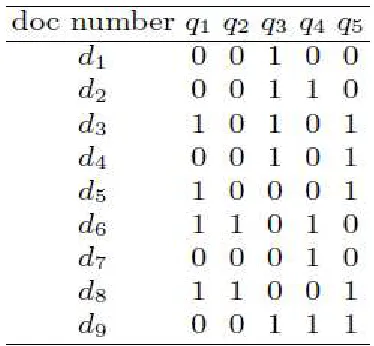
For example, Table 2.1 shows an input matrix for the set covering algorithm. Here {d1,
d2, ..., d9} represents documents of a sample database. {q1, q2, ...., q5} represent
queries. Let this table be a sample from the original database. Suppose that we run the
algorithm on a sample rather than directly on the corpus. Queries selected from a sample
database can also perform on the original data source as well [21].
Table 2.1: The Input Matrix for Set Covering Matrix
According to a simple greedy algorithm for unit cost, next query q is the one
which covers the maximum number of new documents. Here the authors are using a
weighted greedy algorithm. Therefore, they add weights to the documents. It will help to
cover small documents first because they can be matched with few queries. Smaller
According to greedy strategy, queries QJ with larger query weight (qw) are preferred. A
large qw should be obtained by a small number of documents. In other words, queries
with smaller df/qw are preferred. Therefore weighted greedy algorithm will choose next
query with smaller df/qw.
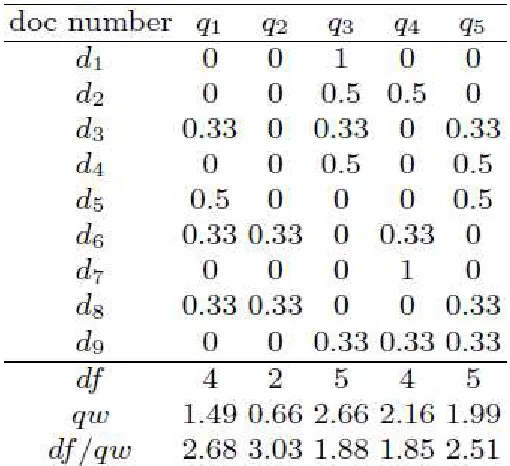
For example Table 2 shows the weights based on Table 1. At the bottom of the
table, document frequencies and query weights are listed. Here the smallest value for
df/qw is 1.85 for q4. q4 is selected, and documents covered by that query are removed
from the matrix. See Table 3 for the matrix in the second round.
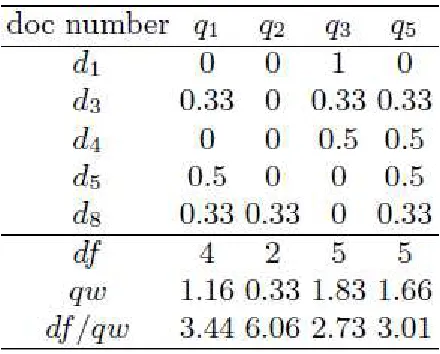
Table 2.3: Second round weighted matrix
See Table 2.3 now, it has only four queries and five documents left. The process
continues until all the documents are removed from the matrix. Table 4 shows the final
results of the weighted greedy method. Here q4, q3, q1 are selected in the first, second
and third round respectively.
Table 2.4: Results of the weighted greedy method.
Here the cost is how many total documents can a query fetch. The unique rows column is
how many total unique documents are fetched by queries after a certain point. For
cost after selecting q4 and q3 is 9. q3 can fetch three new documents which means three
unique rows. The unique rows fetched by q4 and q3 are 7.
The above picture shows the weighted greedy algorithm in [16]. This method performs
better than the greedy algorithm as the experiment shows.
Therefore we will be using this same approach in operational research and provide the
comparison to see if this weighted greedy method performs better in other scenarios.
2.7
Set Cover Algorithms for Very Large Datasets
Graham et al. [1] showed how to work with large datasets to find a solution to the set
covering problem with a standard greedy algorithm. They gave an alternative approach to
the greedy algorithm, particularly for disk-resident datasets. The most backdated research
on this topic is by Berger et al. [11]. The idea of Berger is recently applied to Map
They considered a standard unweighted greedy algorithm for the set covering problem.
The most significant problem for a greedy algorithm is the use of memory because, for
every update of the set, it needs to access information from a disk or access the main
memory. Although modern computers have a significant amount of memory, efficient use
of memory is necessary. For example, random access to disk will be highly expensive.
Graham et al. [1] analyzed the algorithms for external memory model of the running
during the execution.
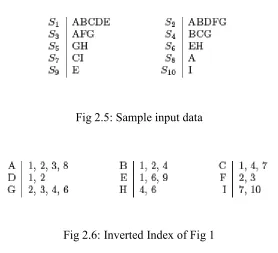
They presented a greedy heuristic using two approaches, inverted index, and multiple
passes.
Inverted Index:- This approach is suitable when random access to a location in the
memory takes a constant amount of time. In inverted index approach, a priority queue is
maintained for each Si\C. The priority queue is a descending order queue of set Si. Here
Si denotes the collection of m subsets of the universe and C denotes elements covered so
far. To update values of Si\C, when a set Si is added to the solution, it is needed to
determine which other sets contain elements of Si. This step can be done using inverted
index in which each item j is associated with
Tj={i:j S
i}
(2.5)
Tj is the inverted index of Si. Tj is created in preprocessing step, and greedy iteration is
Fig 2.5: Sample input data
Fig 2.6: Inverted Index of Fig 1
This algorithm is expensive due to many random accesses to many locations on disk. It is
also tough to predict at which stage Tj will be used.
Multiple Passes:- This approach does not use any priority queue or inverted index. It
merely keeps track of set C covered so far. In this approach, every time two sets are
compared, we look for those already covered elements in those not selected sets. It
makes linear passes through the data which is efficient when the data is resident on the
disk. The only disadvantage is that it will be slow if the size of a selected set is large
because it might need to go through the entire dataset to add this set.
Graham et al. give a new approach which is better than the standard greedy algorithm.
Their approach follows the subsetting of sets according to the size of the sets. Their
algorithm works in two loops. They added a parameter p>1 to govern the approximation
The algorithm by Graham et. al.
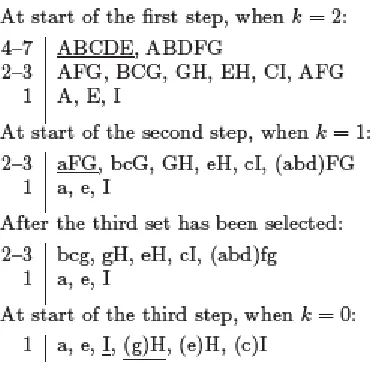
Initially, Si is assigned to sub-collection S(k) if pk Si<pk+1.Here in the algorithm, K is
the largest k with nonempty S(k). Figure 3 shows the algorithm execution on sample
input data in Figure 2.7.
Fig 2.7: Execution of algorithm by Graham. Et al. on sample data in fig 1
The basic functionality of this algorithm is to arrange the sets according to their sizes.
range are reduced to only uncovered elements and appended to the corresponding range
of sets. This process continues until all the elements in the universe are covered. The
proposed algorithm according to the results is much faster than the conventional
algorithms.
This paper gave us an idea to use greedy and variation of greedy with large datasets. We
are interested in seeing the behavior of this algorithm in operational research when data is
large. The approach followed by this paper was to test on disk-resident data and memory
resident data. We are using the leanings from memory resident approach to do our
experiments.
2.8
Set Covering in Locating Facilities
In the planning strategy of big public and private firms, facility location is a critical
component of the study. In facility locating, covering models are most extensively
studied. They are such attractive topics for researchers because of their applicability in
the real world. In covering models, the customer can get service from a facility in a
predefined area. That predefined distance is called coverage distance or coverage radius
[23]. According to Schilling et al. [24], Set covering models can be classified into two
major categories: Set Covering Problem (SCP) and Maximal Covering Location Problem
(MCLP). The difference between these two is that in SCP, the coverage is required and in
MCLP, the coverage is optimized. Classification can also be given based on the solution,
i.e., heuristic or optimal.
According to Reza et. al.[25], the first covering model was introduced by Hakimi in 1965
police needed to cover all the nodes on a highway network. The first mathematical
problem was developed by Toregas et al. [27]. It was used for the location of emergency
service facilities. We are going to discuss various set covering approaches for locating
facilities.
Another paper by Toregas, Swain, et al. [30] gives an emergency vehicle model with a
specified time or distance constraint which is on demand. If this kind of constraints is
given, then the problem is either to find a solution with minimum time or distance or to
find a solution with a minimum number of facilities. They have assumed that the time
needed between every two user nodes is known, and the upper limit for the constraint like
time or distance can be described. If maximum response time for a node is s, then for any
node I that is at most s time away from I, we can provide the emergency service to i. Ni
denotes this set for node i. They give a mathematical problem as follows
xj ={ 0 if no facility is established at point j,
xj={1 if a facility is established at point j.
The actual implementation of (I) requires two steps. In the first step, it determines the sets
Ni for a given value of s and a given shortest distance matrix. The second step involves
A paper by Mark S. Daskin [28] describes the stochastic approach for set covering. They
used a heuristic algorithm to solve the problem. They considered the problem of covering
a location with more than one facility so that in case one facility is not operating; the
other can be reached. They have given an algorithm which describes in the case of
CHAPTER 3
PROPOSED APPROACH AND EXPERIMENTAL SETUP
3.1
Introduction
This chapter introduces the use the weighted greedy algorithm proposed by Wang. Et.
al.[16] in the field of resource management. As demonstrated in the paper, it has
outperformed the traditional greedy algorithm in the field of web crawling for query
selection. Our objective here is to compare the performance of the weighted greedy
algorithm with the traditional greedy algorithm in roadmaps.
3.2
Greedy Algorithm
Greedy algorithms are a type of heuristic algorithms. A greedy algorithm always looks
for a locally optimal solution. Greedy might not find a globally optimal solution, but it
will provide an answer very close to the optimal one with less processing cost. Greedy
Algorithms are used in various fields like networking, machine learning, artificial
intelligence, etc.
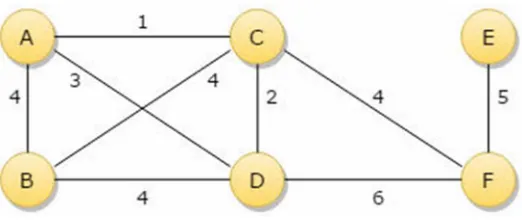
Fig 3.1: A Sample Graph
Figure 3.1 is a sample graph. Suppose that we want to apply a greedy algorithm on this
shortest path is C to F, F to E and the total cost is 9. According to the Greedy algorithm,
it will choose the shortest path at a particular instance. Therefore, the path will be C to A,
A to D, D to F, F to E and the total cost will be 15. The path chosen by greedy algorithm
is not optimal all the time. It only looks for best option at a particular instance. It can be
used in multiple scenarios and setups. There are several algorithms used in the set
covering based on a greedy approach to solve the problems.
The basic greedy algorithm uses the step by step approach to solve the problem, and at
every step, a solution node is chosen for this problem. Greedy is to approximate the
globally optimal solution using the locally optimal solution on each step. For every step,
one column is selected, and there are various ways to select a column. A column here
represents a node.
There are various approaches to apply the greedy approach, it all depends on which factor
we want to focus on. Some of the approaches on which solution can be focused are as
follows:
• Minimize the cost: The next column is selected which has the lowest cost on a
particular step. Using the smallest cost at every step, lowest total cost is
approximated.
• Maximize coverage: Another method is to select the next column which can
cover the largest number of nodes that are not yet covered by previously selected
• Combined Approach: We can also use the combined approach which combines
both the above approaches and take into consideration cost and the number of
new nodes that can be covered.
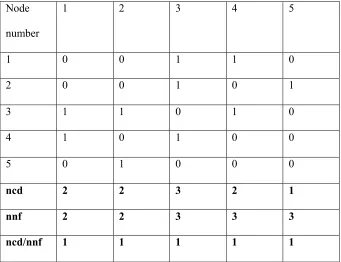
Node
number
1 2 3 4 5
1 0 0 1 1 0
2 0 0 1 0 1
3 1 1 0 1 0
4 1 0 1 0 0
5 0 1 0 0 0
ncd 2 2 3 2 1
nnf 2 2 3 3 3
ncd/nnf 1 1 1 1 1
Table 3.1: Sample matrix of road network for greedy algorithm
The above matrix represents the input matrix to the greedy algorithm. Here ncd is node
coverage degree which means how many nodes can be covered by a node. nnf is new
nodes fetched, i.e., how many new nodes can be fetched by this node. Initially, nnf is the
same as node frequency, and it changes after some iterations. ncd/nnf is to determine
3.3
Weighted Greedy Algorithm
In weighted greedy algorithms, the approach is the same to choose the best at a particular
instance. The only difference is that there are weights added to the nodes which have a
crucial role in deciding for a particular instance to determine which one is the best. The
weighted greedy algorithm, which is used in our approach, is based on choosing the
nodes which are less covered, which means areas that are less accessible are covered first.
The algorithm is as follows:
Node
number
1 2 3 4 5
1 0 0 0.5 0.5 0
2 0 0 0.5 0 0.5
3 0.33 0.33 0 0.33 0
4 0.5 0 0.5 0 0
ncd 2 2 3 2 1
nw 0.83 1.33 2 0.83 0.5
ncd/nw 2.409 1.503 1.500 2.409 2
Table 3.2: Sample matrix of road network for weighted greedy algorithm
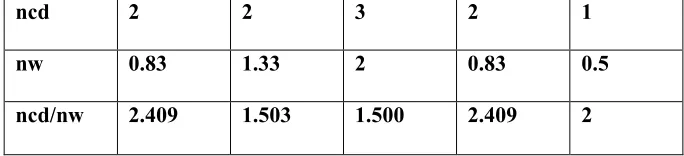
Here ncd stands for node coverage degree, nw for node weight which is the sum of the
significance of all nodes and ncd/nw is used to pick the next solution node. Here node
significance stands for the out degree of a node, i.e. the total sum the column of this node
in the matrix.
According to the algorithm, more focus should be put on nodes with less coverage, i.e.,
nodes that can be reached by less number of nodes. As for greedy strategy, nodes with a
large number of node weight are preferred, i.e., small nf/nw is preferred.
In the greedy algorithm, it does not matter whether a node is covered later or early, but
this is important in the weighted greedy method. In the above table, node 5 is only
covered by node 2, so it is essential to cover this node first. We argue that for each node i,
if the number of the nodes covering node i is bigger, it is better covering node i later. The
reason for this is:
When node i is covered in later steps, more columns covering node i means that there is a
When node i is covered in earlier steps, there is a higher possibility of overlapped
coverage, because node i will be covered multiple times when more columns will be
covering this node.
3.4
Roadmap
Here term roadmap is coined as a network of roads for a particular area demonstrated in
the form of edges and vertices. Every node or vertex represents an intersection, and every
edge is a link between those nodes. These roadmaps can be created from the data
provided in the form of a matrix. Usually, the 0-1 matrix represents which node is
connected to the other node.
3.5
Setup Procedure
The primary purpose of our experiment is to test the performance of the weighted greedy
algorithm in resource management and compare it with the greedy algorithm regarding
solution results. We will run greedy and weighted greedy algorithm on datasets with 100
samples, 50 for coverage radius 1, and 50 for variable coverage radius, using three cost
definitions.
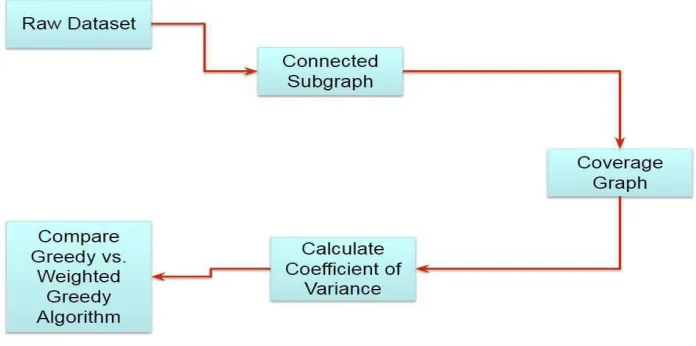
Fig 3.2: Flow of the approach
The raw dataset, Connected Subgraph, and Coverage Graph are the part of data
preprocessing where data is being converted into the suitable format as an input for
greedy and weighted greedy algorithm. Calculation of Coefficient of Variance is being
done as a parameter to compare both algorithms. The last module is a comparison of
Greedy vs. Weighted Greedy algorithm where both the algorithms are implemented and
executed on same input data to test their performance.
3.5.1
Raw Dataset
Raw Dataset is the original data obtained from the SNAP(Stanford Network Analysis
Project)[35]. We are using the dataset which is road network of California. Road network
for California contains 1,965,206 Nodes and 2,766,607 Edges. This raw dataset is in the
form of a matrix with two columns where column 1 denotes the node from which
3.5.2
Connected Subgraph
Working with big data is always a difficult task. There are several issues like memory
and hardware resources we have to deal with and to avoid these problems we are using
the connected subgraphs of smaller size from these raw datasets. The connected
subgraph, as the name suggests is a small portion of the original data coined as a sample.
We are using the sample size of 10,000 nodes approximately. This sample is a matrix
same as the raw dataset but with smaller size and with all the connection among those
selected nodes from the raw dataset.
Fig 3.3: A 10-node connected subgraph
The above figure 3.3 is an example of connected subgraph with 10 nodes fetched from a
raw dataset with all the connection among the nodes. We are using this kind of connected
3.5.3
Coverage Graph
It is the adjacency matrix generated from connected subgraph. The coverage graph is
generated according to the defined coverage. Here coverage is how many nodes can a
node cover starting from its neighbors. If we say the coverage graph has coverage value
of two, then we can say that a node can cover its neighbors and neighbors of their
neighbors. As the coverage value increases, more levels of neighbors each node will
cover. The coverage graph is represented in the form of adjacency matrix where 1
denotes that the node can cover that node and 0 denotes it cannot cover that node.
Fig 3.4: Coverage Matrix with coverage value 1
The above matrix is a representation of connected subgraph in the form of coverage
graph where each row represents which nodes a single node can cover. For example, in
second-row, node 9 can cover 7, 10 and 84. This matrix has coverage 1, i.e., a node can
cover its neighbors only. If this node has coverage 2 then the same node 9 could have
110, 83 and 85. This coverage graph acts as input for the greedy and weighted greedy
algorithm.
3.5.4
Calculation of Coefficient of Variance
This part calculates the coefficient of variance which is used as a parameter to compare
the performance of both the algorithms. The coefficient of Variance (CV) is calculated
using the standard formula which is standard deviation divided by the mean of the
sample. Once the CV is calculated, we can test the performance of algorithms and
analyze for a specific CV range how much improvement our algorithms show. For every
sample, we calculate the CV once.
In our case, we are calculating the CV of a sample using the formula used by Yan Wang
[34] in his approach. We measure the dispersion of node degree (deg) using Coefficient
of Variation. We know that the CV is the ratio of standard deviation to the mean, where
mean is the sum of the node degree over the total number of nodes in the sample.
(3.1)
Mean here can also be called an average node coverage degree. In the same way, we will
calculate the standard deviation of the sample which is
Here deg is the degree of a node and µ is the mean calculated above, and m is a total
number of nodes in the sample. By definition of this standard deviation and mean, we
calculate the value of coefficient of variation (CV) which is
(3.3)
Once the CV is calculated for the sample, we can compare the algorithms and calculate
the improvement of weighted greedy over the greedy algorithm.
3.5.5
Comparison of Greedy and weighted Greedy Algorithm
In this step, a coverage graph with specific CV is supplied as an input to both the
algorithms and the algorithms perform their calculations to compute the solution
outcome. The solution contains two different answers, one from greedy and one from
weighted greedy. The solution contains the number of solution nodes given by each
algorithm. Then those solutions are compared using the improvement formulae to check
how much improvement the weighted greedy algorithm has over greedy algorithm.
−
(3.4)
Formulae to check the improvement
The above formula calculates the improvement of the weighted greedy algorithm over
greedy algorithm. Here Cg and Cw are the results (total cost) for greedy and weighted
greedy respectively.
After calculating the improvement, the data is plotted on the graph which represents the
improvement correlated with CV.
3.6
An Illustrative Example
Here we will show an example of a small data to illustrate the working process. We will
start with a small dataset represented above with ten nodes and illustrate the process on
that dataset. Suppose that we have fetched the following subgraph from the raw dataset
Table 3.3: A 10-node connected subgraph
Fig 3.5: Connected Subgraph plot view
Now we convert this subgraph into an adjacency matrix with the coverage radius 1. The
matrix produced is as follows:
Table 3.4: 01 Matrix of the Subgrap
Now we consider applying the weighted greedy algorithm on this matrix and calculate
the node coverage degree(ncd), node weight(nw) and nf/nw. First, we add all the values
index. We will perform this step for every individual row, and the resulting matrix is as
follows
7 9 10 84 11 110 12 83 112 85 111
7 0 1 0 0 0 0 0 0 0 0 0
9 0.333 0 0.333 0.333 0 0 0 0 0 0 0
10 0 0.25 0 0.25 0.25 0.25 0 0 0 0 0
84 0 0.25 0.25 0 0 0 0 0.25 0 0.25 0
11 0 0 0.333 0 0 0.333 0.333 0 0 0 0
110 0 0 0.25 0 0.25 0 0 0 0.25 0 0.25
12 0 0 0 0 1 0 0 0 0 0 0
83 0 0 0 0 0 0 0 0 0 0 0
112 0 0 0 0 0 0.333 0 0.333 0 0 0.333
85 0 0 0 1 0 0 0 0 0 0 0
111 0 0 0 0 0 0.5 0 0 0.5 0 0
ncd 1 3 4 4 3 4 1 2 3 1 2
nw 0.33 1.5 1.116 2.083 1.5 1.416 0.333 0.583 1.25 0.25 0.583
ncd/nw 3.03 2 3.43 1.92 2 2.82 3.03 3.43 2.4 4 3.43
Table 3.5: Matrix after division of node weights and calculation of nf, nw, nf/nw
We select the value with smallest nf/nw. Now 84 will be added to the solution and
column with node 84 and all rows of nodes it covers will be deleted including 84. The
resulting matrix after this step will be
7 9 10 11 110 12 83 112 85 111
7 0 1 0 0 0 0 0 0 0 0
11 0 0 0.333 0 0.333 0.333 0 0 0 0 110 0 0 0.25 0.25 0 0 0 0.25 0 0.25
12 0 0 0 1 0 0 0 0 0 0
112 0 0 0 0 0.333 0 0.333 0 0 0.333
111 0 0 0 0 0.5 0 0 0.5 0 0
nc d 1 3 4 3 4 1 2 3 1 2
nw 0 1 0.583 1.25 1.166 0.333 0.333 0.75 0 0.583 ncd/n w Inf 3 6.861063 2.4 3.430532 3.003003 6.006006 4 Inf 3.430532
Table 3.6: Matrix after selection of the first node
Now we again select the minimum values for nf/nw, and node 11 will be selected. The
same process will be repeated, and column with node 11 and rows covered by this node
7 9 10 110 12 83 112 85 111
7 0 1 0 0 0 0 0 0 0
112 0 0 0 0.333 0 0.333 0 0 0.333
111 0 0 0 0.5 0 0 0.5 0 0
ncd 1 3 4 4 1 2 3 1 2
nw 0 1 0 0.833 0 0.333 0.5 0 0.333
ncd/nw Inf 3 Inf 4.801921Inf 6.006006 6 Inf 6.006006
Table 3.7: Matrix after second round
In the same way, after the third round now the selected node will be 9, and the same
process will be repeated. In the fourth round, selected result node will be 110, and all the
rows will be deleted.
7 10 110 12 83 112 85 111
112 0 0 0.333 0 0.333 0 0 0.333
111 0 0 0.5 0 0 0.5 0 0
nf 1 4 4 1 2 3 1 2
nw 0 0 0.833 0 0.333 0.5 0 0.333
nf/nw Inf Inf 4.801921 Inf 6.006006 6 Inf 6.006006
Table 3.8: Matrix after the third round
The nodes selected as result nodes are 84,11,9,110
node nf nw Nf/nw cost Unique rows
84 4 2.08 1.92 4 5
11 3 1.25 2.40 7 8
9 3 1 3 10 9
110 4 0.83 4.80 14 11
In this example, a greedy algorithm can start from any random node because initially, the
value of new node fetched will be 1 for every node. Let’s say it starts at 10.
Table 3.10: Matrix at the starting point for greedy algorithm
The above is the matrix at the initial stage after calculating node coverage degree(ncd),
new nodes fetched(nnf) and new node value(nnv). Starting form node 10 we will delete
rows covered by node 10 and delete node 10 from columns.
9 11 84 110 7 12 83 85 111 112
7 1 0 0 0 0 0 0 0 0 0
12 0 1 0 0 0 0 0 0 0 0
83 0 0 1 0 0 0 0 0 0 0
85 0 0 1 0 0 0 0 0 0 0
111 0 0 0 1 0 0 0 0 0 0
112 0 0 0 1 0 0 0 0 0 0
nc d 3 3 4 4 1 1 1 1 1 1
nnf 1 1 2 2 0 0 0 0 0 0
nnv 3 3 2 2 Inf Inf Inf Inf Inf Inf
Table 3.11: Matrix after first round of greedy
1 112
In the same way, the process will continue, and the solution for greedy algorithm will be
as follows
node ncd nnf ncd/nnf cost Unique rows
10 4 4 1 4 5
110 4 2 2 8 7
84 4 2 2 12 9
11 3 1 3 15 10
9 3 1 3 18 11
Table 3.12: Solution table for greedy algorithm
From the above two solution tables, we see that weighted greedy found 4 solutions with a
total cost of 14 whereas greedy algorithm found 5 solutions with a total cost of 18.
3.7
Technologies Used
3.7.1
R
R is a GNU project developed in bell laboratories by John Chambers and his colleagues
[36]. It is an environment for statistical computing and graphics. R is open source
software, and it can run on UNIX, Linux, Windows and Mac operating systems. It is
mostly used for data manipulation, calculation, and graphical display. Following are
• It has excellent graphical facilities for data analysis and display.
• A simple and well developed useful programming language allowing user-defined
recursive functions.
• An efficient storage facility and data handling language.
• A suite of operators for calculations on matrices.
We can extend R easily with packages and anybody can publish his or her packages for
specific tasks.
3.7.2
iGraph Library
It is a package used to plot and analyze the network graphs. We used this package to
create our coverage matrix for variable coverage. This library can be used to create and
plot network graphs from edge or vertex table and vice versa.
3.7.3
R Studio
RStudio is an open source IDE for R. It is also available with a commercial license for
organizations not able to use AGPL software [37]. It also offers other excellent products
which include RStudio Server open source and licensed as well to host applications on
the local server. Shiny io creates applications using R with minimal support and host
CHAPTER 4
EXPERIMENTATION AND RESULTS
In this chapter, we present the experiment results, obtained using the greedy and
weighted greedy method. The purpose is to test whether the weighted greedy is better
than the greedy algorithm in resource allocation setup.
4.1
Data
We are going to perform the experimentation on a dataset by extracting several regional
maps from it. The Dataset contains 1,965,206 Nodes, but we will use regional maps of
10,000 nodes. We will experiment with two different kinds of inputs: one will be with
Coverage Radius 1, and the other will be with Coverage Radius greater than one. We will
run both algorithms on 50 regional maps of coverage radius 1, and 50 regional maps of
variable coverage radius. We will check the improvement of the weighted greedy
algorithm in different scenarios like under different coverage radius or different cost
definitions.
The algorithms will be performed on the symmetric matrix of 10000 * 10000 Nodes. We
will try to cover the gap of CV range between 0.3 and 1.In previous research, there are no
results available for this range. Here CV represents the dispersion of node coverage
Fig4.1: Distribution of node coverage degree in Coverage Radius 7
Fig4.3: Distribution of node coverage degree in Variable Coverage Radius 15
Data Source Number of
Samples
Rows(m) Columns(n) Node Coverage Degree
max min mean CV
Coverage Radius
1
50 10000 10000 8 1 2.75 0.37
Variable Coverage
Radius
50 10000 10000 9744 20 898.11 0.42
Table 4.1: The properties of data source with two types of data: one with coverage radius
1, and the other with variable coverage radius
The above graphs represent the distribution of node out degree under two scenarios: one
represents the properties of two different versions of the data we are using. We are
showing these results for 50 samples of each data. Both types of samples have about
10000 rows and 10000 columns. The table shows the maximum and a minimum number
of node coverage degree, average mean of node coverage degree and average CV of
samples.
4.2
Cost Definition
We also want to see how different cost definitions will affect the performance of the
algorithm. We have used three types of cost definitions as follows:
Infrastructure Cost: With this type, the cost of selecting any node is one. It corresponds
to the situation in traditional set covering problem where the ultimate goal is to minimize
the number of nodes selected. It is also called set covering with unit cost. This type of
cost corresponds to the cost of building a station, for example, a medical facility, food
service or fuel station.
Location Cost: With this type of cost definition, the cost of a node is the out-degree of
this node. For example, if a node is connected to five other nodes, then the out-degree of
this node is five.
Driving Cost: This cost is the sum of the distance between this node and each node it
covers. The distance between two nodes is the length of the shortest path between them in
4.3
Results
We divide the data into two parts and three subparts. Data is divided into two parts: one is
coverage radius 1, and the other with coverage radius greater than 1. These two
categories are then tested using both greedy and weighted greedy algorithms using three
different scenarios of cost definitions.
We used 50 regional maps with coverage radius 1, and 50 maps for with variable
coverage radius greater than 1. We have run the greedy and weighted greedy algorithm
three times on every regional map using each cost definition.
With our experiments, the weighted greedy algorithm turns out to be very efficient on our
data sources according to tables and figures:
• The cost calculated in all different scenarios by the weighted greedy algorithm is
less than that from greedy algorithm.
• On average, on regional maps with variable coverage radius, the weighted greedy
algorithm outperformed greedy algorithm by approximately 8%
Cost Definition Coverage Radius 1 (IMP %) Coverage Radius >1 (IMP %)
MAX MIN AVE MAX MIN AVE
Infrastructure Cost 3 1 1.4 25 1 10
Location Cost 3 0.5 1.2 25 0.8 5
Driving Cost 2 0.6 0.9 33 9 9
Table 4.2: Performance Improvement of Weighted greedy over greedy algorithm
Fig 4.4: Cost difference of solution nodes under Driving Cost
x- Weighted Greedy Algorithm 0-Greedy Algorithm
Fig 4.5: Cost difference of solution nodes under Infrastructure Cost
Fig 4.6: Cost difference of solution nodes under Location Cost
x- Weighted Greedy Algorithm 0-Greedy Algorithm
In the above figures, we can observe that in average results from greedy cost more than
those of weighted greedy for all the cost definitions. This cost can correspond to location
related cost, building cost of each facility etc. in different scenarios.
4. 4 Impact of data distribution
The only difference between the weighted greedy algorithm and a greedy algorithm is
that nw/cost is replaced by new/cost. The main idea is that newly covered rows should
not be considered in the same way: there should be difference in covering different rows.
If all rows are covered by the same number of columns, which means all node weights
are the same, then the weighted greedy algorithm will be same as the greedy algorithm.
In other words, if out degree of all the nodes is the same, then both algorithms work in
coverage degrees, i.e., some nodes have larger coverage degree than the others. The
bigger the dispersion of node coverage degree is, the more improvement we achieved
with the weighted greedy algorithm [34].
As we have shown our results on two different kinds of data with different coverage
radius and different data distribution, we measure the improvement using the dispersion
of node coverage degree. We will measure the improvement of the weighted greedy
algorithm to the CV. To do so, we use the Pearson Product Moment Correlation
Coefficient (PC). PC is used to measure the correlation between two variables X and Y. It
gives a value between -1 to +1 where -1 means decreasing linear correlation and +1
means increasing linear correlation. Definition of PC is as follows:
It is defined as the product of covariance of the two variables divided by the product of
their standard deviations.
(4.1)
The following graph shows the relationship between the CV and improvement of the
Fig 4.7: Relationship between CV and improvement on Infrastructure Cost regional maps
Fig 4.9: Relationship between CV and improvement on Driving Cost regional maps
Base on all the results for different cost definitions, the ρ of different cost definition
results is as follows:
Cost Definition P-value
Infrastructure Cost 0.19
Location Cost 0.49
Driving Cost 0.23
Table 4.3: P-value for different cost definitions
These positive values of ρ and the figures above tell us that there is a positive linear
that the improvement of the weighted greedy algorithm depends upon the dispersion of