Feature Based Face Detection System for
Different Pose Images
Swaroopkrishna G Tangadi, Shivakumar Dalali
M. Tech Student, Dept. of Computer Science and Engineering, Cambridge Institute of Technology, Karnataka, India
Associate Professor, Dept. of Computer Science and Engineering, Cambridge Institute of Technology, Karnataka, India
ABSTRACT: Face identification becomes the prominent because, this technology is considered as natural means of biometric identification since the ability to distinguish among individual appearances is possessed by humans. Biometrics commonly implemented or studied includes fingerprint, face, iris, and voice, signature, and hand geometry. Many other modalities are in various stages of development and assessment. Inspired by Weber's Law, this paper proposes a simple, yet very powerful and robust local descriptor, called the Weber Local Descriptor (WLD). It is based on the fact that human perception of a pattern depends not only on the change of a stimulus (such as sound, lighting) but also on the original intensity of the stimulus.
KEYWORDS: PCA, SVM, Ada-boost, Local Weber Descriptor
I. INTRODUCTION
A face verification system for a portable device should be able to verify a client at any time (day or night) and in any place (indoors or outdoors). Unfortunately, facial appearance depends strongly on the ambient lighting Traditional approaches for dealing with this issue can be broadly classified into three categories: appearance-based, normalization-based, and feature-based methods[6]. In this paper, we propose an integrative framework that combines the strengths of all three of the above approaches. The overall process can be viewed as a pipeline consisting of image normalization, feature extraction, and Classifier. Each stage increases resistance to illumination variations and makes the information needed for recognition more manifest. The method centres on a rich set of robust visual features that is selected to capture as much as possible of the available information. A well-designed image pre-processing pipeline is prepended to further enhance robustness.
Now a days with the network world, the way for crime is become easier than before. Because of this reason, network security has become one of the biggest concerns facing today's IT departments.We heard a lot about hackers and crackers ways to steal any password or pin code, crimes of ID cards or credit cards fraud or security breaches in any important building and then reach any information or important data from any organization or company. These problems allow us to know the need of strong technology to secure our important data.
This technology is based on a technique called “biometrics". Biometric is a form of bioinformatics that uses biological properties to identify people. Since biometric systems identify a person by biological characteristics, they are difficult to fake. Examples of biometrics are iris scanning, signature authentication, voice recognition and hand geometry. Face recognition is one example of biometric and it is use the character of the face to identify a person. Face recognition has drawn attention in computer vision at 1970 and the rest time the system of face recognition used was at 2001 for the purpose of reducing the crimes but this system fails to recognize the clear picture of any thief because the thieves were wearing a mask.
Face recognition techniques can be broadly divided into three categories based on the face data acquisition methodology: methods that operate on intensity images those that deal with video sequences; and those that require other sensory data such as 3D information or infrared imagery.
II. RELEATED WORK
Dr. Pramod Kumar et.al focuses on the meaning of face recognition system, human face features that use to identify the face, face recognition types including two- dimensional system (2D) and three-dimensional system(3D)& the explanation of three-dimensional recognition procedures We also explained our new idea for recognizing the human face. This paper is an attempt to give an idea of the state of the art of face recognition technology.
Jukka et.al [2] proposed approach analyzes the texture of the facial images using multi-scale local binary patterns (LBP). Compared to many previous works, our proposed approach is robust, computationally fast and does not require user-cooperation. In addition, the texture features that are used for spoofing detection can also be used for face recognition. This provides a unique feature space for coupling spoofing detection and face recognition. Extensive experimental analysis on a publicly available database showed excellent results compared to existing works.
Sajida Parveen et.al [3] identify the spoofing attacks on such biometric systems, face liveness detection approaches have been developed. Thus, the current approach is to integrate liveness detection within facial biometrics by using life sign indicators of individual features. This article presents a review of state-of-the-art techniques in face liveness detection, which are classified into two groups, namely intrusive and non-intrusive approaches. Here, each technique is discussed in terms of its implementation, strengths and limitations, as well as indications on possible future research directions that can be studied.
Jie Chen et.al [4] fact that human perception of a pattern depends on not only the change of a stimulus (such as sound, lighting, et al.) but also the original intensity of the stimulus. Specifically, WLD consists of two components: its differential excitation and orientation. A differential excitation is a function of the ratio between two terms: One is the relative intensity differences of its neighbors against a current pixel; the other is the intensity of the current pixel. An orientation is the gradient orientation of the current pixel. For a given image, we use the differential excitation and the orientation components to construct a concatenated WLD histogram feature.
Ihsan Ullah et.al Weber’s Local Descriptor (WLD) for gender recognition. WLD is a texture descriptor that performs better than other similar descriptors but it is holistic due to its very construction. We extend it by introducing local spatial information; divide an image into a number of blocks, calculate WLD descriptor for each block and concatenate them. This spatial WLD descriptor has better discriminatory power. Spatial WLD descriptor has three parameters.
III. PROPOSED SYSTEM
A. Face detection
The face detection algorithm proposed by Viola and Jones is used in the proposed design. The face detection algorithm extracts particular Haar features of a human face. When one of these features is found, the algorithm allows to move to the next stage of detection in the algorithm. A rectangular section of the original image of the driver called a sub-window is acquired. Generally these sub-windows have a fixed size to which resizing is applied. And required portion of sub-window is cropped.
The integral image at location (x,y) contains the sum of the pixels above and to the left of (x,y) inclusive.(equation 1)
II(x, y) = i(x, y) (1) , ,
Haar features are consisting of either two or three rectangles. Face candidates are scanned and searched for Haar features of the current stage and the weights are generated. Each Haar feature has a value that is calculated by taking the area of each rectangle, multiplying each by their respective weights, and then adding the results. The area of each rectangle is easily found using the integral image. The coordinate of the any corner of a rectangle can be used to get the sum of all the pixels above and to the left of that location using the integral image.
B. Feature extraction
This descriptor represents an image as a histogram of differential excitations and gradient orientations, and has several interesting properties like robustness to noise and illumination changes, elegant detection of edges and powerful image representation. (Figure2) WLD descriptor is based on Weber’s Law. According to this law the ratio of the increment threshold to the background intensity is constant. Inspired by this law, Chen et.al proposed WLD descriptor for texture representation. The computation of WLD descriptor involves three steps i.e. finding differential excitations, gradient orientations and building the histogram. For calculating differential excitation ε(x ) of a pixel x first intensity differences of x with its neighborsx, i = 1, 2, … , p are calculated as follows:
ΔI = I −I (2) Then the ratio of total intensity difference of x with its neighbors x to the intensity of x is determined as follows:
f = ΔI
I (3)
Arctangent function is used as a filter to enhance the robustness of WLD against noise which results in:
ε(x ) = arctan ∑ Δ (4)
The differential ε(x )excitation may be positive or negative. The positive value indicates that the current pixel is darker than its surroundings and negative value means that the current pixel is lighter than the surroundings. Next main component of WLD is gradient orientation. For a pixel (x ) the gradient orientation is calculated as follows:
θ(x ) = arctan I
I (5)
where I = I −I is the intensity difference of two pixels on the left and right of the current pixel (x ) and I = I −I is the intensity difference of two pixels directly below and above the current pixel. The gradient orientations are quantized into T dominant orientations as:
ϕ = π Where t=mod
′
+ , T (6)
Figure 2: Flow chart of local Weber Descriptor C. PCA
Principal-component analysis, or PCA, is a technique for taking a dataset consisting of a set of tuples representing points in a high-dimensional space and finding the directions along which the tuples line up best. The idea is to treat the set of tuples as a matrix M and find the eigenvectors for MMT or MTM. The matrix of these eigenvectors can be thought of as a rigid rotation in a high dimensional space.
When you apply this transformation to the original data, the axis corresponding to the principal eigenvector is the one along which the points are most “spread out,” More precisely, this axis is the one along which the variance of the data is maximized. Put another way, the points can best be viewed as lying along this axis, with small deviations from this axis. Likewise, the axis corresponding to the second eigenvector (the eigenvector corresponding to the second-largest eigen value) is the axis along which the variance of distances from the first axis is greatest, and so on.
D. SVM
SVMs (Support Vector Machines) are a useful technique for data classification. Although SVM is considered easier to use than Neural Networks, users not familiar with it often get unsatisfactory results at first. Although users do not need to understand the underlying theory behind SVM, we briefly introduce the basics necessary for explaining our procedure. A classification task usually involves separating data into training and testing sets. Each instance in the training set contains the class labels and several the features or observed variables). The goal of SVM is to produce a model (based on the training data) which predicts the target values of the test data given only the test data attributes. Theoretically it is quite cumbersome to understand SVM without the proper fundamentals about the prediction of the events. Firstly we start with linear regression and go through with the non regression modeling.
IV. RESULT AND DISCUSSION
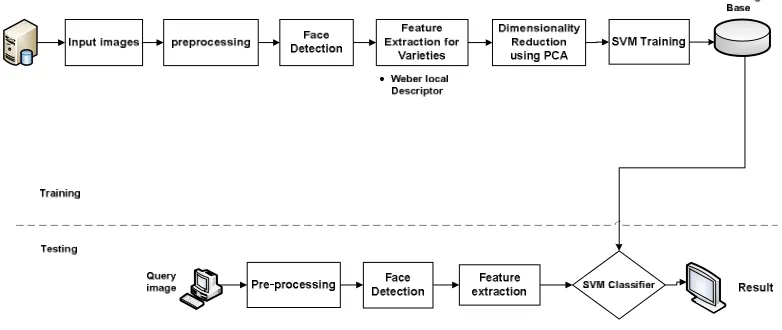
Given image is preprocessed to remove noise and color conversion is applied.
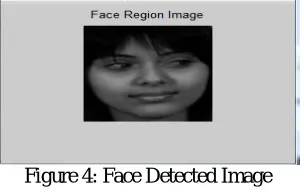
Figure 4: Face Detected Image
Using Viola and Jones method face detection is acheived. Feature is extracted using local weber descriptor. Face recognition is achieved using SVM classifier.
V. CONCLUSION
We propose a novel discriminative descriptor WLD. It is inspired by Weber’s Law, which is a law developed according to the perception of human beings. We organize WLD features to compute a histogram by encoding both differential excitations and orientations at certain locations. The main contributions are as follows: a simple, efficient image Pre-processing chain whose practical recognition performance is comparable to or better than current, Principle component analysis done to reduce the dimensionality.
REFERENCES
[1] Dr. Pramod Kumar, Mrs. Monika Agarwal2, Miss. Stuti Nagar, “A Survey on Face Recognition System - A Challenge”, International Journal of Advanced Research in Computer and Communication Engineering,Vol. 2, Issue 5, May 2013.
[2] Jukka M¨a¨att¨a, Abdenour Hadid, Matti Pietik¨ainen, “Face Spoofing Detection From Single Images Using Micro-Texture Analysis”. [3] Sajida Parveen, Sharifah Mumtazah Syed Ahmad, Marsyita Hanafi and Wan Azizun Wan Adnan.” Face anti-spoofing methods”. [4] Jie Chen, Shiguang Shan1 Guoying Zhao Xilin Chen1 Wen Gao, Matti Pietikäinen,” A Robust Descriptor based on Weber’s Law”.
[5] Jhsan ullah, muhammad hussain, ghulam muhammad , hatim aboalsamh, george bebis, and anwar m. mirza.” , “gender recognition from face images with local wld descriptor”april 2012.