BER Comparison of SC-FDMA and OFDM
System Using Different Modulation
Techniques
Sheenum Vashist1, Raminder Preet Pal Singh2
Research Scholar, Dept. of EEE, Arni University, Indora, India1
Professor, Dept. of ECE, Arni University, Indora, India2
ABSTRACT: OFDM (Orthogonal frequency division multiplexing) is a technique used in wireless communication network to transfer the data on a high speed through multiple sub carriers. OFDM is a technique which uses multiple sub carriers to transfer the data over the channel. The data is transferred over multiple or different channels and the carriers of the channels are orthogonal or independent to their adjacent signals. To achieve this carrier must be placed exactly at the nulls modulation spectra of adjacent signals. There are many problems in OFDM like OFDM does not support the ICI. If the peak of signals goes into non linear region, it will cause the distortion in the signals due to Inter Carrier Interference (ICI). To overcome this problem we use an efficient method known as SC-FDMA. SC-FDMA is known as Single Carrier Frequency Division Multiple Access because it transmits the data serially. SC-FDMA uses the STBC codes to solve the problem of ICI. STBC (Space Time Block Coding) is used to transfer the multiple copies of data to more than one antenna. It is used in Wireless communication for replicating the transferred data at more than one receiver’s end. It also guarantees the reliable data transmission.
KEYWORDS: OFDM; SC-FDMA; STBC; MIMO; Bit error rate; Wireless communication
I. INTRODUCTION
OFDM (Orthogonal Frequency Division Multiplexing) is an effective method or technique adopted in wireless channels. The wireless channels must be selective and time variance based. OFDM is an efficient technique which poses the property of flexibility and multicarrier modulation. OFDM is a technique, method or scheme for digital multi-carrier modulation using some closely spaced submulti-carriers, a previously modulated signal modulated into other signal that have high frequency and bandwidth. OFDM is used in many fields like DAB, Digital Video Broadcasting. OFDM transfers the data with a high transmission rate. OFDM also has the ability to solve the problem of multi path interference and frequency fading. OFDM uses the orthogonal subcarriers for data transmission.
STBC (Space Time Block Coding) is used to transfer the multiple copies of data to more than one antenna. It is used in Wireless communication for replicating the transferred data at more than one receiver’s end. It also guarantees the reliable data transmission. Sometimes data to be transferred gets corrupted with the effect of reflection, refraction or scattering. Sometimes some data also gets tempered due to thermal noise which affects the quality of data at the receiver side. This problem results that there is a scope of being able to use one or more of the received copies to correctly decode the received signal. STBC helps to produce the more accurate information from received signals by combining them together.
II. RELATED WORK
impairments such as Doppler Shift due to user mobility and High-Power Amplifier (HPA) distortion when amplifying the transmitted OFDM symbol. It was shown that the resulting inter-carrier interference (ICI) generated by these impairments becomes very significant in OFDM system, and severely degrades its BER performance. In [3] author presented an efficient technique for the BER of OFDM system over Nakagami–m fading channels, using well known characteristics function based analysis approach. The average BER expressed in terms of the higher transcendental function such as the confluent hyper geometric functions. The numerical results showed that depending on the number
of channel taps, the BER performance may degrade with increasing values of Nakagami–m fading parameters. In [4]
author presented a work in which a guard interval (GI) was inserted using cyclic prefix (CP) and zero padding (ZP) techniques to achieve an error free communication. BER performance for OFDM with 16-QAM with varying length of
GI was presented in this paper. In [5] the performance of OFDM- BPSK,-QPSK and -QAM system by using forward
error correcting codes (convolutional , reed Solomon as well as concatenated coding) schemes that were used to encode the data stream in wireless communications AWGN channel has been reported. In [6] author investigated the bit error rate (BER) performance of Orthogonal frequency division multiplexing (OFDM)-Binary phase shift keying (BPSK) OFDM-Quadrature phase shift keying (QPSK), OFDM-Quadrature amplitude shift keying (QAM) over different fading channels. The performance of transmission modes were evaluated by calculating the BER versus signal to noise ratio (SNR) under the Additive white Gaussian noise(AWGN), Rayleigh fading, Rician fading, Nakagami-m fading channel. In [7] author investigated adaptive modulation & ICI self-cancellation methods for combating the effects of channel fading & ICI respectively. These methods were compared in terms of BER performance, bandwidth efficiency, and computational complexity. In [8] BER performance of BPSK modulation and OFDM -BPSK System over Rayleigh fading channel was analyzed. In [9] author investigated the bit error rate performance of cooperative Diversity for M-ary QAM OFDM-based system with best-relay selection up to 512-M-ary QAM because 256 M-ary is already developed. In
[10] author presented a comparison of the performance of OFDM system using different modulation schemes under the influence of AWGN and Rayleigh fading channel. Simulations of OFDM signals were carried out with Rayleigh faded signals to understand the effect of channel fading and to obtain optimum value of BER. In [11] exact closed-form expressions were derived for calculating the average BER of OFDM systems in the presence of Carrier Frequency Offset and Phase Estimation error in the context of frequency-selective Nakagami-m fading channels.
III. PROPOSED WORK
As per literature it is concluded that the work is much effective with STBC in OFDM system but as per new technology if we replace the traditional OFDM system with FDMA then the system will be more effective and fast. In SC-FDMA, different sets of non overlapping Fourier Coefficients are assigned to different users and multiple accesses is made possible.SC-FDMA is different from OFDM as it is single carrier transmit scheme whereas OFDM is multi carrier transmit scheme. Like OFDM, SC-FDMA has various advantages like low PAPR, low sensitivity to carrier frequency offset, etc. The STBC (Space-Time Block Code) is used with SC-FDMA which works on MIMO (multi input multi output). This code is used to reduce BER (Bit Error Rate).
SC-FDMA (Single Carrier Frequency Division Multiple Access) is a technique which transmits the data serially. In this modulation technique, the value of PAPR is reduced to an extent as compare to OFDM system. Moreover, this system is less sensitive to frequency offset in comparison with the traditional modulation technique. SC-FDMA is more robust with respect to frequency selective fading. SC-FDMA works like OFDMA but the difference is of DFT mapped. In the SC-FDMA, data mapped converts the data bits into modulation symbols. These modulation symbols are converted into a block which consists of N symbols. N symbols are converted into the frequency domain because N-point is in time domain. At last, these frequency domain samples are converted into subset of M subcarriers. M should be greater than N. In case of OFDM, IFFT is used to convert the M point into time domain samples. Consequently, for the lower PAPR SC-FDMA modulation has been preferred.
IV. METHODOLOGY
In this paper the STBC coding is applied for the coding the signal that is to be sends to the receiver. Along with this the SC-FDMA is used instead of OFDMA. The methodology of the proposed work is given below:
Step II Next step after the generation of the signal is to apply modulation on the generated signal. The modulation is done so that it is generated signal is transmitted to the receiver end without any distortion.
Step III In this step the STBC coding is applied over modulated signal. This is done in order to reduce the effect of the BER as multiple signals are transmitted through the channels.
Step IV After the coding of the modulated signal is done, now the signal is transmitted over the channel to the receiver. In this proposed work the traditional OFDM is replaced with the SC-FDMA. As in SC-FDMA the multiple Accesses among users is made possible by assigning different users different sets of non-overlapping Fourier-coefficients.
Step V Next step is to send the signal over the channel so that it is received by the receiver. After passing through the channel the signal is received at the receiver end.
Step VI Finally the receiver received the signal and the calculation of the performance parameters is done. BER is calculated that will show the efficiency of the system.
V. SIMULATION RESULTS
In this section there is discussion about the results of proposed method of routing in the wireless sensor network. The traditional OFDM system is replaced with the SC-FDMA system along with this the STBC codes are used. The graphs given below explain that the proposed method is better and efficient than the traditional method. BPSK, QPSK and 64-QAM are used for the simulation purpose.
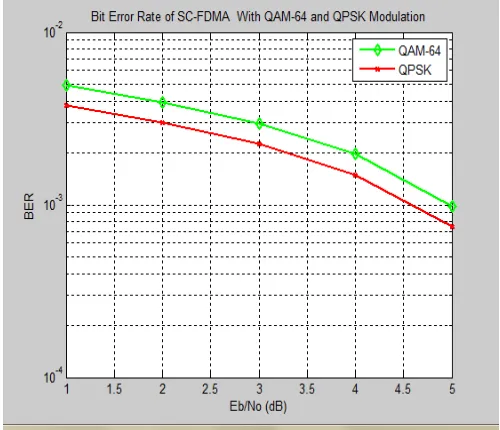
Fig. 1 represents the comparison graph of bit error rate (BER) performance of STBC based SC-FDMA with 64-QAM and QPSK modulation. The graph shows that the value of BER for QPSK is less than higher order modulation scheme i.e. 64-QAM.
Fig. 1: BER comparison graph of SC-FDMA with 64-QAM and QPSK modulation
Fig. 2: BER comparison graph of SC-FDMA with . QPSK and BPSK modulation.
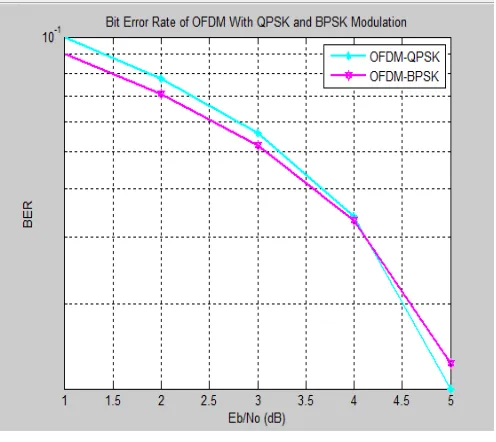
Fig. 3 represents the comparison graph of BER performance of OFDM with two different modulation techniques i.e. BPSK and QPSK. It is seen from the graph that QPSK modulation has best result than BPSK modulation. Therefore, we can say that in case of OFDM the value of BER is reduced in QPSK modulation. Thus it is concluded that in case of OFDM the higher order modulation best supports the BER performance.
Fig. 3: BER comparison graph of OFDM with
QPSK and BPSK modulation.
Fig. 4: BER comparison graph of SC- FDMA with 64-QAM, QPSK and BPSK modulation.
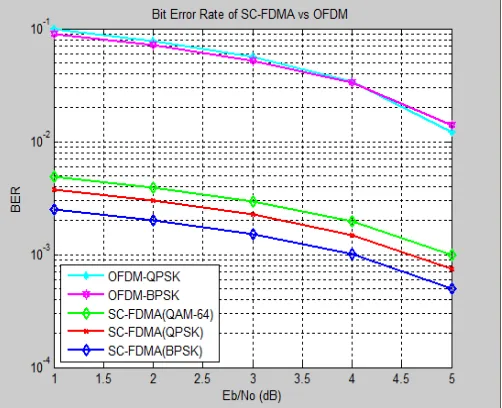
Fig. 5 represents the comparison graph of BER performance of SC-FDMA with 64-QAM, QPSK and BPSK whereas OFDM with QPSK and BPSK. It is concluded from the graph that BER of SC-FDMA is less than OFDM. Thus the proposed work i.e. SC-FDMA scheme outperforms OFDM scheme in terms of BER.
Fig. 5: BER comparison of SC-FDMA with OFDM.
VI. CONCLUSION AND FUTURE WORK
64-QAM. Initially the work was start with OFDM but OFDM faces the problem of ICI which occurs due to distortion in the signals. SC-FDMA along with STBC codes is used in this paper to overcome the problem of ICI. Moreover it is observed from the simulation result that the proposed SC-FDMA scheme has best results compare to OFDM scheme in terms of BER.
In future, some other STBC codes can be introduce to the system to make it more efficient and robust. System can also switch to any other modulation technique also in order to make system better and efficient.
REFERENCES
[1] Lu, J., Tjhung, T. T., Adachi, F., and Huang, C. L., “BER Performance of OFDM-MDPSK System in Frequency-Selective Rician
Fading with Diversity Reception”, IEEE Transactions on Vehicular Technology, Vol.49, Issue4, pp.1216-1225, 2000.
[2] Ahmad, H. A., Sulyman , A. I., and Hassanein, H. S., “BER performance of OFDM system with channel impairments”, Local Computer
Networks, pp.1027-1032, 2009.
[3] Mishra, M. K., Sood, N., and Sharma, A. K., “Efficient BER Analysis of OFDM System over Nakagami -m Fading Channel”,
International Journal of Advanced Science and Technology, Vol.39, pp.37-45, 2011.
[4] Sappal, A. S., and Kaur, P., “BER Performance Of OFDM System With 16-QAM And Varying Length Of Guard Interval”,
International Journal of Electronics and Electrical Engineering, Vol.2, Issue3, 2012.
[5] Sharma, V., Shrivastav, A., Jain, A., and Pandey, A., “BER performance of OFDM-BPSK, QPSK,- QAM over AWGN channel using
forward Error correcting code”, International Journal of Engineering Research and Applications(IJERA), Vol.2, Issue3, pp.1619-1624, 2012.
[6] Jain, G., and Dubey, R., “BER Performance of OFDM System over Nakagami-m Fading Channels with Different Modulation Scheme”,
International Journal of Advanced Researchin Computer Engineering and Technology(IJARCET), Vol.1, Issue6, pp.111-116, 2012.
[7] Jajoria, S., Singh, S., and Prasad, S. V. A. V., “Analysis of BER Performance of OFDM System by Adaptive Modulation”,
International Journal of Recent Technology and Engineering (IJRTE), Vol.1, Issue4, pp.6-9, 2012.
[8] Divya, M., “Bit Error Rate Performance of BPSK Modulation and OFDM -BPSK with Rayleigh Multipath Channel”, International
Journal of Engineering and Advanced Technology (IJEAT), Vol.2, Issue4, pp.623-626, 2013.
[9] Vyas, P., Bohra, S., Parihar, N., Gupta, V., and Jain, R., “A Comparison Study for BER Performance In OFDM Systems Based On
Using M-QAM With Detection Techniques”, International Journal of Advanced Technology and Engineering Research (IJATER), Vol.3, Issue2, pp.7-14, 2013.
[10] Pandey, A., and Sharma, S., “BER Performance of OFDM System in AWGN and Rayleigh Fading Channel”, International Journal of
Engineering Trends and Technologies (IJETT), Vol.13, Issue3, pp.126-128, 2014.
[11] Liu, X., and Hanzo, L., “Exact BER Analysis of OFDM Systems Communicating over Frequency-Selective Fading Channels Subjected
to Carrier Frequency Offset”, IEEE 65th Vehicular Technology Conference, pp.1951-1955, 2007.
BIOGRAPHY
Sheenum Vashist, is doing M.Tech. in Electrical and Electronics Engineering from Arni University Indora, affiliated to Arni University Indora . She completed her B.Tech. in Electronics and Communication Engineering in
2014 from Arni University Indora, affiliated to Arni University Indora.