A Multi-Resolution Wavelet PID Controller
for Internet AQM Routers
Osama A. Awad
1, Hind Ali
2Head of Systems Engineering Dept., College of Information Engineering, Al-Nahrain University, Baghdad, Iraq1
M.Sc. Student, Dept. of Network Engineering, College of Information Engineering, Al-Nahrain University, Baghdad, Iraq2
ABSTRACT: Internet represents a shared resource wherein users contend for the finite network bandwidth. Contention among independent user demands can result in congestion, which in turn leads to long queuing delays, packet losses or both. Congestion control regulates the rate at which traffic sources inject packets into a network to ensure high bandwidth utilization while avoiding network congestion. This paper presents a new Active Queue Management algorithm in internet routers using a hybridization of multiresolution wavelet with the classical PID control (MR. Wavelet PID). The aim is to control the router queue length within a desired threshold queue level for a linearized TCP congestion model. The analytical results for a linearized TCP/AQM model are simulated using MATLAB. The performance of the proposed control scheme is evaluated for various network scenarios and the obtained results show the capability of the proposed controller to compensate for a wide range of TCP flows and link capacity variations.
KEYWORDS: Congestion Control, Active Queue Management (AQM), Wavelet, TCP networks, PID Controller, Multiresolution Wavelet.
I. INTRODUCTION
There are two mechanisms which are working together for the congestion control: the first is the Transmission Control Protocol (TCP) that provides an end-to-end reliable transmission for the packets over the network. The second one is the Active Queue Managements (AQM).
Congestion refers to the phenomenon that takes place as a result of the increase of network load, which affects the network performance negatively by decreasing it. The most common reason for congestion is an increase in the demand, which has become greater than the supply from the network. Network congestion has become a major problem of the Internet with the continuous expansion of Internet scale, as well as continuous increase in type of network applications [1].
In Internet, the Transmission Control Protocol (TCP) controls the end-to-end congestion, which affects the data transmission reliability due to the losses of packet in the congested routers. The TCP congestion control mechanism is powerful and necessary, but it has not been sufficient to provide reliable services due to the rapid growth of demand and the strong requirements of the quality of the service support, due to the limit to how much control they can accomplish at end system. A Drop Tail (DT) strategy is the earliest and simplest policy that the routers have adopted to manage their queues. Implementation of the policy takes place by means of a FIFO queue management. It has been apparent that implementation of the policy, as well as working of the policy is easy and effective in the lightly loaded traffic conditions. However, the convention scheme has some drawbacks. A heavy traffic load leads to a rate deteriorated network conditions and high packet loss, as well as a low network throughput and utilization. Therefore, the Internet routers should address the problem by implementing some queue management mechanism to control queue lengths and inform the end hosts of the inchoate congestion. The mechanism is referred to as Active Queue Management (AQM) [2].
to accommodate nature-occurring burst without affecting the flow of packets. At the same time, AQM will reduce the delays that take place as a result of an overflow. The functions of AQM are particularly significant for the real-time interactive applications [3].
II. RELATED WORK
C. Hollot et al., in 2001 suggested Proportional Integral (PI) controller with the aim of controlling congestion in computer network on the basis of the linear control theory. It has been evident that PI controller better than the well-known RED controller based on the differences in their theoretical properties. Verification of the performance of the controller and comparison with that of RED takes place by the use of NS [4]. F. Yanfei et al., in 2003 suggested a new AQM controller known as the three term PID or Proportional Integral Derivative controller. The tune of the PID parameters takes place by determining phase and gain margins. The simulation outcome compares with the PI controller in order for the PID controller to speed up the responsiveness of an AQM system [5]. P. Xiao, and Y. Tia, in 2006 suggested a new AQM controller known as an Adaptive Neural Proportional Integral Derivative (ANPID). The least mean square learning rule helps in tuning the PID coefficient and weight online. The simulation outcome shows that ANPID can set the queue length to desired values, as well as have good performances with regard to robustness as a result of the variation of the system parameters [6].J. Kim, et al., in 2008 suggested a Wavelet Neural Network (WNN) control technique for an active queue management (AQM). The determination of weight takes place by the use of gradient descent technique (GD) and the Lyapunov theorem, which obtains the ALRs for an actual queue and stable size close to a reference queue value length. The technique shows the stability of the entire system. The simulation results compare to WNN and PID by the use of the FLR controller [7]. S.Tsotoulid et al, in 2013 proposed multiresolution wavelet theory in control structure. The proposed controller structure is deployed on an algorithm that exploits inherit wavelet filtering capabilities for improving control dynamics and stability over a wide operational range [8]. Sengupta et al, in 2014, proposed a wavelet based Proportional Integral Derivative controller for a Liquid levelling plant, where the wavelet transformation of the discrete type (DWT) is used for decomposing the available signal of error from the signal setting point and the signal measuring into various components of frequencies at different levels. The DWT coefficients evaluated are then multiplied by their relevant gains to breed the global controlled actuating signal. The response by using the multiresolution MRPID controller is found targeting its steady state value in much less time than that when the PID controller is used [9]. A. Fakhariana, and A. Abbasib, in 2015 suggested the H∞ TCP congestion controller, which includes the disturbance rejection, as well as the stability of the closed-loop system concerning the round-trip times. The round-trip times are less than a known value is better as compared to the value obtained using the PI. The maximum overshoot in H∞ is smaller as compared to the P and PI controllers in both window size and queue length states. MATLAB is the mathematics program that is useful in validating the performance of H∞ controller when the parameters of the network are C is 3750 packets per second, N is 60 flows, and R0 is 0.246 Seconds [10].
III.A MODEL of TCP BEHAVIOR
A dynamic model of TCP behaviour has been developed using fluid flow and stochastic differential equation analysis. Ignoring the TCP timeout mechanism, a model is developed as [11, 12]:
𝑊̅ (𝑡) = 1
𝑅(𝑡)−
𝑊(𝑡)𝑊(𝑡−𝑅(𝑡))
2𝑅(𝑡−𝑅(𝑡)) 𝑝(𝑡 − 𝑅(𝑡)) eq. (1)
𝑞̅(𝑡) =𝑊(𝑡)
𝑅(𝑡)𝑁(𝑡) − 𝐶 eq. (2
)
𝑊̅ (𝑡) denotes the time-derivative of 𝑊(𝑡), 𝑞̅(𝑡) denotes the time derivative of q(t).
W = is the average TCP window size (packets);
q = is the average queue length (packets);
R (t) = is the round trip time;
N = is the load factor (Number of TCP session);
p = is the probability of packet drop/mark;
Assume a constant number of TCP flows N(t)≡N, and round-trip time 𝑅(𝑡) ≡ 𝑅0 The dynamics of linearized TCP/AQM router is:
∆𝑊̅ (𝑡) = − 2𝑁
𝑅02𝐶∆𝑊(𝑡) −
𝑅0𝐶2
2𝑁2 ∆𝑝(𝑡 − 𝑅0) eq. (3)
∆𝑞̅(𝑡) = 𝑁
𝑅0∆𝑊(𝑡) −
1
𝑅0∆𝑞(𝑡) eq. (4)
IV.WAVELET MULTI RESOLUTION PID
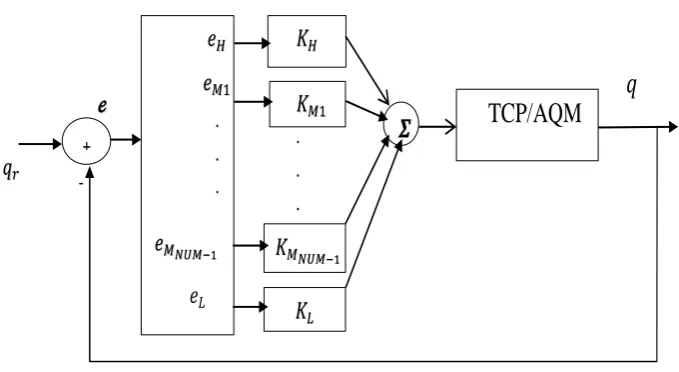
A wavelet multiresolution PID controller (MRPID) was initially introduced by [9, 13], and applied to control a D.C. motor. Based on this approach a modified hybrid controller is introduced to compensate for the congestion problem that occurs in TCP networks. The hybrid controller is designed to control the buffer size (𝑞𝑟). The error signal as being represented by the variation between the required queue length and the actual output queue length can be decomposed into its original high, low and intermediate frequency components, by utilizing the multi-resolution decomposition characteristic of the wavelets. These components can be scaled separately according to their respective gains and, after that, they can be summed together to produce the control signal u as shown in Fig. (1). The decomposed control signal can be written as [10]:
𝑢(𝑘) = kEm eq. (5)
k = [𝑘𝐻𝑘𝑀1𝑘𝑀2𝑘𝑀𝑁𝑈𝑀−1𝑘𝐿] eq. (6)
Em= [𝑒𝐻(𝑘)𝑒𝑀1(𝑘)𝑒𝑀2(𝑘)𝑒𝑀𝑁𝑈𝑀−1𝑒𝐿(𝑘)]
𝑻 eq.(7)
Where, NUM is the decomposition level of the control signal, (𝑘𝐻,𝑘𝑀, 𝑘𝐿 ) are tuning gain parameters for low, high and medium frequency component ofthe error signal.(𝑒𝐻(. )𝑒𝑀1(. )𝑒𝑀2(. )𝑒𝑀𝑁𝑈𝑀−1𝑒𝐿(. )) are the discretized decomposition
Figure 1: Block diagram of MR. Wavelet
For example, by manipulating the value of the low scale gain to have a zero value, i.e. 𝑘𝐿 = 0, this will result in a control signal which minimizes the impact of noise on the plant 𝑞𝑟 output and, as a result of that, a smooth control signal will be produced which will aid in minimizing efforts. Figure (2) shows a combination of PID controller and MR. Wavelet.
Figure 2: Hybrid of PID with MR. Wavelet
Number of Decomposition Levels
In order to obtain sufficient resolution in both time and frequency, the number of levels (NUM) that a signal is decomposed in depends upon the size of the signal error buffer (S) and the number wavelet coefficient (F) as given by the following equation [14]:
NUM ≤ log2 (
2∗𝑆−1
𝐹−1 + 1) eq. (8)
To compute the size of error signal buffer (S), which represented the window of sample error signal required for DWT transformation, the following equations is used:
𝑆 ≥(2𝑁𝑈𝑀−1)(𝐹−1)+1
2 eq. (9)
.
TCP/AQM
−1
+
1
.
.
.
−1
P
.
.
.
1 -e
U2
U
TCP/AQM
model
MR. Wavelet
PID
Daubechies wavelet dbN has been selected as mother wavelet, it more suitable to use with controller, if use three levels decomposition (MUM=3). The controller action of wavelet will become as follows:
𝑢 (𝑘) = 𝑘𝐻𝑒𝐻(𝑘)+𝑘𝑀1𝑒𝑀1(𝑘) + 𝑘𝑀2𝑒𝑀2(𝑘) + 𝑘𝐿𝑒𝐿(𝑘) eq. (10)
If we use the number of decomposition level (NUM=3) and Daubechies wavelet db2 (F=2) the window of sample error signal will be S>=4. If the number of level decomposition (NUM=5) the control action of multiresolution wavelet becomes
𝑢 (𝑘) = 𝑘𝐻𝑒𝐻(𝑘)+𝑘𝑀1𝑒𝑀1(𝑘) + 𝑘𝑀2𝑒𝑀2(𝑘)+𝑘𝑀3𝑒𝑀3(𝑘) + 𝑘𝑀4𝑒𝑀4(𝑘) + 𝑘𝐿𝑒𝐿(𝑘) eq.(11)
VII.NETWORK TOPOLOGY
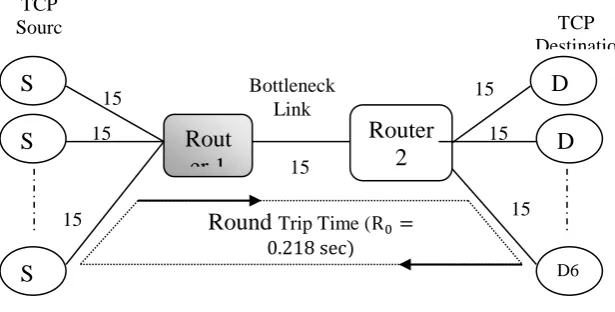
Figure (3) shows the TCP network topology that will be used as a case study taken to study and evaluate the proposed designed controllers. The simulation is conducted for a TCP network with two routers connected through a single link (Bottleneck link). The bottleneck link has a bandwidth capacity (C) of 3750 packets/sec. For a packet size of 500
bytes, the correspondence link capacity will be 15 Mbps. The same bandwidth link capacity is used for the other links that are connecting the sources and the destination nodes. The Round Trip Time (R0) is taken to be 0.218 second. The desired queue size is initially set to 300 packets and the propagation delay is 5 msec. The number of TCP flow sessions (N) is initially set to be 60 for both the source and the destination. The maximum buffer queue length in the AQM router is taken to be 800 packets. The AQM mechanism with the proposed hybrid Multi resolution wavelet PID is configured at A and the drop Tail is used at other gateways. All the simulations are carried out by using MATLAB Version 8.3(R2014a).
Figure 3: Network Topology Case Study.
A. Simulation Results
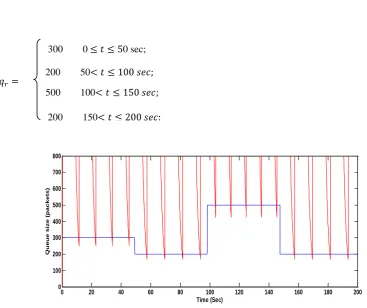
Consider the TCP/AQM model with network parameters as set in the previous section and the reference input (queue size) which has rectangular form changes every 50 seconds as shown in equation (8). First, the simulation is done for the system without controller as shown in Fig. (4).
TCP Sourc e
s
TCP Destinatio ns Bottleneck LinkRound
Trip Time (R0=eq. (12)
Figure (4): System response without Controller
It is clear from Fig.(4) that the system is unable to track the reference queue length nearby to the desired level, where the system goes into a sustained oscillation with continuous queue overflow. When the input packets exceeding the maximum router buffer size, the system shows high packet dropping and large queue delay and the network becomes unstable
1) PID Controller
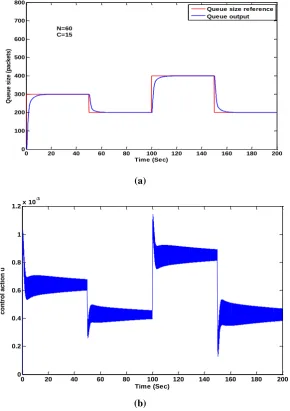
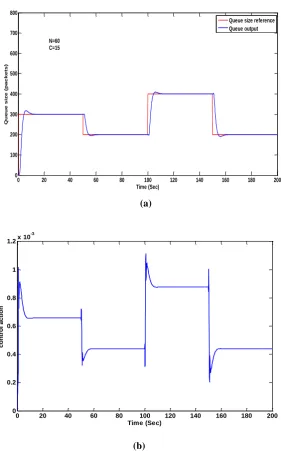
In order to improve the network utilization, the classical PID-controller is applied to get a better queue tracking performance. For the standard case study, the output queue length response with the PID controller is shown in Fig. (5a). The figure depicts that the router has the ability to get the desired performance, where the desired queue length is achieved within the buffer size of the router without any congestion. The controller signal u(t) for the PID controller is shown in Fig.(5b). The controller parameters are tuned by trial and error strategy:
𝐾𝑝= 3 × 10⁻⁶, 𝐾𝑖= 2 × 10⁻⁶, 𝐾d= 1 × 10⁻⁷
2) The Hybrid Multi Resolution Wavelet PID Controller
The hybrid Multi Resolution wavelet PID controller introduced will be first designed for the standard case study, with a daubechies db2 mother wavelet and three level of decomopsition NUM=3. The PID controller parameters are found to be:
𝑘𝑝= 0. 3 × 10⁻⁷, 𝐾𝑖= 0. 8 × 10⁻⁵, 𝐾𝑑= 0. 9 × 10⁻⁸
and the Multi Resolution Wavelet paramters are found to be:
𝐾𝐻= 1 × 10⁻⁵, 𝑘𝑀1= 1 × 10⁻⁶, 𝐾𝑀2= 1 × 10⁻⁷, 𝐾𝐿= 0
0 20 40 60 80 100 120 140 160 180 200
0 100 200 300 400 500 600 700 800
Qu
eue
si
ze
(pa
ck
ets
)
Time (Sec) 500 100< 𝑡 ≤ 150 𝑠𝑒𝑐;
300 0 ≤ 𝑡 ≤ 50 sec;
200 50< 𝑡 ≤ 100 𝑠𝑒𝑐;
200 150< 𝑡 ≤ 200 𝑠𝑒𝑐;
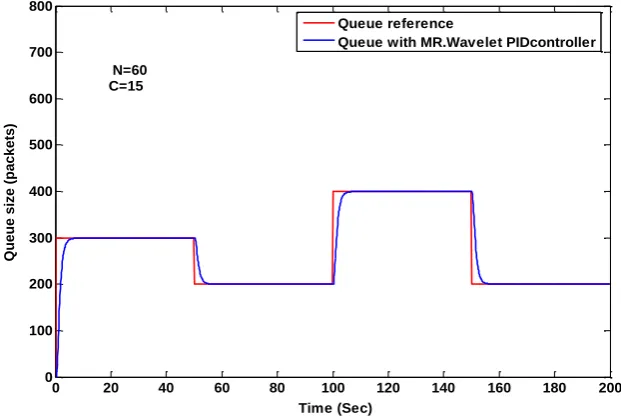
Figure (6a&6b) displays the router output queue length for the standard case study when the hybrid MR.Wavelet PID ( with NUM =3 and db =2 ) is used as AQM controller and its control action respectively.
As can be depicted from Fig. (6 a), the MR. Wavelet PID shows a very good tracking capability for the desired queue size. It enhances the system response, especially in decreasing the (rising time, the settling time. and ISE). Which means that the MR. Wavelet PID has better performance characteristics as proved by the ISE criterion and summarized by Table (1). As a result, it gives better congestion avoidance compared with classical PID controller. The controller action is shown in Fig. (6b).
(a)
(b)
Figure 5: (a) The Output Queue Length using the PID Controller (b) The Controller Action of the PID Controller
0 20 40 60 80 100 120 140 160 180 200
0 100 200 300 400 500 600 700 800
Qu
eue
si
ze
(pa
ck
ets
)
Time (Sec)
Queue size reference Queue output
N=60 C=15
0 20 40 60 80 100 120 140 160 180 200
0 0.2 0.4 0.6 0.8 1 1.2x 10
-3
con
trol
ac
tion
u
As a result, it gives better congestion avoidance compared with classical PID controller. The only disadvantage is the overshoot which means a more packets are added to the buffer, hence increasing the delay and lowering the network throughput. To overcome this, another controller is designed with increasing the number of level NUM to 5 and using db6 filters, the response of the buffer utilization is highly improved as shown from Fig. (7 a). The control action is realized by Fig. (7 b). The MR. Wavelet PID controller parameters are found to be:
k𝑝= 0. 2 × 10⁻⁵; k𝑖= 0.1 × 10⁻⁵; 𝑘𝑑= 0. 9 × 10⁻¹⁰;
k𝐻= 0. 99 × 10−7; k𝑀1= 0.8; 𝑘𝑀2= 0.4; 𝑘𝑀3= 0.3; k𝑀4= 0.6; k𝑙= 0.
(a)
(b)
Figure 6: (a) System response with MR.Wavelet PID controller for num=3, db2.
(b) The controller action of MR. Wavelet PID
0 20 40 60 80 100 120 140 160 180 200
0 0.2 0.4 0.6 0.8 1 1.2x 10
-3
con
trol
ac
tion
Time (Sec)
0 20 40 60 80 100 120 140 160 180 200
0 100 200 300 400 500 600 700 800
Qu
eue
si
ze
(pa
ck
ets
)
Time (Sec)
Queue size reference Queue output
It is proved that by increasing the number of levels and increasing the coefficient of the filter, the overshoot can be eliminated and the overall performance is improved as can be depicted from the ISE.
As a result the MR. Wavelet PID with NUM=5 and db6, gives better congestion avoidance in comparison to the MR.
Wavelet PID with NUM=3 and db2 and the classical PID controllers. The overall performance characteristics for the three controllers are summarized by table (1). .
a) )
(b)
Figure 7: (a) Queue size response with MR.wavelet PID for num=5,db=6
(b) Controller action of the MR.wavelet PID controller
0 20 40 60 80 100 120 140 160 180 200
0 0.2 0.4 0.6 0.8 1 1.2 1.4x 10
-3
con
trol
ac
tion
)
Time (Sec)
0 20 40 60 80 100 120 140 160 180 200
0 100 200 300 400 500 600 700 800
Qu
eue
si
ze
(pa
ck
ets
)
Time (Sec)
Queue reference
Queue with MR.Wavelet PIDcontroller
0 20 40 60 80 100 120 140 160 180 200 0
100 200 300 400 500 600 700 800
Qu
eue
si
ze
(pa
ck
ets
)
Time (Sec)
Queue size reference Queue output N=66
C=15
Table (1): TCP/QAM Response Performance of PID, MR. Wavelet PID for N=60 and C=15Mbps
B. MR. wavelet PID controllers Robustness
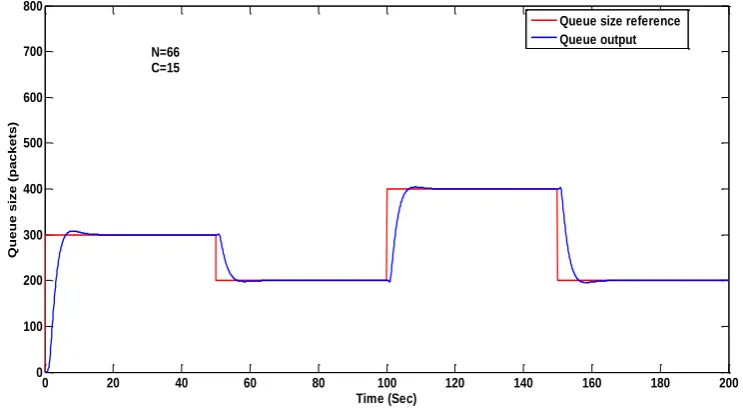
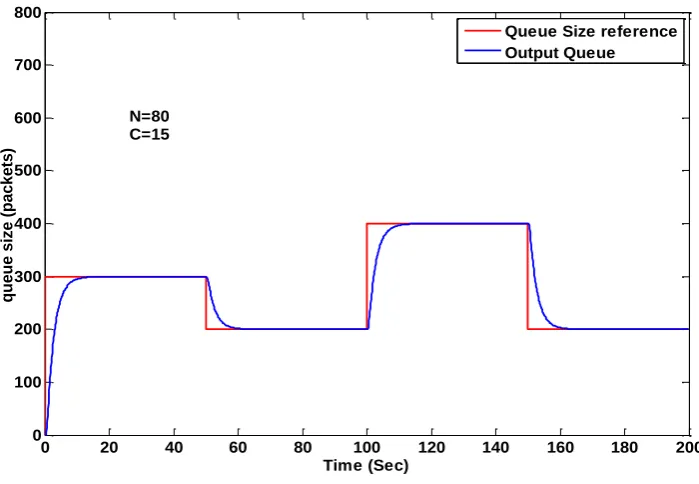
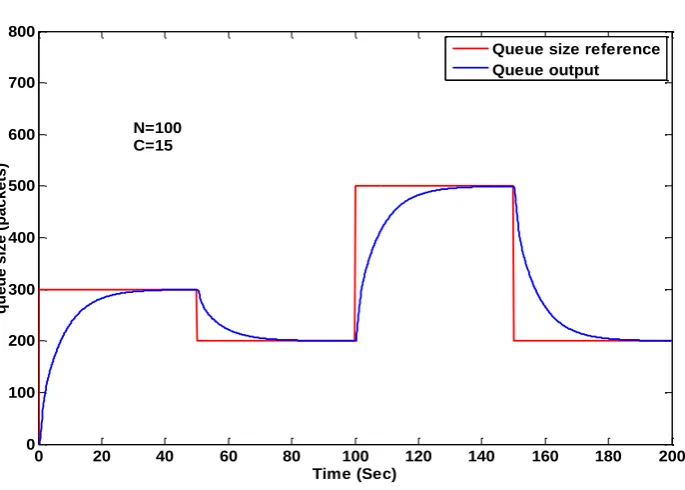
First the number of the TCP flows (N) is increased by (6 nodes), it gets the system response as shown in Figs. (8&9). Figures (8, 9, 10&11) show the effect of perturbing the number of TCP sessions (N) from its nominal value. In Figs. (8&9) the number of TCP sessions (N) is increased by 10% from its original value (N=66) and figure (10) is increased by 33% from original value. In both cases it is noted that the tracking ability of the controller is good reduced if it is compared with its original value (N=60) , while in Figure (11) the number of TCP sessions (N) is increased by (66%), . However, in all cases the MR. Wavelet PID controller succeeds in bringing the queue size near its desired level.
Figure 8: System Response with db 2 and NUM=3 with (N=66 nodes)of TCP Flows.
Controller type rise time (sec) settling time (sec)
overshoot
% packets ISE
classical PID 4.3 20 0 0.4627
MR. wavelet PID with num=3 2 11 17 1.66𝑒−8
MR wavelet pid with NUM=5 1.8 8 0
Figure 9: System Response with db 6 and NUM=5 with (N=66 nodes)of TCP Flows
Figure 10: System Response with db 6 and NUM=5 with (N=80 nodes)of TCP Flows
0 20 40 60 80 100 120 140 160 180 200
0 100 200 300 400 500 600 700 800
queue size (packets)
Time (Sec)
Queue size reference Queue Output
N=66 C=15
0 20 40 60 80 100 120 140 160 180 200
0 100 200 300 400 500 600 700 800
queue size (packets)
Time (Sec)
Queue Size reference Output Queue
Figure 11: The Queue Length Response with the MR. Wavelet PID Controller for NUM=5,db=6 and N=100
XI. CONCLUSIONS
In this paper the hybrid Multiresolution Wavelet PID controller was designed for AQM routers in TCP network and the performance was tested for different scenarios. The objective was carried out using the proposed controller via controlling the buffer queue length at a certain queue reference level to prevent buffer overflow, hence minimizing the packet dropping and reduce delay occurring. The router queue length using this controller shows good performance characteristics to queue reference for the standard case study of 60 TCP flow session and link capacity of 15 Mbps. Also it is compared with the standard PID and proved to be better in term of the ISE criterion.
REFERENCES
1. X. Laisheng, W. Zhengxia, P. Xiaohong "Research on Congestion Control Model and Algorithm for High-speed Network Based on
Genetic Neural Network and Intelligent PID" IEEE Wireless Communications, Networking and Mobile Commuting, pp. 1-6, 2009.
2. A. Al-Hammouri, "Internet Congestion ControlComplete Stability Region for PI AQM and Bandwidth Allocation In Networked Control
", Ph.D Thesis Department Of Electrical Engineering And Computer Science Case Western Reserve University, 2008.
3. R. Fengyuan,L. Chuang, Y. Xunhe, S. Xiuming and W. Fubao "A Robust Active Queue Management Algorithm Based On Sliding Mode
Variable Structure Control " InProceedings of IEEE INFOCOM, 2002.Chen M.S and Yu P.S. (2004), ‘Data Mining: An Overview from a Database Perspective’, IEEE Transactions on Knowledge and Data Engineering, Vol. 8, 866-883.
4. C. Hollot, V. Misra, D. Towsley and W. Gong" On Designing Improved Controllers for AQM Routers Supporting TCP Flows"
InProceedings of IEEE INFOCOM, page 1726-1734, USA, 2001.
5. F. Yanfei R. Fengyuan L. Chuang "Design a PID Controller for Active Queue Management", Proceedings of the Eighth IEEE
International Symposium on Computers and Communication (ISCC’03), 2003
6. P. Xiao and Y. Tiao" Design of robust Active queue Management based on Adaptive neural PID", Proceedings of Fifth international
Conference on machine Learning and Cybernetics, IEEE, Pp. 308-313, 2006.
7. J. Kim, J. Park, and Y. Choi " Wavelet Neural Network Controller for AQM in a TCP Network: Adaptive Learning Rates Approach"
International Journal of Control, Automation, and Systems, vol. 6, no. 4, pp. 526-533, August 2008
8. S. Tsotoulidis,A. Safacas,E. Mitronikas, " Multiresolution PID Control of Brushless DC Motor in Fuel Cell Electric Vehicles"
International Conference on Renewable Energy Research and Applications, pp. 20-23 ,Madrid, Spain, October, 2013.
9. A. Sengupta, A. Mukherjee, A. Roy and R.Paul "Application of MRPID Controller on Liquid Level System: A Performance study ",
International Conference on Control, Instrumentation, Energy & Communication,india,2014.
0 20 40 60 80 100 120 140 160 180 200
0 100 200 300 400 500 600 700 800
queue size (packets)
Time (Sec)
Queue size reference Queue output
10. A. Fakhariana, A. Abbasib, "Design of H∞Congestion Controller for TCP Networks Based on LMI Formulation", Journal of Optimization in Industrial Engineering 17 51-56 , Iran, 2015
11. C.V. Hollot, V. Misra, D. Towsley and W.Gong, "A Control Theoretic Analysis of RED", In Proceedings of IEEE INFOCOM, USA ,
2001.
12. K. M. Lee, J. H. Yang and B. S. Suh, “Congestion Control of Active Queue Management Routers Based on LQ-Servo Control”,
Engineering Letters, ISSN 1816-093X, 2008.
13. J.Tolentino1, A.Silva, L. Velasco and O. Ramirez2, "Wavelet PID and Wavenet PID: Theory and Applications", Intech, 2012.
14. S.Parvez and Z. Gao , " A Wavelet-Based Multiresolution PID Controller", IEEE Transactions On Industry Applications, Vol. 41, No. 2,