An Embedded Electric Meter Using ARM,
ZigBee and GSM
Uday A. Takte, A.V. Nikalje
M.E. Student, Department of Electronics and Telecommunication, Deogiri Institute of Engineering and Management
Studies, Aurangabad (MS), India
Assistant Professor, Department of Electronics and Telecommunication, Deogiri Institute of Engineering and
Management Studies, Aurangabad (MS), India
ABSTRACT: I design an embedded electric meter based on Zigbee data acquisition system in view of the complicated cables and accident potential in the process of data acquisition of electric meter. Combined wireless Zigbee communication technology with data acquisition system, I build wireless data acquisition system based on ARM Cortex M3 processor, zigbee chip and GSM module in the embedded electric meter which can reduce the cable connections. This system, which is comprised of ZigBee network and database management system, has many important advantages such as low cost, low power Consumption, and low date rate. The major difference between Zigbee data acquisition system and other data collector is that it realizes wireless data transmission after the A/D conversion. Furthermore, the system is simpler, integrated, anti-interference, stronger mobility and practicability. The system dedicates to automatic meter data collection and energy auditing and management.
KEYWORDS: Global System for Mobile (GSM); Zigbee; Application Resource Manager (ARM); A/D Conversion; network lifetime
I. INTRODUCTION
Traditionally, the electricity meters are installed on consumer’s premises and the consumption information is collected by meter-readers on their fortnightly or monthly visits to the premises. Over the past years, metering devices have gone through improvements and are expected to become even more sophisticated, offering more and more services. Meters in the past, and today in a few countries are electromechanical devices with poor accuracy and lack of configurability. Theft detection is also a challenge. Such meters are limited to providing the amount of energy consumption on site. This method of billing is also not suitable for the electricity supply company because it gives inaccurate account of the overall electricity consumption in the consumer’s area and may ultimately result in errors in future planning of the company. Recent developments in this direction seem to provide opportunities in implementing energy efficient metering technologies that are more precise accurate and error free. Automatic Electric Meter reading is one method reading and processing data automatically with computer and communication. It relieves reading person’s labor intensity and reduces the reading mistake. Through researching the characteristic of main wireless communication protocol, Zigbee is chosen as lower layer communication protocol. With these applications, the Standard is optimized for low data rate, low power consumption, security and reliability. [1]
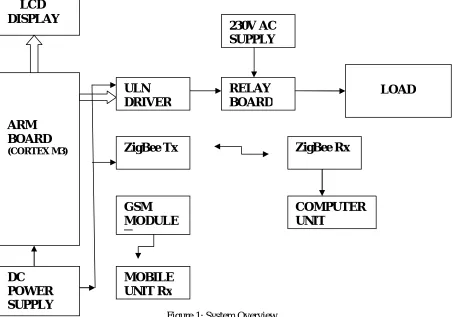
Here we have used the CORTEX M3 ARM controller which is connected to the LCD display and ULN2003 IC, it is again then connected to the Zigbee transmitter which sends decoded data to the another Zigbee receiver which is connected to the computer. 12V power supply is given to controller, Zigbee, GSM and ULN. GSM module is used to send the message to the user and the main office.
II. RELATED WORK
transmission of data using ZIGBEE technology. In [3] authors have designed a system in which there system will work as the prepaid system in that, we can recharge our accounts with some amount and this amount is burned as per the usage in accordance with the current energy tariff. In [4] they have designed a system based on the Zigbee and GSM system in that they have implemented the Wireless Electric Meter Network, implementation of network is based on Zigbee technology. Wireless Electric Meter is used for remote collection of unit count and sending bill on consumer’s meter screen. In [5] the paper presents the design of a simple low cost wireless GSM energy meter and its associated web interface, for automating billing and managing the collected data globally. The proposed system replaces traditional meter reading methods and enables remote access of existing energy meter by the energy provider. Also they can monitor the meter readings regularly without the person visiting each house. In [6] the design and development of the wireless power management system is proposed in this paper. In [7] this paper they described PIC18F46k22 Microcontroller based design and implementation of energy meter using IoT concept. In [8] this paper they described the design, implementation, and testing of a wireless sensor and actuator network for monitoring the energy use of electric appliances in a home environment. In [9] this paper they have mentioned the Zigbee Digital Power meter (ZPM) is a single phase digital kWh power meter with embedded Zigbee modem which utilize the Wireless sensor network to send its power usage reading using information back to the energy provider wirelessly. In [10] they have designed an embedded electric meter based on bluetooth data acquisition system in view of the complicated cables and accident potential in the process of data acquisition of electric meter. In [11] they have designed an embedded electric meter based on Zigbee data acquisition system in view of the complicated cables and accident potential in the process of data acquisition of electric meter. In [12] this system they have mentioned the system that describes the theft detection and energy distribution system.
III.PROPOSED SYSTEM
Proposed system is mainly depends upon ARM controller. Zigbee modules, GSM module, GUI and ULN driver are the key parameters of system. Figure 1 illustrates conceptual diagram of it.
Figure 1: System Overview
ARM
BOARD
(CORTEX M3)
LCD
DISPLAY
ULN
DRIVER
RELAY
BOARD
230V AC
SUPPLY
LOAD
DC
POWER
SUPPLY
GSM
MODULE
Tx
ZigBee Rx
ZigBee Tx
COMPUTER
UNIT
A. ARM Board Cortex M3:
In ARM board the Zigbee module is connected to the Tx and Rx pins of ADC respectively. The relays are connected to the controller’s four ports respectively, GSM module is connected to Tx pin. 12V DC power supply is given to the controller. The ARM cortex M3 is industry leading 32-bit processor, for low power cost sensitive, highly deterministic real time embedded applications. The processor is highly configurable enabling a wide range of implementations from those requiring memory protection and powerful trace technology to cost sensitive devices requiring minimal area.
B. ZigBee Module:
ZigBee is an IEEE 802.15.4 specification for a suite of high level communication protocol used to create personal area networks with small, low- power digital radios. In this system the zigBee module we have used is XBee XB24-Z7WIT-004 module from digital Series 2 improves on the power output and data protocol. This module is operate on3.3V @ 40mA at 250kbps Max data rate whose output is 2mW output (+3dBm) Its range is 400ft (120m) range it will have the built-in antenna It is fully FCC certified It will have 6 10-bit ADC input pins It can have 8 digital IO pins. Here ZigBee module transmitter is used for the transmission of digital data towards the computer unit. Another ZigBee module is used at the receiver end which is connected to the computer unit.
C. GSM Module:
GSM module here we have used for sending the message to the customer. The power leakage message, the warning message and the billing message is send through the GSM module. GSM Modem-RS232 is built with Dual Band GSM engine- SIM900A, works on frequencies 900/ 1800 MHz. The Modem is coming with RS232 interface, which allows you connect PC as well as microcontroller with RS232 Chip (MAX232). The baud rate is configurable from 9600-115200 through AT command. The GSM Modem is having internal TCP/IP stack to enable you to connect with internet via GPRS. It is suitable for SMS, Voice as well as DATA transfer application in M2M interface. The onboard Regulated Power supply allows you to connect wide range unregulated power supply . Using this modem, you can make audio calls, SMS, Read SMS, attend the incoming calls and internet through simple AT commands.
IV.PERFORMANCE ANALYSIS
Before execution of this system I have studied the different meter systems and their reading systems, from that study I have seen that the meters that we are using in now a days are very outdated systems there are so many drawbacks in those systems. So to overcome those drawbacks I have design one embedded electric meter using ARM, ZigBee and GSM module.
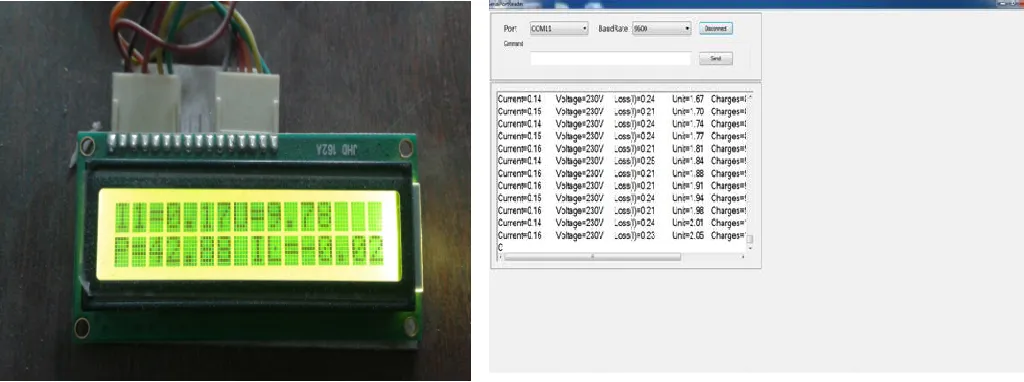
In this system the continues changes in the current and voltage is being showed on to the computer screen and at the receiver on the LCD screen that will be shown in the figure 2. The computer screen shows the change in current and voltage in that the term Iloss is used to show the transmission loss during the distribution line
Figure 3. Shows the messages that have been send from the designed meter to the consumer and the distribution company.
Figure 3: Messages Received at the receiver side The messages send accordingly are like,
i. Power leakage message to both the ends ii. Power limit message
iii. Used power billing message
V. CONCLUSION AND DISCUSSION
In this paper, a wireless Automatic meter Reading System based on ARM, Zigbee and GSM Technology is proposed. Short distance Zigbee transmission can be achieved a high accuracy. The system proposed has many significant excellences such as wireless, moveable, low power consuming, high accuracy. The use of embedded system improves stability of wireless data transmission. The system is simpler, integrated, anti-interference, stronger mobility and practicability. It has many important advantages such as low cost, low power Consumption, reduced complexity of cables.
REFERENCES
1. S.Gopinath, R.Suresh, T.Devika, N.Divya, N.Suthanthira Vanitha,” Embedded Based Digital Energy Measurement for Improved Metering and Billing System” International Journal of innovative research in electrical, electronics, instrumentation and control engineering Vol.1, issue9, December 2013.
2. Mrs. Akanksha Shukla, Shobhit Saxena, Siddhant Singh and Sohil Jain, “Embedded System based Prepaid Electricity Metering & Billing”, International Journal of Emerging Trends in Electrical and Electronics International Journal of Emerging Trends in Electrical and Electronics (IJETEE) Vol. 2, Issue. 4, April-2013.
3. Mahesh Chahare, P.T. Karule, “Wireless Embedded Electric meter reading based on ZigBee Technology”, ISSN (PRINT) : 2320 – 8945, Volume -1, Issue -6, 2013.
4. Ashna K, Sudhish N. George “GSM Based Automatic Energy Meter Reading System with Instant Billing ”, 978-1-4673-5090-7/13/$31.00 ©2013 IEEE.
5. Anita S. Walde, Rucha Bhalerao, “Wireless Intelligent Power Management System”, International Journal of Advanced Research in Electrical, Electronics and Instrumentation Engineering, Vol. 5, Issue 2, February 2016.
6. Darshan Iyer N, Dr. K A Radhakrishna Rao, “IoT Based Electricity Energy Meter Reading, Theft Detection and Disconnection using PLC modem and Power optimization”, Vol. 4, Issue 7, July 2015.
8. Sarwade Narasing J., Dehadray Bhushan M., Khedkar Sachin T., Turkane S. S. , “An Intelligent Energy Metering Using Zigbee and Arm7”, IOSR Journal of Electronics and Communication Engineering (IOSR-JECE) Volume 9, Issue 3, Ver. I (May - Jun. 2014), PP 01-04.
9. Peng Xuange, Xiao Ying, “An embedded electric meter based on Bluetooth data acquisition system”, Second International Workshop on Education Technology and Computer Science, 978-0-7695-3987-4/10 $26.00 © 2010 IEEE DOI 10.1109/ETCS.2010.624
10. Bhushan D. Sawarkar, Snehal S. Golait, “A Review Paper on Automatic Meter Reading and Instant Billing”, Vol. 4, Issue 1, January 2015.
11. Kadu Rahul N., Prof. Shaikh S.A., Prof. Turakne S.S., Prof. Taware S.S., Prof. Aher V.A., “An Embedded Electric Meter based on ARM 9 and ZigBee Technology”, International Journal of Computer Technology and Electronics Engineering (IJCTEE), Volume 2, Issue 3, June 2012.
12. Kalaivani.R, Gowthami.M, Savitha.S, Karthick.N, Mohanvel.S, “GSM Based Electricity Theft Identification in Distribution Systems”, International Journal of Engineering Trends and Technology (IJETT), Volume 8 Number 10- Feb 2014
BIOGRAPHY