Effective Crater Detection Based on Angular
Radical Partitioning (ARP) Gist Features
Jyoti Patil1, Srinivasa Narasimha Kini2,
M.E. Student, Department of Computer Engineering, Jayawantrao Sawant College of Engineering, Pune, India 1
Asst.Professor, Department of Computer Engineering, Jayawantrao Sawant College of Engineering, Pune, India2
ABSTRACT: Craters area unit the foremost torrential landform on the world surface, which helps to find key hints to planetary science. Because of varieties in the landscape, enhancing, and measure, remote identify pictures try to distinguish craters and in addition it need an effective crater element extraction method. In this paper, the technique presented is for crater detection and fitting a circle after determining the position and orientation of the craters. In this paper, we report this issue applies ARP Gist features, which can give remarkably compelling depictions on crater surrounding edges and overall structure. The current discovery technique of craters has three important steps. Before starting, we have to separate all candidate craters patch present on planet surface by using edge based methods and Hough transform. Second, with the help of preparing test calculate the gist features. Third, Craters finding is led by applying Gist features vectors with random forest classification. In the proposed system crater detection methods are compromise of three steps, starting with finding all candidate craters on MOC (Mars Orbiter Camera) image using canny edge detector and Hough transform. Second, with the help of Training Samples to generate ARP (Angular Radical Partitioning) Gist features. And last Random Forest Classification is used to classify craters detection with the help of features vector. Finally compare result by efficiency and time graph for the existing and proposed system. Experimental results shows accuracy and efficiency for the proposed system is better than the existing system.
KEYWORDS: Crater Detection, Canny Edge Detector, Hough Transform, Random Forest Classification.
I. INTRODUCTION
Influence Craters are the most analyzed components on Mars between various components. They structure are molded by effects of meteoroids with the Martian surface. Their significance patents from the abundance of data that detailed studied of their transmissions and morphology can deliver. For instance, insights of crater sizes frame the premise for land stratigraphy of Mars [2].
Furthermore, learning of crater morphologies empowers investigations of various exceptional problems in spaceman Geomorphology, for example, the nature of debasement procedures, common varieties ingeologic substantial, and appropriation of subsurface volatiles. Therefore, looking over spaceman craters is an imperative undertaking in planetary exploration [3].Hence, testing and calculating the crater on the world of sun processed structure is a simple effort for world science. Nevertheless, with endless measurements of picture data picked up through tests of Moon, Mars, and distinct planets, manual crater acknowledgment, file, and examination have transformed into a testing and dull undertaking. Thusly, we require successful and trustworthy modified crater disclosure systems.
In last few years, lots of Crater detection algorithm has been proposed to address the difficulties included. Today, as previously, productive crater recognition in planetary pictures stays as an overwhelming assignment because of the accompanying difficulties. Challenge 1: Lack of recognizing elements. Crater, as a landforms arrangement, need solid regular components recognizing them from different landforms developments. Their sizes vary by requests of extent. They much of the time cover, convoluting the assignment of their detachment from foundation Challenge 2: Mixed morphology in crater pictures. Terrestrial surfaces are not homogeneous where shows that change in surface morphology. Challenge 3: Lots of changes measure in sub kilometer hole for high-determination terrestrial pictures.[4] [5].
Hough transform to detect circle [8]. After applying Gabor wavelets on each candidate patch [9]. Calculate craters features using Gabor Wavelets, it works with local band pass filter with orientation and number of scales. The ARP Gist features[1] calculates by Gabor Wavelets using multiple angles. After using vector features list to make classification model to classify craters. Random forest classification is used to select features selection and identify the craters [6]. Finally detect the crater on MOC Datasets [10].
II. RELATED WORK
The Mechanized crater recognition calculations are exhibited in [11] to achieve the picture information. These calculations are also portrayed. Its application displayed on the assortment of distinct Martian geomorphologic sensors and regions. Examples are, Viking Orbiter Camera, Mars Orbiter Camera (MOC), Mars Orbiter Laser Altimeter (MOLA), and High Resolution Stereo Camera (HRSC). S. Liu, W. Ding, and T. F. Stepinski makes dynamic learning stronger with semi-regulation also figure out the problem of a new semi supervised dynamic class determination framework creation in [12].It is used to take the high determination panchromatic planetary images from crater location. D. Lowe represent the strategy for removing incorrect invariant elements from images which will further used to perform the solid. coordination among distinct perspectives of an item or scene in images [13]. R. Honda, Y. Iijima, and O. Konishi developed the crater detection system in [14]. This system is suitable for large-scale database of images. S. Liu and. Ding, [15] implements three procedures for enhancing the identification accuracy by combining characterization with investigation on unlabeled specimens.
III.PROBLEM STATEMENT
Craters are the hugestentity on the surface of planet, which could provide research material for planetary scientist. Due to continuous changes in the terrain, illumination, and scale properties, it is very difficult and challenging task to detect craters on the basis of remote sensed images. This will requires an effective feature extraction method from crater. During CDA development many difficulties arisesincluding size variances, irregular shape, and Complex terrains. These problems are overcome by using Gist features, which will provide effective crater’s local edges and global structure description.
IV.MATHEMATICAL MODEL
System S is represented as S= {I, B, P, F, TC, R} 1. Input Images
I= {i1, i2, i3, ….in }
Where I is the set of input image of Mars Orbiter Camera (MOC). 2. Finding Boundary using Canny Edge Detector
B= {b1, b2, b3, …..,bn}
Where, B is the set of Finding edge Image and b1, b2, b3, …..,bnare the number of edge Images which are find.
3. Circle Candidate patch apply Hough Transform on Boundary Image. P= {p1, p2, p3, ….pn}
Where, P is represent as a set of Circle Candidate and p1 , p2 , p3 , ....pn are the number of Circle Candidate patch. 4. Feature Selection:
F= {G, A} Where,
G= {g1, g2, g3, ….gn}
Where G is the group of ARP Gist feature.
First Candidate Patch Divide into Np × Np block patches, the ith block patch is marked as Pi, i = 1, . . . , Ng, Ng =
Np × Np.
( , ) = ( − ) + ( / − / ) + ( − ) (1) =scene openness
D is Euclidean distance
5. Training and Classification TC = {tc1, tc2, tc3 ...tcn}
Where TC is the set of classification and tc1, tc2, tc3 ...tcn represent as a number of classes.Calculate the distance between two craters in dataset by using Euclidean formula, if firstcrater = center point ( , ) = ( − ) + ( − ) (p1, p2) and second crater q =center point (q1, q2) then the distance is given by
( , ) = ( − ) + ( − ) (3) 6. Detection Results
R = {r1, r2, r3 ...rn}
Where R is the set of Detection Results and r1, r2, r3 ...rn represent as a results. Mark the red boundary to detection result in MOC datasets.
Gabor wavelet
, ( , ) = exp − + (4)
= ( + ) (5)
y = a (xsinθ+ ycosθ) (6)
θ= π+ 1 (7)
Where n is number of orientation in gabor wavelet and m is scale of mother wavelets [15]. is the spatial aspect
ratio. λ present wavelength of the sinusoidal factor and is phase offset. is orientation of the normal to the parallel stripes of a gabor method and is the standard deviation of gaussian factor.
V. PROPOSED ARCHITECTURE
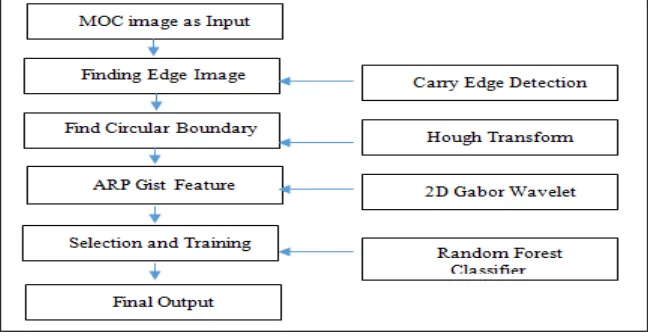
The below figure 1 shows the architectural view of implement system. The explanation of the system is as follows. In this proposed system which detect crater from MOC image, initially input image is uploaded, after this apply canny edge detector to detect edge boundary of image. In canny detector process first apply gaussian filter to make image smooth and remove noise from image after that find the intensity gradients of picture. After that apply non-maximum suppression and apply minimum threshold to detect all the craters edge by using hysteresis track the edge on image. At last the identification of edges by smothering the various edge that are less show and not connected to strong edges [4].After collecting edge apply Hough Transform. In Hough Transform first make 3D Hough values for non-zero values then drawing circle [5]. After finding candidate patch, apply 2D Gabor Wavelet to each candidate patch. Calculate craters features using Gabor Wavelets, it works with local band pass filter with number of orientation and number of scales The ARP Gist features calculates by Gabor Wavelets using multiple angles and make vector features list. After using vector features list to make classification model to classify craters. Random forest classification is used to select features selection and identify the craters [6] .Finally detect the crater on MOC Datasets.
A. Proposed Algorithm
In this section we discuss the algorithm of the proposed system and algorithm for detection crater on MOC datasets.
Algorithm 1: Proposed System Algorithm
Input: Mars Image contain Craters Output: Detect Crater location in Image Process:
Step 1: Input Crater Image.
Step 2: Apply canny edge detector for edge detection.
Step 3: Apply Gaussian filter and calculate intensity gradients of the picture.
Step 4: Select non-maximum suppression and apply minimum threshold to detect all the craters edge. Step 5: Apply Hough transform to detect circle boundary.
Step 6: After getting candidate patch apply2D Gabor wave to each patch and getting vector features list. Step 7: After using vector features list to make classification model to classify craters
Step 8: Random forest classification is used for features selection and identification of crater. Step 9: Finally detect all the crater on MOC Datasets.
VI.RESULT AND DISCUSSION
This system used the MOC Datasets[10] for the detecting Craters. The Crater image as an input, we apply Canny Edge Detector and detect Edge Image as an input for Hough Transform. In proposed system detection of crater image is expected to be from MOC datasets as MOC datasets are the one which are used by the researchers. As discuss earlier the present system are using these features for detection of craters in proposed system detection of craters by using ARP Gist features.
Fig 2. Input Image Fig 3. Output Image
The Fig. 2 and 3 shows the input and output image. Output images represent the number of carter detected.
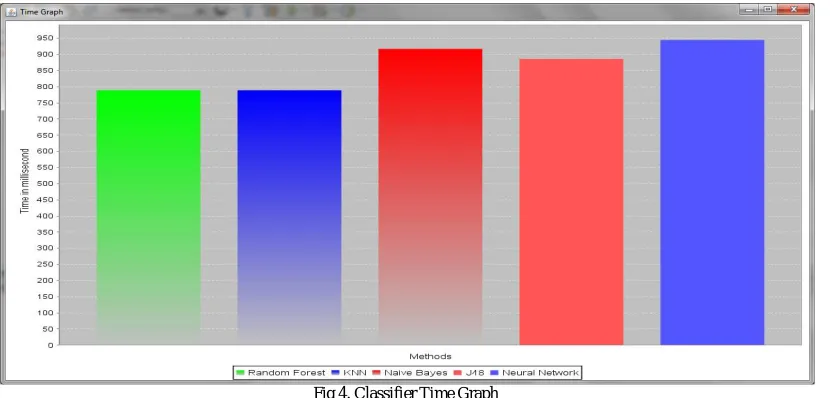
TABLE I. CLASSIFIER TIME TABLE
Methods Time (in miliseconds)
Random Forest 780
KNN 790
Naive Bayes 920
J48 880
Neural Network 940
Fig 4. Classifier Time Graph
The fig. 4 shows the time graph of a classifier where random forest classifier take less time than the other methods. To classify the crater in image taken from MOC dataset, we use 5 classifier namely Random forest, KNN, Naïve Bayes, J48 and Neural Network. Among these classifier, random forest is faster than other for feature selection and crater classification. Random forest efficiently works on large dataset as well as it can manage more input variables without deleting old variables.
TABLE II. ACCURACY TABLE
Gist ARP Gist Feature Accuracy 86 90
Efficiency 87 93
Fig. 5. Accuracy Graph
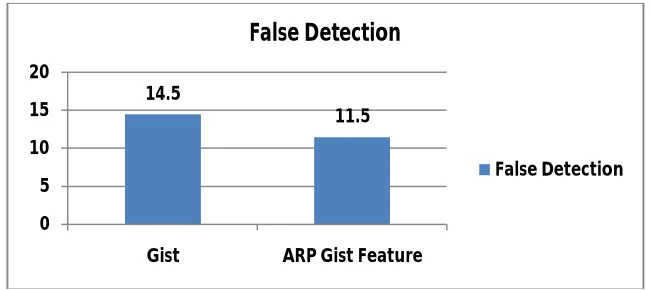
TABLE III. FALSE DETECTION GRAPH
Gist ARP Gist Feature
False Detection 14.5 11.5
86
90
87
93
82 84 86 88 90 92 94
Gist ARP Gist Feature
Accuracy
Fig. 6. False Detection Graph
In our system we use ARP gist for feature selection instead of Gist feature selection method because Gist feature selection method uses coarse spatial layout from N by N rectangular partitioning of images. To increase the accuracy and efficiency and to reduce the false detection rate as shown in Fig. 5, 6 and 7 respectively, we use ARP gist instead of simple gist method because ARP uses coarse spatial layout as well as finer angular layout in image with crater.
VII. CONCLUSION AND FUTURE WORK
The paper proposed automatic craters detection based on ARP Gist features. Random forest classification is used to select features selection and identify the craters. There are many methods for crater detection and some manual methods for crater detection but these methods took more time compared to our method and Efficiency of our method is high compared to others method so that f-score of our method is high compared to the existing system.
In the future, we will plan to implement our method on different territories on mars and detecting different dimension of shape on different planets. We will try to make a system which can detect the holes on the road while travelling. So this will help to people for safe drive. Also we will plan to identify whether craters are formed by gravitation waves?.
REFERENCES
1. JyotiPatil, Dr. Srinivas Narasimha Kini : A Survey Paper on Crater Detection. In: International Journal of Science and Research. PP 81—85 (2015)
2. Jihao Yin, Member, Hui Li, and Xiuping Jia: Crater Detection Based on Gist Features.In: IEEE journal of selected topics in applied earth observations and remote sensing, (2015)
3. J. R. Kim, J. P. Muller, and S. V. Gasselt : Automated crater detection, a new tool for mars cartography andchronology. In: Photogramm. Eng.Remote Sens. pp. 1205--1217, (2005)
4. Bandeira , W. Ding , and T. F. Stepinski : Detection of Sub - kilometer craters in high resolution planetary images Using shape and texture features. In: Adv. Space Res (2012)
5. H. Li and J. Yin : Crater detection based on local non negative matrix factorization. In:Proc. IEEE Conf. 33rd Geosci. RemoteSens. Symp.(IGARSS). pp. 3050--3053Canada (2014)
6. V. Lepetit and P. Fua.:Keypoint recognition using randomizedtrees. In:IEEEPattern Recogn. Mach. Intell, pp. 1465—1479 (2006)
7. B. D. Bue and T. F. Stepinski: Machine detection of Martian impact craters from digital topography data. In:IEEE Trans.Geosci. Remote Sens. (2007)
8. G. Troglio and J. L.Moigne : Automatic extraction of ellipsoidalfeatures for planetary image registration. In: IEEE Geosci.Remote Sens. Lett, (2012)
9. S. Grigorescu, N. Petkov, and P. Kruizinga: Comparisonof texture features based on Gabor filters. In: IEEE Trans.Image Process. pp. 1160-1167 (2002)
10. MOC Dataset, online available:http://www.msss.com/moc gallery
11. J. R. Kim, J. P. Muller, and S. V. Gasselt : Automated crater detection, a new tool for mars cartography and chronology. In:Photogramm. Eng.Remote Sens. pp. 1205--1217(2005)
12. S. Liu, W. Ding, and T. F. Stepinski. Semi-supervised based active class selection for automatic identification of sub-kilometer craters. In: 7th Int.Symp. Image Signal Process. Anal. pp. 615–620. Canada (2014)
13. D. Lowe : Distinctive image features from scale-invariant key points. In: J. Computer Vis. pp. 91--10, (2004). 14.5
11.5
0 5 10 15 20
Gist ARP Gist Feature
False Detection
14. R. Honda, Y. Iijima, and O. Konishi. : Mining of topographic feature from heterogeneous imagery and its application to lunar craters. In: Prog.Discovery Sci., pp. 395–407 (2002)
15. S. Liu and. Ding: Adaptive selective learning for automatic identification of sub-kilometer craters. In: eurocomputing, pp. 78—87(2012)