Enhancing OSPF Routing Protocol in
Dual-Stack Enterprise Networks
Adarsh Misra1, Harsha Chawla 2
M. Tech Student, Department of CSE & NGF College of Engineering &Technology, Palwal, Haryana, India 1, Asst. Professor, Department of CSE & NGF College of Engineering &Technology, Palwal, Haryana, India 2
ABSTRACT: With the growth of IPv6, various IPv6-IPv4 translation systems for communication between IPv4 networks and IPv6 networks have been introduced. The paper showed an IPv4-IPv6 translation technique by utilizing network Address and simulated based on Petri nets that improve the OSPF routing Protocol using IPv4-Pv6 translation system. The paper introduces a translation scheme, which is based on determining two public addresses (IPv4 and IPv6) for every communicating session, understanding the obtained datagram, fetching and identifying the header, transformation of the datagram to the destination atmosphere, converting the header, and then transferring the datagram to the destination address. This mechanism is motivated by the fact that a host only utilize a small amount of port no. to link with others (Some mainstream operating systems also restrict the maximum no. of concurrent TCP links of a host). Additionally, the translation technique deals with the bi-directional operation that converts the obtained packet into the destination atmosphere based on identifying two public addresses for the two different atmospheres (IPv6 and IPv4 atmosphere).
KEYWORDS: Modeling, IPv6, IPv4, Translation, Petri nets
I. INTRODUCTION
The recent concerns about IPv4 address space exhaustion increased the attention provided to IPv6 deployment. Existed globally-addressable space on the IPv4 Internet is reducing. It is hard to evaluate the rate of reduction, and even one or two very large-scale applications that need global address space could exhaust most of the space that can be assigned without interruption to available subscribers and applications. Even an expansion of dedicated Internet links in several countries, if performed utilizing IPv4, could considerably exhaust the left IPv4 address space. IPv6 (Internet protocol, version 6) was formulated by the Internet Engineering Task Force (IETF), initiated in 1993, in reply to a series of perceived issues, mainly regarding current exhaustion, IP version 4 (IPv4)
occur in phases with a few IPv6 nodes proposed into an IPv4 network and the no. slowly increasing over time till sometime in the future when the whole network becomes IPv6 [5,6,7]. Hence, it is essential to resolve IPv4/IPv6 address translation.
II. RELATED WORKS AND RESEARCH MOTIVATION
IPv4 was broadly deployed and utilizes 32-bit for both source and target IP addresses which restrict the address space to 4.3x10⁹ possible unique addresses. Some of these addresses are reserved for particular tasks (in multicast addresses or private networks). IPv4 has some drawbacks with a lack of IP address spaces, the needs for security at the Internet layer, and the increment on quality of services (QoS) requirements. The enhancement from IPv4 to IPv6 offers a platform for new Internet service that will be needed in the coming future in addition to header format and size simplification [8]. Additionally, IPv6 addresses come in three different kinds: Unicast, Multicast, and Any cast; where every address type is utilized to determine if the forwarded packets are targeted for one or many machines [9,12]. Hence, IPv6 has many characteristics i.e. the novel header format with least header overhead, huge address spaces, better support for QoS, built-in security, and improved support for Mobile IP. The issue of porting available applications to IPv6 has been so far addressed by various researchers, involving companies and academic institutes. A white paper by Microsoft [13] concentrates on Windows applications, but simultaneously provides some basic guidelines that use any application for any operating system. IPv6 offers several advantages over IPv4 technique, but IPv6 deployment needs co-existence with IPv4 for some time period for enabling IPv4 network subscribers to interact with their old applications [11,12]. A no. of techniques have been developed for maintaining the transition from IPv6 to IPv4 and vice versa. There are three significant techniques that have already evolved; Tunnelling, Dual-Stack, and Translation. The Dual-Stack Method introduces to utilize the dual stack IP scheme based on IPv4 addresses allocated dynamically only when required, and the usage of IPv4 over IPv6 tunnelling for crossing the local IPv6 network before accessing the outer IPv4 network. But this technique has a drawback that all the edge nodes require edge nodes advanced to run IPv4 as well as IPv6 protocols [10,11]. These edge nodes require to be able to support dual addressing techniques, dual management routing protocols as well as having enough memory for both IPv6 and IPv4 routing tables. The tunnelling scheme can be utilized when two hosts that are positioned in two different IPv6-only zones wish to interact with one another by passing their packets via an IPv4-only zone, in this case the IPv6 packet will be encapsulated in an IPv4 packet to be passed via the IPv4-only zone. The tunnelling technique endures from the increment of the network traffic overhead (as a result of encapsulating IPv6 packets in IPv4 packets).
Several translation techniques are introduced i.e. Network Address Translation Protocol Translation (NAT-PT), Stateless IP/ICMP Translation (SIIT), and Network Address and Port Translation Protocol Translation (NAPT-PT) [12].The translation technique has many drawbacks i.e. the no. of simultaneous links and the translator capacity. Additionally, some security protocols i.e. IPSec are not compatible with the translation device [13].
III. THE IPV4-IPV6 TRANSLATION SYSTEM
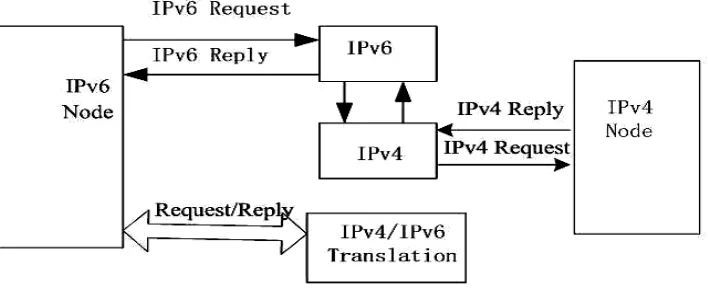
Fig. 1: IPv4 and IPv6 address structures
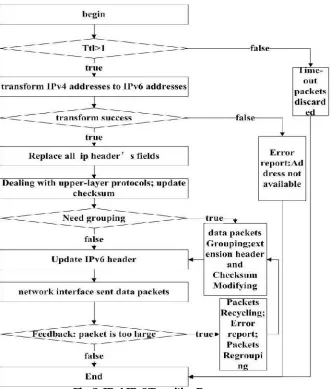
The principle rule of address translation is to set up the mapping technique between receiver and sender, which can map message sequence on a specific protocol to another protocol sequences. Protocol conversion is a procedure of the mapping from one sequence to another. The fundamental operation of IPv4-IPv6 translation is the mapping of the IP header between the two protocols, substituting the header from sender to recipient; whether the higher layer of the two protocols carries out the similar substitution based on differences among them [13,14,15]. In RFC6052 [15], a basic framework of stateless address translation is described. The IPv4 and IPv6 address structures are shown by Figure 1. The IPv6 address header is simplified by neglecting or setting default for some information fields in the IPv4 protocol. Generally, the header of the two protocols is quite same as that some fields can be directly copied between two protocols. Of course, others require to carry out translation. If the IPv6 data packets are needed to address the neighbour discovery protocol, it is addressed; else, IPv4 packets and IPv6 packets continue along the similar way to determine the translation. Then according to the several translation direction, packets are transferred to the corresponding translation processing module. The translation processing module processes modified data packets and produces new packets. At last, the processed data packets are directly forwarded to the network interface. Table I is IPv4-IPv6 Transition Mapping. The system work flow can clearly define the work flow of the IPv6 and IPv4 translation mechanism (as illustrated in Figure 2).
Fig. 2: the IPv4-IPv6 address translation System
to convert ARP request and reply and to manage the ARP table. If the value of packet type is equal to 0x08DD, it is an IPv6 packet [16].
IPv4 to IPv6 transition detailed procedure defines the IPv4 and IPv6 translation details, as illustrated in Figure3. These steps as follow:
(1)To evaluate whether the value of IPv4 packet TTL field is equal to 1. If the value is equal to 1, the lifetime of data packets has been used up. The packet will be dropped. The system will wait to achieve next data packet.
(2)According to the address mapping table, the IPv4’s source address and destination address are translated into IPv6’s address, and a novel IPv6 packet source address and a new destination address are created. If there is no address mapping table to determine the corresponding IPv6 address during translation, an error return: the address is not existed.
(3)According to translation algorithm, the IPv4 packet is transformed into an IPv6 data packet one by one field in accordance with each.
(4)According to the higher-layer protocol type, call suitable functions to deal with UDP, TCP, or ICMP packets, and a new checksum is computed.
IV. MODELLING AND ANALYSIS OF IPV4-IPV6 ADDRESS TRANSITION PROCESS
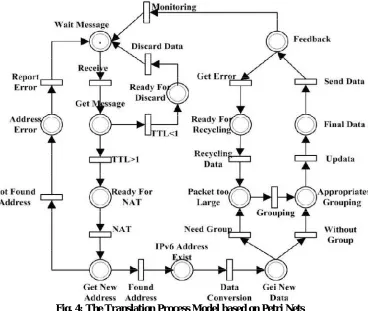
Petri nets are broadly utilized in several application domains for its flexibility and simplicity in presenting dynamic system nature. Their inherently asynchronous concurrent semantics matches that of some physical systems of interest. For instance, they are very appropriate to define a networks architecture, protocols and services. Petri nets have benefits in simulating, analysis, and verification due to their intuitive graphical representation and right mathematical theory and their wealth of analytical mechanisms and tools [17, 18,19]. According to the above system flow chart and the described flow chart, the corresponding Petri translation model was set up besides explaining the function of IPv4-to-IPv6 converter by the setting up Petri net model, it is also
Fig. 4: The Translation Process Model based on Petri Nets
V. RESULT
Throughput can be described as the ratio of the total amount of data arrive a destination node from the source node. The time it consumes by the destination node to obtain the last message is known as throughput. It can be represented as bytes or bits per seconds (byte/sec or bit/sec). A greater throughput is absolute choice in each network. In fig 5. throughput comparison of enhanced OSPF and normal OSPF has been done. Clearly states that our proposed techniques presents better throughput as compared with normal OSPF has greater
Figure 5: throughput of OSPF and enhanced OSPF.
VI. CONCLUSION
The requirement for Internet IP addresses is frequently developing with huge information explosion, but the current IPv4 protocol cannot meet the internet requirements. It is not possible to expect a fast, centrally coordinated cutover. To build the entire transition concept viable, the co-availability of both IPv6 and IPv4 must be arranged in a simple and practical way.The IPv6 translation is introduced in this paper by network address. The paper showed an IPv4-IPv6 translation technique by utilizing network Address and simulated based on Petri nets that improve the OSPF routing Protocol using IPv4-Pv6 translation system. The paper introduces a translation scheme, which is based on determining two public addresses (IPv4 and IPv6) for every communicating session, understanding the obtained datagram, fetching and identifying the header, transformation of the datagram to the destination atmosphere, converting the header, and then transferring the datagram to the destination address. This technique utilizes a small amount of port no. to link with others and deals with the bi-directional operation that transforms the obtained packet into the destination atmosphere based on determining two public addresses for the two different atmospheres (IPv4 and IPv6 atmosphere). Additionally, we examined and verified more exactly the correctness and dynamic features of transition by simulating the translation system. To verify the model can iterate the operation after the successful implementation, and data is orderly and complete,
REFERENCES
[1] Grosse, E. and Lakshman, Y. (2003). Network processors applied to IPv4/IPv6 transition, IEEE Network, 17(4), pp.35-39. [2] Ali, A. (2012). Comparison study between IPv4 & IPv6, International Journal of Computer Science Issues (IJCSI), 9(3), pp.314-317
[3] Batiha, K. (2013). Improving IPv6 Addressing Type and Size, International Journal of Computer Networks & Communications (IJCNC), 5(4), pp.41-51
[4] I. Parra, J. (2014). Comparison of IPv4 and IPv6 Networks Including Concepts for Deployment and Interworking, INFOTECH Seminar Advanced Communication Services (ACS), pp.1-13
[5] Sailan, M., Hassan, R. and Patel, A. (2009). A comparative review of IPv4 and IPv6 for research test bed, Proceedings of International Conference on Electrical Engineering and Informatics (ICEEI '09), Malaysia, pp.427-433.
[6] Ahmad, N. and Yaacob, A. (2012). IPSec over Heterogeneous IPv4 and IPv6Networks: Issues and Implementation, International Journal of Computer Networks & Communications (IJCNC), 4(5), pp. 57-72
[7] Arafat, M., Ahmed, F. and Sobhan, M. (2014). On the Migration of a Large Scale Network from IPv4 to IPv6 Environment, International Journal of Computer Networks & Communications (IJCNC), 6(2), pp.111-126.
[8] Wu, P., Cui, Y., Wu, J., Liu, J. and Metz, C. (2013). Transition from IPv4 to IPv6: A state-of-the-art survey, IEEE Communications Surveys & Tutorials, 15(3), pp.1407--1424.
0 1000000 2000000 3000000 4000000 5000000
6 m 12 m 18 m 24 m
OSPF
[9] Wu, Y. and Zhou, X. (2011). Research on the IPv6 performance analysis based on dual-protocol stack and Tunnel transition, Proceedings of the 6th International Conference on Computer Science & Education (ICCSE), pp.1091--1093.
[10] Chen, J., Chang, Y. and Lin, C. (2004). Performance investigation of IPv4/IPv6 transition Mechanisms, Proceedings of the 6th International Conference on Advanced Communication Technology, pp.545--550
[11] Narayanan, A., Mohideen, M. and Raja, M. (2012). IPv6 Tunnelling Over IPV4, International Journal of Computer Science Issues (IJCSI), 9(2), pp.599-604.
[12] Xiaodong, Z. and others, (2009). Research on the Next-generation Internet transition technology, Proceedings of Second International Symposium on Computational Intelligence and Design (SCID '09), pp.380-382
[13] A. Law, W. Kelton, and W. Kelton, Simulation modelin and analysis. McGraw-Hill New York, 1991, vol. 2.
[14] Y. Wang, S. Ye, and X. Li, “Understanding Current IPv6 Performance: A Measurement Study,” in 10th IEEE Symposium on Computer Communications, Jun. 2005.
[15] X. Zhou, R. E. Kooij, H. Uijterwaal, and P. van Mieghem, “Estimation of Perceived Quality of Service for Applications on IPv6 Networks,” in ACM PM2HW2N’06, Oct. 2006.
[16] D. P. Pezaros, D. Hutchison, F. J. Garcia, R. D. Gardner, and J. S. Sventek, “Service Quality Measurements for IPv6 Inter-networks,” in 12th IEEE IWQoS, Jun. 2004.
[17] T.-Y. Wu, H.-C. Chao, T.-G. Tsuei, and Y.-F. Li, “A Measurement Study of Network Efficiency for TWAREN IPv6 Backbone,” International Journal of Network Management, vol. 15, no. 6, pp. 411–419, Nov. 2005.
[18] K. Cho, M. Luckie, and B. Huffaker, “Identifying IPv6 Network Problems in the Dual-Stack World,” in ACM SigComm Network Troubleshooting Workshop, Sep. 2004.
[19] S. Zeadally and L. Raicu, “Evaluating IPv6 on Windows and Solaris,” IEEE Internet Comput., vol. 7, no. 3, pp. 51–57, May/Jun. 2003. [20] R. Sargent, “Verification and validation of simulation models,” in Proceedings of the 37th conference on Winter simulation. Winter Simulation Conference, 2005, pp. 130– 143
[21] A. Law, “Statistical analysis of simulation output data: the practical state of the art,” in Simulation Conference, 2007 Winter. IEEE, 2008, pp. 77–83.
[22] OPNET, Modeler Release, 14th ed. [Online]. Available: http://www.opnet.com/solutions/network_rd/modeler.html
[23] K. Salah, P. Calyam, and M. Buhari, “Assessing readiness of IP networks to support desktop videoconferencing using OPNET,” Journal of Network and Computer Applications, vol. 31, no. 4, pp. 921–943, 2008.
[24] J. Moy, “OSPF Version 2,” RFC 2328 (Standard), Internet Engineering Task Force, Apr. 1998, updated by RFC 5709 [Online]. Available: http://www.ietf.org/rfc/rfc2328.txt