Abstract
EURE, PETER MICHAEL. Evaluation of Agrochemicals in Situations where Spray Solution Application is Delayed. (Under the direction of Drs. David Jordan and Loren Fisher).
Information is limited concerning agrochemicals performance after solution has been
prepared for an extended period of time prior to application. Separate experiments were
conducted in North Carolina from 2007-2010 to determine the influence of delayed
applications of spray solutions (pH 6.7) on efficacy of the residual herbicides diclosulam,
dimethenamid, flumioxazin, fomesafen, imazethapyr, pendimethalin, and S-metolachlor; the
foliar applied herbicides aciflourofen, atrazine, clethodim, dicamba, glufosinate, glyphosate,
imazapic, imazethapyr, lactofen, paraquat, and 2,4-D; the cotton insecticides acephate,
indoxacarb, lambda-cyhalothrin, lambda-cyhalothrin plus thiamethoxam, methomyl,
spinosad, and thiodicarb; the cotton plant growth regulators mepiquat chloride and mepiquat
pentaborate; the cotton defoliants carfentrazone, ethephon, ethephon plus cyclanalide, diuron
plus thidiazuron, and thidiazuron; the tobacco plant growth regulators C8-C10 fatty alcohol,
flumetralin, flumetralin plus maleic hydrazide, and maleic hydrazide; the tobacco ripening
agent ethephon; the peanut insecticide acephate; the peanut fungicides boscalid,
chlorothalonil, fluazinam, priothioconzole plus tebuconazole, pyraclostrobim, and
tebuconazole; and the peanut plant growth regulator prohexadione calcium. Experiments
were also conducted to determine the influence of weed size and delayed applications of
spray solution on the foliar applied herbicides listed above, with the exception of aciflourofen
and imazapic. The fungicides chlorothalonil, priothioconazole plus tebuconazole,
sources with pH of 3.9, 6.7, and 7.9. Each agrochemical was mixed individually into
solution the day of application at intervals of up to 9 days prior to application.
Control of broadleaf signalgrass, common ragweed, and Palmer amaranth was not
affected by diclosulam, dimethenamid, flumioxazin, fomesafen, imazethapyr, pendimethalin,
and S-metolachlor remaining in spray solution for up to 9 days. Entireleaf morningglory
control was higher when these products were mixed 9 days prior to application compared
with shorter intervals of mixing. Delayed application of spray solution did not affect efficacy
of foliar applied aciflourofen, dicamba, glufosinate, imazapic, and 2,4-D. Occasionally,
efficacy of atrazine, clethodim, glyphosate, lactofen, and paraquat either increased or
decreased compared with applying herbicides the day of mixing with differences of 3 to 20
percentage points. The increase in weed size due to delayed application was a more
important factor in affecting weed control than the amount of time herbicide solutions were
prepared prior to application. In cotton, efficacy of ethephon, indoxacarb, methomyl, and
spinosad, thidiazuron was influenced by delayed applications of spray solution. Efficacy of
acephate, carfentrazone, diuron plus thidiazuron, ethephon plus cyclanalide, indoxacarb,
lambda-cyhalothrin, lambda-cyhalothrin plus thiamethoxam, methomyl, thiadiazuron, and
thiodicarb was not affected by mixing interval when evaluated in cotton. Efficacy of the
tobacco plant growth regulators C8-C10 fatty alcohol, flumetralin, flumetralin plus maleic
hydrazide, and maleic hydrazide was not influenced by mixing interval. However, leaf
yellowing by ethephon 5 days after treatment was occasionally greater when spray solutions
were prepared 3 or 7 days prior to application. In peanut, when comparing the fungicides,
performance was not reduced when remaining in spray solution up to 9 days prior to
application. Water quality did influence efficacy of chlorothalonil, prothioconazole plus
tebuconazole, pyraclostrobin, and tebuconazole with respect to canopy defoliation caused by
early leaf spot and late leaf spot. Over all experiments, the magnitude of the effect of
delayed applications of agrochemical spray solutions was relatively minor and most likely
Evaluation of Agrochemicals in Situations where Spray Solution Application is Delayed
by
Peter Michael Eure
A thesis submitted to the Graduate Faculty of North Carolina State University
in partial fulfillment of the requirements for the degree of
Master of Science
Crop Science
Raleigh, North Carolina
2011
APPROVED BY:
_______________________________ ______________________________
Dr. David L. Jordan Dr. Loren R. Fisher
Co-Chair Co-chair
________________________________ ______________________________
BIOGRAPHY
Peter Eure was born in Pasquotank County, NC and raised by his parents Bobby and Hazel
Eure on his family’s farm in Hertford, NC. Peter graduated from the Perquimans County
High School in 2002 and earned his Bachelor of Science in Extension from North Carolina
State University in 2008. After graduation he worked as an agronomist for a crop consulting
firm in northeastern North Carolina. In May 2009 he began work full time on a Master of
Science under the direction of Drs. David Jordan and Loren Fisher. Peter is married to the
ACKNOWLEDGMENTS
The author would like to express his appreciation to Dr. David Jordan and Dr. Loren
Fisher, Chair and Co-chair of the Graduate committee, for their support throughout the
course of his research. The author would also like to thank the additional committee
members, Dr. Alan York and Dr. Jack Bacheler for their contributions and advice.
The author would like to thank the Crop Science staff and graduate students; Mr.
Rick Seagroves, Mr. Jamie Hinton, Mr. Joe Priest, Mr. Scott Whitely, Mr. Dan Mott, Mr.
Gurindirbir Chahal, Ms. Jenny Johnson, Mr. Charlie Cahoon, and Mr. Matthew Vann for
their help in this project. A great deal of appreciation is also given to the staff at the Upper
Coastal Plain Research Station, the Peanut Belt Research Station, the Central Crops Research
Station, and the Oxford Tobacco Belt Research Station.
The author would like to extend his gratitude to the North Carolina Peanut Growers
Association, the Monsanto Company, and Philip Morris USA for their financial support over
the past two years.
The author would also like to thank his wife, Tabitha for understanding and
supporting of his passion for agriculture, family and friends for their endless support
throughout this experience, and the Lord for giving him strength and guidance in all
TABLE OF CONTENTS
LIST OF TABLES ... vi
Chapter 1 Evaluation of Herbicide Efficacy when Spray Solution Application is Delayed ...1
Abstract ...1
Introduction ...3
Materials and Methods ...5
Results and Discussion ...9
Literature Cited ...19
Chapter 2 Performance of Cotton Agrochemicals when Spray Solution Application is Delayed ...50
Abstract ...50
Introduction ...51
Materials and Methods ...53
Results and Discussion ...57
Literature Cited ...64
Chapter 3 Evaluation of Growth Regulators and Ripening Agent used in Flue-cured Tobacco when Spray Solution Application is Delayed ...78
Abstract ...78
Introduction ...79
Materials and Methods ...81
Literature Cited ...87
Chapter 4 Evaluation of Peanut Agrochemicals in Situations where Spray Solution Application is Delayed Delayed ... 95
Abstract ...95
Introduction ...96
Materials and Methods ...98
Results and Discussion ...103
LIST OF TABLES
Chapter 1
Table 1. Preemergence herbicide experiment soil conditions and first activating
rainfall. ...20
Table 2. P > F in Experiment 1 for broadleaf signalgrass, common lambsquarters, entireleaf morningglory, and Palmer amaranth control 6 weeks after application of diclosulam,
dimethenamid, flumioxazin, fomesafen, imazethapyr, pendimethalin, and S-metolachlorapplied preemergence as influenced by main effects of mixing interval, herbicides, and
locations. ...21
Table 3. Entireleaf morningglory control 6 WAT as influenced by the mixing interval. Data are pooled over herbicides. ...22
Table 4. Broadleaf signalgrass control 6 WAT as influenced by the interaction of
experiment and herbicide. ...23
Table 5. Entireleaf morningglory control 6 WAT as influenced by the interaction of
experiment and herbicide. ...24
Table 6. Common lambsquarters control 6 WAT as influenced by the interaction of
experiment and herbicide. ...25
Table 7. Palmer amaranth control 6 WAT as influenced by the interaction of experiment and herbicide.. ...26
Table 8. P > F in Experiment 2 for broadleaf signalgrass, common ragweed, and yellow nutsedge control 3 WAT by acifluorfin, clethodim, and imazapic mixed the day of
application and 2, 4, and 6 days prior to application. ...27
Table 9. Postemergence broadleaf signalgrass control 3 WAT by clethodim spray
Table 10. P > F in Experiment 2 for broadleaf signalgrass, entireleaf morningglory, and Palmer amaranth control by atrazine, dicamba, glufosinate, glyphosate, imazethapyr, lactofen, and paraquat mixed the day of application and 3, 6, and 9 days prior to
application.. ...29
Table 11. Entireleaf morningglory control by atrazine mixed the day of application and 3, 6, and 9 days prior to application. ...32
Table 12. Common ragweed, entireleaf morningglory, and Palmer amaranth control by lactofen prepared the day of application and 3, 6, and 9 days prior to application. ...33
Table 13. Influence of delayed applications of spray solution on broadleaf signalgrass and Palmer amaranth control by paraquat. ...34
Table 14. P > F in Experiment 3for broadleaf signalgrass, common ragweed, and Palmer amaranth control by atrazine, clethodim dicamba, glufosinate, glyphosate, imazethapyr, lactofen, paraquat and 2,4-D applied at optimum weed size for control, 4 and 8 days after optimum weed size using spray solution mixed the day of application and 4 or 8 days prior to application. ...35
Table 15. P > F in Experiment 3 for entireleaf morningglory control by lactofen and paraquat applied at optimum weed size for control, 4 and 8 days after optimum weed size using spray solution mixed the day of application and 4 or 8 days prior to application. ...37
Table 16. Broadleaf signalgrass control 4 weeks after optimum weed size for control by clethodim applied at optimum weed size for control, four and eight days after optimum weed size using spray solution mixed the day of application and 4 or 8 days prior to application. ...38
Table 17. Broadleaf signalgrass fresh weight reduction using clethodim applied at optimum weed size for control, four and eight days after optimum weed size using spray solution mixed the day of application and 4 or 8 days prior to application ...39
Table 18. Common ragweed and Palmer amaranth control 4 weeks after optimum weed size for control by glyphosate applied at optimum weed size for control, four and eight days after optimum weed size using spray solution mixed the day of
application and 4 or 8 days prior to application.. ...40
Table 19. Common ragweed control 4 weeks after optimum weed size for control by lactofen applied at optimum weed size for control, four and eight days after optimum weed size using spray solution mixed the day of application and 4 or 8 days prior to
Table 20. Palmer amaranth control 4 weeks after optimum weed size for control by atrazine applied at optimum weed size for control, four and eight days after optimum weed size using spray solution mixed the day of application and 4 or 8 days prior to
application.. ...42
Table 21. Palmer amaranth control 4 weeks after optimum weed size for control by lactofen applied at optimum weed size for control, four and eight days after optimum weed size using spray solution mix the day of application and 4 or 8 days prior to
application. ...43
Table 22. Palmer amaranth control 4 weeks after optimum weed size for control by dicamba applied at optimum weed size for control, four and eight days after optimum weed size using spray solution mixed the day of application and 4 or 8 days prior to
application. ...44
Table 23. Palmer amaranth control 4 weeks after optimum weed size for control by glufosinate applied at optimum weed size for control, four and eight days after optimum weed size using spray solution mixed the day of application and 4 or 8 days prior to application .. ...45
Table 24. Palmer amaranth control 4 weeks after optimum weed size for control by imazethapyr applied at optimum weed size for control, four and eight days after optimum weed size using spray solution mixed the day of application and 4 or 8 days prior to application .. ...46
Table 25. Palmer amaranth control 4 weeks after optimum weed size for control by 2,4-D applied at optimum weed size for control, 4 and 8 days after optimum weed size using spray solution mixed the day of application and 4 or 8 days prior to application in Experiment 3 ...47
Table 26. Palmer amaranth control 4 weeks after optimum weed size for control by 2,4-D applied at optimum weed size for control, four and eight days after optimum weed size using spray solution mixed the day of application and 4 or 8 days prior to
application .. ...48
Table 26. Entireleaf morningglory control 4 weeks after optimum weed size for control by lactofen applied at optimum weed size for control, 4 and 8 days after optimum weed size using spray solution mixed the day of application and 4 or 8 days prior to application in
Chapter 2
Table 1.P > F for visual estimates of tobacco thrips damage 10 and 20 days after treatment (DAT), thrips counts per five plants 5 and 10 DAT, and seed cotton yield when application of acephate was delayed for 3, 6, and 9 days after solution preparation or applied or applied the day of solution preparation. rainfall. ...66
Table 2. Visual estimates of tobacco thrips damage 5 and 10 days after treatment (DAT), populations of immature and mature tobacco thrips 10 and 20 DAT, and seed cotton yield. ...67
Table 3. P > F for damage and live bollworms found on cotton bolls and squares 5 days after treatment ...68
Table 4. P > F for damage and live bollworms found on cotton squares 5 days after
treatment (DAT).. ...69
Table 5. Influence of mixing interval on damaged and live bollworms found on cotton bolls and squares 5 days after treatment (DAT).. ...70
Table 6. Interaction between insecticide and mixing interval on number of live
bollworms per 25 squares 5 days after treatment at Rocky Mount during 2010.. ...71
Table 7. P > F for cotton plant height, number of nodes, and height to node ratio 10 and 20 days after treatment (DAT) as influenced by experiment, mixing interval, and plant growth regulator treatment. ...72
Table 8. P > F for cotton plant height and number of nodes 10 and 20 days after
treatment (DAT) as influenced by mixing interval and plant growth regulator. ...73
Table 9. Influence of plant growth regulator on plant height and number of nodes 10 and 20 days after treatment (DAT). ...74
Table 10. P > F for cotton defoliation 10 days after treatment (DAT) and cotton yield as influenced by experiment, mixing interval, and defoliant treatment ...75
Table 11. P > F for defoliation as influenced by mixing interval and defoliant. ...76
Chapter 3
Table 1. P > F percent sucker control 6 WAT when application of C8-C10 fatty alcohol,
flumetralin, flumetralin plus MH, and MH was prepared the day of application, and 3 and 7 days after solution preparation. ...89
Table 2. Percent sucker control 6 WAT when application of C8-C10 fatty alcohol,
flumetralin, flumetralin plus MH, and MH was delayed for 3 and 7 days after solution preparation at Oxford in 2009 and 2010.. ...90
Table 3. P > F chlorophyll estimates when application of ethephon was delayed for 3 and 7 days after solution preparation in Oxford during 2009. ...91
Table 4. P > F chlorophyll estimates when application of ethephon was delayed for 3 and 7 days after solution preparation in Oxford and Rocky Mount during 2009. ...92
Table 5. Flue-cured tobacco leaf chlorophyll estimates 3 DAT when application of ethephon was delayed 3 and 7 days after solution preparation at Oxford and Rocky Mount during 2010. ...93
Table 6. Flue-cured tobacco leaf chlorophyll estimates 5 DAT when application of ethephon was delayed 3 and 7 days after solution preparation at Oxford and Rocky Mount during 2010... ...94
Chapter 4
Table 1. Water analysis report for three water sources used to determine the influence of water quality and delayed applications of fungicide spray solutions on leaf spot defoliation. ...112
Table 2. P > F for thrips population 5 and 10 days after treatment (DAT), visual estimates of tobacco thrips damage 10 and 20 DAT, and canopy width 10, 20, and 56 DAT when
application of acephate was delayed 3, 6, and 9 days after spray solution preparation. ...113
Table 3. Influence of mixing interval on immature thrips found on peanut leaves 5 days after treatment at Lewiston-Woodville during 2010. ...114
Table 5. Influence of mixing interval on visual estimates of thrips damage 10 and 20 days after treatment (DAT) and canopy width 10, 20, and 56 days after treatment at Lewiston-
Woodville during 2009 and 2010. ...116
Table 6. P > F peanut defoliation 1 week before harvest when application of chlorothalanil, prothioconazole plus tebuconazole, pyraclostrobin, and tebuconazole spray solutions were
delayed for 3, 6, and 9 days after solution preparation...117
Table 7. Influence of mixing interval on peanut canopy defoliation 1 week before
harvest. ...118
Table 8. Influence of spray program on peanut canopy defoliation 1 week before
harvest. ...119
Table 9. P > F peanut defoliation 1 and 3 weeks before harvest when application of chlorothalanil, prothioconazole plus tebuconazole, pyraclostrobin, and tebuconazole each mixed in a low, moderate, and high pH was delayed for 3, 6, and 9 days after
solution preparation. ...120
Table 10. Influence of water source and fungicide on peanut canopy defoliation 3 weeks and 1 week before harvest.. ...122
Table 11. Influence of water source, fungicide, and mixing interval on peanut
canopy defoliation 1 week before harvest. ...123
Table 12. Influence of the number of fungicide application on peanut canopy defoliation 3 weeks before harvest and 1 week before harvest.. ...124
Table 13. P > F canopy height and row visibility 8 WAT when applications application of prohexadione calcium was delayed 3, 6, and 9 days after solution preparation and
prohexadione calcium was applied twice. ...125
Table 14. Influence on the number of prohexadione calcium applications on main stem height and row visibility 8 WAT.. ...126
Table 15. Influence of prohexadione calcium on main stem height and row visibility 8 WAT by experiment. ...127
Table 16. P > F for peanut plant condition rating 1 week before harvest following application of fungicides to control Sclerotinia blight. ...128
Evaluation of Herbicide Efficacy when Spray Solution Application is Delayed
P. M. Eure, D. L. Jordan, L. R. Fisher, and A. C. York
Abstract
Information is limited concerning the effect on efficacy of delayed application of
herbicides after solution preparation. Separate experiments were conducted in North
Carolina from 2007 through 2010 to determine the influence of delayed applications on
herbicide efficacy. Efficacy of the residual herbicides diclosulam, dimethenamid,
flumioxazin, fomesafen, imazethapyr, pendimethalin, and S-metolachlor and the
foliar-applied herbicides acifluorfen, atrazine, clethodim, dicamba, glufosinate, glyphosate,
imazapic, imazethapyr, lactofen, paraquat, and 2,4-D was evaluated when herbicides were
mixed individually into solution the day of application, or 3, 6, and 9 days prior to
application with all applications on the same day. In a third experiment, the interaction of
weed size and delayed applications was determined for atrazine, clethodim, dicamba,
glufosinate, glyphosate, lactofen, paraquat, and 2,4-D. Broadleaf signalgrass, common
ragweed, entireleaf morningglory, Italian ryegrass, Palmer amaranth, and yellow nutsedge
control were observed in these experiments. Solutions were mixed in the same water source
with a pH of 6.7 and were stored in the dark at room temperature. Delayed application did
Graduate Research Assistant, Professor, Associate Professor, William Neal Reynolds
Professor Emeritus; Department of Crop Science, North Carolina State University, Box 7620,
not affect efficacy of foliar- applied acifluorfen, dicamba, glufosinate, imazapic, imazethapyr
and 2,4-D. Occasionally, efficacy of atrazine, clethodim, glyphosate, lactofen, mesosulfuron,
paraquat, and pinoxaden either increased or decreased compared with applying herbicides the
day of mixing with differences of 3 to 20 percentage points. The increase in weed size due to
delayed application was a greater factor in affecting weed control than the amount of time
herbicide solutions were prepared prior to application. Although control of broadleaf
signalgrass, common lambsquarters, and Palmer amaranth was not affected by soil-applied
diclosulam, dimethenamid, flumioxazin, fomesafen, imazethapyr, pendimethalin, and S
-metolachlor left in spray solution for up to 9 days, entireleaf morningglory control was
greater when these products were mixed 9 days prior to application compared with shorter
intervals of mixing. Collectively, these data indicated that delayed applications of herbicides
had a minimal impact on herbicide efficacy at solution pH of 6.7 and when herbicides are
successfully brought back into solution.
Nomenclature: acifluorfen; atrazine; clethodim; dicamba; diclosulam; dimethenamid; flumioxazin; fomesafen; glufosinate; glyphosate; imazethapyr; lactofen; paraquat; S
-metolachlor; 2,4-D; broadleaf signalgrass, Urochloa platyphylla Munro ex C. Wright;
common lambsquarters, Chenopodium album L.; common ragweed, Ambrosia artemisiifolia
L.; entireleaf morningglory, Ipomoea herderacea Jacq.; Italian ryegrass, Lolium multiflorum
L.; Palmer amaranth, Amaranthus palmeri S. Watts; yellow nutsedge, Cyperus esculentus L.
Introduction
Unforeseen circumstances such as high wind speed, excessive rain, and equipment
failure may prevent timely application of spray solutions. Many factors may influence
herbicide efficacy. According to the National Water Quality Assessment Program, hard
water is common in domestic wells in east-central and western United States where aquifers
are high in carbonate and concentrations of dissolved solids (Anonymous 2009). Spray
water quality can influence glyphosate efficacy (Buhler and Burnside 1983; Nalewaja et al.
1989; Stahlman and Phillips 1979; Thelen et al. 1995). Spray water sources high in cations
such calcium and magnesium reduce glyphosate efficacy by forming associations with
carboxyl and phosphonate functional groups on glyphosate (Thelen et al. 1995). Spray water
high in calcium chloride concentrations has been shown to antagonize acifluorfen, bentazon,
dicamba, imazethapyr, and 2,4-D (Nalewaja and Matysiak 1993). Additionally, antagonism
of sethoxydim by spray water high in sodium bicarbonate has been observed (Nalewaja et al.
1989).
Herbicide efficacy may be influenced when spray solution remains in spray tanks for
extended periods of time. Stewart et al. (2009) determined there was no effect on velvetleaf
(Abutilontheophrasti Medik.), redroot piqweed (Amaranthus retroflexus L.), common
ragweed, and common lambsquarters control by postemergence applications of dicamba plus
diflufenzapyr, glufosinate, glyphosate, mesotrione plus atrazine, or nicosulfuron plus
rimsulfuron when spray solutions were prepared 1, 3 or 7 days prior to application. Tank
common lambsquarters and velvetleaf less than when solutions were prepared for a shorter
interval (Stewart et al. 2009). Dimethenamid plus dicamba plus atrazine left in spray
solution 3 or 7 days prior to application reduced velvetleaf control compared with shorter
intervals of mixing (Stewart et al. 2009). Rimsulfuron plus S-metolachlor plus dicamba
mixed 1, 3, and 7 days prior to application controlled velvetleaf and common lambsquarters
less effectively than when mixed 1 day prior to application (Stewart et al. 2009).
When herbicide applications are delayed, especially when temperatures are warm to
facilitate rapid growth, weeds may become more difficult to control. Weed size has been
shown to influence postemergence herbicide efficacy (Kegode and Fronning 2005).
Velvetleaf, prickly sida (Sida spinosa L.), sicklepod (Senna obtusifolia L.), pitted
morningglory (Ipomoea lacunosa L.), entireleaf morningglory, and hemp sesbania (Sesbania
exaltata Rydb.) control by glyphosate was greater when weeds had 1 to 3 leaves compared
with application to weeds with four or more leaves (Jordan et al. 1997). Sicklepod control by
imazaquin was greater when applied to one-leaf plants rather than plants with 3 to 5 leaves
(Edmund and York 1987). As weed size increases, herbicide rates may be increased to
maintain adequate weed control (Jordan et al. 1997; Vidrine et al. 1992). Increased
application rates of foliar-applied acifluorfen, fomesafen, glyphosate, and lactofen have been
shown to increase weed control (Jordan et al. 1997; Vidrine et al. 1992).
Although herbicides occasionally remain in spray tanks for several days, there is little
information available concerning the effect of delayed applications of spray solution on
United States agricultural sector, accounting for $4,987 million in expenditures (Kiely et al.
2004). Understanding the potential loss in herbicide efficacy when applications are delayed
is important to prevent weed control failures. Therefore, experiments were conducted to
determine the influence of delayed applications on efficacy of residual soil-applied and
foliar-applied herbicide spray solution when prepared up to 9 days prior to application.
Experiments were also conducted to determine the impact of increased weed size due to
delayed application on herbicide efficacy compared with efficacy when application of spray
solutions was delayed
Materials and Methods
General methodology. Field experiments were conducted from 2007 through 2010 in North Carolina at the Central Crops Research Station near Clayton, the Peanut Belt Research
Station near Lewiston-Woodville, the Upper Coastal Plain Research Station near Rocky
Mount, and an on farm site near Falcon. Soil at Clayton was Johns sandy loam (fine-loamy
over sandy, siliceous, semiactive, thermic Aquic Hapludults). Soils at Rocky Mount,
Lewiston-Woodville, and Falcon were a Norfolk loamy sand (fine-loamy, kaolinitic, thermic
Typic Kandiudults), a Goldsboro sandy loam (fine-loamy, siliceous, subactive, thermic Aquic
Paleudults) and a Autryville loamy sand (loamy, siliceous, subactive, thermic Aquic
Paleudults), respectively. Experiments were conducted in tilled fallow areas with uniform
populations of weeds. Plot size was 2 by 4 m. Herbicide solutions were prepared in plastic
bottles (3 L volume), sealed, and stored in the dark at room temperature. The water solution
concentrations of boron, calcium, magnesium, and zinc of 0.04, 7.3, 0, and 0.06 ppm,
respectively. Herbicides were applied using a CO2-pressurized backpack sprayer calibrated
to deliver 140 L/ha at 207 kPa with tapered flat-fan nozzles1. Spray solutions were thoroughly agitated to bring herbicides into solution immediately prior to application.
The experimental design was a randomized complete block with treatments replicated
four times. Visual estimates of percent weed control were recorded using a scale of 0 to 100,
where 0 = no control and 100 = complete control (Frans et al. 1986). Population reduction
relative to the non-treated control, foliar chlorosis and necrosis, and plant stunting were
considered when making the estimates of visual control. The interval between application
and visual rating varied by experiment. Data were subjected to analysis of variance
(ANOVA) appropriate for treatment structure depending on experiment using the PROC
GLM procedure in SAS.2 Means of significant main effects and interactions were separated using Fisher’s Protected LSD test at p ≤ 0.05.
Experiment 1. Influence of delayed applications of preemergence herbicide spray solutions. Three trials were conducted during 2009 in two separate fields at Rocky Mount and one field at Clayton and during 2010 in two separate fields at Rocky Mount. Treatments
included diclosulam3 (30 g ai/ha), dimethanamid4 (1,100 g ai/ha), flumioxazin5 (70 g ai/ha), sodium salt of fomesafen6 (280 g ae/ha), ammonia salt of imazethapyr7 (70 g ae/ha),
pendimethalin8 (1,100 g ai/ha), and S-metolachlor9 1,300 (g ai/ha) mixed the day of
application, and 3, 6, and 9 days prior to application. All herbicide treatments were applied
minimize confounding effects of tillage, rainfall, and other variables. Soil moisture and days
after application to significant rainfall varied across years and trials (Table 1).
Visual estimates of percent broadleaf signalgrass, common lambsquarters, entireleaf
morningglory, and Palmer amaranth control were recorded 6 weeks after treatment (WAT).
Broadleaf signalgrass was present in three trials during 2009 and two trials during 2010.
Entireleaf morningglory and Palmer amaranth were present in one trial in 2009 and two trials
in 2010. Common lambsquarters was present in one trial during both 2009 and 2010. Data
for percent control of each species were subjected to ANOVA for a seven (herbicide) by four
(interval of delayed application) factorial treatment arrangement.
Experiment 2. Influence of delayed applications on postemergence herbicide spray solutions. In separate experiments, seven foliar-applied herbicides were evaluated from 2007 through 2009. Intervals between mixing and application during 2007 and 2008 were 0, 2, 4,
and 6 days. In 2009, intervals were 0, 3, 6, and 9 days. Herbicides were applied on the same
day to prevent confounding effects of weed size and age, environmental conditions, and plant
stress at time of application.
Treatments included sodium salt of acifluorfin10 (350 g ae/ha), atrazine11 (1,100 g ai/ha), clethodim12 (1,100 g ai/ha), dimethylamine salt of dicamba13 (280 g ae/ha),
glufosinate14 (500 g ai/ha),potassium salt of glyphosate15 (870 g ae/ha), ammonia salt of imazapic16 (70 g ae/ha), ammonia salt of imazethapyr (70 g ae/ha), lactofen17 (220 g ai/ha), and paraquat18 (560 g ai/ha). Atrazine and clethodim were applied with crop oil
nonionic surfactant20 at 0.25% (v/v). Dicamba, glufosinate, glyphosate were applied without adjuvant.
Weeds were 5 to 15 cm in height when herbicides were applied. Weed species,
herbicide, and the number of experiments a weed species was evaluated are presented in
Tables 7 and 8. Visual estimates of percent broadleaf signalgrass, entireleaf morningglory,
common ragweed, and Palmer amaranth control were recorded 3 WAT using the
methodology discussed previously.
Experiment 3. Influence of weed size and delayed applications on efficacy of
postemergence herbicides. In separate experiments during 2010, dimethylamine salt of 2,4-D21 (530 g ae/ha) and atrazine, clethodim, dicamba, glufosinate, glyphosate, imazethapyr, lactofen, and paraquat at rates previously described were applied to control weeds 10 to 15
cm in height using spray solution prepared immediately prior to application. Herbicides were
also applied 4 or 8 days after optimum weed size using solutions prepared the same day and
4 or 8 days prior to application at the rates described previously and rates 1.3 times those
rates. Weed size increased as application was delayed by approximately 10 cm for each
4-day interval.
Visual estimates of percent Palmer amaranth control were recorded 4 weeks after the
optimum timing of application for 2,4-D, atrazine, dicamba, glufosinate, glyphosate,
imazethapyr, lactofen, and paraquat. Above-ground fresh weight of three Palmer amaranth
plants from each plot was also determined 4 weeks after optimum timing of herbicide
experiment was conducted at Falcon. Additionally, visual estimate of common ragweed
control and above-ground fresh weight of three common ragweed plants were recorded for
lactofen, glufosinate, and glyphosate in two separate experiments at Lewiston-Woodville.
Visual estimate of percent broadleaf signalgrass and above-ground fresh weight of three
broadleaf signalgrass plants were recorded as described previously for clethodim. Data for
percent control of broadleaf signalgrass, common ragweed, and Palmer amaranth and percent
reduction in fresh weight for broadleaf signalgrass, common ragweed, and Palmer amaranth
were subjected to ANOVA for a two (herbicide rate) by four (combination of interval of time
following solution preparation and weed size). Means were separated using Fisher’s
Protected LSD test at p ≤ 0.05.
Results and Discussion
Experiment 1. Influence of delayed applications of preemergence herbicide spray solutions. Broadleaf signalgrass, common lambsquarters, entireleaf morningglory, and Palmer amaranth control 6 WAT was affected by the interaction of experiment by herbicide
(Table 2). Entireleaf morningglory control was affected by the main effect of mixing interval
(Table 2). However, broadleaf signalgrass, common lambsquarters, and Palmer amaranth
control was not affected by the main effect of mixing interval or the interaction of
experiment by mixing interval. Averaged over the soil-applied herbicides, entireleaf
morningglory control was 9 percentage points higher when herbicides were left in spray
solution for 9 days as compared to spray solution prepared the day of application (Table 3).
These results were surprising, although there is no published information supporting or
Broadleaf signalgrass, common lambsquarters, entireleaf morningglory, and Palmer
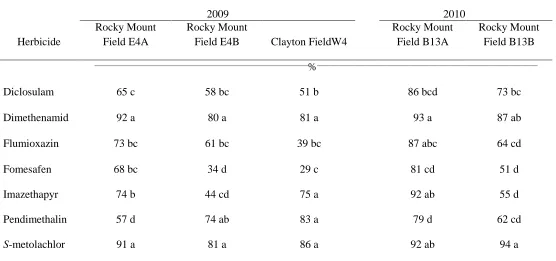
amaranth control varied by experiment and herbicide. Broadleaf signalgrass control by S
-metolachlor and dimethenamid was greater than 80% in all experiments (Table 4). Broadleaf
signalgrass control by the other herbicides varied considerably across experiments. At
Rocky Mount field E4A in 2009 and Rocky Mount field B13A, entireleaf morningglory
control by imazethapyr was 91% while control by diclosulam, flumioxazin, pendimethalin,
and S-metolachlor was less than 80% in all fields (Table 5). Diclosulam and imazethapyr,
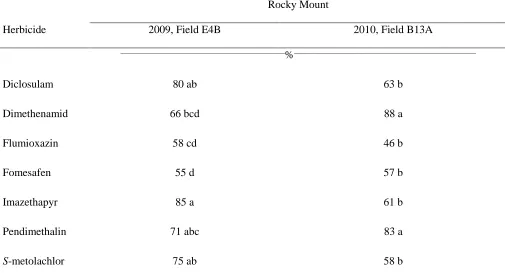
control of common lambsquarters was 80% or greater at Rocky Mount in 2009 (Table 6). At
Rocky Mount in 2010, dimethenamid and pendimethalin control of common lambsquarters
was 88 and 83%, respectively (Table 6). Palmer amaranth control by fomesafen,
flumioxazin, imazethapyr, and S-metolachlor was greater than 85% in all experiments (Table
7).
Experiment 2. Influence of delayed applications on postemergence herbicide spray solutions. Broadleaf signalgrass control by clethodim was influenced by the main effect of mixing interval (Table 8). In contrast, mixing interval did not affect broadleaf signalgrass
control by imazapic (Table 8). Common ragweed control by acifluorfin and yellow nutsedge
control by imazapic was not affected by the interaction of experiment by mixing interval or
the main effect of mixing interval (Table 8). Broadleaf signalgrass was controlled 95, 96, 96,
and 92% by clethodim with spray solution mixed the day of application and 2, 4, or 6 days
prior to application, respectively (Table 9).
Broadleaf signalgrass control by glufosinate, glyphosate, imazethapyr, and paraquat
glufosinate, glyphosate, imazethapyr, and lactofen was not affected by mixing interval, there
was an experiment by mixing interval interaction for atrazine (Table 10). At 2 of 3 locations,
entireleaf morningglory was controlled completely by atrazine (Table 11). However,
entireleaf morningglory was controlled 90, 80, 76, and 70% by atrazine at Clayton with spray
solution mixed the day of application, and 3, 6, and 9 days prior to application, respectively
(Table 11).
Palmer amaranth control was not influenced by the interaction of experiment and
mixing interval or the main effect of mixing interval for atrazine, dicamba, glufosinate,
glyphosate, and imazethapyr (Table 10). However, the interaction of experiment and mixing
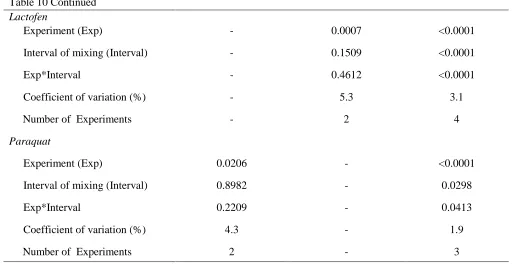
interval was significant for Palmer amaranth control by lactofen and paraquat (Table 10). In
1 of 4 experiments, Palmer amaranth control by lactofen was reduced 6 to 10 percentage
points when lactofen remained in spray solution 3, 6, or 9 days compared with application
the day spray solution was prepared (Table 12). However, at Clayton field 2 and Rocky
Mount, Palmer amaranth control by lactofen prepared 6 or 9 days prior to application was 2
to 12 percentage points higher than lactofen prepared the day of application (Table 12).
Palmer amaranth control by paraquat was influenced by the interaction of experiment
and number of days paraquat was mixed prior to application (Table 10). At Rocky Mount,
Palmer amaranth control was reduced 6% when paraquat remained in spray solution for 3
days compared with spray solution prepared the day of application (Table 13).
Experiment 3. Influence of weed size and delayed applications of postemergence herbicides. Percent fresh weight reduction of Palmer amaranth by atrazine, dicamba,
interaction of experiment and mixing interval or the main effect of mixing interval (Table
14).
The interaction of experiment and mixing interval was significant for visible control
of broadleaf signalgrass by clethodim (Table 14). Efficacy of clethodim was not affected
when spray solution was prepared 4 or 8 days prior to application compared with application
the day solution was prepared regardless of application timing (Table 16). At Rocky Mount
field 2, control of broadleaf signalgrass by clethodim applied at the 1100 g/ha rate 4 days
past the optimum weed size for control was reduced 6 to 8 percentage points (Table 16). At
all locations, broadleaf signalgrass was controlled by clethodim at the 1100 g/ha rate 8 days
past the optimum weed size for control 6 to 19 percentage points less than clethodim applied
at the optimum time of weed control (Table 16). The main effect of mixing interval for
broadleaf signalgrass fresh weight reduction by clethodim was significant (Table 14).
Broadleaf signalgrass control, based on fresh weight reduction, was 97% to 98% when
clethodim was applied at the optimum time for weed control (Table 17). However, fresh
weight reduction decreased 9 and 23 to 26 percentage points when clethodim was applied 4
and 8 days past the optimum weed size for control, respectively (Table 17). Broadleaf
signalgrass control was the same regardless of clethodim rate.
Visible control of common ragweed by glyphosate was influenced by the interaction
of mixing interval and experiment (Table 14). At Lewiston-Woodville field 1, glyphosate
prepared 8 days prior to application controlled common ragweed 7% greater than glyphosate
applied 4 days past the optimum weed size controlled common ragweed 6 to 10 percentage
points greater than when glyphosate was applied at the optimum time of weed control (Table
18). Common ragweed control was similar when comparing glyphosate rates.
Visible control of common ragweed by glufosinate was not influenced by the
interaction of mixing interval and experiment or the main effect of mixing interval (Table
14). Common ragweed control by lactofen was not influenced by the interaction of mixing
interval and experiment but was significant for the main effect of mixing interval (Table 14).
Lactofen applied at 1460 g/ha 4 days after the optimum weed size for control, controlled
common ragweed 4% less than lactofen applied at 1100 g/ha at the optimum weed size for
control (Table 19). However, lactofen applied at 1460 g/ha 8 days after the optimum weed
size for control, controlled common ragweed 2% greater than lactofen applied at the
optimum weed size for control (Table 19).
The main effect of mixing interval was significant for Palmer amaranth control by
atrazine (Table 14). Efficacy of atrazine when left in spray solution for 4 or 8 days prior to
applicaiton was not affected (Table 20). Palmer amaranth control was reduced 17
percentage points when atrazine was applied 8 days past the optimum weed size for control
(Table 20). Increasing the atrazine rate to 1460 g/ha did not increase Palmer amaranth
control when compared to the 1100 g/ha rate applied 4 or 8 days past the optimum weed size
for control (Table 20).
Palmer amaranth control by dicamba was influenced by the interaction of mixing
was prepared 4 or 8 days prior to application compared with application the day solution was
prepared (Table 21). Dicamba applied at the 300 g/ha rate 8 days past the optimum weed
size was 17 to 20 percentage points less effective than application at the optimum weed size
for control (Table 21). Palmer amaranth control using dicamba applied at the 300 g/ha rate
was similar to dicamba applied at the 400 g/ha rate.
Palmer amaranth control by glyphosate was influenced by the interaction of mixing
interval and experiment (Table 14). Glyphosate efficacy was not affected when spray
solution was prepared 4 or 8 days prior to application compared with application the day
solution was prepared (Table 18). Palmer amaranth control at Rocky Mount field 1 by
glyphosate applied 4 and 8 days past the optimum weed size for control was 2 to 3
percentage points less effective than application at the optimum timing (Table 18).
Glyphosate at 1463 g/ ha did not consistently increase Palmer amaranth control compared to
glyphosate at 1100 g/ha irrespective of timing of application (Table 18). At Rocky Mount
field 2, complete control of Palmer amaranth was observed for all treatments.
Palmer amaranth control by glufosinate was influenced by the interaction of mixing
interval and experiment (Table 14). Glufosinate efficacy was not affected when spray
solution was prepared 4 or 8 days prior to application compared with application of spray
solution prepared the day of application (Table 22). At Rocky Mount field 1, Palmer
amaranth control was 13 to 15 percentage points less when glufosinate was applied 8 days
past the optimum weed size for control (Table 22). However, in the second experiment
control was slightly higher than glufosinate applied at the optimum weed size for control
(Table 22). Glufosinate rate did not influence Palmer amaranth control.
Palmer amaranth control by imazethapyr was not influenced by the interaction of
mixing interval and experiment (Table 14). However, Palmer amaranth control by
imazethapyr was influenced by the main effect of mixing interval (Table 14). Imazethapyr
efficacy was not affected when spray solution was prepared 4 or 8 days prior to application
compared with application of spray solution prepared the same day (Table 23). Palmer
amaranth control was reduced 10 to 13 percentage points when imazethapyr was applied 8
days past the optimum weed size for control (Table 23). Palmer amaranth was controlled
similarly irrespective of imazethapyr rate.
Palmer amaranth control by lactofen was influenced by the interaction of mixing
interval and experiment (Table 14). At Rocky Mount, lactofen mixed 8 days prior to
application controlled Palmer amaranth 10 percentage points greater than spray solution
prepared the day of application (Table 24). At Rocky Mount, Palmer amaranth control was
reduced 25 to 35 percentage points when lactofen was applied at the 1100 g/ha rate 8 days
past the optimum weed size for control, however, control was increased 15 to 25 percentage
points when by lactofen was applied at the 1460 g/ha rate (Table 24). Palmer amaranth
control at Falcon was 68% or less for all lactofen treatments. This may be due to drought
during the duration of this experiment.
An interaction of mixing interval and experiment was observed for visual estimates of
solution for 4 or 8 days was not affected (Table 25). At Rocky Mount field 1, Palmer
amaranth control was reduced 18 to 19 percentage points when 2,4-D was applied 8 days past
the optimum weed size for control (Table 25). There were no difference in Palmer amaranth
control at Rocky Mount field 2 when 2,4-D was applied 4 or 8 days past the optimum weed
size for control. There was no difference in Palmer amaranth control by 2,4-D regardless of
rate (Table 25).
Entireleaf morningglory control by lactofen was influenced by the interaction of
mixing interval and experiment (Table 15). At Rocky Mount field 1, entireleaf morningglory
control by lactofen 4 and 8 days past the optimum weed size for control was 5 to 11 and 32 to
34 percentages points less when compared to lactofen applied at the optimum weed size for
control, respectively (Table 26). However, entireleaf morningglory was controlled by the
same at Rocky Mount field 2 regardless of the number of days lactofen was applied past the
optimum weed size for control. The interaction of mixing interval and experiment and the
main effect of mixing interval was not significant for entireleaf morningglory control by
paraquat (Table 15).
While these data suggest that sporadic changes in herbicide efficacy can occur when
spray solutions remain in the tank for extended periods of time, a complete weed control
failure across all experiments and all weed species did not occur. Stewart et al. (2009) also
reported sporadic differences in weed control when herbicide solutions were prepared at
various intervals prior to application, and there was no complete weed control failure in their
control increased when spray solution was prepared for an extended period of time prior to
application. These experiments were conducted using a municipality water source with pH
6.7 and relatively low water hardness. Results may have differed considerably if a different
source of water was used (Stahlman and Phillips, 1979; Buhler et al., 1983). However,
experiments were conducted using plastic spray bottles allowing adequate agitation to restore
spray solutions immediately prior to application. Farmers and commercial applicators may
not have the capability to return herbicide completely into solution after remaining in the
spray tank for extended periods of time.
Acknowledgements
The North Carolina Peanut Growers Association, Philip Morris USA , and the
Monsanto Co. provided partial financial support for this research. Appreciation is expressed
to staff at the Central Crops Research Station, the Peanut Belt Research Station, and the
Upper Coastal Plain Research Station for technical assistance.
Sources of Materials 1
TeeJet TP11002 flat-fan spray nozzles, Spraying Systems Co., Wheaton, IL 60189.
2
SAS v9.1, SAS Institute Inc., Cary, NC 27513.
3
Strongarm herbicide®, Dow AgroSciences, Indianapolis, IN 46268.
4
Outlook herbicide®, BASF Corporation, Research Triangle Park, NC 27709.
5
Valor SX herbicide®, Valent U.S.A Corporation, Walnut Creek, CA 94596.
6
Reflex herbicide®, Syngenta Crop Protection, Inc. Greensboro, NC 27419.
7
8
Prowl H2O herbicide®, BASF Corporation, Research Triangle Park, NC 27709. 9
Dual II Magnum®, Syngenta Crop Protection, Inc. Greensboro, NC 27419.
10
Ultra Blazer herbicide®, BASF Corporation, Research Triangle Park, NC 27709.
11
AAtrex herbicide®, Syngenta Crop Protection, Inc. Greensboro, NC 27419.
12
Select Max herbicide®, Valent U.S.A Corporation, Walnut Creek, CA 94596.
13
Clarity herbicide®, BASF Corporation, Research Triangle Park, NC 27709.
14
Ignite280 herbicide®, Bayer Cropscience, Research Triangle Park, NC 27709.
15
Roundup WEATHERMAX herbicide®. Monsanto Company, St. Louis, MO 63167.
16
Cadre herbicide®, BASF Corporation, Research Triangle Park, NC 27709.
17
Cobra herbicide®, Valent U.S.A Corporation, Walnut Creek, CA 94596-8025.
18
Gramoxone Inteon herbicide®, Syngenta Crop Protection, Inc. Greensboro, NC 27419.
19
Agri-Dex crop oil concentrate, Helena Chemical Company, Collierville, TN 38017.
20
Induce adjuvant, Helena Chemical Company, Collierville, TN 38017.
21
Weedar 64 herbicide®, Nufarm Americas Inc. Burr Ridge, IL 60527.
22
Osprey herbicide®, Bayer Cropscience, Research Triangle Park, NC 27709.
23
Literature Cited
Anonymous. 2009. United State Geological Survey-National Water Quality Assessment Program. http://water.usgs.gov/nawqa/studies/domestic_wells/hardness.html. Accessed: December 23, 2010.
Buhler, D. D. and O. C. Burnside. 1983. Effect of water quality, carrier volume, and acid on glyphosate phytotoxicity. Weed Sci. 31: 163-169.
Edmund Jr., R. M. and A. C. York. Factors affecting postemergence control of sicklepod with imazaquin and DPX-F6025: Spray volume, growth stage, and soil-applied alachlor and vernolate. Weed Sci. 35:216-223.
Frans, R., R. Ralbert, D. Marx, and H. Crowley. 1986. Experimental design and techniques for measuring and analyzing plant responses to weed control practices. Pages 37-38 in N.D. Camper, ed. Research Methods in Weed Sci. 3rd ed. Champaign, IL: SWSS.
Jordan, D. L., A. C. York, J. L. Griffin, P. A. Clay, P. R. Vidrine, and D. B. Reynolds. 1997. Influence of application variables on efficacy of glyphosate. Weed Technol. 11:354-362.
Kegode, G. O. and B. E. Fronning. 2005. Artemisia biennis control is influenced by plant size and weed flora at time of herbicide application. Crop Prot. 24:915-920.
Kiely, T., D. Donaldson, and A. Grube. 2004. Pesticides Industry Sales and Usage. Environmental Protection Agency. Washington, DC. Pages 1-33.
Nalewaja, J. D., F. A. Manthey, and R. Anyska. 1989. Sodium bicarbonate antagonism of sethoxydim. Weed Technol. 3:654-658.
Nalewaja, J. D. and R. Matysiak. 1991. Salt antagonism of glyphosate. Weed Sci. 39:622-628.
Nalewaja, J. D. and R. Matysiak. 1993. Spray carrier salts affect herbicide toxicity to kochia (Kochia scoparia). Weed Technol. 7:154-158.
Stahlman, P. W. and W. M. Phillips. 1979. Effects of water quality and spray volume on glyphosate phytotoxicity. Weed Sci. 27:38-41.
Stewart, C. L., R. E. Nurse, M. Cowbrough, and P. H. Sikkema. 2009. How long can a herbicide remain in the spray tank without losing efficacy? Crop Prot. 28:1086-1096.
Thelen, K. D., E. P. Jackson, and D. Penner. 1995. The basis for the hard-water antagonism of glyphosate activity. Weed Sci. 43:541-548.
Table 1. Preemergence herbicide experiment soil conditions and first activating rainfall.
Location Year Field
Soil moisture at application
Days after application to at least 0.6 cm rainfall
Rocky Mount 2009 E4A Dry 11
Rocky Mount 2009 E4B Good 10
Clayton 2009 W4 Excellent 1
Rocky Mount 2010 B13A Excellent 2
Table 2. P > F in Experiment 1 for broadleaf signalgrass, common lambsquarters, entireleaf morningglory, and Palmer amaranth control 6 weeks after application of diclosulam, dimethenamid, flumioxazin, fomesafen, imazethapyr,
pendimethalin, and S-metolachlorapplied preemergence as influenced by main effects of mixing interval, herbicides, and locations.
Source Broadleaf
signalgrass
Common lambsquarters
Entireleaf morningglory
Palmer amaranth _____________________________________
p value_______________________________________
Experiment (Exp) <0.0001 0.1080 <0.0001 0.1509
Mixing interval (Interval) 0.2530 0.4280 0.0162 0.3253
Herbicide (Herb) <0.0001 <0.0001 <0.0001 <0.0001
Interval*Herb 0.7944 0.7180 0.5660 0.1990
Exp*Interval 0.0769 0.1924 0.6231 0.7134
Exp*Herb <0.0001 0.0002 <0.0001 0.0031
Exp*Interval*Herb 0.1886 0.3822 0.3111 0.3754
Coefficient of variation ( %) 25.4 33.5 28.4 14.7
Table 3. Entireleaf morningglory control 6 WAT as influenced by the mixing interval in Experiment 1.a
Mixing interval Entireleaf morningglory control
days %
0 59 b
3 64 ab
6 62 b
9 68 a
a
Table 4. Broadleaf signalgrass control 6 WAT as influenced by the interaction of location and herbicide in Experiment 1.a
2009 2010
Herbicide
Rocky Mount Field E4A
Rocky Mount
Field E4B Clayton FieldW4
Rocky Mount Field B13A
Rocky Mount Field B13B _____________________________________________________________
%_______________________________________________________________
Diclosulam 65 c 58 bc 51 b 86 bcd 73 bc
Dimethenamid 92 a 80 a 81 a 93 a 87 ab
Flumioxazin 73 bc 61 bc 39 bc 87 abc 64 cd
Fomesafen 68 bc 34 d 29 c 81 cd 51 d
Imazethapyr 74 b 44 cd 75 a 92 ab 55 d
Pendimethalin 57 d 74 ab 83 a 79 d 62 cd
S-metolachlor 91 a 81 a 86 a 92 ab 94 a
a
Table 5. Entireleaf morningglory control 6 WAT as influenced by the interaction of location and herbicide in Experiment 1.a
Rocky Mount
2009 2010
Herbicide Field E4A Field B13A Field B13B
________________________________________
%__________________________________________
Diclosulam 43 d 68 c 50 c
Dimethenamid 60 c 86 ab 59 bc
Flumioxazin 28 e 68 c 50 c
Fomesafen 73 b 90 a 83 a
Imazethapyr 91 a 91 a 73 ab
Pendimethalin 29 e 71 c 56 bc
S-metolachlor 43 d 75 bc 49 c
a
Table 6. Common lambsquarters control 6 WAT as influenced by the interaction of location and herbicide in Experiment 1.a
Rocky Mount
Herbicide 2009, Field E4B 2010, Field B13A
_______________________________________________
%____________________________________________________
Diclosulam 80 ab 63 b
Dimethenamid 66 bcd 88 a
Flumioxazin 58 cd 46 b
Fomesafen 55 d 57 b
Imazethapyr 85 a 61 b
Pendimethalin 71 abc 83 a
S-metolachlor 75 ab 58 b
a
Table 7. Palmer amaranth control 6 WAT as influenced by the interaction of location and herbicide in Experiment 1.
Clayton Rocky Mount
Herbicide Field W2 Field B13A Field B13B
_______________________________________________
%_______________________________________________
Diclosulam 69 c 84 bc 84 c
Dimethenamid 83 b 83 c 84 c
Flumioxazin 96 a 95 a 93 ab
Fomesafen 88 ab 91 ab 87 bc
Imazethapyr 96 a 98 a 98 a
Pendimethalin 90 ab 83 bc 71 d
S-metolachlor 94 a 92 a 86 bc
a
Table 8. P > F in Experiment 2 for broadleaf signalgrass, common ragweed, and yellow nutsedge control 3 WAT by acifluorfin, clethodim, and imazapic mixed the day of application and 2, 4, and 6 days prior to application. Source Broadleaf signalgrass Common ragweed Yellow nutsedge
_____________________________________
p-value_____________________________________
Acifluorfin
Experiment (Exp) - 0.2644 -
Interval of mixing (Interval) - 0.6704 -
Exp*Interval - 0.5852 -
Coefficient of variation (%) - 11.5 -
Number of Experiments - 2 -
Clethodim
Experiment (Exp) <0.0001 - -
Interval of mixing (Interval) 0.0388 - -
Exp*Interval 0.8790 - -
Coefficient of variation (%) 3.3 - -
Number of Experiments 2 - -
Imazapic
Experiment (Exp) 0.2227 - 0.2862
Interval of mixing (Interval) 0.9443 - 0.2737
Exp*Interval 0.4797 - 0.7414
Coefficient of variation (%) 9.7 - 8.2
Table 9. Postemergence broadleaf signalgrass control 3 WAT by clethodim spray solution prepared the day of application and 2, 4, and 6 days prior to application in Experiment 2.a
Mixing interval Broadleaf signalgrass control
Days %
0 95 ab
2 96 a
4 96 a
6 92 b
a
Table 10. P > F in Experiment 2 for broadleaf signalgrass, entireleaf morningglory, and Palmer amaranth control by atrazine, dicamba, glufosinate, glyphosate, imazethapyr, lactofen, and paraquat mixed the day of application and 3, 6, and 9 days prior to application.
Source Broadleaf signalgrass Entireleaf
morningglory
Palmer amaranth ________________________________
p-value____________________________
Atrazine
Experiment (Exp) - <0.0001 <0.0001
Interval of mixing (Interval) - <0.0001 0.9487
Exp*Interval - <0.0001 0.9371
Coefficient of variation (%) - 2.3 5.8
Number of Experiments - 3 3
Dicamba
Experiment (Exp) - - <0.0001
Interval of mixing (Interval) - - 0.4368
Exp*Interval - - 0.5953
Coefficient of variation (%) - - 4.7
Number of Experiments - - 3
Glufosinate
Table 10 Continued
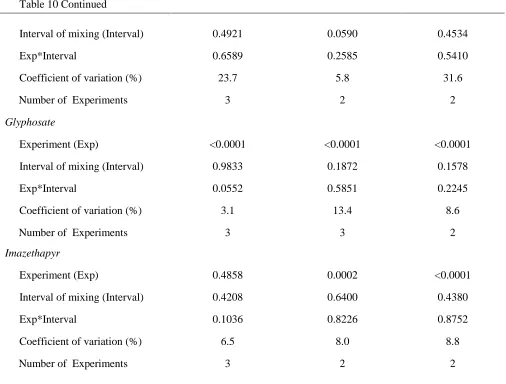
Interval of mixing (Interval) 0.4921 0.0590 0.4534
Exp*Interval 0.6589 0.2585 0.5410
Coefficient of variation (%) 23.7 5.8 31.6
Number of Experiments 3 2 2
Glyphosate
Experiment (Exp) <0.0001 <0.0001 <0.0001
Interval of mixing (Interval) 0.9833 0.1872 0.1578
Exp*Interval 0.0552 0.5851 0.2245
Coefficient of variation (%) 3.1 13.4 8.6
Number of Experiments 3 3 2
Imazethapyr
Experiment (Exp) 0.4858 0.0002 <0.0001
Interval of mixing (Interval) 0.4208 0.6400 0.4380
Exp*Interval 0.1036 0.8226 0.8752
Coefficient of variation (%) 6.5 8.0 8.8
Table 10 Continued
Lactofen
Experiment (Exp) - 0.0007 <0.0001
Interval of mixing (Interval) - 0.1509 <0.0001
Exp*Interval - 0.4612 <0.0001
Coefficient of variation (%) - 5.3 3.1
Number of Experiments - 2 4
Paraquat
Experiment (Exp) 0.0206 - <0.0001
Interval of mixing (Interval) 0.8982 - 0.0298
Exp*Interval 0.2209 - 0.0413
Coefficient of variation (%) 4.3 - 1.9
Table 11. Entireleaf morningglory control by atrazine mixed the day of application and 3, 6, and 9 days prior to application in Experiment 2.a
Interval between mixing and application
Entireleaf morningglory control
Clayton Lewiston-Woodville
Rocky Mount
days __________________________________%___________________________________
0 90 a 100 a 100 a
3 80 b 100 a 100 a
6 76 b 100 a 100 a
9 70 c 100 a 100 a
a
Table 12. Palmer amaranth control by lactofen prepared the day of application and 3, 6, and 9 days prior to application in Experiment 2.a
Interval between mixing and application
Palmer amaranth control
Clayton
Lewiston Rocky Mount
Field 1 Field 2
days __________________________________________________%____________________________________________
0 90 a 98 b 95 a 85 b
3 80 b 97 b 96 a 83 b
6 84 b 100 a 95 a 97 a
9 83 b 100 a 96 a 95 a
a
Table 13. Influence of delayed applications of spray solution on Palmer amaranth control by paraquat in Experiment 2.a
Interval between mixing and application
Palmer amaranth control
Rocky Mt Lewiston Clayton, Field 1
days
_____________________________________
%__________________________________
0 96 a 100 a 97 a
3 90 b 98 a 98 a
6 95 a 98 a 99 a
9 94 a 100 a 97 a
a
Table 14. P > F in Experiment 3 for broadleaf signalgrass, common ragweed, and Palmer amaranth control by atrazine, clethodim dicamba, glufosinate, glyphosate, imazethapyr, lactofen, paraquat and 2,4-D applied at optimum weed size for control, 4 and 8 days after optimum weed size using spray solution mixed the day of application and 4 or 8 days prior to application.
Broadleaf signalgrass Common ragweed Palmer amaranth
Source Visual control Percent
reduction in fresh weight
Visual control Percent reduction in fresh weight
Visual control Percent reduction in fresh weight _______________________________________________________________________p value__________________________________________________________________ Atrazine
Experiment (Exp) - - - - 0.1150 <0.0001
Interval of Mixing (Interval) - - - - 0.0008 0.0958
Exp*Interval - - - - 0.0709 0.0673
Coefficient of variation (%) - - - - 15.5 5.6
Clethodim
Experiment (Exp) <0.0001 0.0125 - - - -
Interval of Mixing (Interval) <0.0001 <0.0001 - - - -
Exp*Interval 0.0054 0.1501 - - - -
Coefficient of variation (%) 3.7 44.9 - - - -
Dicamba
Experiment (Exp) - - - - <0.0001 0.0762
Interval of Mixing (Interval) - - - - <0.0001 0.5897
Exp*Interval - - - - 0.0132 0.2931
Coefficient of variation (%) - - - - 6.3 43.2
Glyphosate
Experiment (Exp) - - <0.0001 0.0274 <0.0001 <0.0001
Interval of Mixing (Interval) - - <0.0001 0.0763 0.0244 0.0876
Exp*Interval - - 0.0005 0.6190 0.0244 0.0876
Coefficient of variation (%) - - 3.3 10.6 1.3 68.1
Glufosinate
Experiment (Exp) - - 0.3020 0.2539 <0.0001 <0.0001
Interval of Mixing (Interval) - - 0.7759 0.6380 0.0039 0.7557
Exp*Interval - - 0.4228 0.4885 <0.0001 0.9678
Table 14 Continued Imazethapyr
Experiment (Exp) - - - - <0.0001 <0.0001
Interval of Mixing (Interval) - - - - 0.0002 0.0627
Exp*Interval - - - - 0.1537 0.06600
Coefficient of variation (%) - - - - 7.6 101.1
Lactofen
Experiment (Exp) - - 0.1236 0.0007 <0.0001 <0.0001
Interval of Mixing (Interval) - - 0.0164 0.0688 0.0003 0.6204
Exp*Interval - - 0.6671 0.1361 <0.0001 0.5673
Coefficient of variation (%) - - 4.0 9.4 10.2 49.0
Paraquat
Experiment (Exp) - - - - 0.8812 <0.0001
Interval of Mixing (Interval) - - - - 0.4564 0.0553
Exp*Interval - - - - 0.4403 0.0513
Coefficient of variation (%) - - - - 12.0 53.8
2,4-D
Experiment (Exp) - - - - 0.1666 0.0001
Interval of Mixing (Interval) - - - - 0.0008 0.9257
Exp*Interval - - - - 0.0453 0.7756
Table 15. P > F in Experiment 3 for entireleaf morningglory control by lactofen and paraquat applied at optimum weed size for control, 4 and 8 days after optimum weed size using spray solution mixed the day of application and 4 or 8 days prior to application.
Source Enireleaf morningglory visual control p-value
Lactofen
Experiment (Exp) <0.0001
Interval of Mixing (Interval) <0.0001
Exp*Interval <0.0001
Coefficient of variation (%) 5.6
Paraquat
Experiment (Exp) <0.0001
Interval of Mixing (Interval) 0.5920
Exp*Interval 0.4123
Table 16. Broadleaf signalgrass control 4 weeks after optimum weed size for control by clethodim applied at optimum weed size for control, 4 and 8 days after optimum weed size using spray solution mixed the day of application and 4 or 8 days prior to application in Experiment 3.a
Broadleaf signalgrass control Days application past
optimum weed size
Days product mixed
prior to application Rate
Rocky Mount
Field 1 Field 2
days days g/ha _________________________%________________________
0 0 1100 96 abc 94 a
0 0 1460 98 a 93 ab
4 0 1100 93 cd 88 bc
4 4 1100 94 bc 86 c
4 0 1460 97 ab 88 abc
8 0 1100 90 de 75 d
8 8 1100 88 e 79 d
8 0 1460 90 de 76 d
a
Table 17. Broadleaf signalgrass fresh weight reduction using clethodim applied at optimum weed size for control, 4 and 8 days after optimum weed size using spray solution mixed the day of application and 4 or 8 days prior to application in Experiment 3.a
Broadleaf signalgrass Days application past
optimum weed size
Days product mixed prior
to application Rate Fresh weight reduction
days days g/ha %
0 0 1100 97 a
0 0 1460 98 a
4 0 1100 88 b
4 4 1100 88 b
4 0 1460 90 b
8 0 1100 74 cd
8 8 1100 71 d
8 0 1460 76 c
a
Table 18. Common ragweed and Palmer amaranth control 4 weeks after optimum weed size for control by glyphosate applied at optimum weed size for control, 4 and 8 days after optimum weed size using spray solution mixed the day of application and 4 or 8 days prior to application in Experiment 3.a
Days application past optimum
weed size
Days product mixed prior to
application
Lewiston-Woodville Rocky Mount
Common ragweed control Palmer amaranth control
Rate Field 1 Field 2 Field 1 Field 2
days days g/ha ______________________________________%_____________________________________
0 0 870 97 ab 89 c 99 a 100 a
0 0 1130 95 ab 96 ab 100 a 100 a
4 0 870 96 ab 95 ab 97 bc 100 a
4 4 870 98 a 99 a 96 c 100 a
4 0 1130 98 a 99 a 97 bc 100 a
8 0 870 86 c 88 c 96 c 100 a
8 8 870 93 ab 91 bc 96 c 100 a
8 0 1130 92 bc 96 ab 97 bc 100 a
b
Table 19. Common ragweed control 4 weeks after optimum weed size for control by lactofen applied at optimum weed size for control, 4 and 8 days after optimum weed size using spray solution mixed the day of application and 4 or 8 days prior to application in Experiment 3.a
Days application past optimum weed size
Days product mixed
prior to application Rate Common ragweed control
days days g/ha %
0 0 220 97 abc
0 0 290 94 abc
4 0 220 93 cd
4 4 220 95 bcd
4 0 290 93 d
8 0 220 97 abc
8 8 220 97 abc
8 0 290 99 a
a
Table 20. Palmer amaranth control 4 weeks after optimum weed size for control by atrazine applied at optimum weed size for control, 4 and 8 days after optimum weed size using spray solution mixed the day of application and 4 or 8 days prior to application in Experiment 3.a
Days application past optimum weed size
Days product mixed prior
to application Rate Palmer amaranth control
days days g/ ha %
0 0 1100
85 a
0 0 1460 88 a
4 0 1100 79 ab
4 4 1100 87 a
4 0 1460 76 abc
8 0 1100 68 bc
8 8 1100 68 bc
8 0 1460 66 c