ISSN(Online): 2320-9801 ISSN (Print) : 2320-9798
I
nternational
J
ournal of
I
nnovative
R
esearch in
C
omputer
and
C
ommunication
E
ngineering
(An ISO 3297: 2007 Certified Organization)
Vol. 4, Issue 10, October 2016
A Software based Approach to Project
Management
Aadrika Singh1, Shrishti Dubey2, Swarnalatha P3
B. Tech, Department of Computer Science and Technology, Vellore Institute of Technology, Vellore, India 1,2 Associate Professor, Department of Computer Science and Technology, Vellore Institute of Technology, Vellore, India3
ABSTRACT: Project management is an important aspect of consideration for all the organizations. It can be seen as
the management of the projects the organization deals with, with respect to several factors. The success of a project lies upon several factors, such as meeting the requirements of the stakeholders(primarily), along with time management, achieving the milestones set, constraining to the budget of the project and allocating resources such as choosing the appropriate team for the project, with appropriate set of skills. The paper is aimed at introducing a software tool for organizations, for supporting the several aspects involved in managing a project. The aim is to make a tool that helps the project managers to keep a track of the projects they are responsible for, and the team that is part of the project. It also keeps a track of the projects an employee of the organization is a part of and his role in the project. It also provides an overall view of the projects an organization is involved in, to all the employees of the organization.
KEYWORDS: Project; Project management; Stakeholders
I. INTRODUCTION
The paper is aimed at introducing a tool for supporting the several aspects involved in managing a project such as the risks involved in the project, the budget plan of the project, the deliverables of the project, the team members part of the project, the estimated time of completion of the project, along with other details crucial for project management. The aim is to make a tool that helps the project managers to keep a track of the projects they are responsible for, and the team that is part of the project. It also keeps a track of the projects an employee is a part of and his role in the project. It gives an overall view of the projects an organization is involved in, to all the employees of the organization.
II. RELATED WORK
A paper on “Does risk management contribute to IT project success? A meta-analysis of empirical evidence” studies the risk management attribute of an IT project and tries to find out the success. [1][2]
A paper on “Discovering complexity and emergent properties in project systems: A new approach to understanding project performance” which proposes the complexity and emergent properties in project systems [3][4].
The paper titled “Project Success: A Multidimensional Strategic Concept” suggests that the new strategic leaders are project managers and studies related strategic concepts.
The paper titled “The association among project manager's leadership style, teamwork and project success” aims to examine whether the impact of teamwork on project performance was moderated by the following data class variable s: industry sector, total installed cost, owner regulation, initial site, team size, complexity, project type, and international involvement [7][8].
ISSN(Online): 2320-9801 ISSN (Print) : 2320-9798
I
nternational
J
ournal of
I
nnovative
R
esearch in
C
omputer
and
C
ommunication
E
ngineering
(An ISO 3297: 2007 Certified Organization)
Vol. 4, Issue 10, October 2016
III.PROPOSED METHODOLOGY AND DISCUSSION
A. STRATEGY:
The strategy for this implementation follows a step-wise approach which can be described as follows: Step 1: Identify project objectives
Step 2: Identify project infrastructure:
The project is an interactive windows form application developed using NetBeans IDE. Java is used for the front- end development of the interface of the project and MySQL is used for the back-end part of the implementation to store the relevant details necessary for viewing at the front-end.
Step 3: Analyze project characteristics:
The project aims at accomplishing the following characteristics:
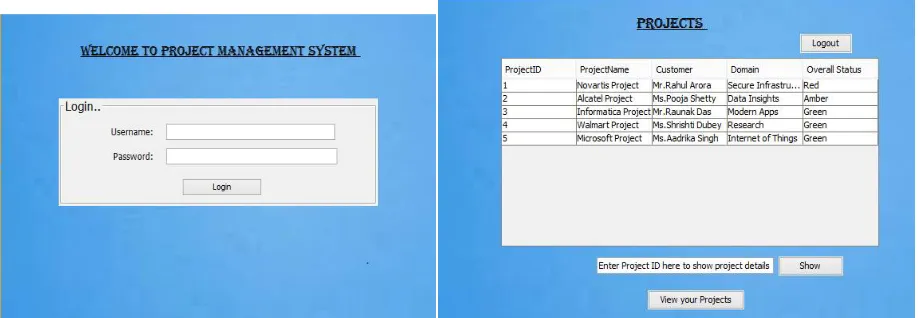
The first page/home page is designed which will ask the user to log into the system.
After authentication, the user will be taken to another page from where he can select the projects he wants to find information about. There will be an option available to redirect the user to the projects he is part of.
On selecting the desired project, he will be redirected to a page consisting of options relating to project i.e. information about the domain the project falls under, the team members associated with the project, information about the budget of the project, the start and end dates of the project, the milestones to be achieved during the course of the project, the current status of the project, and other relevant details.
On each page, we will have navigation buttons to move from one page of the application to the other or back to the homepage.
The Back-End will be created using MySQL. It will consist of Login table, Projects table, Details Table etc. according to the database schema and they would be joined suitably to fetch results and store information.
A proper connection would be made between the front-end and the back-end.
The complete application will be checked for various test cases in order to ensure the proper functioning of the application.
Step 4: Identify products and activities:
The product of this project is a project management tool that helps in keeping track of the several aspects of a project, such as the risks involved in the project, the budget plan of the project, the deliverables of the project, the team members part of the project, the estimated time of completion of the project, along with other details crucial for project management.
ISSN(Online): 2320-9801 ISSN (Print) : 2320-9798
I
nternational
J
ournal of
I
nnovative
R
esearch in
C
omputer
and
C
ommunication
E
ngineering
(An ISO 3297: 2007 Certified Organization)
Vol. 4, Issue 10, October 2016
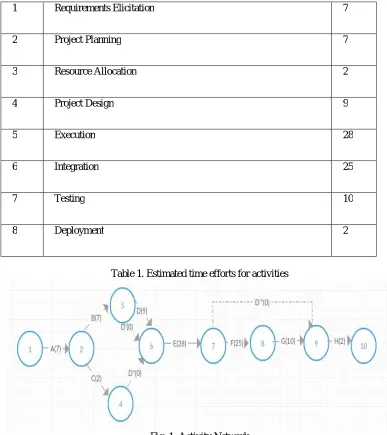
1 Requirements Elicitation 7
2 Project Planning 7
3 Resource Allocation 2
4 Project Design 9
5 Execution 28
6 Integration 25
7 Testing 10
8 Deployment 2
Table 1. Estimated time efforts for activities
Fig. 1. Activity Network The critical path is 1 to 2, 2 to 5, 5 to 6, 6 to 7, 7 to 8, 8 to 9, and 9 to 10. Step 5: Estimate effort for activity:
The project has been broken down into smaller components and the total estimate has been calculated by adding estimates for lower levels. We have used the COCOMO model for estimating the cost of the system. This system is regarded as a semidetached system. Since this project is somewhat small, COCOMO estimate might be inaccurate. COCOMO is designed for use on system larger than 2 KDL. This model estimates the total effort in term of person-month of technical project staff. It does not include the cost of the secretarial staff that might be needed. The basic steps in this model are:
Obtain an initial estimate of the development effort from the estimate of thousands of delivered lines of source code (KDL).
ISSN(Online): 2320-9801 ISSN (Print) : 2320-9798
I
nternational
J
ournal of
I
nnovative
R
esearch in
C
omputer
and
C
ommunication
E
ngineering
(An ISO 3297: 2007 Certified Organization)
Vol. 4, Issue 10, October 2016
Adjust the effort estimate by multiplying the initial estimate with the entire multiplying factor.
There are 15 different attributes, called cost driver attributes that determine the multiplying factors. These factors depend on product, computer, personal, and technology. All 15 factors are multiplied together to get the effort adjustment factor (EAF). The final cost estimate, E, is obtained by multiplying the initial estimate by the EAF.
E= EAF * Ei
The size estimates for these in lines of code are: 6746=6.746 KDL
Category of project is semidetached so constraint of a & b as follows a=3.0 & b =1.12 So,
Ei = 3.0(6.746)1.12 = 3.0(7.5552) = 22.6656
The effort adjustment factor (EAF) is
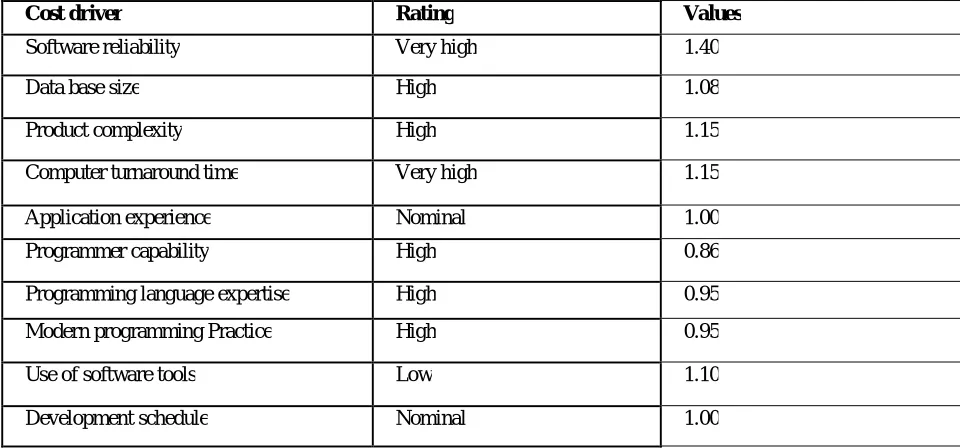
EAF = 1.4*1.08*1.15*1.15*.86*1*.95*.95*1.1*1 = 1.71 The initial effort of the project is = 1.71*22.66 = 38.748PM
Cost driver Rating Values
Software reliability Very high 1.40 Data base size High 1.08 Product complexity High 1.15 Computer turnaround time Very high 1.15 Application experience Nominal 1.00 Programmer capability High 0.86 Programming language expertise High 0.95 Modern programming Practice High 0.95 Use of software tools Low 1.10 Development schedule Nominal 1.00
Table 2. Rating of multiplier for different cost drivers. Step 6: Identify activity risks:
The types of risks involved in this project are:
Software Project risks: Resource constraints, inadequate funding, inter-group coordination
Software Process Risks: Poor design process, poor requirements management, ineffective planning, undocumented software process, lack of effective proper reviews
Software Product Risks: complex design, lack of domain expertise, incomplete or vague requirements.
The ways in which risk can be managed are:
Risk Identification:
ISSN(Online): 2320-9801 ISSN (Print) : 2320-9798
I
nternational
J
ournal of
I
nnovative
R
esearch in
C
omputer
and
C
ommunication
E
ngineering
(An ISO 3297: 2007 Certified Organization)
Vol. 4, Issue 10, October 2016
Process definition—risks associated with the degree to which the software process has been defined.
Business impact—risks associated with constraints imposed by management
Development environment—risks associated with the availability and quality of the tools to be used to build the product.
Technology to be built—risks associated with the complexity of the system to be built and the "newness" of the technology that is packaged by the system.
Staff size and experience—risks associated with the overall technical and project experience of the software engineers who will do the work.
Risk Analysis:
After identifying the various risks, in depth analysis of each and every risks is done so as to know about their intensity i.e. High, Average or low. Accordingly, measures are made.
Risk Planning:
Risks can be dealt with by:
Risk acceptance
Risk avoidance
Risk reduction
Risk transfer
Risk mitigation/contingency measures Step 7: Allocate Resources
Step 8: Review/publicize plan Step 9: Execute plan
Step 10: Lower level planning:
Once the project is under way, plans will need to be drawn up in greater detail for each activity as it becomes due. Detailed planning of the later stages will have to be delayed because more information will be available nearer the start of the stage.
IV.EXPERIMENTALRESULTS
The following system was implemented as an attempt to fulfill the expectations of this paper:
ISSN(Online): 2320-9801 ISSN (Print) : 2320-9798
I
nternational
J
ournal of
I
nnovative
R
esearch in
C
omputer
and
C
ommunication
E
ngineering
(An ISO 3297: 2007 Certified Organization)
Vol. 4, Issue 10, October 2016
Fig 4: Project details page Fig 5: My projects page
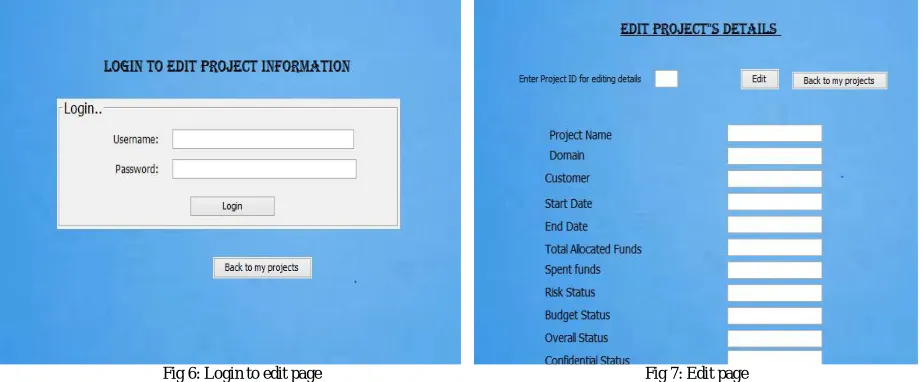
Fig 6: Login to edit page Fig 7: Edit page
V. CONCLUSIONS
The implementation results and strategy of the proposed system suggest that the project management system will act as an aid for the employees of an organization. It will enable better time management among the employees of the organization and will help them to keep the project on track, and fix any issues as soon as it can be done. The portal can help save lot of effort and time needed for project management, so that time can be utilized for development and other related work. The system will attempt to keep the project on the right time track and deliver the projects to stakeholders on time.
REFERENCES
1. Agarwal and Rathod, 2006 N. Agarwal, U. Rathod, Defining ‘success’ for software projects: an exploratory revelation, International Journal of Project Management, 24 (2006), pp. 358–370
2. Akkermans and van Helden, 2002 H. Akkermans, K. van Helden, Vicious and virtuous cycles in ERP implementation: a case study of interrelations between critical success factors, European Journal of Information Systems, 11 (2002), pp. 35–46
ISSN(Online): 2320-9801 ISSN (Print) : 2320-9798
I
nternational
J
ournal of
I
nnovative
R
esearch in
C
omputer
and
C
ommunication
E
ngineering
(An ISO 3297: 2007 Certified Organization)
Vol. 4, Issue 10, October 2016
4. Chan et al., 2001 A.P.C. Chan, D.C.K. Ho, C.M. Tam,Design and build project success factors: multivariate analysis, J. Constr. Eng. Manag., 127 (2001), pp. 93–100
5. T.K. Abdel-Hamid, A study of staff turnover, acquisition, and assimilation and their impact on software development cost and schedule, Journal of Management Information Systems 6 (1), 1989, pp. 21–39.
6. S. Alter, M. Ginzberg, Managing uncertainty in MIS implementation, Sloan Management Review 20 (1), 1978, pp. 23–31.
7. Bass, B.M. (1985) Leadership and Performance Beyond Expectations. Cited 4029 times.
Free Press, New York
8. Carmines, E.G., Zeller, R.A. (1979) Reliability and Validity Assessment. Cited 3362 times.
Sage Publication, California
9. AbouRizk, S-M. and Wales, R-J. 1997, Combined discrete-event=continuous simulation for project planning,Journal of Construction Engineering and Management 123 (1), 11–20.
10. Faniran, O-O., Oluwoye, J-O. and Lenard, D-J. 1998, Interactions between construction planning and inf uence factors, Journal of Construction Engineering and Management 124 (4), 245–56.
11. Boehm, B. W. and R. Valerdi., Achievements andChallenges in Cocomo-Based Software ResourceEstimation, IEEE Computer Society. 74-83 (2008).
12. Boehm, B. W. An Overview of the COCOMO 2.0Software Cost Model (1999).
13. Alukal, G. (2007). Lean kaizen in the 21st century. Quality Progress, 40(8), 69-70. Andersen, E. S., Birchall, D., Jessen, S. A., & Money, A. H. (2006). Exploring project success. Baltic Journal of Management, 1(2), 127- 147.
14. DeToro, I., & McCabe, T. (1997). How to stay flexible and elude fads. Quality Progress, 30(3), 55-60. Fisher, E. (2011). What practitioners consider to be the skills and behaviours of an effective people project manager. International Journal of Project Management, 29(8), 994-1002.
BIOGRAPHY
Dr. Swarnalatha P is an Associate Professor in School of Computer Science and Engineering, Vellore Institute of Technology, Vellore, India. She completed her M.Tech. Degree in 2006 from VIT University, Vellore with first rank in Computer Science and Engineering. She pursued her doctoral programme in the same institution and obtained her Ph.D. Her research interests are Image Processing, Artificial Intelligence and Software Engineering
Aadrika Singh is a Computer Science student pursuing B. Tech at Vellore Institute of Technology, Vellore, India. Her research interests are Internet of Things, Data Insights and Machine Learning.