University of Windsor University of Windsor
Scholarship at UWindsor
Scholarship at UWindsor
Electronic Theses and Dissertations Theses, Dissertations, and Major Papers
4-14-2017
Efficient scalar multiplication against side channel attacks using
Efficient scalar multiplication against side channel attacks using
new number representation
new number representation
Yue Huang
University of Windsor
Follow this and additional works at: https://scholar.uwindsor.ca/etd
Recommended Citation Recommended Citation
Huang, Yue, "Efficient scalar multiplication against side channel attacks using new number representation" (2017). Electronic Theses and Dissertations. 5940.
https://scholar.uwindsor.ca/etd/5940
This online database contains the full-text of PhD dissertations and Masters’ theses of University of Windsor students from 1954 forward. These documents are made available for personal study and research purposes only, in accordance with the Canadian Copyright Act and the Creative Commons license—CC BY-NC-ND (Attribution, Non-Commercial, No Derivative Works). Under this license, works must always be attributed to the copyright holder (original author), cannot be used for any commercial purposes, and may not be altered. Any other use would require the permission of the copyright holder. Students may inquire about withdrawing their dissertation and/or thesis from this database. For additional inquiries, please contact the repository administrator via email
Efficient scalar multiplication against side channel attacks using new
number representation
by
Yue Huang
A Thesis
Submitted to the Faculty of Graduate Studies
through Electrical and Computer Engineering
in Partial Fulfilment of the Requirements for
the Degree of Master of Applied Science
at the University of Windsor
Windsor, Ontario, Canada
2017
c
Efficient scalar multiplication against Side Channel Attacks using new
number representation
by Yue Huang
APPROVED BY:
Dr. Arunita Jaekel
School of Computer Science
Dr. Kemal Tepe
Department of Electrical and Computer Engineering
Dr. Mitra Mirhassani, Co-Supervisor
Department of Electrical and Computer Engineering
Dr. H. Wu, Supervisor
Department of Electrical and Computer Engineering
DECLARATION OF ORIGINALITY
I hereby certify that I am the sole author of this thesis and that no part of this thesis has been published or submitted for publication.
I certify that, to the best of my knowledge, my thesis does not infringe upon anyone’s copyright nor violate any proprietary rights and that any ideas, techniques, quotations, or any other material from the work of other people included in my thesis, published or oth-erwise, are fully acknowledged in accordance with the standard referencing practices. Fur-thermore, to the extent that I have included copyrighted material that surpasses the bounds of fair dealing within the meaning of the Canada Copyright Act, I certify that I have ob-tained a written permission from the copyright owner(s) to include such material(s) in my thesis and have included copies of such copyright clearances to my appendix.
ABSTRACT
DEDICATION
To my family:
Father: Wei Huang
Mother: Yufeng Cong
ACKNOWLEDGEMENTS
I would like to express my sincere gratitude and appreciation to everyone who helped me during my graduate study.
First of all, I am deeply grateful to my supervisor Dr. Huapeng Wu, who guided me during my study for the master degree. He is always patient with me. He guided me throughout the writing of this thesis. His broad knowledge have been of great value. In addition, I would like to show my gratitude to my co-supervisor Dr. Mitra Mirhassani, who gave me a lot of valuable advices and guidances during my research. Also, I want to thank my committee members, Dr. Kemal Tepe and Dr. Arunita Jaekel, for their attendance and advices in my seminar and defense.
Additionally, I would like to appreciate my loving parents. Without their support and encouragement, it is impossible for me to achieve such accomplishment.
Finally, I wish to extend my gratitude to everyone at UWindsor’s Faculty of Electrical and Computer Engineering for their efforts during my study in the M.A.Sc. Program. Moreover, I gratefully thank for the financial support from University of Windsor and my supervisor Dr. Huapeng Wu.
TABLE OF CONTENTS
DECLARATION OF ORIGINALITY iii
ABSTRACT iv
DEDICATION v
ACKNOWLEDGEMENTS vi
LIST OF TABLES x
LIST OF FIGURES xi
LIST OF ALGORITHMS xii
LIST OF ACRONYMS xiv
1 Introduction 1
1.1 Motivation . . . 1
1.2 Main Contributions . . . 2
1.3 Thesis Organization . . . 3
2 Public Key Cryptography and Side Channel Attacks 4 2.1 Asymmetric Cryptography . . . 4
2.1.1 Elliptic curve cryptosystem and scalar multiplication . . . 4
2.2 Side Channel Attacks . . . 5
2.2.1 Timing attack . . . 6
2.2.2 Powering analysis . . . 6
2.2.4 Other side channel attacks . . . 7
3 Overview of Existing Works 9 3.1 Doubling-and-Add Always Algorithms . . . 9
3.1.1 Doubling Attack . . . 10
3.1.2 C Safe Error Attack . . . 11
3.2 Montgomery Powering Ladder . . . 11
3.2.1 Relative Doubling Attack . . . 12
3.2.2 M Safe Error Attack . . . 13
3.2.3 Comparative Power Analysis . . . 16
3.2.4 Park’s Fault Attack . . . 16
3.3 Follow up Countermeasures on Exponent and Message Masking . . . 18
3.3.1 Exponent Splitting . . . 18
3.3.2 High Orders Attack against Exponent Splitting . . . 19
3.3.3 Blinded Fault Resistant Exponentiation . . . 19
3.3.4 Template Attack against Masked MPL . . . 20
3.4 Sequence Masking . . . 21
3.5 Combined Sequence Masking and Exponent Splitting algorithm proposed by He . . . 21
3.6 Joye’s m-ary Algorithms . . . 21
3.6.1 Joye’s Binary Algorithms . . . 24
4 Proposed Elevated Binary Number System (EBNS) 27 4.1 Elevated Binary Number System Property . . . 27
4.1.1 Convert between EBNS and Binary Number System . . . 27
4.1.2 Conversion between EBNS and Decimal Number System . . . 28
5 Proposed Algorithms using Elevated Number System 31
5.1 Binary Representation . . . 31
5.2 High Radix Representation . . . 35
5.3 Security Analysis and Comparison . . . 38
5.3.1 Binary Representation . . . 38
5.3.2 High Radix Representation . . . 44
5.4 Complexity Analysis and Comparison . . . 46
5.4.1 Binary Representation . . . 46
5.4.2 High Radix Representation . . . 48
6 Conclusions and Possible Future Works 54 6.1 Conclusions . . . 54
6.2 Possible Future Works . . . 54
REFERENCES 56
LIST OF TABLES
2.1 Side channels and Corresponding Side channel attacks . . . 6 3.1 Computations ofMe and(M2)eusing Montgomery Powering Ladder . . . . 14 3.2 Computation of modular exponentiation when a fault is injected in the
squaring operation . . . 18 3.3 Computation of modular exponentiation when a fault is injected in the
squaring operation . . . 18 5.1 Computations ofkPand 2(kP)using Proposed Alg 5.1 . . . 40 5.2 Security against SCAs among Left-to-Right algorithms (Binary
Represen-tation) . . . 41 5.3 Computation of Alg 5.3 when a fault is injected in the addition operation . . 43 5.4 Computation of Alg 5.6 when a fault is injected in the addition operation . . 43 5.5 Security against SCAs among Right-to-Left algorithms (Binary
Represen-tation) . . . 44 5.6 Comparison against SCAs among High Radix algorithms . . . 46 5.7 Complexity comparison among left-to-right algorithms (Binary
Represen-tation) . . . 46 5.8 Complexity comparison among right-to-left algorithms (Binary
LIST OF FIGURES
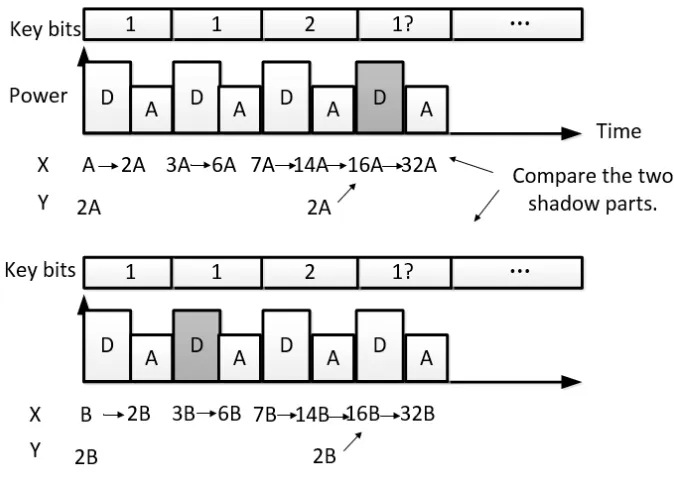
3.1 Example of comparative power attack against MPL . . . 17
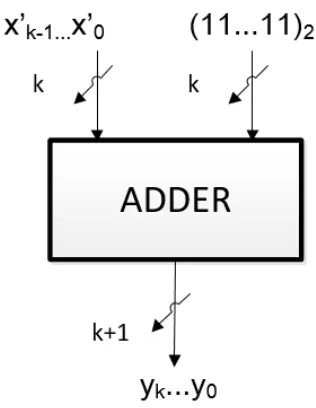
4.1 Architecture of converting EBNS into Binary Number System . . . 28
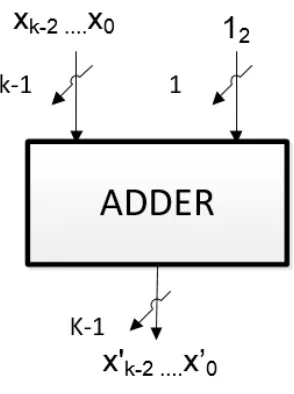
4.2 Architecture of converting Binary Number System into EBNS . . . 29
LIST OF ALGORITHMS
3.1 Doubling-and-Add algorithm (left-to-right) . . . 9
3.2 Doubling-and-Add algorithm (right-to-left) . . . 9
3.3 Square-and-Multiply Always algorithm (left-to-right) . . . 10
3.4 Montgomery Powering Ladder . . . 12
3.5 Rewrite square-and-multiply algorithm . . . 15
3.6 Masked Montgomery Powering Ladder . . . 20
3.7 Joye’s m-ary left-to-right algorithm (RSA) . . . 22
3.8 Joye’s m-ary left-to-right algorithm (ECC) . . . 23
3.9 Joye’s m-ary right-to-left algorithm (RSA) . . . 24
3.10 Joye’s m-ary right-to-left algorithm (ECC) . . . 24
3.11 Joye’s binary left-to-right algorithm (RSA) . . . 25
3.12 Joye’s binary left-to-right algorithm (ECC) . . . 25
3.13 Joye’s binary right-to-left algorithm (RSA) . . . 26
3.14 Joye’s binary right-to-left algorithm (ECC) . . . 26
4.1 Convert EBNS into Binary Number . . . 27
4.2 Convert Binary Number into EBNS . . . 28
4.3 Convert Decimal Number into EBNS . . . 29
5.1 Scalar multiplication using EBNS (left-to-right) . . . 31
5.2 Scalar multiplication using EBNS (right-to-left) version 1 . . . 32
5.3 Scalar multiplication using EBNS (right-to-left) version 2 . . . 33
5.4 Scalar multiplication using EBNS (right-to-left)version 3 . . . 33
5.5 Scalar multiplication using EBNS (right-to-left) version 4 . . . 34
5.6 Scalar multiplication using EBNS (right-to-left) version 5 . . . 35
5.7 Scalar multiplication using Elevated High Radix Number (left-to-right) . . 35
5.9 Scalar multiplication using Elevated High Radix Number (right-to-left) . . 37 5.10 Scalar multiplication using Elevated High Radix Number (right-to-left)
version 2 . . . 38 5.11 Scalar multiplication using Elevated High Radix Number (right-to-left)
LIST OF ACRONYMS
DPA Differential Power Analysis
EBNS Elevated Binary System
ECC Elliptic Curve Cryptosystem
ECDLP Elliptic Curve Discrete Logarithm Problem
EM Electromagnetic
MPL Montgomery Power Ladder
SCAs Side channel attacks
1
Introduction
1.1
Motivation
The Internet has an enormous impact on many aspects of our daily life. One of the great advantage of Internet is that it makes data communication much easier. Accordingly, cy-ber security gains people’s attentions more than ever. Among a variety of technologies to provide cyber security, cryptography is probably the most important and effective one. Cryptography can provide many security services, such like confidentiality and authentica-tion. For instance, public key cryptography is well known for providing digital signature and solving key distribution problems. Elliptic curve cryptography (ECC) is considered the most popular public key systems nowadays. The most demanded computation in ECC is scalar multiplication.
However, there exist many kinds of attacks which can potentially compromise the secu-rity of the cryptosystems. Besides the brute force attack, mathematical attacks and protocol level attacks [1], side channel attacks (SCAs) [2] has become probably the most dangerous threat to cryptosystems. SCAs utilize the information leaked from the physical implemen-tation of a cryptosystem, rather than the weaknesses in the algorithms and protocols. The leakage information includes timing information, power consumption, electromagnetic ra-diation and sounds etc. By collecting and analysing these side channel information, an attacker is able to launch the corresponding SCAs.
Recently, a few sophisticated SCAs have been proposed to against MPL, such as rel-ative doubling attack [4], comparrel-ative power analysis [5] and Park’s fault attack [6]. For example, comparative power analysis uses two related inputs to generate collisions for MPL. A more recent algorithm described in [7] by Joye can successfully resist to the SCAs proposed in [4] [5] but still shows weakness in resisting Park’s fault attack [6]. In this thesis, we proposed new scalar multiplication algorithms which are shown more advanta-geous over or comparable to the best of existing similar algorithms, in terms of resistance to SCAs and computational efficiency.
1.2
Main Contributions
The main contributions of this thesis are summarized as follows:
• A new binary number system, called Elevated binary number system (EBNS), is proposed. Conversions between this new number system and the conventional binary number is discussed. An extension of EBNS to high radix system is also presented.
• New left-to-right scalar multiplication algorithm using EBNS is proposed. This algo-rithm shows advantage in terms of computation efficiency while maintains the same security strength against SCAs compared to the best existing work. We also propose five right-to-left algorithms using EBNS. Compared to the best existing work, all proposed 5 algorithms have a advantage of not having a constraint condition. One of the proposed right-to-left algorithm is able to resist Park’s fault attack [6] while all other existing work can not.
1.3
Thesis Organization
2
Public Key Cryptography and Side Channel Attacks
2.1
Asymmetric Cryptography
Asymmetric cryptography, also known as public key cryptography, uses public and private keys to encrypt and decrypt data. One key in the pair which can be shared with public is called public key. The other key in the pair is kept secret named private key. Either of the keys can be used to encrypt a message, while the opposite key is used for decryption.
Public key cryptography is addressed to provide two main security services: key dis-tribution, which is used to exchange keys without having to trust a third party, and digital signature, which is used to verify the intactness of a message from a claimed sender. There are several public key cryptosystems which are frequently used currently, such as RSA and ECC. Compared with symmetrical key cryptosystems, public key cryptosystems usu-ally have higher computational complexity while provides unique security services, which makes them indispensable in cyber security.
2.1.1 Elliptic curve cryptosystem and scalar multiplication
Assume Alice wants to use ECC for communication. She needs to set up an ECC system. It includes parameters ofp,a,b,P,n,h,Q,d. First, she selects a prime pand elliptic curveE with(a,b)overGF(p).
E:y2=x3+ax+b, whereaandb∈GF(p).
Second, she counts the points on E and let it be]E(GF(p)). Then she selects a point P
of the maximal ordernonE, whichh=]E(GF(p))/n. For public-private key pair(Q,d), Alice needs to choose a secret numberd∈[1,n−1]. Then computes scalar multiplication
Q=dP. Qis Alice’s public key,d is the private key.
In a scenario, Bob wants to send an encrypted message to Alice using ECC. Assumem
is the original message. He should choose a random numberr, and computesC1=m+rQ,
C2=rP. Then sends C1 and C2 to Alice. Upon receiving the message, Alice needs to
computesC1−dC2=mto get the original messagem.
From the computations mentioned above, we can see the core operations of ECC en-cryption and deen-cryption is point addition and point doubling based on elliptic curve. In order to illustrate how to compute point addition and point doubling, we firstly assume an elliptic curve:
E:y2=x3+ax+b, wherea,b∈GF(p). Then letP1(x1,y1)andP2(x2,y2)be the two points on the curve.
AssumeP3(x3,y3) =P1(x1,y1) +P2(x2,y1)6=O. Then we can get
x3=λ2−x1−x2;y3=λ(x1−x3)−y1;
whereλ = yx2−y1
2−x1 ifP16=P2andλ =
3x21+a
2y1 ifP1=P2.
2.2
Side Channel Attacks
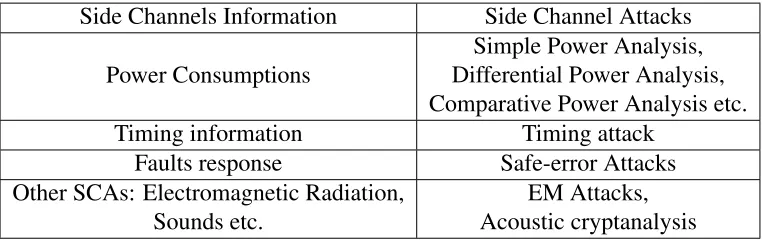
The side channel attacks we consider are a class of physical attacks in which an attacker tries to exploit physical information leakages such as timing information, power consump-tion, or electromagnetic radiation [2].
cate-Table 2.1: Side channels and Corresponding Side channel attacks
Side Channels Information Side Channel Attacks Power Consumptions
Simple Power Analysis, Differential Power Analysis, Comparative Power Analysis etc. Timing information Timing attack
Faults response Safe-error Attacks Other SCAs: Electromagnetic Radiation,
Sounds etc.
EM Attacks, Acoustic cryptanalysis
gorized it into several types. The common types of leakage information and corresponding side channel attacks are shown in Table 2.1.
2.2.1 Timing attack
When the running time of a cryptographic device is not constant, this time may leak in-formation about the secret parameters involved, so that careful timing measurement and analysis may allow an attacker to recover the system’s secret key. This idea was first ap-peared in the scientific literature in 1996 [10].
Timing attack is practical in many cases. For example, in 2003, Boneh and Brumley demonstrated a network-based timing attack on an OpenSSL-based web server running on a machine in a local network. The attack was able to successfully recover a server private key [11].
2.2.2 Powering analysis
Power analysis involves an attacker studies the power consumption of a cryptographic hard-ware device (such as a smart card). It can be roughly divided in two types: simple power analysis (SPA) and differential power analysis (DPA) [2].
the data operated on and the instructions performed during different parts of an algorithm’s execution [3].
Differential power analysis (DPA) is a more advanced form of power analysis which can allow an attacker to compute the intermediate values within cryptographic computations by statistically analysing data collected from multiple cryptographic operations [12].
2.2.3 Fault attack
Fault attack is a well known cryptanalysis method in which an attacker purposely induces certain types of fault into a cryptographic device. Based on the correctness of outputs from the device due to the injection of faults, an adversary is able to obtain certain knowledge of the secret key which is embedded in the device [6]. These so-called fault attacks were first described against public key schemes by Boneh, DeMillo and Lipton [13].
As illustration of the attack scheme, one of fault based attack mentioned by Sung Ming Yen and Marc Joye is explained as follows. In [14] and [15], they describe the attack as this: By timely inducing a fault during the execution of an instruction, an attacker may deduce whether the targeted instruction is redundant. If the final result is correct then the instruction is indeed redundant (or dummy operation [15]). If not, the instruction is effective. This knowledge may then be used to obtain one or more bits of an exponent. Such attacks are referred to as safe-error attack. Since safe error attack is able to check the effectiveness of each operation, it is dangerous to have dummy operations in cryptographic algorithms. More fault attacks can be found in [6] [16] [17].
2.2.4 Other side channel attacks
In the public domain, the significance of the EM side channel was first demonstrated by van Eck in 1985 [18]. He showed that EM emanations from computer monitors could be captured from a distance and used to reconstruct the information being displayed.
Acoustic cryptanalysis is a type of side channel attacks which exploits sounds emitted by computers or machines. Modern acoustic cryptanalysis mostly focuses on the sounds produced by computer keyboards and internal computer components, but historically it has also been applied to impact printers and electromechanical cipher machines [19].
3
Overview of Existing Works
3.1
Doubling-and-Add Always Algorithms
The most classic algorithms to compute scalar multiplication is Doubling-and-Add algo-rithms, which are presented as Alg. 3.1 and Alg.3.2. The first one computes from the most significant bit, while the other one starts from the least significant bit.
Algorithm 3.1Doubling-and-Add algorithm (left-to-right)
Input: PointP∈E,k=(kh−1kh−2...k1k0)2, ki∈ {0,1}
Output: R=kP∈E
1: x=P;
2: fori=h−2 down to 0do
3: x=2x;
4: ifki=1then
5: x=x+P;
6: end if 7: end for
8: The final value ofxisx=kP.
We can see from Alg 3.1 and Alg 3.2, if ki equals to 1, there are two operations per-formed, which are one doubling and one addition. Ifki=0, only one doubling operation is computed. Since the number of operation varies from different value of key bits, the power spectrum of performing this algorithm can certainly reveal the value of each key bit. So doubling-and-add algorithms are obviously vulnerable to SPA.
Algorithm 3.2Doubling-and-Add algorithm (right-to-left)
Input: PointP∈E,k=(kh−1kh−2...k1k0)2, ki∈ {0,1}
Output: R=kP∈E
1: x=O;
2: y=P;
3: fori=0 down toh−1do
4: ifki=1then
5: x=x+y;
6: end if 7: y=2y;
8: end for
Square-and-multiply always algorithm as an improvement to against SPA was invented by J. Coron in 1999 [21]. The algorithm which computes scalar multiplication has also been developed. The left-to-right version of algorithm is shown as Alg 3.3. Dummy operation is introduced in the algorithm to balance the number of operations for different value of key bits. Though this algorithm resists to SPA, it’s still vulnerable to newer attacks such as doubling attack [22] and C safe error attack [15].
Algorithm 3.3Square-and-Multiply Always algorithm (left-to-right)
Input: PointP∈E,k=(kh−1kh−2...k1k0)2, ki∈ {0,1}
Output: R=kP∈E
1: x=O;
2: y=O;
3: fori=h−1 down to 0do
4: x=2x;
5: y=x+P;
6: ifki=1then
7: x=y;
8: end if
9: end for
10: The final value ofxisx=kP.
3.1.1 Doubling Attack
Doubling attack was proposed in 2003 [22]. It’s so named since it is based on the doubling operation in the scalar multiplication. Consider left-to-right version of doubling-and-add algorithm as an example, the main idea of this attack is to computekP and k(2P) at the same time and compare the power spectrum of their doubling operations. As a result, we can observe that if and only if the secret key bit ki equals to 0, the doubling operation in iteration i+1 for compute kP is the same as in iteration i for compute k(2P). So if a collision is detected, the information ofki=0 can be obtained. This attack is also effective
to against square-and-multiply algorithms, in which the attacker chooses to compute me
3.1.2 C Safe Error Attack
Another attack square-to-multiply always algorithm vulnerable to is C safe error attack. It was proposed by S. Yen in 2002 [15]. It specifically targets algorithms with dummy operations. The error an attacker injects to is a temporary random computational error. The attack is so named as C safe error attack. We use Alg 3.3 as an example to illustrate how this attack works in detail. If the attacker injects an error into the dummy operationy=x+P, then this error will be ignored if the secret bitki=0. This is because the faulty resultywill not participate into the next operationx=y. As a result, the algorithm is correct and the secret bitki=0 can be extracted. Otherwise,ki=1 is obtained.
Even doubling attack and C safe error attack have been proven effectively against sev-eral algorithms, they can be prevented by using a newer algorithm, Montgomery Powering Ladder.
3.2
Montgomery Powering Ladder
Montgomery Powering Ladder (MPL) was initially invented as an improvement of square-and-multiply algorithm towards SPA in 2003 [23]. As shown in Algorithm 3.4, it always performs a multiplication followed with a squaring. Consequently, there is no difference in power consumption regarding to compute different value of bits. Also, there is no dummy operation in the algorithm, the error induced by C safe error attack would always cause a faulty result. Thus, no useful information can be obtained to tell the value of key bits. Moreover, the original doubling attack can not tell the value of key bits either.
Algorithm 3.4Montgomery Powering Ladder
Input: M,N,e= (en−1en−2...e1e0)2, ei∈ {0,1}
Output: C=MemodN
1: R0=1;R1=M;
2: fori=n−1 down to 0do
3: ifei=0then
4: R1=R0×R1; R0=R02;
5: else
6: R0=R0×R1; R1=R12; 7: end if
8: end for
9: The final value ofCisC=Me modN.
3.2.1 Relative Doubling Attack
Relative doubling attack was proposed in 2006 to specifically attack Montgomery power ladder [24]. The assumption of this attack is basically the same as what is in doubling attack. The difference is that the relative doubling attack aims to derive the knowledge of whether or not the key bits equal to each other but not the value of key bits directly. The relative doubling attack is based on the following observations of MPL:
Let ∑ti=−10ei2i be the binary expansion of exponent e. Defining Lj =∑ti−=1jei2i−j and
Hj=Lj+1. Then we have
Lj=2Lj+1+ej=Lj+1+Hj+1+ej−1=2Hj+1+ej−2 Based on the above observation, we can obtain
Lj=2Lj+1,Hj=Lj+1+Hj+1,ifej=0;
Lj=Lj+1+Hj+1,Hj=2Hj+1,ifej=1;
Recall from the MPL algorithm, the operations of step 4 and step 6 are designed to be as follows:
Equation 1:(R1=MHi,R0=MLi) = (MLi+1∗MHi+1,(MLi+1 2
)ifei=0; Equation 2: (R0=MLi,R1=MHi = (MLi+1∗MHi+1,(MHi+1
2
)ifei=1; It’s easy to observe two facts:
Fact 2. Givenei=1, then we haveHi=2Hi+1.
From Equation 1, we understand that ifei=ei−1=0 then both
R0=MLi 2
: step 4 of iterationi−1 when evaluatingMe.
R0= (M2) Li+1
: step 4 of iterationiwhen evaluating(M2)e.
will perform the same computation because of Li =2Li+1. Due to this observation of collision on computation, a new doubling-like attack can be implemented to obtain the knowledge ofei=ei−1=0.
From Equation 2, we also observe that ifei=ei−1=1, then both
R1=MHi2: step 6 of iterationi−1 when evaluatingMe.
R1= (M2) Hi+1
: step 6 of iterationiwhen evaluating(M2)e.
will perform the same computation because ofHi=2Hi+1. This observation of collision
on computation leads to the knowledge ofei=ei−1=1.
It’s easy to understand that the collision of two computations will not reveal the value of the operand. The only knowledge obtained isei=ei−1, if a collision is detected. On the other hand,ei6=ei−1, if no collision is detected.
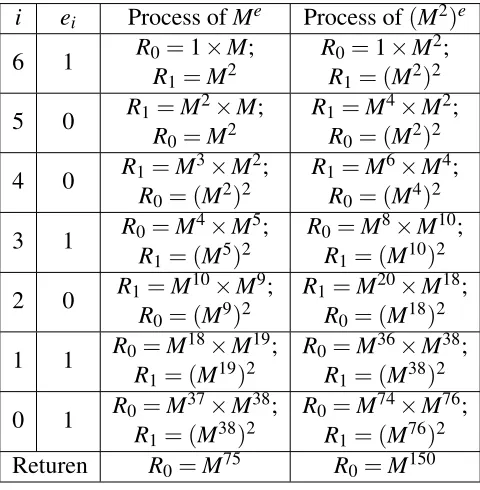
For example, we assume the private exponent e to be 75= (1001011)2 and the two related input to beMeand(M2)erespectively. Table 3.2 provides the details of computing
Meand(M2)eusing MPL. Givene0=1, then step 6 of MPL algorithm will be calculated.
If we observe a collision of comparing doubling operation in iteration 0 for compute Me
and in iteration 1 for compute (M2)e, then we can obtain the knowledge ofe0=e1=1. If no collision is detected, e0 =1 is obtained. The idea of this attack is also applied to MPL algorithm computes scalar multiplication. Instead of choosingMeand(M2)e, the two related input data should be chosen askPand 2(kP).
3.2.2 M Safe Error Attack
Table 3.1: Computations ofMe and(M2)eusing Montgomery Powering Ladder
i ei Process ofMe Process of(M2)e
6 1 R0=1×M;
R1=M2
R0=1×M2;
R1= (M2)2
5 0 R1=M
2×M;
R0=M2
R1=M4×M2;
R0= (M2)2
4 0 R1=M
3×M2;
R0= (M2)2
R1=M6×M4;
R0= (M4)2
3 1 R0=M
4×M5;
R1= (M5)2
R0=M8×M10;
R1= (M10)2
2 0 R1=M
10×M9;
R0= (M9)2
R1=M20×M18;
R0= (M18)2
1 1 R0=M
18×M19;
R1= (M19)2
R0=M36×M38;
R1= (M38)2
0 1 R0=M
37×M38;
R1= (M38)2
R0=M74×M76;
R1= (M76)2
Returen R0=M75 R0=M150
classic square-and-multiply algorithm first. The commonly used algorithm for computing
Me modNwhere the exponenteis expressed in the binary form ase=∑in=−01ei2i. Suppose
that the modular multiplicationR=ABmodN has to be preformed. Let∑in=−01ai2i be the
binary expansion ofA. Then,Acan be recoded in radix 2t as∑mj=−01Aj(2t)j instead. Hence
Algorithm 3.5Rewrite square-and-multiply algorithm
Input: M,N,e= (en−1,en−2. . .e0)2
Output: A=Me modN
1: A=1;B=M;
2: fori=0 ton−1do
3: ifei=1then
4: R=0;
5: for jfromm−1 down to 0do
6: R= (R2t+AjB)modN;
7: end for
8: A=R;
9: end if
10: R=0;
11: for jfromm−1 down to 0do
12: R= (R2t+BjB)modN;
13: end for
14: B=R;
15: end for
The main idea of M safe error can be understood as follows: We can see from algorithm 3.5, if one or several errors are introduced into the more significant bit positions of register
A, after restoring the result R into A (step 8), no error will be detected if the faulty bits belong to wordsAj are no loner required. For example, we assume that during iterationi,
an error is injected into wordAk. In the scenario thatei=1 and the error is induced when counter j of step 6 is less than k, then the faulty Ak will not affect the final result of R. Eventually, after step 8, the faultyAwill be cleared, Such kind of temporary error is called a safe error. But in the scenario ofei=0, the final result will be incorrect. Thus, we can obtain the value ofei[14] [2].
M safe error attack is effectively against MPL too. Recall from Alg 3.4, suppose that
R1is assigned as the multiplier. Ifei=0, two operationsR1=R0×R1andR0= (R0)2are
case of settingR0as the multiplier.
3.2.3 Comparative Power Analysis
Comparative power analysis is a power analysis technique which was proposed in 2000 [5]. It can attack multiple algorithms including multiply algorithms, square-and-multiply always algorithms, Sliding window methods and MPL.
It’s similar to doubling attack only more powerful, the basic idea is also to input a chosen messages to generate collisions. Instead of choosing Me and(Me)2, The message pair could be selected as(Me)α and(Me)β. We can see, if 2α =β, it can be seen as the
doubling attack. It’s the same case for MPL algorithm that computes scalar multiplication. The message pair can be chose asαkPandβkP.
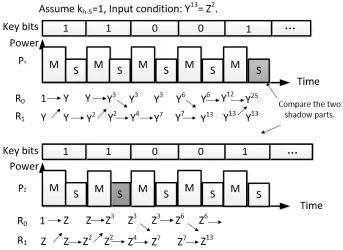
Fig.3.1 shows an example of comparative power analysis applied to MPL. Suppose the attacker already knows the first four bits of the exponente, which are (1100)2. Assuming
thatek−5=1, we use the value ofR1(=Y13)as the input of the squaring operation. Since
ek−2=1, the message pairY13 =Z2 is then selected to meet the condition. Compare the power traces of the two shadow parts, if the results are identical, it means the assumption is correct. otherwise, the assumption is wrong, which meansek−5=0.
3.2.4 Park’s Fault Attack
MPL is also vulnerable to Park’s fault attack which was proposed in 2009 [6]. The main idea of this attack is to inject a fault into one loop of the algorithm and check the correctness of the next loop’s result. The attacker is able to obtain the relationship of two adjacent secret bits.
Fig. 3.1: Example of comparative power attack against MPL
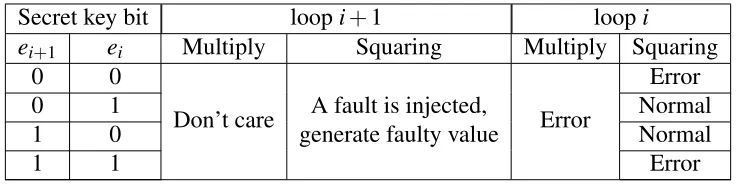
In the first scenario, we assume that an attacker injects a fault during the multiplication computationR1orR0=R0×R1of the loopi+1. Recall from algorithm 3.4, ifei+1=0/1, then the intermediate value R1/R0 becomes a faulty one. The output of this scenario is shown as Table 3.2. From the table, we can see if bit ei+1 =ei, the two power traces of squaring operation in loop i will be the same. However, when the two key bits are different, the attacker is able to observe difference between two power traces. As a result, the attacker can obtain the knowledge of whether or notei+1equals toei. More specifically,
if an attacker who knows the value of ei+1, he can obtain the value of next key bit ei by observing the power differences in loopi.
Table 3.2: Computation of modular exponentiation when a fault is injected in the squaring operation
Secret key bit loopi+1 loopi
ei+1 ei Multiply Squaring Multiply Squaring
0 0
A fault is injected,
generate faulty value Normal Error
Normal
0 1 Error
1 0 Error
1 1 Normal
Table 3.3: Computation of modular exponentiation when a fault is injected in the squaring operation
Secret key bit loopi+1 loopi
ei+1 ei Multiply Squaring Multiply Squaring
0 0
Don’t care A fault is injected,
generate faulty value Error
Error
0 1 Normal
1 0 Normal
1 1 Error
power traces in the squaring operation in loopiwill be the same. However, when key bits
ei+1 andeiare the same, the erroneous processing within squaring operation in the loop i
will generate some power differences between the two power traces. So an attacker who knows ei+1 can also derive the next secret bit ei by observing the power spectrum in the loopi.
3.3
Follow up Countermeasures on Exponent and Message Masking
3.3.1 Exponent Splitting
S=Sr×Sr0 =Mr+r 0
modN =MemodN. The weakness of this method is it doubles the computation load and can be broke by high order attack [27].
3.3.2 High Orders Attack against Exponent Splitting
High Orders Attack was proposed in [27] by Frederic Muller and Frederic Valette. They discovered some statistical properties of the exponent splitting. Then they used their dis-covery to mount side channel attacks.
The properties can be understood as this:Ci=Ci⊕ri⊕ri0is always satisfied, whereCi
is the carry bit ini-th iteration andri,r0i refer to the two split elements of exponente. Piis defined as the probability for the case ofCi=0 andPr(ri,r0i)as the probability for bracket
case, we could have the probability transactions. From it, the bit-level probabilities of step
ican be derived from previous steps.
With this property in hand, an attacker can apply it with side channel attacks such as fault attacks, safe error attacks and address-bit attacks to learn the secret exponent. Then exponent splitting countermeasure is no longer secure.
3.3.3 Blinded Fault Resistant Exponentiation
Blinded Fault Resistant Exponentiation is also known as Masked Montgomery Powering Ladder (Masked MPL). It was proposed in [26] by G. Fumaroli and D. Vigilant in 2009. It is a message masking technique based on MPL. It’s shown as Algorithm 3.6. At the beginning of the algorithm, two registers R0 and R1 are blinded by multiply a random picked numberr. Then all the intermediate values ofR0andR1are masked by the element
r2n−i.
The registerR2is initialized with the anti-maskr−1and such anti-mask is also updating
during each iteration process. MultiplyR0andR2at the end of the algorithm will maintain
such purpose.
Other than resist to SPA, Masked MPL also successfully withstand differential power analysis (DPA) and fault attacks. Unless the random numberr is revealed, or it is a weak mask, Masked MPL is considered secure. And thanks to the Checksum function’s partici-pation, most fault attack cannot pass the very last sum checking. Failure in such checking will cause the calculated results wiped. However this attack is vulnerable to template at-tack, which is able to reveal the secret mask.
Algorithm 3.6Masked Montgomery Powering Ladder
Input: M,e= (en−1en−2...e1e0); init(CKS)
Output: C=Me
1: Pick random numberr
2: R0=r;R1=rM;R2=r−1;
3: fori=n−1 down to 0do
4: ifei=0then
5: R1=R0×R1; R0=R02; R2=R22
update(CKS,ei);
6: else
7: R0=R0×R1; R1=R12; R2=R22
update(CKS,ei);
8: end if
9: R2=R2⊕CKS⊕CKSre f;
10: end for
11: ReturnC=R0×R2.
3.3.4 Template Attack against Masked MPL
C. Herbst and M. Medwed proposed the template attacks in [28]. It has been proved that it is effective to attack Masked Montgomery Ladder via guessing the value of random mask [28].
candidates are filtered out. In the second step, the correct bit will be selected. Hence, the mask will be revealed.
3.4
Sequence Masking
Sequence masking is another effective countermeasure to resist certain side channel attacks. It usually changes the procedure of exponentiation methods. One example is Square-and-Multiply-always method [21]. There is few work about sequence masking. since it’s diffi-cult to change the computation sequence in an algorithm. carelessly modifying may dam-age its correctness. Also, simply adding dummy operation may make the algorithm more vulnerable. Nevertheless, sequence masking is a possible countermeasure of preventing SCAs.
3.5
Combined Sequence Masking and Exponent Splitting algorithm
proposed by He
A highly secure algorithm which combines sequence masking and exponent splitting tech-nique together was proposed by He in 2013. In [29], it shows that despite its high complex-ity, the algorithm can successfully resist to all the side channel attacks mentioned above.
3.6
Joye’s m-ary Algorithms
There is another algorithm called highly regular m-ary powering ladders [7], which can be seen as m-ary generalizations of Montgomery ladder. It was originally invented to compute modular exponentiation in RSA. It can be easily extended to perform scalar multiplication in ECC. Similar to MPL, this algorithm always repeat the same instructions in the same order, without inserting dummy operations. It’s available in any radixmand in any compute direction (left-to-right or right-to-left).
a representation ofe−1 instead of the original exponente. The m-ary algorithms can be understood as follows:
Lete=∑il=−01eimidenotes the m-ary representation of exponente. Then
e= (el−1−1)ml−1+ (∑il=−02(di+m−1)mi) +1;
The equation above can be rewritten as
e−1=∑il=−01e∗imi;
wheree=e∗i =ei+m−1 for 06i6l−2;e=e∗i =el−1−1 fori=l−1.
For the left-to-right algorithm which computes modular exponentiation in RSA is shown as Algorithm 3.7, it makes use of an registerA, initialized toge∗l−1. At each iteration of the
main loop, the register A is raised to the power of m and then always multiplied by ge∗i.
At the end of the main loop, the register is multiplied by g to get the correct result. The corresponding algorithm that computes scalar multiplication is shown as Alg 3.8.
Algorithm 3.7Joye’s m-ary left-to-right algorithm (RSA)
Input: Pointg∈G,d=∑hi=−01dimi, di∈ {0,1, ...,m−1}
Output: gd
1: fori=1 tomdo
2: R[i] =gm+i−2;
3: end for
4: A=gdh−1−1
5: fori=h−2 down to 0do
6: A=Am;
7: A=A×R[1+di]; 8: end for
9: A=A×g;
Algorithm 3.8Joye’s m-ary left-to-right algorithm (ECC)
Input: PointP∈E,k=(kh−1kh−2...k1k0)2, ki∈ {0,1...m−1}
Output: kP
1: fori=1 tomdo
2: R[i] = (m+i−2)P;
3: end for
4: A= (kh−1−1)P
5: fori=h−2 down to 0do
6: A=mA;
7: A=A+R[1+ki];
8: end for
9: A=A+P;
10: The final value isA=kP.
For the right-to-left algorithm, we have
ge−1= ((gm)l−1)dl∗−1×∏m−1
j=1(L∗j)m+j−2;
whereL∗j =∏06i6l−2,e∗i=jgm
i
.
The right-to-left algorithm uses m registers, R[1]...R[m] to keep track of the value of
Algorithm 3.9Joye’s m-ary right-to-left algorithm (RSA)
Input: Pointg∈G,d=∑hi=−01dimi, di∈ {0,1, ...,m−1}
Output: gd
1: fori=1 tomdo
2: R[i] =1G; 3: end for
4: A=g;
5: fori=0 toh−2do
6: R[1+di] =R[1+di]×A;
7: A=Am;
8: end for 9: A=Adh−1−1×
∏mi=1R[i]m+i−2; 10: A=A×g;
11: The final value isA=gd.
Algorithm 3.10Joye’s m-ary right-to-left algorithm (ECC)
Input: PointP∈E,k=(kh−1kh−2...k1k0)2, ki∈ {0,1...m−1}
Output: kP
1: fori=1 tomdo
2: R[i] =O;
3: end for
4: A=P;
5: fori=0 toh−2do
6: R[1+ki] =R[1+ki] +A;
7: A=mA;
8: end for
9: A= (kh−1−1)A+∑mi=1(m+i−2)R[i]; 10: A=A+P;
11: The final value isA=kP.
3.6.1 Joye’s Binary Algorithms
If m=2, from high radix algorithms, we obtain the binary cases, in which the exponent
e∈ {0,1}. Thene−1=∑li=−02e∗i2i withe∗i =ei+1. Also,el−1is set to be 1. For the
is a correction step which includes one multiplication at the end of the algorithm.
Algorithm 3.11Joye’s binary left-to-right algorithm (RSA)
Input: Pointg∈G,d=∑ih=−01di2i, di∈ {0,1}
Output: gd
1: R[1] =g;
2: R[2] =R[1]2;
3: A=R[dh−2+1]
4: fori=h−3 down to 0do
5: A=A2;
6: A=A×R[1+di]; 7: end for
8: A=A×R[1];
9: The final value isA=gd.
Algorithm 3.12Joye’s binary left-to-right algorithm (ECC)
Input: PointP∈E,k=(kh−1kh−2...k1k0)2, ki∈ {0,1}, kh−1=1
Output: kP∈E
1: x=(kh−2+1)P; 2: y=2P;
3: fori=h−3 down to 0do
4: ifki= 0then
5: x= 2x; x=x+P;
6: else
7: x= 2x; x=x+y;
8: end if 9: end for
10: x=x+P;
11: The final value isx=kP.
For right-to-left algorithm, the most significant bit is also set to be 1. In order to prevent the final correction step,R[1]is initialized to bege0 andR[2]tog. Then the loop can start at
Algorithm 3.13Joye’s binary right-to-left algorithm (RSA)
Input: Pointg∈G,d=∑ih=−01di2i, di∈ {0,1}
Output: gd
1: R[1] =gd0;
2: R[2] =g;
3: A=R[2]
4: fori=1 toh−2do
5: A=A2;
6: R[1+di] =A×R[1+di];
7: end for
8: A=R[1]×R[2]2;
9: The final value isA=gd.
Algorithm 3.14Joye’s binary right-to-left algorithm (ECC)
Input: PointP∈E,k=(kh−1kh−2...k1k0)2, ki∈ {0,1}, kh−1=1
Output: kP∈E
1: x=k0P;
2: y=P;
3: z=P;
4: fori=1 toh−2do
5: ifki=0then
6: z=2z; x=x+z;
7: else
8: z=2z; y=y+z;
9: end if
10: end for
11: z=x+2y;
4
Proposed Elevated Binary Number System (EBNS)
4.1
Elevated Binary Number System Property
For an integer in EBNS of lengthk(there arekdigits in the representation),
X = (xk−1xk−2...x1x0)2; wherexi∈ {1,2}
The maximal representable value is 2k+1−2 and the minimal representable value can be calculated as 2k−1. So, the representation range of k digits for this new number system is2k−1,2k+1−2. By contrast, the representation rang ofk digits for binary number is
2k−1,2k−1. So, for the same value, EBNS representation needs one bit less than binary number system.
For example, if we want to represent decimal number 27 in this new number system. We can write it as(2211)2.
4.1.1 Convert between EBNS and Binary Number System
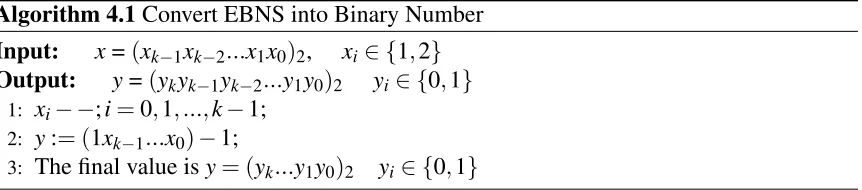
We also present the conversion algorithms between binary number system and EBNS. The algorithms are shown as Algorithm 4.1 and 4.2. The main difference between EBNS and binary number system is their digit set. We can consider that for EBNS, we use digit 1 to replace binary digit 0 and replace binary digit 1 by 2.
Algorithm 4.1Convert EBNS into Binary Number
Input: x=(xk−1xk−2...x1x0)2, xi∈ {1,2}
Output: y=(ykyk−1yk−2...y1y0)2 yi∈ {0,1} 1: xi− −;i=0,1, ...,k−1;
2: y:= (1xk−1...x0)−1;
3: The final value isy= (yk...y1y0)2 yi∈ {0,1}
Fig. 4.1: Architecture of converting EBNS into Binary Number System
digit sets, for the same value, EBNS representation is always one bit less than binary rep-resentation. There is one unique situation, which is all the bits are 1. It’s the same case for binary number and Elevated binary number. But it has no practical use. We can ignore this situation.
Algorithm 4.2Convert Binary Number into EBNS
Input: x=(xk−1xk−2...x1x0)2, xi∈ {0,1}, xk−16=0
Output: y= (...y1y0)2, yi∈ {1,2} 1: y= (xk−2...x1x0) +1;
2: yi+ +;i=0,1, ...,k−2;
3: The final value isy=(...y1y0)2 yi∈ {1,2}
4.1.2 Conversion between EBNS and Decimal Number System
Fig. 4.2: Architecture of converting Binary Number System into EBNS
Algorithm 4.3Convert Decimal Number into EBNS
Input: xin decimal representation
Output: y=(yk−1yk−2...y1y0)2, yi∈ {1,2} 1: i=0;
2: whilex6=0do
3: y=xmod 2;
4: ifyi=0then
5: yi=2; x=x/2−1;
6: else
7: x= (x−1)/2;
8: end if
9: end while,
10: i=i+1;
11: The final value isy=(yk−1yk−2...y1y0)2
4.2
Elevated High Radix Number System
System of lengthk(there arekdigits in the representation),
X= (xk−1xk−2...x1x0)m; wherexi∈ {1,2,· · ·,m}
The maximal representable value is m(11−−mmk). and the minimal representable value can be calculated as (11−−mmk). So, the representation range ofkdigits for this new number system is h(1−mk)
1−m ,
m(1−mk)
1−m
5
Proposed Algorithms using Elevated Number System
In this section, several algorithms compute scalar multiplication using our proposed new number systems are proposed. Algorithms using EBNS are firstly presented. Then we ex-tend the algorithms to high radix cases. We also show the proposed algorithms outperform or comparable to the best of existing similar algorithms in terms of against side channel attacks and computational efficiency.
5.1
Binary Representation
For left-to-right version of algorithm, we propose Algorithm 5.1. The correctness of this algorithm is easy to prove. The core operation can be wrote as{x=2x; x=x+kiP}. After
h−1 loops of computation, we can get the result ofx=2h−1x+2h−2kh−2P+2h−3kh−3P+ ...+k0P. Sincexis initiated askh−1P, final resultx=kPis obtained.
For each loop, the core computation includes one doubling and one addition no matter
kequals to 1 or 2. Apparently, with this balanced number of operation for different value of key bits, this algorithm can resist to SPA.
Algorithm 5.1Scalar multiplication using EBNS (left-to-right)
Input: PointP∈E,k=(kh−1kh−2...k1k0)2, ki∈ {1,2}
Output: kP∈E
1: x=kh−1P;
2: y=2P;
3: fori=h−2 down to 0do
4: ifki=1then
5: x=2x; x=x+P;
6: else
7: x=2x; x=x+y;
8: end if
9: end for
10: The final value isx=kP.
can be wrote as {z=2y; x=x+ (2−ki)y; x=x+ (ki−1)y; y=z;}. After computing from loop 1 to looph−1. the result ofxisk0P+21k1P+22k2P+...+2h−1kh−1P. Since
xis initiated asO, we can obtain the final resultx=kP. As seen from Alg 5.2, at the end of each loop, registerzneeds to be assigned toy. The main computation in every loop also includes one doubling and one addition. Apparently, Alg 5.2 resist to SPA.
Algorithm 5.2Scalar multiplication using EBNS (right-to-left) version 1
Input: PointP∈E,k=(kh−1kh−2...k1k0)2, ki∈ {1,2}
Output: kP∈E
1: x=k0P;
2: y=2P;
3: fori=1 toh−1do
4: ifki=1then
5: z=2y; x=x+y;
6: else
7: z=2y; x=x+z;
8: end if
9: y=z;
10: end for
11: The final value isx=kP.
The second algorithm of computing from right to left is illustrated as Algorithm 5.3. The main computation can be wrote as {x=x+ (2−ki)z; y= y+ (ki−1)z; z =2z;}. So after the h−1 loops of computation, the result of x is k0P+21k1P+22k2P+...+
Algorithm 5.3Scalar multiplication using EBNS (right-to-left) version 2
Input: PointP∈E,k=(kh−1kh−2...k1k0)2, ki∈ {1,2}
Output: kP∈E
1: x=O;
2: y=O;
3: z=P;
4: fori=0 toh−1do
5: ifki=1then
6: x=x+z; z=2z;
7: else
8: y=y+z; z=2z;
9: end if 10: end for
11: z=x+2y;
12: The final value isz=kP.
The third right-to-left algorithm is shown as Algorithm 5.4. The core computation is the same as in Alg 5.3. It can also be calculated in parallel. Differ from Algorithm 5.3, the correctness step at the end of Alg 5.4 isz=kh−1z+x+2y. There areh−1 loops in total. If the most significant bit (MSb) is 1, the last correction step includes one doubling and two additions. Otherwise, it contains two doubling and two additions.
Algorithm 5.4Scalar multiplication using EBNS (right-to-left)version 3
Input: PointP∈E,k=(kh−1kh−2...k1k0)2, ki∈ {1,2}
Output: kP∈E
1: x=O;
2: y=O;
3: z=P;
4: fori=0 toh−2do
5: ifki=1then
6: x=x+z; z=2z;
7: else
8: y=y+z; z=2z;
9: end if
10: end for
11: z=kh−1z+x+2y;
12: The final value isz=kP.
In Alg 5.5, we initialize register x to k0P and register z to 2P. The correction step is represented as z=kh−1z+x+2y. There are two cases for correction step. Ifkh−1=1, the correction step includes two additions and one doubling. Otherwise, it contains two additions and two doubling. There areh−2 loops involved.
Algorithm 5.5Scalar multiplication using EBNS (right-to-left) version 4
Input: PointP∈E,k=(kh−1kh−2...k1k0)2, ki∈ {1,2}
Output: kP∈E
1: x=k0P;
2: y=O;
3: z=2P;
4: fori=1 toh−2do
5: ifki=1then
6: x=x+z; z=2z;
7: else
8: y=y+z; z=2z;
9: end if
10: z=kh−1z+x+2y;
11: end for
12: The final value isz=kP.
The fifth right-to-left algorithm is shown as Algorithm 5.6. Register x, y and z are initialized as k0P, Oand P. The correction step at the end of the algorithm includes one doubling operation and one addition operation. The main computation can be wrote as
{z=2z; x=x+ (2−ki)y; x=x+ (ki−1)y; y=z;}. So after the last correction step, we
Algorithm 5.6Scalar multiplication using EBNS (right-to-left) version 5
Input: PointP∈E,k=(kh−1kh−2...k1k0)2, ki∈ {1,2}
Output: kP∈E
1: x=k0P;
2: y=O;
3: z=P;
4: fori=1 toh−1do
5: ifki=1then
6: z=2z; x=x+z;
7: else
8: z=2z; y=y+z;
9: end if 10: z=x+2y;
11: end for
12: The final value isz=kP.
5.2
High Radix Representation
After propose algorithms compute scalar multiplication using EBNS, we extend the algo-rithms to high radix cases. The left-to-right version of algorithm is shown as Algorithm 5.7.
mrepresents any high radix. As illustrated in the Alg 5.7, we initializeR[i]toiPforifrom 1 tomandAtokh−1P. The main operations for every loop isA=mA; andA=A+R[ki].
There is no correction step needed in the algorithm.
Algorithm 5.7Scalar multiplication using Elevated High Radix Number (left-to-right)
Input: PointP∈E,k=∑hi=−01kimi, ki∈ {1,2, ...m}
Output: kP∈E
1: fori=1 tomdo
2: R[i] =iP;
3: end for
4: A=kh−1P;
5: fori=h−2 down to 0do
6: A=mA;
7: A=A+R[ki]; 8: end for
9: The final value iskP=A.
is shown as Alg. 5.8. For the initialization,R[i]is set to beOGforifrom 1 tomandAtoP. The main computation isR[ki] =R[ki] +A; andA=mA. The correction step at the end of
the algorithm isA=∑mi=1iR[i]. It can be rewrote as
A=R[m];
Fori=m−1 down to 1.
R[i] =R[i] +R[i+1];
A=A+R[i]
End for
Alg 5.9 is the rewrote algorithm of Alg 5.8.
Algorithm 5.8Scalar multiplication using Elevated High Radix Number (right-to-left) ver-sion 1
Input: PointP∈E,k=∑hi=−01kimi, ki∈ {1,2, ...m}
Output: kP∈E
1: fori=1 tomdo
2: R[i] =OG;
3: end for
4: A=P;
5: fori=0 toh−1do
6: R[ki] =R[ki] +A;
7: A=mA;
8: end for
9: A=∑mi=1iR[i];
10: The final value iskP=A.
The second version of right-to-left algorithm is shown as Alg. 5.10. It’s similar to Alg. 5.8. The initialization steps and main computations are the same. The difference is that Alg 5.10 has one less loop and the correction step addskh−1A. The correction step can be rewrote as follows:
A= (kh−1)A;
A=A+R[m];
Fori=m−1 down to 1.
A=A+R[i]
End for
Algorithm 5.9Scalar multiplication using Elevated High Radix Number (right-to-left)
Input: PointP∈E,k=∑hi=−01kimi, ki∈ {1,2, ...m}
Output: kP∈E
1: fori=1 tomdo
2: R[i] =OG;
3: end for
4: A=P;
5: fori=0 toh−1do
6: R[ki] =R[ki] +A;
7: A=mA;
8: end for
9: A=R[m];
10: fori=m−1 down to 1do
11: R[i] =R[i] +R[i+1];
12: A=A+R[i];
13: end for
14: The final value iskP=A.
The third right-to-left algorithm is shown as Alg. 5.11. We can see from the algorithm, the main computation isX =X+kiY;Y =mY, which can be computed in parallel. kiY is the multiple results of pointP. If we calculate and restore all the multiple results of point
Pin advance,kiPdoes not need to be computed during the algorithm. The core operation
Algorithm 5.10 Scalar multiplication using Elevated High Radix Number (right-to-left) version 2
Input: PointP∈E,k=∑hi=−01kimi, ki∈ {1,2, ...m}
Output: kP∈E
1: fori=1 tomdo
2: R[i] =OG;
3: end for 4: A=P;
5: fori=0 toh−2do
6: R[ki] =R[ki] +A;
7: A=mA;
8: end for
9: A=kh−1A+∑mi=1iR[i];
10: The final value iskP=A.
Algorithm 5.11 Scalar multiplication using Elevated High Radix Number (right-to-left) version 3
Input: PointP∈E,k=∑hi=−01kimi, ki∈ {1,2, ...m}
Output: kP∈E
1: X =OG;
2: Y =P;
3: fori=0 toh−1do
4: X =X+kiY;
5: Y =mY;
6: end for
7: The final value iskP=X.
5.3
Security Analysis and Comparison
5.3.1 Binary Representation
In this subsection, we analyse our proposed binary algorithm’s security strength against several side channel attacks and compared the results with existing works.
Since proposed Alg 5.1 has its feature of highly regular, which means it has balanced number of operation for different value of key bits. It can certainly resist to simple power analysis.
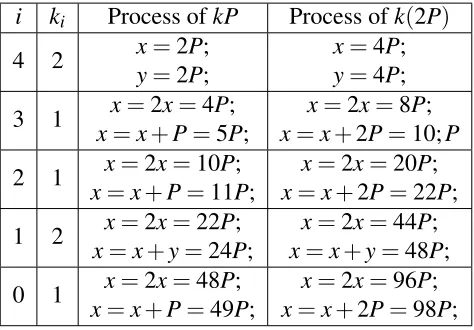
in Section 3.2. However, for our proposed Alg 5.1, those two attacks have no use. In order to perform a doubling attack, the attacker needs to computekPandk(2P)at the same time and compare their power traces of doubling operation to observe a collision. In Alg 5.1, doubling operation is always performed before the addition operation no matter the secret key bit equals to 1 or 2. So no collision will be detected. Table 5.1 shows the results of computing scalar multiplication with input ofkP=49Pand k(2P) =98Pusing Alg 5.1. We can see from the table, there is no collision generated. As a result, Alg 5.1 can resist to doubling attack. It’s the same case for launching comparative power analysis. Even we chose random inputαkPandβkP, there is still no collisions generated since doubling
operation is always performed before the addition operation in the loop. Figure 5.1 is an illustration for proposed algorithm against comparative power analysis, we assume the first four digit of kis (1112)2and the fifth digit is 1. Since k2=1, we select message pair of
4A=B. No matterk4 equals to 1 or 2, the shadow parts are always the same. There is no way to obtain the value ofk4. So Alg 5.1 can resist to Comparative Power Analysis.
Table 5.1: Computations ofkPand 2(kP)using Proposed Alg 5.1
i ki Process ofkP Process ofk(2P)
4 2 x=2P;
y=2P;
x=4P;
y=4P; 3 1 x=2x=4P;
x=x+P=5P;
x=2x=8P;
x=x+2P=10;P
2 1 x=2x=10P;
x=x+P=11P;
x=2x=20P;
x=x+2P=22P; 1 2 x=2x=22P;
x=x+y=24P;
x=2x=44P;
x=x+y=48P; 0 1 x=2x=48P;
x=x+P=49P;
x=2x=96P;
x=x+2P=98P;
C safe error Attack is specifically attack algorithms with dummy operations. Since proposed Alg 5.1 does not include dummy operation, this attack has no use toward Alg 5.1. Proposed Alg 5.1 can also resist to M safe error attack. Recall from Section 3.2.2, the main idea of M safe error Attack is to inject an error into a register, if the register is restored afterwards, this attack can be seen as a safe error. Otherwise, it will result into a faulty result. For Alg 5.1, all the intermediate results are restored into registerx, so the error injected intoxwill always cause a safe error. Then there is no way to distinguish the secret key bits from 1 to 2. So Alg 5.1 is M safe error prevented.
Park’s fault attack is no threat to proposed Alg 5.1 either. Recall from Section 3.2.4, the main idea of this fault attack is to insert a fault during the computation of loop i+1 and check the correctness of results in loopito distinguish the secret key bit. For Alg 5.1, all the intermediate results are stored into registerx, so any fault injected in loopi+1 will always lead to a faulty result in loopi. Then there is no way to distinguish the different key bits.
we will not analyse the security strength of proposed algorithms against these two attacks two attacks, since they are not applicable to all of them.
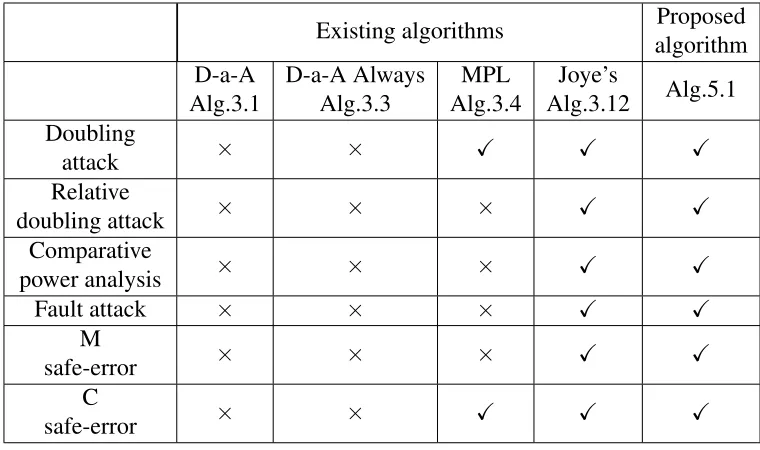
According to the above analysis, the comparison results of existing and proposed al-gorithm against Side Channel Attacks is presented in Table 5.2. As seen in Table 5.2, X means the algorithm can resist to certain attack. while×indicates the algorithm is vulner-able to the certain attack. Our proposed Alg 5.1 has the same security strength compared to the best existing algorithm.
Table 5.2: Security against SCAs among Left-to-Right algorithms (Binary Representation)
Existing algorithms Proposed algorithm D-a-A
Alg.3.1
D-a-A Always Alg.3.3
MPL Alg.3.4
Joye’s
Alg.3.12 Alg.5.1 Doubling
attack × × X X X
Relative
doubling attack × × × X X
Comparative
power analysis × × × X X
Fault attack × × × X X
M
safe-error × × × X X
C
safe-error × × X X X
We propose five right-to-left algorithms using elevated binary representation. For every algorithm, we analyse its security strength against side channel attacks.
ki=1 andki=2. So there is still no way to distinguish the secret key bits. As a result, Alg 5.2 is M safe error attack prevented. Alg 5.2 is able to resist Park’s fault attack too. Assume the attacker injects a fault into the doubling operation in loopi, the addition operation and the doubling operation in loop i−1 will both result in faulty outputs. There is no way to distinguish the secret key bit 1 from 2. If the fault is injected into the addition operation in loopi, the results of doubling operation in loopi−1 will all be correct. While the results of addition operation in loopifor bothki=1 andki=2 are wrong. Still no way to distinguish the secret bits. So it’s safe to say Alg 5.2 can resist to Park’s fault attack.
Alg 5.3, Alg 5.4 and Alg 5.5 share a lot similarities, the main computations are the same, while the differences lie on initializations steps and correction steps. Due to their similarities, We analyse their security against side channel attacks together.
First, recall from these three algorithms, the doubling operation of main computation isz=2z;, zwill always double itself no matterki equals to 1 or 2. Also it has nothing to do with other registers likexandy. Then there is no way to generate collision by choosing different inputs. So doubling attack and comparative power analysis cannot attack these three algorithms. Second, C safe error attack has no use towards these three algorithms, since no dummy operation is involved in these three algorithms. Third, M safe error has no use towards these algorithms either, assume the attacker inject an error into register x. If
ki=1, a safe error is generated. Ifki=2, the error will not be able to affect the correctness of the result either. There is no way to tell the value of secret key bits. It’s the same case for injecting error into register y andz. Unfortunately, these three algorithms are vulnerable to Park’s fault attack. We use Alg 5.3 as an example, assume a fault is insert into addition operation in loopi+1. The computation results is shown in Table 5.3.
We can see from the table 5.4, if a fault is injected into addition operation in loopi+1, the doubling operation followed is normal. But for loopi, ifki+1equals toki, the doubling
Table 5.3: Computation of Alg 5.3 when a fault is injected in the addition operation
Secret key bit loopi+1 loopi
ki+1 ki Doubling Addition Doubling Addition
1 1
A fault is injected,
generate faulty value Normal
Error
Normal
1 2 Normal
2 1 Normal
2 2 Error
Table 5.4: Computation of Alg 5.6 when a fault is injected in the addition operation
Secret key bit loopi+1 loopi
ki+1 ki Doubling Addition Doubling Addition
1 1
Don’t care A fault is injected,
generate faulty value Normal
Error
1 2 Normal
2 1 Normal
2 2 Error
Alg 5.6 is the fifth version of right-to-left algorithm. First, for the main computation, there is always a doubling operation followed by an addition operation. Also, z always double itself and has nothing to do with other registers. So, there is no way to generate collisions by choosing different inputs. Then, this algorithm can resist to doubling attack and comparative power analysis. Second, C safe error attack is still no use towards this algorithm. Any error injected into register x,y and z will all result in a safe error. Then there is no way to extract the value of secret key bit. So M safe error is no use either. Unfortunately, Park’s fault attack can threat Alg 5.6. Assume a fault is injected into addition operation of loopi+1. The computation results is shown in Table 5.4. We can see from the table, if the addition operation in loopigenerates correct results, we can obtainki+1=ki. Otherwise, we can extract the information ofkiis differ fromki+1.
is vulnerable to the certain attack. According to the table, Proposed Alg 5.11 has the best performance since it can resist to all the side channel attacks.
Table 5.5: Security against SCAs among Right-to-Left algorithms (Binary Representation)
Existing algorithms Proposed algorithms D-a-A
Alg.3.2
Joye’s
Alg.3.14 Alg.5.2 Alg.5.3 Alg.5.4 Alg.5.5 Alg.5.6 Doubling
attack × X X X X X X
Comparative
power analysis × X X X X X X
Fault attack × × X × × × ×
M
safe-error × X X X X X X
C
safe-error X X X X X X X
5.3.2 High Radix Representation
Alg 5.7 is the left-to-right version of compute scalar multiplication using high radix m. The security analysis of this algorithm is very similar to Alg 5.1. First, since the number of operation is the same for different value of secret key bit, the algorithm can certainly resist to simple power analysis. Second, the m-times operation A=mA is always performed before the addition operation, there is no way to generate collisions by choosing different inputs. Then comparative powering analysis can not threat this algorithm. Third, since all the intermediate values are restored into A and there is no dummy operation involved, C safe error and M safe error has no use towards this algorithm either. Last, any fault injected into loopi+1 will always results in faulty output in loopi. So Alg 5.7 is Park’s fault attack prevented.
m-times operation for any key bit, so these two algorithms can certainly resist to SPA. Sec-ond, register Aalways mtimes itself during every loop, so comparative power analysis is not a threat. Third, for any valueki, any error injected intoR[ki]always results into a safe
error and any error injected into A always cause a faulty output. So, there is no way to distinguish the secret key bits. M safe error is no threat either. Last, since the addition for main computation isR[ki] =R[ki] +A, there is no guarantee the sameR[ki]will be computed
in both loopi+1 and loopi. So, if any fault injected into loopR[ki+1]results into a faulty
output in loopi, then we can obtainR[ki+1] =R[ki]. So Park’s fault attack can successfully
attack these two algorithms.
The main computation of Alg 5.11 isX =X+kiY;Y =mY, which can be seen as one
addition and one m-times operation. Apparently, this algorithm is SPA prevented. Since registerY multiple itself during every loop, comparative power analysis is not a threat. No matter what the value ofkiis, any error injected into registerX turns to be a safe error and any error injected intoY will cause faulty outputs. So, M safe error attack cannot threat this algorithm either. For Park’s fault attack, if a fault is injected intoXin loopi+1, it will cause addition operation in loop i a faulty result for allki. If the fault is injected intoY, the addition andm-times operation in loopiwill both be wrong for every key bit. So, this algorithm can successfully against Park’s fault attack.