PAPPALARDO, GABRIEL. Emotional Labor and Motivation: Applying the
Three-Component Model to Display-Rule Commitment. (Under the direction of Dr. Adam Meade.) This study expands upon our understanding of the antecedents and outcomes of emotional labor by introducing tenets of the Three-Component Model of employee commitment. First, the results of a latent profile analysis on the levels of affective, normative, and continuance commitment to display rules challenge the assertion that the presence of display rules always has a negative effect on workers perceptions of job
by
Gabriel Pappalardo
A dissertation submitted to the Graduate Faculty of North Carolina State University
in partial fulfillment of the requirements for the Degree of
Doctor of Philosophy
Industrial/Organizational Psychology
Raleigh, North Carolina 2015
APPROVED BY:
____________________________ ____________________________ Dr. Samuel Pond, III Dr. Bart Craig
BIOGRAPHY
Gabriel Pappalardo graduated with honors from Cary High School in his hometown of Cary, North Carolina. He was accepted into North Carolina State University where he was inducted into the Phi Beta Kappa honor society and received the Joseph D. Moore Scholarship as well as the National Society for Collegiate Scholars Integrity Scholarship. He finished his
Bachelor of Arts in Psychology as Valedictorian in 2009 and received the Outstanding Graduating Senior Award from the Psychology department. He also completed a Spanish Language Minor after attending The University of Cantabria in Santander, Spain during a semester study abroad program. Pappalardo continued his education at North Carolina State University under the direction of Dr. Adam Meade in the Industrial/Organizational
TABLE OF CONTENTS
LIST OF TABLES ... iv
LIST OF FIGURES ... vi
EMOTIONAL LABOR AND MOTIVATION: APPLYING THE THREE-COMPONENT MODEL TO DISPLAY-RULE COMMITMENT ...1
Emotional Labor Theory and Discrepant Findings ...3
Moderating Mechanisms: Display-rule Commitment and Perceived Autonomy ...6
The Three-Component Model, Display-Rule Commitment, and Merging the Moderators ...8
Exploring Emotional Labor Motivated by Affective Commitment ...11
The Present Study: Research Questions and Hypotheses ...13
METHOD ...18
Participants and Procedure ...18
Measures ...19
Analyses ...22
RESULTS ...24
Display-rule Commitment Profiles ...24
Display Rules and Emotional Labor ...27
Emotional Labor, Job Satisfaction and Emotional Exhaustion ...34
DISCUSSION ...36
Motivational Bases for Display-Rule Commitment ...37
Display-rule Commitment Main and Interaction Effects ...38
Surface Acting vs. Deep Acting ...39
The Role of Autonomy in Emotional Labor Models ...40
Limitations/Future directions ...41
Recommendations for Practice and Conclusion ...43
TABLES ...44
FIGURES ...68
REFERENCES ...80
APPENDICES ...87
Appendix A. Scale Creation and Validation Pilot Study ...88
Appendix B. Study Scale Items ...94
Appendix C. Mplus Syntax for Latent Profile Analyses ...98
LIST OF TABLES
Table 1 Sample Demographics ...44 Table 2 Model fit indices for latent profile analyses ...45 Table 3 Classification posterior probabilities for the 6-profile model ...46 Table 4 LPA sample proportions and standardized mean values for six-profile solution ..47 Table 5 Descriptive statistics and bivariate correlations for study variables ...48 Table 6 Regression Analysis for Surface Acting on Display-rule Perceptions and
Affective Display-Rule Commitment ...50 Table 7 Regression Analysis for Surface Acting on Display-rule Perceptions and
Normative Display-Rule Commitment ...51 Table 8 Regression Analysis for Surface Acting on Display-rule Perceptions, Affective
Display-rule Commitment and Normative Display-rule Commitment ...52 Table 9 Regression Analysis for Surface Acting on Display-rule Perceptions and
Continuance Display-Rule Commitment...53 Table 10 Regression Analysis for Surface Acting on Display-rule Perceptions, Affective
Display-rule Commitment, and Continuance Display-Rule Commitment ...54 Table 11 Regression Analysis for Deep Acting on Display-rule Perceptions and Affective
Display-Rule Commitment ...55 Table 12 Regression Analysis for Deep Acting on Display-rule Perceptions and Normative
Table 13 Regression Analysis for Deep Acting on Display-rule Perceptions and
Continuance Display-Rule Commitment...57 Table 14 Regression Analysis for Noncompliant, Natural Emotional Displays on
Display-rule Perceptions and Affective Display-Rule Commitment ...58 Table 15 Regression Analysis for Noncompliant, Natural Emotional Displays on
Display-rule Perceptions and Normative Display-Rule Commitment ...59 Table 16 Regression Analysis for Noncompliant, Natural Emotional Displays on
Display-rule Perceptions and Continuance Display-Rule Commitment ...60 Table 17 Regression Analysis for Compliant, Natural Emotional Displays on Display-rule
Perceptions and Affective Display-Rule Commitment ...61 Table 18 Regression Analysis for Compliant, Natural Emotional Displays on Display-rule
Perceptions and Normative Display-Rule Commitment ...62 Table 19 Regression Analysis for Compliant, Natural Emotional Displays on Display-rule
Perceptions and Continuance Display-Rule Commitment ...63 Table 20 Regression Analysis for Job Satisfaction on Surface Acting and Autonomy ...64 Table 21 Regression Analysis for Emotional Exhaustion on Surface Acting and Autonomy
LIST OF FIGURES
Figure 1 Conceptual Framework ...68
Figure 2 Mediated moderation analysis for Hypothesis 5a ...69
Figure 3 Mediated moderation analysis for Hypothesis 5b ...70
Figure 4 Mediated moderation analysis for Hypothesis 5c ...71
Figure 5 Mediated moderation analysis for Hypothesis 5d ...73
Figure 6 Display-rule commitment profiles (DRCPs) ...74
Figure 7 Interaction of Display-rule Perceptions (DRP) and Affective Display-rule Commitment (AC) on Surface Acting ...75
Figure 8 Interaction of Display-rule Perceptions (DRP) and Normative Display-rule Commitment (NC) on Surface Acting ...76
Figure 9 Interaction of Display-rule Perceptions (DRP) and Continuance Display-rule Commitment (CC) on Noncompliant, natural emotional displays...77
Figure 10 Interaction of Display-rule Perceptions (DRP) and Affective Display-rule Commitment (AC) on Compliant, natural emotional displays (CNED) ...78
Emotional Labor and Motivation: Applying the Three-Component Model to Display-Rule Commitment
It is hard to imagine a job where a member of an organization has total autonomy in the emotions he or she displays at work. Servers in restaurants are expected to provide “service with a smile” even to the rudest of customers, and an employee may fear
repercussions if they express frustration at the incompetence of a supervisor. Organizations socialize their members to be aware of display rules, tacit or formal norms dictating how emotions are to be appropriately displayed at work (Bono & Vey, 2005; Grandey, 2000; Hochschild, 2008). Workers may therefore feel the need to suppress or fake emotions in the workplace, motivated by feelings of social obligation to the organization or by feelings of fear that negative consequences may result from display-rule violation (Grandey, 2000; Hochschild, 2008). Dominant theories on emotional labor, “the process of regulating both
feelings and emotional expressions” (Grandey, 2000, p. 97), contend that regulating the
emotional labor (Grandey & Diamond, 2010). Therefore, it is imperative that we improve our understanding of the causes and effects of emotional labor so we can discover methods of mitigating potential damage to our workforce.
Emotional Labor Theory and Discrepant Findings
Emotional labor theories draw heavily from Hochschild’s work on feeling rules,
which reflect the “social guidelines that direct how we want to try to feel” (2008, p. 124) in certain contexts and are analogous to the display rules described in the emotional labor literature. Feeling rules exist in all social situations, for instance, dictating that we feel and display happiness at weddings, sadness at funerals, and gratefulness upon receiving a gift. However, the emotions a person feels may not always match the display rules for the situation, and this discrepancy can create a sense of emotional dissonance that can be distressing. The person may therefore engage in emotion work (of which emotional labor is considered a subtype limited to the context of paid employment),to feel, or at least fake a display of, the normatively appropriate emotion (Grandey, 2000; Hochschild, 1983; 2008). For example, if a person is given a truly disappointing birthday present, he may not feel the appropriate level of gratitude dictated by feeling rules. He may therefore attempt to suppress feelings of disappointment and evoke feelings of gratitude, and if he fails, he may at least fake an emotional display of gratitude so as not to hurt the feelings of the person who has given him the gift.
1983; 2008), workers are motivated to strive towards the goal of conforming to display rules. Most models of emotional labor identify two strategies that workers employ toward
achieving this goal: surface acting and deep acting (Gosserand & Diefendorff, 2005;
Grandey, 2000; Hochschild, 2008). Surface acting “involves engaging in a superficial display of the normative emotion without making any effort to change what one is actually feeling” (Judge et al., 2009, p. 57-58). For example, a customer service representative may suppress her annoyance and fake a smile when dealing with an unpleasant customer. Deep acting, on the other hand, “consists of trying to modify felt emotions in order to bring both behavior and internal experience into alignment with expected displays” (Judge et al., 2009, p. 58). An unenthused sales associate, who is expected to be energetic and excited about his product, may jump up and down or may engage in energetic chants with coworkers in an effort to summon up genuine excitement at the start of a work day. By utilizing these strategies, workers resolve the mismatch between how they feel and what they are supposed to display and avoid the negative outcomes associated with display rule violation (Gosserand & Diefendorff, 2005).
higher burnout, higher turnover, and higher reports of physical complaints (Abraham, 1999; Bono & Vey, 2005; Grandey, 2000; Morris & Feldman, 1996; Zapf et al., 2001). This model suggests that emotional labor is an inherently negative experience for workers as they
struggle to resolve the differences between what they feel and what they can display (Hochschild, 1983).
While the assertions made above represented the zeitgeist of emotional-labor theories for a time (Grandey, 2000; Hochschild, 1983; Hochschild, 2008), empirical evidence failed to consistently support the proposed relationships between display rules, emotional labor, and its effects on worker attitudes and well-being (Bono & Vey, 2005; Judge et al., 2009; Kruml & Geddes, 2000). These theories generally asserted that “The purpose of surface and deep acting is to alter one’s emotional displays to be consistent with display rules” (Gosserand & Diefendorff, 2005, p. 1257), but the unimpressive indices of association between display-rule perceptions and emotional-labor behaviors observed in Bono and Vey’s meta-analysis
prompted the authors to describe the relationship as “modest at best” (2005, p. 227).
Furthermore, while a wealth of literature exists that connects high levels of surface acting to lower job satisfaction, higher burnout, and lower job commitment (Bono & Vey, 2005; Grandey, 2000; Judge et al., 2009), this pattern does not consistently hold for deep acting. Bono and Vey’s (2005) meta-analysis found that deep acting had a small, positive
are a response to emotional dissonance between what a worker feels and what display rules demand (Gosserand & Diefendorff, 2005), and management of this dissonance drains physical and psychological resources (Gross, 1998a; Gross, 1998b; Gross & Levenson, 1997), then the inability of researchers to consistently find the same effects on workers for deep acting as they do for surface acting is puzzling. These inconsistencies prompted a call for researchers to investigate potential moderators (Judge et al., 2009), and answers to this call (Gosserand & Diefendorff, 2005; Grandey et al., 2005; Johnson & Spector, 2007) have identified interaction effects that further refined emotional-labor theories as a whole. Moderating Mechanisms: Display Rule Commitment and Perceived Autonomy
difficult conditions” (2005, p. 1257). The results indicate that the relationship between display-rule perceptions and emotional labor is significant for surface acting but not deep acting, and the relationship between display-rule commitment and emotional labor is significant for deep acting but not surface acting. Only the display-rule perception by commitment interaction significantly predicts both forms of emotional labor (Gosserand & Diefendorff, 2005). Taken together, it appears that the presence of display rules alone is insufficient to drive both forms of emotional labor. Particularly in the case of deep acting, the workers’ levels of motivation to follow display rules become a critical factor to consider.
Further evidence revealed that situational work conditions could also play important roles in labor models by interacting with the relationships between emotional-labor behaviors and subsequent worker outcomes. Researchers have explored emotional labor in workers with varying levels of perceived job autonomy, “the degree to which the job
provides substantial freedom, independence, and discretion to the employee” (Hackman & Oldham, 1975, p. 162). Autonomy plays an essential role in a number of work-motivation theories, including the Job-Characteristics Model (Hackman & Oldham, 1975),
physiological resources that aid workers in coping with the stress of emotional labor, ultimately giving workers the ability to effectively protect themselves from damage to their job attitudes and well-being (Grandey & Diamond, 2010; Hochschild, 1983; Hochschild 2008).
Empirical investigations support that autonomy has a moderating effect: meta-analytic findings suggest that perceptions of autonomy are predictive of experiencing emotional dissonance, r = -.20, even above perceptions of display rules, r = .12 (Bono & Vey, 2005). Additionally, workers who perceive greater autonomy at work experience the negative effects of surface acting and deep acting on job satisfaction and affective well-being to a lesser degree than workers with lower autonomy perceptions. The same buffering effect is seen for emotional exhaustion in the case of surface acting, although autonomy does not significantly interact with its relationship with deep acting (Grandey et al., 2005; Johnson & Spector, 2007). In sum, the evidence points to perceived autonomy as an important factor to include in emotional-labor models.
The Three-Component Model, Display-Rule Commitment, and Merging the Moderators
and to test an integrative model that examines the effects of the two moderating forces working in conjunction.
The Three-Component Model specifies that commitment to a target (i.e., an organization, a team, or a goal) is composed of varying levels of affective commitment, normative commitment, and continuance commitment. Higher levels of one or more of any combination of the three reflect a higher propensity for a worker to exert effort on behalf of a target, but the basis underlying each form of commitment is different. Affective commitment stems from a worker’s autonomous desire to exert effort, either because he or she personally identifies with the target or perceives the values of the target as congruent with his or her own. This results in the worker feeling he or she wants to be committed to the target. Normative commitment stems from workers’ perceptions of normative obligations to the target, resulting in the worker feeling he or she ought to be committed to a target. Finally, continuance commitment stems from perceptions of costs associated with failing to commit to a target or a lack of alternatives to committing to the target, resulting in the worker feeling he or she has to be committed to the target. The varying combinations of these three
commitment types form commitment profiles that represent distinct motivational mindsets in workers (Allen & Meyer, 1990; Diefendorff & Chandler, 2012; Meyer & Allen, 1991; Meyer, Becker, & Vandenberghe, 2004; Meyer & Herscovitch, 2001; Meyer et al., 2012).
understanding of the relationship between perceptions of display rules and emotional labor can be further refined by examining if the underlying basis of this commitment has an impact on the interaction. Employing the Three-Component Model framework to the examination of display-rule commitment is important because the presence of affective organizational commitment is related to a number of behaviors and workplace outcomes important to the emotional-labor literature. For instance, workers who exhibit higher levels of affective commitment are more likely to engage in organizational citizenship behaviors and are more likely to report higher levels of job satisfaction, well-being, positive affect, engagement and general health (Markovits, Davis, & van Dick, 2007; Meyer et al., 2012). Given that workers with different motivational mindsets vary significantly on a number constructs related to emotional labor (Abraham, 1999; Bono & Vey, 2005; Grandey, 2000; Morris & Feldman, 1996; Zapf et al., 2001), an examination into how workers with different bases of display-rule commitment differ in their behavioral responses to display display-rules is merited.
Chandler, 2011), and individuals who report higher fulfillment of their autonomy needs are more likely to have higher affective commitment (Meyer et al., 2012). Given autonomy’s relationship with affective commitment, (Gagné et al., 2010; Meyer et al., 2004; Meyer et al., 2012), affective commitment’s relationships with ratings of worker job attitudes and well-being (Markovits et al., 2007; Meyer et al., 2012), and commitment’s more proximal position in affecting work motivation compared to autonomy, (Diefendorff & Chandler, 2011) this study will explore the possibility that the observed buffer effects of perceived autonomy against emotional labor’s impacts on job satisfaction and emotional exhaustion (Grandey et al., 2005; Johnson & Spector, 2007) operate indirectly through perceived autonomy’s impact on affective commitment.
Exploring Emotional Labor Motivated by Affective Commitment
This study will also explore an alternate theoretical position regarding the relationship between autonomy and display rules. The conservation-of-resources perspective in
previously discussed models (Grandey et al., 2005; Hochschild, 1983) presents display rules and perceptions of autonomy as inextricably at odds. Goldberg and Grandey (2007) even operationalized their measure of display autonomy as the absence of display rules. These researchers believe the presence of display rules are perceived by workers as impositions on their autonomy, undermining intrinsic motivation and creating the resource-draining need for emotional regulation (Gross 1998a; Gross, 1998b; Gross & Levenson, 1997). These theories emphasize the social obligations and perceived costs of display-rule violation as the
statements reminding them of their obligations to follow norms for appropriate emotional expression, for instance, “You shouldn’t feel so guilty” or “You don’t have the right to feel jealous”. Additionally, she writes that others may “chide, tease, cajole, scold, or shun—in a word, sanction us for ‘mis-feeling.’” (2008, p. 124), representing costs associated with display-rule violation. Viewing these propositions through a Three-Component Model lens, display-rule commitment of workers should therefore be dominated be normative and continuance components and lacking a strong affective component. The normative
obligations and fear of sanctions serve as bases for normative and continuance commitment respectively, and the destruction of autonomy perceptions due to the presence of display rules undermines the identification that serves as the basis for affective commitment (Gagné et al., 2010; Meyer et al., 2004; Meyer et al., 2012). Under this framework, the worker is always at odds with organizational display rules, conforming to display rules out of obligation or perceived cost rather than personal desire.
However, it is possible that there are alternative motivations for engaging in
imagined slights” (Organ, 1988, p. 11) and display a “demonstration of willingness to forbear minor or temporary personal inconveniences and impositions without fuss, appeal, or
protest” (Organ & Ryan, 1995, p. 782). From this description, it is evident that workers may engage in surface acting or deep acting to regulate their emotional displays to be consistent with those of a “good sport”. Where these sportsmanship behaviors differ from behaviors normally associated with emotional labor is that sportsmanship behaviors, as organizational-citizenship behaviors, are widely regarded to be discretionary behaviors rather than
behaviors performed out of obligation or fear of sanction (Organ, M. Podsakoff, & P. Podsakoff, 2011). Workers who engage in sportsmanship are regulating their emotional displays because they want to rather than because they ought to or have to;the behaviors are
autonomous rather than controlled. Consistent with this theory, workers with higher affective commitment are more likely to engage in organizational-citizenship behaviors (Meyer et al., 2012). Given the conceptual similarities between sportsmanship and emotional labor, and the positive associations between autonomy, sportsmanship, and affective commitment (Meyer et al., 2012), it follows that not all display rules are perceived as destructive to autonomy and that “good faith” emotional labor may at times emerge from affective commitment to display rules.
The Present Study: Research Questions and Hypotheses
to calculate organizational-commitment profiles (2012), I measure each participant’s affective display-rule commitment, normative display-rule commitment, and continuance rule commitment and then employ latent profile analysis to calculate their display-rule commitment profiles. Past investigations that have employed this strategy to compute organizational-commitment profiles have reliably returned four profiles: Fully committed (High affective, normative, and continuance commitment), AC-NC Dominant (High affective and normative commitment, low continuance commitment), CC Dominant (Low affective and normative commitment, high continuance commitment), and Uncommitted (Low affective, normative, and continuance commitment); however, some studies have detected additional profiles (i.e., Somers, 2010; Stanley, Vandenberg, Vandenberghe, & Bentein, 2009; Meyer et al., 2012). As this is the first application to date of the commitment profile procedure to display-rule commitment, it is currently unknown whether or not similar profiles will emerge. For instance, if it is correct that display rules and autonomy are inherently incompatible (Goldberg & Grandey, 2007, Hochschild, 2008), display-rule commitment profiles with strong affective components may not emerge or may only be exhibited by a small proportion of the population when compared to the proportion that exhibits display-rule commitment profiles without a strong affective component. Therefore, I will explore the following research questions:
Research Question 1a: What latent display-rule commitment profiles will emerge
from latent profile analysis of participants’ affective display-rule commitment,
normative display-rule commitment, and continuance display-rule commitment
Research Question 1b: What proportions of the sample will be classified under each
display-rule commitment profile?
Empirical investigations into surface acting’s relationships with display rules and worker outcomes have be generally consistent with what would be predicted from emotional-labor theories. Surface acting worsens job attitudes and well-being consistent with the idea that it is a draining and stressful experience (Bono & Vey, 2005; Grandey, 2000; Gosserand & Diefendorff, 2005; Judge et al., 2009). Therefore, it is likely that arguments by Grandey, Hochschild, and others that the motivation for surface acting stems from obligation or fear of costs and that these behaviors occur in low autonomy situations where display rules are perceived as impositions are valid (Grandey & Diamond, 2010; Hochschild, 1983;
Hochschild 2008). Deep acting, on the other hand, has not consistently contributed to these negative outcomes as predicted (Bono & Vey, 2005; Judge et al., 2009; Kruml & Geddes, 2000), and its conceptualization as a “good faith” form of emotional labor (Diefendorff et al., 2005; Grandey, 2000, p. 100; Rafaeli & Sutton, 1987) suggests that the motivation
underlying it may be more analogous to the motivation to engage in sportsmanship organizational-citizenship behaviors than the motivation to engage in surface acting. This study is largely exploratory in its examination of how these three commitment components interact to affect the relationship between display-rule perceptions and emotional labor, but I also hazard some specific hypotheses:
Research Question 2: How will varying levels of affective display-rule commitment,
interact with the relationship between display-rule perceptions and a) surface acting
and b) deep acting?
Hypothesis 1a: The positive relationship between display-rule perceptions and
surface acting will be weaker for participants higher in affective display-rule
commitment than for participants lower in affective display-rule commitment.
Hypothesis 1b: The positive relationship between display-rule perceptions and
surface acting will be stronger for participants higher in normative display-rule
commitment than for participants lower in normative display-rule commitment.
Hypothesis 1c: The positive relationship between display-rule perceptions and
surface acting will be stronger for participants higher in continuance display-rule
commitment than for participants lower in continuance display-rule commitment.
Hypothesis 2a: The positive relationship between display-rule perceptions and deep
acting will be weaker for participants higher in affective display-rule commitment
than for participants lower in affective display-rule commitment.
the organization’s desired emotions, he or she may be able to conform to display rules with no additional labor required. Therefore, I hypothesize the following:
Hypothesis 3a: The negative relationship between display-rule perceptions and
noncompliant, natural emotional displays will be stronger for participants higher in
affective display-rule commitment than for participants lower in affective display-rule
commitment.
Hypothesis 3b: The negative relationship between display-rule perceptions and
noncompliant, natural emotional displays will be stronger for participants higher in
normative rule commitment than for participants lower in normative
display-rule commitment.
Hypothesis 3c: The negative relationship between display-rule perceptions and
noncompliant, natural emotional displays will be stronger for participants higher in
continuance display-rule commitment than for participants lower in continuance
display-rule commitment.
Hypothesis 4a: The negative relationship between display-rule perceptions and
compliant, natural emotional display will be weaker for participants higher in
affective rule commitment than for participants higher in affective
display-rule commitment.
autonomy and affective commitment, (Gagné et al., 2010; Meyer et al., 2004; Meyer et al., 2012), affective commitment’s relationships with ratings of worker job satisfaction and emotional exhaustion (Markovits et al., 2007; Meyer et al., 2012), and commitment’s more proximal position in affecting work motivation compared to autonomy, (Diefendorff & Chandler, 2011), I hypothesize the following:
Hypothesis 5a: Affective display-rule commitment will significantly mediate the
moderating effect of autonomy on the relationship between surface acting and job
satisfaction.
Hypothesis 5b: Affective display-rule commitment will significantly mediate the
moderating effect of autonomy on the relationship between surface acting and
emotional exhaustion.
Hypothesis 5c: Affective display-rule commitment will significantly mediate the
moderating effect of autonomy on the relationship between deep acting and job
satisfaction.
Hypothesis 5d: Affective display-rule commitment will significantly mediate the
moderating effect of autonomy on the relationship between deep acting and emotional
exhaustion.
Method Participants and Procedure
Mechanical Turk allows requestors to approve or reject the work of online participants and allows requestors to filter participants by their approval rating. I required respondents to have a 95% approval rating or higher to participate.
I removed one participant from the sample due to missing data and a second for working fewer than the required ten hours per week at a single employer. Finally, in order to improve the normality of frequency distributions for the study variables (Field, 2005), I deleted 23 participants from analysis who scored three standard-deviations above or below the sample mean on any of the study variables. This yielded a final sample of 432
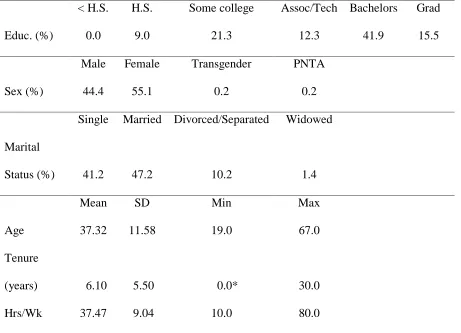
participants, for which demographic data is displayed in Table 1. Measures
Emotional Labor. Surface acting and deep acting were assessed using slight alterations of Diefendorff et al.’s (2005) 7-item and 4-item scales respectively. Example items from each scale include “I put on an act in order to deal with customers in an appropriate way” and “I try to actually experience the emotions that I must show to
customers.” Participants were asked to use a 7-point, Likert scale to indicate the frequency with which they engage in each behavior (1 = Almost Never, 7 = Almost Always).
Cronbach’s alphas were .93 and .84 for the surface acting and deep acting scales respectively in this sample.
Natural Emotional Displays. Inspired by Diefendorff et al.’s (2005) three-item
natural emotional display scale, I created two, 3-item scales for compliant natural emotional displays and noncompliant natural emotional displays. The psychometric properties of these measures were validated in a pilot study detailed in Appendix A. Example items include “There is rarely a conflict between what I really feel and the emotions I’m supposed to show to customers.” and “I refuse to fake or suppress my true feelings to customers.” Participants will be asked to use a 7-point, Likert scale to indicate the degree to of frequency with which they engage in each behavior (1 = Almost Never, 7 = Almost Always). Cronbach’s alphas were .77 and .85 for compliant and noncompliant displays respectively in this sample.
Display-rule Commitment. Inspired by Gosserand and Diefendorff’s (2005) display-rule commitment scale, the conceptual definitions of affective commitment, normative commitment and continuance commitment, and the theoretical bases of value congruence, normative obligation, and perceived costs, I created three, 3-item scales to measures
of these measures were validated in a pilot study detailed in Appendix A. Participants were presented with the stem, “I strive to follow my organization’s rules about displaying
appropriate emotions and not displaying inappropriate emotions to customers because…” and were then asked to use a 7-point, Likert scale to indicate the degree to which they agree with each completion of the phrase (1 = Strongly Disagree, 7 = Strongly Agree). Example items from each scale include “I would strive to display these emotion even if the organization didn't expect it of me”, “I feel I owe it to my organization to try to follow their rules”, and “Violating the rules would be too costly.” Cronbach’s alphas were .85, .67, and .72 for affective, normative, and continuance display-rule commitment respectively in this sample.
Perceived Autonomy. Perceived autonomy was measured using Morgeson, Delaney-Klinger, and Hemingway’s (2005) 3-item adaptation of Hackman and Oldham’s (1980) autonomy facet of the Job Diagnostic Survey. An example item reads, “I can decide on my own how to go about doing my work.” Participants used a 7-point scale the degree to which they agree with each statement (1 = Strongly Disagree, 7 = Strongly Agree). Cronbach’s alpha was .92 for the scale in this sample.
Emotional Exhaustion. Emotional exhaustion was assessed using Wharton’s (1993) 6-item Job-Related Emotional Exhaustion Scale. An example item reads, “I feel emotionally drained from my work.” Participants used a 7-point scale to indicate the frequency with which they experience feelings consistent with the scale items (1 = Almost Never, 7 = Almost Always). Cronbach’s alpha was .91 in this sample.
Sportsmanship organizational-citizenship behaviors. Sportsmanship
organizational-citizenship behaviors were assessed using Podsakoff, MacKenzie, Moorman, and Fetter’s (1990) 5-item measure. An example item is “I rarely gripe about small
inconveniences at work.” Participants used a 7-point, Likert scale to indicate the frequency with which they engage in each behavior (1 = Almost Never, 7 = Almost Always).
Cronbach’s alpha was .83 in this sample. Analyses
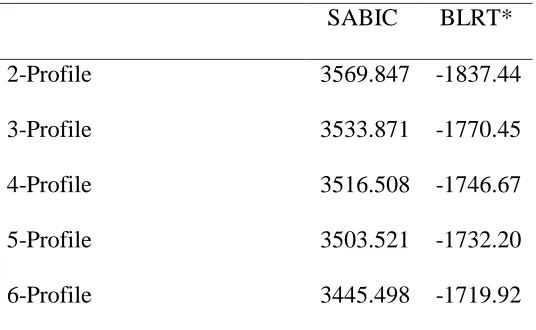
To explore Research Question 1, I employed latent profile analysis (Vermunt & Magidson, 2002). The procedure uses maximum-likelihood estimation to assign participants with similar patterns of affective, normative, and continuance display-rule commitment scores to a latent category, or profile. I replicated the procedure performed by Meyer et al. (2012) following Nylund, Asparouhov, and Muthén’s (2007) guidelines. I specified a two-profile model, and then added two-profiles until non-convergence problems emerged (Lubke & Muthén, 2005). I assessed the fit of each model using the sample-adjusted Bayesian
parameters, and a significant BLRT determines that adding a new profile significantly improves fit over the current model. The optimal solution is considered to
(a) show the lowest SABIC and BLRT, (b) have a significant BLRT p-value, (c) not contain profiles with a small number of individuals, and (d) show clearly defined profiles, indicated by a high probability that individuals actually belong to the profile to which they were assigned and a low probability of belonging to other profiles (Meyer et al., 2012, p. 8).
Research Question 2 and Hypotheses 1-4 were examined using moderation regression analyses that regressed each behavioral response (surface acting, deep acting, noncompliant natural emotional displays, and compliant natural emotional displays) on display-rule perceptions and each form of display-rule commitment (affective, normative, or
continuance). In models where significant main effects were detected, I added the appropriate display-rule perceptions by commitment interaction term. In cases where the addition of this term produced a model that explained a significant amount of additional variance in the outcome variable and where the interaction term was a significant predictor controlling for main effects, I employed simple-slopes analysis (Preacher, Curran, & Bauer, 2006) to decompose the interaction and explore the moderation effect. For each hypothesis to be supported, each predictor must be significantly associated with the outcome variable controlling for other predictors, the addition of an interaction term to the regression model must explain significant variance in the outcome variable above the main effects, the
I explored Hypothesis 5 by first using moderation regression analyses to establishing whether or not autonomy is a significant moderator of the relationship between each
emotional labor strategy (surface acting and deep acting) and each worker well-being outcome (job satisfaction and emotional exhaustion). In cases where this moderation effect emerged, I then used mediated moderation (Preacher, Rucker, & Hayes, 2007) path models as detailed in Figures 2-5. Significant modeled path coefficients in each model must be returned to support Hypotheses 5a-5d.
Results Display-rule Commitment Profiles
Table 4 displays the standardized mean estimates for affective, normative, and continuance display-rule commitment and the proportions of the sample included for each of the six profiles. Figure 6 displays the mean estimates graphically to aid interpretation. Profile 1, comprised of 12.0% of the sample, is characterized by lower than average affective and normative commitment and the highest level of continuance commitment, although this was only .2 standard deviations above the sample mean as a whole. Individuals with this profile appear to only comply with display rules out of threat of sanction or lack of alternatives, and I therefore label this group the “Forced Commitment” group. Profile 2, which is comprised of only 2.5% of the sample, is characterized by lower than average commitment of all kinds, especially affective commitment. These rare individuals feel no sense of commitment to display rules, and so I label the group the “Uncommitted” group. Profile 3, consisting of 24.1% of the sample, display below-average affective and normative commitment and roughly-average continuance commitment. These individuals feel little commitment to follow display rules, and what little commitment they feel stems from perceived costs of failing to comply. I term these individuals the “Minimally Committed” group. Profile 4, comprised of 3.5% of the population, is characterized by above average affective
as value congruence and social obligation than fear of sanction, and consistent with Meyer et al. (2012), I label these individuals the “AC-NC Dominant” group. Profile 6, comprised of 17.1% of the sample, is characterized by the highest levels of affective and normative commitment as well as slightly above-average continuance commitment. I label this final group, the “Fully Committed” group as these individuals appear to commit primarily out of a sense of value-congruence, but also acknowledge commitment stemming from both social obligation and fear of sanction. For
These results answer Research Question 1 by identifying existing display-rule commitment profiles and the proportions of the sample that were assigned to each display-rule commitment profile. Some interesting patterns emerge from examining these profiles as a whole. First, with the exception of the very small Value-Congruent group, there was comparatively little deviation across profile means in continuance commitment compared to affective and normative commitment. Therefore, it appears that the average worker
A second pattern of note is that, again with the exception of the rare Value-Congruent individuals, levels of normative display-rule commitment closely followed behind levels of affective display-rule commitment. This is poorly accounted for in my earlier hypotheses, but in retrospect, the existence of affective commitment without normative commitment may be a rarity. If an individual agrees with the goals of a target (i.e., supervisor or organization), he or she may therefore become more likely to feel a sense of obligation to commit to the target’s goals. Therefore, it would make sense that those who experience high affective commitment would also experience normative commitment. This explanation is supported in that Meyer et al. (2012) did not detect a purely Dominant profile, but did detect an AC-NC Dominant profile that comprised 19% of their sample.
Display Rules and Emotional Labor
inappropriate emotional displays than workers in settings where display-rules are perceived to be weaker. The relationship between compliant, natural emotional displays and display-rule perceptions was non-significant, suggesting the expression of genuine, appropriate emotional displays is unrelated to their perceptions of display-rule strength.
I then conducted a series of multistep regression analyses to determine to what degree different forms of display-rule commitment moderate the relationship between display-rule perceptions and these various behavioral responses to them.
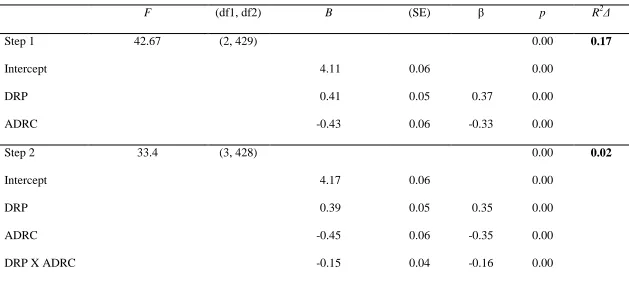
Surface acting. Beginning with surface acting, Table 8 displays the results
examining the moderating effect of affective display-rule commitment. Step 1 demonstrates that, controlling for each other, display-rule perceptions are positively associated with surface acting and affective display-rule commitment is negatively associated with surface acting such that participants who perceive displays-rules in the workplace as stronger are more likely to engage in surface acting, and participants who report higher affective commitment are less likely to engage in surface acting. Step 2 of the model introduces the display-rule perceptions by affective commitment interaction term, improving the overall variance in surface acting explained by the model. The regression weight for the interaction term was statistically significant suggesting that the level of affective display-rule
commitment reported by the participant significantly moderates the relationship between the perception of display-rules and the amount of surface acting in which a worker engages. Figure 7 displays the decomposition of the interaction and the results of simple-slopes
deviation below the mean level of affective display-rule commitment. Together these results suggest that for workers higher in affective display-rule commitment, the positive
relationship between the perception of display-rule strength and engagement in surface acting is weaker than for workers lower in affective display-rule commitment. For workers who identify with an organization’s display-rules out of sense of value-congruence, the presence of stronger display-rules is less likely to bring out increased levels of faking emotional displays than for workers who do not commit to these rules out of a sense of value congruence, supporting Hypothesis 1a.
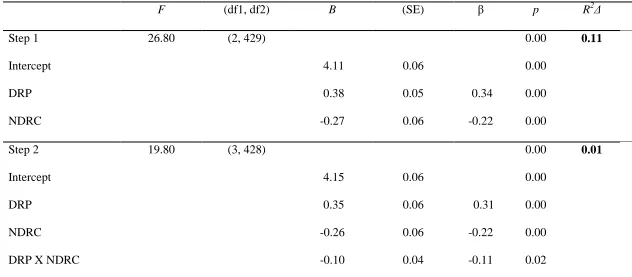
The same procedure was conducted to examine the potential moderating effect of normative display-rule commitment. Table 7 and Figure 8 detail that the direction and significance of effects were the same as those described above for affective display-rule commitment, as was the nature of the interaction between normative display-rule
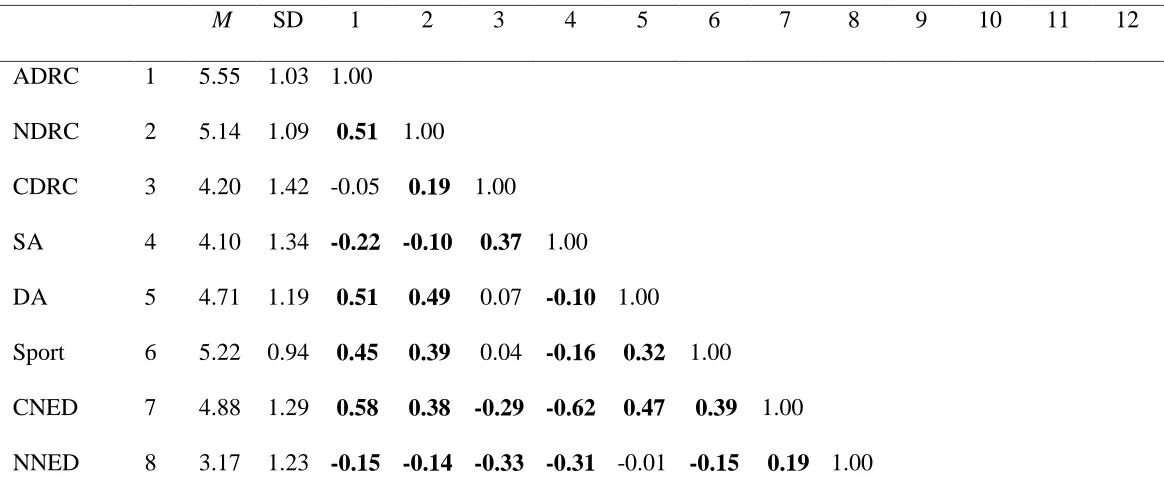
commitment and display-rule perceptions in predicting surface acting. This is likely due to the strong, positive correlation between the two forms of commitment (See Table 5). To examine this explanation further, I regressed surface acting on both affective and normative display-rule commitment simultaneously, and the results (displayed in Table 8) demonstrate that normative commitment does not account for a significant amount of variance in surface acting controlling for affective display-rule commitment. Contrary to my Hypothesis 1b, yet consistent with the results of the latent profile analysis, it appears that commitment to
The same procedure was conducted to examine the potential moderating effect of continuance display-rule commitment. Step 1 in Table 9 details that, controlling for each other, both display-rule perceptions and continuance display-rule commitment are
significantly and positively related to surface acting. Step 2 introduced the commitment by display-rule perception interaction term; however, this addition did not explain significantly more variance in surface acting above the previous model. Therefore, it appears that while workers who commit to display-rules out of fear of sanction are more likely to fake
emotional displays on average, the level of this of commitment does not significantly affect the relationship between the perceived strength of display-rules and the degree to which workers engaging in emotional faking behaviors. While the required main effects required are present, the lack of a significant interaction term suggests that Hypothesis 1c is
unsupported.
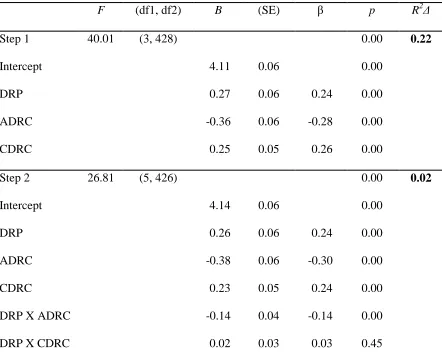
interaction term was not, with the affective commitment by display-rule perceptions interaction decomposition being nearly identical to the one depicted earlier in Figure 7.
The sum of these analyses answers Research Question 2a, suggesting that the basis of a worker’s commitment to display rules significantly changes the degree to which they engage in surface acting. Workers who commit to display rules out of sense of value
congruence or sense of social obligation are less likely on average to fake emotional displays, whereas workers who commit to display rules out of fear of sanctions are more likely to fake emotional displays. In addition, the degree to which workers engage in more faking
behaviors in response to stronger perceptions of display rules is lessened when they commit to those display-rules from a sense of value congruence or social obligation, but this
relationship is unaffected by the degree to which workers commit to these display rules out of a fear of sanction.
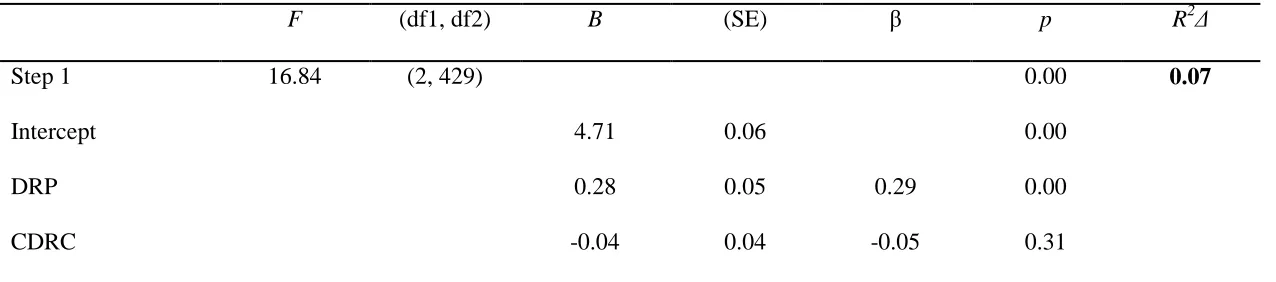
Deep acting. I then repeated this analytic strategy for deep acting. Tables 11-13 detail that controlling for display-rule perceptions, affective display-rule commitment and
normative display-rule commitment were both positively associated with deep acting and continuance display-rule commitment was negatively related to deep acting in their
rules. Workers who commit to these display rules out of a fear of sanction are less likely to attempt to genuinely change their felt emotion regardless of the perceived strength of these rules.
Together, these analyses answer Research Question 2b, demonstrating that the strength of display rules and commitment to display rules affect the amount of deep acting workers engage in separately and that the relationship between commitment and deep acting functions in the opposite direction as the relationship between commitment and surface acting.
this is particularly the case when their motivation to comply with these rules stems from a fear of being punished for their violation.
Compliant, natural emotional displays. Finally, I repeated these analyses for compliant, natural emotional displays. Table 17 details that, controlling for display-rule perceptions, affective display-rule commitment is positively associated with the expression of compliant, natural emotional displays suggesting that workers who commit to display rules out of sense of value congruence are more likely to display genuine emotions that conform to these display rules. Step 2 introduces a significant interaction term, and the decomposed interaction (displayed in Figure 10) reveals that the negative relationship between display-rule perceptions and compliant, natural emotional displays is weakened to non-significance when affective commitment is high, supporting Hypothesis 4a. This
suggests that the presence of stronger display rules do not significantly inhibit the expression of genuine emotional displays that are compliant when workers commit to the rules from a sense of value congruence.
Finally, I repeated these analyses for continuance display-rule commitment. Table 19 details that, controlling for display-rule perceptions, continuance commitment was
significantly, negatively related to compliant, natural emotional displays, suggesting that workers who commit to display rules out of a fear of sanction are less likely on average to display genuine emotions in response to emotional demands at work. Step 2 introduced the commitment by display-rule presence interaction term, but this addition did not explain a significant amount of additional variance in compliant, natural emotional displays. Emotional Labor, Job Satisfaction and Emotional Exhaustion
The final phase of analyses explores the relationships of emotional labor strategies with worker outcomes and the potential moderating effects of autonomy and affective display-rule commitment. Bivariate correlations (Table 5) suggest that surface acting is negatively related to job satisfaction and positively related to emotional exhaustion. Deep acting, on the other hand, was positively related to job satisfaction and negatively related to emotional exhaustion. Additionally, surface acting and deep acting are negatively correlated with one another, and deep acting is positively correlated with a measure of sportsmanship organizational-citizenship behavior. These results lend additional support to the idea that deep acting does not appear to have the detrimental effects to worker well-being suggested by emotional labor theories (Grandey, 2000; Zapf et al., 2001), and functions more similarly to sportsmanship organizational-citizenship behaviors than to surface acting.
Moderation regression analyses were conducted to determine whether or not
satisfaction (See Table 20) revealed that, controlling for each other, surface acting is negatively associated with job satisfaction and autonomy is positively associated with job satisfaction. Step 2 added a significant interaction term resulting in a model that accounted for significant portion of additional variance. Figure 11 decomposes the interaction, suggesting that, consistent with earlier findings (Grandey et al., 2005; Johnson & Spector, 2007), higher autonomy decreases the strength of the relationship between surface acting and job satisfaction.
A mediated moderation path analysis shown in Figure 12 was conducted to assess whether or not affective display-rule commitment mediated the moderating effect of
autonomy on the relationship between surface acting and job satisfaction. However, the path coefficient representing the regression of affective display-rule commitment on the autonomy by surface acting interaction term was non-significant, failing to support Hypothesis 5a. Mplus (Muthén, L., & Muthén, B., 1998-2011) syntax used in this procedure is displayed in Appendix D.
Step 1 of the analysis for emotional exhaustion (See Table 21) reveals that, controlling for each other, surface acting was positively association with emotional
exhaustion and autonomy was negatively associated with emotional exhaustion. However, the addition of the interaction term in Step 2 did not explain a significant portion of
additional variance. Therefore, it does not appear that the degree to which a person perceives higher autonomy on the job changes the relationship between how often they fake emotional displays and their emotional exhaustion, rendering the mediated moderation analysis
This analytic strategy was then repeated for deep acting. Table 22 details the results of the analysis regressing job satisfaction on autonomy and deep acting. Controlling for each other, both predictors are positively associated with job satisfaction. However, the addition of the interaction term in Step 2 did not explain a significant portion of additional variance. Table 23 details the results of the analysis regressing emotional exhaustion on autonomy and deep acting. Controlling for each other, autonomy is negatively related to emotional
exhaustion, but deep acting is not significantly related. In addition, the introduction of the interaction term in Step 2 did not explain a significant portion of additional variance. As neither analysis demonstrates autonomy as having a significant moderating effect, the mediated moderation analyses are unnecessary in concluding there is no evidence to support Hypothesis 5c and Hypothesis 5d.
Discussion
This study has produced a number of findings that contribute to our understanding of emotional labor. First, the results challenge the assertion that the presence of display rules always has a negative effect on workers by demonstrating that many workers commit to display rules because they want to rather than have to. Second, the basis from which workers commit differentially predicts the degree to which they engage in behavioral strategies regarding their emotional displays at work. Third, the moderating effect of commitment on the relationship between perceptions of display-rule strength and emotional labor (Gosserand & Diefendorff, 2005) is further delineated by treating display-rule commitment as a
outcomes. Finally, past moderating effects of autonomy between emotional labor strategies and worker well-being outcomes (Grandey et al., 2005; Johnson & Spector, 2007) were partially replicated, but hypotheses that affective display-rule commitment would mediate these effects were unsupported.
Motivational Bases for Display-Rule Commitment.
Some emotional labor theorists have posited that emotional labor is an inherently negative experience, asserting that the display rules that serve as the causal agent for emotional labor are perceived as impingements on autonomy and that the motivation to comply with these display-rules stems from the guilt of failing to uphold social norms or the fear of sanctions resulting from failing to do so (Grandey et al., 2010; Hochschild, 1983, 2008). The results of the latent profile analysis challenge these assertions. For 61.3% of the sample, a sense of value-congruence with organizational-display rules serves as the strongest motivating force behind their reported commitment. It appears that these individuals agree with the display-rules set by their organization, and therefore, there is an autonomous
Display-rule Commitment Main and Interaction Effects
Having established that varying bases for display-rule commitment exist, this study explored how each type of commitment differentially predicted four behavioral strategies a worker could adopt to address emotional display demands at work: two forms of emotional labor (surface acting and deep acting) and the expression of genuine emotions that either complied or did not comply with organizational display rules. Affective-display rule commitment and normative display-rule commitment were found to function fairly synonymously. Both forms of commitment were associated with lower levels of surface acting and higher levels of deep acting and compliant, natural emotional displays. Normative display-rule commitment did not function as hypothesized, but the results of the latent profile analysis and the high correlation between normative and affective commitment suggest that these two forms of motivation are unlikely to exist absent of each other. Continuance commitment functioned oppositely, with higher levels associated with more surface acting, lower deep acting, and lower compliant natural emotional displays. Workers who commit to display rules more autonomously are more likely to attempt to genuinely display their emotions or to genuinely try and change their emotions on behalf of the organization, whereas workers who commit to display rules out of a sense of fear are more likely to fake emotional displays. Finally, only continuance commitment was associated with noncompliant natural emotional displays such that workers who commit to display rules out of fear are less likely to display inappropriate emotions at work. Together, these results suggest that differing bases for display-rule commitment do not only exist but differentially predict what
The study also expands upon Gosserand and Diefendorff’s (2005) finding that display-rule commitment moderated the relationship between display-rule perceptions and surface acting and between display rule perceptions and deep-acting, although the effect for deep acting was not replicated. Affective display-rule commitment weakens the relationship between display-rule perceptions and surface acting, suggesting that when workers commit to display rules because they want to, they are less likely to choose to fake emotional displays in response to stronger display rules. Examining this effect together with the finding that the relationship between display-rule perceptions and compliant natural emotional displays is weakened to non-significance in the presence of high affective display-rule commitment suggests that workers who comply with display-rules out of a sense of value congruence do not need to change their emotional displays away from what they would naturally display. Therefore, it appears that workers who commit to display rules because they want to are spared the need to engage in emotional regulation.
Surface Acting vs. Deep Acting
While relationships between surface acting, its causes, and its outcomes have
degrees to which participants engage in the two forms of emotional labor are negatively associated with one-another. Additionally, surface acting and deep acting are related in opposite directions with regards to outcomes for worker well-being, with surface acting being associated with lower job satisfaction and higher emotional exhaustion and deep acting being associated with higher job satisfaction and lower emotional exhaustion. Furthermore, participants who reported higher levels of autonomy reported engaging in higher levels of deep acting and sportsmanship organizational citizenship behaviors and lower levels of surface acting. Finally, surface acting and deep acting are differentially predicted by varying forms of display-rule commitment. Surface acting is positively associated with commitment stemming from fear of sanctions, consistent with theory. Deep-acting, however, is positively associated with commitment stemming from value-congruence and social obligation, lending additional evidence to the idea that it is a “good faith” form of emotional labor (Diefendorff et al., 2005; Grandey, 2000, p. 100; Rafaeli & Sutton, 1987). Taken together, theories that posit that deep acting is an emotionally draining experience similar to surface acting and that these two emotional labor strategies share common causes (Grandey et al., 2010; Gross, 1998a; Hochschild, 1983) appear unsupported by empirical findings. Results of this study suggest that deep acting should be treated as more similarly to organizational-citizenship behavior than to surface acting.
The Role of Autonomy in Emotional Labor Models.
This study attempted to integrate observed moderating effects of autonomy (Grandey et al., 2005; Johnson & Spector, 2007) and display-rule commitment (Gosserand &
relationships between emotional labor strategies and worker outcomes would be mediated by its relationship with affective display-rule commitment. However, the moderation effect was only replicated in the relationship between surface acting and job satisfaction, and the mediated moderation hypothesis was not supported. These findings suggest that while autonomy may be a more distal predictor of work behavior than commitment (Diefendorff & Chandler, 2011), its effects on the relationship between surface acting and job satisfaction is direct rather than indirect through commitment.
Limitations/Future directions
Sample characteristics also raise some additional questions and concerns. Data for this investigation was collected from an entirely North American sample; however, significant differences in display-rules have been detected between samples in different countries. For instance, a Japanese sample reported display rules that were less permissive of expressions of anger, disgust, and contempt compared to the display rules reported by
samples from the United States and Canada (Safdar et al., 2009). Therefore, additional research is needed to determine whether or not these findings generalize to populations outside of North America. Furthermore, this sample was not restricted to any particular industry or job type. Findings from this study may be further refined by making comparisons between samples from industries with different levels of emotional labor demands. For instance, comparisons could be made between jobs with high levels of customer interfacing versus low levels of customer interfacing.
Recommendations for Practice and Conclusion
The results of this study suggest overall that it is possible for workers to identify with display rules out of a sense of affective commitment, and workers who do this are more likely to engage in less draining behavioral strategies in response to display rules. Therefore, when organizations employ display rules, they should make efforts to gain buy-in from their workforce when possible rather than relying only on reward, punishment, and disciplinary systems focused on achieving compliance. Such efforts should improve the chances that workers will identify the values of the organization embodied in the display rule as congruent with their own, boosting affective commitment (Deci & Ryan, 2000; Diefendorff &
Table 1.
Sample Demographics
< H.S. H.S. Some college Assoc/Tech Bachelors Grad
Educ. (%) 0.0 9.0 21.3 12.3 41.9 15.5
Male Female Transgender PNTA
Sex (%) 44.4 55.1 0.2 0.2
Single Married Divorced/Separated Widowed Marital
Status (%) 41.2 47.2 10.2 1.4
Mean SD Min Max
Age 37.32 11.58 19.0 67.0
Tenure
(years) 6.10 5.50 0.0* 30.0
Hrs/Wk 37.47 9.04 10.0 80.0
Table 2.
Model fit indices for latent profile analyses
SABIC BLRT*
2-Profile 3569.847 -1837.44
3-Profile 3533.871 -1770.45
4-Profile 3516.508 -1746.67
5-Profile 3503.521 -1732.20
6-Profile 3445.498 -1719.92
Table 3.
Classification posterior probabilities for the 6-profile model
Profile 1 Profile 2 Profile 3 Profile 4 Profile 5 Profile 6
Profile 1 0.94 0.00 0.06 0.00 0.00 0.00
Profile 2 0.01 0.99 0.00 0.00 0.00 0.00
Profile 3 0.01 0.00 0.93 0.01 0.06 0.00
Profile 4 0.00 0.00 0.02 0.85 0.13 0.00
Profile 5 0.00 0.00 0.02 0.02 0.93 0.04
Profile 6 0.00 0.00 0.00 0.00 0.03 0.97
Table 4.
LPA sample proportions and standardized mean values for six-profile solution
Profile 1 Profile 2 Profile 3 Profile 4 Profile 5 Profile 6
N (% Sample) 52 (12.0%) 11 (2.5%) 104 (24.1%) 15 (3.5%) 176 (40.7%) 74 (17.1%)
ADRC -1.59 -3.02 -0.54 0.29 0.37 1.25
NDRC -0.85 -1.13 -0.36 -1.76 0.35 0.79
ADRC 0.20 -0.04 0.04 -1.02 -0.01 0.08
Table 5.
Descriptive statistics and bivariate correlations for study variables
M SD 1 2 3 4 5 6 7 8 9 10 11 12 13
ADRC 1 5.55 1.03 1.00
NDRC 2 5.14 1.09 0.51 1.00
CDRC 3 4.20 1.42 -0.05 0.19 1.00
SA 4 4.10 1.34 -0.22 -0.10 0.37 1.00
DA 5 4.71 1.19 0.51 0.49 0.07 -0.10 1.00
Sport 6 5.22 0.94 0.45 0.39 0.04 -0.16 0.32 1.00
CNED 7 4.88 1.29 0.58 0.38 -0.29 -0.62 0.47 0.39 1.00
NNED 8 3.17 1.23 -0.15 -0.14 -0.33 -0.31 -0.01 -0.15 0.19 1.00
Table 5 continued.
Descriptive statistics and bivariate correlations for study variables
M SD 1 2 3 4 5 6 7 8 9 10 11 12 13
Autonomy 9 4.89 1.44 0.41 0.25 -0.33 -0.25 0.23 0.22 0.47 0.14 1.00
DRP 10 5.26 1.20 0.31 0.35 0.42 0.26 0.27 0.25 0.01 -0.36 -0.09 1.00
JS 11 4.79 1.47 0.49 0.40 -0.34 -0.53 0.33 0.35 0.69 0.13 0.57 -0.03 1.00
EE 12 3.52 1.49 -0.35 -0.30 0.35 0.54 -0.18 -0.32 -0.58 -0.06 -0.43 0.10 -0.81 1.00
Table 6.
Regression Analysis for Surface Acting on Display-rule Perceptions and Affective Display-Rule Commitment
F (df1, df2) B (SE) β p R2Δ
Step 1 42.67 (2, 429) 0.00 0.17
Intercept 4.11 0.06 0.00
DRP 0.41 0.05 0.37 0.00
ADRC -0.43 0.06 -0.33 0.00
Step 2 33.4 (3, 428) 0.00 0.02
Intercept 4.17 0.06 0.00
DRP 0.39 0.05 0.35 0.00
ADRC -0.45 0.06 -0.35 0.00
DRP X ADRC -0.15 0.04 -0.16 0.00
Table 7.
Regression Analysis for Surface Acting on Display-rule Perceptions and Normative Display-Rule Commitment
F (df1, df2) B (SE) β p R2Δ
Step 1 26.80 (2, 429) 0.00 0.11
Intercept 4.11 0.06 0.00
DRP 0.38 0.05 0.34 0.00
NDRC -0.27 0.06 -0.22 0.00
Step 2 19.80 (3, 428) 0.00 0.01
Intercept 4.15 0.06 0.00
DRP 0.35 0.06 0.31 0.00
NDRC -0.26 0.06 -0.22 0.00
DRP X NDRC -0.10 0.04 -0.11 0.02
Table 8.
Regression Analysis for Surface Acting on Display-rule Perceptions, Affective Display-rule Commitment and Normative
Display-rule Commitment
F (df1, df2) B (SE) β p R2Δ
Step 1 29.47 (3, 431)
Intercept 4.11 0.06 0.00 0.17
DRP 0.43 0.05 0.38 0.00
ADRC -0.38 0.07 -0.29 0.00
NDRC -0.11 0.06 -0.09 0.10
Table 9.
Regression Analysis for Surface Acting on Display-rule Perceptions and Continuance Display-Rule Commitment
F (df1, df2) B (SE) β p R2Δ
Step 1 38.59 (2, 429) 0.00 0.15
Intercept 4.10 0.06 0.00
DRP 0.14 0.06 0.13 0.01
CDRC 0.30 0.05 0.32 0.00
Notes: DV = surface acting. DRP = display-rule perceptions. CDRC = continuance display-rule commitment. Bolded R2 Δ
Table 10.
Regression Analysis for Surface Acting on Display-rule Perceptions, Affective Display-rule
Commitment, and Continuance Display-Rule Commitment
F (df1, df2) B (SE) β p R2Δ
Step 1 40.01 (3, 428) 0.00 0.22
Intercept 4.11 0.06 0.00
DRP 0.27 0.06 0.24 0.00
ADRC -0.36 0.06 -0.28 0.00
CDRC 0.25 0.05 0.26 0.00
Step 2 26.81 (5, 426) 0.00 0.02
Intercept 4.14 0.06 0.00
DRP 0.26 0.06 0.24 0.00
ADRC -0.38 0.06 -0.30 0.00
CDRC 0.23 0.05 0.24 0.00
DRP X ADRC -0.14 0.04 -0.14 0.00
DRP X CDRC 0.02 0.03 0.03 0.45
Table 11.
Regression Analysis for Deep Acting on Display-rule Perceptions and Affective Display-Rule Commitment
F (df1, df2) B (SE) β p R2Δ
Step 1 79.32 (2, 429) 0.00 0.27
Intercept 4.71 0.05 0.00
DRP 0.12 0.04 0.12 0.01
ADRC 0.54 0.05 0.47 0.00
Table 12.
Regression Analysis for Deep Acting on Display-rule Perceptions and Normative Display-Rule Commitment
F (df1, df2) B (SE) β p R2Δ
Step 1 70.95 (2, 429) 0.00 0.25
Intercept 4.71 0.05 0.00
DRP 0.11 0.04 0.11 0.01
NDRC 0.49 0.05 0.45 0.00
Table 13.
Regression Analysis for Deep Acting on Display-rule Perceptions and Continuance Display-Rule Commitment
F (df1, df2) B (SE) β p R2Δ
Step 1 16.84 (2, 429) 0.00 0.07
Intercept 4.71 0.06 0.00
DRP 0.28 0.05 0.29 0.00
CDRC -0.04 0.04 -0.05 0.31
Table 14.
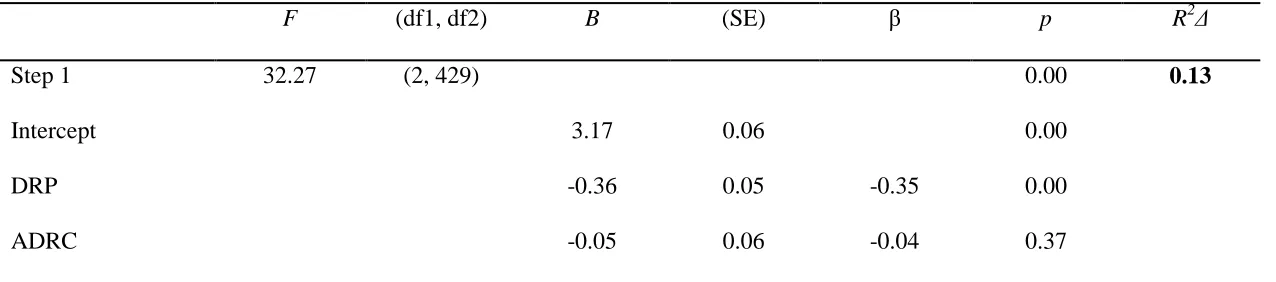
Regression Analysis for Noncompliant, Natural Emotional Displays on Display-rule Perceptions and Affective Display-Rule
Commitment
F (df1, df2) B (SE) β p R2Δ
Step 1 32.27 (2, 429) 0.00 0.13
Intercept 3.17 0.06 0.00
DRP -0.36 0.05 -0.35 0.00
ADRC -0.05 0.06 -0.04 0.37
Table 15.
Regression Analysis for Noncompliant, Natural Emotional Displays on Display-rule Perceptions and Normative Display-Rule
Commitment
F (df1, df2) B (SE) β p R2Δ
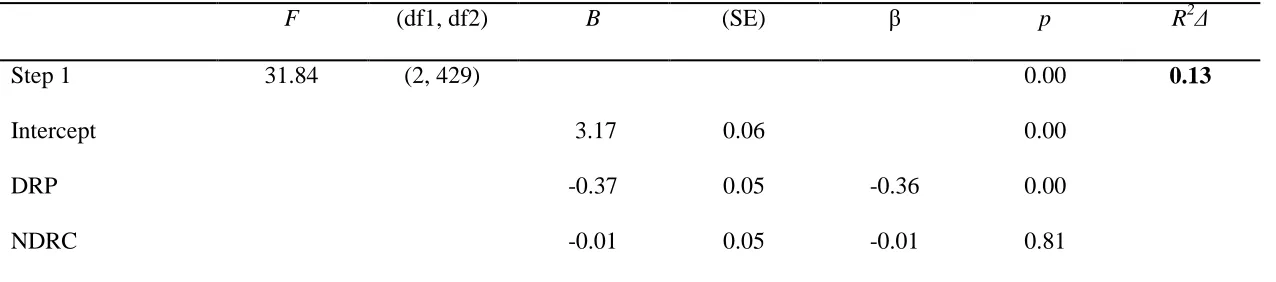
Step 1 31.84 (2, 429) 0.00 0.13
Intercept 3.17 0.06 0.00
DRP -0.37 0.05 -0.36 0.00
NDRC -0.01 0.05 -0.01 0.81
Table 16.
Regression Analysis for Noncompliant, Natural Emotional Displays on Display-rule Perceptions and Continuance Display-Rule
Commitment
F (df1, df2) B (SE) β p R2Δ
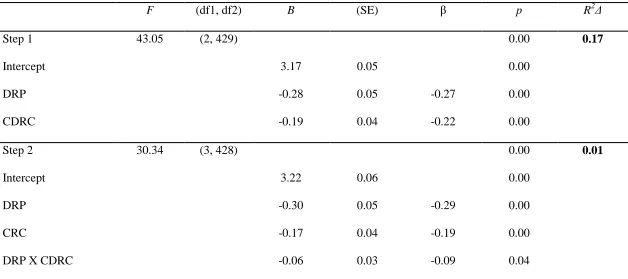
Step 1 43.05 (2, 429) 0.00 0.17
Intercept 3.17 0.05 0.00
DRP -0.28 0.05 -0.27 0.00
CDRC -0.19 0.04 -0.22 0.00
Step 2 30.34 (3, 428) 0.00 0.01
Intercept 3.22 0.06 0.00
DRP -0.30 0.05 -0.29 0.00
CRC -0.17 0.04 -0.19 0.00
DRP X CDRC -0.06 0.03 -0.09 0.04