Improve Image Categorization based on Novel
Features & Weighted Classifier
Vanshikha Gupta, Nidhi Seth
M.Tech Student, Dept. of C.S, JMIT, Radaur, India
Assistant Professor, Dept. of C.S, JMIT, Radaur, India
ABSTRACT: Image categorization refers to the tagging of images into one of several predefined categories. Categorization of remotely sense data is used to assign corresponding levels with respect to clusters with homogeneous characteristics, with the aim of discriminating numerous object from each other within the image. Categorization contains a broad range of decision-theoretic approach to the detection of images. The K-Nearest Neighbor algorithm is based on the hypothesis that the image describe one or more features and that each of these features belong to one of numerous distinct and exclusive classes. In this paper, we used improved K-NN classifier with hybrid (DWT and Texture Analysis) feature selection algorithm. We have compared our logic with basic K-NN and validate the results using performance metrics like accuracy, recall, precision, f-measure.
KEYWORDS: Image Categorization, Feature Based Image Classification, Weighted Classifier, Feature Extraction, DWT, Texture Analysis.
I. INTRODUCTION
Each day millions of images produced. Each image requires categorization, by which they can occur effortlessly and in a higher speed. Humans have the capabilities to categorize the images more easily than computers. A simple categorization system consists of a camera fixed high above the interested zone where images are captured and consequently process [1]. Categorization is a procedure to categorize images into several categories, based on their similarities. Image categorization analyzes the numerical properties of various image features and organizes data into categories. Categorization system consists of database that contains predefined patterns that compares with detected object to categorize in to correct category. Image categorization is an important and challenging duty in a range of application domains like biomedical imaging, remote sensing.
II. RELATED WORK
Ryfial Azhar, Desmin Tuwohingide, Dasrit Kamudi, Sarimuddin, Nanik Suciati [2] concluded that the system classification batik image is built through several phases of process which are converting RGB image into grayscale image, feature extraction using BOF & SIFT and classification method using SVM. Xiankai Lu, Zheng Fani, Tao Xu, Hailing Zhang, Hongya Tuo [3] sparsified the Fisher vector code matrix by adding local regular term. These ways allow efficient image categorization without undermining its performance on several public datasets and coding outputs preserve the similarity among input features. Luming Zhang, Yue Gao, Yingjie Xia, Qionghai Dai, and Xuelong Li [4] proposed a fine-grained image categorization method by introducing a cellet for the representation of the spatial layout
of images. Luming Zhang, Yang yang, Richang Hong [5] used a graph mining framework that efficiently detects
discriminative object parts with multiple sizes. Xiaomeng Wu, Minoru Mori, Kunio Kashino [6] showed that overall accuracy, local classification margin, and complexity are not always conflicting. Their relation depends on the class
distribution in the instance space. Marcin Korytkowski, Leszek Rutkowski, Rafał Scherer [7] Generating simple fuzzy classifiers using local image features to distinguish between one known class and other classes. Advanced meta-learning is used to find the most diplomat local features.
over the detected wavelet based salient points in complex images. Gabor features and Moment features are computed separately for every patch and classified using SVM classifier. The combination of these two features are called new composite features.
Luming Zhang, Richang Hong, Yue Gao, Rongrong Ji, Qionghai Dai , Xuelong Li [10] proposed to learn object-shaped and directional receptive fields for image categorization. By generating a number of graphlets as object descriptors, we developed an embedding algorithm that encodes the semantics of image tags into graphlets, based on which graphlets highly correlated with an object are emphasized. Luming Zhang, Meng Wang, Richang Hong, Bao-Cai Yin, Xuelong Li [11] proposed an efficient aerial image categorization algorithm which focuses on learning a discriminative topological codebook of aerial images under a multitask learning framework. The learned topological codebook guides the extraction of the discriminative graphlets.
III. PROPOSED WORK
Every day thousands of images are generated, which implies the necessity to classify and access them by an easy and faster way. Categorization is an information processing task in which images are categorized into several groups [13]. Image categorization refers to the labelling of images into one of some predefined categories [14].
Fig: 1 Steps for Image Classification
1. DataSet
The data used in this study are male and female images which consist of 2 classes. There are 80 images with size 92 x 112 in each class. The total numbers of images are 80, which is divided into 48 images for training and other 32 images for testing.
2. Feature Extraction
The intention of feature extraction technique in image processing is to represent the image in its compress and unique form of single values or matrix vector. Low level feature extraction involves automatic withdrawal of features from an image without doing any processing method. The wavelet transform has achieved extensive acceptance in image compression. Wavelet transform decomposes a signal into a set of basic functions. These basic functions are called wavelets [12]. The DWT command performs a single-level 1-dimensional wavelet
Image Dataset Reader
Feature Extraction
Train/Test Splitter
Classifier
decomposition. Wavelet transform has recently become a very well-liked when it comes to analysis, de-noising and compression of signals and images. Wavelet converts the image into a series of wavelets that can be stored more efficiently than pixel blocks. In DWT, a time scale representation of the digital signal is obtained using digital filtering techniques.
Texture analysis refers to the categorization of area in an image by their texture contents. Texture analysis attempts to quantify intuitive qualities described by term such as rough, smooth, silky, bumpy as a function of the spatial difference in pixel intensities. The roughness refers to variations in the intensity values or gray levels. Texture analysis is used in a range of applications including remote sensing, automated inspection and medical image processing. Texture analysis can be used to discover the texture boundaries called texture segmentation. The toolbar includes numerous texture analysis functions that sift an image using standard statistical measures. These statistics can characterize the texture of an image because they give information about the local variability of the intensity values of pixels in an image.
3. Train / Test Splitter
In this step, we have divided the dataset into two parts; one is train class and another is test class. The test class and train class are divided on the basis of training percentage. The training percentage consists of n-rows from which some values are chosen randomly and then we check with which class it belongs.
4. Classifier
In pattern recognition, the k-Nearest Neighbors algorithm (or k-NN for short) is a non-parametric method
used for categorization and regression. In both cases, the inputs consist of the k closest training instances in the trait area. The output depends on whether k-NN is used for categorization or regression:
In k-NN categorization, the output is a class membership. An object is categorized by a majority vote of its neighbors, with the object being assigned to the class most usable among its k nearest neighbors (k is a positive integer, typically small). If k = 1, then the object is pu0072ely assigned to the class of that single nearest neighbor.
In k-NN regression, the output is the belongings value for the object. This value is the average of the values of its k nearest neighbors.
k-NN is a type of instance-based learning, where the function is only estimated locally and all computation is deferred until categorization. The k-NN algorithm is among the easiest of all machine learning algorithms. Both for categorization and regression, it can be helpful to assign weight to the contributions of the neighbors,
so that the nearer neighbors contribute more to the average than the more nearest ones.The neighbors are
taken from a set of objects for which the class (for NN classification) or the object belongings value (for k-NN regression) is known. This can be thought of as the training set for the algorithm, even if no explicit training step is required. A shortcoming of the k-NN algorithm is that it is sensitive to the local construction of the data. The algorithm has nothing to do with and is not to be confused with k-means, an additional popular machine learning technique.
The k-nearest neighbour classifier can be viewed as assigning the k-nearest neighbours a weight and rest
others 0 weight. This can be generalised to weighted nearest neighbours a classifier. That is, where the ith
nearest neighbour is assigned a weight ωni, with ∑ωni = 1. An analogous result on the tough consistency of
weighted nearest neighbour classifiers also holds.
5. Performance Metrics
Accuracy – The accuracy is the proportion of the total number of predictions that were correct. It is determined using the equation :
= +
--- [15]
Recall - Recall is the proportion of positive cases that were correctly identified, as calculated using the equation :
= +
--- [16]
Precision – Precision is the proportion of the predicted positive cases that were correct, as calculated using the equation :
= +
--- [17]
where TP – true positive; FN – false negative; TN – true negative; FP – false positive; P – positive; N – negative .
IV. EXPERIMENTS AND RESULTS
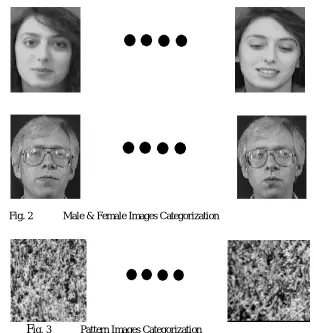
We have collected the data manually in which one of the data consists of male and female images & another data consists of pattern images. We compared both the data for checking the approximation percentage in terms of accuracy, precision, time etc.
Fig. 2 Male & Female Images Categorization
Testing results of the comparison of two classifiers KNN and Improved-KNN describe on Graph 1 and Graph 2 in terms of accuracy and time.
Graph 1. Accuracy Graph 2. Time
V. CONCLUSION
Based on the observations during the process of features extraction and proposed classifier; we concluded that categorization images is built through several stages of process. The features are extracted using Discrete Wavelet Transform (DWT) and Texture Analysis and images are categorized using K-Nearest Neighbor (KNN) and Weighted K-Nearest Neighbor (KNN) classifier. Based on the analytical results obtained, the amount of accuracy [15] is determined by the number of features matched. The future work can be conducted using PCA or log Gabor based filter in feature selection and ensamble classifier. Also in case of classifier we can use FNN, Naive Bayes.
REFERENCES
[1] Pooja Kamavisdar, Sonam Saluja, Sonu Agrawal. “A survey on image classification approaches and techniques”, Department of Computer Science & Applications, SSCST, Bhilai, India, IJARCCE, Vol 2, Issue 1, Jan 2013.
[2] Ryfial Azhar, Desmin Tuwohingide, Dasrit Kamudi, Sarimuddin, Nanik Suciati, “Batik Image Classification Using SIFT Feature Extraction, Bag of Features and Support Vector Machine”, Department of Informatics, Institut Teknologi Sepuluh Nopember Surabaya, Indonesia, Science Direct, 2015.
[3] Xiankai Lu, Zheng Fang, Tao Xu, Haiting Zhang, Hongya Tuo. “Efficient image categorization with Sparse Fisher Vector”, Department of Automation, Shanghai Jiao Tong University, Shanghai, China, IEEE, 2015.
[4] Luming Zhang, Yue Gao, Yingjie Xia, Qionghai Dai, Xuelong Li. “A Fine-Grained Image Categorization System by Cellet-Encoded Spatial Pyramid Modeling”, IEEE, January, 2015.
[5] Luming Zhang, Yang yang, Richang Hong, “Detecting Densely Distributed Graph Patterns for Fine-Grained Image Categorization”, IEEE, February, 2016.
[6] Xiaomeng Wu, Minoru Mori, Kunio Kashino, “Data-driven taxonomy forest for Fine-Grained Image Categorization”, IEEE.
[7] Marcin Korytkowski, Leszek Rutkowski, Rafał Scherer, “Fast Image Classification by boosting Fuzzy Classifiers”, Institute of Computational Intelligence, Poland, Science Direct, 2015.
[8] Yuxing Hu, Liqiang Nie, “An aerial image recognition framework using discrimination and redundancy quality measure”, National University of Singapore, Singapore, Science Direct, 2015.
[9] S. Arivazhagan, R. Ahila Priyadharshini, “Generic visual categorization using composite Gabor and moment features”, Mepco Schlenk Engineering College, Sivakasi, Tamil Nadu, India, Science Direct, 2015.
[11] Luming Zhang, Meng Wang, Richang Hong, Bao-Cai Yin, Xuelong Li, “Large-Scale Aerial Image Categorization Using a Multitask Topological Codebook”, IEEE, 2015.
[12] A.Alice Blessie, J. Nalini and S.C.Ramesh, 2011, ―Image Compression Using Wavelet Transform Based on the Lifting Scheme and its
Implementation‖ IJCSI International Journal of Computer Science Issues, Vol. 8-No. 1.
[13] Zhiwu Lu, Horace H.S Ip. “Image Categorization by Learning with context and consistency”, Department of Computer Science, City University of Hong Kong, Kowloon, Hong Kong, IEEE, 2009.