Volume 8, No. 5, May-June 2017
International Journal of Advanced Research in Computer Science
RESEARCH PAPER
Available Online at www.ijarcs.info
ISSN No. 0976-5697
Clustered Approach to Dynamic Data Allocation in Distributed Database Systems
Raju Kumar
Research Scholar Department of Computer Science
GurukulKangriVishwavidyalaya, Haridwar India
Neena Gupta
Assistant Professor Department of Computer Science
KanyaGurukulMahavidyalayaDehradun(Second Campus of Gurukul Kangri Vishwavidyalaya, Haridwar),India
Abstract: Distributed database is very much popular in organizations which are distributed and operating from multiple geographic locations. The two important issues to improve the performance of distributed database systems (DDS) are - grouping of different sites into clusters, and dynamic reallocation of data fragment to these clusters. Clustering network sites and data allocation are still open research problems as their optimal solution is NP-hard. The prime contribution in this field is to develop a near optimal solution. In this paper a new algorithm is proposed for clustering distributed database sites based on the distance between sites to minimise the number of communications and network overhead between sites. Moreover, a Clustered Approach to Dynamic Data Allocation (CADDA) algorithm is proposed to dynamically reallocate data fragments to clusters in redundant and non-redundant distributed database system to reduce the remote data accesses and network overhead. The proposed approach is implemented on a sample distributed database system and compared with other cluster and non-cluster based data allocation algorithms. The comparison results show that proposed approach efficiency is better and it improves the overall performance of the distributed database system.
Keywords: Distributed database system, Redundant and non-redundant, Dynamic data allocation, Cluster of sites, DDS performance.
1. INTRODUCTION
The recent advances in database technology and network technology caused distributed database system (DDS) a favourable choice for geographically dispersed organizations. DDS is considered as a collection of logically interrelated data that are actually allocated at several locations over a computer network [1]. Each site of the network can perform local applications independently. Each site also must contribute to the execution of at least one global application, which requires data accessing at different sites through a communication subsystem [2]. Although distributed database is in great demand, before adopting, its several security issues and challenges need to be considered carefully [3].
To improve distributed database performance several methods have been proposed. Improvement in the performance can be gained by improving one or more of the following database management issues: database fragmentation, data allocation & replication, and clustering of different sites. The task of fragment allocation falls under NP-hard problem so its complexity is high [1]. To solve such problems heuristic algorithms are appropriate approach. To achieve the data availability, system reliability, and system performance, each fragment can be allocated to one or more than one network nodes.
In clustering approach distributed database sites are grouped into logical clusters to reduce the number of extra communications and associated costs between the network sites which results as enhanced DDS performance. Static data allocation is used in almost all cluster based approaches developed for improving the DDS performance. In this paper a new Clustered Approach to Dynamic Data Allocation (CADDA) algorithm is proposed, which dynamically reallocates data among different clusters. This algorithm easily handles the dynamic data reallocation case, when at the same time more than one clusters qualify for
data reallocation in redundant and non-redundant distributed database system. The comparison between proposed approach and other approaches proposed in papers [4,5,6,7,8,9]proves that the new proposed approach is more efficient and significantly enhances the performance of the system.
In [10]a threshold algorithm for non-replicated distributed databases was introduced, which relocates data fragments as per the changing data access patterns and data access threshold value. In[11] an algorithm called Threshold and Time Constraint Algorithm (TTCA) was proposed, where the relocation of non-redundant data was performed according to the changing data access patterns,data access threshold value and time constraint in distributed database systems. Scaling problem was the main drawback with this algorithm. To remove the scaling problem of TTCA, an Extended Threshold Algorithm (ETA) was proposed in [12], which also minimized space requirements. A new algorithm was introduced in [7]which dynamically reallocates data in non-redundant distributed database system based on access threshold, time constraints of database accesses and volume of data transmission. Thereafter[8] extended the work done in [7]by additionally introducing distance parameter which enabled the algorithm for efficiently handling the situation where multiple sites qualify for fragment relocation.
carried out in [7, 8], this algorithm also reallocates data dynamically in redundant distributed database system. Many database researchers proposed the clustering method for data allocation to minimize number of communications and associated communication cost. In[4]an integrated method for clustering and fragment allocation in distributed database was proposed. Its clustering method reduced the number of communications and associated communication costs among the sites. In [5] clustering method was used to improve the performance of distributed database system by improving transactions response time.To improve the performance of distributed database system, a new integrated approach was proposed in [6] by combining three enhanced techniques - database fragmentation, network sites clustering and data allocation. Cluster based data allocation methods presented in [4,5,6] used static data allocation. The remaining sections of the paper is presented as follows: In section 2 algorithm for clustering network sites is described. Section 3 demonstrates the cluster performance. Section 4 describes the proposed CADDA algorithm for data allocation in redundant and non-redundant distributed database system. Section 5 demonstrates algorithm working with sample database. In section 6 the comparison of proposed CADDA algorithm with algorithms proposed in [4,5,6,7,8,9] is performed.At last in section 7, the conclusion of the study is presented.
2. CLUSTERING NETWORK SITES
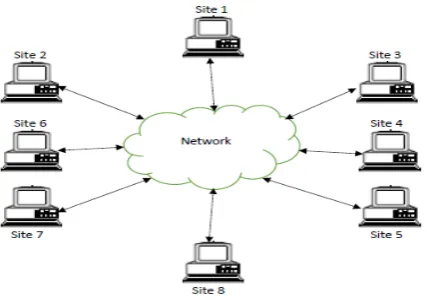
[image:2.595.40.254.450.600.2]Suppose that distributed database has eight sites connected with one another with some communication links. Each site can directly communicate with any other site as shown in figure 1.
Figure 1: Distributed Database System with Eight Sites
The parameters considered for the proposed clustering technique are described as follows:
• Logical Cluster C
Logical place that used to group network sites together based on some physical property like distance between them exist.
i
• Distributed Network Sites
Set of fully connected network sites Si, Sj , . . . Sn
• Distance Range DR
, of distributed database system. Each site is the place from where the transactions are triggered, and transaction results are held.
The maximum distance value (in Km) that is allowed between the DDS network sites for grouping into the same cluster can be decided by the network administrator. Shortest path method is used to calculate the distance between two sites.
• Distance D(Si, Sj
The shortest path distance between two sites S
)
iand Sj
• Cluster Site Matrix CSM
in the DDS.
Calculated matrix by which the clusters are created and their network sites are assigned.
• Clustering Decision Value CDV
The binary value that determineswhether a pair of sites
Siand Sjcan be grouped together in the same cluster. CDV is
calculated using following formula:
It is obvious that CDV for the same site is equal to zero. If the CDV(Si, Sj) is equal to 1, then sites Si, Sjare grouped
into the same cluster, otherwise they are assigned to different clusters. Suppose the eight sites of distributed database are placed at some distance (in Km) from one another according to the site distance matrix shown in table 1.
Table 1. Site Distance Matrix
Site
S1 S2 S3 S4 S5 S6 S7 S8
S1 0 90 600 680 400 700 900 800
S2 90 0 700 800 500 400 550 750
S3 600 700 0 80 50 300 500 700
S4 680 800 80 0 100 400 600 800
S5 400 500 50 100 0 650 700 850
S6 700 400 300 400 650 0 85 95
S7 900 550 500 600 700 85 0 60
S8 800 750 700 800 850 95 60 0
For setting up an efficient clustering method, it is assumed that each site is assigned to only one cluster. The clustering algorithm is described as follows:
Clustering algorithm Input:
Site Distance Matrix showing distance between sites D(Si, Sj
Distance Range (DR) )
Number of network sites of distributed database system (NS)
Processing
/*Determining the sites that match the distance range in order to group them in one cluster*/ Step 1: Set 1 to i
Step 2: Do steps (3–12) until i>NS Step 3: Set 1 to j
Set 0 to cluster site matrix CSM Step 4: Do steps (5–10) until j >NS Step 5: If i ≠j AND D(Si, Sj
Else, go to step (7)
) <= DR, go to step (6)
Go to step 8
Step 7: Set 0 to the CSM(Si, Sj
Step 8: End IF
)
Step 9: Add 1 to j Step 10: Loop Step 11: Add 1 to i Step 12: Loop
Output:
Cluster Site Matrix (CSM) having generated clusters and their respective network sites
End
[image:3.595.52.267.259.339.2]Suppose distance range (DR) value is 100 Km. After using the above clustering algorithm and site distance matrix, a cluster site matrix (CSM) is produced as shown in table 2.
Table 2. Cluster Site Matrix
Site Cluster
S1 S2 S3 S4 S5 S6 S7 S8
C1 1 1 0 0 0 0 0 0
C2 0 0 1 1 1 0 0 0
C3 0 0 0 0 0 1 1 1
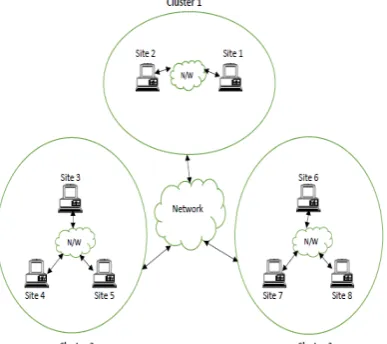
After clustering, the resulting distributed database system is shown in figure 2.
Figure 2: Distributed Database System after Clustering
3. PERFORMANCE EVALUATION OF CLUSTERING
In this section the details about the performance improvement obtained by proposed clustering algorithm is evaluated. For sake of simplicity, it is assumed that the sites as well as clusters of distributed database system are fully connected as shown in figure 2. One site act as a cluster head in each cluster. If the cluster head fails, next node within the cluster will act as cluster head; although it will come at certain cost but will reduce the downtime and increase the availability. Network/Database administrator has the flexibility to decide a cluster head/next cluster head. Generally, the site which is at the central position with respect to others sites within the cluster can be considered as
cluster head. Communications among clusters can be performed through cluster heads.
Number of communications: Generally grouping of sites into clusters reduces the number of communications. The figure 1 showing distributed database of 8 sites, each site is communicated with the other 7 sites, so the initial total number of communications is (8 X 7 = 56). After clustering the sites into three clusters, each cluster is communicated with the other 2 clusters, so number of communications between clusters is (3 X 2 = 6) and taking into account the communication within the cluster itself; in this case the total number of communications is 20. Therefore, a high-performance is achieved by using proposed clustering method, which reduces the number of communications from 56 to 20 and enhances the system progress by 64.29 % as calculated using the following formula:
Improvement percentage = (Reduced number of
communications/Total number of communications) X100
Improvement percentage = (36 / 56) X 100 = 64.29 %
4. PROPOSED CADDA ALGORITHM
[image:3.595.42.236.382.554.2]Initially data fragments are allocated to distributed database system sites using any static data allocation algorithm. Each fragment may be allocated at one or more sites. Thereafter using proposed clustering algorithm, the sites are grouped into disjoint clusters. The proposed clustered approach to dynamic data allocation (CADDA) algorithm is described in two phases- preparation phase and action phase. The description about various notations used throughout the paper are shown in table 3.
Table 3. Algorithm Notations
Notation Meaning
X Number of data fragments in distributed database system
Y Number of sites in distributed database system
Z Number of clusters in distributed database system
Fi The ith data fragment
Sj The jth site
Ck The kth cluster
α Access threshold for fragment relocation
β Time constraint for fragment relocation Apq Access log record for pth access at cluster q
nij Total number of accesses from cluster Cj to the
fragment Fiwithin time interval β up to current
access time t
Vi Volume of data transmitted between fragment
F
j
i and cluster Cjwithin time interval β up to
current access time t
Dij Distance between cluster Ci and cluster Cj
Preparation Phase:
[image:3.595.310.565.452.732.2]using proposed clustering algorithm. In each cluster there is a site which acts as a cluster head and responsible for cluster to cluster communication. The interaction within the sites of a cluster as well as among the clusters are performed through some communication network. Each site has one or more fragment allocated to it. The site fragment allocation matrix is assigned to each site. The cluster site allocation matrix is stored at each cluster, so that it can prepare its access plan. Each cluster also keeps the value of two parameters- Access Threshold for fragment reallocation (α)
and Time constraint for fragment reallocation (β).
Dynamic reallocation of data fragments within the sites of a cluster can be left out. Since the sites within a cluster are at closer distance, so relocating data fragments within the cluster sites will not reflect a significant improvement in system performance. Moreover, dynamic reallocation of data fragments among the sites of a cluster can be allowed on system administrator’s wish. In that case each site within the cluster has to additionally store site distance matrix, site-access-log table and the value of Access Threshold for
fragment reallocation (α1) and Time constraint for fragment
reallocation (β1) within the cluster.The value of α and α1 as
well as β and β1 may be the same or different.Now data
reallocation within the sites of a cluster can be performed using approach discussed in [9]. At each cluster various activities are performed as per following steps:
Step1:Allocate all the data fragments to different sites of distributed database using any static data allocation method in replicated / non-replicated manner.
Step2:At each cluster set the constant value for Access
threshold (α) and Time constraint (β).
Step3:At each cluster store a row of cluster distance matrix, which shows the cluster distance from all other clusters.
Step4:At each cluster store Access_Log table having
following schema:
Access_Log (AFID, ACID, ADateTime, DataVol)
Where AFID represents ID of the accessed fragment, ACID represents ID of the cluster which accesses the fragment, ADateTime represents date and time of fragment access, and DataVol represents volume of data transmitted to and from the accessed fragment. An access log record is stored at each cluster for each access to the fragments allocated to that cluster. Apq represents an Access_Log record which means
pth access at cluster Cq
Step5: At any particular time t (say 24 hours i.e. 00:00:00 - hh:mm:ss) access Access_Log table daily at each cluster and delete all records which is older than time constraint β up to current access time t.
, where p=1,2,3,...∞ and q = 1,2,3,….,Z.
For example, if time interval β up to current access time t is 10 days. This may be implemented at each cluster by executing a SQL query like “Delete from Access_Log where DATEDIFF (SYSDATE,ADateTime) >10”.
Each transaction must preserves the ACID (Atomicity, Concurrency, Isolation and Durability) properties, whereas [17] supports for ACIA (Atomicity, Concurrency, Isolation and Availability) properties by giving preference to high availability over durability.Further it is assumed that there exists some distributed concurrency control mechanism that maintains ACID/ACIA properties for all transactions; and ensures that for every write operation performed on a fragment which is stored at a particular site of a cluster,
changes made to the fragment should be reflected to all clusters/sites wherever copy of that fragment is stored.
Action Phase:
This phase involves a set of activities, which are performed during each fragment access. Suppose at time t, cluster Cj
accessesfragment Fiwhich is initially allocated at cluster Cq,
where i= 1,2,3,...X, j=1,2,3,...,Z, q= 1,2,3,...,Z, and q = j or q ≠ j. At cluster Cq
Step1: For every access made to fragment F
the following steps 1 to 8 activities are performed by local agent for every access to a fragment stored at this cluster by some application or query invoked from the different or same cluster:
i allocated at
cluster Cq, write a log record Apqin Access_Log table at
cluster Cq
Step2: In the log record A
.
pq if the ID of the accessing
cluster is the same as the ID of cluster Cq, that indicates
local access is made (Cq = Cj
Step3: In the log record A
), then nothing need to be done.
pq if the ID of the accessing
cluster is different than ID of cluster Cq, that indicates
remote access is made (Cq ≠ Cj
Step4: Find out the total number of accesses made to the
fragment F
), then proceed to the next step.
i
Letn
from each accessing remote cluster(s).
icrepresents the total number of accesses made to the
fragment Fi allocated at cluster Cq by each cluster C, where
C = 1,2,3,...,Z. If (nic
Step5: Find out the average volume of data transmitted
between fragment F
<=α) then nothing need to be done, otherwise proceed to the next step.
i and all clusters (including cluster Cq
where fragment Fi is stored) from where accesses to the
fragment Fi are made (Vict) and also find out the average
volume of data transmitted between fragment Fi and each
remote cluster(s) Cj from where accesses to the fragment Fi
are made (Vijt) where C = 1,2,3,....,Z and Cj ≠ Cq
The average volume of transmitted data can be determined using equation – (1). LetA
, then proceed to next step.
pq Vic represents the volume of
data transmitted between the fragment Fi allocated at cluster
Cq and the cluster C in the access_logApq, where C =
1,2,3,...,Z. Now considerVict represents the average volume
of data transmitted between the fragment Fi allocated at
cluster Cq and the all accessing cluster C, then:
Vict = (∑ ApqVic ) / ∑ nic (1)
Step6: If every accessing remote cluster(s) Cjfails to qualify
the condition (Vijt>Vic
Step7: If the condition (V
t), then nothing need to be done, otherwise proceed to next step.
ijt>Vict) is TRUE for only one
remote accessing cluster Cj, then the fragment Fiis
reallocated to cluster Cj and removed from the current
cluster Cq
Step8: If the condition (V
and the site fragment allocation matrix at each cluster isupdated accordingly, otherwise proceed to next step.
ijt>Vict) is TRUE for more than
one remote accessing clusters Cjsimultaneously, then find
out the distance between the cluster Cq where fragment Fi is
allocated and the clusters which qualified the condition. The fragment Fiis reallocated to the cluster which is at maximum
cluster Cq
By reallocating fragment F
and the site fragment allocation matrix at each cluster is updated accordingly.
i to cluster which is at maximum
distance from current cluster Cqdelay in transactions can be
reduced, which results improved system performance.
5. ILLUSTRATIVE EXAMPLE
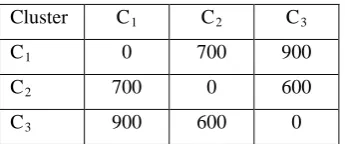
[image:5.595.329.545.54.129.2]To demonstrate how the proposed CADDA algorithm works, consider a distributed database system with three clusters and eight sites as shown in fig.2. These clusters are located at some distance (in km.) from one another as shown in the following table 4:
Table 4. Cluster Distance Matrix
Cluster C1 C2 C3
C1 0 700 900
C2 700 0 600
C3 900 600 0
Only the respective row of cluster distance matrix is stored at each cluster. Consider that global relations in DDS have total twelve fragments (F1, F2, F3, ..., F12
Table 5. Site Fragment Allocation Matrix
). Each fragment is allocated at one or more sites as per scheme shown in table 5:
Fragme nt Site
F F
1
F
2
F
3
F
4
F
5
F
6
F
7
F
8
F
9
F
10
F
11 12
S1 1 1 0 0 0 0 0 0 0 0 0 0
S2 0 0 0 0 0 0 0 0 1 1 0 0
S3 0 0 1 1 0 0 0 0 0 0 0 0
S4 0 0 0 0 1 0 0 0 0 0 1 0
S5 0 0 0 0 1 0 0 0 0 0 0 1
S6 0 0 0 0 0 1 1 0 0 0 0 0
S7 0 0 0 0 0 0 0 1 1 0 0 0
[image:5.595.73.246.236.308.2]S8 1 0 0 0 0 1 0 0 0 0 0 0
Table 6. Access_Log at cluster C1
AFID ACID ADateTime DataVol
F1 C1 21-Feb-2017 12:26:15 180
F2 C1 21-Feb-2017 16:30:50 159
F2 C2 22-Feb-2017 11:55:57 270
F2 C3 22-Feb-2017 14:12:26 260
F2 C3 23-Feb-2017 10:44:33 300
F2 C2 23-Feb-2017 15:16:17 274
F2 C2 24-Feb-2017 12:18:24 356
F2 C3 24-Feb-2017 14:28:42 250
F1 C1 24-Feb-2017 16:32:48 245
F2 C2 25-Feb-2017 15:20:30 - - -
F2 C3 25-Feb-2017 15:20:30 - - -
At a particular moment the records of Access_Log table at cluster C1 is shown in table 6. The Access_Log at cluster C1
displays that total number of accesses made from clusters C2
and C3for fragment F2 till 24-Feb-2017, is 3. i.e. n22 = n23 =
α = 3. On 25-Feb-2017 due to simultaneous read access, the
total number of accesses made from clusters C2 and C3for
fragment F2 becomes 4, i.e. n22 = n23 = 4 > α. Since there
may be possibility of reallocation of fragment F2,
The following data transfer between different clusters for fragment F
the last two transactions are kept on hold till the determination of fragment reallocation decision.
2
• For fragment F
can be calculated using Eq. (1):
2,the average volume of data
transferred between cluster C1
= (159 + 270 + 260 + 300 + 274 + 356 + 250) bytes/7 = 1869 bytes/ 7 = 267 bytes
and all other clusters
• For fragment F2, the average volume of data
transferred between cluster C1 and cluster C
= (270 + 274 + 356) bytes/3 = 900 bytes/3 = 300 bytes
2
• For fragment F2, the average volume of data
transferred between cluster C1 and cluster C
= (260 + 300 + 250) bytes/3 = 810 bytes/3 = 270 bytes
3
With above calculations, it is clear that 300 bytes >267 bytes and 270 bytes > 267 bytes, and n22 = n23= 4 > α therefore
both clusters C2 and C3are eligible for fragment F2
reallocation. The cluster which is at more distance from cluster C1 will be finally eligible for reallocation of
fragment F2
Distance between cluster C
. The distance between the clusters can be determined using Cluster Distance Matrix (CDM). As per CDM -
1 and C2: D12
Distance between cluster C
=700 km and
1 and C3: D13
So fragment F
=900 km
2 is reallocated to cluster C3 and deleted from
the cluster C1 and accordingly site fragment allocation
matrix is modified at every cluster. As compare to cluster C2, cluster C3 is at more distance from current cluster C1
where fragment F2 is allocated, has to travel a lot, which
results delay in operation. Reallocation of fragment F2 to
cluster C3 results faster access. Similarly,for non-redundant
distributed database system dynamic reallocation of data fragments can be performed.
6. COMPARISON
[image:5.595.51.266.632.782.2]Table 7. Comparison with cluster based algorithms
Paper Reference Property
CADDA Algorithm
[4,5,6]
Cluster to cluster dynamic data reallocation capability
Yes No
No. of remote data accesses Less More
Network overhead Less More
Efficiency Higher Lower
In [4,5.6] clusters are created first, thereafter data fragments are allocated to them. This data allocation is static.Therefore, initial allocation may not be appropriate after some time due to changing data access patterns and caused more number of remote data accesses. This will lead to more traffic on the network and take more time to respond a query. While in CADDA algorithm data fragments are allocated dynamically with respect to the changing data access patterns, which results less remote data accesses, less network traffic and consequently take less time to respond a query. In proposed approach, since data fragments are reallocated dynamically as per changing data access patterns of the clusters, complexity is slightly more as compared to static data allocation approach, but the system performance is better.
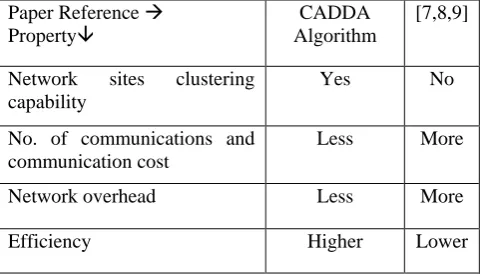
Table 8. Comparison with non-cluster based algorithms
Paper Reference Property
CADDA Algorithm
[7,8,9]
Network sites clustering capability
Yes No
No. of communications and communication cost
Less More
Network overhead Less More
Efficiency Higher Lower
The CADDA algorithm facilitates clustering of network sites while algorithms proposed in [7,8,9]do not support clustering. Due to clustering of sites in CADDA algorithm, number of communications is less that results less communication cost as compared to algorithm proposed in[7,8,9]. Less number of communications in CADDA algorithm caused less network traffic, which consequently take less time to respond a query. Therefore, efficiency of CADDA algorithm is higher than algorithms proposed in [7,8,9].
Comparison results shown in table 7 and table 8 provedthat CADDA algorithm is more efficient and capablethan all other algorithms introduced in [4,5,6,7,8,9] and enhances the performance of the system.
7. CONCLUSION
In distributed database system, data allocation is a prominent performance aspect. System performancehighly
depends on the efficient allocation of data fragments to sites.This paper discussed the performance improvement achieved by the proposed clustering method and CADDA algorithm. This clustering method groups the distributed database system network sites into clusters, and decrease the communication overhead between the network sites. CADDA algorithm further reduced network overhead by decreasing remote data accesses by dynamically reallocating data fragments to clusters as per changing data access patternsin redundant and non-redundant distributed database system. The comparative evaluation with other cluster and non-cluster based algorithms showed that proposed approach significantly improves the performance of distributed database system. This conclusion further needs more experiments and investigations. Therefore, as future work investigation of the proposed approach can be performed on larger scale networks consisting of more number of database sites. Moreover, for further improving the system performance,different clustering techniques, strong criteria for grouping database sites, and soft computing techniques can be explored.
8. REFERENCES
[1] M.T. Ozsu, P.Valduriez,“Principles of Distributed Database Systems,” 3rd
[2] S. Ceri, G.Pelagatti, “Distributed Databases: Principles &Systems,” edn. 2008. McGraw-Hill International: New Delhi, India, 2008.
edn. Springer Science+Business Media, LLC 2011: New York, USA, 2011.
[3] R.Kumar, “Distributed database security: issues and challenges,” Proceedings of Int. Conf. Computing: Updates & Trends, Ghaziabad, India, 2010, 301-309.
[4] I. Hababeh, M. Ramachandran, N. Bowring,“A high-performance computing method for data allocation in distributed database systems,” J Supercomput. 2007; 39(1): 3– 18.
[5] I.Hababeh, “Improving network systems performance by clustering distributed database sites,”The Journal of Supercomputing, 2012; 59: 249-267.
[6] R.M.H Al-Sayyed, F.A Al-Zaghoul,D. Suleiman, M. Itriq, I. Hababeh,“A new approach for database fragmentation and allocation to improve the distributed database management system performance,” Journal of Software Engineering and Applications. 2014; 7: 891-905.
[7] N. Mukharjee,“Non-replicated dynamic fragment allocation in distributed database systems,” Springer-Verlag Berlin Heidelberg, CCSIT, Part I, CCIS 131, Bangalore, Jan. 2011, 560-569.
[8] R. Kumar, N. Gupta, “An extended approach to non-replicated dynamic fragment allocation in distributed database systems,” IEEE Xplore, ICICT, Ghaziabad, India, 2014, 861-865.
[9] R. Kumar, N. Gupta,“An extended efficient approach to dynamic fragment allocation in distributed database systems,” International Journal of Control Theory and Applications (IJCTA). 2016; 9(20): 473-482.
[10] T. Ulus, M. Uysal,“Heuristic approach to dynamic data allocation in distributed database systems,” Pakistan Journal of Information and Technology. 2003; 2(3): 231-239.
[11] A. Singh, K.S Kahlon,“Non-replicated dynamic data allocation in distributed database systems,” International Journal of Computer Science and Network Security, 2009; 9(9): 176-180.
[13] S. Kamali, P. Ghodsnia, K. Daudjee, “Dynamic data allocation with replication in distributed systems,” IEEE Explore, 2011, 978-1-4673-0012-4/11/$26.00.
[14] H.I Abdalla,“A new data re-allocation model for distributed database systems,”International Journal of Database Theory and Application. 2012; 5(2): 45-59.
[15] A.A Amer, H.I Abdalla,“A heuristic approach to re-allocate data fragments in DDBSs,” Information Technology and
e-Services (ICITeS) Int. Conf., Sousse, Tunisia, March 2012, 01-06.
[16] R. Kumar, N. Gupta,“Dynamic data allocation in distributed database systems: a systematic survey,” International Review on Computers and Softwares, 2013; 8(2): 660-667.