Volume 2, No. 5, Sept-Oct 2011
International Journal of Advanced Research in Computer Science
RESEARCH PAPER
Available Online at www.ijarcs.info
E-Learning Standards and their Necessity
Bharat Singh Deora*
Department of Computer Science & ITJRN Rajasthan Vidyapeeth University Udaipur, India
Prof. S.S. Sarangdevot
Department of Computer Science & ITJRN Rajasthan Vidyapeeth University Udaipur, India
Abstract: The advancement of ICT gives new directions to e-learning and the world has started to understand that e-learning is important because it can make a significant difference: to how quickly one can learn a skill; to the ease with which one can study; and to the degree to which learning can be made enjoyable. E-learning has the power to bring quality and accessible learning to everyone so that every learner can achieve goals of the study. The present world is surrounded by e-learning at home, at work and, at the college. It also contributes to the objective of education by raising standards, improving quality of education, removing barriers to learning, preparing for employment, up skilfulness in the workplace and, ensuring that all learners achieve their target. The benefits of e-learning are increasing year by year. E-learning is achieving their goals due to acceptance of accredited e-learning standards. The main organizations working for e-learning standards include AICC, IEEE, IMS and ADL. This article gives an overview of various e-learning standards available & future possibilities and their necessity for creating a uniform learning platform.
Keywords: E-learning; E-learning standards; AICC; IEEE-LTSC; IMS; ADL; SCORM; Metadata;
I. INTRODUCTIONTOE-LEARNINGSTANDARDS
E-learning covers a wide set of applications and processes such as web-based learning, computer-based learning, virtual classrooms and digital collaboration. It includes the delivery of content via the Internet, intranet/extranet, audio and videotape, satellite broadcast, interactive TV and CD-ROM [1].
The e-learning and its benefits are increasing year by year. Some of the reasons for this are: the learners and instructor get prompt feedback, there is huge sources of learning material available over internet, and the learners get there progress with the completion of modules.
During the last decade, many electronic learning systems and resource have emerged to impart e-learning. Their existence and sometimes chaotic use raised problems of resources reuse or interoperability. To overcome these problems, many organizations and international consortia have been encouraging and sponsoring several activities related to standardization, promoting the development of different recommendations about the use of learning objects and designs [2].
At present there are several learning objects that makes e-learning easy. However, the use of e-learning objects individually is not sufficient for transforming traditional teaching into a new teaching approach. Some bases of interoperability and compatibility are necessary to permit such that components developed by different entities can change information and be used as a whole without modifications. The existence of standards is essential for the successful development of e-learning systems.
The benefits derived of standardization have been profusely described and are commonly known as “ileitis” (accessibility, affordability, durability, extensibility, discoverability, interoperability, manageability and reusability) [2].
a. Accessibility: availability of content anywhere and
anytime.
b. Interoperability: components developed by different
vendors can be used together and interchange information.
c. Reusability: a way to save efforts when educational contents are created.
d. Extensibility: the capacity of easily new educational
contents through the assembly and construction of module-based contents.
e. Discoverability: facility to locate contents stored in
repositories.
f. Affordability: reasonable costs.
g. Manageability: facility to manage the content by
designing small modules.
h. Durability: development of standard content, so that
change of platform can’t make the content obsolete.
II. WHYE-LEARNINGSTANDARDS?
According to ISO (International Organization for Standardization) [3], “Standard is a documented agreement containing technical specifications or other precise criteria to be used consistently as rules, guidelines, or definitions of characteristics to ensure that materials, products, processes and services are fit for their purpose”.
The necessity of development of e-learning standards arises because:
a. Learners can’t find the courses they need.
b. For course authors or developers it is difficult to combine contents of different distributors.
c. Course managers can’t move course (as the courses has many files), from one system to another.
load because the pages were not optimized for the web. For example, a product is developed using particular software or tool is designed to run on stand-alone PC. Although materials created with these tools could be distributed on the web, not in their original form. The materials needed to be “re-packaged” by using some other program and returned to their original format for viewing.
When reusability is concerned, we lose the efforts of authors and content developers. Although, efforts can be made to transfer the old data formats to new format. So the question arises that, whether the early developed e-learning products disappointed and fails to achieve its promise of providing just-in-time, just-in-place training, which would be the need of learners. But, organizations invested in converting existing learning content for distribution on the web.
The emergence of HTML as the primary tool for creating web based content and related software, like XML, PHP, and Java ensured the easy interchange and interoperability of content that is, content developed on one computer could be easily viewed on others, regardless of the
hardware and operating system of that other computer [4].
III. LEARNINGOBJECTS
According to the Learning Technology Standards Committee of the IEEE [5], “A Learning Object can be any entity, digital or not, that can be used or referenced in technology-supported learning.” A 'digital learning object' is any electronic resource that may be used for learning. These objects include text, images, audio, video etc. in digital format, but exclude physical objects like books and CD-ROM’s, which are not sharable.
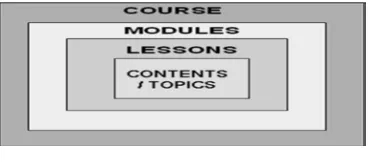
Learning objects generally does not operate across different platforms, making them difficult and expensive to use easily. Making learning objects to be reused and managed across various LMS, organizations like AICC, IEEE LTSC has take initiatives for the development of industry-wide standards and specifications. The following figure shows the granularity of learning objects:
Figure 1. Granularity of Learning Object
According to Warwick Bailey [6], a course is divided into different units of learning to create a package of Sharable Content Objects. After this these units are created as a web page from assets (text, images or any other object that may reach to learner through web browser). To enable run-time communication, commands of JavaScript are added to the web page. Then Metadata files are created to describe the assets, the Sharable Content Objects, and the entire course.
For assembling the collection of SCOs, their assets and the metadata files into a course structure, packaging tools are used. To use a content package of SCOs, Java Applet or Active X control must be supported by the learner’s computer.
IV. E-LEARNINGSTANDARDSDEVELOPMENT PROCESS
The e-learning standard development process includes three steps [7]:
a. Specification: In this first step, organizations work
together to develop initial specifications that they propose as e-learning standards. Organizations and consortia developing specifications relevant to e-learning are: IMS Global Learning Consortium, CEN/ISSS, IBM, Microsoft, Cisco, click2learn, AICC and HR-XML Consortium.
b. Validation: In the second step, newly developed
products include these specifications and tested for the effectiveness and usability of the specifications. Reference models are developed to show how different specifications and standards work together to support e-learning environment. Organizations creating reference models for e-learning include: ADL/SCORM, ALIC, EdNA etc.
c. Standardization: This is the final step; in this
specifications that have been tested are considered for refinement, consolidation, and accreditation. If approved, the specifications get official certifications by the accredited standard organizations. Organizations creating accredited standards for e-learning include: IEEE LTSC, ISO/IEC.
After going through these steps we get accredited standards. The following figure shows the e-learning standards development process:
Figure 2. E-Learning Development Process
The various issues which need to be considered before including standards into e-learning content are [8]:
a. Which standards apply to your project?
b. Which standards can add value to the finished product? c. Which standards can make workflow more efficient? d. Which standards allow reusability of components? e. How are standards incorporated into one’s work? f. How are standards incorporated into one’s work?
V. ORGANIZATIONSDEVELOPINGE-LEARNING STANDARDS
E-learning standards are developed by following main organizations:
a. AICC (Aviation Industry CBT Committee),
b. IEEE LTSC (IEEE Learning Technology Standards Committee),
c. IMS (Instructional Managements Systems Project), and d. ADL (Advanced Distributed Learning Initiative)
A. AICC (Aviation Industry CBT Committee):
The main e-learning AGRs (AICC Guidelines and Recommendations) are [9]:
a. AGR002 (1989) - This AGR is related to course delivery stations (hardware) and contains both hardware-related recommendations and software-related recommendations. During development of the recommendations Flexibility, Expandability and Changing Technologies are considered.
b. AGR003 (1992) - This AGR recommends guidelines that promote the interoperability of digital audio i.e. the ability of courseware with audio to playback on different personal computers with different audio cards in them.
c. AGR005 (1992) – This AGR recommends guidelines that promote the interoperability of the peripheral devices such as Video overlay card, Video disk player and XY input device (such as a touch screen, mouse, or trackball).
d. AGR006 (1993) - This AGR is related to computer managed instructions and recommends guidelines that promote the interoperability of CMI systems.
e. AGR007 (1995) – This AGR is related to courseware interchange and recommends guidelines for the interchange of the elements that occur in CBT courseware. These elements include: Text, Graphics, Motion (Frame-based), Audio and Logic.
f. AGR008 (1995) – It is related to digital video and recommends guidelines for the creation, distribution, and use of digital video in CBT courseware.
g. AGR009 (1996) – It is related to icon guidelines and these guidelines are for the functions of the student/user interface to CBT material and delivery systems. h. AGR010 (1998) - This AGR is related to Web-based
CMI. It recommends guidelines that promote the interoperability of Web-Based CMI systems.
i. AGR011 (2005) - This AGR promote a means of simplifying the transfer of content packages between systems. The guidelines support a notification service to announce the location of content package(s) that are available for transport.
j. AGR012 (2008) - This AGR Describes a check list of AICC guidelines to be considered before developing CBT/WBT systems.
B. IEEE LTSC (IEEE Learning Technology Standards
Committee):
The LTSC is chartered by the IEEE Computer Society Standards Activity Board to develop accredited technical standards, recommended practices, and guides for learning technology. The LTSC is organized into many working groups known as WGs. Some of them are WG4 (Digital Rights Expression Language), WG11 (Computer Managed Instruction), WG12 (Learning Object Metadata), WG13 (Resource Aggregation Models for Learning, Education and Training), etc.
IEEE LTSC has developed a number of internationally accredited standards. The active standards for learning technology include [10]:
a. 1484.12.1-2002 IEEE Standard for Learning Object Metadata
b. 1484.11.2-2003 IEEE Standard for Learning
Technology-ECMAScript Application Programming
Interface for Content to Runtime Services Communication
c. 1484.1-2003 IEEE Standard for Learning Technology-Learning Technology Systems Architecture (LTSA)
d. 1484.11.1-2004 IEEE Standard for Learning
Technology-Data Model for Content to Learning Management System Communication
e. 1484.11.3-2005 IEEE Standard for Learning
Technology-Extensible Markup Language (XML) Schema Binding for Data Model for Content Object Communication
f. 1484.12.3-2005 IEEE Standard for Learning
Technology-Extensible Markup Language (XML) Schema Definition Language Binding for Learning Object Metadata
g. 1484.20.1-2007 IEEE Standard for Learning
Technology - Data Model for Reusable Competency Definitions
C. IMS (Instructional Managements Systems Global
Learning Consortium):
IMS GLC is a non-profit consortium whose
are leading institutions, suppliers, and governments worldwide that collaborates on [11]:
a. Interoperability: A supplier-neutral
learning applications, and tools to be seamlessly integrated with campus learning and administrative systems – from on campus or the cloud.
b. Adoption: Community support for institutional and
system-wide adoption of standards-based digital learning innovations, such as books, learning, e-assessment, e-classroom, e-homework.
c. Learning Impact: An annual conference and awards
program that feature a focus on evaluation of the application of technology to the effective delivery of education.
D. ADL (Advanced Distributed Learning):
ADL is known for the Sharable Content Object Reference Model. SCORM is a compilation of technical specifications for web-based e-learning. ADL governs and publish standards for SCORM. The goals of SCORM are to enable interoperability, accessibility and reusability of web-based learning content. SCORM divides the learning technology into two components Learning Management Systems (LMS) and Sharable Content Objects (SCOs).
“SCORM is a set of technical standards which specify how e-learning software should be built. It is the de facto industry standard for e-learning interoperability”. SCORM tells programmers how to write their code so that it can “play well” with other e-learning software [12].
SCORM specifies that content should: a. Be packaged in a ZIP file. b. Be described in an XML file. c. Communicate via JavaScript. d. Sequence using rules in XML. SCORM is composed of three sub-parts:
a. Content Packaging: It is based primarily on XML. It
b. Run-Time: It is based primarily on ECMAScript/ JavaScript. It specifies how content should be launched and how it communicates with the LMS.
c. Sequencing and Navigation: It is defined by a set of
rules and attributes written in XML. It specifies how the learner can navigate between parts of the course (SCOs).
E. Other organization and consortia working for
e-learning standards:
Other organizations and consortiums working for the learning standards or works with AICC, IMS, ADL etc. for e-learning standards include: ARIADNE (Alliance of Remote Instructional and Distribution Networks for Europe), DCMI (Dublin Core Metadata Initiative), e-learning Consortium, HR-XML Consortium, IETF (Internet Engineering Task Force), ISO (International standards Organizations), PROMETEUS (PROmoting Multimedia Access to Education and Training in European Society), and W3C (World Wide Web Consortium).
VI. TYPESOFE-LEARNINGSTANDARDS
At present packaging, communication, metadata, and quality are the main standards for learning adapted by e-learning developers and users.
A. Packaging Standards:
The Packaging standards describe the ways to gather disunited objects, transport them and secure them. The packaging standards denote how to gather disunited files which combines to make up a content unit, course or lesson. They are important to assure that all thousands or hundreds of files are installed and included in the appropriate location. It is a way to catalog contents of a course. It provides some techniques to move courses and modules from one system to another, without re-cataloging or reorganizing their parts. Also helps to join all the separate files and Web addresses into a single file for easy transport.
B. CommunicationStandards:
A language where things or people can communicate is referred to as the communication standards. The things each management must understand before implementing a communication standards include: The object asks the learner name so it can personalize the answers; The system management requirements must know whenever an object initiates; The needs of management system to record the scores; The object report back to the systems management how much object the learner has finished and Finally, the systems management must require to know when the learner has declined and finished an object. Typically a communication standard denotes two things: a data model and a protocol. The data model defines the things of vocabulary. The protocol defines the procedures for how the modules and the management systems send messages then and there.
C. Metadata standards
Metadata is about data. For e-learning, metadata describes courses and other modules. Metadata standards provide ways to describing learning modules so that potential learners and authors can find the module they need. Data used for this purpose is called learning object metadata.
Metadata makes e-learning content more useful to buyers, learners and designers. Metadata provides a way of describing courses, lessons, topics and media’s components that are consistent in format and in terms recorded. Such descriptions can be complied into catalog that can be searched electronically. Some examples of metadata are: SCORM Meta-data standards (adlnet.org), IMS Learning Resources Meta-Meta-data Specification (imsproject.org), and IEEE 1484.12 Learning Object Metadata Standard (ieee.org).
D. Quality Standards:
A quality standard helps us to select products. The most important design quality standard for e-learning is the E Learning Courseware Certification Standards from the ASTD E-learning Certification Institute. It certifies that e-learning courses fulfill composite standards that cover user-interface design, compatibility with standard OS, instructional design, and production quality.
The benefits of the quality e-learning standards as pointed out by Stracke (2009) [13] are described below:
a. Economics: Quality e-learning standard defines
understandable processes leads to the lowering down of errors during the design, analysis, and production of e-learning.
b. Competitiveness: Quality e-learning standards permit
the performance benchmarking between the providers and products of e-Learning.
c. Motivation: Through given involvement and
transparency the motivation can be developed based on the needs of all stakeholders by the quality standards.
d. Customer Orientation: By quality standards the
providers of e-learning can set up common partnership with their students and learners for good mutual relationship.
e. Image: Their international approval affects the
reputation and helps the marketing of e-learning products.
f. Planning Reliability: Quality e-learning standards
allow a risk management for e-learning.
g. Continuous Improvement Cycle: One of the most
essential quality standards benefits is the setting up of a regular improvement cycle by evaluation and optimization.
Accessibility standards concern how to make information technology accessible to those with common disabilities, such as impaired vision or hearing, lack of eye-hand coordination, or reading disabilities. There are no explicit accessibility standards for e-learning alone; however, e-learning falls under accessibility standards for information technology and Web content [14].
The important accessibility standard for information technology is Section 508 of the U.S. Rehabilitation Act., which lists following technical standards in the areas of information technology.
a. 1194.21- Software applications and operating systems b. 1194.22- Web-based intranet and internet information
and applications
VII.SOMEMORESPECIFICATIONSANDSTANDARDS FORASPECTSOFINTEROPERABILITY
The following are additional standards that are being currently developed by e-learning authorities to support interoperability [14].
a. Test Questions. Test questions developed in one LMS
or LCMS systems often cannot be transferred to another system. The IMS question and test interoperability specification seeks to define generic ways of specifying tests that can be realized in many different systems.
b. Enterprise Information Model. Learning management
systems often need to exchange data with other corporate systems. The IMS enterprises information model seeks to define formats for exchanging administrative data among such systems.
c. Learners Information Packaging. Likewise,
administrators often spend much time entering information about the learner into multiple learning management systems. The IMS learner information about learners. Descriptions adhering to the specification could then be freely exchanged among systems.
VIII.FUTURESTANDARDSINE-LEARNING
E-learning industry or e-learning is not developed completely with respect to establishing standards. There may be scope for future e-learning standards. According Lim Kin Chew [15], there are several possibilities for the future e-learning standards. The areas of possibility include; Content Aggregation-refers to the process in which the learning content can be packed as a zip file, Integrating knowledge management and e-learning , Extension of the Question and Test Interoperability specification-to produce adaptive ongoing assignments, Combining collaborative learning and assessment-will enable teachers to make better use of technology to monitor and assess student’s learning, Content tracking-allow designer to add simulation data model, Combining eBook specification with mobile learning, and Extending the application of current e-learning SCORM specification-to the area like games, simulation and virtual reality.
To meet these possibilities, developers and learners need to understand learning processes. This will help organizations and authors to design courses and other learning material to help learners. These standards when implemented properly will yield better results in simplifying the process of e-learning.
IX. CONCLUSION
At present, individuals, educational institutions and, universities use the opportunities offered by the technology. There are many ways in which learners could be engaged, either as individual or in small groups, through adaptation of latest technologies. Standardizing the usage of these technologies will create an opportunity for all e-learners to get benefited in a uniform manner without any bias thereby improving the overall quality of education imparted through e-learning. Standards are necessary for anything to be accepted or recognized globally. For example internet is used
everywhere in the world because of standards such as TCP, IP, HTTP, FTP, HTML, XML. In the same manner e-learning standards are necessary. AICC, IEEE LTSC, IMS, ADL etc are working for universal standards of e-learning. So the developers of e-learning contents must follow, adopt or implement these standards to promote open technologies, platform independent and user centric e-learning systems.
X. REFERENCES
[1] Learning Circuits, http://www.astd.org/LC/glossary.htm [2] Ferrer and Alfonsa (2011), Content Management of E-learning,
Springer Science, NewYork, London.
[3] http://www.iso.org/iso/support/faqs/faqs_standards.htm
[4] Carliner S and Shank P (2010), The e-learning handbook: past promises, present challenges, Pfeiffer, San Francisco
[5] IEEE (2002), Final Fraft Standard, Learning Object Metadata, http://ltsc.ieee.org/wg12/files/LOM_1484_12_1_v1_Final_Draft .pdf
[6] Warwick Bailey,
http://www.icodeon.com/pdf/WhatIsScorm2_web.pdf
[7] Robson R, Collier G (2002), “e-learning interopolarity
standards”, White papers, Sun Microsystems
[8] Kanendran, Johnny Savarimuthu, Durga Kumar (2005): “Issues in e-learning standards”, Sunway Academic Journal 2, 55–65
[9] AICC Publications, AICC Guidelines and Recomdations,
http://www.aicc.org/joomla/dev/index.php?option=com_content &view=article&id=64&Itemid=28
[10]IEEE standards for learning technology,
http://ieeexplore.ieee.org/xpl/standards.jsp [11]IMS GLC, http://www.imsglobal.org/ [12]SCORM, http://scorm.com/scorm-explained/
[13]Stracke, Christian M. (2009): "Quality Development and Standards in e-Learning: Benefits and Guidelines for Implementations"; in: Proceedings of the ASEM Lifelong Learning Conference: e-Learning and Workplace Learning. Bangkok (Thailand).
[14]Horton W (2003), E-learning tools and technologies, Wiley Publishing, Canada
[15]Lim Kin Chew, Future of e-leaning standadrs,
http://www.itsc.org.sg/pdf/synthesis09/Three_eLearning.pdf
Short Biodata of the Author
B.S. Deora is M. Phil., M. Tech. and M.Sc., in Computer Science. Presently he is working as faculty in the Department of Computer Science & IT, JRN Rajasthan Vidyapeeth University. His research paper has been published in Conference and journals. He has 15 years of experience in teaching, and guided various academic projects & M.Phil. dissertations. He is a life member of Computer Society of India.