Volume 3, No. 3, May-June 2012
International Journal of Advanced Research in Computer Science
TECHNICAL NOTE
Available Online at www.ijarcs.info
ISSN No. 0976-5697
Framework to Develop Intelligent Knowledge Structure in e-learning Environment
Mahendra A. Pund
Research Scholar
Department Of Computer Sci. & Engineering PRMITR, Badnera.
Prof. Dr. M.S. Ali
Principal
Prof. Ram Meghe College of Engineering and Management, Badnera.
Abstract: Nowadays the Internet constitutes an inexhaustible source of information for the majority of people. Web based information is fast and provides face-to-face interaction with the user. E-learning on Internet is growing as a powerful tool for the tutoring system. Many projects run under the LMS for heavy interaction with the learner achieving the goal of direct learning. But question that arises is whether this will replace human teacher. So in this paper an attempt is made to enhance the Intelligent Tutoring System (ITS) by building an evolving intelligent object. Intelligent Object Oriented Knowledge Structures are today’s requirement for object oriented artificial intelligence based system. This paper aimed at planning and designing a Object Oriented Knowledge Structure that fulfills the objectives placed by the scientific community formulate a domain independent content based knowledge structure, provide the dynamic courseware generation at run time, building an evolving intelligent object, and the sequence of content as per user’s ‘knowledge level’. One-to-one interaction involves the concentration of the user and specific attention of the teacher or other person. So sequencing of user’s level knowledge and providing it at run time seems to have intelligence. Thus achieving the goal of direct learning, it is proposed that the implementation of the Knowledge-Model using the concept of SCORM (Shareable Content Object Reference Model) will enhance the capabilities of the E-learning process as well as will give the facility to update the expert’s knowledge at run time. The Content Based knowledge storage will encourage the expert to provide the latest updates to the learning system at any time. Execution of the concept in the RTE will seem to add the intelligence in the object. This could possibly trap the attention problems during e-learning.
Keywords: Learning Management System (LMS),Knowledge Bases(LSKB),Ontology,Distributed Knowledge Structure.
I. INTRODUCTION
The increasing prevalence of the Internet in homes and public institutions require that educators look beyond generalized approaches to learning and acquiring knowledge. As the cost of technology decreases, many universities are finding ways to bring the benefits of the classroom into a distance-learning setting. However, distance teaching has been described as an industrialized form of education, characterized by rationalization of process, division of labor and mass production. The new information and communication technologies can facilitate this development but only if policy makers are sensitive to the opportunities, especially at an international level. Web-based teaching and learning call for a serious reconsideration of the effectiveness, especially in light of increased demand for education and the opportunities for increased student motivation by new technologies if integrated with knowledge-based design sites.
This paper describes an approach to incorporate the human intelligence in the learning process. It is necessary to add some domain independent knowledge object in the Intelligent Computer Assisted Learning (ICAL). Further it is proposed to enhance the ADL, that the independence of the knowledge can be organized by dynamically loading the concerned knowledge of the respective course.
A. Advance Distributed Learning (ADL):
One of the important and useful Web-Based tool for Teaching and Learning developed under the well known concept is ADL. SCORM was developed to enable the development of content objects that are reusable and interoperable across multiple LMSs. For this to be possible, there must be a common way to launch and manage content objects, a common mechanism for content objects to
communicate with an LMS and a predefined language or vocabulary forming the basis of the communication. As illustrated in Figure:-1 these three aspects of the RTE are Launch, API and Data Model.
Figure:-1 General Learning Management System
Some of the Current Issues and Attitudes Related to E-Learning are knowledge representation, knowledge capture and management, adaptability, domain independence and intelligence. These issues need to be addressed for making e-learning systems real intelligent. In this paper we made attempt to address these issues. One of the major Object Oriented issues can be implemented is Reusability through Reusable Learning Objects.
II. KNOWLEDGEREPRESENTATION
A. Defining knowledge:
and what was seen before, termed the confusion phase, then by remaining patient, what was known is dislodged by what is new, and knowledge is gained.
From a quotation given by Kaylyn Anderson, “A wise man knows what he know, and he knows what he does not know” a web search found a paper by Dr Phil Goppold [NEC 2003]. The Art of Not knowing, he makes some interesting observations, in particular the distinction between potential and actual knowledge. Further, he stated, "There is no such thing as knowledge. There is only knowing. Knowing is that "what you have between your ears". Ania Lian [ NEC 2003 ] suggested that there is no such a thing as knowledge or knowing. All we have are considerations, a word borrowed from JR Saul. These can be thought of as understandings which are relative (hence not absolute) and relational (revealing not telling as it is). This presents a challenge for teaching since if we hold to this view of knowledge, then we must not only present our current knowledge or fact base but the reasoning and justification for that fact base. That is the inquiry process or the proof process. Kaylyn Anderson disagreed, and stated Knowledge had better be more than "knowing" or even considerations. Knowledge is being able to put into practice what you have learned; many subsequent postings supported this view. Errol suggested that knowledge is built up from the study of the current evidence and practice of the current techniques derived from years of research and practice. All of that research and practice is the current justification for their current knowledge (justified true belief).
When educated, we understand the implications and are able to draw conclusions about what we have experienced and about what we will experience, because in becoming educated we have expanded our integrated knowledge base and our ability to use it in new ways. Knowledge capture is having a base knowledge of a topic that can be discussed and even argued.
B. Knowledge Management:
Knowledge Management (KM) is somewhat old and somewhat new at the same time, it is the combination of new ideas with the ideas ‘everybody knows of old’ [Prusak, 2001]. Davenport [Davenport, 1996] refers to procedures that drive KM in daily process: Knowledge Management (KM) is a framework and a set of tools to improve an organization knowledge infrastructure, aiming to furnishing the right knowledge to the right person in the right way and in the right moment [Schreiber, 1998]. The grounds for KM are: exploring knowledge and its adaptability, finding the value of knowledge and actively managing knowledge [Wiig, 1999]. KM may be considered as the process that a) Integrates information (accessing, organizing, storing, searching, recovering, navigating, codifying, referring, categorizing and cataloging it); b) Draws some sense out of incomplete information, and c) Updates information, ensuring its continuity through manual procedures, supplemented by information technologies tools [Paradela, 2001].
C. Knowledge sniplets and context:
As a person who works in the field of Technology Education where we encourage teachers to involve students in dealing with real situations with meaning and interest for the students one wonders about the purpose for this fragmentation. What is it that is being captured and how is it
going to benefit learners? How do students interact with something that is isolated in this way? It is indicated that it was correct, the "sniplet" on its own is de-contextualised, but sniplets have been linked to a backbone taxonomy to maintain the sniplet in context. To allow for reusability, a facilitator (Lecturer/Tutor/Teacher) or learner creates a copy of the backbone taxonomy and customizes this to their individual needs. As the individualized taxonomy still links to the backbone taxonomy, any annotations will be kept with the sniplet and therefore available to anyone in any taxonomy that accesses it. At present only one taxonomy (the backbone) is available.
D. Defining a Sniplet Object:
Since the original approach had all the information/knowledge in HTML linked documents, the first task was to develop an entity that would reproduce the static pages. The concept of a small logical piece of knowledge evolved. In some systems (for example, Hyperskript) this is known as a fragment but to enable a progressive definition, the term sniplet has been coined. Since ‘Learning Object’ is a pre-defined term, which has a rather broader meaning, it was not seen as replacing the term “Sniplet”. For example, the IEEE (1999) definition of Learning Objects includes learning objectives, persons, organizations, or events. From the file sharing system two major requirements emerged to enable content delivery. Firstly, the ability to provide detailed content in the form of handouts, suitable for a printed format, and second to provide a summary suitable for an overhead projector/data-show. After several prototypes, the content fragment that proved to be most workable was a piece of knowledge or information that could be represented by one overhead transparency, and in order to provide a way to refer to this, the term “Sniplet” was coined. Core attributes of the sniplet are: Sniplet (Creator, id, Backbone taxonomy id, title, description, summary, multimedia id and bibliographic id) based on this entity; other related entities were created such as backbone taxonomy, bibliography, and multimedia elements
III. THREE-TIREDOMAINMODELFOR TUTORINGSYSTEM
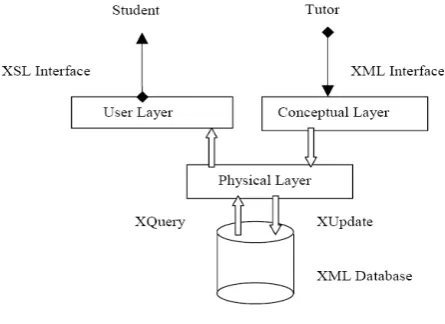
Dr. Ali [Ali, 2005] proposed the architecture for a three-layer domain model consists of a user three-layer, a conceptual layer and a physical layer. The functionality of each of the layers is described below.
User-Layer: It consists of Lesson Objects (LO) for the presentation of course material to the learner. This is similar to the Sharable Content Object (SCO) as defined in SCORM [SCORM, 2004]. However, its structure is simpler than SCO, and it is obtained after aggregation. It is interfaced with the user through eXtensible Stylesheet Language (XSL).
composed from the learning assets according to the lesson plan.
[image:3.595.44.267.188.350.2]Physical Layer: Actual content consisting of text, images, figures, code, facts, principles etc. named as 'Assets' in SCORM. It is the most basic form of a learning resource. Assets are an electronic representation of media, such as text, images, sound, assessment objects or any other piece of data that can be rendered by a Web client and presented to a learner. Assets are stored in XML database and can be updated through XUpdate interface. The retrieval of the assets for aggregation can be done using XQuery language.
Figure 2 Three-Layer Domain Model.
The subject domain is composed of several Units. Each unit is composed of several Topics. Each topic being the combination of several Lessons. Thus, a hierarchical structure very similar to a textbook is designed, wherein a unit is equivalent to a chapter, a topic is equivalent to a section and a lesson is similar to a subsection. A lesson is composed of description of the concept with examples and explanation. The physical layer consists of concept description, examples and explanation. The objects at the physical layer are designed in such a way that they can be reused.
IV. INTELLIGENTKNOWLEDGEOBJECT
It is built upon a sound engineering foundation of the object-oriented paradigm, integration of object-oriented design with rules, the content-based knowledge storage, dynamic courseware generation at run time, whose elements are collectively called the knowledge object model. The object containing data elements and functions are governed by the strategic sequencing. It gives power to the object to enhance the capabilities of tutoring system.
The class and inheritance features of the Object Oriented paradigm assist users to describe and define entities more naturally and emphasize the semantic rather than the syntactic content of applications. Users can thus incorporate more of the rich meaning of real world systems. Systems can therefore become more user-oriented than system-oriented. The encapsulation and dynamic binding of the object-oriented paradigm make the resultant software more maintainable, adaptable, and recyclable. The object-oriented technique is characterized by encapsulation, inheritance and dynamic-link, although, as a complete description, abstraction, modularity, hierarchy and polymorphism should also be included as features of the object-oriented technique.
V. DOMAINSPECIFICKNOWLEDGEOBJECT
MANAGEMENT(KOM)
Integration of object-oriented design with rules, the content based knowledge storage, the dynamic courseware generation at run time, whose elements are collectively called the knowledge object model. Managing KO at run time and creating dynamic binding in specific domain resulting into the Intelligent Knowledge Structure (IKS) to enhance the capabilities of tutoring system.
The class and inheritance features of the Object Oriented paradigm assist users to describe and define entities more naturally and emphasize the semantic rather than the syntactic content of applications.
Integration of Object-Oriented Design with Rules: The ability to combine object-oriented and logic programming paradigms provides an extremely flexible and powerful environment for developing knowledge-based applications. The rule-based paradigm provides us with general facilities for deductive retrieval and pattern matching, and the object-oriented programming provides us with a clear intuitive structure for programs in the form of class hierarchies. Therefore, it would be very useful if we can integrate both of them in order to exploit their synergism. The integration of both could also provide an ability to access the state of objects and their global context. In addition to the integration of rules and objects, there have also been many research efforts reported in the literature on coupling rule bases and databases using either the entity-relationship or object-oriented data models.
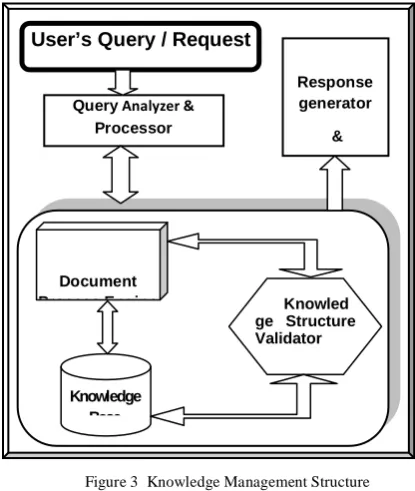
In the following figure 3 the knowledge objects are organized in manner that the at physical layer of domain model will enhance the capabilities of the learning system. The Learner query will be collected as request. These requests are kept in a recorded sequence for tracking the behavior of the learner. Query analyzer deal with the core knowledge management component where document process engine extract the required peace of information from knowledge base. Another component of KM validate the extracted information by analyzing the requested information.
The KM module includes the knowledge repository (institutional or academic memory) with the codified knowledge as well as an interface to easily ‘navigate’ it.
The knowledge in the KM module is codified in:
a. heuristic knowledge (HK). Examples are best practices, learned lessons, frequent and unfrequented questions and
b. descriptive knowledge (DK). It is a concept or an idea, the knowledge with which a situation is described.
c. procedural knowledge (PK). It is the knowledge required to take an action. It describes a procedure or a
d. anecdotal knowledge (AK). It refers to anecdotes, process
gene ral way, the comparative DK describes a knowledge as compared with another. Monitoring is an exercise for checking the understanding of a descriptive knowledge.
[image:4.595.323.558.57.192.2]PK could be basic, replicate for analogy, monitoring or alternative. The basic procedural knowledge represents the fundamental procedural knowledge. The replicate for analogy is knowledge that may be obtained as a replication of another by means of analogy; that of monitoring is an exercise for checking the understanding or application of a concept, idea or procedure, and the alternative PK is another form of carrying out a procedure.
Figure 3 Knowledge Management Structure
The format of each component of the module of KM is: Describer Knowledge Counter The describer is one of the values: HK, PK, AK, DK.
The knowledge refers to a knowledge object. Each knowledge object is linked to other types of knowledge. The attributes of knowledge are: description, learning strategy, importance (fundamental, non fundamental), medium (text, video, sound, multimedia), required level (basic, medium, advanced), responsible professor and topic. The counter tallies the number of accesses to the record. With the counter, the system is able to reclassify a question or to decide which are the most consulted knowledge objects. For example, at the beginning of a new course, such a re-classifying could be made.
In the knowledge repository, all of the knowledge that the professor considers necessary will be initially stored. For gathering the knowledge requirements, techniques of knowledge engineering, such as interviews, analysis of protocols and observation, as well as techniques used in the area of software requirements engineering might be used.
VI. THEPROPOSEDMODELOFA KNOWLEDGEMANAGEMENTFORE-LEARNING
ENVIRONMENT
[image:4.595.44.252.185.431.2]Following Figure 4 will consist of student entity, professor entity, supervisor process and Knowledge Management.
Figure 4 Knowledge Management Structure
The student entity represents a student or a group. When interacting with the environment, through access to the KM module, a ‘portfolio’ or ‘portfolio of works’ containing a log of the activities performed and learning preferences is recorded. This information may be used by the intelligent tutorship. The student entity can collaborate in the evaluation of the types of knowledge, is able to reclassify them as needed and, if necessary, may incorporate learned lessons. In this way, he participates in the learning CP. The professor entity participates and interacts directly with the KM module, defining and restructuring it according to the students’ use of the environment. In this way the professor is able to adjust the contents of the KM module. The supervisor process carries out the intelligent tutorship, observing the user actions and suggesting action roads according to the user preferences. For example, if a student prefers certain types of knowledge, when facing new requirements knowledge of those same types could be offered.
The format of each component of the module of KM is: Describer Knowledge Counter The describer is one of the values: HK, PK, AK, DK.
The knowledge refers to a knowledge object. Each knowledge object is linked to other types of knowledge. The attributes of knowledge are: description, learning strategy, importance (fundamental, non fundamental), medium (text, video, sound, multimedia), required level (basic, medium, advanced), responsible professor and topic. The counter tallies the number of accesses to the record. With the counter, the system is able to reclassify a question or to decide which are the most consulted knowledge objects. For example, at the beginning of a new course, such a re-classifying could be made.
In the knowledge repository, all of the knowledge that the professor considers necessary will be initially stored. For gathering the knowledge requirements, techniques of knowledge engineering, such as interviews, analysis of protocols and observation, as well as techniques used in the area of software requirements engineering might be used.
VII. CONCLUSION
Intelligent Object Oriented Knowledge Structure are today’s requirement for object oriented artificial intelligence based system. This paper aimed at providing design for a “Object Oriented Knowledge Structure” that fulfills the following objectives placed by the scientific community.
These objectives with their view of future scope and trends are as follows.
User’s Query / Request
Query Analyzer &
Processor
Knowled ge Structure Validator
Document
Process Engine
Knowledge Base
Response generator
a. Formulate a domain independent content based knowledge structure, which provide the dynamic courseware generation at run time to build an evolving intelligent object.
b. At any point if an object is created it builds the sequence of content as per user’s ‘knowledge level’.
c. An implementation of Intelligent Knowledge Structure that will support the self evolving intelligent program.
Web based information is fast and provids face-to-face interaction with the user. This one-to-one interaction involves the concentration of the user and specific attention of the teacher or other person. So sequencing of user’s level knowledge and providing it at run time seems to have intelligence. This paper achieving the goal of direct learning.
The concept of SCORM (Shareable Content Object Reference Model) enhance the capabilities of the e-learning process as well as giving the facility to update the expert’s knowledge at run time. It can be possible by taking the advantage of the dynamicity feature of the Object Oriented Technology.
The Content Based knowledge storage will encourage the expert to provide the latest updates to the learning system at any time. Since it possesses the property of the reusability sharing the required object gives the long distance accessibility on web.
VIII. FUTURESCOPE
This project aims at design and development of an intelligent knowledge structure using object oriented paradigm with reference to an E-learning system. The major focus of this project is an intelligent learning object that is adaptive, extensible, and can be easily pluged into an existing Learning Management System (LMS). The proposed learning object design is inspired from Advanced Distributed Learning (ADL’s) Shareable Content Object Reference Model project.
There is no doubt that nowadays, the Internet constitutes an inexhaustible source of information for the majority of people. The question that arises is whether this point also applies for the disabled population. The answer is that this can be possible by adapting computer technology to the needs of disabled individuals. Thus, the web technological evolution combined with collective and determined efforts may provide the disabled society to participate actively in the Web Based Information and Communication society and E-learning. Development and Implementation of this Knowledge Model is supported by the internet based ADL and by Run-Time-Environment of the SCORM. This Implementation will little bit contribute to facilitate the communication of the visually impaired people with the global Internet community and other disabled Internet users, rendering their disability ‘invisible’ at least for a while. This way, equal access to information, knowledge, education and work as well as their participation in social activities, is ensured.
IX. REFERENCES
[1] [Ali, 2004] Dr. M.S. Ali “An Architecture for Web-based Intelligent Tutoring System” Presented at AICTE, New
Delhi sponsored National Conference on Achieving Excellence in Education & Industry, YCCE, Nagpur, 26-28 Nov. 2004.
[2] [Ali, 2005] Dr. M.S. Ali “A Fuzzy-Neural Intelligent Tutoring System for the World Wide Web” Ph.D. thesis at Sant Gadge Baba Amravati University in Electronics Engineering discipline in the Faculty of Engineering & Technology.
[3] [Davenport, 1996] Davenport, T., ‘The future of knowledge management’, CIO Magazine, January 1996.
See document in: http://www.cio.com/archive/010196/davenpor_content.htm
l.
[4] [Davidson et al.,1992] Davidson, G.V., Savenye, W.C. and Orr, K.B. (1992) "How Do Learning Styles Relate to Performance in a Computer Applications Course?", Journal of Research on Computing in Education (24:3), pp. 348-358.
[5] [L. Wong, 1990] L. Wong, “Inference rules in object oriented programming systems,” in Deductive and Object-Oriented Databases, W. Kim, J.-M. Nicolas, and S. Nishio, Eds. Amsterdam, The Netherlands: Elsevier Science , 1990.
[6] [Major & Reichgelt, 1992] Major, N. and H. Reichgelt. (1992) “COCA – A Shell for Intelligent Tutoring Systems”, in Proceedings of Intelligent Tutoring Systems, Frasson, C., Gautheir, G. and McCalla, G., eds. Springer Verlag, Berlin.
[7] [Merrill et al., 1996] Merrill, M.D., Drake, L., Lacy, M.J., Pratt, J. and Group, I.R. (1996) "Reclaiming Instructional Design”, Educational Technology, pp. 5-7.
[8] [Mike, 2002] Mike Neubauer IEEE Learning Technology Standards Committee (LTSC) (1999) Learning Object Metadata, retrieved July 10, 2003
[9] [NEC site, 2003] NEC research division (n. d.) Retrieved July 10, 2003 from http://citeseer.nj.nec.com/ [Public bibliographic database] http://citeseer.nj.nec.com/
[10] [Paradela, 2001]Paradela, L., Una metodología para la gestión del conocimiento. Tesis doctoral. Spain, Universidad Politécnica de Madrid, 2001.
[11] [Prusak, 2001] Prusak, L., ‘Where did knowlegde management come from?’, IBM Systems Journal, Vol. 40, Number 4, 2001. See document i
[12] [Schreiber, 1998] Schreiber, A., Wielinga, B. J., ‘Knowledge Model Construction’, Proceedings of Eleventh Workshop on Knowledge Acquisition, Modeling and Management, KAW 98, Canada, 1998
[13] [SCORM 2004] SCORM® 2004 3rd Edition Run Time Tnvironment Data Suit Run-Time Environment (RTE)
[14] [Wiig, 1999] Wiig, K., Knowledge Management Foundations: thinking about thinking. How people and organizations create, represent, and use knowledge, USA: Schema Press (2nd ed,1999.)