Anders Søgaard
Center for Language Technology
University of Copenhagen
Njalsgade 80
DK-2300 Copenhagen, Denmark
[email protected]
Petter Haugereid
Dept. of Lang. and Comm. Studies
Norwegian University of Science
and Technology, Dragvoll
NO-7491 Trondheim, Norway
[email protected]
Abstract
The implementation of the Scandina-vian Grammar Matrix gave rise to a number of methodological and theo-retical discussions about the desider-ata for a formal theory of natural lan-guage grammar. In this paper, a strong hypothesis of the functional-ity of grammar is presented. Func-tionality is imposed on constraint-based grammars, on their lexicons and on the grammars themselves. It is demonstrated how this radically re-duces complexity, i.e. the recogni-tion problem is in ptime. Certain as-pects of the hypothesis are motivated by methodological and psycholinguis-tic considerations too. The imple-mentation employs underspecification techniques, type inference and some amount of constructional specification.
1
Credits
Our joint work was supported by the Scandi-navian Network of Grammar Engineering and Machine Translation (NorFa) and conducted at various institutions: Bremen Universität, Copenhagen Business School, Göteborg Uni-versitet, and the Norwegian University of Sci-ence and Technology in Trondheim. In the weeks and months spend at these institutions, we benefited from discussions with a number of people, incl. Lars Ahrenberg, Felix Bildhauer, Dan Flickinger, Lars Hellan, Per Anker Jensen and Stefan Müller.
2
Introduction
We begin with a text-book definition of a math-ematical function:
In mathematics, a function is a relation, such that each element of a set is associated with a unique element of another (possibly the same) set.
It is in this sense we will speak of function-ality. The next preliminary step is to bring to mind how natural language grammar is often defined as “a finite set of computable functions on signs”. If functionality is understood math-ematically, many interesting consequences can be derived from this definition. In fact, it turns out that this is a very strong hypothesis about the nature of natural language grammars; a hy-pothesis few (if any) grammatical frameworks pursue in full.
discussion of the syntax of the prenominal field in Mainland Scandinavian. The discussion fo-cuses on distribution, modification and quan-tification. The next section presents an ap-proach to argument structure under this kind of functionality. Since the lexicon (in the worst case) only contains sound-meaning pairs and closed class items, argument structures are in-ferred in syntactic composition. Some possi-ble objections to functionality are mentioned that all relates to ambiguity, and a novel ar-gument that (some) natural languages are non-context-free is given. The last section briefly discusses the role of syntax as perceived here in a system of natural language understand-ing. All data is from the Scandinavian Gram-mar Matrix (Søgaard and Haugereid, 2005); seewww.cst.dk/anders/matrix/main.html.
3
Complexity of constraint-based
grammars
Of the set of constraint-based grammar for-malisms (patr, lfg, . . . ), our interest lies with those formalisms which employ typed feature structures, e.g. lkb-hpsg (Copestake, 2001) and other computational variants of hpsg. It is a common feature of constraint-based formalisms that they combine a generative-enumerative backbone with a model-theoretic perspective on well-formedness of structures described in terms of some feature logic. The model-theoretic perspective tells us that the set of well-formed strings of a grammar with princi-ples π is the strings for which the generative-enumerative backbone generates analyses that satisfy π. The most common backbone is a context-free grammar. Consequently, a typed constraint-based grammar is a tuple T =
hh{τ1, . . . , τn},⊑i, π,Ci, whereh{τ1, . . . , τn},⊑iis
a partial order on a set of typed feature struc-tures{τ1, . . . , τn}.
Definition 3.1. A context-free grammar is a tu-ple C = hC, s, W, R, Li where C is a finite set of categories (feature structures), s ∈C is the distinguished start symbol, W is a finite set of words, R ⊆ C×C∗ is a set of grammar rules,
andL⊆C×W is a lexicon.
Consider only grammars for which ǫ /∈ L(G), in which all rules are unary or binary, and in which no cyclic unary extensions are possi-ble. This is an off-line parsability constraint. Call an off-line parsable context-free grammar
a cfg−. In constraint-based formalisms, off-line
parsability ensures the decidability of recogni-tion, e.g. Johnson (1988). Call a cfg− with a
functional lexicon a cfg−
lx.
Definition 3.2. A cfg−lx is a tuple C =
hC, s, W, R, lxi where C is a finite set of cate-gories (feature structures),s ∈C is the distin-guished start symbol,W is a finite set of words (andǫ /∈W),Ris a set of binary grammar rules, and lx : W −→ C is a lexicon. C is off-line parsable.
cfg−
f is the subset of cfg
−
lxwhere each string
in the language receives exactly one parse, i.e. there is a functionf :σ−→τsfor every
gram-matical stringσs.t.τs⊒s.
Three classes of grammars are now defined. The classes have different properties. For in-stance, a non-functional lexicon means multiple input for the combinatory parsing procedure, since the lexical resolution results in a disjunc-tion of possible inputs. Consequently, iflis the number of lexemes associated with a string of
nlength in the language of cfg−and cfg−
lx, then
if the complexity of cfg−
lxisc, the complexity of
cfg− is(l−n)c.
Trautwein (1994) shows that a restricted ver-sion of constraint-based hpsg, roughly the off-line parsable fragment corresponding to cfg−in
lkb-hpsg with no lexical rules, is NP complete.
The standard NP hardness proof for
constraint-based formalisms relies on a translation of the 3sat problem into the fea-ture logic. The correspondence depends on assignments, i.e. g : φ −→ ⊥/⊤ translates into L ⊆ C × W, truth preservation, i.e. reentrancies, and preservation of satisfiability. In other words, “the ability to have multiple derivation trees and lexical categorizations for one and the same terminal item plays a crucial role in the reduction proof” (Berwick, 1982). The standard proof does not apply to a cfg−
f
constraint-based grammar. It is thus natural to ask if there is a tractable (ptime) parse algorithm for constraint-based grammars with restricted backbones, i.e. cfg−
f?
Since weak subsumption of typed feature structures (without disjunction or negation) is polynomial (Dörre, 1991), the recognition prob-lem of cfg−
f constraint-based grammars with
simple typed feature logic, say Tf, is also in
Theorem 3.3. The recognition problem of Tf
is in ptime.
Proof. This follows immediately from the poly-nomial nature of satisfiability in standard fea-ture logic where unification is defined wrt. weak subsumption.
Tf provides a tractable, but very restrictive
grammar formalism. Since it is a trivial task to write a tractable grammar formalism, the next sections are devoted to demonstrating the ad-equacy ofTf. First, however, let us briefly
ad-dress the psychological plausibility of a strong functionality hypothesis.
Functionality has vast consequences for the lexicon. For instance, any open-class lexeme must be underspecified with respect to syn-tactic category, if there is a remote possibil-ity that at some point it is used in the cloth-ings of two different syntactic categories. Since this is very likely for most open-class items, the functional lexicon generally underspecifies open-class items for syntactic categories. The intuition is that the closed-class items coerce the open-class items into nouns, verbs and ad-juncts in syntactic composition.
Functionality is thus falsifiable and is open to psycholinguistic evidence that the lexicon in-cludes category information at the grammati-cal level, i.e. that the verbal and nominal as-sociations cannot be reduced to the ontology of the referents. A recent article by Collina et al. (2001) reviews the literature on the lexical organizations of (what functions as) nouns and verbs.
It is often remarked in the literature that agrammatic patients experience greater diffi-culties in the production of verbs that in the production of nouns. Syntactic and seman-tic explanations of this category specific deficit have been proposed. Some influential studies have reported that dyslexics showed no cate-gory dissociation when presented with nouns and verbs of matched imageability and fre-quency. Such a claim supports our view of the lexicon. The dissociation comes from ontologi-cal concerns and language use. Similar studies have proposed that patients’ performance re-flects an object-action distinction. This again supports our view of the lexicon. Collina et al. (2001) show that there is a relational noun deficit too, i.e. argument structure or relation-ality is important for the performance of
agram-matic patients. If the deficit is in fact due to ar-gument structure or (ontological) relationality seems an unsettled issue. See Borer (2005) for more linguistic and philosophical arguments for a functional lexicon.
4
Linearized modification and
quantification
The prenominal field in Mainland Scandinavian comes in the following set of configurations:
(1) (a) Quantifier?
≪Demonstrative? ≪
Possessive?
≪Numeral?
≪(Adjective∗)≪
Noun?
(b) alle disse mine fem røde bamser (’all these my five red teddybears’)
The point is that all constituents are op-tional, but the order is fixed. The configura-tion of the prenominal field can be analyzed in two ways, roughly. The first analysis is a right branching analysis, while the other bun-dles the prenominal elements one way or an-other; cf. Neville (2003). A conventional cfg posits 10 rules to account for (1). Since the cat-egory labels in the cfg backbone of an hpsg are feature structures, complexity moves from the rules into the lexical entries. Conventionally, the hpsg Specifier Head Schema and Modifier Head Schema are used to collapse the 10 rules into two, e.g.:
(2)
X”hsprhii−→1Y” h
spec 2 i
+ 2X’
sprD1 E
The schema subsumes both the right branch-ing and the bundlbranch-ing approach. Interestbranch-ingly, they seem to be equally complex, roughly. The complexity does not come from the number of rules now, but from the number of lexical en-tries. This is easily illustrated. If no specifier phrase is assumed, only one constituent can function as the specifier of the noun phrase, but since – according to (1) – the specifier can be of any category licensed in the prenominal field, a demonstrative pronoun, for instance, must be listed as both a specifier and a non-specifier. On this right branching analysis, the total number of lexical entries for our five word fragment in (1b) is 11. On the bundling analysis, the num-ber is 9.
(3) quant-nom
aaaa ! ! ! !
quant dem-nom
aaa ! ! !
dem poss-nom
H HH
poss num-nom
b bb " " "
num adj-nom
ll , ,
adj nom
Introduce now some featureβs.t. a prenomi-nal typeαiconstrains the type it combines with
(to the right) to be of type β(αi) = αj. The
appropriate constraints are easily implemented relative to the type hierarchy, e.g. δ(quant) =
dem-nom, δ(dem) = poss-nom, etc. The ex-ceptions to this systematic behavior are eas-ily added, e.g. the constraints imposed by ar-ticles and definite inflections. Søgaard and Haugereid (2004; 2005) describe how this ac-count of the prenominal field fits into a general account of the distributional syntax of Mainland Scandinavian noun phrases.
Since there is no way in (1) to know which elements introduce quantification and determi-nation, our setup calls for a constructional ac-count of such phenomena. Our solution is to basically treat quantification and determination as agreement phenomena. Consider, for illus-tration, the givenness hierarchy of the Scandi-navian Grammar Matrix: (The type names and their model-theoretic interpretation are intro-duced in Borthen and Haugereid (to appear).)
(4)
cogn-st
-act
uniq-uniq-fam-act
-fam
fam-uniq-fam fam-act
-uniq
act-type-id uniq-id fam act in-foc
The intuition here is that while the given-ness value of a nominal percolates up the noun phrase tree, it is forced down this hierarchy in search of the greatest lower bound of all the prenominal constituents’ givenness values. At the constructional level, i.e. the mother node of the noun phrase, an actual givenness predi-cation is then inserted. Similarly for quantifica-tion.
The constructional approach is not just an artefact of our design, motivated only by effi-ciency, but results in a linguistically more ad-equate treatment of quantification and deter-mination, we claim. Our arguments for a con-structional account of quantification relate to floating quantifiers, measure phrases (Søgaard and Haugereid, 2004), number agreement and anaphora resolution (Søgaard, to appear). Our arguments for a similar account of determina-tion relate to the behavior of light pronouns and bare singulars (Borthen and Haugereid, to appear), and declension, vocatives and specifi-cation in logical form (Søgaard and Haugereid, 2004; Søgaard and Haugereid, 2005).
The conceptualization of grammar that is proposed here is quite simple: A grammar de-termines word order (by partial orders), agree-ment (by unification) and linking. Linking is discussed in the next section and is more con-figurational than the “linearized” structure of the prenominal field. The linearized structure is found in Mainland Scandinavian with modifi-cation more generally. Consider also the distri-bution of adverbs, e.g. in the DanishNachfeld (Nimb, 2005):
(5) Manner or free adverbs∗≪Predicative
adverbs∗≪Bound adverbs∗≪Free adverbs∗
5
Underspecification of argument
structure
Åfarli (2005) claims that verbs in a language like Norwegian can have five different argu-ment frames, an intransitive, a transitive, a ditransitive, a resultative and a ditransitive-resultative frame. These frames are illustrated in (6-10). Åfarli also points out that some verbs (‘danse’dance) are found with all these frames.
(6) Marit Marit
grubler. ponders ’Marit ponders.’
(7) Marit Marit
kasta threw
steinen. stone.def ’Marit threw the stone.’
(8) Marit Marit
innvilga granted
oss us
lånet. loan.def ’Marit granted us the loan.’
(9) Marit Marit
la put
arket sheet.def
på on
(10) De they puster breathe oss us dårlig bad ånde breath i in ansiktet. face.def
’They breathe us bad breath into our face.’
Haugereid (2004) suggests to encode link-ing information in the syntax rather than in the lexicon, using a neo-Davidsonian semantics and letting valence rules introduce relations which identify the relation between the main event and the index of the argument. Conse-quently, a arg1-rule, an arg2-rule, etc., and a set of single-valued features (arg1, arg2, etc.) were introduced. It is described below how this leads to a satisfactory account of Åfarli’s va-lence frames. Ergatives and null-verbs are also treated as frames. For expository reasons, re-sultative frames are omitted here.
It is assumed that phrases which mark the outer boundary of a clause (like the head-filler phrase) constrain the verb projection to have minus link types as values of the valence tures. In (11) it is shown how the arg1 fea-ture of the head daughter has a arg1– value, the arg2 feature has aarg2– value and the arg3 feature has a arg3– value.
(11) head-filler-phrase
synsem|non-local|slash ! !
h-dtr|ss
loc|cat|val "arg1
|link arg1– arg2|link arg2– arg3|link arg3– #
non-local|slash ! 1!
non-head-dtr|synsem|local 1
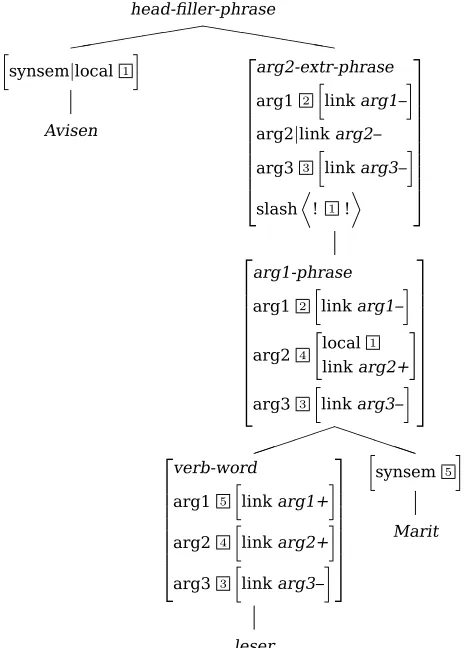
When a valence rule applies, it changes the minus link type in the mother to a plus link type in the head daughter as shown in Figure 1. For example, the arg1-rule changes the arg1– type in the mother node toarg1+ in the head daugh-ter.
The tree in Figure 1 shows how informa-tion about which valence rules have applied, ends up in the verb word. The verb word will now unify the linking types (13). In the case of Avisen leser Marit (‘The newspaper Marit reads’), the typesarg1+, arg2+ and arg3– are unified. The type hierarchy of linking types in (12) then ensures that we get a transitive frame arg12.
(12)
link
arg1+ arg3+ arg2+ arg3– arg1– arg2–
arg12-123 arg1-12 arg12-2 arg2-23 arg0-1
arg123 arg12 arg23 arg1 arg2 arg0
(13) verb-word
synsem|local|cat
head verb val
arg1|link 1
arg2|link 1
arg3|link 1
Open class lexemes can be underspecified, e.g. smile in (14). This makes it possible for the same lexical entry to enter all kinds of argu-ment frames, and it can be the input of a verb word inflectional rule as well as a noun word inflectional rule. The head value open-class is compatible withadjective, noun and verb.1
(14) open-class-lxm phon“smile”
ss|loc
"cat|head open-class
cont|rels D!pred “smile-rel”!E #
If one on the other hand wants to stipulate that a verb like burn can be both agentive-transitive and ergative, one can do that by giv-ing it an intermediate link type like arg12-2 in (12). That will make the lexical entry com-patible with the arg12 frame, which is the ac-tive version of the transiac-tive verb, and thearg2 frame, which is the ergative frame.
5.1 Ambiguities
The obvious question if one wants to maintain a functional grammar, is how to represent natu-ral ambiguities? Our answer is equally obvious: underspecification. The technicalities are not always straight-forward, however. This is the main concern of a grammar writer, as we see it, to construct adequate type hierarchies. The hierarchies are supposed to reflect all sorts of
1Selection of a direct object of a certain case, for
head-filler-phrase
hhhhhhh (
( ( ( ( ( (
h
synsem|local 1 i
Avisen
arg2-extr-phrase
arg1 2 h
linkarg1–i
arg2|linkarg2–
arg3 3 h
linkarg3–i
slashD! 1 ! E
arg1-phrase
arg1 2 h
linkarg1–i
arg2 4
local 1
linkarg2+
arg3 3 h
linkarg3–i
PP PPP
verb-word
arg1 5 h
linkarg1+i
arg2 4 h
linkarg2+i
arg3 3 h
linkarg3–i
leser
h
synsem 5 i
[image:6.595.195.427.236.560.2]Marit
generalizations, e.g. in the Scandinavian Gram-mar Matrix the type hierarchy directly encodes cross-linguistic generalizations. On the other hand, a type hierarchy must also provide an un-derspecified type whenever it is relevant to ob-tain functionality in the language-specific com-ponent.
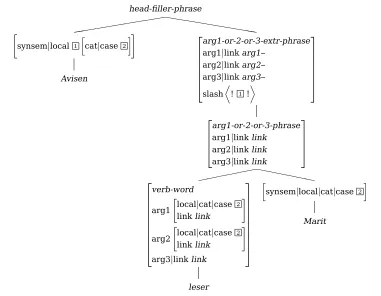
The analysis in Figure 2 obviously subsumes the analysis in Figure 1 when the complements are unmarked. Consequently, if no further restrictions are imposed, Avisen leser Marit would result in three parses, two specified ones and the underspecified analysis in Figure 2. How is this avoided? (15) presents a rather complex alternation of the encoding of case to account for similar ambiguities with scrambling in Western Germanic, but in Scandinavian it is actually a lot easier, since only pronouns are case-marked. Consequently, the specified rules only apply to pronominal complements. The un-derspecified rule of course has more specified subtypes, so that the placement of sentence ad-verbials, for instance, can coerce a particular reading.
(15)
acc-dat
acc-only dat-only force-case
acc[1] dat[2]
(16)
acc case-type 1
In (15), acc[1] is an abbreviation of (16). The case types are lexically declared, e.g. proper names are specified to be case-type = 3, but only in rules that enforce case by force-case case-type values are relevant, i.e. proper names are still compatible with acc-only and dat-acc-only. The specific arg1- and arg2-rules are thus incompatible with proper names and most common nouns, i.e. an underspec-ified rule combines verbs and their non-case-marked complements. However, the under-specified phrase can be further under-specified by context (e.g. the position of sentence adver-bials in Danish). This is why it is important that non-case-marked nominals are still compatible with acc-only and dat-only. In this way, func-tionality is maintained, since the case types are incompatible.
A third alternative, and perhaps a more elegant one, is to stipulate one
underspeci-fied rule with an underspeciunderspeci-fied valence-type, which subsumes a hierarchy of different va-lence types. The vava-lence type can then be fur-ther specified by its context. So, for instance, if the rule applies for the first and only time, and the verb is agentive, the valence type will be forced into an arg1-val. This of course com-plicates the type hierarchies somewhat, but the underspecified rule seems rather elegant.
Similarly, attachment ambiguities must be addressed. This issue is ignored here, though, since the topic is already covered in the litera-ture, e.g. Chrysmann (2004). A more serious problem would be functor-argument ambigui-ties, but it is not clear to us if such actually ex-ist (at least not if punctuation is said to serve as sentence type classifiers).
5.2 Another argument for non-context-freeness
The feature logic of lkb-hpsg of course ex-tends the expressivity of context-free gram-mars. Some evidence for the non-context-freeness of natural languages, i.e. that there are constructions in natural language that cannot be generated by a context-free gram-mar, has been presented, for instance by Shieber (1985). If functionality, in our sense, is found to be a realistic requirement for mod-els of natural language grammar, another ar-gument for non-context-freeness can be made. The reason is that certain context-free lan-guages are inherently ambiguous, i.e. there is no context-free grammar that can derive all the strings of one of these languages unam-biguously. Consider, for instance, the two lan-guages L1 = {anbncm|n, m > 0} and L2 =
{an, bm, cm|n, m >0}. Any grammar that
gener-atesL1∪L2is inherently ambiguous (Sudkamp, 2005). Such a language translates into a natu-ral language where you have (i) case-marking, (ii) SVO and OVS constructions, and (iii) nomi-native objects. In Mainland Scandinavian, only the two first requirements are satisfied. Con-structions with nominative objects are attested in other languages, however, and include the Icelandic copula construction (17) and various constructions in Korean, e.g. with verbs of di-rect perception (18):
(17) Hún she
spurði asked
hvort whether
sá the.nom grunaði
suspected.nom væri was.3sg.subj
head-filler-phrase
hhhhhhhhh
h (
( ( ( ( ( ( ( ( (
synsem|local 1 h
cat|case 2 i
Avisen
arg1-or-2-or-3-extr-phrase arg1|linkarg1–
arg2|linkarg2– arg3|linkarg3–
slashD! 1 ! E
arg1-or-2-or-3-phrase arg1|linklink arg2|linklink arg3|linklink
``````
verb-word
arg1
local|cat|case 2
linklink
arg2
local|cat|case 2
linklink
arg3|linklink
leser
h
synsem|local|cat|case 2 i
[image:8.595.121.502.76.372.2]Marit
Figure 2:Avisen leser Marit, underspecified.
þú.
you.sg.nom
’She asked whether the suspect surely was you.’
(18) Minwu-ka Minwu.nom
umak-i/*ul music.nom/*acc
tulli-ess-ta hear.pst.decl ’Minoo heard the music.’
Icelandic also satisfies (i), obviously, and (ii). In Korean, (ii) is paralleled by the co-existence of SOV and OSV constructions (SOV is canoni-cal). Such SOV-OSV ambiguities are also found in West Germanic subordinate clauses. Conse-quently, both languages are non-context-free, if natural language grammar is fully functional.
6
Parsing, generation and
inference
What are the consequences of functionality for a natural language processing system? The amount of underspecification complicates the type declarations considerably, and the infor-mation addressed by the syntactic component should thus be as limited as possible. Selec-tional restrictions, anaphora resolution and el-lipsis, for instance, are treated in terms of
in-ference. On our view, grammatical composi-tion is interfaced with two inference compo-nents, a monotonic and a non-monotonic one. The monotonic component performs highly effi-cient, taxonomic inferences which are to some extent subconscious. The studies of Søgaard (to appear) and Hardt (to appear) suggest that pre-liminary model generation also takes place at this step of natural language processing and is in fact crucial to the resolution of anaphora and ellipsis. The non-monotonic component is conscious higher-order cognition and performs more complicated pragmatic accommodation.
Is there functionality, is it a relevant no-tion, in these components? The distinction be-tween the monotonic component and the non-monotonic one is important here. On our view, the monotonic component is clearly non-deterministic. This is evidenced by the relative freedom of thought. The monotonic component, however, is believed to be deterministic, and for each logical form it outputs a unique structure or model. In Konrad (2004) and Søgaard (to ap-pear), this is thelocally minimal model.
un-derspecification of phonological strings. Some of this relates to word order, but also, for in-stance, to homographs. A separation of linear precedence from immediate dominance may al-low some underspecification of word order, but novel techniques must be invented to under-specify the phonology of a lexeme. This may be an interesting technical challenge, but it is far from certain that it has any empirical value. It is very unclear, at least to us, if nat-ural language generation is in fact functional and monotonic.
7
Computational resources
In the first report of the Scandinavian Grammar Matrix (Søgaard and Haugereid, 2004), a broad coverage noun phrase grammar was presented. It covered various word order phenomena, agreement, double articulation, superlatives, secondary modification, coordination, geniti-val possession, quantifying nouns, pseudopar-titives, parpseudopar-titives, comparatives, compounds, postnominal possession and postgenitival quan-tification. The report came with a test suite. The functionality ratio of the noun phrase frag-ment of the Scandinavian Grammar Matrix was relatively low. The test suite consisted of 138 sentences covering the phenomena just listed. Four sentences were assigned two readings, and one sentence was assigned three readings. The rest of the sentences which were grammat-ical, were assigned only one parse. The func-tionality ratio is not perfect, however. So we re-alize it is not an easy task to obtain a fully func-tional grammar, but we conjecture that this is a realistic goal and a sound objective for gram-mar engineers.
In addition, Petter Haugereid is currently finishing an implementation of a consider-able fragment of Norwegian which employs a high degree of functionality. It also relies on the principles for underspecification of ar-gument frames and syntactic categories pre-sented here. A preliminary version of the gram-mar is available from Petter’s website; see the link from the website of the Scandinavian Grammar Matrix. The topological approach sketched in this paper is extended in a Danish grammar that Anders Søgaard is now working on. Some preliminary work on a new formalism, designed to implement functionality in a more direct way, has also begun.
8
Conclusions
This paper discussed various aspects of func-tionality in grammar design. It was shown how a typed feature structure grammar can, however complicated this task is, implement a strong functionality hypothesis. It was shown that such a grammar is also learnable and, apparently, quite realistic. Some fragments with a functionality ratio close to one has al-ready been written for Mainland Scandinavian as part of the Scandinavian Grammar Matrix project. These fragments were written in lkb-hpsg. It is uncertain if other formalisms im-plement a strong functionality hypothesis, but it was shown that if the adequate grammar is functional, natural language is not context-free.
References
Tor Åfarli. 2005. Do verbs have argument structures? Unpublished manuscript, Nor-wegian University of Science and Technology.
Robert C. Berwick. 1982. Computational complexity and lexical-functional grammar. American Journal of Computational Linguis-tics, 8(3–4):97–109.
Hagit Borer. 2005. Structuring sense, vol-ume 1. Oxford University Press, Oxford.
Kaja Borthen and Petter Haugereid. to appear. A grammar component for referential proper-ties of nominals. Readings in Language and Computation.
Simona Collina, Paola Marangolo, and Patrizia Tabossi. 2001. The role of argument struc-ture in the production of nouns and verbs. Neuropsychologia, 39:1125–1137.
Ann Copestake. 2001. Implementing typed feature structure grammars. CSLI, Stanford, California.
Jochen Dörre. 1991. Feature logic with weak subsumption constraints. In Proceedings of the 29th annual meeting on Association for Computational Linguistics, Berkeley, Califor-nia.
Daniel Hardt. to appear. Natural language inference as triggered submodel search. In The 18th International Florida Artificial Intel-ligence Research Society Conference, Clear-water Beach, Florida.
the 11th International Conference on Head-Driven Phrase Structure Grammar, Stanford.
Mark Johnson. 1988. Attribute-value logic and the theory of grammar. CSLI, Stanford, Cali-fornia.
Karsten Konrad. 2004. Model generation for natural language interpretation and analysis. Springer, Berlin.
Anne Neville. 2003. Danish pre-nominals as specifier heads. In Proceedings of Scandi-navian Conference of Linguistics 19, Tromsø, Norway.
Sanni Nimb. 2005. Danske adverbier mellem leksikon og syntaks. Ph.D. thesis, Center for Language Technology, Copenhagen, Den-mark.
Stuart Shieber. 1985. Evidence against the context-freeness of natural language. Lin-guistics & Philosophy, 8:333–343.
Anders Søgaard and Petter Haugereid. 2004. The noun phrase in mainland scandinavian. InThe 2nd Meeting of the Scandinavian Net-work of Grammar Engineering and Machine Translation, Gothenburg, Sweden.
Anders Søgaard and Petter Haugereid. 2005. A brief documentation of a computational hpsg grammar specifying (most) of the common subset of linguistic types for danish, nor-wegian and swedish. In Henrik Holmboe, editor, Nordisk Sprogteknologi 2004, pages 247–256. Museum Tusculanum, Copenhagen.
Anders Søgaard. to appear. Model genera-tion in a dynamic environment. In Takashi Washio, Akito Sakurai, Satoshi Tojo, and Makoto Yokoo, editors, New frontiers in ar-tificial intelligence. Springer, Berlin.
Thomas Sudkamp. 2005. Languages and ma-chines. Pearson, Boston, Massachusetts, 3rd edition.