Linguistic Features for Automatic Evaluation of Heterogenous MT Systems
Jes ´us Gim´enez and Llu´ıs M`arquez TALP Research Center, LSI Department
Universitat Polit`ecnica de Catalunya Jordi Girona Salgado 1–3, E-08034, Barcelona
{jgimenez,lluism}@lsi.upc.edu
Abstract
Evaluation results recently reported by Callison-Burch et al. (2006) and Koehn and Monz (2006), revealed that, in certain cases, theBLEU metric may not be a reliable MT quality indicator. This happens, for in-stance, when the systems under evaluation are based on different paradigms, and there-fore, do not share the same lexicon. The reason is that, while MT quality aspects are diverse, BLEU limits its scope to the lex-ical dimension. In this work, we suggest using metrics which take into account lin-guistic features at more abstract levels. We provide experimental results showing that metrics based on deeper linguistic informa-tion (syntactic/shallow-semantic) are able to produce more reliable system rankings than metrics based on lexical matching alone, specially when the systems under evaluation are of a different nature.
1 Introduction
Most metrics used in the context of Automatic Ma-chine Translation (MT) Evaluation are based on the assumption that ‘acceptable’ translations tend to share the lexicon (i.e., word forms) in a predefined set of manual reference translations. This assump-tion works well in many cases. However, several results in recent MT evaluation campaigns have cast some doubts on its general validity. For instance, Callison-Burch et al. (2006) and Koehn and Monz (2006) reported and analyzed several cases of strong
disagreement between system rankings provided by human assessors and those produced by the BLEU
metric (Papineni et al., 2001). In particular, they noted that when the systems under evaluation are of a different nature (e.g., rule-based vs. statistical, human-aided vs. fully automatical, etc.) BLEUmay not be a reliable MT quality indicator. The reason is thatBLEU favours MT systems which share the ex-pected reference lexicon (e.g., statistical systems), and penalizes those which use a different one.
Indeed, the underlying cause is much simpler. In general, lexical similarity is nor a sufficient neither a necessary condition so that two sentences convey the same meaning. On the contrary, natural lan-guages are expressive and ambiguous at different levels. Consequently, the similarity between two sentences may involve different dimensions. In this work, we hypothesize that, in order to ‘fairly’ evalu-ate MT systems based on different paradigms, simi-larities at more abstract linguistic levels must be an-alyzed. For that purpose, we have compiled a rich set of metrics operating at the lexical, syntactic and shallow-semantic levels (see Section 2). We present a comparative study on the behavior of several met-ric representatives from each linguistic level in the context of some of the cases reported by Koehn and Monz (2006) and Callison-Burch et al. (2006) (see Section 3). We show that metrics based on deeper linguistic information (syntactic/shallow-semantic) are able to produce more reliable system rankings than those produced by metrics which limit their scope to the lexical dimension, specially when the systems under evaluation are of a different nature.
2 A Heterogeneous Metric Set
For our experiments, we have compiled a represen-tative set of metrics1 at different linguistic levels. We have resorted to several existing metrics, and we have also developed new ones. Below, we group them according to the level at which they operate.
2.1 Lexical Similarity
Most of the current metrics operate at the lexical level. We have selected 7 representatives from dif-ferent families which have been shown to obtain high levels of correlation with human assessments:
BLEU We use the default accumulated score up to
the level of 4-grams (Papineni et al., 2001).
NIST We use the default accumulated score up to
the level of 5-grams (Doddington, 2002).
GTM We set to 1 the value of the e parame-ter (Melamed et al., 2003).
METEOR We run all modules: ‘exact’,
‘porter-stem’, ‘wn stem’ and ‘wn synonymy’, in that order (Banerjee and Lavie, 2005).
ROUGE We used the ROUGE-S* variant (skip
bi-grams with no max-gap-length). Stemming is enabled (Lin and Och, 2004a).
mWER We use1−mWER (Nießen et al., 2000).
mPER We use1−mPER (Tillmann et al., 1997).
Let us note that ROUGEand METEORmay con-sider stemming (i.e., morphological variations). Ad-ditionally, METEORmay perform a lookup for syn-onyms in WordNet (Fellbaum, 1998).
2.2 Beyond Lexical Similarity
Modeling linguistic features at levels further than the lexical level requires the usage of more complex linguistic structures. We have defined what we call
‘linguistic elements’ (LEs).
2.2.1 Linguistic Elements
LEs are linguistic units, structures, or relation-ships, such that a sentence may be partially seen as a ‘bag’ of LEs. Possible kinds of LEs are: word forms, parts-of-speech, dependency relationships, syntactic phrases, named entities, semantic roles, etc. Each
1
All metrics used in this work are publicly available inside the IQMTFramework (Gim´enez and Amig´o, 2006). http://
www.lsi.upc.edu/˜nlp/IQMT
LE may consist, in its turn, of one or more LEs, which we call ‘items’ inside the LE. For instance, a ‘phrase’ LE may consist of ‘phrase’ items, ‘part-of-speech’ (PoS) items, ‘word form’ items, etc. Items may be also combinations of LEs. For instance, a ‘phrase’ LE may be seen as a sequence of ‘word-form:PoS’ items.
2.2.2 Similarity Measures
We are interested in comparing linguistic struc-tures, and linguistic units. LEs allow for compar-isons at different granularity levels, and from dif-ferent viewpoints. For instance, we might compare the semantic structure of two sentences (i.e., which actions, semantic arguments and adjuncts exist) or we might compare lexical units according to the se-mantic role they play inside the sentence. For that purpose, we use two very simple kinds of similarity measures over LEs: ‘Overlapping’ and ‘Matching’. We provide a general definition:
Overlapping between items inside LEs, according
to their type. Formally:
Overlapping(t) =
X
i∈itemst(hyp) count0
hyp(i, t)
X
i∈itemst(ref)
countref(i, t)
wheretis the LE type2,items
t(s)refers to the set of items occurring inside LEs of type tin sentences, countref(i, t) denotes the number of times itemiappears in the reference trans-lation inside a LE of typet, andcount0
hyp(i, t) denotes the number of times i appears in the candidate translation inside a LE of typet, lim-ited by the number of timesiappears in the ref-erence translation inside a LE of typet. Thus, ‘Overlapping’ provides a rough measure of the proportion of items inside elements of a cer-tain type which have been ‘successfully’ trans-lated. We also introduce a coarser metric, ‘Over-lapping(*)’, which considers the uniformly aver-aged ‘overlapping’ over all types:
Overlapping(?) = 1
|T|
X
t∈T
Overlapping(t)
whereTis the set of types.
2
Matching between items inside LEs, according to
their type. Its definition is analogous to the ‘Overlapping’ definition, but in this case the relative order of the items is important. All items inside the same element are considered as a single unit (i.e., a sequence in left-to-right or-der). In other words, we are computing the pro-portion of ‘fully’ translated elements, accord-ing to their type. We also introduce a coarser metric, ‘Matching(*)’, which considers the uni-formly averaged ‘Matching’ over all types.
notes:
• ‘Overlapping’ and ‘Matching’ operate on the assumption of a single reference translation. The extension to the multi-reference setting is computed by assigning the maximum value at-tained over all human references individually.
• ‘Overlapping’ and ‘Matching’ are general met-rics. We may apply them to specific scenarios by defining the class of linguistic elements and items to be used. Below, we instantiate these measures over several particular cases.
2.3 Shallow Syntactic Similarity
Metrics based on shallow parsing (‘SP’) analyze similarities at the level of PoS-tagging, lemmati-zation, and base phrase chunking. Outputs and references are automatically annotated using state-of-the-art tools. PoS-tagging and lemmatization are provided by theSVMToolpackage (Gim´enez and M`arquez, 2004), and base phrase chunking is pro-vided by thePhrecosoftware (Carreras et al., 2005). Tag sets for English are derived from the Penn Tree-bank (Marcus et al., 1993).
We instantiate ‘Overlapping’ over parts-of-speech and chunk types. The goal is to capture the propor-tion of lexical items correctly translated, according to their shallow syntactic realization:
SP-Op-t Lexical overlapping according to the part-of-speech ‘t’. For instance,‘SP-Op-NN’roughly
reflects the proportion of correctly translated singular nouns. We also introduce a coarser metric, ‘SP-Op-*’ which computes average
overlapping over all parts-of-speech.
SP-Oc-t Lexical overlapping according to the chunk type ‘t’. For instance,‘SP-Oc-NP’roughly
reflects the successfully translated proportion of noun phrases. We also introduce a coarser metric, ‘SP-Oc-*’ which considers the average
overlapping over all chunk types.
At a more abstract level, we use the NIST
metric (Doddington, 2002) to compute accumu-lated/individual scores over sequences of:
Lemmas –SP-NIST(i)l-n Parts-of-speech –SP-NIST(i)p-n Base phrase chunks –SP-NIST(i)c-n
For instance,‘SP-NISTl-5’corresponds to the accu-mulated NIST score for lemman-grams up to length 5, whereas‘SP-NISTip-5’corresponds to the
individ-ualNISTscore for PoS 5-grams.
2.4 Syntactic Similarity
We have incorporated, with minor modifications, some of the syntactic metrics described by Liu and Gildea (2005) and Amig´o et al. (2006) based on de-pendency and constituency parsing.
2.4.1 On Dependency Parsing (DP)
‘DP’ metrics capture similarities between
depen-dency trees associated to automatic and reference translations. Dependency trees are provided by the
MINIPARdependency parser (Lin, 1998). Similari-ties are captured from different viewpoints:
DP-HWC(i)-l This metric corresponds to the HWC metric presented by Liu and Gildea (2005). All head-word chains are retrieved. The fraction of matching head-word chains of a given length, ‘l’, is computed. We have slightly modified this metric in order to distinguish three differ-ent variants according to the type of items head-word chains may consist of:
Lexical forms –DP-HWC(i)w-l
Grammatical categories –DP-HWC(i)c-l Grammatical relationships –DP-HWC(i)r-l
Average accumulated scores up to a given chain length may be used as well. For instance,
‘DP-HWCiw-4’retrieves the proportion of
match-ing length-4 word-chains, whereas‘DP-HWCw
com-pute average accumulated proportion of cate-gory/relationship chains up to length-4.
DP-Ol|Oc|Or These metrics correspond exactly to the LEVEL, GRAM and TREE metrics intro-duced by Amig´o et al. (2006).
DP-Ol-l Overlapping between words hanging at level ‘l’, or deeper.
DP-Oc-t Overlapping between words directly
hanging from terminal nodes (i.e.
gram-matical categories) of type ‘t’.
DP-Or-t Overlapping between words ruled by non-terminal nodes (i.e. grammatical relationships) of type ‘t’.
Node types are determined by grammatical cat-egories and relationships defined byMINIPAR. For instance,‘DP-Or-s’reflects lexical
overlap-ping between subtrees of type ‘s’ (subject). ‘DP-Oc-A’ reflects lexical overlapping between
ter-minal nodes of type ‘A’ (Adjective/Adverbs).
‘DP-Ol-4’ reflects lexical overlapping between
nodes hanging at level 4 or deeper. Addition-ally, we consider three coarser metrics (‘DP-Ol
-*’, ‘DP-Oc-*’and ‘DP-Or-*’) which correspond to the uniformly averaged values over all lev-els, categories, and relationships, respectively.
2.4.2 On Constituency Parsing (CP)
‘CP’ metrics capture similarities between
con-stituency parse trees associated to automatic and reference translations. Constituency trees are pro-vided by the Charniak-Johnson’s Max-Ent reranking parser (Charniak and Johnson, 2005).
CP-STM(i)-l This metric corresponds to the STM metric presented by Liu and Gildea (2005). All syntactic subpaths in the candidate and the reference trees are retrieved. The fraction of matching subpaths of a given length, ‘l’, is computed. For instance, ‘CP-STMi-5’ retrieves the proportion of length-5 matching subpaths. Average accumulated scores may be computed as well. For instance,‘CP-STM-9’retrieves av-erage accumulated proportion of matching sub-paths up to length-9.
2.5 Shallow-Semantic Similarity
We have designed two new families of metrics, ‘NE’ and ‘SR’, which are intended to capture similari-ties over Named Entisimilari-ties (NEs) and Semantic Roles (SRs), respectively.
2.5.1 On Named Entities (NE)
‘NE’ metrics analyze similarities between
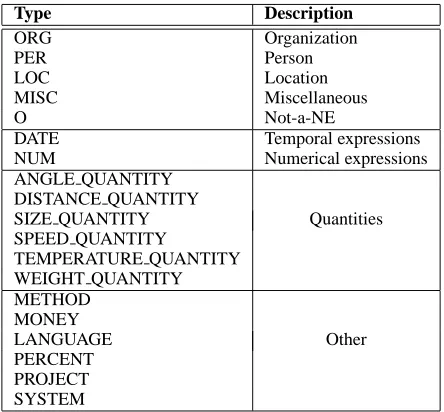
auto-matic and reference translations by comparing the NEs which occur in them. Sentences are automati-cally annotated using the BIOS package (Surdeanu et al., 2005). BIOS requires at the input shallow parsed text, which is obtained as described in Sec-tion 2.3. See the list of NE types in Table 1.
Type Description
ORG Organization
PER Person
LOC Location
MISC Miscellaneous
O Not-a-NE
DATE Temporal expressions
NUM Numerical expressions
ANGLE QUANTITY DISTANCE QUANTITY
SIZE QUANTITY Quantities SPEED QUANTITY
TEMPERATURE QUANTITY WEIGHT QUANTITY METHOD
MONEY
LANGUAGE Other
[image:4.612.315.537.257.463.2]PERCENT PROJECT SYSTEM
Table 1: Named Entity types.
We define two types of metrics:
NE-Oe-t Lexical overlapping between NEs accord-ing to their typet. For instance,‘NE-Oe-PER’
re-flects lexical overlapping between NEs of type ‘PER’ (i.e., person), which provides a rough es-timate of the successfully translated proportion of person names. The‘NE-Oe-*’metric consid-ers the average lexical overlapping over all NE types. This metric includes the NE type ‘O’ (i.e., Not-a-NE). We introduce another variant,
‘NE-Oe-**’, which considers only actual NEs.
NE-Me-t Lexical matching between NEs accord-ing to their type t. For instance, ‘NE-Me-LOC’
metric considers the average lexical matching over all NE types, this time excluding type ‘O’.
Other authors have measured MT quality over NEs in the recent literature. In particular, the
‘NE-Me-*’ metric is similar to the‘NEE’ metric defined by Reeder et al. (2001).
2.5.2 On Semantic Roles (SR)
‘SR’ metrics analyze similarities between
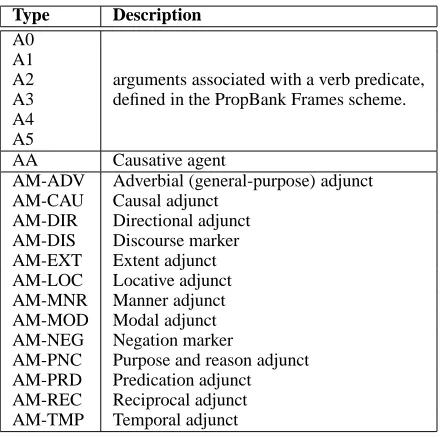
auto-matic and reference translations by comparing the SRs (i.e., arguments and adjuncts) which occur in them. Sentences are automatically annotated using the SwiRL package (M`arquez et al., 2005). This package requires at the input shallow parsed text en-riched with NEs, which is obtained as described in Section 2.5.1. See the list of SR types in Table 2.
Type Description
A0 A1
A2 arguments associated with a verb predicate, A3 defined in the PropBank Frames scheme. A4
A5
AA Causative agent
AM-ADV Adverbial (general-purpose) adjunct AM-CAU Causal adjunct
AM-DIR Directional adjunct AM-DIS Discourse marker AM-EXT Extent adjunct AM-LOC Locative adjunct AM-MNR Manner adjunct AM-MOD Modal adjunct AM-NEG Negation marker
[image:5.612.75.295.290.509.2]AM-PNC Purpose and reason adjunct AM-PRD Predication adjunct AM-REC Reciprocal adjunct AM-TMP Temporal adjunct
Table 2: Semantic Roles.
We define three types of metrics:
SR-Or-t Lexical overlapping between SRs accord-ing to their typet. For instance, ‘SR-Or-A0’
re-flects lexical overlapping between ‘A0’ argu-ments. ‘SR-Or-*’considers the average lexical overlapping over all SR types.
SR-Mr-t Lexical matching between SRs accord-ing to their type t. For instance, the met-ric ‘SR-Mr-AM-MOD’ reflects the proportion of
fully translated modal adjuncts. The‘SR-Mr-*’ metric considers the average lexical matching over all SR types.
SR-Or This metric reflects ‘role overlapping’, i.e.. overlapping between semantic roles indepen-dently from their lexical realization.
Note that in the same sentence several verbs, with their respective SRs, may co-occur. However, the metrics described above do not distinguish between SRs associated to different verbs. In order to account for such a distinction we introduce a more restric-tive version of these metrics (‘SR-Mrv-t’, ‘SR-Orv-t’, ‘SR-Mr v-*’,‘SR-Or v-*’, and‘SR-Or v’), which require SRs to be associated to the same verb.
3 Experimental Work
In this section, we study the behavior of some of the metrics described in Section 2, according to the linguistic level at which they operate. We have selected a set of coarse-grained metric vari-ants (i.e., accumulated/average scores over linguis-tic units and structures of different kinds)3. We ana-lyze some of the cases reported by Koehn and Monz (2006) and Callison-Burch et al. (2006). We distin-guish different evaluation contexts. In Section 3.1, we study the case of a single reference translation being available. In principle, this scenario should diminish the reliability of metrics based on lexical matching alone, and favour metrics based on deeper linguistic features. In Section 3.2, we study the case of several reference translations available. This sce-nario should alleviate the deficiencies caused by the shallowness of metrics based on lexical matching. We also analyze separately the case of
‘homoge-neous’ systems (i.e., all systems being of the same
nature), and the case of ‘heterogenous’ systems (i.e., there exist systems based on different paradigms).
As to the metric meta-evaluation criterion, the two most prominent criteria are:
Human Acceptability Metrics are evaluated on the
basis of correlation with human evaluators.
Human Likeness Metrics are evaluated in terms of
descriptive power, i.e., their ability to distin-guish between human and automatic transla-tions (Lin and Och, 2004b; Amig´o et al., 2005). In our case, metrics are evaluated on the basis of ‘Human Acceptability’. Specifically, we use Pear-son correlation coefficients between metric scores
3
and the average sum of adequacy and fluency as-sessments at the document level. The reason is that meta-evaluation based on ‘Human Likeness’ re-quires the availability of heterogenous test beds (i.e., representative sets of automatic outputs and human references), which, unfortunately, is not the case of all the tasks under study. First, because most transla-tion systems are statistical. Second, because in most cases only one reference translation is available.
3.1 Single-reference Scenario
We use some of the test beds corresponding to the “NAACL 2006 Workshop on Statistical Machine
Translation” (WMT 2006) (Koehn and Monz, 2006).
Since linguistic features described in Section 2 are so far implemented only for the case of English be-ing the target language, among the 12 translation tasks available, we studied only the 6 tasks corre-sponding to the Foreign-to-English direction. A sin-gle reference translation is available. System out-puts consist of 2000 and 1064 sentences for the ‘in-domain’ and ‘out-of-‘in-domain’ test beds, respectively. In each case, human assessments on adequacy and fluency are available for a subset of systems and sen-tences. Table 3 shows the number of sentences as-sessed in each case. Each sentence was evaluated by two different human judges. System scores have been obtained by averaging over all sentence scores.
in out sys
French-to-English 2,247 1,274 11/14
German-to-English 2,401 1,535 10/12
Spanish-to-English 1,944 1,070 11/15
Table 3: WMT 2006. ‘in’ and ‘out’ columns show the number of sentences assessed for the ‘in-domain’ and ‘out-of-‘in-domain’ subtasks. The ‘sys’ column shows the number of systems counting on human assessments with respect to the total number of systems which presented to each task.
Evaluation of Heterogeneous Systems
In four of the six translation tasks under study, all the systems are statistical except ‘Systran’, which is rule-based. This is the case of the German/French-to-English in-domain/out-of-domain tasks. Table 4 shows correlation with human assessments for some metric representatives at different linguistic levels.
fr2en de2en
Level Metric in out in out
1-PER 0.73 0.64 0.57 0.46 1-WER 0.73 0.73 0.32 0.38 BLEU 0.71 0.87 0.60 0.67
Lexical NIST 0.74 0.82 0.56 0.63
GTM 0.84 0.86 0.12 0.70 METEOR 0.92 0.95 0.76 0.81
ROUGE 0.85 0.89 0.65 0.79
SP-Op-* 0.81 0.88 0.64 0.71
SP-Oc-* 0.81 0.89 0.65 0.75 Shallow SP-NISTl-5 0.75 0.81 0.56 0.64 Syntactic SP-NISTp-5 0.75 0.91 0.77 0.77
SP-NISTc-5 0.73 0.88 0.71 0.54
DP-HWCw-4 0.76 0.88 0.64 0.74
DP-HWCc-4 0.93 0.97 0.88 0.72
DP-HWCr-4 0.92 0.96 0.91 0.76 Syntactic DP-Ol-* 0.87 0.94 0.84 0.84
DP-Oc-* 0.91 0.95 0.88 0.87
DP-Or-* 0.87 0.97 0.91 0.88
CP-STM-9 0.93 0.95 0.93 0.87
NE-Me-* 0.80 0.79 0.93 0.63
NE-Oe-* 0.79 0.76 0.91 0.59
NE-Oe-** 0.81 0.87 0.63 0.70
SR-Mr-* 0.83 0.95 0.92 0.84 Shallow SR-Or-* 0.89 0.95 0.88 0.90 Semantic SR-Or 0.95 0.85 0.80 0.75
SR-Mrv-* 0.77 0.92 0.72 0.85
SR-Orv-* 0.81 0.93 0.76 0.94
[image:6.612.312.539.55.364.2]SR-Orv 0.84 0.93 0.81 0.92
Table 4: WMT 2006. Evaluation of Heterogeneous Systems. French-to-English (fr2en) / German-to-English (de2en), in-domain and out-of-domain.
Although the four cases are different, we have identified several regularities. For instance, BLEU
and, in general, all metrics based on lexical match-ing alone, except METEOR, obtain significantly lower levels of correlation than metrics based on deeper linguistic similarities. The problem with lex-ical metrics is that they are unable to capture the ac-tual quality of the ‘Systran’ system. Interestingly,
METEOR obtains a higher correlation, which, in the case of French-to-English, rivals the top-scoring metrics based on deeper linguistic features. The rea-son, however, does not seem to be related to its ad-ditional linguistic operations (i.e., stemming or syn-onymy lookup), but rather to theMETEORmatching strategy itself (unigram precision/recall).
Metrics at the shallow syntactic level are in the same range of lexical metrics. At the properly syntactic level, metrics obtain in most cases high correlation coefficients. However, the ‘DP-HWCw-4’
de-pendency relationships, still considers only lexical matching, obtains a lower level of correlation. This reinforces the idea that metrics based on rewarding longn-grams matchings may not be a reliable qual-ity indicator in these cases.
At the level of shallow semantics, while ‘NE’ metrics are not equally useful in all cases, ‘SR’ met-rics prove very effective. For instance, correlation attained by ‘SR-Or-*’ reveals that it is important to
translate lexical items according to the semantic role they play inside the sentence. Moreover, correlation attained by the‘SR-Mr-*’metric is a clear indication
that in order to achieve a high quality, it is impor-tant to ‘fully’ translate ‘whole’ semantic structures (i.e., arguments/adjuncts). The existence of all the semantic structures (‘SR-Or’), specially associated to
the same verb (‘SR-Orv’), is also important.
Evaluation of Homogeneous Systems
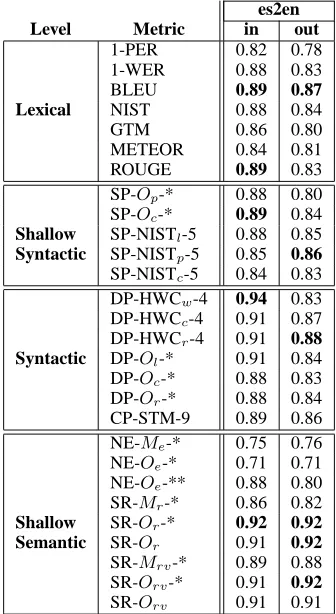
In the two remaining tasks, Spanish-to-English in-domain/out-of-domain, all the systems are sta-tistical. Table 5 shows correlation with human as-sessments for some metric representatives. In this case, BLEU proves very effective, both in-domain and out-of-domain. Indeed, all metrics based on lex-ical matching obtain high levels of correlation with human assessments. However, still metrics based on deeper linguistic analysis attain in most cases higher correlation coefficients, although not as significantly higher as in the case of heterogeneous systems.
3.2 Multiple-reference Scenario
We study the case reported by Callison-Burch et al. (2006) in the context of the Arabic-to-English exercise of the “2005 NIST MT Evaluation
Cam-paign”4 (Le and Przybocki, 2005). In this case all systems are statistical but ‘LinearB’, a human-aided MT system (Callison-Burch, 2005). Five reference translations are available. System outputs consist of 1056 sentences. We obtained permission5 to use 7 system outputs. For six of these systems we counted
4http://www.nist.gov/speech/tests/
summaries/2005/mt05.htm
5
Due to data confidentiality, we contacted each participant individually and asked for permission to use their data. A num-ber of groups and companies responded positively: Univer-sity of Southern California Information Sciences Institute (ISI), University of Maryland (UMD), Johns Hopkins University & University of Cambridge (JHU-CU), IBM, University of Edin-burgh, MITRE and LinearB.
es2en
Level Metric in out
1-PER 0.82 0.78 1-WER 0.88 0.83 BLEU 0.89 0.87
Lexical NIST 0.88 0.84
GTM 0.86 0.80 METEOR 0.84 0.81 ROUGE 0.89 0.83 SP-Op-* 0.88 0.80
SP-Oc-* 0.89 0.84 Shallow SP-NISTl-5 0.88 0.85 Syntactic SP-NISTp-5 0.85 0.86
SP-NISTc-5 0.84 0.83
DP-HWCw-4 0.94 0.83
DP-HWCc-4 0.91 0.87
DP-HWCr-4 0.91 0.88 Syntactic DP-Ol-* 0.91 0.84
DP-Oc-* 0.88 0.83
DP-Or-* 0.88 0.84
CP-STM-9 0.89 0.86 NE-Me-* 0.75 0.76
NE-Oe-* 0.71 0.71
NE-Oe-** 0.88 0.80
SR-Mr-* 0.86 0.82 Shallow SR-Or-* 0.92 0.92 Semantic SR-Or 0.91 0.92
SR-Mrv-* 0.89 0.88
SR-Orv-* 0.91 0.92
[image:7.612.341.509.58.365.2]SR-Orv 0.91 0.91
Table 5: WMT 2006. Evaluation of Homogeneous Systems. Spanish-to-English (es2en), in-domain and out-of-domain.
on a subjective manual evaluation based on ade-quacy and fluency for a subset of 266 sentences (i.e., 1596 sentences were assessed). Each sentence was evaluated by two different human judges. System scores have been obtained by averaging over all sen-tence scores.
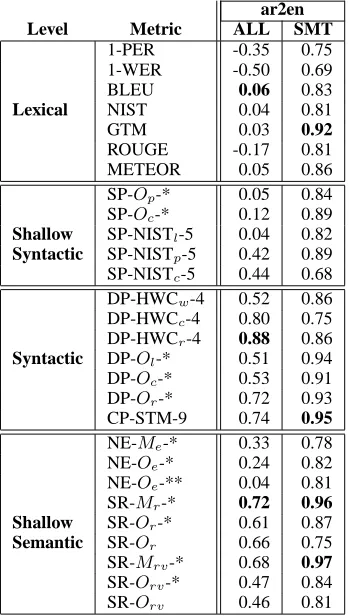
Table 6 shows the level of correlation with hu-man assessments for some metric representatives (see ‘ALL’ column). In this case, lexical metrics obtain extremely low levels of correlation. Again, the problem is that lexical metrics are unable to cap-ture the actual quality of ‘LinearB’. At the shallow syntactic level, only metrics which do not consider any lexical information (‘SP-NISTp-5’and ‘SP-NISTc
-5’) attain a significantly higher quality. At the prop-erly syntactic level, all metrics attain a higher corre-lation. At the shallow semantic level, again, while ‘NE’ metrics are not specially useful, ‘SR’ metrics prove very effective.
ar2en
Level Metric ALL SMT
1-PER -0.35 0.75 1-WER -0.50 0.69
BLEU 0.06 0.83
Lexical NIST 0.04 0.81
GTM 0.03 0.92
ROUGE -0.17 0.81 METEOR 0.05 0.86 SP-Op-* 0.05 0.84
SP-Oc-* 0.12 0.89 Shallow SP-NISTl-5 0.04 0.82 Syntactic SP-NISTp-5 0.42 0.89
SP-NISTc-5 0.44 0.68
DP-HWCw-4 0.52 0.86
DP-HWCc-4 0.80 0.75
DP-HWCr-4 0.88 0.86 Syntactic DP-Ol-* 0.51 0.94
DP-Oc-* 0.53 0.91
DP-Or-* 0.72 0.93
CP-STM-9 0.74 0.95
NE-Me-* 0.33 0.78
NE-Oe-* 0.24 0.82
NE-Oe-** 0.04 0.81
SR-Mr-* 0.72 0.96 Shallow SR-Or-* 0.61 0.87
Semantic SR-Or 0.66 0.75
SR-Mrv-* 0.68 0.97
SR-Orv-* 0.47 0.84
[image:8.612.98.274.58.366.2]SR-Orv 0.46 0.81
Table 6: NIST 2005. Arabic-to-English (ar2en) ex-ercise. ‘ALL’ refers to the evaluation of all systems. ‘SMT’ refers to the evaluation of statistical systems alone (i.e., removing ‘LinearB’).
‘SMT’ column), lexical metrics attain a much higher correlation, in the same range of metrics based on deeper linguistic information. However, still met-rics based on syntactic parsing, and semantic roles, exhibit a slightly higher quality.
4 Conclusions
We have presented a comparative study on the behavior of a wide set of metrics for automatic MT evaluation at different linguistic levels (lexical, shallow-syntactic, syntactic, and shallow-semantic) under different scenarios. We have shown, through empirical evidence, that linguistic features at more abstract levels may provide more reliable system rankings, specially when the systems under evalu-ation do not share the same lexicon.
We strongly believe that future MT evaluation campaigns should benefit from these results, by cluding metrics at different linguistic levels. For
in-stance, the following set could be used:
{‘DP-HWCr-4’, ‘DP-Oc-*’, ‘DP-Ol-*’, ‘DP-Or-*’,
‘CP-STM-9’, ‘SR-Or-*’, ‘SR-Orv’}
All these metrics are among the top-scoring in all the translation tasks studied. However, none of these metrics provides, in isolation, a ‘global’ measure of quality. Indeed, all these metrics focus on ‘partial’ aspects of quality. We believe that, in order to per-form ‘global’ evaluations, different quality dimen-sions should be integrated into a single measure of quality. With that purpose, we are currently explor-ing several metric combination strategies. Prelim-inary results, based on the QUEEN measure inside the QARLA Framework (Amig´o et al., 2005), indi-cate that metrics at different linguistic levels may be robustly combined.
Experimental results also show that metrics re-quiring linguistic analysis seem very robust against parsing errors committed by automatic linguistic processors, at least at the document level. That is very interesting, taking into account that, while reference translations are supposedly well formed, that is not always the case of automatic translations. However, it remains pending to test the behaviour at the sentence level, which could be very useful for er-ror analysis. Moreover, relying on automatic proces-sors implies two other important limitations. First, these tools are not available for all languages. Sec-ond, usually they are too slow to allow for massive evaluations, as required, for instance, in the case of system development. In the future, we plan to incor-porate more accurate, and possibly faster, linguistic processors, also for languages other than English, as they become publicly available.
Acknowledgements
outputs and human assessments for the purpose of this research.
References
Enrique Amig ´o, Julio Gonzalo, Anselmo Pe˜nas, and Fe-lisa Verdejo. 2005. QARLA: a Framework for the Evaluation of Automatic Sumarization. In Proceed-ings of the 43th Annual Meeting of the Association for Computational Linguistics.
Enrique Amig ´o, Jes´us Gim´enez, Julio Gonzalo, and Llu´ıs M`arquez. 2006. MT Evaluation: Human-Like vs. Hu-man Acceptable. In Proceedings of COLING-ACL06.
Satanjeev Banerjee and Alon Lavie. 2005. METEOR: An Automatic Metric for MT Evaluation with Im-proved Correlation with Human Judgments. In Pro-ceedings of ACL Workshop on Intrinsic and Extrinsic Evaluation Measures for Machine Translation and/or Summarization.
Chris Callison-Burch, Miles Osborne, and Philipp Koehn. 2006. Re-evaluating the Role of BLEU in Ma-chine Translation Research. In Proceedings of EACL.
Chris Callison-Burch. 2005. Linear B system descrip-tion for the 2005 NIST MT evaluadescrip-tion exercise. In Proceedings of the NIST 2005 Machine Translation Evaluation Workshop.
Xavier Carreras, Llu´ıs M´arquez, and Jorge Castro. 2005. Filtering-ranking perceptron learning for partial pars-ing. Machine Learning, 59:1–31.
Eugene Charniak and Mark Johnson. 2005. Coarse-to-fine n-best parsing and MaxEnt discriminative rerank-ing. In Proceedings of ACL.
George Doddington. 2002. Automatic evaluation of ma-chine translation quality using n-gram co-occurrence statistics. In Proceedings of the 2nd IHLT.
C. Fellbaum, editor. 1998. WordNet. An Electronic Lexi-cal Database. The MIT Press.
Jes´us Gim´enez and Enrique Amig ´o. 2006. IQMT: A Framework for Automatic Machine Translation Eval-uation. In Proceedings of the 5th LREC.
Jes´us Gim´enez and Llu´ıs M`arquez. 2004. SVMTool: A general POS tagger generator based on Support Vector Machines. In Proceedings of 4th LREC.
Philipp Koehn and Christof Monz. 2006. Manual and Automatic Evaluation of Machine Translation between European Languages. In Proceedings of the Workshop on Statistical Machine Translation, pages 102–121.
Audrey Le and Mark Przybocki. 2005. NIST 2005 ma-chine translation evaluation official results. Technical report, NIST, August.
Chin-Yew Lin and Franz Josef Och. 2004a.
Auto-matic Evaluation of Machine Translation Quality Us-ing Longest Common Subsequence and Skip-Bigram Statics. In Proceedings of ACL.
Chin-Yew Lin and Franz Josef Och. 2004b. ORANGE: a Method for Evaluating Automatic Evaluation Metrics for Machine Translation. In Proceedings of COLING.
Dekang Lin. 1998. Dependency-based Evaluation of MINIPAR. In Proceedings of the Workshop on the Evaluation of Parsing Systems.
Ding Liu and Daniel Gildea. 2005. Syntactic Features for Evaluation of Machine Translation. In Proceed-ings of ACL Workshop on Intrinsic and Extrinsic Eval-uation Measures for Machine Translation and/or Sum-marization.
Mitchell P. Marcus, Beatrice Santorini, and Mary Ann Marcinkiewicz. 1993. Building a large annotated cor-pus of english: The penn treebank. Computational Linguistics, 19(2):313–330.
I. Dan Melamed, Ryan Green, and Joseph P. Turian. 2003. Precision and Recall of Machine Translation. In Proceedings of HLT/NAACL.
Llu´ıs M`arquez, Mihai Surdeanu, Pere Comas, and
Jordi Turmo. 2005. Robust Combination
Strat-egy for Semantic Role Labeling. In Proceedings of HLT/EMNLP.
S. Nießen, F.J. Och, G. Leusch, and H. Ney. 2000. Eval-uation Tool for Machine Translation: Fast EvalEval-uation for MT Research. In Proceedings of the 2nd LREC.
Kishore Papineni, Salim Roukos, Todd Ward, and Wei-Jing Zhu. 2001. Bleu: a method for automatic evalu-ation of machine translevalu-ation, rc22176, ibm. Technical report, IBM T.J. Watson Research Center.
Florence Reeder, Keith Miller, Jennifer Doyon, and John White. 2001. The Naming of Things and the Con-fusion of Tongues: an MT Metric. In Proceedings of the Workshop on MT Evaluation ”Who did what to whom?” at MT Summit VIII, pages 55–59.
Mihai Surdeanu, Jordi Turmo, and Eli Comelles. 2005. Named Entity Recognition from Spontaneous
Open-Domain Speech. In Proceedings of the 9th
Inter-national Conference on Speech Communication and Technology (Interspeech).
C. Tillmann, S. Vogel, H. Ney, A. Zubiaga, and H. Sawaf.
1997. Accelerated DP based Search for Statistical